It was an early start to get from Umina to Sydney airport but traffic is very light that time of the morning so made it without problems. The Qantas flight to Adelaide was uneventful. Turned out that the father of the guy I was sitting next to owned a property in Milton. It has been a long time sinc I had flown Qantas. We had a nice breakfast and the service was excellent.
I had a few hours to fill in in Adelaide so walked to the international airport from the domestic. A bad move! It was a lot longer than I expected plus it is a major construction zone.
The Singapore Airlines flight to Singapore was great. I had been upgraded to first class on a brand new Boeing 777-200. There were very few passengers on board and the service was exceptional. Food and wine were as good as any good restaurant. The flat bed seats would also be an advantage on the next flight. I arrived in Singapore early and made it through immigration and customs in record time. My ex business collegue was there to meet me and we headed into town for a meal. He took me to a very nice cafe that served traditional Singaporean fare. It was a combination of seafood and chicken with nose running chilli all washed down with excellent Tiger beer. We then moved on to a bar where a friend of his was singing and consumed a few more Tigers. Then it was back to the airport to catch my 1 am flight to Rome. There is no doubt that Changi Airport is one of the best in the world, spacious and efficient with lots to do and see while waiting.
Monday, May 23, 2005
Sunday, May 01, 2005
Nature Shows It's the Boss
On Friday afternoon, about 3pm, we experienced an extremely violent hail storm. The winds were swirling like a tornado with a noise as loud as a jumbo jet. The house was shaking as it was battered by wind, hail and eventually rain. It all lasted about 20 minutes but seemed longer. It is probably the worst storm I have ever been through in this area.
We only got a minute's warning via the radio so it was too late then to get much under cover.
What a mess! There is hardly a leaf left on any tree. Lots of trees as well as branches are down. The water tanks have had holes punched in them. Hail stones were still around hours after. It looked like snow in the paddocks. Some were as big as cricket balls with the average golf ball size. The cows and calves were ok, just a few small cuts and a little traumatised. My neighbor's horses were ok too. However, they have had all their skylights in the house broken and their beautiful garden is ruined. Another neighbour turned up to check out that we were ok. His car looked like someone had gone over it with a hammer.
Then we got fogged in with a real pea-souper so it was impossible to find out what other damage had been done to the property. I had water in the house through the ceiling as the gutters and downpipes filled with hail and the run off backed up so was busy mopping up most of the evening. I have the fans going so hopefully it will all dry before I leave for overseas as I don't want things going mouldy! I can be thankful that no windows were broken.
There was no damage to the car which was under cover in the car port. But it still had hailstones on the roof blown in by the wind.
All my new vines have been stripped and tree branches are down all over them. Many have been badly damaged. In fact you could say that they have been trashed! I think I will have to consider starting all over again next spring. This means cutting back to two buds and beginning the training procedure all over. The trellis has also been damaged and the electric fence is squashed. All very depresssing.
There was considerable damage in Ulladulla with windows smashed and cars written off.
I did a property boundary tour on Saturday morning. There were many trees down, some very big. A lot had been completely uprooted, others snapped off at the top. A few had fallen across the fence line, so it was out with the chain saw and the repair wire. I think there must be at least 10 years firewood in the fallen trees, not to mention a good stock of fence posts and strainers.
I was about to rack off the wine this weekend but the hail has smashed to pieces the 60L plastic bins I use during transfer and were outside drying.
The cows head off today for tomorrow's sale in Milton. They have put on considerable weight since being separated from their calves. Prices are still quite high so hopefully the return will at least pay for my air ticket.
During all this drama, I have been packing and "mothballing" the house as I leave for Sydney on Tuesday.
Then it's off to Rome via Adelaide and Singapore on Thursday. I am having dinner with an old business friend in Singapore during my 6 hour layover there so that will break the monotony of 32 hours travel time, 23 of which are in aircraft. Luckily I have been able to upgrade to business class with my frequent flyer points which should make the trip a little more bearable.
If I can find an internet cafe in the Montefalco area, the next post will be from beautiful Umbria!
We only got a minute's warning via the radio so it was too late then to get much under cover.
What a mess! There is hardly a leaf left on any tree. Lots of trees as well as branches are down. The water tanks have had holes punched in them. Hail stones were still around hours after. It looked like snow in the paddocks. Some were as big as cricket balls with the average golf ball size. The cows and calves were ok, just a few small cuts and a little traumatised. My neighbor's horses were ok too. However, they have had all their skylights in the house broken and their beautiful garden is ruined. Another neighbour turned up to check out that we were ok. His car looked like someone had gone over it with a hammer.
Then we got fogged in with a real pea-souper so it was impossible to find out what other damage had been done to the property. I had water in the house through the ceiling as the gutters and downpipes filled with hail and the run off backed up so was busy mopping up most of the evening. I have the fans going so hopefully it will all dry before I leave for overseas as I don't want things going mouldy! I can be thankful that no windows were broken.
There was no damage to the car which was under cover in the car port. But it still had hailstones on the roof blown in by the wind.
All my new vines have been stripped and tree branches are down all over them. Many have been badly damaged. In fact you could say that they have been trashed! I think I will have to consider starting all over again next spring. This means cutting back to two buds and beginning the training procedure all over. The trellis has also been damaged and the electric fence is squashed. All very depresssing.
There was considerable damage in Ulladulla with windows smashed and cars written off.
I did a property boundary tour on Saturday morning. There were many trees down, some very big. A lot had been completely uprooted, others snapped off at the top. A few had fallen across the fence line, so it was out with the chain saw and the repair wire. I think there must be at least 10 years firewood in the fallen trees, not to mention a good stock of fence posts and strainers.
I was about to rack off the wine this weekend but the hail has smashed to pieces the 60L plastic bins I use during transfer and were outside drying.
The cows head off today for tomorrow's sale in Milton. They have put on considerable weight since being separated from their calves. Prices are still quite high so hopefully the return will at least pay for my air ticket.
During all this drama, I have been packing and "mothballing" the house as I leave for Sydney on Tuesday.
Then it's off to Rome via Adelaide and Singapore on Thursday. I am having dinner with an old business friend in Singapore during my 6 hour layover there so that will break the monotony of 32 hours travel time, 23 of which are in aircraft. Luckily I have been able to upgrade to business class with my frequent flyer points which should make the trip a little more bearable.
If I can find an internet cafe in the Montefalco area, the next post will be from beautiful Umbria!
Tuesday, April 12, 2005
Harvest....finally
We picked the Cabernet last Wednesday. Sugar level was 12' Baume, pH 3.7 and TA 10g/L. The latter figure is a surprise in such a warm climate. Hopefully MLF will eventually reduce the impact of this high acidity.
We got about 300L of must which commenced fermentation very quickly and was quite active for almost a week. The cap was plunged at least four times a day and color extraction was excellent.
Today we drained and pressed. Just under 200L of wine went into the tank. French oak mini staves were added to the fermentation and subsequently into the tank to impart the traditional oak flavor.
Fermentation will finish in the tank and then settling of the lees will take place.
The wine will be racked off these lees just before I leave for Italy in early May.
In the meantime, the cattle are still doing well. There has been a significant weight gain in both cows and calves. The former will be sent to market the first week of May.
We got about 300L of must which commenced fermentation very quickly and was quite active for almost a week. The cap was plunged at least four times a day and color extraction was excellent.
Today we drained and pressed. Just under 200L of wine went into the tank. French oak mini staves were added to the fermentation and subsequently into the tank to impart the traditional oak flavor.
Fermentation will finish in the tank and then settling of the lees will take place.
The wine will be racked off these lees just before I leave for Italy in early May.
In the meantime, the cattle are still doing well. There has been a significant weight gain in both cows and calves. The former will be sent to market the first week of May.
Thursday, March 24, 2005
It's All About the Weather!
Autumn came with a rush with greatly reduced temperatures and unfortunately, for grapegrowers with late ripening crops eg. Cabernet Sauvignon, lots of rain. A deep low pressure system in the Tasman Sea caused gale force southerly winds on the south coast. These brought rainfalls of up to 75mm (3ins)over a few days. Obviously fruit sugar levels have been reduced by the dilution affect. Lucklily there is still no sign of disease and leaf cover is still dense. If we get a few weeks of sunshine then maybe Baume' levels will increase to a reasonable level. There is some sign of bunch stalk senescence so think that another 2 weeks may be the limit of the ripening process. It would be nice to get a sugar level of around 13.0 Baume' with a resultant 13% alcohol wine.
The netting configuration has been improved and the bird attack has been reduced. Hopefully once they realise they can't get any more they will move on. Apart from the Currawongs, the satin birds are also in the area. I have seen them trying to burrow under the pinned netting.
The new vines continue to do well.
Easter is here and this means an influx of tourists to town and surrounding areas for the four days. Even this morning, activity in the supermarkets and shops was a little frantic. I got my holiday supplies early and headed home. It's safer to be a recluse at this time of the year and let the holiday makers do their own thing. I fear the beaches could be a dangerous place over the next few days. The storms have brought in a huge 3-4 m swell which will persist until next week. The roads will also be crowded with drivers trying to get where they are going as quickly as possible no matter the risk. The police have indicated that they are targeting the Princes Highway, our main thoroughfare and, as it's double demerit points time, there is even more reason to be careful.
The netting configuration has been improved and the bird attack has been reduced. Hopefully once they realise they can't get any more they will move on. Apart from the Currawongs, the satin birds are also in the area. I have seen them trying to burrow under the pinned netting.
The new vines continue to do well.
Easter is here and this means an influx of tourists to town and surrounding areas for the four days. Even this morning, activity in the supermarkets and shops was a little frantic. I got my holiday supplies early and headed home. It's safer to be a recluse at this time of the year and let the holiday makers do their own thing. I fear the beaches could be a dangerous place over the next few days. The storms have brought in a huge 3-4 m swell which will persist until next week. The roads will also be crowded with drivers trying to get where they are going as quickly as possible no matter the risk. The police have indicated that they are targeting the Princes Highway, our main thoroughfare and, as it's double demerit points time, there is even more reason to be careful.
Sunday, March 13, 2005
And the Winner is.......
NOT ME!!!!!!
No ribbons for either the pictures or the wine at the Milton show. The standard of photography in the various classes was excellent and I wasn't surprised that I missed out.
I got some valuable feedback from the wine judging. My wines were considered "unbalanced" which is caused by too high an acidity. So from now on will be looking more carefully at the total acidity (TA) as well as the pH. There were positive comments about color and the use of a carbonic macerated fraction which lifts the fruit flavor.
The show was well attended and the weather held out for both days despite dire forecasts. In fact the weather bureau has been so far off the track lately it makes you wonder what sort of models they are working with. The grape protective spray programme is dependant on accurate forecasts so it's important that they get it right most of the time.
The calves have accepted their separation and are enjoying the abundance of green grass in the upper paddocks. Their mothers are looking good as well. I think they must be greatful at not having to feed for two.
We have been having some wild dog problems. A pack of 5 feral domestic dogs has been causing concern in the valley especially for those with foals and calves. I approached the Rural Lands Protection Board for assistance but as the problem is not with dingoes, they passed the buck onto the local council. They were no help at all so we will take matters into our own hands by laying baits.
The grapes are all doing well. The Cabernet is slowly ripening and early April looks like the harvest date. Despite the netting there has been a lot of activity from Currawongs which have caused some fruit loss from the vine extremities. These birds hang on the netting and swing back and forth picking off the grape berries on each inward swing. Very clever. This loss however will not be substantial. The only way to combat this problem is to overall net the whole bock rather than row by row. I will investigate the economics of this.
The Semillon and the Tempranillo continue to flourish although there are now signs that the growth flush is coming to an end. I guess it is Autumn and they are getting ready to "close down".
No ribbons for either the pictures or the wine at the Milton show. The standard of photography in the various classes was excellent and I wasn't surprised that I missed out.
I got some valuable feedback from the wine judging. My wines were considered "unbalanced" which is caused by too high an acidity. So from now on will be looking more carefully at the total acidity (TA) as well as the pH. There were positive comments about color and the use of a carbonic macerated fraction which lifts the fruit flavor.
The show was well attended and the weather held out for both days despite dire forecasts. In fact the weather bureau has been so far off the track lately it makes you wonder what sort of models they are working with. The grape protective spray programme is dependant on accurate forecasts so it's important that they get it right most of the time.
The calves have accepted their separation and are enjoying the abundance of green grass in the upper paddocks. Their mothers are looking good as well. I think they must be greatful at not having to feed for two.
We have been having some wild dog problems. A pack of 5 feral domestic dogs has been causing concern in the valley especially for those with foals and calves. I approached the Rural Lands Protection Board for assistance but as the problem is not with dingoes, they passed the buck onto the local council. They were no help at all so we will take matters into our own hands by laying baits.
The grapes are all doing well. The Cabernet is slowly ripening and early April looks like the harvest date. Despite the netting there has been a lot of activity from Currawongs which have caused some fruit loss from the vine extremities. These birds hang on the netting and swing back and forth picking off the grape berries on each inward swing. Very clever. This loss however will not be substantial. The only way to combat this problem is to overall net the whole bock rather than row by row. I will investigate the economics of this.
The Semillon and the Tempranillo continue to flourish although there are now signs that the growth flush is coming to an end. I guess it is Autumn and they are getting ready to "close down".
Friday, February 25, 2005
Life Goes On
The bad news is my digital camera, a Canon G3, has major problems and Canon want to charge more to fix it than a reasonable new camera would cost. This is very disappointing as it is less than two years old. I am now pondering a new purchase. Although I am disillusioned a little with Canon, they still seem to be at the cutting edge of digital photography technology. Meanwhile it's back to my trusty Pentax A3 and film. I have used this again at two weddings in the last few weeks and the results have been reasonably good. There are of course disadvantages to using film and, once bitten by the digital bug, these seem to be amplified. Another result will be the reduced number of pics on this site for the time being. Scanning and pasting is a tedious business.
The grapes are doing well although the weather has been variable. We have a few inches of rain this month which is good for the new vines but not so good for the fruit trying to ripen on the older ones. Taste testing of the Cabernet Sauvignon has shown we have a long way to go until we can pick. The grapes are still quite acidic. I won't be sugar testing until mid March. At this rate, I think we will be harvesting in late March or early April.
I am also weaning the calves. Separation was easy but there has been continual mooing from both sides of the fence. This will go on for a few days until they realise that they are not getting back together. I will be keeping the younger cattle and selling the older ones, probably in May. Weaning will allow the cows to "dry up" and put on some weight for the sale yard.
The Milton show is on during the first week of March. I have entered a couple of bottles of my wine as well as a few photographs.
Meanwhile I am considering my winter break. A month in Europe (Italy and Germany) followed by 2 months in the USA is planned. I have already organised an around the world ticket. My itinerary was 128 miles over the fare limit. They wanted another $500 but got around that by organising to leave from Adelaide. This meant finding a cheap fare to that city. Luckily Qantas were having a seat sale on the net so was able to take advantage of that. The fare was a little less than the bus (a 24 hour trip!)and half that of the train. Most of the accomodation has also been arranged. All that is left is the car hire.
The grapes are doing well although the weather has been variable. We have a few inches of rain this month which is good for the new vines but not so good for the fruit trying to ripen on the older ones. Taste testing of the Cabernet Sauvignon has shown we have a long way to go until we can pick. The grapes are still quite acidic. I won't be sugar testing until mid March. At this rate, I think we will be harvesting in late March or early April.
I am also weaning the calves. Separation was easy but there has been continual mooing from both sides of the fence. This will go on for a few days until they realise that they are not getting back together. I will be keeping the younger cattle and selling the older ones, probably in May. Weaning will allow the cows to "dry up" and put on some weight for the sale yard.
The Milton show is on during the first week of March. I have entered a couple of bottles of my wine as well as a few photographs.
Meanwhile I am considering my winter break. A month in Europe (Italy and Germany) followed by 2 months in the USA is planned. I have already organised an around the world ticket. My itinerary was 128 miles over the fare limit. They wanted another $500 but got around that by organising to leave from Adelaide. This meant finding a cheap fare to that city. Luckily Qantas were having a seat sale on the net so was able to take advantage of that. The fare was a little less than the bus (a 24 hour trip!)and half that of the train. Most of the accomodation has also been arranged. All that is left is the car hire.
Thursday, February 17, 2005
Tayah
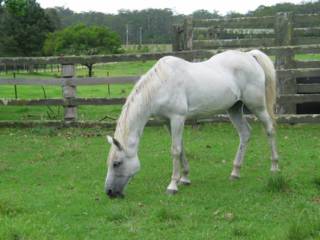
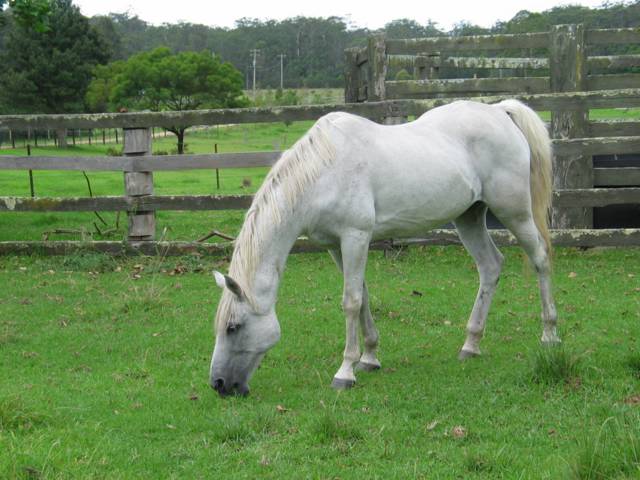
Tayah had been with us a long time, about 17 of her 23 years. She really belonged to my daughter who learnt to ride on her when she was a youngster. I was merely a babysitter/feeder who paid the vet, farrier and feed bills.
She was a great pony club horse that was really good at barrel racing, jumping and even dressage. You could tell she really enjoyed herself at those events. She rarely baulked at going into the horse float or misbehaved and caused problems with other horses and their riders
We even thought she could be good on the agricultural show circuit when, at her first outing, she won a 2nd place in the Maiden Galloway Hack competiton at the Milton show. She also won a ribbon for a clear round in the C Class Jump.
It was with full expectation of victories that we entered her next year. What a disaster! In the Hacking event she went sideways, backwards, around in circles; everyway but forward. In the jumping she refused at the first hurdle and continued to do so until disqualified.
So that was the end of a budding show career.
She was retired to the farm and spent her time doing trail rides into our backcountry. She was not safe from incident here either. Once she was frightened into the armourguard railing alongside the highway and badly cut her leg. She also suffered at one stage from stifle lock. In the paddock one day while running around madly she tripped and fell head over heels and couldn’t walk for three days. But she came back well from all these setbacks.
So it was with confidence that I expected her to recover from the slight lameness I had noticed on my return from Queensland. But it got progressively worse. The vet said she was 99% sure the problem was neurological rather than physical but just to make sure she was put on a course of anti inflammatories. Unfortunately there was no improvement.
So on Tuesday we made the difficult and sad decision to put her down before she deteriorated any further to a stage where she could really hurt herself.
Tayah
Tayah was part of the family and a constant source of enjoyment for all who came to stay here. Her loud greeting of visitors at the front gate as well as louder demands for food at breakfast and dinnertime were well known. Her dislike of men in general and her stubbornness at being caught by or accepting any treatment from them could be as amusing as it was frustrating. Her breaks for “freedom” through the front gate when in season so she could parade up and down the road in front of the local stallions and geldings, in typical Arab fashion, confirmed she was a bit of a tart. She was, however, easily induced back into her yard with the rattle of the feed bucket and the promise of her favourite food, Economix horse pellets.
She now has a prime position in her favourite paddock looking down the hill where she can still check out all her horse friends in the neighbourhood as well as those pesky cows who have periodically encroached upon her patch.
Life here will be a lot quieter without her.
She was a great pony club horse that was really good at barrel racing, jumping and even dressage. You could tell she really enjoyed herself at those events. She rarely baulked at going into the horse float or misbehaved and caused problems with other horses and their riders
We even thought she could be good on the agricultural show circuit when, at her first outing, she won a 2nd place in the Maiden Galloway Hack competiton at the Milton show. She also won a ribbon for a clear round in the C Class Jump.
It was with full expectation of victories that we entered her next year. What a disaster! In the Hacking event she went sideways, backwards, around in circles; everyway but forward. In the jumping she refused at the first hurdle and continued to do so until disqualified.
So that was the end of a budding show career.
She was retired to the farm and spent her time doing trail rides into our backcountry. She was not safe from incident here either. Once she was frightened into the armourguard railing alongside the highway and badly cut her leg. She also suffered at one stage from stifle lock. In the paddock one day while running around madly she tripped and fell head over heels and couldn’t walk for three days. But she came back well from all these setbacks.
So it was with confidence that I expected her to recover from the slight lameness I had noticed on my return from Queensland. But it got progressively worse. The vet said she was 99% sure the problem was neurological rather than physical but just to make sure she was put on a course of anti inflammatories. Unfortunately there was no improvement.
So on Tuesday we made the difficult and sad decision to put her down before she deteriorated any further to a stage where she could really hurt herself.
Tayah
Tayah was part of the family and a constant source of enjoyment for all who came to stay here. Her loud greeting of visitors at the front gate as well as louder demands for food at breakfast and dinnertime were well known. Her dislike of men in general and her stubbornness at being caught by or accepting any treatment from them could be as amusing as it was frustrating. Her breaks for “freedom” through the front gate when in season so she could parade up and down the road in front of the local stallions and geldings, in typical Arab fashion, confirmed she was a bit of a tart. She was, however, easily induced back into her yard with the rattle of the feed bucket and the promise of her favourite food, Economix horse pellets.
She now has a prime position in her favourite paddock looking down the hill where she can still check out all her horse friends in the neighbourhood as well as those pesky cows who have periodically encroached upon her patch.
Life here will be a lot quieter without her.
Saturday, February 05, 2005
The Trip Home
The final few humid days in Brisbane were enjoyable. We had a great dinner at "Urbane" in the city on the Friday night and welcomed home our friends from Canada on the Sunday morning. After catching up with all their news, we headed south down the inland New England Highway. It is certainly an easier drive than the coastal route. The temperature was a steamy 33C as we lunched at Warwick but, an hour later, we hit a huge storm with torrential rain, thunder and lightning. By the time we reached Stanthorpe, near the Queensland New South Wales border, the temperature had dropped to 17C. Break out the sweatshirts!!!!!
We stopped for the evening in the small country town of Glen Innes. The motel was OK but their "famous" steakhouse restuarant served stodge. What a pity! From all the advertising we expected a lot better. A locally produced Semillon was pretty ordinary too.
Next morning we headed off to the thriving rural centre of Armadale. Here we had a great breakfast and enjoyed the hustle and bustle of this obviously wealthy university town.
Next was Tamworth but we didn't stop. We heard on the radio they were nursing hangovers from the two week Australian Country Music Festival, the biggest in the world, that had finished the night before.
Lunch in Scone was accompanied by another thunderstorm. Undaunted by the weather, we headed through the Hunter Valley coal mines and electricity generating plants to the wine district of the lower valley.
Here we stayed a the Hunter Valley Resort, a huge complex with great accommodation and facilities. For dinner that night we ate at the Cellar Restuarant in the Hunter Valley Gardens - previously known as the Pokolbin Village. We returned for breakfast at one of the cafes.
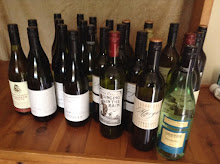
Then we did some serious wine buying at Tyrells, Brokenwood and Draytons before heading to a friend's home in Woy Woy for the night.
Next morning I dropped off my travel partner at Sydney airport for her long 22 hour trip back to the USA and headed home.
All was ok at the farm apart from the horse being a little lame. Why? Who knows. Her left back leg is definitely bothering her and there is slight swelling. If things don't improve over the next week will have to get the vet.
The new vineyard was looking good. The Tempranillo has had a new lease of life and growth over the three weeks was amazing. Likewise for the Semillon apart from the top row which is suffering from either lack of moisture or soil compaction difficulties. The tops of the Pinot Noir had all been eaten off by the wallabies. This was not unexpected but disappointing all the same. The Cabernet Sauvignon is in the veraison stage with the grapes slowly changing color. The early netting seems to have deterred the birds although there are some satin birds keeping watch at a distance. There is no sign of disease in any block despite some heavy rain. The new spray program (preventative + curative) seems to be working.
The new Milton vineyard, however, has been "attacked" by downy mildew so there has been some frantic spraying going on in that area. The planting out continues apace.
That weekend found me at a wedding in Gerringong followed by a reception at Addisons in Shellharbor. A great time was had by all. The venue is really nice, the staff very accommodating and the food for the 130 guests was excellent. They have a restaurant underneath which may be worth checking out.
My ex secretary came down for a few days with her husband. We had a lot of laughs, drank a few bottles of wine, played very competitive Scrabble and pigged out on German food for 3 days.
The day after they left, my daughter brought a friend from England down for a few days. Sadly the weather was not typical (storms, wind and overcast) but we did the tourist guide thing and I think she was pretty impressed with our beaches and scenery. We also found her some kangaroos to photograph up close.
My digital camera is still in hospital. Am waiting to find out whether the problem is terminal or not.
We stopped for the evening in the small country town of Glen Innes. The motel was OK but their "famous" steakhouse restuarant served stodge. What a pity! From all the advertising we expected a lot better. A locally produced Semillon was pretty ordinary too.
Next morning we headed off to the thriving rural centre of Armadale. Here we had a great breakfast and enjoyed the hustle and bustle of this obviously wealthy university town.
Next was Tamworth but we didn't stop. We heard on the radio they were nursing hangovers from the two week Australian Country Music Festival, the biggest in the world, that had finished the night before.
Lunch in Scone was accompanied by another thunderstorm. Undaunted by the weather, we headed through the Hunter Valley coal mines and electricity generating plants to the wine district of the lower valley.
Here we stayed a the Hunter Valley Resort, a huge complex with great accommodation and facilities. For dinner that night we ate at the Cellar Restuarant in the Hunter Valley Gardens - previously known as the Pokolbin Village. We returned for breakfast at one of the cafes.
Then we did some serious wine buying at Tyrells, Brokenwood and Draytons before heading to a friend's home in Woy Woy for the night.
Next morning I dropped off my travel partner at Sydney airport for her long 22 hour trip back to the USA and headed home.
All was ok at the farm apart from the horse being a little lame. Why? Who knows. Her left back leg is definitely bothering her and there is slight swelling. If things don't improve over the next week will have to get the vet.
The new vineyard was looking good. The Tempranillo has had a new lease of life and growth over the three weeks was amazing. Likewise for the Semillon apart from the top row which is suffering from either lack of moisture or soil compaction difficulties. The tops of the Pinot Noir had all been eaten off by the wallabies. This was not unexpected but disappointing all the same. The Cabernet Sauvignon is in the veraison stage with the grapes slowly changing color. The early netting seems to have deterred the birds although there are some satin birds keeping watch at a distance. There is no sign of disease in any block despite some heavy rain. The new spray program (preventative + curative) seems to be working.
The new Milton vineyard, however, has been "attacked" by downy mildew so there has been some frantic spraying going on in that area. The planting out continues apace.
That weekend found me at a wedding in Gerringong followed by a reception at Addisons in Shellharbor. A great time was had by all. The venue is really nice, the staff very accommodating and the food for the 130 guests was excellent. They have a restaurant underneath which may be worth checking out.
My ex secretary came down for a few days with her husband. We had a lot of laughs, drank a few bottles of wine, played very competitive Scrabble and pigged out on German food for 3 days.
The day after they left, my daughter brought a friend from England down for a few days. Sadly the weather was not typical (storms, wind and overcast) but we did the tourist guide thing and I think she was pretty impressed with our beaches and scenery. We also found her some kangaroos to photograph up close.
My digital camera is still in hospital. Am waiting to find out whether the problem is terminal or not.
Saturday, January 22, 2005
The Trip North.....Pictures
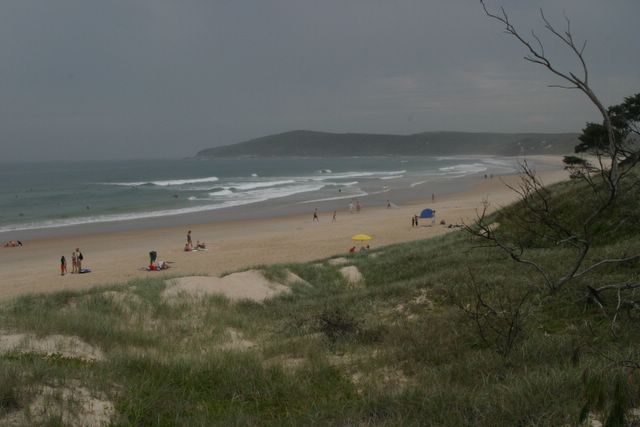
Back Beach, Angourie, NSW.

Cape Byron Lighthouse, Byron Bay, NSW.

Tallows Beach looking towards Broken Head, Cape Byron, NSW.

Glass House Mountains, Qld.

Purling Brook Falls, Lamington National Park, Qld.

View into New South Wales and Mount Warning from Lamington National Park, Qld.

Last Remnants of 2000 Year Old Antarctic Beech Forest, Lamington National Park, Qld.

A Sunning Blue Tongue Lizard, Rainforest, Lamington National Park, Qld.
Friday, January 21, 2005
The Trip North........ continued
Brisbane has been extremely hot and humid all the time we have been here so we spend as much time as possible in airconditioning ie. home, the car, restuarants, malls and cinemas.
This is not to say we haven't been on some sightseeing tours. We had a pleasant day driving up to Springbrook, Lamington National Park, in the Gold Coast hinterland. The altitude there made the climate more pleasant (7 degrees cooler)and the views from the escarpment to the coast as well as the rain forest walks and waterfalls were quite spectacular. We returned to Brisbane via Murwillumbah on the New South Wales side of the border.
Another trip involved the Eumundi markets on the Sunshine Coast. These markets are well worth the 90 minute trip north. It takes a couple of hours to get around and most of the goods and artifacts on sale are made locally. There is very little of the usual "market junk". A few local bands were playing and the food stalls are good too. Can recommend the bratwurst and sauerkraut on a roll with German mustard. We then headed for Noosa. This was another personal disappointment for me. Not having been there for many years, it was sad to see how developed this area had become. The once quiet beachside village with one of the best surf breaks in the country is now a thriving metropolis with high rise hotels, thousands of people and no parking spots! The surf break was a log jam of surf boards. As a result we headed back down south along the coast through Coolum, Mooloolaba and Caloundra. Needless to say the whole area mirrored the the Noosa developement although the latter town had managed to maintain some of its old world charm.
Back in Brisbane, we took the Rivercat up the Brisbane River to South Bank to see "Mamma Mia" at the Lyric Theatre in the Queensland Centre for Performing Arts. This was the fourth time I had seen the show and enjoyed it as much as the first but I think I may be Abba'd out now.
We also went back to the Breakfast Creek Hotel for another steak and then headed across the road to the Breakfast Creek Raceway to a trotting meeting. We stayed for four races and had a few bets. I think "break even" was the result on the night. Well, that's my story and I am sticking to it.
The movies seen so far have included "Meet the Fockers" (don't bother), Bridget Jones 2 (ok, but not as funny as the first) and "Finding Neverland" (well worth seeing!).
Can also recommend the restuarant and coffee house strips of Racecourse Road, Ascot and Oxford Street, Bulimba. The Piccolo BYO Restaurant near Oriel Park, Ascot is also nice with the banana pudding and rum sauce to die for.
At "home" we have also been enjoying the fresh seafood. We have eaten lots of reef fish including Red Emperor, Parrot Fish and Coral Trout. We had Barramundi one night as well as different types of prawns, red spot, tiger etc. and fresh mussels. The Bar B Q has been working overtime.
Our friends return from Canada on Sunday morning when we will begin our trip home. In the meantime we will enjoy our last few days.
For those that are asking "where are the pics?", I am sad to say my digital camera has decided to go on holidays too. I need to take it for service once I get back to Sydney. But I have access to other photos which will be put up on the site in due course.
This is not to say we haven't been on some sightseeing tours. We had a pleasant day driving up to Springbrook, Lamington National Park, in the Gold Coast hinterland. The altitude there made the climate more pleasant (7 degrees cooler)and the views from the escarpment to the coast as well as the rain forest walks and waterfalls were quite spectacular. We returned to Brisbane via Murwillumbah on the New South Wales side of the border.
Another trip involved the Eumundi markets on the Sunshine Coast. These markets are well worth the 90 minute trip north. It takes a couple of hours to get around and most of the goods and artifacts on sale are made locally. There is very little of the usual "market junk". A few local bands were playing and the food stalls are good too. Can recommend the bratwurst and sauerkraut on a roll with German mustard. We then headed for Noosa. This was another personal disappointment for me. Not having been there for many years, it was sad to see how developed this area had become. The once quiet beachside village with one of the best surf breaks in the country is now a thriving metropolis with high rise hotels, thousands of people and no parking spots! The surf break was a log jam of surf boards. As a result we headed back down south along the coast through Coolum, Mooloolaba and Caloundra. Needless to say the whole area mirrored the the Noosa developement although the latter town had managed to maintain some of its old world charm.
Back in Brisbane, we took the Rivercat up the Brisbane River to South Bank to see "Mamma Mia" at the Lyric Theatre in the Queensland Centre for Performing Arts. This was the fourth time I had seen the show and enjoyed it as much as the first but I think I may be Abba'd out now.
We also went back to the Breakfast Creek Hotel for another steak and then headed across the road to the Breakfast Creek Raceway to a trotting meeting. We stayed for four races and had a few bets. I think "break even" was the result on the night. Well, that's my story and I am sticking to it.
The movies seen so far have included "Meet the Fockers" (don't bother), Bridget Jones 2 (ok, but not as funny as the first) and "Finding Neverland" (well worth seeing!).
Can also recommend the restuarant and coffee house strips of Racecourse Road, Ascot and Oxford Street, Bulimba. The Piccolo BYO Restaurant near Oriel Park, Ascot is also nice with the banana pudding and rum sauce to die for.
At "home" we have also been enjoying the fresh seafood. We have eaten lots of reef fish including Red Emperor, Parrot Fish and Coral Trout. We had Barramundi one night as well as different types of prawns, red spot, tiger etc. and fresh mussels. The Bar B Q has been working overtime.
Our friends return from Canada on Sunday morning when we will begin our trip home. In the meantime we will enjoy our last few days.
For those that are asking "where are the pics?", I am sad to say my digital camera has decided to go on holidays too. I need to take it for service once I get back to Sydney. But I have access to other photos which will be put up on the site in due course.
Wednesday, January 12, 2005
Another Trip North
We headed for Brisbane via Gosford just after New Year. This is a 1000km journey on one of the most dangerous highways in Australia. The traffic was quite heavy most of the way due to the holiday period but most drivers were well behaved. This was due perhaps to a considerable police presence both in marked and unmarked cars. It also rained most of the way which slowed people down. We stopped at Port Macquarie for lunch and then drove onto Coffs Harbour where we spent the night. Had a great el fresco fish dinner at the wharf, squid ink pasta with seafood and barramundi deep fried in a parmasan batter. Next morning we had a nice brekky at Woolgoolga and headed on a small detour to Yamba and Angourie, an old surfing haunt of mine many years ago.
They say you should never go back.
The once pristine area is now covered in houses and the beaches were crowded with people. The once clear fresh water pools near Angourie Point were murky and on the verge of algae pollution. But the old Yamba pub still sold the coldest beer in the area.
Further north we ventured on another detour (also surfing related) from Ballina to Byron Bay via Lennox Head. Same story! All now over developed. Cape Byron is the most easterly point on the Australian mainland. A very grand lighthouse stands there. The view is usually impressive but on that day a howling north easterly wind had caused a considerable sea mist which blanketed the area. The Byron township was over run with people so we continued our journey north spending the night at Tweed Heads on the New South Wales/Queensland border. We went over to the local bowling club for a drink. It is more like a Las Vegas casino with slots, restaurants, and shows. We played bingo and each won $15 shopping vouchers. It was a fun night with all the old foggies.
The next morning we detoured through Surfers Paradise (a paradise by name only), the main centre of the Gold Coast, and finally arrived in Brisbane for our house sitting duties.
After depositing our friends at Brisbane Airport for their trip to Canada, we began our rediscovery of Brisbane which, by the way, I consider my home town. Our local area has a nice street of coffee shops and restaurants and is handy to the freeway to both north and south coasts as well as to the city via the river ferry.
On Saturday we headed north past the Glasshouse Mountains and up into the Blackall Range to the town of Maleny. Apart from the spectacular views of the volcanic formations of the Glasshouses, this little town is now a tourist hub with lots of arts and craft shops as well as coffee shops and cafes. We continued on and got a little lost ending up a lot further north than expected. This gave us a chance, however, to visit the "largest ginger processing plant in the world" to buy ginger chocolates and biscuits as well as have lunch at Coolum, a thriving beachside town between Noosa and Caloundra. In my surfing days this place consisted of a petrol station and hamburger store in the middle of the sand dunes. Not any more!!!!
On Sunday we ventured into the city for the Riverside markets, saw a movie (The Fockers) and had dinner at the Breakfast Creek Hotel for one of the best (and most expensive) steaks in the country.
So far so good! This adventure continues!
They say you should never go back.
The once pristine area is now covered in houses and the beaches were crowded with people. The once clear fresh water pools near Angourie Point were murky and on the verge of algae pollution. But the old Yamba pub still sold the coldest beer in the area.
Further north we ventured on another detour (also surfing related) from Ballina to Byron Bay via Lennox Head. Same story! All now over developed. Cape Byron is the most easterly point on the Australian mainland. A very grand lighthouse stands there. The view is usually impressive but on that day a howling north easterly wind had caused a considerable sea mist which blanketed the area. The Byron township was over run with people so we continued our journey north spending the night at Tweed Heads on the New South Wales/Queensland border. We went over to the local bowling club for a drink. It is more like a Las Vegas casino with slots, restaurants, and shows. We played bingo and each won $15 shopping vouchers. It was a fun night with all the old foggies.
The next morning we detoured through Surfers Paradise (a paradise by name only), the main centre of the Gold Coast, and finally arrived in Brisbane for our house sitting duties.
After depositing our friends at Brisbane Airport for their trip to Canada, we began our rediscovery of Brisbane which, by the way, I consider my home town. Our local area has a nice street of coffee shops and restaurants and is handy to the freeway to both north and south coasts as well as to the city via the river ferry.
On Saturday we headed north past the Glasshouse Mountains and up into the Blackall Range to the town of Maleny. Apart from the spectacular views of the volcanic formations of the Glasshouses, this little town is now a tourist hub with lots of arts and craft shops as well as coffee shops and cafes. We continued on and got a little lost ending up a lot further north than expected. This gave us a chance, however, to visit the "largest ginger processing plant in the world" to buy ginger chocolates and biscuits as well as have lunch at Coolum, a thriving beachside town between Noosa and Caloundra. In my surfing days this place consisted of a petrol station and hamburger store in the middle of the sand dunes. Not any more!!!!
On Sunday we ventured into the city for the Riverside markets, saw a movie (The Fockers) and had dinner at the Breakfast Creek Hotel for one of the best (and most expensive) steaks in the country.
So far so good! This adventure continues!
Sunday, January 02, 2005
The Rest of December
Christmas celebrations were held on the farm with extended "family". There were lots of presents to open on Christmas morning and Santa was very kind to each of us. Instead of the traditional hot dinner we decided this year to make it 100% seafood. So we had a feast of oysters, prawns, lobster and Balmain bugs all washed down with copious quantities of sparkling white wine and Semillon. We did however revert to plum pudding and brandy custard at the finish.
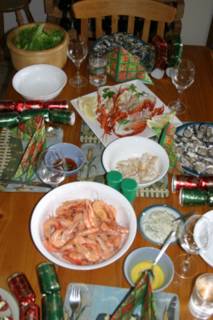
Christmas Dinner
The Cabernet Sauvignon has reached the bunch closure stage ie. the grape berries have reached maximum size. This meant a final spray against botrytis. Most of the bunches are quite large and have substantial "wings". This indicates a good potential yield. We now await veraison (color change) and the ripening process.

Bunch Closure Cabernet Sauvignon
Due to the fact we are heading north to Brisbane for 3 weeks, we had to net the Cabernet in case early ripening attracted the dreaded birds. They can wipe out a crop in a few days. This meant a thorough spraying against downy and powdery mildew. It is a risk to leave the grapes for 3 weeks without spraying but am sure the weather will be with us and all will turn out ok. The new vines continue to do well.
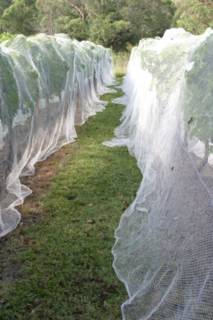
Netted Cabernet Sauvignon

Christmas Dinner
The Cabernet Sauvignon has reached the bunch closure stage ie. the grape berries have reached maximum size. This meant a final spray against botrytis. Most of the bunches are quite large and have substantial "wings". This indicates a good potential yield. We now await veraison (color change) and the ripening process.

Bunch Closure Cabernet Sauvignon
Due to the fact we are heading north to Brisbane for 3 weeks, we had to net the Cabernet in case early ripening attracted the dreaded birds. They can wipe out a crop in a few days. This meant a thorough spraying against downy and powdery mildew. It is a risk to leave the grapes for 3 weeks without spraying but am sure the weather will be with us and all will turn out ok. The new vines continue to do well.
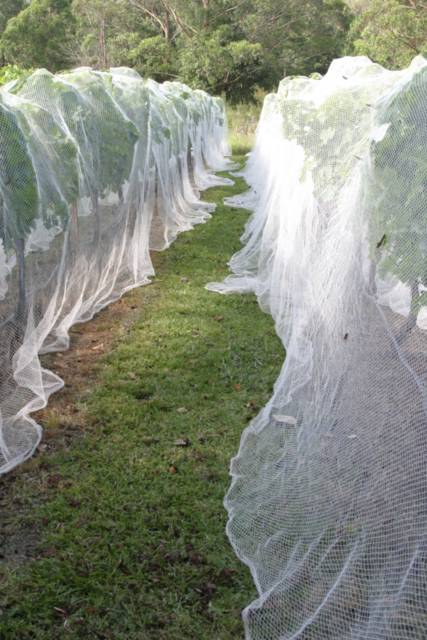
Netted Cabernet Sauvignon
Tuesday, December 14, 2004
December...so far
We have a busy few weeks. A trip to Sydney doubled as a Christmas shopping excursion and a new car pickup. We also enjoyed a Thai meal with family in the shadows of the Sydney Harbour Bridge at Milsons Point. It is a very crowded and noisy restuarant that spills out onto the street but the food is excellent and there is a excellent wine shop next door. The 2004 Giesen Sauvignon Blanc from Marlborough, NZ is a wonderful wine to try and goes well with Asian food.
The new car is great. It is very comfortable to drive and has lots of "goodies" to play with. I have to be careful with the speed however. It does tend to get away from me. Guess that's what happens when you suddenly have a motor double the capacity you are used to.
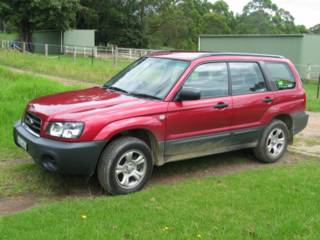
Subaru Forester 2.5 X
We have had weeks of rain and thunderstorms. So far the grapes have remained disease free. This is not the case with a lot of vineyards in the area. Downy mildew is such a problem there is a shortage of chemicals to deal with it. No one expected such a prolonged rain event. The Cabernet Sauvignon has set its fruit and bunch sizes seem bigger than usual.
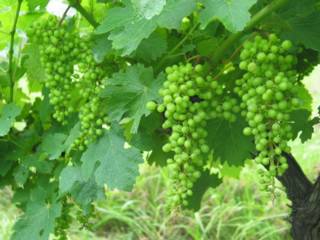
New Bunches on Cabernet Sauvignon
In the new block, the Semillon is being trained along the cordon wire. Almost 80% are at this stage. The rest are catching up. The Tempranillo have put on a spurt and may not be the problem first thought. In the meantime we continue to help out in the Milton vineyard. We estimate that we must be at least to 50% of planting. That's 7500 vines! It should be all downhill from here.
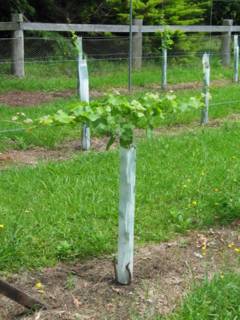
Semillon Trained Along Cordon Wire
The farm is looking good. Dams are full and the grass is green and lush. The cattle are taking advantage of the good feed and are looking fatter. The calves are doing well and it may soon be time to wean them which is always a noisy time.
The downside of the humid weather is the huge tick population explosion. They are annoying not only the cattle and the horse but us humans as well. We have to be sure to be wearing insect repellent any time we spend a lot of time in the paddocks. Their bites can be quite nasty if you are allergic and of course there is always the danger of Lyme Disease.
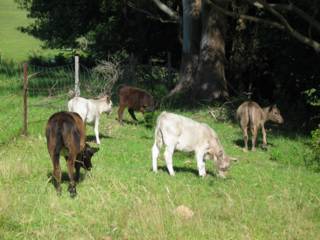
The Calves
The horse should be sprayed with insecticide. But as she hates this I have to wash her with it. This is always fun! I have found a "pour on" for the cattle which will not only deal with the ticks but also with internal worms, lice and even liver fluke. This beats oral administration any day. So I guess we will be rounding them up any day now and doing the job on them.
In the meantime we are enjoying our fresh peaches from the orchard and our fresh lettuce, rocket and herbs from the vege garden.
The new car is great. It is very comfortable to drive and has lots of "goodies" to play with. I have to be careful with the speed however. It does tend to get away from me. Guess that's what happens when you suddenly have a motor double the capacity you are used to.

Subaru Forester 2.5 X
We have had weeks of rain and thunderstorms. So far the grapes have remained disease free. This is not the case with a lot of vineyards in the area. Downy mildew is such a problem there is a shortage of chemicals to deal with it. No one expected such a prolonged rain event. The Cabernet Sauvignon has set its fruit and bunch sizes seem bigger than usual.

New Bunches on Cabernet Sauvignon
In the new block, the Semillon is being trained along the cordon wire. Almost 80% are at this stage. The rest are catching up. The Tempranillo have put on a spurt and may not be the problem first thought. In the meantime we continue to help out in the Milton vineyard. We estimate that we must be at least to 50% of planting. That's 7500 vines! It should be all downhill from here.
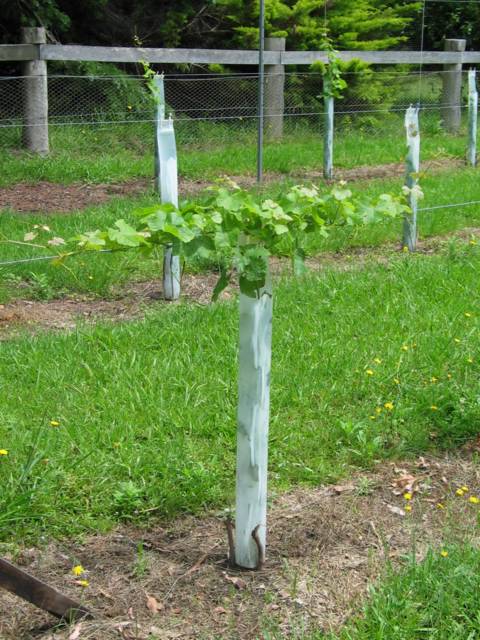
Semillon Trained Along Cordon Wire
The farm is looking good. Dams are full and the grass is green and lush. The cattle are taking advantage of the good feed and are looking fatter. The calves are doing well and it may soon be time to wean them which is always a noisy time.
The downside of the humid weather is the huge tick population explosion. They are annoying not only the cattle and the horse but us humans as well. We have to be sure to be wearing insect repellent any time we spend a lot of time in the paddocks. Their bites can be quite nasty if you are allergic and of course there is always the danger of Lyme Disease.

The Calves
The horse should be sprayed with insecticide. But as she hates this I have to wash her with it. This is always fun! I have found a "pour on" for the cattle which will not only deal with the ticks but also with internal worms, lice and even liver fluke. This beats oral administration any day. So I guess we will be rounding them up any day now and doing the job on them.
In the meantime we are enjoying our fresh peaches from the orchard and our fresh lettuce, rocket and herbs from the vege garden.
Monday, November 29, 2004
November Vineyard Update
Weather conditions have been perfect for vine growth. The pattern seems to be a day of rain followed up by a week of sunshine. Sub soil moisture is now at optimum level. Weeds in the interrows have been successfully sprayed off. There has been no evidence of disease or insect attack. The antifungal spray program against powdery and downy mildew continues on an 8 -14 day cycle depending on the intensity of rain events.
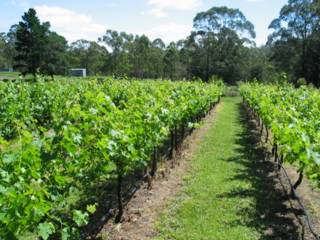
Cabernet Sauvignon in November
The Cabernet Sauvignon is in flower. Each individual flower loses its “cap”, which, unusually, are the flower petals joined at the top. Because domesticated grapevines have perfect flowers ie. they contain both male and female parts, five stamens and a pistil are exposed. This enables grapevines to be self-pollinating. The stamens contain the pollen and the pistil contains the ovary.

Cabernet Sauvignon in Flower
Pollination usually occurs by wind distribution together with some help of insects. Heavy wind conditions and rain hinder pollination however. It will be some time until we know how many of the flowers have been successfully fertilised and what the resultant level of fruit set will be. This will then determine the size of the bunches. Each flower represents one potential grape berry.
It will be soon be time to spray the vines, or more specifically the newly forming bunches against the fungal disease, botrytis (grey mould). This is done at 80% capfall (and again before bunch closure). The spores of this particular fungus lodge within the inflorescences and can lie dormant until bunches are well developed before conditions encourage mould growth. Then it is too late to spray.

New Semillon Block in November
The new Semillon continues to grow well. Many of the vines are reaching the stage when the main vertical shoot needs to be cut (topped) to promote the growth of two upper lateral shoots that will eventually become the permanent arms (cordon) of the vine. The vine is cut through a node just above or below the cordon wire. Then it is attached by string from this cut node to a foliage wire in a continued effort to keep the developing trunk straight.
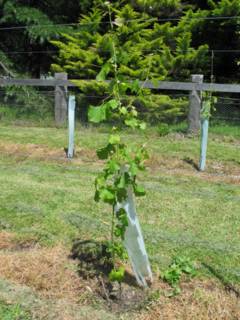
Semillon Grown to Foliage Wire
All but the top 2 laterals are then removed. Due to the apical dominance of grapevines, these two laterals will begin to grow quite vigorously and will be eventually trained along the cordon wire. It is important that these two shoots are between 10cm and 15cm below the cordon wire so that the angle between the trunk and the cordon is sufficient to provide strength for the arms to support the weight of shoots and fruit in the coming years.
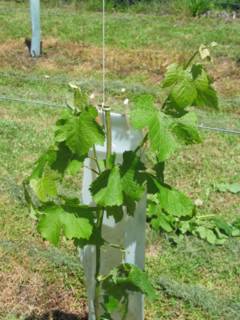
Semillon "Topped" and Tied
The Tempranillo is disappointingly slow in growth. Despite the good conditions and the application of nitrogen fertiliser only a few have reached the top of the vineguards. It is possible that two years of drought and their resultant longer than normal stay in the seedbed has negatively affected them. It is a matter of wait and see.
The same cannot be said for the Pinot Noir. After a slow start many of the vines are at the top of the vineguards and it may be time to think about a wallaby fence to protect them.
In the meantime I have been in the process of buying a new car. Instead of running around dealers trying to get the “best” deal, I used a broker via the internet for the first time. It appears that I have saved about $A3000 off the recommended retail price by doing this. The Subaru Forester, red of course, will be ready for delivery sometime this week.

Cabernet Sauvignon in November
The Cabernet Sauvignon is in flower. Each individual flower loses its “cap”, which, unusually, are the flower petals joined at the top. Because domesticated grapevines have perfect flowers ie. they contain both male and female parts, five stamens and a pistil are exposed. This enables grapevines to be self-pollinating. The stamens contain the pollen and the pistil contains the ovary.

Cabernet Sauvignon in Flower
Pollination usually occurs by wind distribution together with some help of insects. Heavy wind conditions and rain hinder pollination however. It will be some time until we know how many of the flowers have been successfully fertilised and what the resultant level of fruit set will be. This will then determine the size of the bunches. Each flower represents one potential grape berry.
It will be soon be time to spray the vines, or more specifically the newly forming bunches against the fungal disease, botrytis (grey mould). This is done at 80% capfall (and again before bunch closure). The spores of this particular fungus lodge within the inflorescences and can lie dormant until bunches are well developed before conditions encourage mould growth. Then it is too late to spray.

New Semillon Block in November
The new Semillon continues to grow well. Many of the vines are reaching the stage when the main vertical shoot needs to be cut (topped) to promote the growth of two upper lateral shoots that will eventually become the permanent arms (cordon) of the vine. The vine is cut through a node just above or below the cordon wire. Then it is attached by string from this cut node to a foliage wire in a continued effort to keep the developing trunk straight.

Semillon Grown to Foliage Wire
All but the top 2 laterals are then removed. Due to the apical dominance of grapevines, these two laterals will begin to grow quite vigorously and will be eventually trained along the cordon wire. It is important that these two shoots are between 10cm and 15cm below the cordon wire so that the angle between the trunk and the cordon is sufficient to provide strength for the arms to support the weight of shoots and fruit in the coming years.
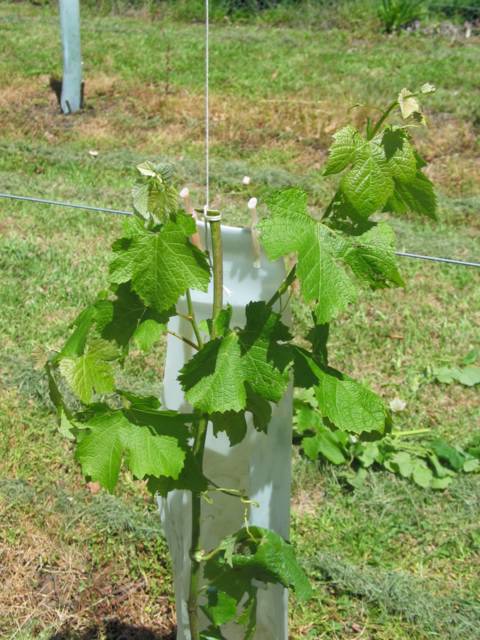
Semillon "Topped" and Tied
The Tempranillo is disappointingly slow in growth. Despite the good conditions and the application of nitrogen fertiliser only a few have reached the top of the vineguards. It is possible that two years of drought and their resultant longer than normal stay in the seedbed has negatively affected them. It is a matter of wait and see.
The same cannot be said for the Pinot Noir. After a slow start many of the vines are at the top of the vineguards and it may be time to think about a wallaby fence to protect them.
In the meantime I have been in the process of buying a new car. Instead of running around dealers trying to get the “best” deal, I used a broker via the internet for the first time. It appears that I have saved about $A3000 off the recommended retail price by doing this. The Subaru Forester, red of course, will be ready for delivery sometime this week.
Sunday, November 21, 2004
Creating a New Vineyard from Scratch
Friends of ours have purchased an old dairy farm near the historic town of Milton.
Of the 72ha (180acres), 4ha (10acres) will be initially set aside for grapes. There will be four separate blocks in various parts of the property to take advantage of the best aspect, slope, soil and microclimate for grape growing.
The varieties selected include Semillon, Sauvignon Blanc, Voignier, Verdelho, Arneis, Cabernet Franc and Gamay.
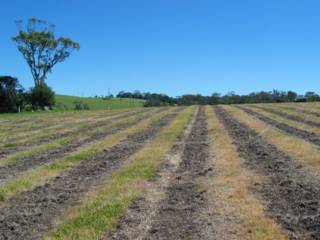
The first step in developing a vineyard, after site selection, is deciding on row length, spacing, and orientation as well as headland dimensions and positioning of access roads and drainage systems. Then it is a matter of marking out the rows, spraying off the grass cover with a herbicide and cultivating by ripping, discing and rotary hoeing.
Then the end assemblies for the trellises are installed along with the intermediate posts. This involves accurate marking then mechanically driving the posts a minimum of a metre (3ft) into the ground.
The new vines are delivered as one-year-old bare rooted rootlings that have been kept in cold storage to prevent them shooting or banded vines which are already growing in degradable pots. The former have to be removed from cold storage and hydrated for 24 hours before planting while the latter is gradually exposed to their new environment on delivery and kept well watered.
In the vineyard, the position of each individual vine has to be marked ie. at the correct spacing directly under where the cordon wire will eventually be. This is done with a line and a spray can of marking paint. Then a hole is dug at a spade’s width and depth.
The rootling or a banded vine is placed in the hole, covered with soil and firmed down.
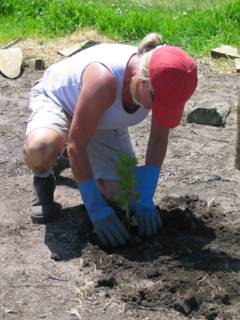
We have found that a team of one marker (who becomes a planter/waterer after that job is finished), two diggers, one planter and one waterer can get around 600 vines into the ground in a day.
15000 divided by 600 equals……………….. too much work to contemplate.
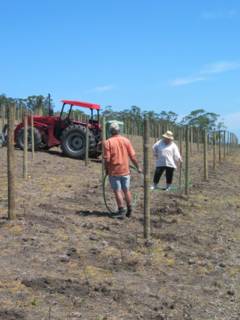
And you get to touch up your suntan as well.
Of the 72ha (180acres), 4ha (10acres) will be initially set aside for grapes. There will be four separate blocks in various parts of the property to take advantage of the best aspect, slope, soil and microclimate for grape growing.
The varieties selected include Semillon, Sauvignon Blanc, Voignier, Verdelho, Arneis, Cabernet Franc and Gamay.
The first step in developing a vineyard, after site selection, is deciding on row length, spacing, and orientation as well as headland dimensions and positioning of access roads and drainage systems. Then it is a matter of marking out the rows, spraying off the grass cover with a herbicide and cultivating by ripping, discing and rotary hoeing.

Cultivated Rows
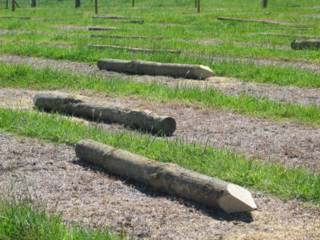
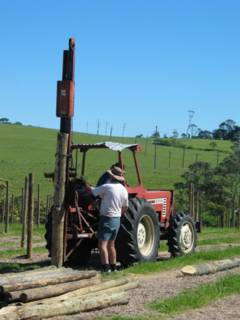
This is also the time that the soil can be ameliorated (eg. lime) and nutrients (N, P, K etc.) added according to the results of previous soil tests. Generally a pre-emergent herbicide is incorporated in the prepared soil during the last of these operations. This prevents weeds competing with the new vines for nutrients and moisture. Then the end assemblies for the trellises are installed along with the intermediate posts. This involves accurate marking then mechanically driving the posts a minimum of a metre (3ft) into the ground.
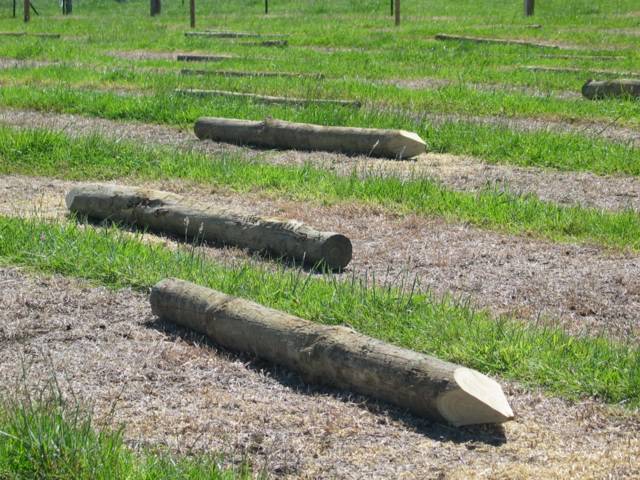
"Sharpened" End Posts Ready for Driving
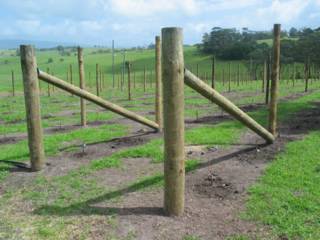
The end assemblies have to take quite a deal of strain once the wires are installed and tightened and the grapevines are growing on them. There are many designs of end assemblies that perform successfully. In our case, wooden end posts of a larger diameter than the intermediate posts have been used and are supported by a strut that is chocked by the first intermediate post in the row. 
Driving the Posts
A properly designed and installed end post reduces the instance of breakage and pull out. CCA treated pine posts have been selected for this vineyard. They are strong as well as being rot and termite resistant. 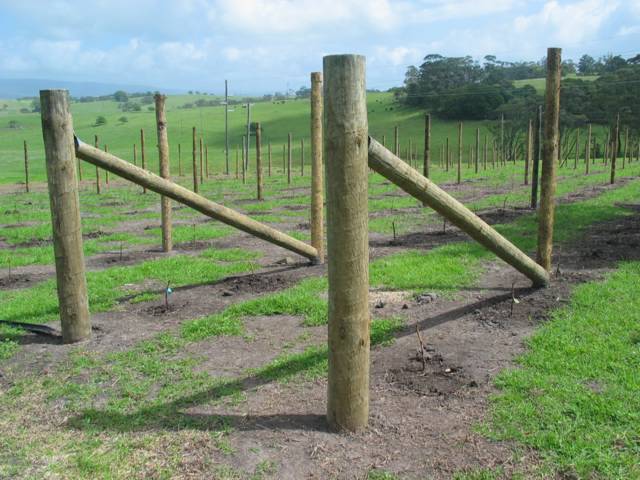
Completed End Assemblies
We have become involved with planting. At a row spacing of 2.2m and a vine spacing of 1.2m, this involves a total of approximately 15000 vines for the vineyard. The new vines are delivered as one-year-old bare rooted rootlings that have been kept in cold storage to prevent them shooting or banded vines which are already growing in degradable pots. The former have to be removed from cold storage and hydrated for 24 hours before planting while the latter is gradually exposed to their new environment on delivery and kept well watered.
In the vineyard, the position of each individual vine has to be marked ie. at the correct spacing directly under where the cordon wire will eventually be. This is done with a line and a spray can of marking paint. Then a hole is dug at a spade’s width and depth.
The rootling or a banded vine is placed in the hole, covered with soil and firmed down.
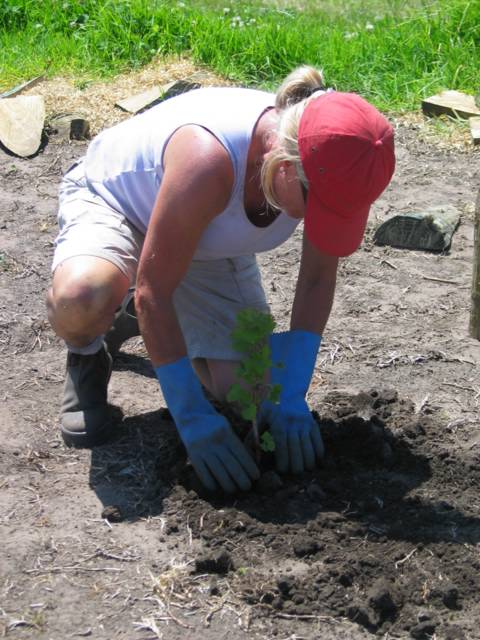
Planting
The final step in the process is watering. This will settle the earth around the roots and prevent them from drying out. Each new vine should receive 3-5L. We have found that a team of one marker (who becomes a planter/waterer after that job is finished), two diggers, one planter and one waterer can get around 600 vines into the ground in a day.
15000 divided by 600 equals……………….. too much work to contemplate.
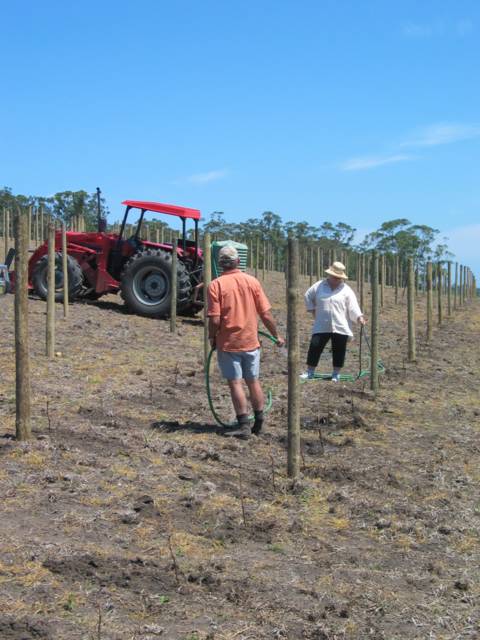
Watering
It’s hot work under the blazing summer sun but there is a sense of achievement when at the end of the day you look back along the rows at the “sticks” that will eventually burst into leaf and grow into the walls of green. And you get to touch up your suntan as well.
Wednesday, November 17, 2004
Weeds
A weed is a plant growing where you don’t want it. In many cases, somebody’s weed is another’s botanical specimen.
The recent rain has brought a burst of weed growth on the farm. There are two categories, vineyard row weeds and pasture weeds. You cannot leave them uncontrolled. They need to be dealt with before they seed. As the old saying goes “one years seeds is seven years weeds”.
Vineyard row weeds are a diverse collection of plants that grow easily in the rows as these are kept bare soil most of the growing season and wind blown seeds lodge there in autumn to germinate the following spring. They are easily disposed of spraying with a systemic herbicide like glyphosate (Roundup® or a cheaper generic). Care must be taken not to let any over-spray get to the green parts of the growing vines as this chemical is non specific and will kill or severely retard most anything it settles on. I use an upside down plastic bucket slotted over the spray head to stop drift.
Pasture weeds are usually endemic to the region and are spread by seed, rhizomes or by suckering. The very low grass cover at the end of winter aids germination of the first type.
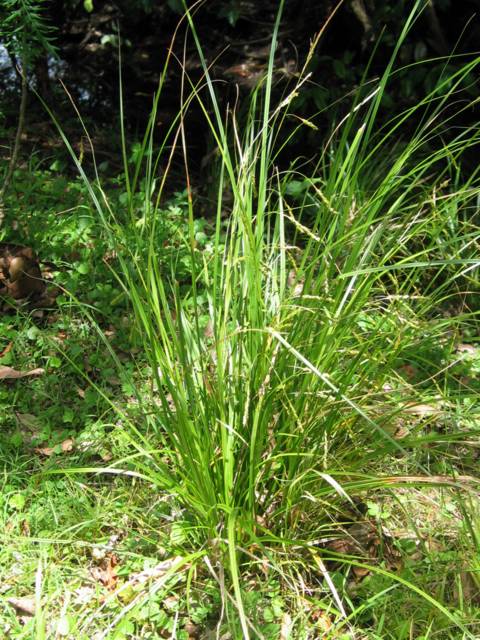
The main problem in this area is the native poa tussock. It grows into huge clumps that the cattle won’t eat, retards grass growth and eventually will take over a pasture if not controlled. It is also a great harbour for rabbits and their burrows and warrens.
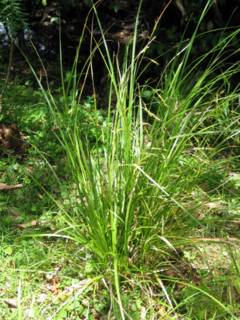
Poa Tussock
I spray each individual tussock with glyphosate using a conical nozzle on the sprayer to limit over-spray. This took considerable time initially, over a year, to reduce the huge numbers over the 10.5ha (25acres). However, since these first treatments killed off the vast majority of the plants, seed production and hence new growth have been considerably reduced. Annual follow up before seeding (early summer) is purely a maintenance task.
Another problem weed germinating from wind blown seed is the thistle. It usually grows in the bare soil that results from tussock treatment. Despite its pretty purple flower, it has very prickly foliage and can grow to over a metre in height. It seeds prolifically and will spread quite rapidly making wide tracts of pasture unproductive. It can be controlled by physically removing it by hoeing or by herbicide spray.

Scotch Thistle
Bracken fern is a native plant that grows in open pasture and under light tree cover. It can be toxic to animals and reduces pasture growth by competing for light, nutrients and moisture. It can also take over large tracts of land. It grows from an extensive network of underground rhizomes. While winter frosts kill old annual growth, new ferns appear in great numbers early in spring. To kill this plant it is necessary to use a bracken specific chemical that is systemic and translocates into the rhizomes.
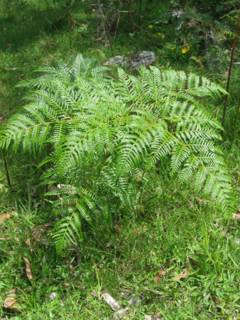
Bracken Fern
Brushoff® is such a product and has worked well on the farm. It took months of spraying the mature bracken to get control and now annual maintenance is all that is needed.
Blackberries are an imported curse. They spread from seed dropped by birds and from horizontal roots as well as from roots formed on the growing tip of the plant that makes contact with the ground. It really needs to be controlled. Apart from being a legal requirement, it can reduce pasture use and harbour rabbits.
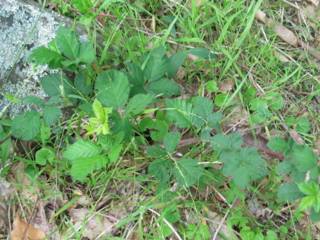
Young Blackberry Bush
Brushoff® is the best product for use against blackberries. But no matter how much you spray, every year new growth appears somewhere on the property. It’s an ongoing battle to control this brute of a plant.
Another problem here is the snake vine, a native ground cover with attractive foliage and large yellow flowers.
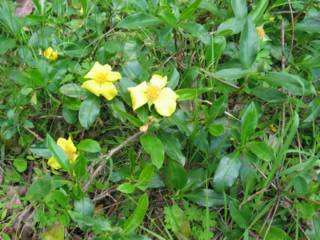
Snake Vine
It grows in large clumps, is very prolific and reduces pasture growth. Spraying with glyphosate together with a wetting agent to penetrate the waxy leaves works well. The other alternative is to dig it up and sell it to nurseries. They get $15 a pot for these plants to be used in domestic gardens !!!!!!!!
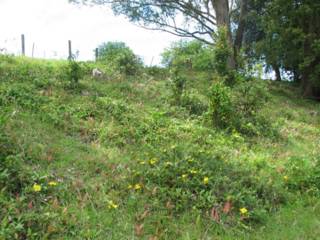
Snake Vine Infestation
As I said, somebody’s weed…………….
The recent rain has brought a burst of weed growth on the farm. There are two categories, vineyard row weeds and pasture weeds. You cannot leave them uncontrolled. They need to be dealt with before they seed. As the old saying goes “one years seeds is seven years weeds”.
Vineyard row weeds are a diverse collection of plants that grow easily in the rows as these are kept bare soil most of the growing season and wind blown seeds lodge there in autumn to germinate the following spring. They are easily disposed of spraying with a systemic herbicide like glyphosate (Roundup® or a cheaper generic). Care must be taken not to let any over-spray get to the green parts of the growing vines as this chemical is non specific and will kill or severely retard most anything it settles on. I use an upside down plastic bucket slotted over the spray head to stop drift.
Pasture weeds are usually endemic to the region and are spread by seed, rhizomes or by suckering. The very low grass cover at the end of winter aids germination of the first type.
The main problem in this area is the native poa tussock. It grows into huge clumps that the cattle won’t eat, retards grass growth and eventually will take over a pasture if not controlled. It is also a great harbour for rabbits and their burrows and warrens.
Poa Tussock
I spray each individual tussock with glyphosate using a conical nozzle on the sprayer to limit over-spray. This took considerable time initially, over a year, to reduce the huge numbers over the 10.5ha (25acres). However, since these first treatments killed off the vast majority of the plants, seed production and hence new growth have been considerably reduced. Annual follow up before seeding (early summer) is purely a maintenance task.
Another problem weed germinating from wind blown seed is the thistle. It usually grows in the bare soil that results from tussock treatment. Despite its pretty purple flower, it has very prickly foliage and can grow to over a metre in height. It seeds prolifically and will spread quite rapidly making wide tracts of pasture unproductive. It can be controlled by physically removing it by hoeing or by herbicide spray.
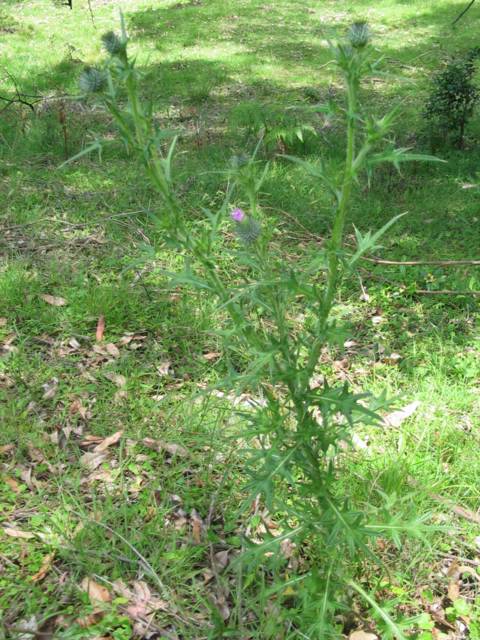
Scotch Thistle
Bracken fern is a native plant that grows in open pasture and under light tree cover. It can be toxic to animals and reduces pasture growth by competing for light, nutrients and moisture. It can also take over large tracts of land. It grows from an extensive network of underground rhizomes. While winter frosts kill old annual growth, new ferns appear in great numbers early in spring. To kill this plant it is necessary to use a bracken specific chemical that is systemic and translocates into the rhizomes.
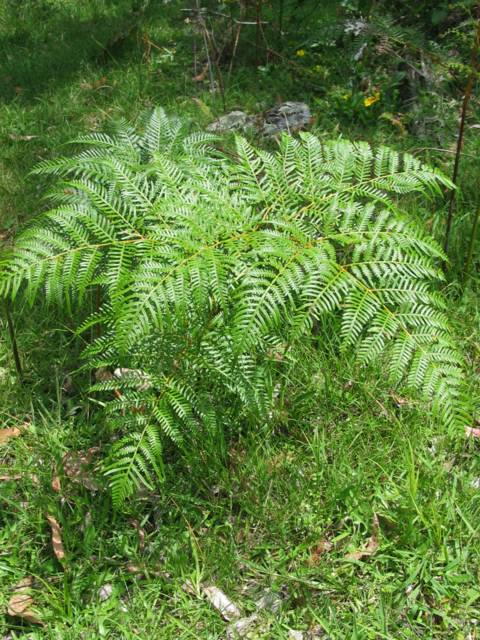
Bracken Fern
Brushoff® is such a product and has worked well on the farm. It took months of spraying the mature bracken to get control and now annual maintenance is all that is needed.
Blackberries are an imported curse. They spread from seed dropped by birds and from horizontal roots as well as from roots formed on the growing tip of the plant that makes contact with the ground. It really needs to be controlled. Apart from being a legal requirement, it can reduce pasture use and harbour rabbits.

Young Blackberry Bush
Brushoff® is the best product for use against blackberries. But no matter how much you spray, every year new growth appears somewhere on the property. It’s an ongoing battle to control this brute of a plant.
Another problem here is the snake vine, a native ground cover with attractive foliage and large yellow flowers.

Snake Vine
It grows in large clumps, is very prolific and reduces pasture growth. Spraying with glyphosate together with a wetting agent to penetrate the waxy leaves works well. The other alternative is to dig it up and sell it to nurseries. They get $15 a pot for these plants to be used in domestic gardens !!!!!!!!
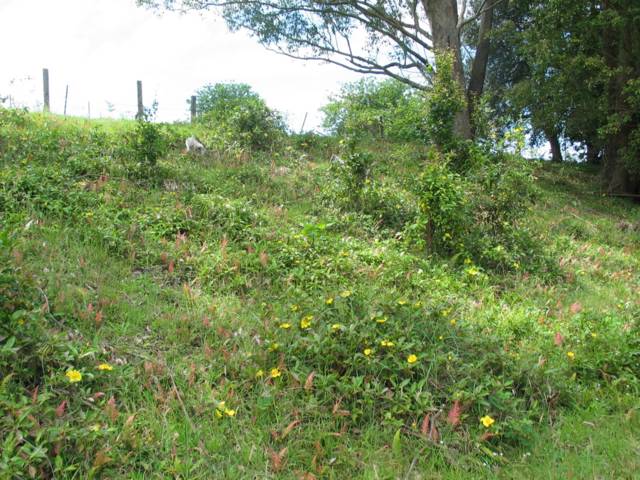
Snake Vine Infestation
As I said, somebody’s weed…………….
A Trip North
Last week we headed for Sydney to catch up with family to celebrate my birthday.
My daughter had organised a few games of ten-pin bowling at a retro alley where you stepped back in time at least 30 years. Lots of memorabilia and great music.
We had a fun time. It was a laugh a minute. It had been at least 20 years since I had bowled and I managed to score over 100 both games. The others? Well………
We then drove to Norton St. Leichhardt, which is the Italian part of Sydney for a cheap and cheerful meal which turned out to be excellent.
Next morning we headed into the Sydney CBD and did a few bookshops as well as the Dupane photographic exhibition at the Museum of Sydney.
We also caught a movie, “The Anchorman”. Don’t bother, it’s really awful.
After dinner at Wagamammas, a Japanese noodle bar, the ladies headed off for a Dido concert while I settled for another movie. It was an Australian production “A Man’s Got to Know” which turned out to be very funny in a quirky sort of way.
Next morning we set off for the Hunter Valley, about 160km (100mi) north of Sydney to visit some wineries, to do some tasting and to buy some wine to replenish the stock that had greatly diminished over the last few months. The region grows most grape varieties but because of its maritime climate, the most successful are Semillon and Shiraz. It also appears that Verdelho will be a variety that will perform well in this difficult climate.
It was a warm sunny day and surprisingly there were very few people in the area. This allowed the winery staff more time to talk about their wines as well as offer a few specials not normally available.
At Margan Family Wines we bought some of their ’04 Semillon and Verdelho as well as their Saignee Shiraz Rose’. This winery continually produces high quality wines at reasonable prices and the 2004 vintage is no exception.
At Oakvale Wines we bought some older Semillon which had developed nicely in the bottle as well as their most recent Verdelho which in fact may be better than the Margan.
Then it was time for lunch at the Enzo Café at the Pepper Tree Winery complex where I had a great smoked salmon salad and shared a couple of nice glasses of wine. The chicken Caesar salad across the table looked good too. It was a very pleasant hour sitting outside in the sun listening to a “best of” Dixie Chicks album and relaxing before the wine buying frenzy continued.
At Tullochs we bought 3 bottles of their top of the range Hector 1999 Shiraz for special occasions.
Then finally, we ended up at a new winery, Iron Gate Wines. There we bought some of their Semillon as well as a range of their Shiraz. The Reserve Shiraz comes in at a whopping 15.6% alcohol. That will definitely be a non-driving dinner when we open that one.
So all in all it was a successful day. It’s always nice to visit a few new places as well as the tested and true in the Hunter Valley. The fact that I got a call on my mobile phone from the security department of my credit card company while on the way home asking whether I still had possession of my card because the abnormal number of purchases in a day is neither here nor there.
We stayed overnight with a friend in the Gosford area just north of Sydney and tried some of our purchases with a great meal of bar b q’d whole fillet steak, baked potato and salad.
But now it is back to the grind!
My daughter had organised a few games of ten-pin bowling at a retro alley where you stepped back in time at least 30 years. Lots of memorabilia and great music.
We had a fun time. It was a laugh a minute. It had been at least 20 years since I had bowled and I managed to score over 100 both games. The others? Well………
We then drove to Norton St. Leichhardt, which is the Italian part of Sydney for a cheap and cheerful meal which turned out to be excellent.
Next morning we headed into the Sydney CBD and did a few bookshops as well as the Dupane photographic exhibition at the Museum of Sydney.
We also caught a movie, “The Anchorman”. Don’t bother, it’s really awful.
After dinner at Wagamammas, a Japanese noodle bar, the ladies headed off for a Dido concert while I settled for another movie. It was an Australian production “A Man’s Got to Know” which turned out to be very funny in a quirky sort of way.
Next morning we set off for the Hunter Valley, about 160km (100mi) north of Sydney to visit some wineries, to do some tasting and to buy some wine to replenish the stock that had greatly diminished over the last few months. The region grows most grape varieties but because of its maritime climate, the most successful are Semillon and Shiraz. It also appears that Verdelho will be a variety that will perform well in this difficult climate.
It was a warm sunny day and surprisingly there were very few people in the area. This allowed the winery staff more time to talk about their wines as well as offer a few specials not normally available.
At Margan Family Wines we bought some of their ’04 Semillon and Verdelho as well as their Saignee Shiraz Rose’. This winery continually produces high quality wines at reasonable prices and the 2004 vintage is no exception.
At Oakvale Wines we bought some older Semillon which had developed nicely in the bottle as well as their most recent Verdelho which in fact may be better than the Margan.
Then it was time for lunch at the Enzo Café at the Pepper Tree Winery complex where I had a great smoked salmon salad and shared a couple of nice glasses of wine. The chicken Caesar salad across the table looked good too. It was a very pleasant hour sitting outside in the sun listening to a “best of” Dixie Chicks album and relaxing before the wine buying frenzy continued.
At Tullochs we bought 3 bottles of their top of the range Hector 1999 Shiraz for special occasions.
Then finally, we ended up at a new winery, Iron Gate Wines. There we bought some of their Semillon as well as a range of their Shiraz. The Reserve Shiraz comes in at a whopping 15.6% alcohol. That will definitely be a non-driving dinner when we open that one.
So all in all it was a successful day. It’s always nice to visit a few new places as well as the tested and true in the Hunter Valley. The fact that I got a call on my mobile phone from the security department of my credit card company while on the way home asking whether I still had possession of my card because the abnormal number of purchases in a day is neither here nor there.
We stayed overnight with a friend in the Gosford area just north of Sydney and tried some of our purchases with a great meal of bar b q’d whole fillet steak, baked potato and salad.
But now it is back to the grind!
Friday, November 05, 2004
Spring Still Dominates, Summer Struggles
The weather is still typical Spring, warm one day, cold the next. And the rain persists. We have had another 50mm (2in) since the last report. It looks as though the area to the south of us which has been in drought for three years is finally getting some relief. They do not get the same high falls as we do being in the shadow of the Snowy Mountains but they have had sufficient to revive the pasture and give some hope to the farmers there who have in most cases sold off all their stock to survive.
Our garden looks good. All the exotic trees are in leaf and the orchard is full of developing apples, plums, peaches, pears, nectarines and nashis. Whether all will survive the usual bird life enslaught, mainly parrots, is another question. We have netted the early ripening peaches in the vain hope we will be allowed to share.
All the native trees are in bloom, especially the bottle brush, grevilleas and the black wattles.
The Biggest Bottlebrush Tree in the World?
The bottlebrush in the backyard is a huge tree. It is a "weeping" variety that continues to get bigger every year. The tree is covered in red brushes and is a haven to parrots, honeyeaters and other birdlife.
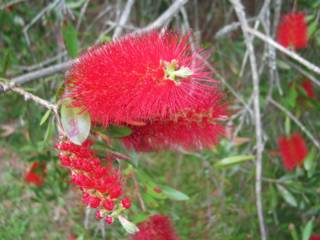
Bottlebrush Flower
Most of the grapes continue to do well. I have started a fertilizer program for the new plantings now that the roots have started to grow. Will be giving them a feed of nitogren via urea applications of 2 x 3g each a month until well into next year. Hopefully this will push along the slower varieties.
The infloresences in the cabernet have separated and flowering cannot be too far away. This is the first time you really see evidence of the upcoming grape crop.
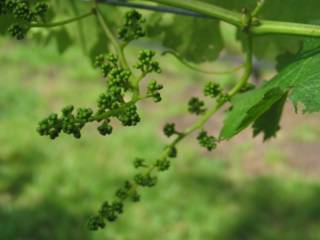
Cabernet Sauvignon Inflorescences
There was some excitement in the backyard the other afternoon when quite a large red bellied black snake decided to visit.
While I leave them alone in the bottom paddocks, and it is illegal to kill them, they are not welcome around the house. So a chase with my weapon of choice, a hoe, ensued. But he was quite quick to move and stayed close to the house so it was hard to get a good shot. After some abortive swipes, he managed to hide in some thick bush in the garden....minus a few cm of his tail. Hopefully this encounter will send him looking for greener pastures. The sharpened hoe is now at the ready by the back door for the summer season just in case he or any of his mates return.
Our garden looks good. All the exotic trees are in leaf and the orchard is full of developing apples, plums, peaches, pears, nectarines and nashis. Whether all will survive the usual bird life enslaught, mainly parrots, is another question. We have netted the early ripening peaches in the vain hope we will be allowed to share.
All the native trees are in bloom, especially the bottle brush, grevilleas and the black wattles.
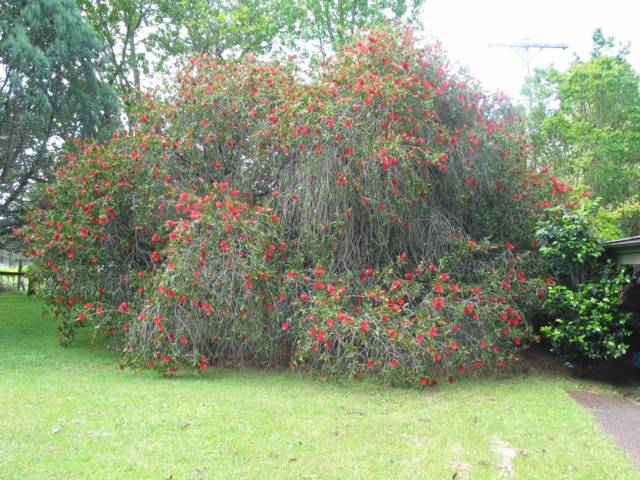
The Biggest Bottlebrush Tree in the World?
The bottlebrush in the backyard is a huge tree. It is a "weeping" variety that continues to get bigger every year. The tree is covered in red brushes and is a haven to parrots, honeyeaters and other birdlife.
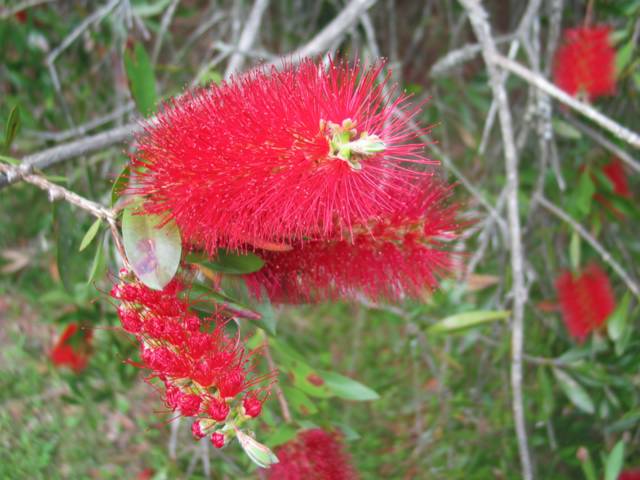
Bottlebrush Flower
Most of the grapes continue to do well. I have started a fertilizer program for the new plantings now that the roots have started to grow. Will be giving them a feed of nitogren via urea applications of 2 x 3g each a month until well into next year. Hopefully this will push along the slower varieties.
The infloresences in the cabernet have separated and flowering cannot be too far away. This is the first time you really see evidence of the upcoming grape crop.
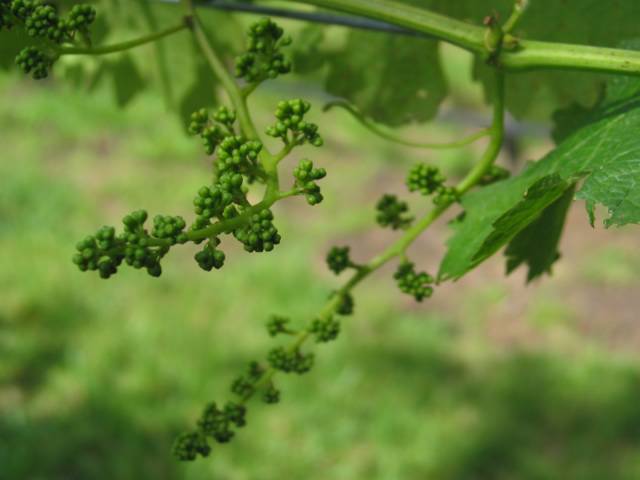
Cabernet Sauvignon Inflorescences
There was some excitement in the backyard the other afternoon when quite a large red bellied black snake decided to visit.
While I leave them alone in the bottom paddocks, and it is illegal to kill them, they are not welcome around the house. So a chase with my weapon of choice, a hoe, ensued. But he was quite quick to move and stayed close to the house so it was hard to get a good shot. After some abortive swipes, he managed to hide in some thick bush in the garden....minus a few cm of his tail. Hopefully this encounter will send him looking for greener pastures. The sharpened hoe is now at the ready by the back door for the summer season just in case he or any of his mates return.
Subscribe to:
Posts (Atom)

.jpg)