Friday, April 13, 2007

Vintage 2007

Refractometer readings of a vineyard sampling showed the Cabernet sauvignon to be at a sugar level of around 12° Baume. The older vine leaves were starting to turn red which is suspected to be a result of a phosphorus deficiency in the soil (low pH) rather than the onset of autumn. Also a few bunches were beginning to shrivel which was more evidence that the vines had run out of "puff". So it was time to pick.

Easter Monday seemed a good time to start so under sunny blue skies, after the morning dew had dried off, we started hand harvesting. It is always fun battling the spiders, bees and ants as well as other creepy crawlies that have taken up residence in the vineyard over the last six months. And all the time you are concentrating on not cutting one of your fingers off.

Buckets were soon filled without incident and transferred to the "winery" otherwise known at other times of the year as the garage.
Hence our unofficial wine appellation classification of Vin de Garage.

Crusher / Destemmer and Fermenter
Here we have all the necessary basic equipment to make wine. But there is none of the high technology and sophistication of a modern winery. Therefore we rely on quick processing, good equipment hygiene and a detailed technical knowledge of winemaking techniques to protect the product from possible spoilage during the vinification phase.

The bunches were tipped into the crusher/destemmer where they are run through rollers to gently break the berry skins. The berries are then "beaten" off the stalks by rotating paddles and the crushed destemmed grapes fall through a stainless steel screen into the open fermenter.
Must in Open Fermenter
The stalks are ejected through the end of the machine and are eventually returned to the vineyard as mulch. Too many stalks in the ferment produce off flavours in the finished wine.

Tests on the resultant juice by refractometer and hydrometer confirmed a Baume reading of 12.0° . This means the wine will have an alcohol content of around 12%.
pH or acidity activity was 3.7. Acid levels are important as this determines the taste balance of the wine as well as how well certain additives eg. sulphur do their job. Acid levels can be increased (and pH reduced) by the addition of tartaric acid which is one of the naturally occurring acids in grape juice. The other main one is malic acid. Warm climate grapes are usually low in acidity and we keep the pH of our red wine between 3.5 and 3.6 by acid addition. Red wines usually have lower acidity than whites.
Another important measurement of acidity is titratable acid (TA) measured in g/L tartaric acid and sometimes called, wrongly, total acid.

Essential Winemaking Tools:
pH meter, hydrometer, refractometer
In Europe, sugar can be added at specified levels to grape juice to increase the final level of alcohol of wine. This is necessary as climatic conditions do not always allow grapes to ripen enough and wines of low alcohol are thin and insipid.
In the New World eg. Australia and the USA, the addition of sugar is prohibited. However in Australia the addition of grape juice concentrate (made by freezing the juice and removing the water as ice) is allowed but our warm climate most years guarantees grapes ripening to the required level. It should be pointed out that not all varieties are allowed to ripen to the maximum possible sugar level. New thinking has developed the flavour ripe theory where some grapes are picked at a lower sugar content according to the wine style being made eg. Semillon in the Hunter Valley of NSW is picked at between 10.0° and 11.0° Baume to produce a typical Hunter style. The same grape in Western Australia is allowed to ripen to 13.0° + Baume producing a bigger fruitier wine with less varietal characteristics. Some viticulturists even look at seed ripeness to determine when grapes should be picked.

Yeast and LAB Cultures
Back in the winery, sulphur was added to protect the must (grape skins, seeds and juice) from oxidation and wild yeasts before a controlled fermentation begins. This is done by adding a calculated amount of potassium metabisulphite at very low ppm rates.
A calculated amount of a commercial dried wine yeast (Saccharomyces cerevisiae) is then rehydrated in warm water. There are many wine style specific strains of that species available and this year I am trying a Bordeaux strain. Wild yeasts are present in all vineyards and they too can ferment the wine. But wild yeast fermentation is fraught with danger eg. slow or stuck fermentation and off flavours. Some say wild fermentation gives a wine special character. Maybe one day I will be brave enough to try it.
A lactic acid bacteria (LAB) culture was also rehydrated. This is added to the wine to initiate malolactic fermentation (MLF) where the bacteria convert the rather harsh malic acid in the grapes to the softer lactic acid. This also stabilizes the finished product. MLF can occur at any time but usually after the wine is made and is in storage.
It is essential that MLF occurs before bottling as a by-product of the reaction is carbon dioxide. This can make the bottled wine ‘fizzy’ and a bit musty tasting and can even blow the corks out of the bottle.

Disassembled Crusher Destemmer
The yeast and the LAB were then added to the must. The yeast metabolises the sugar in the grape juice turning it into alcohol and carbon dioxide. This takes some time to begin especially since the added sulphur initially inhibits the yeast.
But after a while the sulphur is "bound" to the red pigments in the grape skins and fermentation starts in earnest with increased temperature and obvious foaming. The crushed grapes release their juice as the alcohol level rises and the skins start to float to the surface. This layer is called the cap.
The carbon dioxide produced is now what protects the wine from oxidation. Another result of increased alcohol is the extraction of the red colour and tannins from the skins. Almost all grape juice whether from white or red grapes is clear with only the skins giving it colour. It is therefore necessary to keep pushing the cap down into the fermenting juice to extract as much colour and tannin as possible. This is done 4-6 times a day. Purple hands and arms result.
But there is nothing like the smell of fermenting wine up close.
Red wine is usually stored in oak barrels which, during controlled ageing, impart an oaky flavour to the wine. Wine barrels are very expensive, around $1000 for a hogshead (300L), so a cheaper way to get oak character is to add mini staves to the ferment. The two main types of oak are American and French. Like the barrels the staves are available in varying degrees of charring or toasting. This time I used medium toasted French oak in keeping with the Bordeaux style.

Oak Staves
After 7 days enough colour and tannins have been extracted from skins and it was time to drain the still fermenting wine off them.
Basket Press
We use the winepress for this, bucketing the must into the press basket and transferring the free running wine into a variable capacity stainless steel tank. The lids of these tanks float on the wine surface and seal by an inflatable tube.

Then the skins remaining in the basket are pressed slowly and thoroughly extracting more wine which has increasing levels of tannins and colour as the pressure increases. These pressings are also added to the tank along with the oak staves already removed from the ferment.
The skins that are left in the press (the marc) are almost dry and form a solid "cake" which is dumped back onto the vine rows as a fertiliser/mulch.

The wine is now left to finish fermentation and begin the settling process where solids begin to "fall out" and wine starts to clarify. We know when fermentation has finished when the Baume reading is below zero ie. no sugar is left.
The wine will then go through a number of racking processes where the clarifying liquid is separated from the settled solid residue. There are a number of settling aids eg. bentonite, but I prefer to let things happen naturally, albeit much slower, as any additions tend to strip the flavour. During this time oxidation can be a real problem so we will keep the wine under a blanket of carbon dioxide in the sealed tank. Any addition of sulphur, the normal antioxidant, at this stage would inhibit MLF.
VC Stainless Steel Storage Tank
So that’s the story so far. More on the progress of our 2007 vintage later.
White wines are made a little differently but that will be a blog topic for next year’s vintage.

Sunday, April 08, 2007

A Busy Few Weeks

This month has been a month of interior decorating and property maintenance while waiting for the Cabernet sauvignon to ripen.
The former has involved a lot of painting, not with conventional paints, but a lime wash. This type of coating has a life of its own and the finish is very dependent on climatic conditions, particularly temperature and humidity, and the "brush load" during application. We weren’t happy with the result the first time which then meant resealing the walls and starting again!
But it was worth it in the end. The rooms look great.
We are reliant solely on rain on the farm for domestic water use. We used to have four 10,000L galvanised steel tanks that stored water from roof runoff. The water is then supplied to the house via a pressure pump from the main tank which is replenished, when levels become low, from the other three. However one had succumbed to old age and rusted out, another was completely destroyed in a hailstorm some years ago and the main tank was showing major corrosion problems. Under normal rain event conditions we could survive on 20,000L but the drought has caused us to self impose pretty severe water restrictions. It doesn’t appear that an improvement in rainfall which for the last five years has been running at 50% annual average will be forthcoming.
So we bit the bullet and decided to revamp the entire water supply infrastructure. This meant new guttering on all the buildings and three new tanks.
We decided to use high density polyethylene tanks this time to overcome any potential corrosion problems. These PE tanks are a one-piece design, made with a rotational moulding system to produce a strong, hygienic and long lasting rainwater tank. They are made with a centre pole for further strength and safety. Apart from being corrosion proof they have excellent impact resistance and come in an extensive range of colours.

We selected heritage green to fit in with the surrounds. Our 10,000L tanks were the smallest that Bushman produce in their rural range but it still took three of us to get them off the 20m long semi with trailer that delivered them and roll them into position. One of our neighbours is a plumber and he and a roofer mate took only a day and a half to replace all the guttering and downpipes and connect up the tanks. We put up with being completely "waterless" for that time reverting to a bucket delivery system and cold outdoor bucket showers. Lucky it is still relatively warm.

The poor condition of the main tank became evident after we pumped any useable water into one of the spare tanks and took an axe to it. Rusty fine mud, just like lava, covered the bottom in a thick layer. It made the tank so heavy we had to cut the wall and top off to move it. Unfortunately I had the job of getting rid of the ‘lava’.
Now all we need are some heavy downpours to fill the empty tanks. We could always get a tanker in but who wants chlorinated town water "contaminating" pure rainwater.
In the years I have been here I have slowly repaired or replaced all the fencing on the property by hand. Apart from one boundary fence with which I have an ongoing dispute with a neighbour about the type of replacement, I am nearly finished. I won’t go into details other than to say he has horses and I have cattle and he wants a much fancier fence than I am willing or legally bound to share payment for. A temporary electric fence is doing a great job so far. None of the animals. horses or cows, like a 5000V zap through the nose.

So it was great to get the last falling down paddock divider ripped out and replaced with a new four-strand barbed wire, wooden post and star picket fence.
It looks like we will be picking the grapes and making wine within a week and that will obviously be the topic of my next entry.

Thursday, March 08, 2007

Harvest Time

Harvest time is with us and we have already picked the Semillon. Baume was around 11.0 so we are making a Hunter Valley style of this variety ie. low alcohol, fruit driven.
The drought conditions during the season had caused considerable leaf drop with these newer vines so there was little hope of getting the grapes riper without running the risk of more sunburn and/or fungus attack. Since we had had considerable rain late February/early March (too late, unfortunately, for the vines) the risk of bunch fungus was very real. There were some signs of botrytis emerging so the decision to pick was made.
A similar situation existed with the Tempranillo and Pinot Noir so these were picked two weeks later together with some Cabernet from partially defoliated vines growing in shallower soil.
These were all crushed together, sulfured and left on the skins for 24 hours. Then the free run juice was drained and combined with very light pressings to make a rose'. Baume was 11.5.
Both the white and red are being fermented under temperature controlled conditions in a cool room to preserve the fruit flavour.
The remainder of the Cabernet Sauvignon has good leaf cover and will be left to ripen over the next month. Current Baume is around 10.0 and our target is between 12.5 and 13.5.
Meanwhile in South Dakota, the blizzards continue.
Am I glad I am not there? In a way but it sure looks pretty.

Still impossible to bar b q in that sort of weather.


BBBBBBRRRRRRRRRRRRRRRRRRRRR!!!!!!

Saturday, February 17, 2007

About Grape Bunches

Vine identification, ampelography, is based on the morphological characters of the growing tips, shoots and leaves as well as those of bunches and berries.
In a December 2005 blog, we looked at the various leaf characteristics of the vines growing in our small vineyard.
Now with harvest almost upon us, it's time to look at bunch shapes of those same varieties and how the berries fill them.
Tempranillo has large well shouldered, well filled to compact bunches with berries that are variable in size shape and which have a heavy bloom.


Semillon has medium, conical bunches which are well filled to compact. Berries are rather small round to short oval and juicy. Bunches are very easily damaged.


Pinot Noir bunches are small cylindrical and winged. Because they are very compact, the small short oval berries are often pressed out of shape.


Chardonnay bunches are rather small, cylindrical generally with a wing well filled to compact with small round berries.


Cabernet Sauvignon bunches are rather small, conical often winged and loose to well filled. The small round berries detach easily (shattering).

The 2007 South Coast Wine Show

The 2007 South Coast Wine show took place on Australia Day. Judges David Morris and David Lowe tasted 155 entries from 25 vineyards and wineries from the Shoalhaven Coast and Southern Highlands Regions and South Coast Zone. For the first time, as part of a training program, associate judges were invited to attend both white and red sections of the show.
Gold Medal Pinot Noir
Seventy seven medals comprising six gold, fourteen silver and fifty seven bronze were awarded. The gold medal winners were Coolangatta Estate 2006, 2004, 2001 and 2000 Semillons as well as McVitty Grove 2005 Black Label Pinot Noir and Cherry Tree Hill 2005 Riesling.
This was another successful show with a record number of entries. Judges commented on the increasing quality of the wines submitted.
The following day separate exhibitors' and public tastings took place where wine makers had the opportunity to discuss their results with the judges. This is an integral part of improving the regions' wine quality.
Silver Medal Cabernet Sauvignon
The public tasting attracted a record crowd who enjoyed two hours of good wine and food.
The Wine Show Presentation Dinner took place in early February and was well attended with excellent venue and food provided by Bannisters Restaurant and the opportunity to taste some of the gold and silver medal winning wines.
All medal winning wines will go on display at the Milton Agricultural Show in early March.

Monday, January 15, 2007

Christmas and New Year in the USA

It was indeed a long flight to the USA this time. After 7 hours to Singapore and a 3 hour layover, I connected to a 16 hour direct flight to Los Angeles. The latter flight, however, was quite comfortable as Singapore Airlines have configured their long haul Airbus 340-500 to executive economy which gives passengers a lot more room. The food and entertainment were also excellent. They even have a stand up bar down the back where you can stretch your legs, enjoy a few drinks and snacks and swap travel stories with other passengers. After a night in a very comfortable hotel at LAX I continued my journey to Sioux Falls, South Dakota via Denver. Luckliy I missed out on the blizzard caused three day shutdown of Denver airport a few days later. Some people never made it to their Christamas Day destination.
It only took a walk out of the airport into a freezing cold car park to remind me it was winter in the Northern Hemisphere. Not that any snow was about, it was just a grey day with a brown landscape, frozen rivers and ponds and a temperature well below zero. We stayed a few nights in town to do some Christmas shopping and then headed north to the family home.

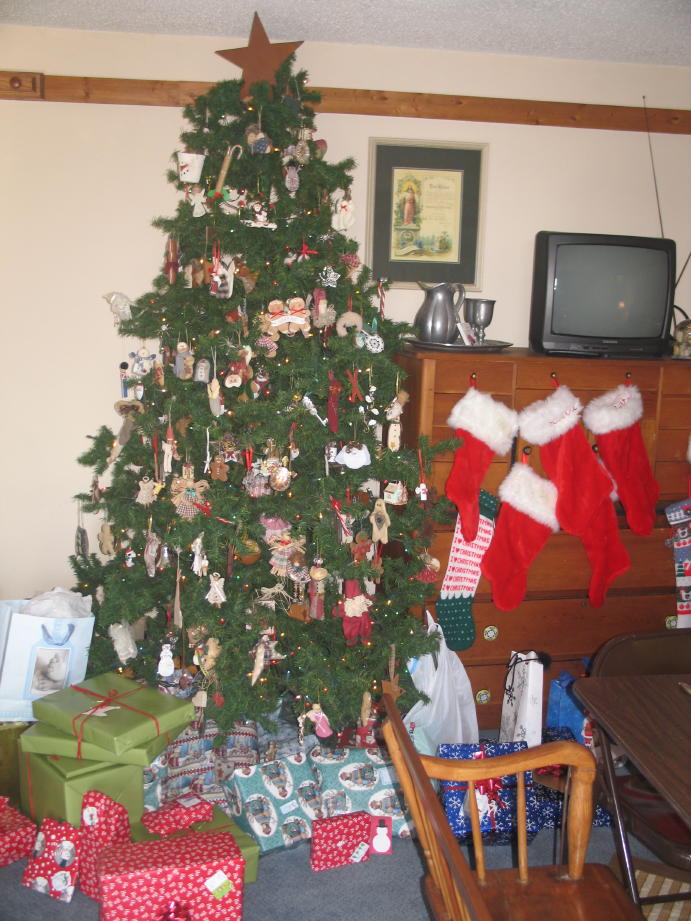
Preparations for Christmas were in full swing but we took time off for a limo ride around Sioux Falls to see all the Christmas lights. Some people go all out. There were some tremendous sights from simply religious to kitschy over the top Santa spectaculars. Mid western Americans really get into the season's celebrations. No catering to any religious minority there. It's a full on Christmas! People wear themed t shirts and electronic ear rings, some radio stations play 24 hour Christmas songs and even the gravestones in the cemetries had lights and/or wreaths on them as did the roadside accident memorials.

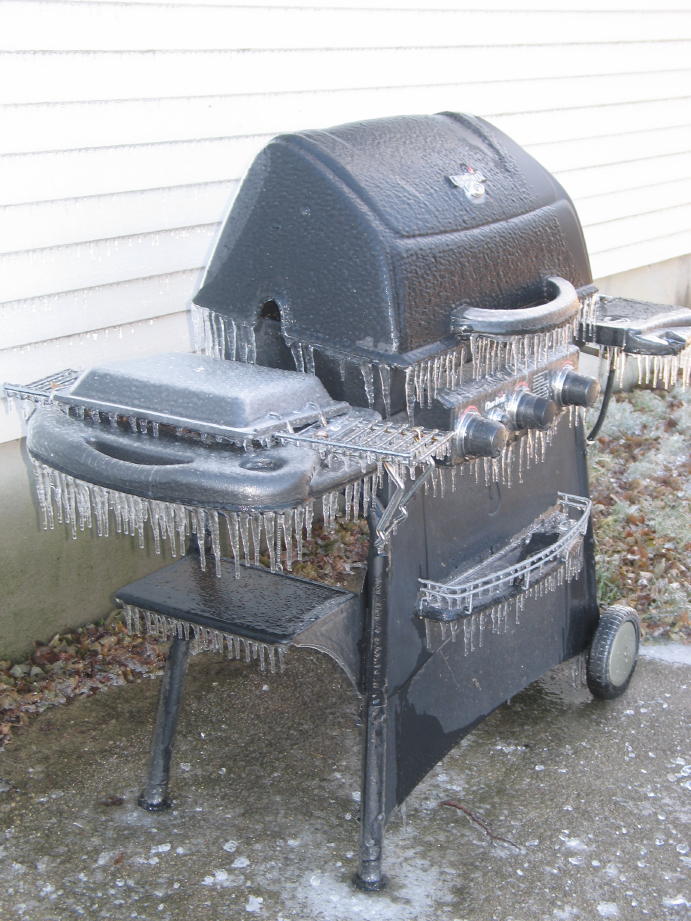
My request for snow was looked upon with some scepticism by the locals. Instead we had a minor ice storm which turned the landscape into a sparkling fairyland and the roads into death traps.
Outdoor activity is severely restricted due to the weather conditions, especially sport. But we managed to keep active with a few games of ten pin bowling. This is better known as "get the foreigner drunk" and turns into a game of 20 pin bowling with a moving head pin as the consumption of MJD seems to increase with every frame.
Christmas day was fun with all the family (20+) turning up for a lunch of roast turkey, honeyed ham, mashed potato, corn casserole and a lot of other goodies.

We all took part in the "greed game". Simply explained this is where everyone brings a few presents of useful and sometimes quirky nature. These are put into the centre of the room and are "won" by tosses of a dice. Once all are distributed and shown off, another round of dice tossing allows these presents to be "stolen" from each another. Needless to say my coverted electric toothbrush was to disappear a number of times (Thank you, Melissa who is now off my friends and family list!). At least I ended up with a decent bag of Caribu coffee and an ice scraper (something you really need in Australia!).
After Christmas, we took advantage of rather mild weather (zero degrees) and headed up to Minneapolis for a few days to see more family and had fun there too. Great food and drink and not the least, great company.
Back in South Dakota, we had a night out at the local casino run by the local Latoka tribe. I won a bit on the slots and saw an old rocker from the 70's, Eddy Money (no, I hadn't heard of him either) make a complete arse of himself on stage. Why don't they know when to quit. He was so p'd he could hardly stand up. But his fan club loved him and one young lady (about 25) got escorted from the auditorium after flashing her boobs at him. Actually that was the best thing that happened at the concert.
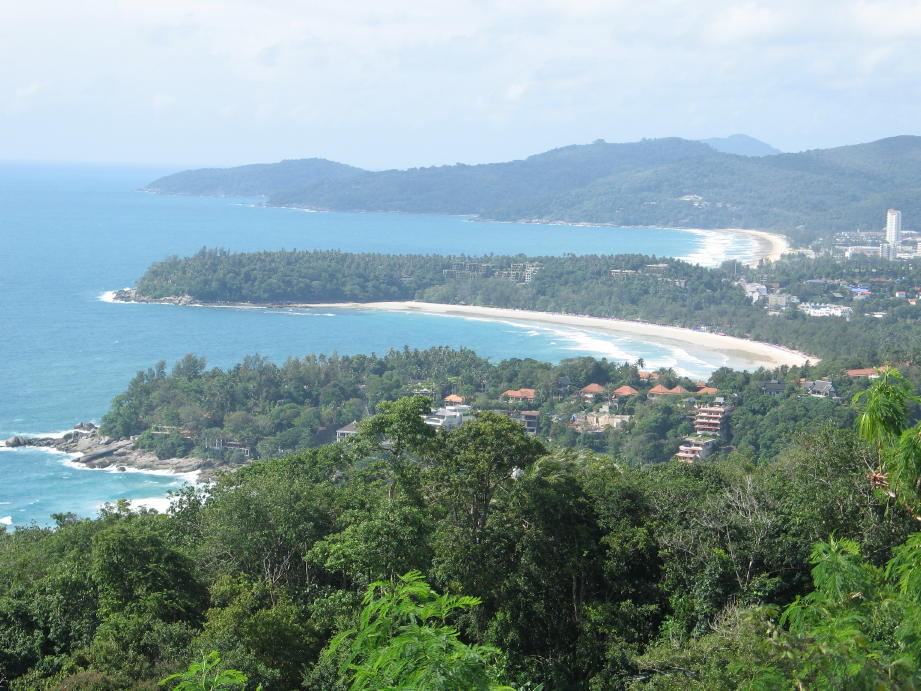
It snowed on New Years Eve. Not a lot but enough to turn the countryside white, clean and beautiful....well, in my eyes anyway. We had a small get together with plenty of wine and snacks and eventually hit the sack around 1:30am.

The week after we wound down catching up with family and friends and hit a few of the post holiday sales. Over the three weeks, apart from good home cooking, we ate a bit of Mex,a few Perkin's brekkies (pancakes to die for), lots of Culver's burgers (and frozen custard - chocolate, of course)and a great steaks at Foleys and the Texas Roadhouse.

Despite these endulgences hardly any weight was put on. You gotta believe me!
All too soon it was time to head back home. This time I did the Sioux Falls-Denver-LAX-Singapore-Sydney route in one hit, forty hours door to door. Never again! Am getting too old for these sorts of marathons.
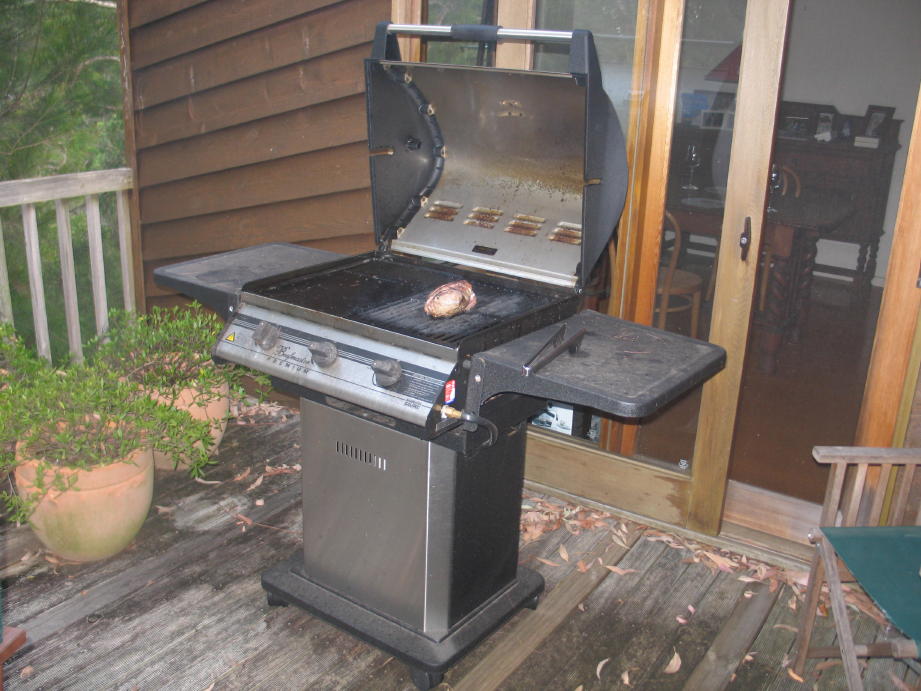
At least it was good to get back to a warm climate and be actually able to open a bar b q that was not frozen or snowed shut, cook a steak, drink a red wine and soak up summer, all alfresco, without freezing essential parts of the body off.

Now it's back into work on the farm. Luckily the weather had been hot and relatively dry while I was away so there is no hint of fungus in the vines. The downside of that is that the younger vines are suffering from a water shortage with premature ripening and leaf drop evident. There is no spare water in the dams to irrigate so they will have to tough it out this year.
Climate change is a fact of life these days. One has to deal with the changed conditions. I ordered three additional 10,000L house tanks. There is a 12 week delivery delay so obviously others are coming to realise that you need to be prepared for what is coming also.

Saturday, December 09, 2006

December 2006

The drought continues in the south east. The newer grapevines are suffering as their roots have not yet made it into the deep subsoil. Leaves are turning yellow and dropping. Nothing much can be done as the water left in the dams is needed for the stock.
Two new calves arrived. One was basically abandoned by her mother so had to hand feed her for a few weeks. I locked the both of them in the yards to bond and forced the little one to suck while her mother was locked in the race. The ploy worked. Eventually the milk came on and the little one was soon strong enough to go back with the herd.
Am off to celebrate Christmas in cold South Dakota, USA in a few days. Will be a long trip as I have cashed in some frequent flyer points and have to go to and from Los Angeles via Singapore. That's 7 hours in the wrong direction.
Compliments of the season to all my readers (if there are any!)

Sunday, November 05, 2006

The Sonoran Desert - A Retrospective

I started preparing this story during my stay in Tucson but time got away and I have only now got around to finishing it.
There are four major deserts in North America; the Chihuahuan Desert (Northern-Central Mexico and southwestern Texas), the Sonoran Desert (southern Arizona and northern Mexico), the Mojave Desert (Southern California, Baja California, and western Arizona), and the Great Basin Desert of Utah and Nevada with isolated pieces extending as far north as southern British Columbia.
The deserts of North America are characterized as either "hot desert" or "cold desert". The Sonoran, Mojave, and Chihuahuan Deserts are classified as "hot deserts", and the Great Basin Desert as "cold desert".
The Sonoran Desert is an arid region covering 120,000 square miles in southwestern Arizona and southeastern California, as well as most of Baja California and the western half of the state of Sonora, Mexico. Subdivisions of this hot, dry region include the Colorado and Yuma deserts.

Sonoran Desert Landscape
This is the hottest of the North American deserts, but a distinctly bimodal rainfall pattern produces a high biological diversity. Winter storms from the Pacific nourish many West Coast annuals such as poppies and lupines, while well-developed summer monsoons host both annuals and woody plants originating from the south. Freezing conditions can be expected for a few nights in winter.
Trees are usually well developed on the desert ranges and their bajadas. Often abundant on these well-drained soils are Little-leaf Palo Verdes, Desert Ironwoods, Catclaw and Saguaro.
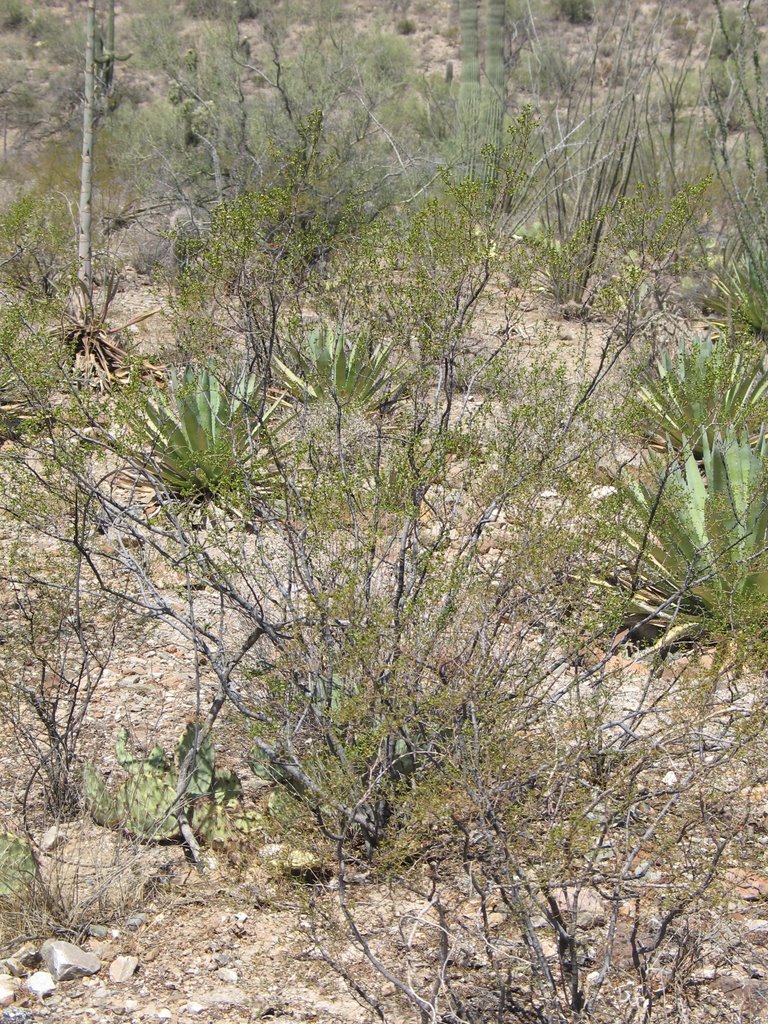
The understory consists of three, four or even five layers of smaller woody shrubs. Tall chollas may occur in an almost bewildering array of species. The alluvial lowlands host communities of Desert Saltbush, wolfberry and bursage. On coarser soils, Creosote Bush and bursage communities may stretch for miles. Where the water table is high, Honey or Velvet Mesquite may form dense bosques or woodlands.
Other species are restricted to alkaline areas. Stream sides may be lined with riparian woodlands composed of Arizona Ash, Arizona Black Walnut, Fremont Cottonwood and various willows, with a dense understory of Arrow-weed, Seepwillow and Carrizo. The Sonora Desert is rich in animal life as well, with many species in all groups derived from tropical and subtropical regions.
The western part of the Sonora Desert (sometimes called the "Colorado Desert") is closer to the source of Pacific storms and is noted for spectacular spring flowering of ephemerals when there is winter-spring rainfall. However, the western portion is relatively depauperate, lacking many of the species such as the Saguaro that depend on good summer rainfall.
Reference: http://www.desertusa.com/du_sonoran.html
The desert vegetation in and around Tucson was varied and particularly interesting to one who had an interest in horticulture and who had never been in a desert environment before.
The following describes the most obvious and prolific plantlife in the area.
Two species of palo verde commonly occur in the Southwest: the foothill, yellow or littleleaf palo verde and the blue palo verde. Palo verde, Spanish for green wood or stick, describes the plant’s greenish branches and trunk.
Both species are spiny, green, multi-trunked, deciduous trees. Foothill palo verdes only reach about 7m in height and have more yellowish bark and duller yellow/white flowers. Blue palo verdes top out at 12m. Their twigs and young branches are bluish-green, as are the leaves, which are larger than the foothill variety. Pods contain from one to eight seeds, with one being far more common than eight. The foothill species pods have narrow waists between the seeds, which are lentil sized. Blue palo verde seeds are slightly larger and flatter, with thicker, harder shells.
The blue palo verde species grows primarily in washes. It requires more water than the foothill species, which grows more commonly in the uplands. The blue species occurs principally in fine soils, and the foothills species, in coarser soils. Foothill palo verdes often live for over 100 years and may reach 400 years. In contrast, blue palo verdes grow faster and die sooner, rarely reaching the century mark.

Palo Verde
During their short flowering seasons, both species are clothed with thousands of five-petaled yellow blossoms. They attract numerous pollinators, including beetles, flies and social and solitary bees.
The trees can photosynthesize through their green bark, an important adaptation for a tree that drops its leaves during the warm season and in response to fall cooling. Palo verdes also drop stems and branches to combat drought.
Palo verdes serve as nurse plants for saguaro cacti by providing a canopy – in effect, a microhabitat – which offers warmth in winter and shade in summer. The slower-growing, longer-lived cactus will eventually replace its one-time protector.
Reference: http://www.desertusa.com/mag01/aug/papr/palov.html
The Ocotillo is a bajada resident that can be relied on to bloom annually, even without leafing in particularly dry springs. It is an inverted, funnel-shaped desert plant with several woody, spiny, whip-like, straight branches angling outward from the base and rising as high as 7m.
Red flowers are 12mm to 25mm in length, with five short lobes curled back into 25cm clusters. They appear at the ends of branches March through June or later, depending on rainfall.

Ocotillo
Ocotillo are leafless most of the year, except immediately after rain; the leaves then quickly wither after the soil dries out. These narrow, oval leaves are about 2 inches long, appearing in bunches above spines.
Mature plants have as many as 75 slender branches (canes). Planted in rows, Ocotillo become living fences.
Reference: http://www.desertusa.com/nov96/du_ocotillo.html
The Creosote Bush is the most characteristic feature of North America's hot deserts. It is one of the best examples of a plant that tolerates arid conditions simply by its toughness. It competes aggressively with other plants for water, and usually wins, accounting for its prevalence in many arid locations of the southwest.
This medium-to-large evergreen shrub has numerous flexible stems projecting at an angle from its base. It is usually less than 1.5m high, but can grow to 4m heights with abundant water.

Creosote Bush
Its small, pointed, yellow-green leaves have adapted to conserve water and dissipate heat. The bush may lose some of these waxy, resinous leaves during extreme drought, but never loses them all. These leaves are especially pungent after a rain, and have been used as antiseptics and emetics by native peoples. Its foliage provides refuge for crickets, grasshoppers and praying mantids.
Flowers are 25mm wide twisted, yellow petals bloom from February-August. Some individuals maintain flowers year round. After the Creosote blooms the flower turns into a small white fuzzy fruit capsule that has 5 seeds.
Reference: http://www.desertusa.com/creoste.html
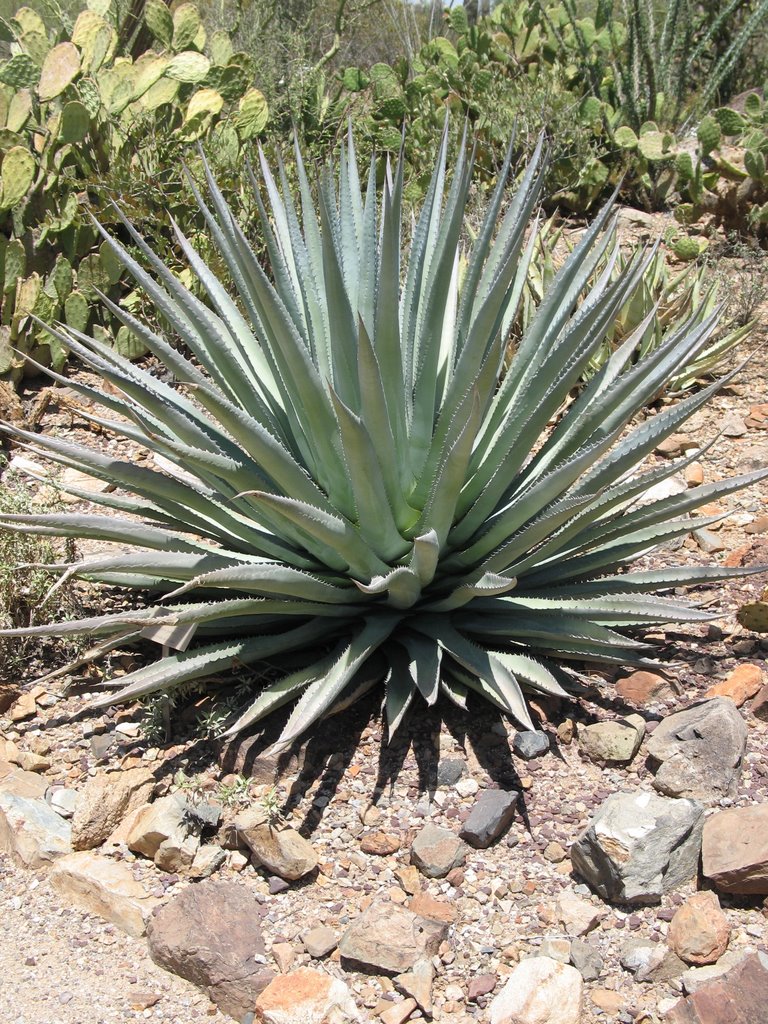
Over 300 species of Agave have been described, but only about 200 are currently recognised. They are succulents but not cacti. Most species are monocarpic, although a few can flower several times during their life. This differentiates them from the Yucca which although very similar in appearence, flowers annually. The flowers are "perfect" with both male and female parts. Many species of Agave are bat pollinated and produce musky perfumes as attractants. Others produce sweeter odours to attract insects.
Most Agaves consist of rosettes of thick, hard, rigid leaves often with marginal teeth and usually with a lethally sharp terminal spine. Prolific vegetative growth and offsetting at the base of the plant or through stolons, usually maintains a clump of plants thus compensating for loss of flowering rosettes. A few species remain solitary, relying on seed production for survival of the species.

Agave
Carbohydrates stored in the core of several species of Agave were fermented by native Americans to make a beverage called pulque which was used in religious ceremonies. Distillation of a similar ferment made from the developing Agave flower bud is the basis for modern production of Mescal. Only if made from the Blue Agave within the Tequila region of Mexico can the distillate be called Tequilla.
Reference: http://www.succulent-plant.com/agave.html
All but one species of cacti are native to the New World and their habitat extends from Canada to Argentina. All cacti are succulents but not all succulents are cacti.
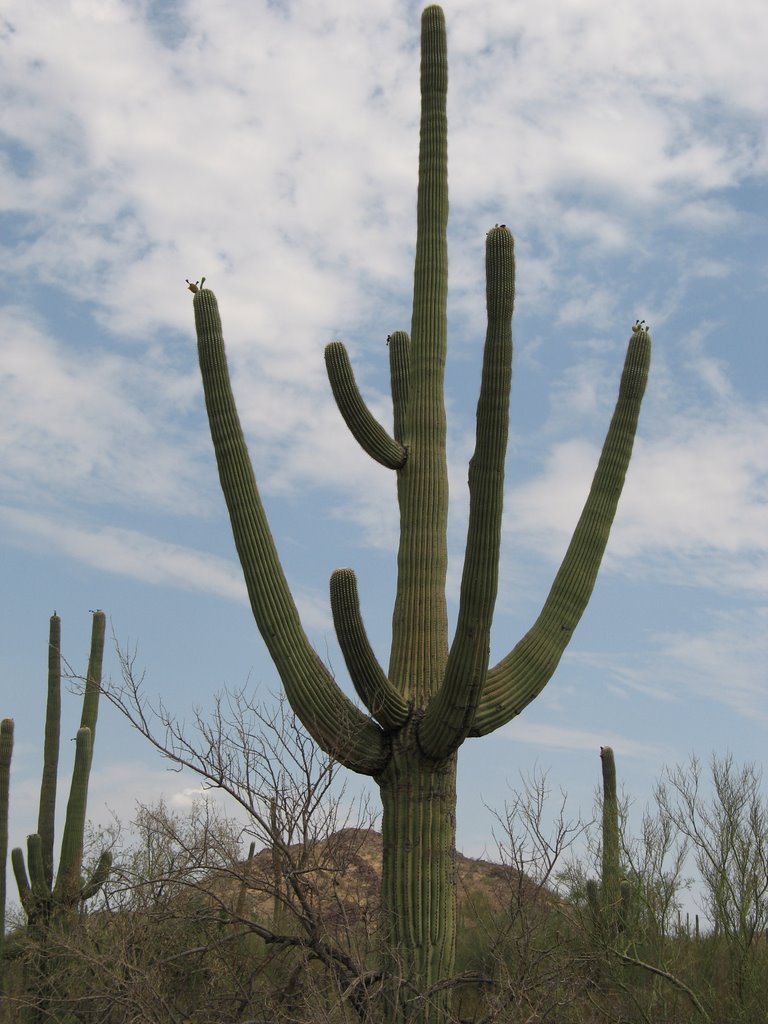
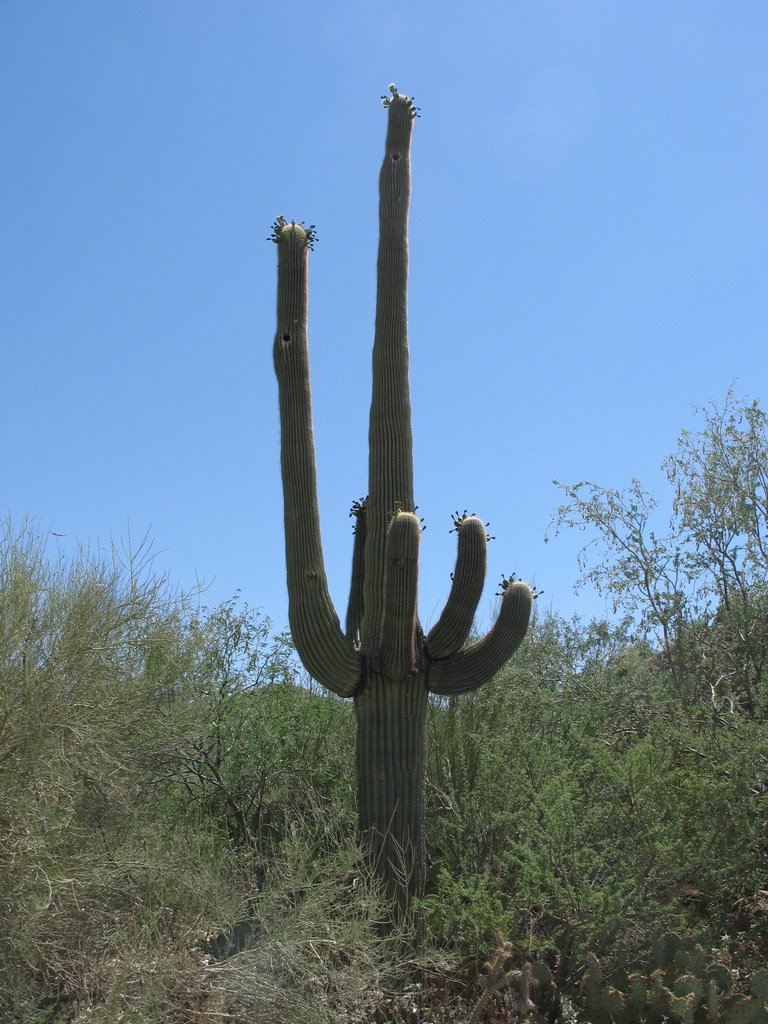
The magnificent Saguaro Cactus, the state flower of Arizona, is composed of a tall, thick, fluted, columnar stem, 45 to 60 cm in diameter, often with several large branches (arms) curving upward in the most distinctive conformation of all Southwestern cacti.

Sagauro Cactus
The skin is smooth and waxy, the trunk and stems have stout, 2-inch spines clustered on their ribs. When water is absorbed , the outer pulp of the Saguaro can expand like an accordion, increasing the diameter of the stem and, in this way, can increase its weight by up to a ton.
The Saguaro grows very slowly, perhaps an inch a year, but to a great height, 5 to 15m. The largest plants, with more than 5 arms, are estimated to be 200 years old. An average old Saguaro would have 5 arms and be about 6m tall.
The Saguaro has a surprisingly shallow root system , considering its great height and weight. It is supported by a tap root that is only a pad about 1m long, as well as numerous stout roots no deeper than 30cm, emanating radially from its base. More smaller roots run radially to a distance equal to the height of the Saguaro. These roots wrap about rocks providing adequate anchorage from winds across the rocky bajadas.
The slow growth and great capacity of the Saguaro to store water allow it to flower every year, regardless of rainfall. The night-blooming flowers have many creamy-white petals around a tube about 10cm long. Like most cactus, the buds appear on the southeastern exposure of stem tips, and flowers may completely encircle stems in a good year.

Sagauro Cactus in Flower
A dense group of yellow stamens forms a circle at the top of the tube; the Saguaro has more stamens per flower than any other desert cactus. A sweet nectar accumulates in the bottom of this tube. The Saguaro can only be fertilized by cross-pollination -- pollen from a different cactus. The sweet nectar, together with the color of the flower, attracts birds, bats and insects, which in acquiring the nectar, pollinate the Saguaro flower.
The oval, green fruit ripens just before the fall rainy season, splitting open to reveal the bright-red, pulpy flesh which all desert creatures seem to relish. This fruit was an especially important food source to Native Americans of the region who used the flesh, seeds and juice. Seeds from the Saguaro fruit are prolific -- as many as 4,000 to a single fruit -- probably the largest number per flower of any desert cactus.
Reference: http://www.desertusa.com/july96/du_saguaro.html
Cholla cactus represent more than 20 species of the Opuntia genus (Family Cactacea) in the North American deserts. Cholla is a term applied to various shrubby cacti of this genus with cylindrical stems composed of segmented joints. These stems are actually modified branches that serve several functions; water storage, photosynthesis and flower production.
Like most cactus, chollas have tubercles, small wart-like projections on the stems from which sharp spines, actually modified leaves, grow. But chollas are the only cactus with papery sheaths covering their spines. These sheaths are often bright and colorful, providing the cactus with its distinctive appearance.
Opuntia are unique because of their clusters of fine, tiny, barbed spines called glochids. Found just above the cluster of regular spines, glochids are yellow or red in color and detach easily from the pads or stems. Glochids are often difficult to see and more difficult to remove, once lodged in the skin.

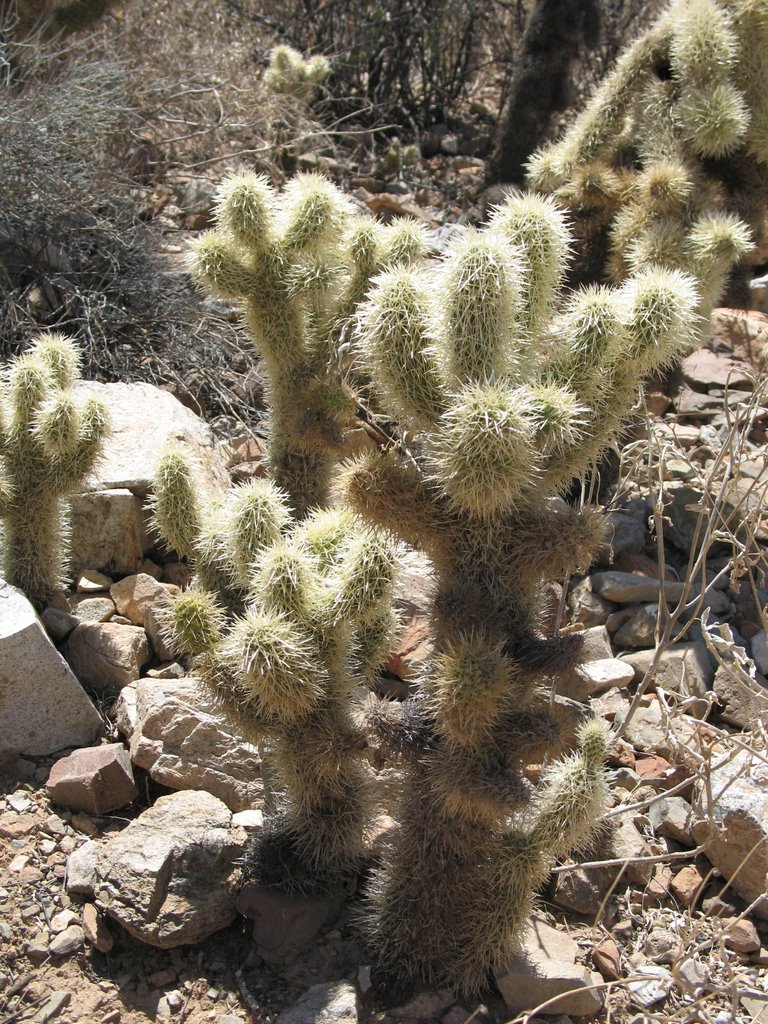
Teddy Bear Cholla
Most cholla cactus have orange or greenish-yellow flowers with a variety of colors, even among the same species. Most species bloom April through June, depending on local conditions. Stems and joints vary in width, length, shape, and color, as well as in the profusion of spines and glochids. Chollas may appear as ground creepers, shrubs or trees, varying in height from less than a foot (Club or Devil Cholla) to as much as 5m (Chain-Fruit Cholla).
Teddy Bear or Jumping Cholla is said to resemble the fuzzy arms and legs of a Teddy Bear, it can be distinguished by its dense, straw-colored spines and yellow to green flowers.
Reference: http://www.desertusa.com/mag99/may/papr/chollas.html
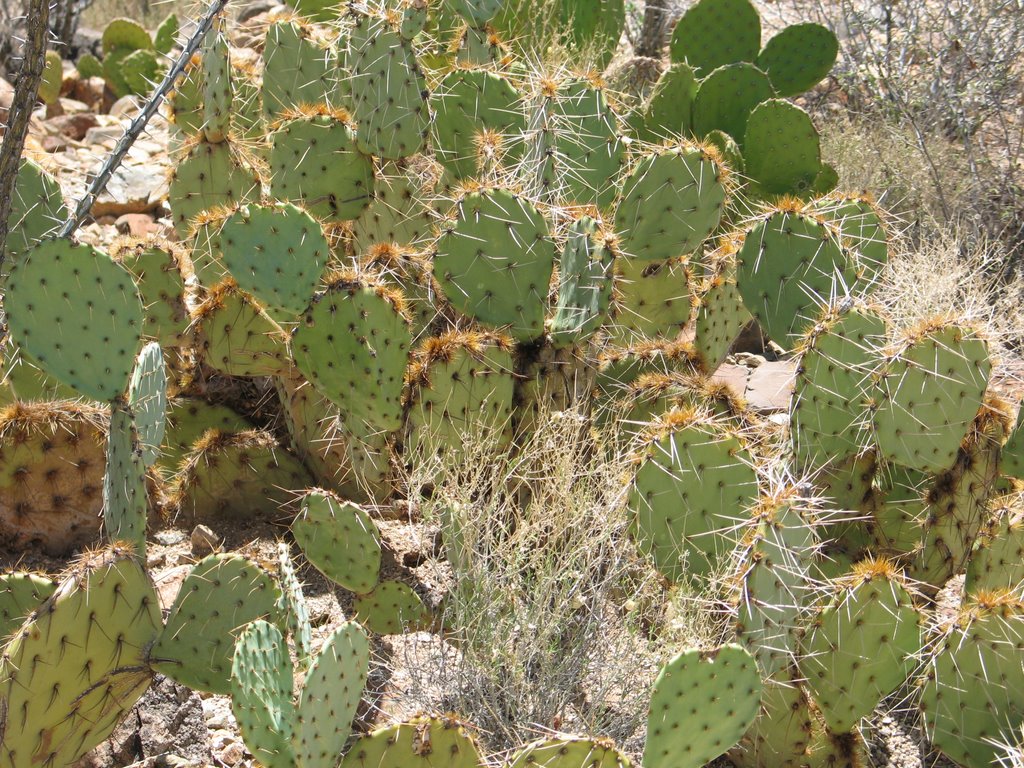
Prickly pear cactus represent about a dozen species of the Opuntia genus (Family Cactaceae) in the North American deserts. All have flat, fleshy pads that look like large leaves. Like other cactus, most prickly pears have large spines, modified leaves, growing from tubercles which are small, wart-like projections on their stems. Members of the Opuntia genus are unique because of their clusters of fine, tiny, barbed spines called glochids. Found just above the cluster of regular spines, glochids are yellow or red in color and detach easily from the pads. Glochids are often difficult to see and more difficult to remove, once lodged in the skin.

Prickly Pear
The fruits of most prickly pears are edible and sold in stores under the name "tuna." Prickly pear branches (the pads) are also cooked and eaten as a vegetable. They, too, are sold in stores under the name "Nopalito."
Reference: http://www.desertusa.com/magoct97/oct_pa/du_prkpear.html
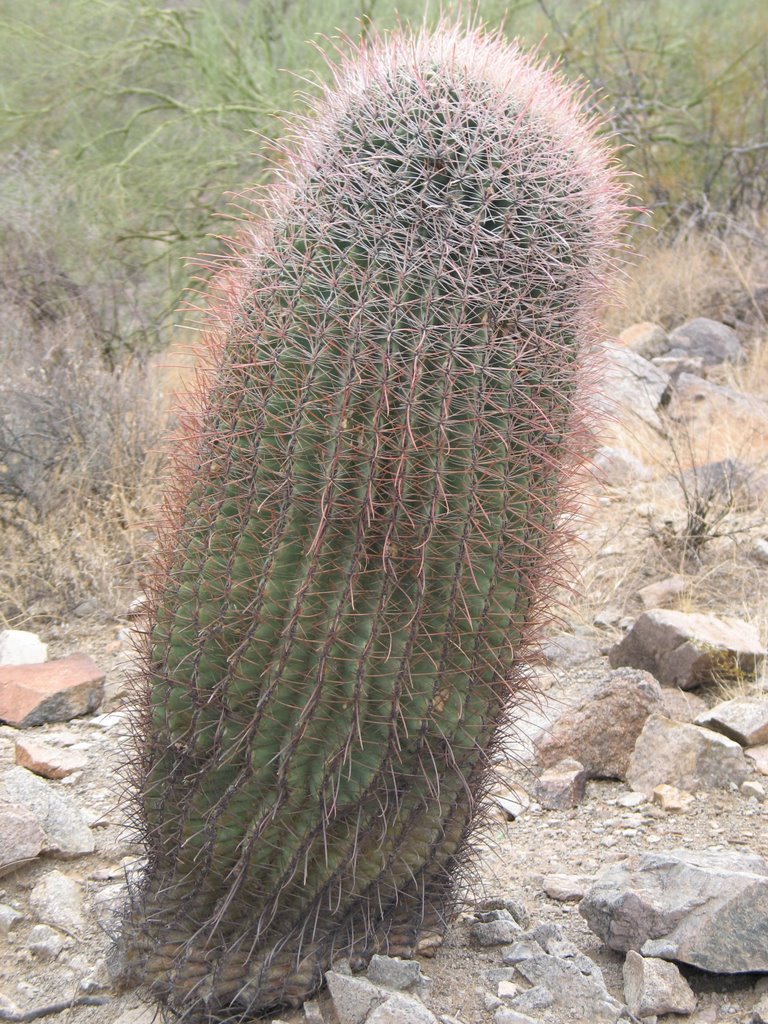
Ferocactus, meaning "fierce or wild cactus,"are always cylindrical or barrel shaped and are usually among the largest cacti of the North American deserts. All members of this genus have prominent ribs and are fiercely armed with heavy spines. In some species, one or more central spines are curved like a fishhook, accounting for the common name Fishhook Barrel Cactus.
Barrel Cactus flowers always grow at the top of the plant. They bear no spines and only a few scales. Fruits become fleshy and often juicy when mature, but are not usually considered edible.

Fish Hook Barrel Cactus
Native Americans boiled young flowers in water to eat like cabbage and mashed older boiled flowers for a drink. They also used the cactus as a cooking pot by cutting off the top, scooping out the pulp and inserting hot stones together with food. The spines were used as needles, awls and in tattooing.
The pulp of barrel cactus has been widely used for making cactus candy (thus one of its common names, Candy Barrel Cactus), but this has also accounted for its destruction and, therefore, protected status in many areas.
Reference: http://www.desertusa.com/mag99/june/papr/barrelcactus.html
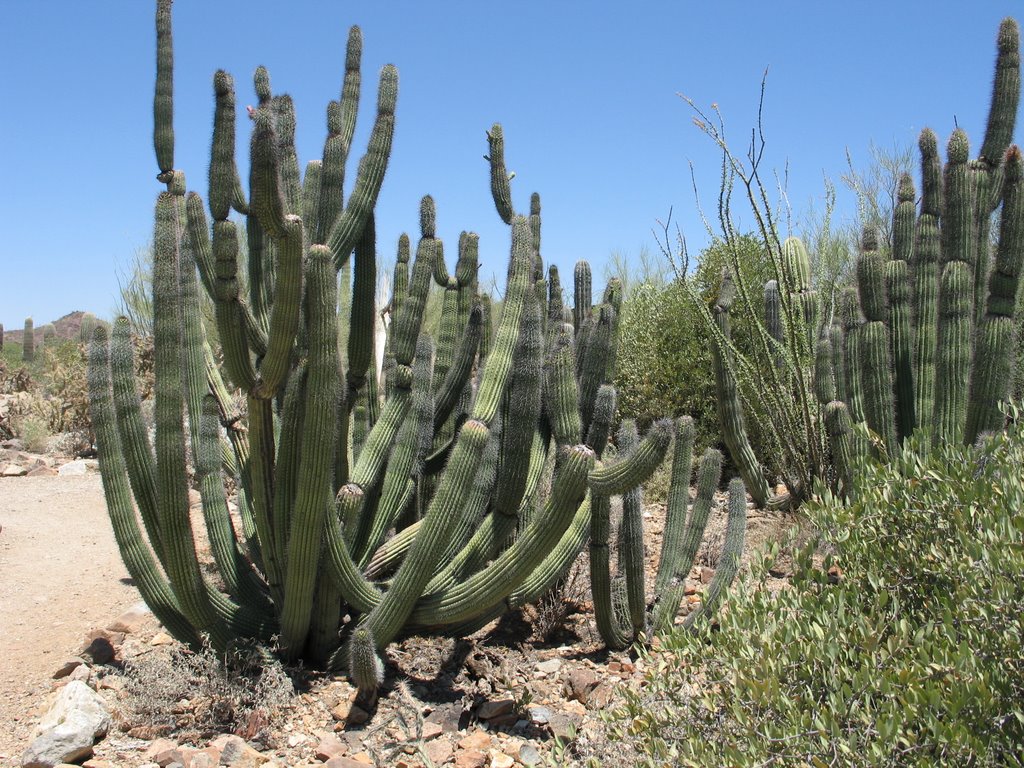
Organpipe cactus is a columnar cactus which is the second largest in the U.S.A (next to the Saguaro) growing as tall as 8m. Instead of having a central stem, however, a cluster of 5 to 20 slender branches grow from a point at ground level and curve gracefully upward.
These water-storing trunks are about 15cm in diameter and have 12 to 17 deep-green, rounded ribs. The areoles are set close together with 9 or 10 brown radial spines that turn gray with age.
Organpipe Cactus
Fruits lose their spines at maturity, opening to display an edible red pulp. This fruit has provided a food source to Native Americans for centuries. The pulp can be eaten as is, made into jelly or fermented into a beverage.
Reference: http://www.desertusa.com/aug96/du_organpipe.html

Monday, October 16, 2006

Phuket and Singapore

A few days before we were due to leave for Thailand, news came through that tanks had rolled out onto the streets of Bangkok and the army had overthrown the democratically elected but alleged corrupt government while its prime minister was at the the World UN conference in New York. Coups are not unknown in Thailand so after we had found out that the King had virtually sanctioned the action, we knew it was safe to go. As it turned out you would not have known the country was in a little bit of turmoil politically. People were happy and smiling as ever and it was business as usual. There were however a huge number of yellow (the King's color) flags flying which I took as a sign of support for the changed regime albeit a temporary military dictatorship.
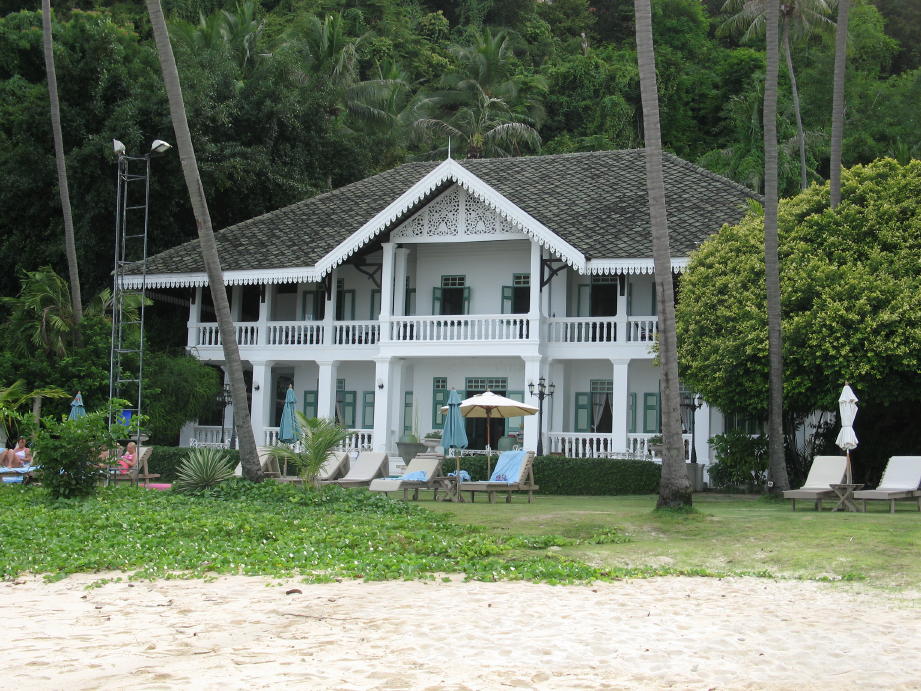
It was a very early morning start for the 7 hour flight to Singapore's wonderful Changi Airport (a holiday destination on its own) where we transferred for another 2 hours to Phuket. There we were picked up in our mini bus and taken to the Cape Panwa Hotel.

I first came across this hotel as a setting for a TV cooking show. I was so impressed I went to my travel guru, tripadvisor.com, read the reviews and made a booking to celebrate my 60th birthday.
We were not disappointed and spent eight great days with almost perfect weather despite being the monsoon season. We were accommodated in rooms overlooking the harbour. These were large and well appointed with aircon that worked well and beds that were comfortable. Staff at all levels were friendly, helpful and went out of their way to make our holiday enjoyable.
Sure the hotel is a bit out of the way. But this is a blessing in disguise. It makes for a peaceful holiday especially for families, romantics and old farts like us (some company excluded).
We ate in all the restaurants. Breakfast was little bit of a hit and miss affair as is the case with any buffet. Thai dinners or lunches at the Cafe Andaman was always good. A special Thai dinner at Panwa House was also excellent.

We celebrated the birthday at the Top of the Reef after drinks in Otto's Bar and the staff went out of their way to make the party a success, even providing a surprise bithday cake with candles and hearty staff rendition of the song! The food here is expensive by Thai standards but 50% of what you would pay in Australia at a similar venue. Wine is very expensive in Thailand so we stuck to Singha beer at most venues but as this was a special occasion we enjoyed a good Italian red and French white selected from a broad wine list.
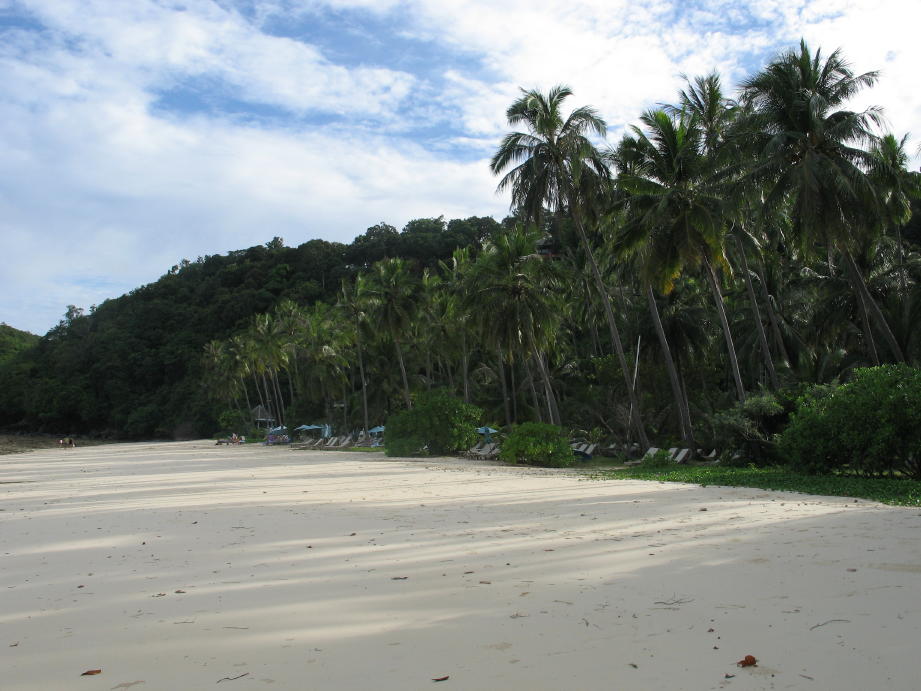
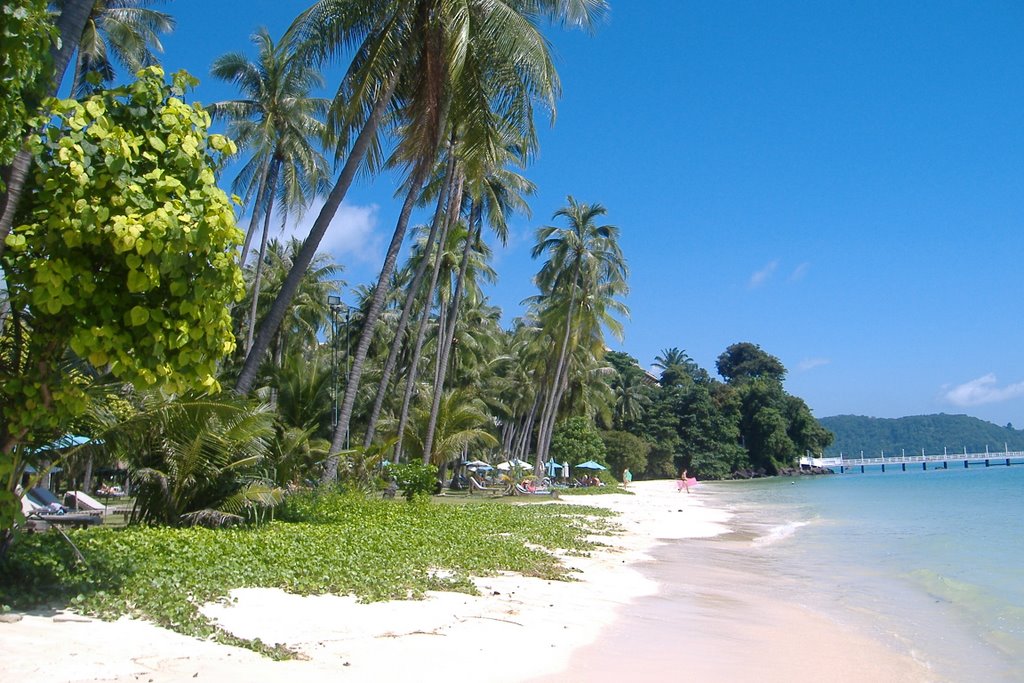
The beach was a focal point for us. Tide charts in the rooms provide the best time for swimming and for us this always appeared to be between 8am. and 2pm. Water was not all that clear (by Pacific Island standards) but warm and clean. Sitting on our lounge chairs under the palms and strategically placed umbrellas with beer in hand (thank you, Manop), was a perfect way to spend most of the day. The tide goes out in the afternoon to reveal a coral reef that is good to explore via a concrete pathway although it's not by any means the Great Barrier Reef.

Both swimming pools were kept immaculately clean and with virtually undetectable chlorine levels. Our favourite was the one at the beach, deserted on most occassions.
You have to be a little bit fit to stay at the Panwa. Lots of steps no matter where you go. But it helps work off the food.
We ate a few times at the Sawasdee, a small family restaurant in Panwa Village, just over the hill and reached by hotel shuttle bus. Here was very cheap food of good quality served by a lovely staff. As a person who could eat Thai food every meal I was in foodie heaven! There are prawn cakes, fish cakes and spring rolls among other things as starters, spicy soups and salads, stir fries of chicken, seafood and meat flavored with different herbs and spices, fried rices, noodles, red, green and yellow curries and woked fried seafood just to mention a few dishes. Some come with quite a chilli kick so you have to be a little bit careful. The usual bowl of steamed rice can save your head from being blown off.

Although it was tempting to just chill out at the hotel we did a little bit of touring. Our initial trip was a "orientation tour" of the south part of the island. I have been visiting Thailand since the late 1960's initially on business and for the last 15 years as a tourist. I have grown to respect the Thai people, their culture, gentle humour and way of life. So it was with a little trepidation that I returned to Phuket after a 20 year absence. I have to say that the tourist boom may have done wonders for the island economically but nothing much for the image of Thailand. Off the beaten track, you can still find the essence of the country but on the well trodden tourist routes there is little to attract. Patong the main tourist centre is an ugly town where the beach is a dirty strip of sand covered in thousands of beach chairs where people lie cheek by jowl and listen to jet skis whine their way around the bay. Why anyone would want to spend any time here is beyond me.

The surrounding coastal area from Kata, Karon and north has been developed to an inch of its life. There was no evidence of tsumani damage and it was here that the worst destruction occurred. It just seemed a pity to me that they hadn't taken advantage of the situation and rebuilt the area in a more environmentally friendly way.

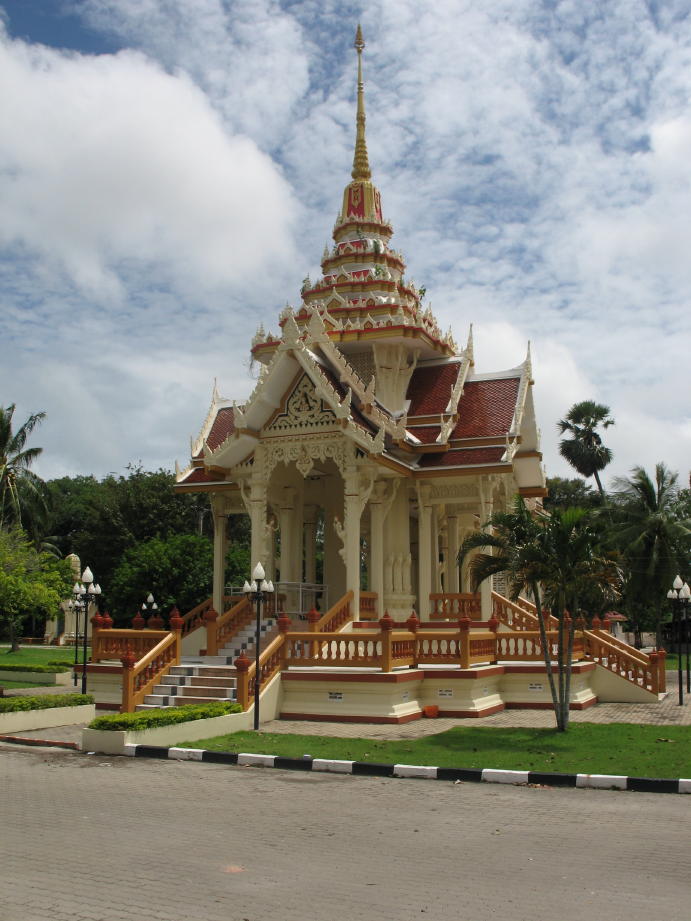
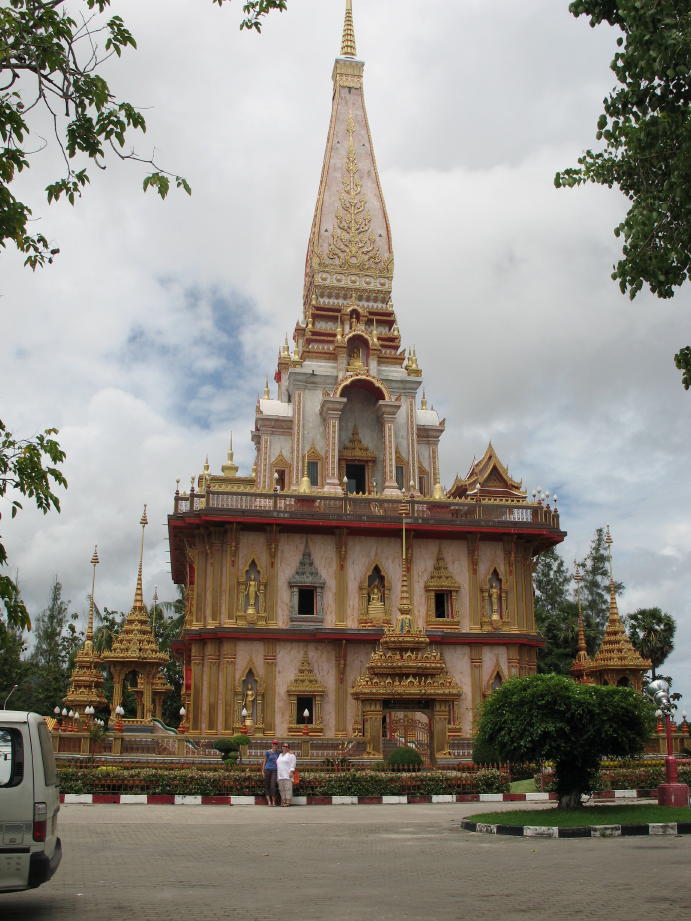
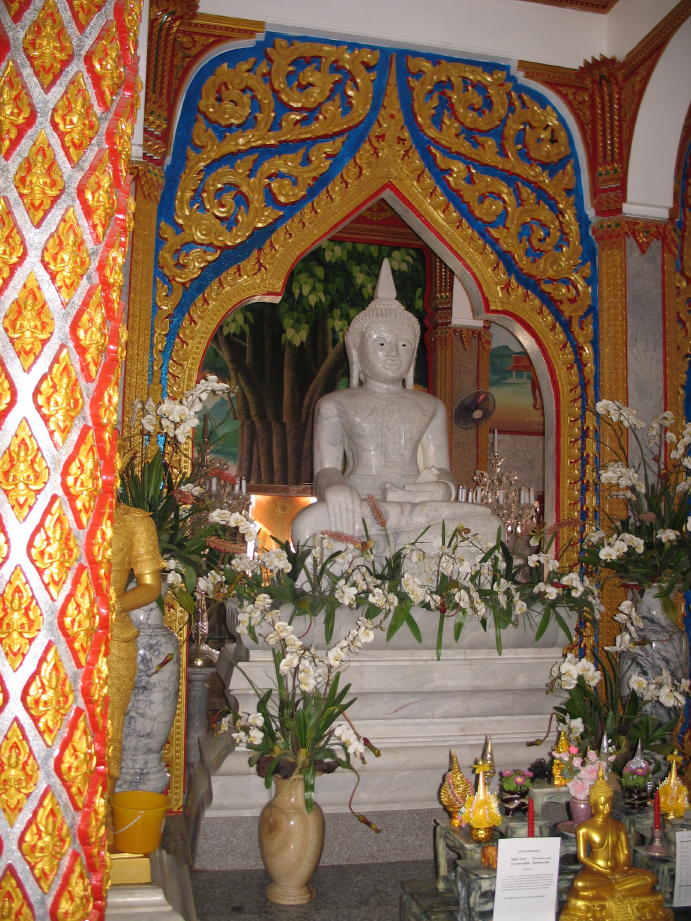
Thailand is predominantly a Buddhist country and a visit to a temple or wat is mandatory. They are always colorfully and extravagantly decorated and accessible by all faiths as long as you are suitably dressed. Wat Chalong was no exception.
This is Phuket’s most important Buddhist temple and is the biggest and most ornate of Phuket’s 29 Buddhist monasteries. The architecture is typical of wats found throughout Thailand.
Wat Chalong is associated with the revered monks, Luang Pho Chaem and Luang Pho Chuang, both of whom were famous for their work in herbal medicine and tending to the injured. During the tin miners’ rebellion of 1876 they mobilized aid for the injured on both sides. They also mediated in the rebellion, bringing the warring parties together to resolve their dispute. Statues honoring them stand in the sermon hall.

Many Thais come here to be blessed by the monks and receive a good luck charm in the form of a string tied around the wrist, which they believe protects them from injury and illness.
Local Thais and Asian tourists set off fire crackers and ask for the lucky lottery numbers, and have their fortune told. The fire crackers were a little disconcerting at first. Set off in what looked like a huge brick kiln it sounded like gun fire. A sad commentary on the state of the world.

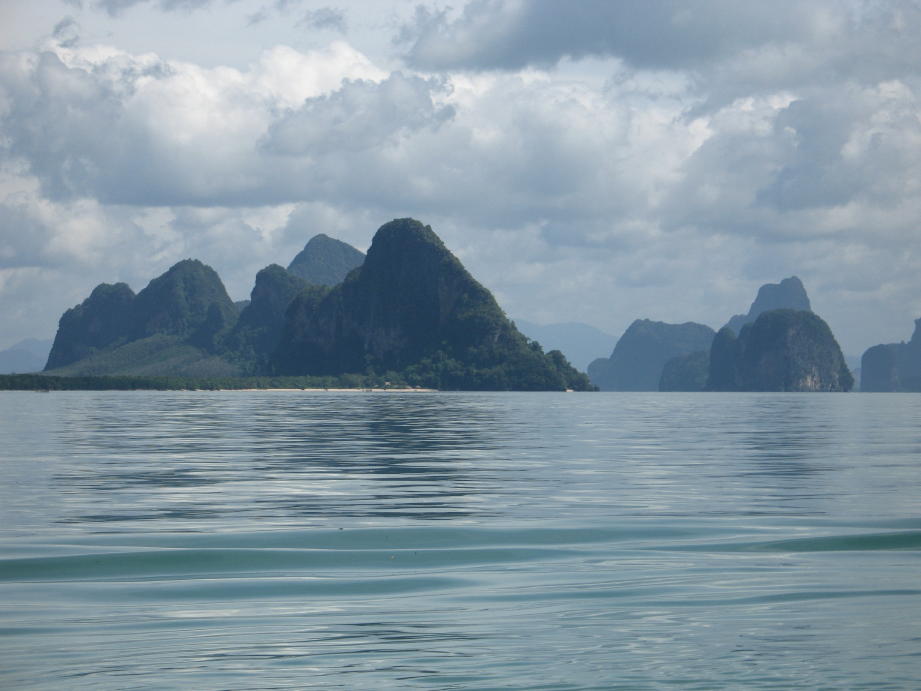
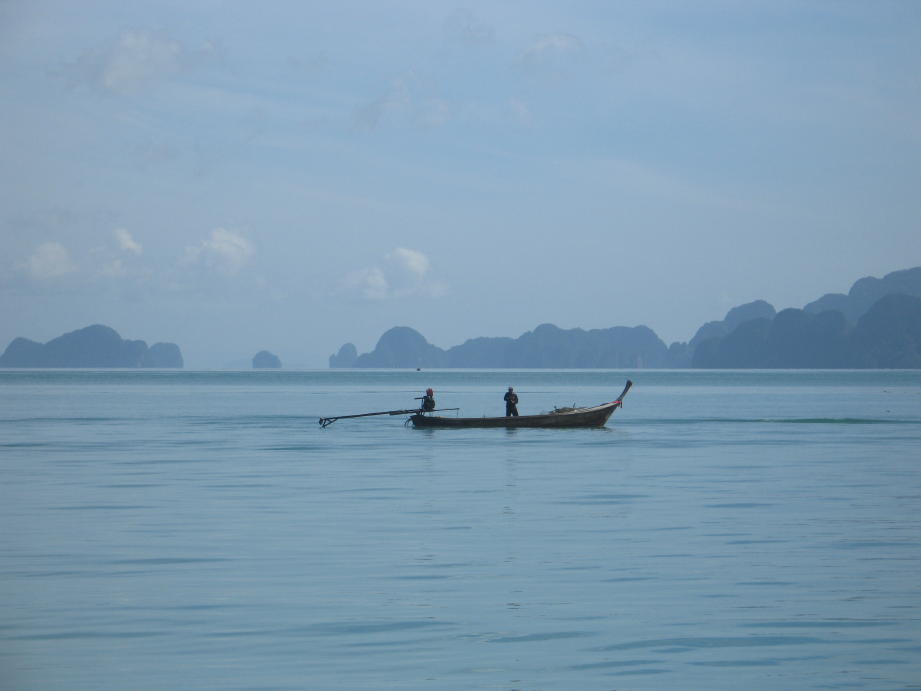
We took the June Bahtra junk day cruise to Phang Nga Bay which is wonderful.The boat was not really a junk but a converted trawler that has been rigged with junk sails and was extremely comfortable.

There were only a few of us on board so we had plenty of room to stretch out as we headed north through glassy calm waters towards the famous limestone islands of the bay. We motored for part of the way and then the sails were raised and we heeled over and the wind took us.

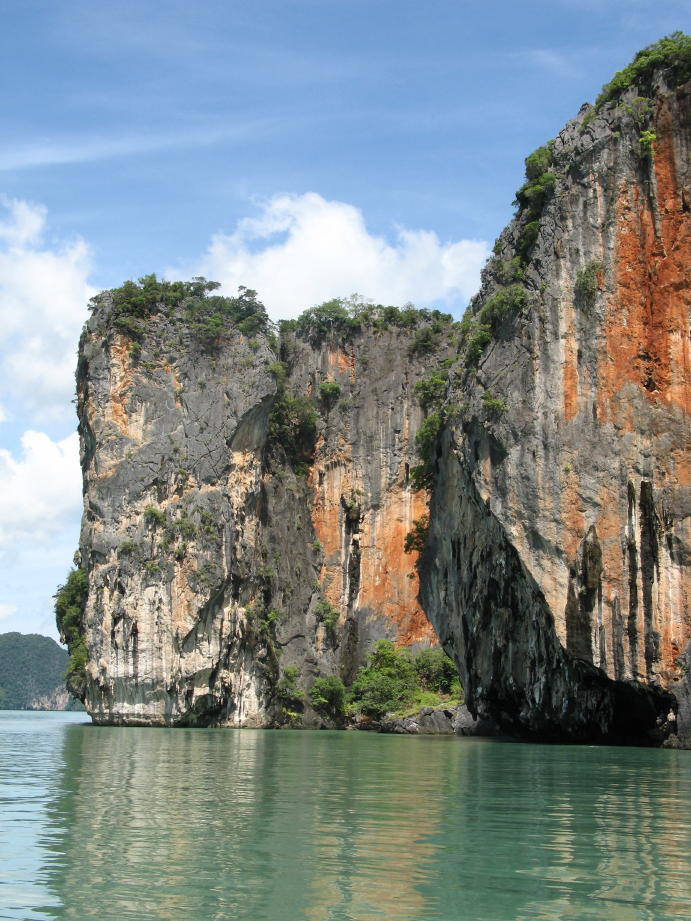
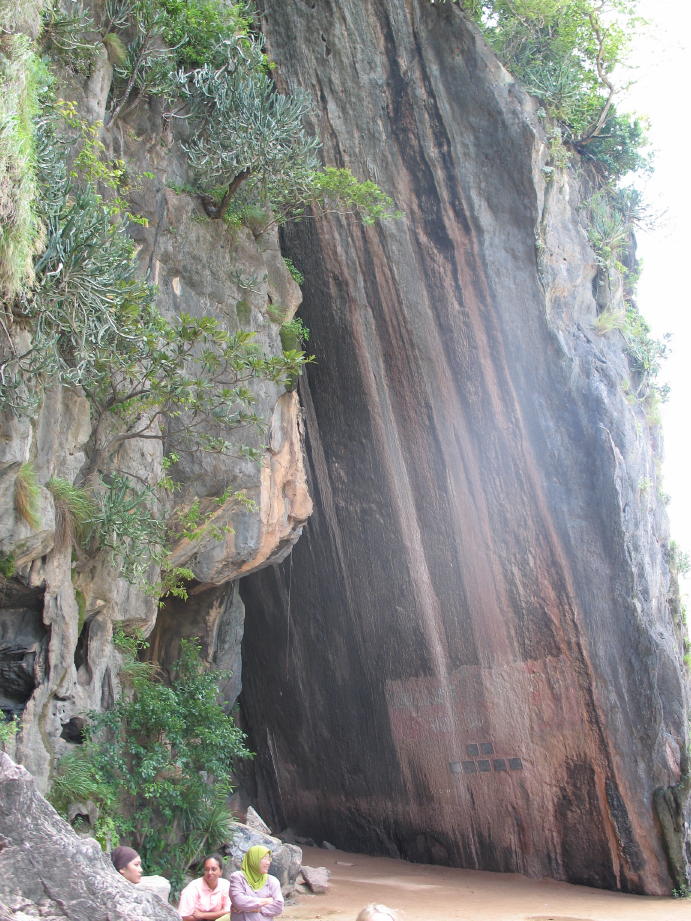
The sheer limestone cliffs jut vertically out of the emerald green water. Over millions of years, the skeletons from a constant rain of marine organisms, plus the chemical precipitation of yet more calcium carbonate build thick layers of sediment.

Eventually, the heat and pressure of their own weight turn these strata, hundreds of metres thick, to stone.

A variety of geological forces have then fractured the limestone beds and pushed up the 40 steep-sided islands that provide the exotic scenery for which this shallow bay is noted. Mineral oxides from various sources paint the vari-coloured streaks that characterise the cliffs.

It wasn't many years ago that aerial surveys first revealed the Hong, or "rooms", that lie inside some of Phang Nga's islands. These hidden realms, rich in unspoiled flora and fauna, are collapsed cave systems open to the sky and surrounded by towering limestone walls. They can be accessed by sea-canoeing, where you paddle sturdy inflatable boats through caves (when the tide is right) into the mysterious hearts of islands such as Koh Panak and Koh Hong.

The long tail boat is a typical mode of water transport in south east Asia. It has a distinct narrow and beautifully crafted wooden hull and is powered by the famous longtail engine - basically a car or truck engine with a propeller shaft attached. The longtails can really move when the boatman opens up the throttle. Because a few places of interest were in parts of the bay too shallow for our boat we transferred (with life jackets on) to one of these and sitting on narrow wooden benches sped across the water with wind and spray in our hair. Nothing like the roar of a unmuffled 5L V8 pushing you along to stir the soul, petrolhead or not.
We made a small detour through a huge limestone grotto that is only accessible at certain times of the tide as well as to part of the mangrove forest that surrounds the northern part of the shoreline.
First stop was Koh Pannyi or Sea Gypsy Island. This is an interesting village, the whole of it, including a Mosque, built out over water on stilts and with a giant rock monolith guarding its rear. The inhabitants are of Indonesian origin but have been Thai citizens for generations and are of Muslim faith. They are not really sea gypsies but it makes good tourist propaganda. We were there during Ramadan so the place was very quiet but not so quiet as to prevent them trying to sell us the cheap and nasty souveniers that this type of place is known for. The smell of drying fish and "other stuff" pervades the atmosphere and can be a little off putting to novice south east Asian visitor.
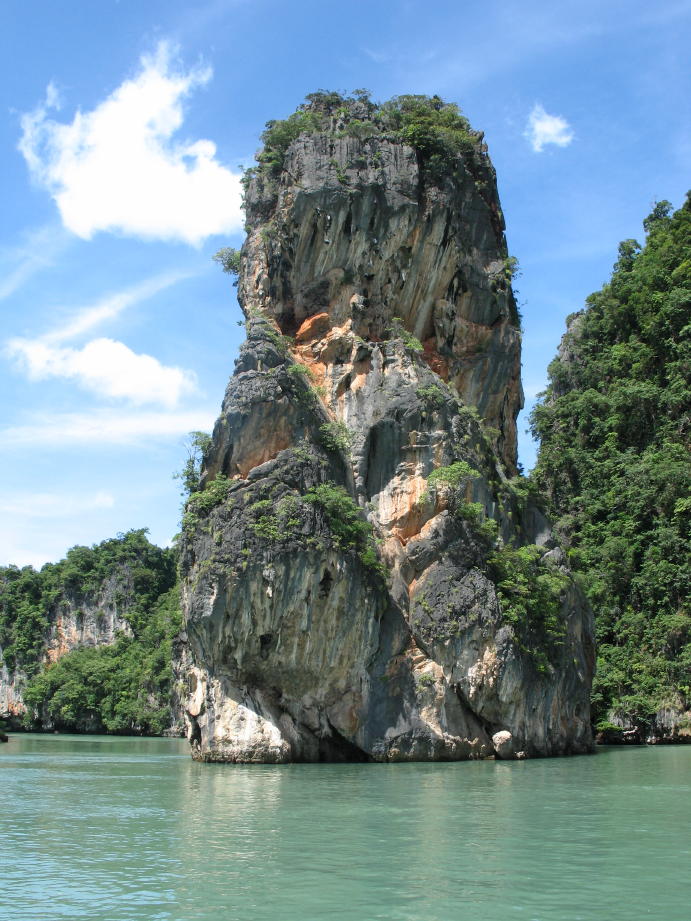
James Bond Island was next stop. This famous landmark, called Koh Ping-gan, first found its way onto the international map through its starring role in the James Bond movie "The Man With the Golden Gun". And this is where they seem to take all of the tourists - all at one time. The entire area surrounding this island with its signature rocky pinnacle is indeed spectacular, but sadly it's covered in souvenier huts and overrun by long tail boat passengers who disembark in great numbers at what seems one minute intervals. A complete waste of time!

We were however soon back on board our junk, eating a freshly prepared lunch of fish, chicken and rice followed by fresh pineapple, papaya and bananas and heading south for a short stop in a bay where some of us ie. the brave ones, jumped off the boat for a refreshing swim in the warm water. I was more concerned with the strong current than the possibility of sharks!
We had heard that the night markets in Old Phuket Town were worth visiting so off we went one evening to explore. It turned out to be a food market with some of the most unusual things for sale. Some food items were totally unrecognizable. We were about the only westerners there and soon realised there was nothing much for us to buy. But it was an interesting insight at what the local people purchase for their weekly meals.

Our taxi driver had disappeared for the allocated two hours so we set off along the dark narrow streets looking for somewhere to eat and came across a small group of restaurants in the centre of the old town. Anna's was airconditioned and quite modern and served some of the best Thai food we had on the trip. Three courses plus beer and soft drinks and coffee for $A16 a head including tip!
All too soon we were back at the aiport for our short trip to Singapore made even shorter by an unexpected upgrade. Thank you Silk Air!

Back on Cape Panwa beach our empty chairs await our return.
Singapore is basically a huge shopping mall and restaurant. This island country is very crowded with a population of 15000 sq.mile accommodated in high rise condos, hotel towers and office blocks. The area is serviced by busy freeways and one of the best (and ever expanding) MRT's in the world. They have done a great job of greening the city with shady street trees and tropical gardens full with lush vegetation and colorful orchids. The city also boasts of numerous museums, art galleries, live theatres, a zoo, a bird park and botanical gardens. There is a fun park, Sentosa, on an outer island which attracts many tourists to its kitschy domain. Singapore also has one of the busiest ports in the world.
The first of my numerous visits here was in 1964. Things have sure changed since then. Under a somewhat ruthless and moralistic totalitarian government and the Chinese work ethic, the country has gone from third to first world in 40 years. Five percent of the population are millionaires. But there has been a price paid for this development. In my opinion that has been the de-asiaisation of the place. Culturally diverse centres like China Town, Little India, Arab Street and Bugis street are now mere shadows of their former selves and are kept in a sanatized form simply for the tourist industry.
Being a couple of degrees north of the equator Singapore is also a sauna. To make things worse, land clearing fires in Indonesia had caused a heavy pall of smoke to settle over the city. But all major shopping malls were well airconditioned and MRT connected so it was almost unnecessary to go outside.

Our main aim for the two days was shopping and eating. Singapore always has the latest in electronics, photographic and computer equipment as well as the largest selection of luxury goods with all major designer names represented. A huge amount of clothing and fabric is also on offer. Unfortunately the high standard of living means that prices are no longer as competitive as they used to be so much of our hard earned stayed in our pockets. But we still managed a great Chinese lunch washed down with Tiger beer at Clark Quay on the Singapore River as well as a wonderful steamed wonton dinner.
We even managed to fit in one last Thai meal before heading for the airport and home.