Saturday, August 20, 2011

Goodbye Tree!

Neighbour Ralph, the builder, is putting on our new roof, well rather, he and a couple of his employees are.
After doing a building inspection, he had a suggestion.
Get rid of the Sasanqua sp. growing outside the bathroom window as it will eventually cause problems with the house footings and exterior wall.
Its roots have already started to block up some drainage pipes.

So goodbye old tree.
Your displays twice a year have been magnificent.
Luckily we will have a few pics to remember you by.
But what has to be done, has to be done.
Out with the chainsaw!

Wednesday, August 17, 2011

Saturday, August 13, 2011

A Date Day - Canberra

Canberra is the capital of Australia and is a 2 hour drive for us west over the mountains. Half way is the historic town of Braidwood where we usually have a pit stop. This time however we noticed one of the old pubs, The Albion, had been converted into a cafe retaining the same name. They have excellent coffee (we partook going and coming back) and an interesting lunch menu. They will soon be open for weekend dinners.
The main reason for going was the Canberra Quilt Show.
We arrived just on opening. There was a huge queue waiting for tickets and entry but it all moved fast. A quick survey estimated the female to male ratio of around 5000:1. But I like quilt shows and shops and feel quite at home in that environment. There were some amazing works of art on display, so will leave it to the co driver to take up the story.......
Co-driver here....
As The Mister said, we had date day yesterday. I love date days!
Up at the butt-crack of dawn and on the road by 7:30 with thoughts of quilts dancing in my head.
Originally, I had planned to go to the Sydney Craft and Quilt Show but it didn't work out so the Canberra one was IT. I hadn't been before so I kept my expectations low but, man oh man, there were some beautiful quilts on display.
And the number of people? Holy crap, Batman, they must have been bussed in from all over Australia.
The market area was bustling also but I kept my purchases under $25.
Yes! you read that correctly, $25.
Everything is double or triple the price here in OZ so I'm saving my fabric dollars until I get to the United States of America.
Here is a selection of my favorite quilts from the show. The artistry of these women just blows my mind.
Enjoy.
And there are more to follow over the next month or so!


And for more amazing detail, some close ups of the above.

Monday, August 08, 2011

A Winter's Day at the Beach

Some days during its season, winter forgets to make an appearance.
The last week has been one of those occasions with temperatures in the mid 20s accompanied by brilliant sunshine.
The co driver, daughter and I spent this morning at one of our many beaches walking.
We thought it would good to share a few pictures.


Wednesday, August 03, 2011

Wine Show Judging / A Small Insight

When I was associated with our local wine show, I was always amazed how the judges could get through 150 plus wines a day without obvious fatigue and then have the energy to 'party' at the post judging dinner.
Also at bigger wine shows more wines are judged, often over a longer period.
One of Australia's leading wine personalities and a judge, James Halliday, explained all in a recent interview.
He said that the greatest demand was concentration. He could not let his mind wander from the job in hand for a second. The result was mental exhaustion at the end of the day.
He also needed to protect his mouth, particularly his tongue. He rinses with soda water every 10 wines or so to help neutralize the continuous acid attack.

He says that if he is tasting continuously for 5 days or more the 'erosion' of the surface of the tongue can be painful as well as distracting. Some judges even start to experience severe sensitivity of the teeth.
James has found that cheese helps battle the acidity of white wines and green olives on the stone helps strip the mouth of tannin build up from red wines.
He introduced an idea into the Australian Wine Show system where red and white wine classes are alternated to reduce some of the mouth stress. This was adopted at our local show.
James estimates he tastes 10,000 wine a year!
But he drinks a beer at the end of each judging day.
On the surface wine judging sounds like a great job but maybe just enjoying a bottle or two with food is a better option.

Friday, July 15, 2011

All My Male Readers, PLEASE TAKE NOTE!

In all men beyond the age of 40, the prostate gland begins to enlarge and continues to do so throughout the rest of a man’s life.
In about 10% of cases this enlargement will contain a cancerous element.
A PSA (Prostate Specific Antigen) reading from simple blood test will indicate the possibility of prostate cancer.
Although not entirely reliable, it’s the best test currently available.
The disease can be confirmed by a biopsy.
3,000 men die in Australia every year from prostate cancer. That is equivalent to the number of women who die from breast cancer.
However with some 20,000 cases diagnosed every year it appears the survival rate is fairly high.
Treatment and possible cure will depend on the progress of the cancer therefore it is important to catch it early.
In my case I needed a radical prostatectomy.
My thanks to my surgeon, Dr. Phillip Brenner and his da Vinci robot, my anaesthetists and the wonderful staff at St. Vincents Private Hospital and its Clinic.
Thanks, too, to family and friends for all their love and support during this somewhat stressful time.
The good news is that, at this stage, the road to recovery looks to be a relatively short one.
Getting my dignity back may take a little longer.
But the real point of this post is to get a message to all the over 40 men out there.
Get the PSA test done on a regular basis !!!!!

Thursday, July 14, 2011

A July Update

Mid winter has passed and the days are slowly getting longer.
We have begun the pruning process.
Tempranillo, Semillon and Pinot Noir have been done but the later shooting Cabernet Sauvignon can wait until the middle of August.
It was also time to repair the netting and 'close up' the blocks. A mob of kangaroos has moved into our neighbourhood and they were getting used to eating around the vines. No more guys, sorry. They like new shoots so it's time to keep them out. They have been patrolling the perimeter quite perplexed at this new development.

Grass is getting a bit light on in the paddocks so it will soon be time to start supplementary feeding of the cattle. They can work a bit harder finding feed for a few more weeks and then it will be a daily bale or two of lucerne. Luckily we did a good deal on hay earlier this year.
They have had a good season and all are looking well.
The 2011 wine is still in the tanks settling and we have been adding the required amount of sulphur on a regular basis. The wine this year is not great due to the wet weather. But knowing my neighbours, this won't matter much and it will all be drunk.
The house is getting a new roof. The storm a few years ago obviously altered the structure a bit and we had developed a few leaks. I had tried finding them but it was futile. Builder Ralph, a neighbour, came to have a look and said the only solution was a new one. So it's off with the old tiles and on with a nice new green metal one.
Our trip away this year is in the final planning stage. Plenty to look forward to.

Tuesday, July 05, 2011

Banksias

Some time ago I mentioned the Grevilleas that were growing in our area.
Another member of the Proteaceae family is the Banksia, named after the botanist Sir Joseph Banks who accompanied Captain James Cook on the first European exploration of the east coast of Australia back in 1770.

Australia wide there are 73 species but only 15 on the east coast. The rest are in south west Western Australia and are by far the most spectacular. Cultivation of the latter in the east is difficult as they have problems adapting to the naturally acidic soils compared to the alkaline ones of their natural habitat.

The plants range from ground covers to shrubs to large trees. Leaf shape is extremely variable as is flower shape and colour. The remaining seed case is also an attractive feature.
We have about half a dozen species growing wild in the bush around us as well as on the beach front.
Autumn and winter are the seasons the flowers are at their best.

Monday, June 13, 2011

Cleanskins

I have broached this subject before but a recent purchase rekindled my interest.
Cleanskin is a term used for bottled wine that does not carry a label or any other identifying marks.
They have been sold in Australia for a long time now but are generally more prevalent during times when there is excess wine in the Australian domestic wine market.
We have however recently had New Zealand cleanskins on our bottle shop shelves due to the over production of Sauvignon Blanc in that country.
Wineries sell cleanskins to get rid of unwanted stock while at the same time avoiding the negative consequences of discounting their existing brands.
This form of disposal often has very little to do with the quality of the wine and wine drinkers can benefit greatly by buying them.
Having said that, there is always an element of risk when purchasing cleanskins from a quality point of view.

During our trip around South Australia last year I had left my name at various wineries to be advised when specials came up.
One of those was the well known Pikes in the Clare Valley who are famous for their Riesling.
They contacted me to say they had on special many of their wines at 30% off with free delivery. For each dozen purchased, the customer had access to a dozen 2010 Clare Valley Riesling cleanskins.
I paid $18.40 a bottle for their labeled Traditional Riesling and $6.50 for the cleanskin.
The co driver and I did a comparative tasting the other night.
We both agreed they were probably the same wines or near enough to it.
We really could not tell the difference.
And there is also an 'in between' marketing ploy. Wineries have been known to produce a completely new label for a particular wine and sell it at a greatly reduced price compared to the established brand.
We think we have some of those in our wine rack too; no names, no pack drill.

Tuesday, June 07, 2011

The Daughter's Italy / Part 3

I always knew Positano and I would be great friends. What wasn’t there to love about it? There was the iridescent sea lapping gently against the pebbly beach, briny air caressing our faces and THE MEN. These are the men of the Amalfi coast! There is something unique about these men. They roam the shadowy corridors and steep stairways of Positano with tanned seafaring physiques that made our knees go weak with a casual “ciao bella!”. We knew we were in trouble from the get-go, but successfully managed to manoeuvre ourselves around the slick lothario’s with a smile and a quickened step.

Ms. B and I were in Positano to gossip, eat enough bread to fill a bakery, laugh from the pit of our bellies and get drunk on red wine in tumblers and stumble home arm in arm. What could be better?
After a few days of meandering through the snake and ladder like pathways of Positano, Ms. B and I decided to expand our horizons by going to Capri for the day. A stomach churning ferry ride out to the Island, complete with the mantra
“I am AUSTRALIAN – I will not V-O-M-I-T/I am AUSTRALIAN – I will not V-O-M-I-T”... we landed in the somewhat disappointing and glum looking Marina Grande. The blue skies that had been with us in Positano had disappeared under a cluster of clouds and it was cold and windy as we boarded our smaller boat to circumnavigate the island (I am AUSTRALIAN – I will not V-O-M-I-T/ I am AUSTRALIAN – I will not V-O-M-I-T).

Unfortunately due to the rough weather the Blue grotto was closed (seriously – who comes all the way from Australia to Capri and doesn’t get to see the Blue grotto? Me it seems!). Fortunately we did get to see the Green grotto (lucky for our guide... I was murderous with sea sickness by this stage (I am AUSTRALIAN – I will not V-O-M-I-T/ I am AUSTRALIAN – I will not V-O-M-I-T)). The harbour couldn’t come soon enough as we disembarked the boat, green to the gills and still chanting the mantra over and over in our heads.

In typical family tradition, by the time we had made it up the heady slopes to Capri town my mind was on food. Seasickness, what seasickness?? There was no way we wanted to sit in the touristy trattorias dotted around the piazza, we wanted REAL Italian food. My trusty guidebook told us of a “secret” pizza joint (hey Lonely Planet – it’s not too secret if you published it in your guidebook is it?) that proved a little tricky to find. Apparently the restaurant had been cooking pizza for 18 generations and it involved going down various alleyways that led you to believe you were heading towards a public urinal.

After a couple of wrong turns, we finally found what we were looking for. Ms.B and I exchanged glances of “Do we/don’t we?”... I pushed her through the doorway to discover the largest living man we have ever seen! He looked like Jabba the Hut from Star Wars. Seriously. I could tell his genetic code was based on the piles of pizza the place was churning out. As we sat down Ms.B elbowed a bottle of wine towards me with a twinkle in her eye... Our host was pictured on the wine label languishing on the rocks of Capri in the sun... In just his shorts. There goes lunch we giggled.

What came out of that pizza oven in a dark and dingy alley in Capri can only be described as glorious. And believe me, I have eaten many pizzas across Italy and nothing will ever compare to this! A thin crispy base, lusciously creamy mozzarella, blood red tomato sauce and every meat an Italian butcher could find was washed down with an icy coke. Eyes glossy with desire and molten cheese hanging down our chins, I don’t think we spoke to each other for a full 15 minutes.

Ms.B and I still send each other desperate texts every once and a while with just 2 words “Pizza.. Capri...”.....

Saturday, June 04, 2011

A Date Day

For a change we decided to head south for some shopping and lunch.
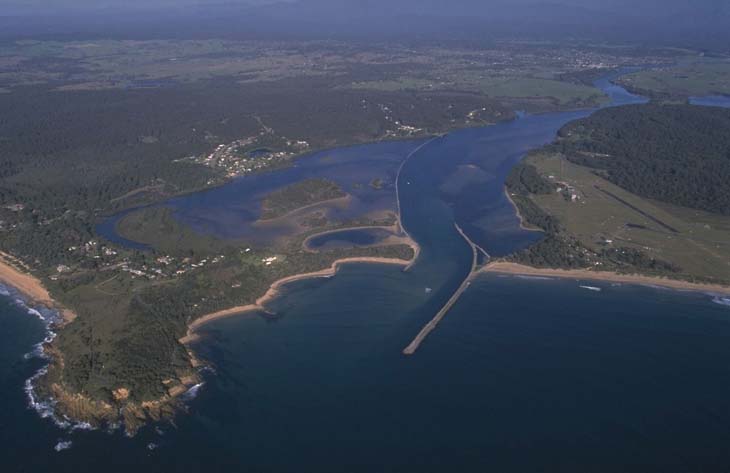
About an hour's drive away is the small town of Moruya which sits on the banks of the river of the same name.
The town's name comes from an Aboriginal word, mherroyah, meaning "home of the black swan". Black swans can still be to seen in the surrounding lakes and rivers.
There are a number of historic buildings preserved in the main streets of the town including the court house.

Although being the smallest of the three major towns on the Eurobodalla Shire, the council area bordering our Shoalhaven, Moruya is the administrative centre of the shire and home to the council offices and other public institutions.
Not surprisingly there is also a quilt shop.
At the mouth of the river is Moruya Heads which has a great surfing beach. The surf was very big when we were there and waves were breaking over the bar and heading up river.
There are many other unspoiled beaches to the south including Congo and Bingi as well as some others without names which are within a short drive from the town.

The town is also famous for its granite quarry.
The granite for the Sydney Harbour Bridge pylons was quarried in the area. From 1925 to 1932, the Harbour Bridge works saw 250 stonemasons employed and relocated to Moruya by the contractor to produce 18,000 cubic metres of dimension stone for the bridge pylons, 173,000 blocks, and 200,000 yards of crushed stone that was used as aggregate for concrete.
During the seven years of this work, a small town of about 70 houses grew up near the quarry called Granitetown. Unfortunately despite the quarry still being in use not much remains of this historic town site today.
Moruya's other claim to fame is it is the site of our local airport albeit a pretty small one. You can just make out the runway in the above picture to the right.
The airline Regional Express, known as REX, flies mostly Saab 340B aircraft from Moruya to Sydney and Moruya to Merimbula, with connecting flights to Melbourne.

Sunday, May 22, 2011

Goodbye, Old Friend.

Australians tend to keep their cars for quite a long time.
But this must be some sort of record.
Neighbour Bob has a 1987 Ford Falcon which has racked up 546,000 km (341,250 miles).
It has been relegated to a work horse for many years now, helping Bob carry his tools of trade around many rural properties as well as his rods to the beach for fishing trips.
He was aware that she was fast wearing out and his fears were confirmed during the last annual registration inspection when the mechanics said although they will pass it one more time not to bother bringing it back again.

The "Bobmobile" as it is known around here reacted to this news by developing a huge oil leak and internally destroying her power steering system.
So on Tuesday it's off to the wreckers.
There will be an appropriate wake that evening at the Tavern.
The number plates will obviously be transferred to the replacement vehicle.

Sunday, May 15, 2011

Burning Off

Australia is very prone to bush fires especially during summer.
Our valley borders a national park and a state forest so we are surrounded by a potential fire hazard.
As some of my readers know, we were threatened by an out of season bush fire back in August of 2009.
To reduce the hazard, the local Rural Fire Brigade carries out 'cool burns' in the parks and forests around us to reduce the 'fuel' level during autumn and winter which is considered the low risk time.
Property owners are also encouraged to reduce fuel levels and burn fire breaks when it is safe to do so
.

So Neighbour Bob and I decided to burn a fire break strip along the road bordering our properties. I had sprayed it all off with herbicide a few months before and cut down all the saplings.
This morning we had light winds and a bit of dew so we went ahead.
It all went to plan with no dramas. Bob kept guard on one side with a shovel in case any 'residents' who had been hiding there made a break for it. There were none.
I patrolled the fence line with a sprayer to put out any fence posts that caught alight.
There are plenty more of these jobs to do over the next few months. I have burn off piles ready all over the place.

Sunday, May 08, 2011

Old Friends

Last week we had a quick visit from Pam and Bruce who live in Brisbane, Queensland.
I first met them in 1957 at my primary school there when we moved from Melbourne.
So I guess they are my oldest friends.
We certainly shared a great number of adventures together during our 'formative years'.
Bruce continued onto secondary school with me and became part of our surfing group.
Pam did her own thing overseas for a while but eventually came home.

We have kept in contact over the years since I moved away in 1968 and have visited one another sporadically.
Funny though that no matter how long it's been between contacts, we pick up the threads of our lives so quickly.
We had a fun day (and night) catching up on all the gossip about family, mutual friends, acquaintances and our travel adventures.
To say the wine flowed would not be an exaggeration.
And today is their 40th wedding anniversary.
Congratulations, guys!

Sunday, May 01, 2011

pH Day

pH is the measure of the acidity or basicity (alkalinity) of an aqueous solution.
Pure water is neutral and has a pH of 7.0
Solutions with a pH of less than 7.0 are acidic, more than 7.0 are alkaline.
In wine production we usually work with pH levels between 3.0 and 4.0
In practice white wine should have a pH between 3.1 and 3.4 and red wines 3.3 to 3.6
Why is this so important?
From a drinking point of view, acidity accentuates the fruitiness and balance of wine.
However from a oenological point of view, the 'correct' acid levels have a bearing on the antimicrobial and antioxidant properties of the sulphur dioxide that is added to the wine as well as encouraging growth of desirable micro organisms, inhibiting microbial spoilage and aiding in the clarification process.

While sulphur dioxide is added to wine, it's the molecular sulphur content of the 'free portion' of that addition, as opposed to the 'bound portion', that is most affective.
The amount of molecular sulphur is dependent on acidity
Therefore simply put, the lower the pH, the more molecular sulphur is available to do its work.
Our wine region is considered 'warm' in viticultural terms.
This means the grapes ripen relatively rapidly with an associated degradation of acid.
In general all our grape juice, in particular the reds, can have a low acidity in wine terms (pH of around 3.5 to 4.0) at harvest. And pH becomes even higher during the fermentation process as well as after malolactic fermentation.
In Australia we are allowed to add acid to compensate for this.
So to get our juices and ultimately our wine to the correct pH level, tartaric acid is added. This acid is a natural acid component of the grape juice in any case.
But we need to know first what the pH of the wine is.
This is done with a pH meter.
There are some pretty sophisticated pieces of equipment around but we use a basic hand held unit.

First job is calibration. This is carried out using two commercial solutions of known pH, in our case, 4.0 and 7.0.
Once the unit is calibrated, the wines are tested.
Then, when the pH is known then, we can estimate the amount of acid to be added.
And I mean estimate.
There is no formula relating to acid addition and pH drop due to the 'buffering' capacity of wine which we wont go into here.
So it's a matter of adding acid in progressive amounts from 4 to 1 g/L until the required level is achieved. Doing a test run on a 1L sample initially will give some indication however.
The acid is dissolved into a minimum amount of water and added to the wine.
So I did this with three of the four 2011 wines as the Semillon at pH 3.4 was ok.
After a few hours or so I tested them again. And as usual they all needed more.
So the task was repeated until satisfactory levels were reached.
So what about titratable acidity (TA) I hear some of you ask.
I can say I used to do it but eventually questioned the necessity so now rely on pH (and my palate) only.