Results of the 2011 Census have been published and both the Australian Bureau of Statistics and the press have done the usual analysis.
So here is a summary (thanks to the Sydney Morning Herald and the ABS).
• Just over half of the population is female. There have been slightly more women than men in Australia since 1979; the ratio has been pretty constant at around 99 men for every 100 women for several years.
• The average Aussie is 37 years old.
• The average citizen was born in Australia. In fact, 74 per cent of the population was born in Australia, and more than 54 per cent had both their parents born here, too.
• The average citizen only speaks English at home, compared to the one in five who speak another language. The most common languages other than English are Mandarin (1.6 per cent), Italian (1.5 per cent), Arabic (1.4 per cent), Cantonese (1.3 per cent), Greek (1.2 per cent) and Vietnamese (1.1 per cent).
• The average citizen identifies with a Christian religion, most probably Catholic. This has changed a lot over the past 100 years – in 1911, 96 per cent of people considered themselves Christian, but that number has now fallen to 61 per cent.
• Both the average man and woman are in paid employment. Across the sexes, the most common occupation is sales assistant, reflecting the number of casual or part-time staff in the workforce. Other common occupations for men were truck driver, electrician, and retail manager; for women, the list included general clerk, primary school teacher, and office manager.
• Of those who worked in the week before Census night, men worked an average of 41 hours, compared with 32 hours for women. But this was switched when it came to domestic work; the average woman did five hours or more of housework a week, while the average man did less than five hours.
• The average citizen travels by car to work, usually as the driver – and the average family now has two or more cars.
• Just over half of the adult population (54 per cent) is married.
• The average married couple lives in a home with their son and daughter – and the children’s median ages are nine and six. It's most common for families to have two children; in those, 52 per cent have a girl and a boy, 25 per cent have two boys, and 23 per cent have two girls.
• The average family lives in a suburb of a state or territory capital, in a free-standing, three-bedroom home.
• The average family is paying $1800 a month to pay off their mortgage (35 per cent). Just over a third of families (33 per cent) own their homes outright, and 29 per cent are renting.
More details here.
Monday, April 15, 2013
Thursday, March 28, 2013
Easter 2013
Easter is early this year. As result, despite it being autumn, we are still experiencing summer weather.
It's been hot and muggy with temperatures around 30C.
They have predicted a change for Good Friday and maybe that will be the beginning of our favourite time of the year climate wise.
Big things happen in Ulladulla at Easter. By far the most important event is the Blessing of the Fleet followed by a parade through the streets with floats and bands.
All the various arts and crafts clubs and groups have exhibitions of their work throughout the town and there is a huge outdoor market down at the wharf on Easter Monday.
 Of course this means we are inundated with tourists during this time.
The roads in and out of town will be clogged and most visitors will be trying to eke out every second of their holiday break over the four days.
For us it means a a quiet time at home.
We did our shopping early on Wednesday getting enough vittles to see us through until next Tuesday.
We have stocked up on hot crossed buns but resisted the urge to overdo the chocolate eggs and bunnies.
We shall close the gate, put up the electric fences and get the cattle up to eat down the grass in the house paddock effectively shutting us off from the outside world.
Not a bad thing to do occasionally.
It's been hot and muggy with temperatures around 30C.
They have predicted a change for Good Friday and maybe that will be the beginning of our favourite time of the year climate wise.
Big things happen in Ulladulla at Easter. By far the most important event is the Blessing of the Fleet followed by a parade through the streets with floats and bands.
All the various arts and crafts clubs and groups have exhibitions of their work throughout the town and there is a huge outdoor market down at the wharf on Easter Monday.

The roads in and out of town will be clogged and most visitors will be trying to eke out every second of their holiday break over the four days.
For us it means a a quiet time at home.
We did our shopping early on Wednesday getting enough vittles to see us through until next Tuesday.
We have stocked up on hot crossed buns but resisted the urge to overdo the chocolate eggs and bunnies.
We shall close the gate, put up the electric fences and get the cattle up to eat down the grass in the house paddock effectively shutting us off from the outside world.
Not a bad thing to do occasionally.
Monday, March 18, 2013
A Combined Date Day
Neighbour Bob called early on Sunday morning wondering if we were interested in joining him and the Jude for lunch at the Pigeon House Tea Rooms.
This is a relatively new cafe set on top of the mountains behind us.
It overlooks the wild Budawang Range which is part of the Great Dividing Range that runs the entire length of eastern Australia.
The dominant feature of this part of the Budawangs is Pigeon House Mountain named by Captain Cook on his voyage of discovery up the east coast in 1770. The summit rises to 720 m above sea level.
The aboriginal name is Didhol (or Dithol or Didthul ) which means woman's breast.
Behind and to the north-west are two elongated plateaux of Byangee Walls and The Castle.

Pigeon House is easily accessible from the coastal towns and around 8000 people climb it each year. The approach from the car park is relatively steep and rough going and on reaching 'the core' you are faced with vertical steel ladders to climb. Not a place for the acrophobic.
Once on top, however, the 360 degree view can be amazing on a clear day.
Most people allow around 4 hours for the return journey and take lunch for a picnic on the summit.

The cafe is in a perfect spot with a panoramic view of the mountains, reasonable food, good service and a relaxed atmosphere. Lots of people there too which is a good sign.
We think we may have our half yearly valley residents get together there in July.

Friday, March 01, 2013
Rain......and Lots of It
February is our wettest month and we have had plenty of rain.
Total for the month was around 200mm (8in) which is double the average.
And not only that, we have had a lot of thunderstorm activity, some quite large and intense, and unusually for Australia these have spawned tornadoes albeit smallish ones.
Just to the north of us last weekend four touched down and made their way through some highly densely populated areas and caused quite a lot of damage.

For the grapes, continual wet weather means diluted juice and exposure to fungus disease.
The latter is patently obvious with sugar levels stalling around the 10 deg Be' mark.
We need at least another 2 deg Be' before it is worthwhile to harvest.
The good news is that so far the fungus has been kept away. This means that the leaf cover will be still good enough to start increasing the sugar level in the grapes once the fine weather returns.......if it ever does.
Sunday, February 17, 2013
Cabernet Sauvignon and Its Parents (and Grandparents)
All European wine grapes are the same species ie. Vitis vinifera.
It is widely conceded that this cultivated species came from the wild race subspecies Vitis sylvestris found over southern Europe and western Asia.
The different varieties we are familiar with today are a result of centuries or probably millennia of natural cross pollination.
Many wine grapes are also the result man made crosses even to the point of crossing different wine grape species.
Up until recently is was not possible to tell what the origin of the current wine grape varieties were.
But with DNA profiling the puzzle is slowly being unravelled.
It is estimated there are over 10,000 grape varieties with around 1500 being used for wine production. Only a small percentage have been genetically analyzed.
I have spent the day in the Cabernet Sauvignon block, green pruning, spraying, mowing and net mending.
I got to wondering where this variety, which is the classic Bordeaux red wine grape, came from and did some research.

Surprisingly it turns out that Cabernet Sauvignon is not so old.
It was a chance crossing between Cabernet Franc and Sauvignon Blanc in a French vineyard some time during the 17th century.
Cabernet Franc is a very old variety and is said to be selected from wild vines.
Sauvignon Blanc on the other hand is a natural cross of Traminer and Chenin Blanc.
Traminer is one of the oldest European varieties and is said to be selected from wild vines.
Chenin Blanc is indigenous to the Loire Valley (Anjou), France and is reputed to have been in that area at least since the 9th century.
So there you have it.
Many countries are researching and developing hybrids. Our CSIRO already have a few in the field and in production eg. Tarrango (Touriga Nacional x Sultana) and Taminga ( a cross of a previously created crossing Merbein 29-56 and Traminer).
And the natural evolution also continues outside the realm of hybridization. Two different coloured Cabernet Sauvignon grapes are indigenous to Australia.
A chance discovery of pinky bronze fruit on a Cabernet Sauvignon vine in 1977 provided Cleggett Wines the opportunity to propagate this single cane cutting (called a sport in horticultural terms) at their Langhorne Creek (South Australia) vineyard.
This Bronze Cabernet Sauvignon grape is registered as Malian.
Several years later in 1991 through the same process of nature a White Cabernet Sauvignon grape was identified and subsequently registered as Shalistin.
Wednesday, February 13, 2013
Preparation for Vintage 2013
The main pre-vintage task is to get all the equipment clean as well as check out the integrity of some components. The acid environment of the wine making process can be harsh on tank seals, piping, gaskets and plastic airlocks
This includes the crusher, fermenter, basket press, tanks and even the picking baskets and shears.
While we cleaned up thoroughly after last vintage, a year's (and in our case 2 year's) dirt and grime can build up and everything needs to be pulled apart and done again.
It is absolutely critical to have good winery cleanliness and sanitation as dirty equipment does nothing but invite unwanted bacteria and yeasts to spoil the wine.
There are three important words used for getting equipment ready for clean winemaking.
The terms cleaning, sanitizing and sterilizing are used interchangeably.
But all three mean very different things.
Cleaning refers to the physical removal of visible dirt, grunge and old wine deposits. This is usually done with a hose with a jet spray, scrubbing brushes, scouring pads and old towels plus lots of detergent and elbow grease.
Sanitizing means doing something to equipment to reduce the microbial load to an acceptable level ie. killing spoilage microorganisms with heat or a chemical solution.
Sterilizing is another step altogether and one that goes beyond the scope of anything that can be done practically in a winery environment ie. making it completely free of bacteria or other microorganisms.
Sanitizing takes place just before equipment use.

The most common sanitizing solution used in small wineries is a strong sulphite solution.
I usually dissolve 3g potassium metabisulphite and 12g of citric acid in 4L of water. This yields about a 500 ppm solution of sulphur dioxide (SO2) which is very effective as most wine spoilage microbes are sensitive to it at this concentration.
The acid addition essentially makes the sulfur dioxide more effective ie. the SO2 consists of molecular (unionised) sulphur dioxide, the bisulphite anion and the sulphite anion with the proportions of these depending mainly on the pH.
Molecular SO2 is the most germicidal.
The more acid the solution, the higher the proportion of molecular sulphur dioxide.
All the physically clean surfaces are rinsed well, let dry and then sprayed with the sulfur/citric acid solution. After it has been in contact for about 5 to 10 minutes the surfaces are rinsed again with clean water.
And then we are ready to go.
Saturday, February 09, 2013
The Mystery May Be Solved.
This year we lost three calves out of the six born.
We have never had such a high mortality rate.
The vet said it was the very wet season that had caused a tick plague and that young animals were very susceptible to the tick toxin.
We received our rural rates notice the other day. This comes from a state government instrumentality that deals with pasture protection and livestock health, sales and transport.
Their newsletter had very an interesting article.

There has been an outbreak of the Ikeda variant of Theileriosis (bovine anaemia) on the south coast.
This disease is caused by Theileria orientalis a vector borne blood parasite.
Bush ticks, among other biting insects, are believed to be a common transmitter of the disease.
Calves are very susceptible succumbing from between 6 and 16 weeks of age.
Most the symptoms listed were noticed in our calves including the sudden death of apparently healthy ones.
There is no treatment.
Prevention is the cure.
Keeping the animals healthy by drenching for fluke and worms as well as feed supplements is one way.
Pour on insecticides/repellents during the tick season is another.
We will be ready next season.
Wednesday, February 06, 2013
Vintage 2013 / Harvest Gets Closer
We have been busy testing the grapes for ripeness.
Ripeness can mean a number of things. To most, sugar ripeness is the criteria. This means when the sugar level gets to a certain stage that produces a wine with suitable alcohol content then it's ready.
To others there is flavour ripeness to also consider. That is when the grape is exhibiting its typical varietal characteristics. To get both these happening at the same time is the goal.
My first ripeness runs are simple ie. walks around the rows with sample tastings from a selection of berries from random bunches. It's easy to tell when the sugar level is not quite there. There are 'green' flavour characteristics with a distinct malic acidity showing through.
During follow up walks, I look at the stalk of the bunch for colour change (brownish rather than green) and during a taste for sweetness look at the seeds for maturation (again dark rather than green), then I test the juice which I squeeze onto a hydrometer.

This gives me the sugar level in Baume' (a degree of density) which in turn gives me an indication of the final alcohol content of the wine ie. 13 deg Be' should be around 13% alcohol.
We look for a level between 13.0 and 14.0 deg Be' with the exception of Semillon when around 11.5 deg Be' suits the wine style we like to make.
This is a good indication when a final test should be made.
The final test is more exhaustive. We take a larger representative sample ie. grape berries from the top, bottom, outside and inside of many bunches, crush them and let the juice settle before testing.
We usually find that at harvest the Be reading is always about 1.0 deg below that of the test.
Some think pH (acidity) is also a critical test.
In warm climates like ours, pH will always be high ie. outside the required range for wine making.
We can adjust that with acid addition (allowed in Australia) during the wine making process.
So it looks like we will be harvesting the Tempranillo, Semillon and Pinot Noir in the next week or two.
The Cabernet has a long way to go. It will be late March, I suspect, before it is ready.
Tuesday, January 29, 2013
Tropical Cyclone Oswald
On 17th January, an area of low pressure developed over the the Gulf of Carpentaria several thousand kilometers to the north of us. The system quickly organized and strengthened into a tropical cyclone early on 21st January.
Although a relatively weak storm, Oswald produced torrential rain over much of Queensland causing extensive flooding, severe winds and even tornados.
In what is considered a strange set of circumstances the now intense low storm moved south down the east coast of Australia leaving chaos in its wake

Late last night it hit us with torrential rain and rather high, but not high as predicted, winds. We were warned of possible 100km/hr plus.
We have had nearly 150 mm of rain in 2 days. The dams and tanks are full and the creek is running again.
The surf is HUGE with 10m swells off the coast.
Needless to say the potential drought is over and, even better, the bush fires are out.
Saturday, January 26, 2013

Monday, January 21, 2013
Grapevines / Heat Damage
A couple of days of 40C deg plus and some fierce drying winds have taken their toll on the grapevines.
When you take into consideration that the official temperatures are taken in the shade it's not hard to imagine what the exposed temperatures would be. Some estimates are 10-20 degrees higher.
Plants draw moisture up from the soil via their roots and expel it mainly through their leaves in what is known as transpiration.
When the rate of transpiration exceeds the rate of absorption the plant comes under stress.
The plant tries to compensate by closing the stomata in its leaves to prevent water loss but under extreme conditions of heat, air movement and low humidity this is not always possible.
This is when the leaves start to wilt or droop. If a plant reaches permanent wilting point (PWP) it will more than likely die.

The lack of moisture in the leaves makes them susceptible to burn. We noticed this happening with the grapevines very early in the heatwave as we have had very little rain and the soil moisture content is very low.
A couple of days later the leaf damage was more than obvious.
These damaged leaves will eventually die and fall.
A reduction in the number of leaves will affect the ability of the vine to ripen the fruit.

But the leaves weren't the only plant part affected. The fruit was also dehydrated by the heat with considerable raisining of the bunches.

All this will probably mean a considerable reduction in yield.
This is very disappointing as the vintage this year had been progressing well and harvest is or, maybe now, was only a few weeks away.
The worst affected is the Pinot Noir followed by the Tempranillo.
The Cabernet seems to have weathered the storm a little better as the vines are much older and the roots a lot deeper.
Only time will tell.
Friday, January 18, 2013
Another Scorcher
OK, these hot days can stop now.
We have had enough.
The temperature here reached 43.8 degC at 2pm.
The cool change didn't arrive until 5pm when the temperature dropped to 23 deg C within an hour .
We had headed down the beach in the morning for a swim but it was even too hot down there.
The poor garden is suffering too, the lawn turning brown and the grapevines are drooping.
Am sure we will have leaf and bunch burn on the outer rows.
In Sydney it reached just under 46 degC, which equaled the all time high record set in 1939.
Now for "our fire".

It became active again but thankfully the winds stayed down and its containment has been preserved on the southern side.
It has now burnt out 9100 ha.
Fires in the west of the state are still burning with 50 properties lost. At last count there were 90 with 30 uncontrolled. The largest has burnt out 52,000 ha.
And to finish off a great day, the gusty southerly wind obviously caused problems with the power supply. So we headed into town for dinner and have just now returned with the power finally restored.
So that's it for my whinge of the day.
Thursday, January 17, 2013
Brooman Revisited
Last year, around this time, the co driver's quilting group met at Brooman on the Clyde River for a family day.
This year we did the same but with a twist.
We all met at the Clyde River Berry Farm first.

It was a fairly bone jarring drive over the mountain range into the river valley along a route we have never taken before. This area is predominantly state forest and the dirt roads are used for transporting timber out and get pretty chewed up by the big trucks. And since we haven't had much rain, it was very dusty as well.

The berry farm produces mainly blueberries but has a range of others as well including strawberries, raspberries and loganberries. It is a commercial farm which has PYO facilities for the tourists who flock to our area for the summer holidays.

The blueberries here are all low chill Florida high bush cultivars developed in the USA way back when but improved to the current standard by Ralph Sharpe of the University of Florida in the 1950s.
While doing my horticultural course I did my thesis on blueberry production and fully intended that the farm would be a commercial blueberry enterprise. Suffice to say it didn't happen for all sorts of economic and technical reasons.

We spent about an hour walking the rows, picking the fruit and having a sneaky taste now and again.
Then we headed for the weigh in. The cost was about half of what we pay in the supermarket.
It seemed we overdid it a bit with 2.5kg but we will freeze most of them for muffin and smoothie production.
And the Farm makes the best berry ice cream cones there too. Worth the trip just for one of those.
Then it was onto our friends' place on the river at Brooman for a picnic lunch and a bit of a fish.
It was a total reprise of last year ie. wonderful setting, warm sunny weather, great company, good food........and no fish, not even one bite!


Wednesday, January 09, 2013
A Scorching Day (with Final Bushfire Update)
A so called 'dome of heat' had formed over central Australia. This is not unusual at this time of year as it's summer but the temperatures were some of the highest on record with almost 50deg C (122deg F) being reached in some parts.
Due to a set of unusual weather patterns 'the dome' moved east and south.
The small island state of Tasmania which is normally the coolest in the country experienced extreme temperatures and the inevitable bushfires with more than 100 homes being lost in the south of the state.

Yesterday was our turn.
The bushfire warning was cranked up to "catastrophic" and we had messages delivered to us the night before via our landline and mobile phones to activate our bushfire survival plan.
We knew we were in for a bad day early in the morning. The temperature at 7am was already 32 deg C (90 deg F) and the wind was gusting strongly from the west.
By midday it was 40 deg C (104 deg F) and the winds were 70km/hr north westerly. The perfect storm.
We were aware a relatively small fire had started a few days ago to the north west of us and they had been working hard to contain it. Unfortunately the conditions turned it into a raging out of control inferno as it headed east towards the small beach side villages of the Sussex Inlet area.
This is about a 45 minute drive to the north of us.
We kept track of things through the excellent Rural Fire Brigade web site and were ready to 'hit the road' if necessary.

The main road north was soon cut and the residents who had not already left were sent to evacuation centers.
It was a pretty chaotic day up there.
Lots of pictures and stories from our local paper on this link.
As long as we didn't see smoke we knew we were ok.
At 6:30pm the long awaited southerly change came in. The temperature dropped 20 degrees in 15 minutes.
The fire up north is still burning today but conditions have eased. The Sussex Inlet villages are no longer in danger but the highway is still closed. This bush fire has a 44km perimeter and has burnt out an area of over 3,800 hectares.
There were over 140 bush fires burning in the state of New South Wales yesterday with around 20 threatening life and property. There is still a total state wide fire ban today.
This is summer in Australia and I don't think we have seen the last of the fires this season.
Update 10/01/13: The above fire is still not under control. Today 100 personnel, 8 helicopters and 27 fire trucks were involved in the fire fighting effort. So far 6500ha have been burnt but there has been limited property damage and no loss of life.
Conditions are expected to deteriorate over the next two days with higher temperatures predicted.
Update 12/01/13: An earlier than expected southerly change today has helped firefighters get the upper hand in containing the blaze which has now burnt out more than 8400 hectares in the Jerrawangala area.
Around 175 fire fighters, with 31 tankers, are still working to contain the blaze over the 100km perimeter.
With them are 7 aircraft and about 10 heavy machinery units who will be working to strengthen containment lines throughout the day.
The really good news for fire crews was containment lines had held over night and the fire hadn't crossed through a former military range in the rugged and mostly inaccessible north west area which is scattered with unexploded bombs.The containment lines on the eastern side of the fire, near the Princes Highway, were holding and the threat to communities in and around Sussex Inlet had eased.
 The highway remains open, however this is subject to fire conditions with smoke expected to impact at times during the day.
The cooler conditions expected to continue tomorrow and Monday.

Update 13/01/13: Much cooler weather (low 20s) with southerly winds bringing in the high humidity and even a suggestion of light showers. Can imagine the firefighters in our area are happier. "Our fire" is still considered out of control with the western front now in inaccessible country and being water bombed by aircraft. Eastern front which has been our main worry is contained. The cooler weather is expected to last a few more days then heating up again by late next week.
However a series of lightning strikes in the north of New South Wales have sparked 45 new bush fires.
Across the state 130 fires are now burning, 30 of which are not contained. Temperatures in that region have been in the 40s.
Moomba in the far northeast of South Australia yesterday recorded a maximum temperature of 49.6 degrees, which makes it the highest temperature recorded in Australia in 15 years.

Update 15/01/13: It appears that the threat from the fire has now abated. We have had some rain and the southerly wind stream, apart from bringing in much needed humidity, has pushed the fire to the north west. The eastern perimeter which was our main worry is contained. But the fire is not out and more hot weather and the wrong wind could change this situation.
Meanwhile out west of the state the fire situation is dire. Lots of property and stock losses.
Due to a set of unusual weather patterns 'the dome' moved east and south.
The small island state of Tasmania which is normally the coolest in the country experienced extreme temperatures and the inevitable bushfires with more than 100 homes being lost in the south of the state.

Yesterday was our turn.
The bushfire warning was cranked up to "catastrophic" and we had messages delivered to us the night before via our landline and mobile phones to activate our bushfire survival plan.
We knew we were in for a bad day early in the morning. The temperature at 7am was already 32 deg C (90 deg F) and the wind was gusting strongly from the west.
By midday it was 40 deg C (104 deg F) and the winds were 70km/hr north westerly. The perfect storm.
We were aware a relatively small fire had started a few days ago to the north west of us and they had been working hard to contain it. Unfortunately the conditions turned it into a raging out of control inferno as it headed east towards the small beach side villages of the Sussex Inlet area.
This is about a 45 minute drive to the north of us.
We kept track of things through the excellent Rural Fire Brigade web site and were ready to 'hit the road' if necessary.

The main road north was soon cut and the residents who had not already left were sent to evacuation centers.
It was a pretty chaotic day up there.
Lots of pictures and stories from our local paper on this link.
As long as we didn't see smoke we knew we were ok.
At 6:30pm the long awaited southerly change came in. The temperature dropped 20 degrees in 15 minutes.
The fire up north is still burning today but conditions have eased. The Sussex Inlet villages are no longer in danger but the highway is still closed. This bush fire has a 44km perimeter and has burnt out an area of over 3,800 hectares.
There were over 140 bush fires burning in the state of New South Wales yesterday with around 20 threatening life and property. There is still a total state wide fire ban today.
This is summer in Australia and I don't think we have seen the last of the fires this season.
Update 10/01/13: The above fire is still not under control. Today 100 personnel, 8 helicopters and 27 fire trucks were involved in the fire fighting effort. So far 6500ha have been burnt but there has been limited property damage and no loss of life.
Conditions are expected to deteriorate over the next two days with higher temperatures predicted.
Update 12/01/13: An earlier than expected southerly change today has helped firefighters get the upper hand in containing the blaze which has now burnt out more than 8400 hectares in the Jerrawangala area.
Around 175 fire fighters, with 31 tankers, are still working to contain the blaze over the 100km perimeter.
With them are 7 aircraft and about 10 heavy machinery units who will be working to strengthen containment lines throughout the day.
The really good news for fire crews was containment lines had held over night and the fire hadn't crossed through a former military range in the rugged and mostly inaccessible north west area which is scattered with unexploded bombs.The containment lines on the eastern side of the fire, near the Princes Highway, were holding and the threat to communities in and around Sussex Inlet had eased.
The highway remains open, however this is subject to fire conditions with smoke expected to impact at times during the day.
Update 13/01/13: Much cooler weather (low 20s) with southerly winds bringing in the high humidity and even a suggestion of light showers. Can imagine the firefighters in our area are happier. "Our fire" is still considered out of control with the western front now in inaccessible country and being water bombed by aircraft. Eastern front which has been our main worry is contained. The cooler weather is expected to last a few more days then heating up again by late next week.
However a series of lightning strikes in the north of New South Wales have sparked 45 new bush fires.
Across the state 130 fires are now burning, 30 of which are not contained. Temperatures in that region have been in the 40s.
Moomba in the far northeast of South Australia yesterday recorded a maximum temperature of 49.6 degrees, which makes it the highest temperature recorded in Australia in 15 years.

Update 15/01/13: It appears that the threat from the fire has now abated. We have had some rain and the southerly wind stream, apart from bringing in much needed humidity, has pushed the fire to the north west. The eastern perimeter which was our main worry is contained. But the fire is not out and more hot weather and the wrong wind could change this situation.
Meanwhile out west of the state the fire situation is dire. Lots of property and stock losses.
Monday, December 31, 2012
2012 In Retrospect
It’s been a relatively quiet year for us.
There was no international travel but we had a few weeks away locally with one trip to Melbourne in Victoria and another to Orange via Canberra in New South Wales.
It was good to explore some wine regions (and quilt shops) in those places and en route.
Plenty of trips to Sydney as well for family and medical reasons. As far as the latter is concerned all was good.
On the sporting front we enjoyed the London Olympic Games immensely. Our satellite TV coverage was excellent and it was great to see the best, instead of just Australian performances which seem to be the focus of the free to air channels.
Rugby was another matter. Our local state team, the Waratahs, played very badly all year and the Australian Wallabies weren’t much better. The former team will have a new coach in 2013 but regrettably the latter won’t. Australia is stuck with the incumbent New Zealander! Could be more of the same for the national team in the upcoming season and with the British and Irish Lions Tour looming this is not a good thing to contemplate.
Our national cricket team has had a patchy year in all forms (Test, One Day, T20) of the game. But they are in rebuilding mode. In 2013 we again face the poms in England in a test series which is always a good battle.
Life on the farm has not been too fraught with problems. The 2012 vintage was a disaster. Continual wet weather hampered all efforts to keep the fungus out of the grapes. We eventually threw in the towel and decided not to harvest. Things are looking better for 2013.

We had a good calf drop in spring but sadly have lost two so far. It’s been a very bad year for ticks (wet weather related) and vets in the area have been aware they are taking their toll on new born farm animals including cattle, alpacas and goats. Nothing much can be done against this apparently. The paralysis tick is also particularly fatal for dogs and cats so lots of pour on and tick collars being sold.
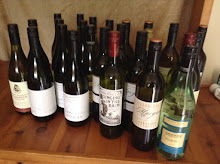
As you can see from our wine list, a considerable range was consumed this year. Not too many bad ones.
The highlights this year were the wines out of the Orange wine region, the Hunter Valley Semillons and Verdelhos , the Clare Valley Rieslings as well as the Victorian Pinot Noirs. We are so spoilt for choice both from a local and imported point of view. And prices are still very good. The strong Australian dollar has hampered exports so suppliers are trying to get rid of excess stocks on the local market. For the same reason, imported wine has never been so cheap.
We shall continue our evaluation into 2013. It's a tough job but someone has to do it.
So that's another year gone.
We look forward to the new one.
All the best to my readers.
Saturday, December 22, 2012
Christmas 2012
Obviously the world didn’t end on the 21st so we shall continue on with life on the beautiful south coast of New South Wales.
Our Christmas this year will be, as usual, minimalist.
We have planned a seafood lunch with a couple of really good bottles. When there are just the two of us I can access my secret stash! The only concession to a traditional Christmas lunch will be a big slice of plum pudding for me. The co driver still thinks of that as poison especially when slathered in custard.
Prawns, oysters, scallops and mussels (with some old Hunter Valley Semillon or maybe a nice sparkling Tasmanian Chardonnay/Pinot Noir .....or both) and maybe a piece of salmon from the BBQ (with a Mornington Peninsula or Yarra Valley Pinot Noir) might be on the menu. And just maybe a small glass of sticky with the pud.
We are lucky to have a really good fish shop in town called, you guessed it, “Lucky’s”. After all, Ulladulla was once a major fishing port. He has the freshest and best all year 'round. Getting into the shop on Christmas Eve can be bedlam with queues forming outside at 6am. We go late the day before.
"Mate, it's the same stuff you will get the next day" says Lucky who makes a fortune at this time of year but can never come to grips with the mentality of the last minute rush.

We had the annual valley party last weekend at one of the neighbour’s places. It was, as always, a fun evening with good food, a little bit of wine and lots of laughter. The evening started off pretty hot and humid, typical December weather, but the southerly, known as ‘the doctor’ around here, came in after about an hour and the temperature dropped 10 degC which made for an even more pleasant evening.
The forecast for Christmas day is not that good with cloud and showers predicted, minimum 17 degC maximum 23 degC. However this is better than being below zero and up to our necks in snow like other places we know.
We were going to hit the beach early for a swim before the hordes arrive and then retire to the peace and quiet of home. We shall see.
A happy Christmas to all my readers.
Sunday, December 09, 2012
Grapevine Growth
It's amazing how fast grapevines grow.
From the pictures below you can see their development from early September to early December.
This year the Pinot Noir seems to have developed much larger leaves than normal and certainly more vigorous shoot growth. This may be the result of our wet spring and plenty of residual soil moisture.
We have been green pruning fairly severely already in order to thin out the fruitless shoots. This allows more air circulation around and through the canopy to help prevent fungus.
A less dense canopy also allows better spray penetration.
In addition it also prevents shading ie. allows more sunlight onto the leaves and bunches to assist in the ripening process. This means increased sugar levels (higher resultant wine alcohol), increased colour in red grapes, increased tartaric acidity and overall better varietal flavour.


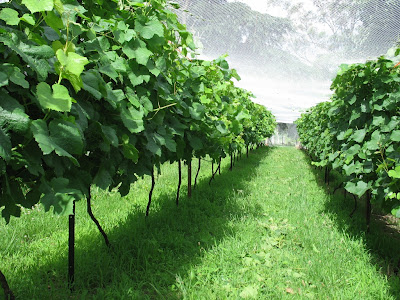
Meanwhile the Pinot Noir bunches are developing. They have reached the 31st stage according to the Eichhorn and Lorenz system ie. berries pea size, bunches hanging down. The berries will continue to 'swell' until they are touching. This is known as bunch closure. Some varieties 'close' more than others. Chardonnay for instance has very tight bunches while those of Cabernet Sauvignon are more open. Tight bunches always have problems with botrytis in wet conditions and it is always essential to get a preventative spray on before bunch closure as a follow up to the first at 80% cap fall.

From the pictures below you can see their development from early September to early December.
This year the Pinot Noir seems to have developed much larger leaves than normal and certainly more vigorous shoot growth. This may be the result of our wet spring and plenty of residual soil moisture.
We have been green pruning fairly severely already in order to thin out the fruitless shoots. This allows more air circulation around and through the canopy to help prevent fungus.
A less dense canopy also allows better spray penetration.
In addition it also prevents shading ie. allows more sunlight onto the leaves and bunches to assist in the ripening process. This means increased sugar levels (higher resultant wine alcohol), increased colour in red grapes, increased tartaric acidity and overall better varietal flavour.


Meanwhile the Pinot Noir bunches are developing. They have reached the 31st stage according to the Eichhorn and Lorenz system ie. berries pea size, bunches hanging down. The berries will continue to 'swell' until they are touching. This is known as bunch closure. Some varieties 'close' more than others. Chardonnay for instance has very tight bunches while those of Cabernet Sauvignon are more open. Tight bunches always have problems with botrytis in wet conditions and it is always essential to get a preventative spray on before bunch closure as a follow up to the first at 80% cap fall.

Grape berries follow a double sigmoid growth curve. The initial phase of growth results from cell division and expansion. Then the growth slows. This is known as the lag phase. This is not a physiological growth stage, but an artificial designation between the two growth periods of the berry, the second of which is ripening. This is signalled by veraison or colour change.
Thursday, November 29, 2012
A November Update
Summer is here on some days, not on others.
But the few hot and muggy days remind us what is ahead over the next three to four months.
We are just waiting for the ocean to warm up a bit before we start our daily surfing adventures.
The grapes are all growing well. We have managed to keep the spray program to schedule with no thanks to the weather bureau's forecasts. I can't think of another period where they have been so consistently wrong.
Working under the increased net height has been a godsend so all the work involved with that was worth it. And the power sprayer is also proving to be a great investment.
I am a bit surprised at the lack of fruit on the Tempranillo and the Pinot Noir. Maybe that has something to do with the poor season we had last year which may have caused the lack of initiation of fruitful shoots. I need to go back into the text books to find out for sure but what is there is there.
We may have to produce a Pinot/Tempranillo blend this year to get a reasonable quantity of wine from these two varieties.
On the other hand the Cabernet Sauvignon is loaded with flowering bunches. Let's hope the fruit set is good.
I had pruned them really hard this year to increase spur spacing in an effort to decrease quantity and improve quality. This has resulted in an explosion of shoots other than the two required on each spur which has necessitated a fair amount of shoot removal work.

It is interesting to watch our small resident kangaroo family attempting to get under the nets to get at the fresh green grass shoots of the inter-rows as well as the grapevine shoots. They move along the row ends using their noses to try and lift the netting which this year is securely pinned into the ground. The buck is small but quite powerfully built and I don’t think he would have much trouble ripping the nets with his very long sharp claws but they never seem to try this.
We had a bit of drama with the white newborn calf. She suddenly became quite sick and I found quite a number of paralysis ticks on her. She displayed the same symptoms as dogs and cats when they succumb to this parasite ie. back leg paralysis. The vet said she had had a few calves and alpacas go down this year from ticks and it has been a very bad year for them. The only thing they could do would be to give the calf some tick anti venom at $500 a dose and even then they could not guarantee survival. So Doctor Bob and I began hand feeding her 4 times a day with her mother’s milk to prevent dehydration but she got weaker and weaker and eventually died. Sad for us and sad for the cow which has been mooing plaintively for the last two days. But as Farmer/Doctor/Trainer Bob said “that’s life on the land.” The other four calves are doing very well.
We are gearing up for the tourist season. It was reported today in our local paper the population of the Shoalhaven Council area is expected to increase from 97,000 to about 320,000 from Boxing Day and will probably be at that level for the following 4 weeks.
I am not going to have my annual whinge about the ‘touros’ but as usual we will be glad when we get our beaches, town and roads back in February.
But the few hot and muggy days remind us what is ahead over the next three to four months.
We are just waiting for the ocean to warm up a bit before we start our daily surfing adventures.
The grapes are all growing well. We have managed to keep the spray program to schedule with no thanks to the weather bureau's forecasts. I can't think of another period where they have been so consistently wrong.
Working under the increased net height has been a godsend so all the work involved with that was worth it. And the power sprayer is also proving to be a great investment.
I am a bit surprised at the lack of fruit on the Tempranillo and the Pinot Noir. Maybe that has something to do with the poor season we had last year which may have caused the lack of initiation of fruitful shoots. I need to go back into the text books to find out for sure but what is there is there.
We may have to produce a Pinot/Tempranillo blend this year to get a reasonable quantity of wine from these two varieties.
On the other hand the Cabernet Sauvignon is loaded with flowering bunches. Let's hope the fruit set is good.
I had pruned them really hard this year to increase spur spacing in an effort to decrease quantity and improve quality. This has resulted in an explosion of shoots other than the two required on each spur which has necessitated a fair amount of shoot removal work.

It is interesting to watch our small resident kangaroo family attempting to get under the nets to get at the fresh green grass shoots of the inter-rows as well as the grapevine shoots. They move along the row ends using their noses to try and lift the netting which this year is securely pinned into the ground. The buck is small but quite powerfully built and I don’t think he would have much trouble ripping the nets with his very long sharp claws but they never seem to try this.
We had a bit of drama with the white newborn calf. She suddenly became quite sick and I found quite a number of paralysis ticks on her. She displayed the same symptoms as dogs and cats when they succumb to this parasite ie. back leg paralysis. The vet said she had had a few calves and alpacas go down this year from ticks and it has been a very bad year for them. The only thing they could do would be to give the calf some tick anti venom at $500 a dose and even then they could not guarantee survival. So Doctor Bob and I began hand feeding her 4 times a day with her mother’s milk to prevent dehydration but she got weaker and weaker and eventually died. Sad for us and sad for the cow which has been mooing plaintively for the last two days. But as Farmer/Doctor/Trainer Bob said “that’s life on the land.” The other four calves are doing very well.
 |
| The Suspected Culprit |
We are gearing up for the tourist season. It was reported today in our local paper the population of the Shoalhaven Council area is expected to increase from 97,000 to about 320,000 from Boxing Day and will probably be at that level for the following 4 weeks.
I am not going to have my annual whinge about the ‘touros’ but as usual we will be glad when we get our beaches, town and roads back in February.
Subscribe to:
Posts (Atom)