Saturday, February 26, 2011

It's That Time of Year Again

The grapes are starting to ripen and we are preparing for harvest.
Tests have shown that the Semillon is at 10.2 degrees Baume', Pinot Noir at 10.0 and Tempranillo at 9.8. It's too early to test the late ripening Cabernet Sauvignon.
If we get a few weeks of dry weather and sunshine then two more degrees Baume' for the white and three for the reds would be perfect.
But we have had the wettest summer on record with weeks and weeks of rain and cloudy days.

This has slowed up the ripening process mainly by the vines absorbing water and diluting the grape juice.
Also unfortunately the weather has completely disrupted our spraying program and for the first time ever we have a concerning amount of fungus in the vineyard.
One, although recently it has been classified as an algae, is downy mildew, Plasmopara viticola.
This shows up as a white deposit on the underside of leaves.
It attacks the leaves and eventually kills them and they drop. Without leaves the grapes will not ripen.

Another problem fungus is Botrytis or grey rot or bunch rot.
Botrytis cinerea results in a disintegration of grape berry structure and creates the ideal conditions for the infection of the fruit with yeasts and bacteria which increase volatile acidity
and laccase activity. The musts obtained from infected grapes are strongly compromised both microbiologically and chemically. This shows up as laccase enzymes, a high concentration of apiculated yeasts, acetic bacteria, lactic bacteria and high concentrations of gluconic and acetic acid.
The most important wine making problems are caused by the presence of laccase, an enzyme that oxidises wine polyphenols.
As an indirect consequence it causes the production of acetaldehyde, the reduction of the free sulphur dioxide, an increase in "faded" aromatics, the loss of primary aromas, the darkening of white wines, and an increase of orange notes in red wines.

So we have a bit of a battle on our hands this vintage to produce reasonable wine.
And why is downy mildew now an algae and not a fungus?
Because it needs water to sporolate and spread and it can produce its own food through photosynthesis.
Fungi feed on other organisms.
OK, enough microbiology, back to getting tanks, the destemmer/crusher, buckets and press cleaned up and ready.

Wednesday, February 09, 2011

Parli Italiano?

I certainly don't, but would like to.
The co driver is enthusiastic too especially since we intend to return to Italy for a long term stay in the near future. Our first trip to Umbria back in 2005 where we stayed in and visited out of the way places convinced us that more than a basic tourist knowledge of the language would be of great benefit.
My only other language is German (and sometimes American, when the need arises). Foreign languages don't come easy to me and it was quite a struggle to become proficient in the one. I can see a number of my readers from Germany nodding knowingly here (At least I tried, Dieter!).
During the same 2005 trip when in Germany, I was amazed how much I remembered and how easy the language came back. Being able to 'convince' a couple of locals to move from our pre booked train seats between Frankfurt and Mainz was a good testament to the training of the Inlingua Sprachschule in Koeln (Cologne), not to mention the patience of my work colleagues. I would also throw in a little teutonic assertiveness learnt in the corporate environment a few kilometers to the north of that city.
Universities of the Third Age, or U3As as they are more often called are voluntary, non-profit organisations which aim to offer older people low-cost educational opportunities which operate in a pleasant, supportive social setting.

There are no formal entry requirements, no examinations and no "awards". U3As are basically self-help groups built on the premise that collectively older people have the skills and knowledge to provide learning opportunities for themselves. In fact the word "university" in the title is used in its earliest sense ie. a community of scholars who get together to help each other in a learning/social experience.
U3A is a world wide organisation with groups in many countries. There are more than 3000 groups spread over all continents. The U3A movement in Australia per head of population, has the greatest number of groups in the world and continues to expand.
Most of the groups in Australia are community based and we have one in our town and they are running a beginners Italian language course.
We have enrolled and had our first lesson. Our teacher, Sam, is of Italian heritage (like so many residents in this once thriving fishing port) and the class has ten enthusiastic students.
We are trying to learning the alphabet, numbers up to 100 and days of the week and months as homework. The Internet is proving a wonderful tool in this endeavour. Lots of video/audio lessons can be easily accessed, especially on YouTube.
By the way, did you know the Italian alphabet has only 21 letters, not 26?
So we are ahead already!

Monday, February 07, 2011

South Coast Wine Show 2011

The 2011 show has been run, the presentation dinner held and medals awarded.
This year the judging and the public tasting took place at a new venue, the Mollymook Golf Club function center, and everyone agreed it was a much more comfortable place for both activities.
Certainly the view over Mollymook beach could be considered a bit distracting.
There were 143 entries from 24 vineyards and wineries, 10 in the Southern Highlands Wine Region, 7 in the Shoalhaven Coast Wine Region, 5 in the Nepean Hawkesbury Area and 2 from the remainder of the South Coast Wine Zone.
87 medals were awarded; 7 Gold 19 Silver 61 Bronze
Again, white wines were dominant.
More details can be found on this link.

Sunday, February 06, 2011

Yasi's Aftermath

Yasi has now weakened to a tropical low causing flash flooding, hailstorms and 90km/h winds in an arc from Queensland's north-west, through Alice Springs and as far south as Melbourne.
Huge amounts of warm, moisture-laden air brought across the continent by one of the largest cyclones in memory have been dragged south, colliding over Victoria with a large cold front heading north.
That front ''ingested'' the moisture, causing huge cloudbursts that dumped rainfall of up to 200mm in just two hours over Melbourne and regional Victoria. Thunderstorms were also recorded in NSW's south-west and hailstones ''as big as golf balls'' fell in Mildura.
While Victoria coped with flash flooding in suburban Melbourne early yesterday, forcing the rescue of 84 people from homes and cars, 4000 calls to the State Emergency Services and the closure of train lines, major roads and freeways, Sydney was in the seventh day of a heatwave.
But the Bureau of Meteorology said Yasi was not affecting Sydney's weather. The heat was due to a hot northerly airstream, caused by a slow-moving high-pressure system in the Tasman Sea, bringing hot air from the centre of the continent, coupled with high humidity, cloudy nights and high ocean temperatures.

Yesterday Yasi was hovering over the Northern Territory about 430km south-west of Mount Isa, causing heavy rain in far west Queensland.
For us sweltering on the south coast, south of Sydney, the news of snowstorms in the USA looked particularly appealing.
We have just sweated through our hottest night on record. The overnight low of 27.6 degrees was one degree higher than the previous record of 26.6, which occurred in February 1973. It was still 33.2 degrees at midnight, seven degrees above the average daytime maximum temperature.
The sweltering night followed a record-breaking seven days of temperatures over 30 degrees, a feat never before seen in 150 years of weather records.
But according to the Bureau the heatwave will finally, and quickly, come to an end today, Sunday, after a hot start to the day.
And as I type, the cooling southerly is starting to blow.
AAAAAHHHHHHHHHHHHHHHHHHHH!!!!!!!!!!!!!!!!!!!!!!!

Friday, February 04, 2011

Yes, We Have No Bananas

Queenslanders returned to their homes today to begin counting the cost of Cyclone Yasi after it smashed through the state's northeast coast, flattening crops in Australia's main banana and sugar cane growing region.

Banana crops in the region may be only 15% of their normal level, which is expected to see national banana prices quickly skyrocket toward $15 per kilo, in a similar pattern to Cyclone Larry, another category five cyclone, that hit the region five years ago.
A huge area of the sugar cane crop was also completely flattened by the cyclone. It is estimated more than $A500 million of cane could be lost.
Australia is the world's third-largest sugar exporter, after Brazil and Thailand.

The storm had forced tens of thousands of residents to seek safety away from its path, with the Queensland police confirming only one death so far . Others remain missing although Queensland Emergency Services Minister said the damage doesn't appear to be "as bad as had been feared."
The fallout will continue however. Rains from Yasi are due to hit the southern states over the weekend. Australia, particularly in the east, continues to struggle with a La Nina weather event responsible for Yasi and recent flooding in an area roughly the size of Germany and France in a devastating seasonal pattern that could persist for a few more months and possibly most of 2011.
More pictures of the aftermath of Cyclone Yasi are available on the link below:
http://tinyurl.com/4r2adyf

Thursday, February 03, 2011

Cyclone Yasi Update

Cyclone Yasi crossed the north Queensland coast at Mission Beach, south of Cairns about midnight last night as a category five. Mission Beach, Tully, Tully Heads, and Cardwell appear to have borne the monster cyclone’s full force. It was early this morning downgraded to a category three and is still considered dangerous. The cyclone has left the major city of Cairns relatively unscathed and the city will be open for business "very soon", the city’s mayor says.


The premier of Queensland said it was too early to have even basic assessments of the damage in some of the hardest hit communities such as Cardwell, to the south of Mission Beach as police have not been able to get into town as yet. She said about 175,000 people in the area were without power, after the cyclone hit major transmission lines and restoring supply would be a major priority.

Wednesday, February 02, 2011

Cyclone Yasi

A category 5 tropical cyclone (hurricane) has been developing in the Coral Sea off northern Queensland for some time now.
It is now heading for the coast and is expected to cross it between Cairns and Ingham sometime tonight.
Winds are expected to be around 300km/hr (190mph) accompanied by a tidal surge of some 8-12m.
This is potentially the most damaging storm in living memory dwarfing Cyclone Tracy which completely destroyed Darwin in 1974.

Coastal areas have been evacuated and those who were unable to travel south have been located to cyclone shelters in major centers.
The Australian Airforce evacuated the patients from two major hospitals in the area south to Brisbane.
All the tourist islands on the Great Barrier Reef have also been cleared of people and all airports in the region closed.

The size of this storm is difficult to comprehend.
The above picture of its scale will probably help those not familiar with the Australian continent.
This, on top of the floods some weeks ago in Queensland, is making this 'wet season' one of the most disastrous on record.
Yasi could take at least 24 hours to weaken after it makes landfall probably going to go 500km inland before it's no longer of a cyclone intensity. Extensive outback flooding is expected.
I shall keep you updated.

Wednesday, January 26, 2011

My Summer Holiday Reading

It has been a very wet and cloudy summer so far this year. Not a lot of beach time.
But with a big stash of books on hand it was good to catch up on some reading.
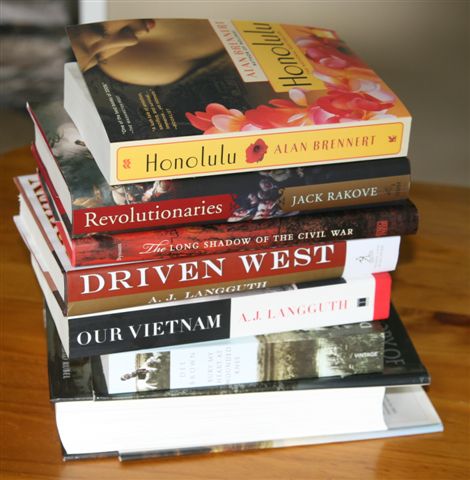
Here are a few books that I enjoyed.

Peter FitzSimons is a journalist, an ex Wallaby (Australian Rugby player) and a prolific writer with twenty one books so far to his credit. He is predominantly a biographer. This time however he has written about growing up on a citrus orchard in the Peats Ridge area just north of Sydney during the 1960s.
An entertaining book written in his usual humorous style full of characters synonymous with the Australian bush and that era. The hardships and discomforts of country life are tempered by family love and support. Many of the scenarios reminded me of my childhood even though it was in suburban Melbourne. And, yes, it was indeed a simpler time.

Andrew Jackson...hero or villain? He was certainly a man of contradictions. A supporter of slavery and Indian removal on one hand, and on the other, a reshaper of American politics, including popular campaigning techniques, media manipulation and engagement of citizens in the process. He transformed both the American presidency and the nation he led during his two turbulent terms in office.
The book covers all the usual ground, Eaton affair, the Bank Wars, Federal Import Tariffs and Nullification as well as the many personal and political conflicts with the other major players of the time.
However there is plenty of new material gleaned from personal papers in the Hermitage archives.
Can be read as a history book or an historical novel.
A good follow up to the above Andrew Jackson book covering the sorry tale of native American tribes' forced removal from the east to the mid west over a number of presidential administrations. It is a story of greed, betrayal,and racism vividly told in the typical Langguth character driven style. I found the story of internal tribal conflict over Removal particularly interesting and not one generally well known.

A work of fiction which includes some actual real life characters eg. Father Damien, woven into the story. It's a tale of the leper colony on Moloka'i, Hawaii with a little bit of Hawaiian political history and centuries-old Hawaiian religious beliefs and mythology thrown in.
An easy read and with a 'hard to put down' status.

Saturday, January 15, 2011

Back Up!

It seems I am destined to buy computers with a four year shelf life.
My HP laptop started doing 'funny things' a few months ago and, from experience, alarm bells started ringing.
So I started to back up my files.
Then all went quiet and I thought it was just a false alarm.
But no, a few days ago............POOF!
The dreaded blue screen.
Optimistically I took it into the repair shop. I always do this and always I get bad news and a bill for $50.
This time was no different.

So now I have a new one. Not another HP (you have had three chances, guys) but a Toshiba.
Learning a new operating system, Windows 7, reloading other programs and reestablishing 'favorites' is a time consuming task.
At least I have my precious files including photos and word documents.
The only exception are emails. I looked at backing these up a few times but it was a quite a convoluted procedure which I sadly postponed. But at least I had backed up my email address book.
So the lesson to be learned from all this is BACK UP!

External HDD's are cheap and easy to use. USB sticks even more so.
Put aside an hour or so every week or two and just do it!

Friday, January 14, 2011

The Queensland Floods

This is all happening 1000km or so to the north of us so we are unaffected. The Northern Rivers of New South Wales are also in flood.
It has been devastating for all concerned with many lives lost.

The Brisbane Times Newspaper is the best web site to catch up with all the details as well as some pretty grim pictures.
But as usual, Australians meet adversity head on with a little humour.

A statue of Rugby League football hero, Wally Lewis, outside the Brisbane football stadium is dressed appropriately.

Thursday, January 13, 2011

The Daughter's Italy / Part 2

My travel companion Ms. B, and I landed in Naples airport on a humid afternoon with a long and unbeknown to us, convoluted trip ahead of us. We had challenges you see. Not only did the trip from Naples to Positano involve various planes, trains and automobiles, but in true family form I was H-u-n-g-o-v-e-r. Yes, with a Capital H. I had been out partying until 1am in my old Cambridge stomping ground and then I couldn’t sleep because I was paranoid about missing my flight. Polish vodka + old friends + early morning flight = Travel nightmare!

Something to remember when visiting Naples, well actually – strike that, make it ALL of Italy is that the male population are not backwards in coming forward. You could have heard a pin drop and the necks cracking as we collected our luggage and made our way to the bus. I hurriedly explained to the incredulous Ms. B that we were not about to get mugged by the group of mafia looking types that followed us, but they were simply staring because we were WOMEN. You know.. because Italy doesn’t have any women – right?
After navigating the connections that took us to the dizzying heights of Positano we disembarked the bus with a sigh of relief. I should have known that Italian bus drivers could drive one handed along sky high cliffs, while arguing with a passenger in addition to talking on his mobile phone. Believe me, my friend, The Hangover (yes, at that stage it was still with a Capital H) was tagging along in full force.

There’s always a problem with taking the bus in Italy. Knowing which stop to get off at – we knew we were in Positano… we could even see our hotel… but what separated us from it was about 1000 steps down to it (who knew we should have waited another stop?). So off we trudged. In the rain. With our suitcases. And a new friend who became a fixture in our Positano stay. Randy the dog (I will leave it up to you to deduce how he came to earn his name.. along with his girlfriend…. Mandy).
A pizza, a few glasses of Chianti and a generous serving of gelato in one of the seaside restaurants soon set things straight (and farewelled the Hangover – Hurrah for small mercies!).

I had one thought as we watched the sun slip into the sea…
Italy….. I really, truly, unashamedly love you.

Saturday, January 01, 2011

Looking Back at 2010

A Happy New Year to all my readers.
Looking back, I guess the major highlight of 2010 was the breaking of the seven year drought. With the La Nina influence in full affect, rain came to most of Australia. Lake Eyre filled, even the Todd River in Alice Springs flowed and metropolitan dams that were down to twenty percent or less capacity are now over flowing. In fact a lot of NE Australia is now in flood.
Our dams and tanks are certainly full.

Weather also produced one of our year’s low lights when a horrific wind storm in early September battered us for 24 hours bringing down trees and leaving us without electricity for 3 days. Luckily there was no one hurt or house damage done.
Our decision to stay home and travel was a good one. The journey through western New South Wales into South Australia to the fringes of the outback and back through coastal Victoria was a highlight of the year.

We backed this up with a trip to northern Queensland and the Great Barrier Reef with American family in September. The day we spent snorkeling on the outer reef was magic!

Politically, our first woman Prime Minister, who came to power during a party coup, was re-elected for another term albeit as head of a minority government.
Australia had missed out on the worst of the global financial crises but the poor situation in North America and Europe continued to influence our stock market which bounced along at a regular level for most of the year. At least it is well above its lowest levels of a few years earlier.
The big news was the strength of the Australia dollar with it being worth more than the US dollar for the first time since it was floated in the early 1980s. Its strength was also reflected in record levels against the Euro. How long will this last is anyone’s guess but our currency is noted for being an investment ‘plaything’ so we just have to take advantage while we can. Certainly the high level reduces the competitiveness of our export industries eg. minerals, which are a major component of our economy.

So what are our plans for 2011?
First off we will enjoy the rest of summer, mainly at the beach, and then get through harvest. Then we will look at some travel plans for later in the year. With our strong currency the USA or Europe (or maybe both!) look tempting. But with the success of staying home to travel in 2010, southwest Western Australia and Tasmania are also on the radar.
So much to see, so little time!

Thursday, December 30, 2010

Spiders

Australia has its fair share of spiders and a lot of them are quite nasty.
We have in our area the funnel-web and redback whose bites can be lethal. The white tail and mouse spiders are not too pleasant either.
But we don't see too many of these on a daily basis.

The black house spider is however quite prevalent. It prefers dry habitat areas and secluded locations and is commonly found in window framing, under eaves, gutters, in brickwork, sheds, car ports and among rocks and bark. Electric lights attract their main food source of moths, flies, mosquitoes and other insects so they tend to congregate on our front and back verandahs as well as in the garage. Their bites can be painful but not lethal.

The St. Andrews Cross spider is also common. This spider with its brown and yellow striped markings is a web-weaver usually found in summer in garden areas around the home. It is considered beneficial as it spins a large web to snare flying insects, such as flies and mosquitoes. They are non toxic and non aggressive. There are a lot of these in the vineyard.
An adult Huntsman spider may have a body length of up to 20 mm. It's the diameter including legs may reach 45 mm. The first 2 pairs of legs are longer than rear two. This spider is hairy, buff to beige brown colour, with dark patches on it's body.

The spider prefers to live under the flaking bark of trees, under flat rocks and under eaves or within roof spaces of buildings.
It often wanders into homes and is found perched on a wall. They are shy, timid spiders able to move sideways at lighting-fast speed. We usually 'relocate' the ones we find inside.
We always have plenty of these around.

Saturday, December 11, 2010

Why is the Surf SO Cold?

It's almost mid December.
It's summer.
Daytime temperatures are getting up into the high 20s.
Then why is the ocean so cold? Jumping into 15-16 degree water is no fun.
This is winter stuff.
Finally we had an explanation from my surf report web site today.
Coastalwatch.com report that "The coldest water is pretty much isolated between the mid north coast (around Port Macquarie) and the south coast (Eden/Bateman’s Bay) anomalous to what we expect for summer and a La Nina season.
This summer is not living up to its reputation. We have just endured the wettest spring on record, the wettest start to summer, and sea surface temperatures have been fluctuating around 16-17 degrees(DECC, MHL) during the last week of November and the first few weeks of December, the lowest recorded temperature was below 15 degrees. The East Australian Current travels south down the east coast sending warm water down to Tasmanian waters from QLD, however BOM sea surface maps show the current is flicking offshore just south of Port Macquarie transporting warm water offshore.
During La Nina cycles the east coast of Australia is expected to experience warmer wetter conditions and persistent onshore winds. Relentless ENE and NE winds blowing at a parallel angle to the coast drive ocean currents south and offshore, due to the Coriolis Force. The centrifugal motion of the Coriolis effect causes water to move to counter-clockwise in the southern hemisphere i.e. away from the coast.
Persistent onshore wind conditions result in Ekman transport, the term for when surface water is pushed away at the ocean surface and is then replaced by colder water from the depths offshore."
So there you have it.
We can only wait and hope.
Meanwhile it's fun to watch the newly arrived tourists running down the beach for their first plunge of their holiday....and then obviously wishing they hadn't.

Friday, December 10, 2010

BOOKS!

I love books.
Reading has always been a passion. So much to learn, so little time.
Nothing like the smell of a bookshop and especially a newly opened book.
But books are really expensive in Australia due to Parallel Import Restrictions (PIR's).
Under the PIRs, if a novel or textbook is published in Australia within a certain time limit of it being published elsewhere in the world, booksellers cannot import and sell stocks of the same book from UK, the US or Asia. This enables rights holders to charge prices (or obtain royalties) in the Australian market with the certainty that they cannot be undercut by commercial quantities of imports of the same titles.
This means in the USA, the same book can be 50% or more cheaper than in Australia. Needless to say when we are in the USA, we stock up to our airline baggage allowance limit.

Then there is Amazon.com
Both the co driver and I keep a running list of books that we are interested in. These are usually gleaned from reviews, references in other books, author interviews on TV, web sites and word of mouth.
When we have a sufficient amount, we order from Amazon. Ten or more books including airfreight costs are still around 50% cheaper than we can get here. The near parity $A/$US exchange rate is also a help.
The government is not interested in collecting tax on such small value imports (they have a $1000 limit) so that saves us another 10%.
Our last shipment arrived yesterday. It is always like Christmas opening the box.
And that smell!
Can't wait to get started on them!

Monday, December 06, 2010

The Daughter's Italy / Part 1

Italy. My credit card’s Achilles’ Heel but always and forever my happy place. Numerous visits to the home of creamy gelato, heavenly pizzas, rolling Tuscan hills, azure seas and lecherous men have not quelled my fascination and love for a country that lies 14,000km from my home.


I barely speak the language. "Non parlo molto Italiano" is my favourite Italian phrase and get-out-of-jail-free card (see lecherous men above). I don’t seem to actually do all that much when I am there apart from shop for beautiful handbags, drink wine and meander around the countryside…. Oh… and I eat…
I eat A LOT in Italy. One afternoon after a third Nocciola gelato (hazelnut ice-cream) I pondered how many gelatos a day was considered excessive. I mean – you have to have one mid-morning to quash those hunger pangs as you peruse the shops (glorious lunchtime aromas of garlic, oregano and basil start wafting through the air – it’s a killer). Then comes the post lunch gelato – always a must – you need to help all that pasta, cheese and bread digest don’t you? Last, but definitely not least is the post dinner gelato. This is enjoyed while practicing the art of "la passeggiata". This is a great evening ritual in Italy. Everyone strolls gently (slow! think slow!) through the main streets of the old town. Italians tend to dress up in their latest designer gear (seriously though, when don’t they dress up??) and tourists are usually easy to spot in their dusty jeans and Converse (yes, me). I love that la passeggiata is where budding romances are displayed as well as newly purchased shoes and handbags. So, after some lengthy consideration I have come to the conclusion that 3 gelatos are just right (because anymore would be just plain greedy – right????).

Friday, December 03, 2010

Introducing a Guest Blogger

It's still raining here. Most outside activity has been put on hold. This means blog subjects are a little hard to come by.
But there is a solution at hand. The daughter has just completed a five week tour of Italy and France and has offered to share some of the highlights.
Here's what she originally wrote in the offer to help her old man out:
.
I’m not going to lie to you. I am the first to admit that the idea was not very original – especially since it came to me while flicking through a copy of 'Eat, Pray, Love'. I thought to myself “If you could go anywhere in the world this very second, someplace that would make your heart sing and your lips smile wide - where would you go?”.
Without a moment of hesitation, the answer came to me.
One word. Three syllables. Italy.
So now she is busy writing her story. I have seen the pictures and now wait expectantly for the tales behind them.
Hope you will all enjoy them too.

Saturday, November 20, 2010

A New Grape Variety?

There are two ways of propagating plants. One is sexually by seed, the other is asexually by vegetative means eg. cuttings, grafting, budding, layering are some of many.
One of the problems with sexual propagation is that in many cases a seed will not produce an exact ‘copy’ of the female parent due to its heterozygous nature.
On the other hand vegetative propagation will ensure an exact 'copy' of the parent.
Last year I found a grape seedling growing in a remote part of the garden. One can only assume the seed was deposited there by a bird and it came from one of the five varieties of grapes I grow here.
So I dug it up and planted it in a pot.
This year it has grown extremely well.
And the resultant vine is quite a puzzle .
The leaves of the new vine (top) look pretty much like Cabernet Sauvignon (bottom) with medium deeply five lobed leaves and the petiolar sinus cut right into the veins at the base. The only other vine that I know of with the latter characteristic is Chardonnay but its leaves are three lobed and very much different in shape.

The most distinguishing feature of the new vine however is its red shoots and red leaf veins and none of the established vines here have that.
Do we have a new variety here?
Will the fruit be red or white?
Next year I will plant it out and wait to see what eventuates.