Friday, June 09, 2006

Lewis and Harris

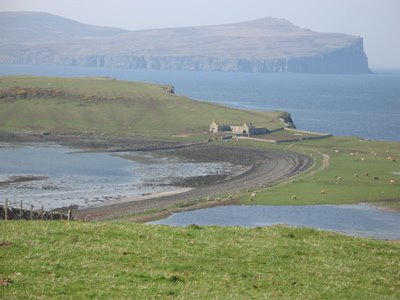
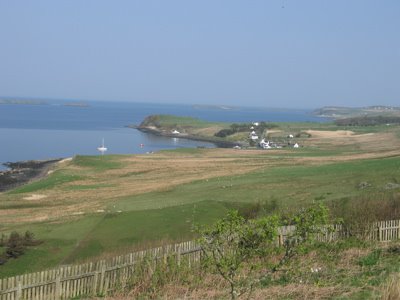
Sitting in the ferry queue at Uig, the fog began to clear and we were in for yet another fine sunny day. The trip across the Little Minch to Tarbet on Lewis and Harris takes around 90 minutes. It’s pretty smooth sailing with great views. After landing, we headed towards Rodel at the tip of South Harris. The scenery here is amazing. Rocky, treeless hills and mountains and peat bogs. You could be on the moon. These islands are made of some of the oldest rock in the world, some 3000 million years old. Man has lived here for some 6000 years. Gaelic is the language spoken. The dialect in Harris differs from that in Lewis despite the fact it is one island. Gaelic is also the language of the road signs. This could be a bit of a problem if you have an English language map. Then you realize that there is only one main road and all side roads eventually come back to it.

The narrow “highway” winds around the mountains changing from two lane to single-track road at whim. Suddenly we were on the western coast. Wide white sandy beaches with azure blue water stretched into the distance. If the temperature wasn’t 10C you could be in Hawaii. Maybe you would need to plant a few palm trees as well.
Traveling through Leverburgh we ended up in Rodel. This might be the end of Harris but it could also be the end of the world. One lone hotel stood on this barren point looking over the Sound of Harris to the Island of Uist. It was the dourest looking building I have seen. But we took the plunge and went for lunch. Inside was the complete opposite to the exterior. Warm inviting bar and restaurant, good food and beer and very friendly staff. I don’t think they get many tourists down there in May. It was nice to hear the quiet lilting Gaelic language being spoken (except to us). It is in complete contrast to the relative hard Scottish brogue we had become used to.
Buoyed by our lunch and a few beers as well as the fact we were becoming used to the intimidating landscape, we decided to head back to Tarbet via the minor eastern route. Well, the road looked fairly straight on the map.
It wasn’t!
It was the narrowest, twistiest, hilliest and sheep strewn single-track road yet traveled. But the scenery was just WOW! Deep indented sea lochs with their tiny villages were to our right, rocky wind swept peaks to our left (and ewes and lambs in front).
The next day started cold, misty and wet. We drove north over the ‘border’ mountains into Lewis. It’s quite a climb and, on the pass, it started to snow on us. The descent provided even more spectacular views. Taking a B road we drove towards Miaviag passing a field of standing stones and came across some beautiful beaches and seascapes. At random we chose to do a coastal circle road and ended up at a surf beach (possibly called Cliobh) on the Atlantic coast. By now the sun was out but it was a cool 5C. It was time for a beach walk. Then we knew why we had taken our winter coats (plus gloves plus ski cap). The wind chill must have had the temp below zero.
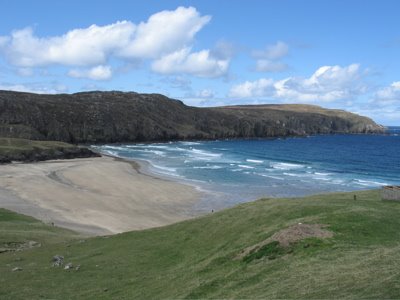
Continuing around the coastline into Loch Rog we came across white sandy beach after sandy beach as well as islands just offshore i.e. within swimming distance if you had a 10mm steamer wetsuit, all with the same white sand and azure blue water.
Notice I am no longer mentioning single-track roads. They were the norm by now and we were handling them well.
Taking another side road we arrived on the Great Bernera, an island just off the mainland. Here they had found evidence of ancient civilizations and had rebuilt an Iron Age house. They had also uncovered evidence of Viking occupation. Those Iron Age dudes knew a thing or two about real estate. The view over Bosta Beach to the outer islands was something.
A major attraction of Lewis is the Callanish Standing Stones. It is considered one of significant and important megalithic complexes in Europe. It consists of rows of large pieces of Lewisian gneiss arranged in a cross shape.
They were erected between 3000 and 4000 years ago and are a complex arrangement of some 50 stones. At their heart is a circle of 13 stones between 8 and 13 feet tall, surrounding the tallest stone on the site, 16 feet high and weighing in at about 5.5 tonnes. Some time later a stone tomb was added to the centre of the circle.
Extending north from the main circle is an avenue formed by a double row of stones, while single rows of stones extend roughly east, west and south from the main circle.
It is thought that the alignments of the various stones were used to mark significant points in the lunar cycle. The stone circle and the north avenue were probably built before 2000BC, while the three single lines and the tomb added around 1500BC.
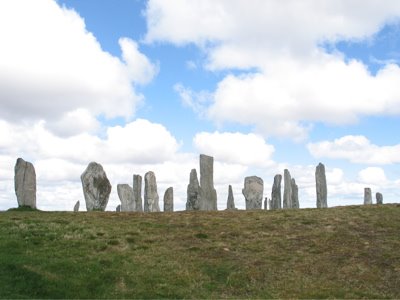
The site had probably lost its special significance by about 800BC, when a small settlement was built close by. By then climate change had meant peat had been growing across the site for over 500 years and some of the stones were probably already out of sight. The peat was cleared from the site in 1857, by which time it was approaching 6 feet in depth.
Although of huge significance the stones have not always been as well respected as might be expected. One of the stones at the end of the north avenue was broken in the 1860s. The missing tip was later found in a local wall and stuck back in place. Meanwhile a stray stone to the south east of the main circle was set in concrete in the 1860s after being snapped off by a drunk waiting for a boat at the nearby pier.
We had a late lunch at the visitor centre a decided to call it day and make our way back over the mountains to Harris and Scalpay. No snow, just bright sunshine this time.
Sunday is a closed day on Lewis and Harris so you have to make sure the car is filled with petrol and that you stock up on some picnic food on the Saturday. The really mean it too. There was a sign outside the local playground in Scalpay, in English, that said CLOSED ON SUNDAYS!
Because of this we had a dilemma. We had been told that we must go to Huisinis Bay. We still had things to see in Lewis and if we did those Sunday it was possible that they may be closed.
We let the weather decide and as Saturday was fine and sunny we headed for Huisinis.
Our guidebook told us that the B887 to Huisinis is 15 miles of the narrowest and most challenging single-track road we are likely to find again, anywhere in Scotland. And once you get to the other end, and you have had your fill of what's waiting for you there, you have no choice but to turn around and drive the 15 miles back.
The first stretch of road contours around the hillside above Loch a Siar. On the shore below there is the tall brick chimney and the remains of the other buildings of Scotland's last shore-based whaling station at Bunabhainneadar. This was established by the Norwegians in 1904 and purchased with three whaling vessels by Lord Leverhume in 1922 as part of his grand plan for the development of Leverburgh. After his death in 1925 it fell into disuse. A little further on the road passes a rather surreal sight: Bunabhainneadar Tennis Court, built and operated by a sporting charity and available for hire every day of the year (except Sundays). We'd be surprised if there's a tennis court anywhere with a better view.
Prominent in that view to the south is the Island of Taransay, abandoned as unsustainable by is remaining population in 1942. More recently it achieved fame as home in 2000 to a group of people as part of the TV programme "Castaway".
The next surprise en route to Huisinis is the biggest. About ten miles along the road, it mounts a rise and you suddenly find yourself in the front garden of Amhuinnsuidhe Castle. This was built in 1864-7 for the 7th Earl of Dunmore, whose family had brought Harris in the 1830s. The Bulmer cider family owns the castle and the surrounding estate and you can rent it by the week. The road runs right past the front door of the castle before rounding the end of Loch Leosavay and continuing west.

Journey's end is the car park at the east end of the stunning white beach at Huisinis. This is a truly wonderful spot, somewhere to watch the waves breaking or to explore the beach and the surrounding rocks. Huisinis itself is a small collection of cottages and crofts at the west end of the beach, and you approach either along the beach or along the road behind it, which the windblown sand is trying to reclaim for nature. They were right about the road. The 15 miles took us over an hour and caused a sweaty back. Who expected a semi with a bulldozer on the trailer to be using this road!
Huisinis lies at the far end of a neck of land leading to a headland and if you climb the grassy slopes to the north you realise that Amhuinnsuidhe Castle is not quite the final surprise in store on this wonderful journey. Facing you across the half mile wide Sound of Scarp is the island of Scarp. By 1881 clearance elsewhere meant there were 213 people surviving on this beautiful but barren island. But the population fell through the 1900s, the school closed in 1967, the post office in 1969 and the last two families left on 2 December 1971.
Scarp is now best known for a failed attempt to improve the poor inter-island communications that contributed to its demise. On 28 July 1934, the German rocket scientist Gerhard Zucker launched a 14kg solid fuel rocket carrying mail from Huisinis towards its intended destination on Scarp, including a letter written to mark the occasion by the King. Unfortunately the rocket exploded on launch. The scattered and singed mail was collected by the Harris postmaster, marked to record it had been "Damaged by explosion at Scarp, Harris", and delivered by more conventional means. A later rocket fired from Scarp to Huisinis was successful, but the idea never caught on.
We spent a few glorious hours here out of the wind in the sun. Only 4 other cars came and went in that time. Definitely one of the highlights of our trip to Scotland!
After picking up supplies and lunch in Leverburgh, we drove back into the maze of little roads that serviced southeast Harris. Here we found possibly one of the remotest coffee shop and art gallery in the world. Margaret was again the recommender. Set above a small cove with a few crofts and fishing boats we enjoyed a good cappo and fresh scones, jam and cream. They also had internet. VERY SLOW INTERNET! It took me the time limit of 10 minutes just to access and read my email. This area is also the home of the famous Harris Tweed. Unfortunately both cloth and yarn were too expensive for our wallets.
Sunday saw us back over the mountains and on our way to the Butt of Lewis and its impressive lighthouse. The landscape of Lewis is completely different from that of Harris being predominantly rolling heather covered hills and peat bogs. The relative flatness is quite a contrast. They still dig the peat for fuel and piles of it are drying along the road.
This was about as far north as we could go here and would be during this trip. Back along the west coast we came across the single Trussel Stone, at 6m the largest standing stone in Scotland.
The Gearrannan Blackhouse village was closed but we were still able to walk around and spend some time at a very picturesque location. Although people lived in this area of western Lewis in the Iron Age, "modern" settlement here dates back to the 1600s. For over three hundred years people eked out a living here; lived, died, paid their rents, or were quickly evicted if they didn't. The 1886 Crofting Act gave crofters a security of tenure they had never had before and patterns of living and farming changed as a result. The blackhouses seen in Gearrannan today, though seeming much older, date back only to the end of the 1800s.
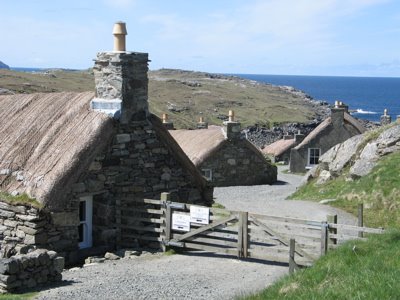
Perhaps the most remarkable aspect of life in Gearrannan was how far its inhabitants had to go to earn a living. In May 1920, as part of an annual cycle, seven teams of three women from the village left for Stornoway to process fish before following the herring to the east coast of Scotland then down to eastern England, only returning home at the end of the season. In 1934 a team of three sisters from Gearrannan won the title of "Supreme Champions" in Lowestoft for gutting, salting and layering a barrel of herring faster than anyone else. And it wasn't just the village women who were well-traveled: in the 1950s men from Gearrannan could be found in South Georgia in the South Atlantic each year for the whaling season.
Meanwhile life in the village changed only slowly. In Gearrannan, oil lamps were replaced by electricity from 1952, and in the 1960s piped water arrived in the village, though it still had to be fetched from outside taps. This brought to an end the tradition of communal washing of heavier laundry in the loch, with water heated over open fires on the shore. And from 1965 a daily milk delivery started, ending the need to keep a cow and grow the crops to feed it.
By the 1970s those who could leave had left for easier and more modern accommodation nearby and only five residents remained in the blackhouses. In 1974 the last occupants moved out, leaving the blackhouse village to the ghosts of a way of life now gone.
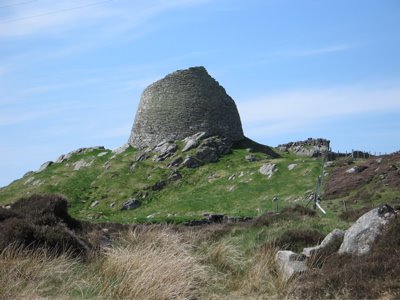
Just down the road we found a pub that was actually open for lunch (thank you tourist guide) and little beyond that the Carloway Broch, an Iron Age fort which dated back about 2000 years.
So it was back to Scalpay for our ‘picnic’ dinner and preparation for our trip to Stornoway to catch the ferry back to the mainland the next morning.
For me Harris and Lewis was one of the most interesting and strangely beautiful places I have ever been to. My Scottish father was right to tell me to go there one day. Pity it took me 30 years to heed his advice.
Tuesday, June 06, 2006

Isle of Skye to Lewis and Harris

It’s a quick 25 minute trip across the Sound of Sleat from Mallaig to Armadale on Skye on a very comfortable Calmac ferry. We drove another 90 minutes along one-track roads in single file with the rest of the cars from the ferry and then, thankfully, on the major north south highway through some pretty stunning country with snow capped mountains, deep valleys, heather covered moors and vast seascapes to Edinbane and our accommodation at the Lodge Hotel.
Built in 1543, this building has had many uses over the centuries including a hunting lodge and coachhouse. It is now a pub with B&B facilities. Not the most modern place we stayed in, but our hosts Hazel and Peter made it like home. The bar with its sprinkling of regulars in the evening, the lounge with its huge peat fueled fire, the great breakfast (with haggis (OK) and black pudding (yuk)) and home cooked dinners made for a comfortable stay. Hazel was a wealth of tourist information and where else would the host race out to the car park with your room key when you arrived back from a day’s sightseeing. It also had a resident ghost which we never saw.

The following day saw blue sky and sunshine and was the day, we were told, to go on the Loch Coruisk boat trip on the ‘Bella Jane’.
We first explored the main town of Portree, a fishing port on a well protected harbor with its Thomas Telford designed pier. Here you can tie your fishing boat up and wait for the tide to go out to do some bottom scraping (of the boat that is). The town itself clings to the surrounding cliffs and is a hive of activity full of hotels, B&B’s and restaurants. The town centre has two main streets built around a nice square. There were the usual smattering of tourist businesses including the ubiquitous Scottish Woollens Shop, potteries and, unusually, a hand made soap and candle shop which managed to open one of our wallets.
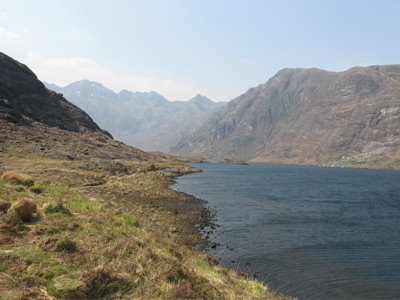
After lunch, we drove back down south to Broadford where we picked up some really beautiful naturally dyed silk yarn. Then, on another twisting narrow hilly one-track road complete with wandering sheep without an ounce of road sense, we arrived in Elgol. There we picked up our small boat and motored across open ocean to the loch. This is the Cuillin Hills area of Skye with rugged snow capped mountains rising to a height of over 1000m. Islands at the entrance to the loch were home to a sun basking seal colony. They dropped us off just below a waterfall that drains the loch into the sea and told us they would be back in ninety minutes. Talk about isolation! An ‘on the run’ Bonnie Prince Charlie supposedly said of this place “even the Devil shall not follow me here”. We walked along the loch shore, found a sheltered spot in the sun and sat gazing at the most amazing scenery. Yes, they did come back and get us and after a pretty rough trip back to port, we wound our way back to Portree for a really nice seafood meal and a bottle of Marlborough Sauvignon Blanc which made our hard working New Zealand waitress happy.

Next morning was again bright and sunny, and it was the day to do the northwest circle tour. We drove down the Waternish Peninsula on a single track that leads to Stein, Lusta, Trumpan and other small settlements. Trumpan found its place in history as the site of two separate massacres on a single day in May 1578.
It helps to understand the background. In 1577 some 395 MacDonalds on the Isle of Eigg were killed by raiding MacLeods from Skye. The MacLeods lit a fire in the entrance to the cave in which the MacDonalds were hiding and suffocated them. On the first Sunday in May 1578, MacDonalds from Uist arrived in Ardmore Bay and caught the local population of MacLeods celebrating mass in Trumpan Church. In an act of revenge for Eigg they barred the door of the church and set fire to the thatched roof. All but one of the MacLeods were killed.
The girl who escaped managed to get word of the attack to Dunvagen. More MacLeods quickly arrived in force, capturing the MacDonalds' boats stranded by the retreating tide in Ardmore Bay. They attacked and killed the raiding party. The dead MacDonalds were lined up next to a turf dyke or wall, which was pushed over on top of their bodies. For this reason the Battle of Trumpan is also sometimes called the Battle of the Spoiled Dyke.
The ruined St. Conans church is still there and the view over Ardmore Bay is stunning.

We drove into Dunvegan catching a glimpse of the castle which is the seat of the MacLeod clan and then on to Waterstein with its lighthouse and magnificent views over Moonen Bay. Is it my imagination or were these single-track roads getting narrower and populated by more and sillier sheep?
At Carbost we sat in the beer garden of a loch side pub in brilliant sunshine and had a simple lunch before visiting the Talisker Distillery where a distinctive single malt scotch is made. We were given a tour and had the process explained. Distilleries have lost the human touch these days and are basically factories. Where once this one employed 60 now 6 plus computers do the job. We were also given a dram of the particularly fiery liquid to try. Hmmmmmmm…… a few of these might take the pain out of single-track road driving!
Next day was again bright, warm and sunny! What is going on here? Why did we bring our thick heavy waterproof jackets?
Time to do the northeast circle tour of the Trotternish Peninsula.
As we drove north out of Portree, we became aware of The Storr. This 720m mountain rises above the east-facing cliffs that run down the centre of the peninsula for most of its length. It is almost as if the entire eastern part of Trotternish slipped suddenly at some time in the distant past.

And if The Storr is not dramatic enough, sitting at the foot of its cliffs is a 50m high tooth of rock, the Old Man of Storr, so daunting it remained unclimbed until 1955. The Old Man is part of a weird wonderland of rock scenery and outcrops that lie above and below the cliffs. The road north took us along a coast marked by spectacular rock scenery. There are many stop off points and short walks along this road to enjoy the views. Best of all is Kilt Rock, 200ft high cliffs marked in an almost tartan-like pattern by the rock strata, and with a waterfall tumbling sheer to the pebbled shore below.
The grave of Flora McDonald, the woman who saved Bonnie Prince Charlie from capture by the English, is at Clarin. We stopped to pay our respects and met a couple on tour from Brisbane. They turned out to be friends of friends I grew up with. Small world!!!!!!
There is more to the Flora MacDonald story than her association with Charles.
After he eventually escaped to France, Flora was arrested after one of the boatmen had talked about the strange maid who had traveled with them to Skye. She was imprisoned, first in Dunstaffnage Castle, then in the Tower of London, where she was allowed to live nearby "on parole". Flora's story and her courage gained her much sympathy in London and in 1547 she was allowed to go free.
In 1750 Flora married Allen MacDonald of Kingsburgh. In 1773, like many other Scots, they emigrated, moving to the North Carolina Colony. During the American War of Independence Allen served with the British forces (in common with many other expatriate Scots). He was captured by revolutionaries at the Battle of Moore's Creek Bridge on 27 February 1776. Flora was exiled from the United States to Nova Scotia.
In 1779 Flora returned to Scotland and settled in South Uist amongst her clan. She was joined by Allan after his release in 1783 and they moved to Flodigarry, on the Isle of Skye. Flora died on 4 March 1790. To keep the Jacobite legend strong to the end, it is said that she was buried in a shroud formed of a bedsheet used by Charles. Apparently he never made contact with her again after his escape. The more I get to “know” Charles Edward Stuart, the less time I have for him. Is it treason for a man with 50% Scottish blood running in his veins to say this?

That afternoon, after lunch in Uig, we headed back to Stein and the Stein Inn for a few beers in blazing sunshine by Loch Bay. We stayed well into the evening (it didn’t get dark until 11pm) and it was a perfect end to a great three days on Skye.
Next morning we were up early to catch the ferry to Harris and Lewis. Hazel, the trouper she is, had our breakfast prepared and after our ‘goodbyes’, we set off in the fog back to the port of Uig for more adventure.

Monday, June 05, 2006

Sydney to Isle of Skye

The flights from Sydney to Manchester were long and uneventful. I arrived on time, progressed through immigration and customs without a problem and waited for my partner to arrive from Chicago. We picked up our car, a brand new Vauxhall (Holden) Astra and headed up the M6 towards Windermere. Jetlag and motorways don’t mix too well so it was good to finally get off onto the less hectic country roads. Spring was definitely in the air. The fields were green as green and covered in wild daffodils, the trees were coming into leaf and black faced ewes with their newborn lambs, many twins, were everywhere. We reached our destination in record time despite a few wrong turns and headed for lunch. Good old greasy fish and chips at a chippie.
Then we found the Rockside Guesthouse where we had arranged an early check in and headed up numerous flights of narrow stairs into our attic room (quiet and away from the road) for some sleep. That evening we headed for the pub across the road and consumed a few beers before going back to bed. 9pm was too late for them to serve food.
Of course we woke up at 3am bright and cheerful but were soon put back to sleep by BBC early morning television. There is just so much you want to learn about the blue tit warbler’s mating habits. After a traditional English breakfast we started our Lake Country tour by driving around Coniston Water, scene of Donald Campbell’s demise, in misty rain on some pretty narrow roads that were to be a preview of what was to come in Scotland. Actually, as it turned out, these were freeways in comparison.

We ended up in Levens Hall’s famous gardens which features a topiary garden laid out in 1694. This was a pleasant interlude in clearing skies which got rid of the cobwebs and got us prepared for what was later called a scorcher of a day. 28C!
Back around the shores of Lake Windermere, we arrived in Bowness for lunch. We had been recommended Hole Int’ Wall, a pub built in 1612 and frequented previously by such luminaries as William Wordsworth and Charles Dickens. We had a few pints and a sandwich in the beer garden. By now the sun was streaming down and the Poms were threatening to take their shirts off and show us acres of white skin so we headed to the lake for the traditional holiday lake/river cruise.
We judge these on the basis of the Rhine Cruise being ten points and the Memphis Mississippi River Cruise being zero points. This one scored a five. Pleasant enough but spoiled by Japanese tourists taking pictures of each other taking pictures. After another catch up sleep we went back to Bowness for dinner at another recommendation. This was the Porthole, an Italian restaurant which turned out to be one of the better meals of the trip. We forewent our entree in order to buy a 1st growth St. Emilion to go with our excellent pepper steak (with a sauce to die for). Then we succumbed to dessert.
Then came the bill!
I will not harp on about the prices in the UK, especially when converted back into Australian dollars ($A1 = GBP 0.40) but we were caught a little by surprise. Just a few examples in case you are intending to travel there. Petrol cost $A 2.50L (that’s $US7.50 gal), a pint of beer was $A6-$A7, a pub lunch with a beer was a minimum of $A25 each and a double room with en suite in a STB rated four star B&B averaged $150 a night. I should also mention here that despite the fact that British cooking and, in particular pub food, gets a bit of a bashing, we were more than happy with the variety, freshness and presentation offered, even in the smallest country village. British stodge still exists for the traditionalist but we were never forced to succumb.

Next morning and another sunny day, we drove over the spectacular Kirkstone Pass. Its barrenness and moonscape is in complete contrast to the Lake Country we left behind. However after some easy country driving and great scenery, we were soon back onto the M6 and into Scotland.
Again we hit the country roads and arrived at the medieval Caelaverock Castle built in 1270. It is an archetypical fairy-tale castle with a moat surrounding its red stone towers. Despite being the victim of many sieges, border clashes and its eventual demise in 1640, the structure is still in amazing condition. Almost alone, we were able to climb stairs and enter some rooms with their huge fireplaces and soak up the atmosphere.

Then it was on through Dumfries to New Abbey, with its ruined Sweetheart Abbey on the outskirts, for a pub lunch. The story of the founding of Sweetheart Abbey is said to be testament to the enduring power of love. In 1273 Lady Devorgilla signed a charter establishing a new Cistercian Abbey in memory of her husband, John Balliol, who had died four years earlier.
Lady Devorgilla's love for her departed husband extended to carrying his embalmed heart around with her in an ivory box with enameled silver trimmings. After her death in 1289 she was buried in the sanctuary of the abbey church she had founded, and on her instructions the casket containing her husband's heart was buried beside her. Cheery stuff, huh?
Then followed a spectacular drive along the coast to the artists’ town of Kirkcudbright (pronounced kercoobrie; ok, if you say so!) at the mouth of the River Dee where we spent the night at a really nice B&B, Gladstone House, run by an ex divorce lawyer and his wife. They were amusing company and ran a tight ship. We ‘did’ a couple of pubs and ended up at the Selkirk Arms for a very nice dinner of venison sausage and mash.
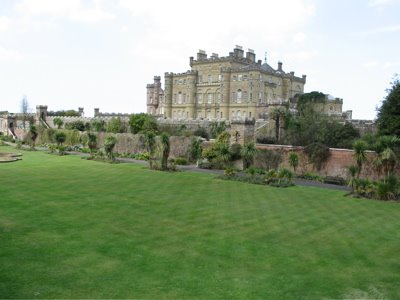
Another bright sunny but colder morning saw us on the road to Culzean Castle passing by the famous Turnberry golf links. This castle stands on a cliff edge with panoramic views across the sea to the Isles of Arran and Kintyre. It was built in 16th Century, remodeled in the 1770’s by Robert Adam and restored in the 1970’s. It’s now in the National Trust of Scotland’s hands and is a showcase of Adam’s neo-classical style. I am not big on castle tours but this is one out of the box. Some of the rooms are breathtaking. It was a favorite getaway for General Eisenhower during WW11 and in appreciation of his role in that conflict, he was given the top floor to use at any time of his life.

Back on the road and we skirted Glasgow heading for our next stop at Arrochar. On the way, we visited the much-vaunted village of Luss on Loch Lomond. It turned out to be a Scottish Disneyland whose only redeeming feature was the old church and graveyard.
Our B&B, the Argyll View, sat at the end of Loch Long with spectacular views to the mountains that tower above the water. It was here the weather turned nasty and we thought our luck had run out. A dinner of salmon steaks in a deconsecrated church now restaurant eased the pain.
Next morning it was cold, wet and foggy. We headed north along the shores of Loch Lomond with the 975m peak of Ben Lomond covered in swirling mists. We knew we must be in the highlands. The road signs became bi-lingual with Gaelic on the top.
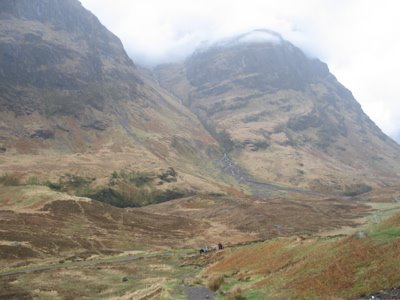
We climbed up onto Rannoch Moor and sped over this barren rugged landscape finally descending into Glencoe Gorge. Wet, cold and misty is the right weather to be there. Apart from its savage history, the area is famous for its awesome scenery and it did not disappoint. The 1692 massacre takes a back seat. At the NTS visitors centre it was hardly mentioned. We heard though, later, that the MacDonalds still have no time for the Campbells.
Little wonder!

Then it was on through Fort William to the ‘Road to the Isles’ and Malliag and our ferry to Skye. Ben Nevis is in the area but its snowy 1345m peak was not to be seen. Apparently it is in cloud 90% of the year. We stopped along the way at the Glenfinnan Monument which commemorates those who supported Bonnie Prince Charlie in the 1745 Jacobite rebellion and where he first raised his standard. Not far down the road is a cairn marking the spot where he left for France in 1746 with his tail between his legs. This sorry tale of folly which lead to Scottish history being changed forever is better told during our visit to Culloden a few weeks down the track.
This is a very spectacular road along Lochs Eil, Shiel and Eilt before hitting the coast and the sea lochs and the first of the white sandy beaches. We had a roast dinner lunch in a nice restaurant in the tiny village of Arisaig. What this establishment was doing here who knows. Maybe it survives solely from the summer tourist trade.
We were coming across more and more single-track roads. These are roads, some of them main roads, wide enough only for one car, which have passing places strategically located along them, every 100m or so. If you see a car coming you pull over onto one of these to let them past. If someone is tailgating you (usually a local in a white mini van or the postman) you should do the same and let them overtake. Sometimes you don’t see someone coming and you meet at the top of a hill on a blind corner. Then it’s time to decide who will back up. It is customary to give a little wave of thanks to those who stop or a toot for those that pull over. It should also be customary for newbies at this game to wear brown corduroy trousers and have a change of underwear handy. We thought these were a little intimidating but we were blissfully unaware of what Lewis and Harris had in store for us.
Mallaig is a busy fishing and ferry port as well as rail head. The setting is very beautiful with tall cliffs surrounding the harbor and the Isle of Skye in the distance about 25 minutes away by sea. We were early so put the car in the ferry queue and went for a walk around town. Lots of tourist shops, hotels and take aways.
But soon it was time to drive the car into the bowels of the ship and head upstairs for a quiet drink while contemplating the next part of our adventure.
And guess what? The weather was improving!

Monday, April 17, 2006

Autumn Colour

The summer to autumn season change is not really noticeable in the bush apart from progressively shorter daylight hours and cooler temperatures. The foliage of native Australian flora does not generally change colour and drop so we live in a green environment 12 months a year. This does not mean we don’t have colour in our gardens and in the bush at this time of year. Many exotic and native plants choose to flower at this time.
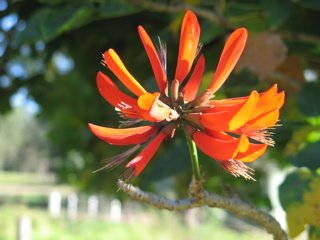
Those we have around us on the south coast include the Coral Tree. This is an exotic species from India. It grows into a huge tree with dark green foliage on thorny branches. It has been used on rural properties for years as a shade tree.

Standing under one of these in mid summer you can feel the moisture being pumped out via the transpiration process. It is nature’s air conditioning unit. But it does have its problems. Large heavy branches are notoriously brittle and can snap off and fall without warning. The timber when dry is like balsa wood and completely useless. Although in Australia its seeds are sterile, it can shoot from any branch or twig that falls on the ground. Uncontrolled, the tree can take over pasture and choke up creek beds. It is now considered a weed and is part of land care organisations’ eradication programs. In autumn the leaves change colour and fall. At the same time bright read spiked flowers start to appear until the whole leafless tree is covered. This then becomes a haven to all the honey loving birds, especially lorikeets.
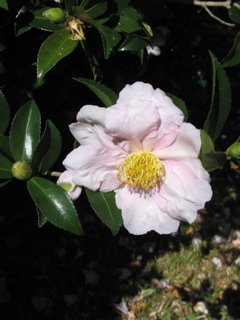
Then there is the Sasanqua which is part of the camellia family and is native to China and Japan. This evergreen bush bursts into flower at the beginning of April and is soon covered with pink flowers buzzing with thousands of bees.

We also have quite a collection of Hibiscus in the garden that continue to flower into winter. Originally a native of Asia, this variety has been hybridised in warmer climates the world over, particularly in Hawaii. The range of colours is stunning. Double and single blooms are possible.

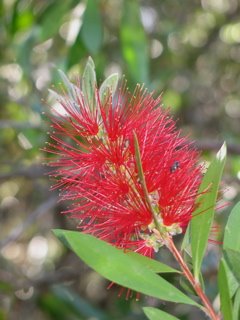
Two native varieties that do well here are the bottlebrush (Callistemon sp.) and Grevillea. Although the former flowers mainly in spring it does have a considerable autumn flush which produces a great number of red bottlebrush shaped flowers.

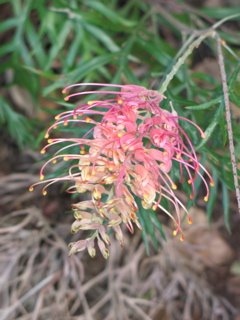
The latter species is easily hybridised and there are a huge number available for the garden. We have Grevillea “Ned Kelly” here which flowers all year round but is at its best in autumn.

An oddity in our garden is the Burrawang (Macrozamia communis) which belongs to the ancient group of plants known as cycads. Our plants were saved when very small from bulldozers in the near by state forest around 15 years ago.
We now have about ten survivors growing to almost 2m in height. They do not produce flowers but cones. Male and female cones are borne on separate plants and look like pineapples. So far we have only seen female cones on the plants we have.

The seeds that develop from the large female cone turn red or yellow when ripe. They are very high in starch and were eaten by Aborigines after they had washed out the toxic components. We only admire them from a distance as the leathery fonds are quite spikey.
Back on the farm, one of the cows has had a calf and another seems imminent. The new addition seems healthy enough and the mother has plenty of milk. She has taken to hiding her offspring so it took a few days to find it and make sure all was ok. Normally Murray Grey cattle do not have problems calving but since losing a mother last year which necessitated the hand rearing of its calf, it's reassuring to at least keep an eye on the couple for the first few weeks.
Our trip to Europe is all planned. We leave the first week of May. Direct flights to Manchester via Singapore from Sydney, then by road and ferry through the highlands of Scotland for the 3 weeks.
The trip home will be via the USA where we will be staying in Tucson, Arizona for a few months. It is from here, hopefully, my next post shall be.

Monday, April 10, 2006

Big Sunday

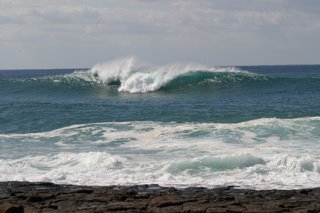
An intense low pressure system in the south Tasman Sea sent huge swells up the south coast of New South Wales. In Sydney most beaches were closed and even the Sydney Harbour ferries were cancelled because of the size of the waves rolling in through the heads.

Seven Metre Wave 500m Off Bawley Point
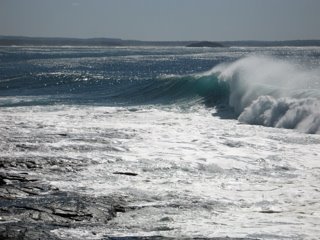
Our local beaches were also closed by the huge swell. At Bawley Point waves were breaking half a kilometer off the point and washing over the normally dry rocky headland. It was a case of take a picture and run.

Complete Closeout of Gannet Beach
Sets of four to five waves were completely closing out Gannet and Cormorant Beaches and washing up over the sand dunes. How much damage has been done to the beaches can only be established once the swell dies down. That is expected to occur over the next few days.

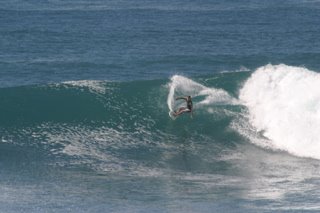
Surfer at Gannet Beach Bombie
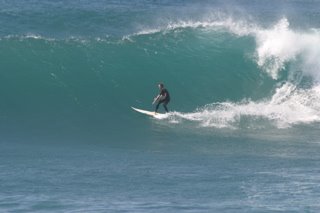
But it was not all bad news. In the lee of Brush Island the swells were rolling over the bombie at Gannet Point and peeling off in perfect long tubes for the surfers who were brave enough to venture out.

Surfer at Gannet Beach Bombie
There were some spectacular rides and wipe outs. Both board riders and boogie boarders were having a great time watched by a large group of spectators on the headland.

Big Swell at Bawley Point
Meanwhile back on the farm, the Cabernet Sauvignon has been harvested and vinification commenced. Sugar level was 13% and pH 3.7. Yield was down due to the wallaby damage earlier on in the year but quality will more than make up for this.
Nets have been removed, rows mowed and the last of the summer weeds sprayed off. Now we have time off from viticultural duties until pruning commences in winter.

An Autumn Vineyard
Last year's vintage has been bottled to make way for this years. The wine has held up well in the tank with no sign of oxidation. Wine quality is acceptable with good varietal nose, medium body and alcohol and just a hint of French oak. A good quaffing wine.
Now it's time to turn attention to this year's overseas trip. Three weeks in Scotland and two months in the USA are planned.

Saturday, March 18, 2006

A Few Days in New Zealand

We flew to New Zealand for a few days on a "visa run". The late morning Air New Zealand flight to Auckland was pleasant and formalities at the airport were completed in record time. We drove an hour and a half south to the small town of Camdridge where we spent the night. This town is full of character with streets of huge trees and quaint old houses. The town centre offered a wide selection of restaurants and pubs. We chose the Oynx Cafe where there was a good selection of local wines by the glass as well as excellent steak.

We can recommend the Cambridge Mews as a place to stay. The one bedroom apartment was comfortable and the bathroom had a huge spa.
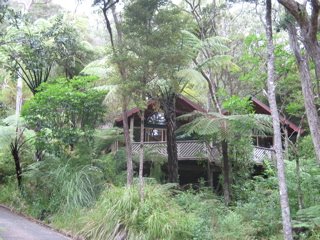
Next morning we headed east towards the coast and headed up to Pauanui. We had booked into the Puka Park Resort (only because they had a hugely discounted mid week rate) and it was worth the stay. The rooms, or chalets as they are called, stand in the rain forest on a very steep hill overlooking a valley with views to the beach. The whole resort reflects its five star status. Transport around the resort is by electric cart only but, apart from being delivered to our room in one, we decided that walking the slopes was not beyond us. The restaurant was ok but not as good as the menu might have suggested. They did have a huge wine list (top wine $750 a bottle!!!!) and desserts were delicious.

Our Chalet, Puka Park Resort, Pauanui
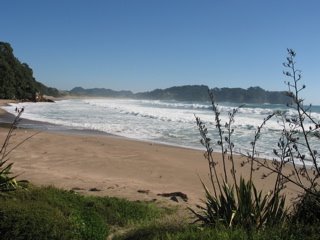
After a nice buffet breakfast we headed further north to Hot Water Beach. Here at low tide you can dig a hole in the sand and sit in a pool of hot thermal water that bubbles up while the surf washes over you. Unfortunately our visit coincided with a very high tide and a monster surf so we have to take the word of the travel brochures that this actually happens.

Hot Water Beach, Coromandel Peninsula
In any case, it was nice to sit in the sun, watch the waves crash in and try to wash unsuspecting tourists to their deaths and read a book. A little futher north is Hahei Beach and Cathedral Cove. Both are beautiful places and not too crowded at this time of year.

Cathedral Cove, Hahei
The main Coromandel Peninsula town is Thames. We got to this busy thriving centre in time for lunch and indulged in a great hamburger and chips. After the rich food of the previous few days it was something we both needed.

Hahei Beach
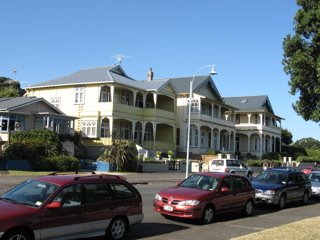
That afternoon we drove into Auckland, across the harbour bridge and into the small village of Devonport. This is a great place to stay if visiting Auckland. It is only a 10 minute ferry ride from the city and has an "olde worlde" atmosphere. There are plenty of restaurants, bars and specialty shops to keep one occupied. We stayed at the Villa Cambria B&B and can recommend it.

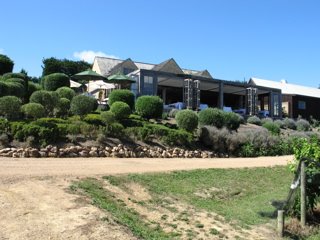
Mudbrick Winery and Restaurant, Waiheke Island
About 30 minutes ferry ride from Devonport, Waiheke Island lies at the head of the Hauraki Gulf. This is a tourist mecca with beautiful beaches, lots of vineyards and spectacular scenery.

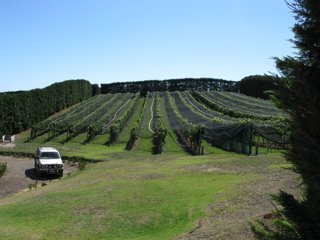
Well Tended Vines, Mudbrick Vineyard
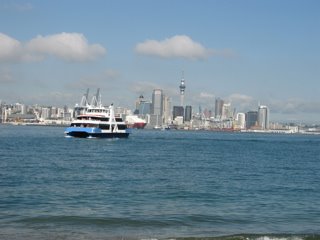
We took a taxi to the Mudbrick Vineyard for one of our traditional three hour lunches. The restaurant over looks the bay with the Auckland skyline in the background. Food is great as is the wine. Hamish, our eccentric taxi driver, came back at the appointed time to take us back to the wharf. This was a great day!

Cane Pruned Cabernet Sauvignon Ready for Harvest at Mudbrick
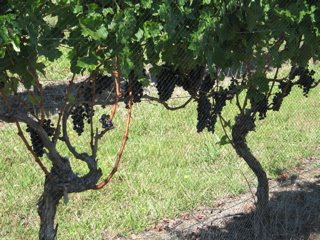
They grow Cabernet Sauvignon and Chardonnay on the island but import a lot of other varieties from other parts of New Zealand which are vinified on this site. We tried a Nelson Riesling and a local Cabernet, both of which passed our taste tests with flying colors. The vineyards are a show case of viticulture with each block surrounded by pine tree wind breaks. Both varieties are cane pruned and there appeared to be considerable leaf plucking employed to increase the ripeness and color of the red grapes. They used cover all netting to protect the fruit from birds and possums!

Grand Old Houses, Devonport
Next morning we headed across the harbour by ferry into Auckland to pick up "the visa". It was a 10 minute job. We did a little sight seeing and shopping but cities are not really our bag so eventually went back to Devonport for lunch.

Auckland Skyline from Devonport
Then it was an easy drive to the airport to catch our flight back (or "beck" as the Kiwis say) to Sydney. Another pleasant ANZ flight had us in on time. We seemed to be the only aircraft arriving so we were soon through immigration and customs and on our way home.

Monday, February 20, 2006

The South Coast Wine Show

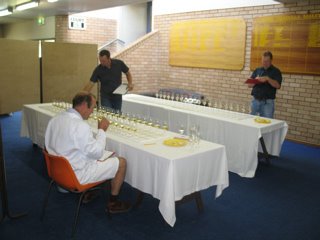
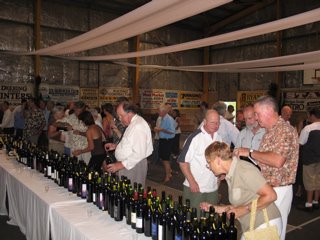
A total of 5 gold, 11 silver and 46 bronze medals were presented at the South Coast Wine Show dinner at Bannisters Restaurant Mollymook. This followed assessment of a strong field of 136 entries in 15 classes by the three highly experienced judges, David Morris, David Lowe and Russell Cody.

Chardonnay Class Ready for Judging
Special awards went to Coolangatta Estate 1998 Semillon (gold medal and trophies for Best Wine of Show, Best White Wine and Best Wine from Shoalhaven Coast grapes), Breakfast Creek 2004 Chambourcin (gold medal and trophies for Best Red Wine and Best Chambourcin), Berrima Estate 2005 ‘Tertini’ Riesling (gold medal and trophy for Best Wine from Southern Highland Grapes) and Crooked River 2004 Unwooded Chardonnay (silver medal and Best Wine Made in a Shoalhaven Coast Winery).
Chief judge David Morris, commented that the best white styles were Sauvignon Blanc, Verdelho & Semillon with a very good example of a young Riesling and some superb aged Semillon. He said this years Chambourcin class was the best seen at the show to date with the best reds being medium bodied Rhone styles with soft fleshy flavours.

The Judges at Work
Coolangatta Estate continued their impressive show record with gold medals for the 2001 and 2003 and 1998 Semillon, as well as 4 silver and 11 bronze medals across a wide range of classes.
Other successful Shoalhaven Coast entrants were: Cambewarra Estate (2 silver, 3 bronze), Crooked River Wines (1 silver, 7 bronze), Kladis Estate Wines (4 bronze), Bawley Vale Estate (2 bronze), Seven Mile Vineyard (1 bronze), Fern Gully Winery (1 bronze), Roselea Vineyard (1 bronze), and The Silos Estate (1 bronze).

The Public Tasting of All Wines
Medal winners from the Southern Highlands were: Berrima Estate (1 gold, 1 bronze); Centennial Vineyard (2 silver, 6 bronze); McVitty Grove (1 silver, 1 bronze); Blue Metal Vineyard (2 bronze); Bousaada Vineyard (1 bronze); Diamond Creek Estate (1 bronze) and Eling Forest Winery (1 bronze).

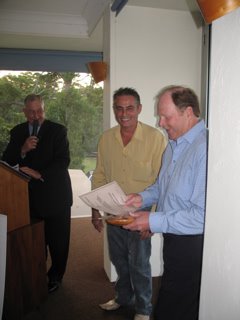
Presentation of Awards at Wine Dinner
Far south coast producers Breakfast Creek (1 gold, 1 silver, 1 bronze) and Tilba Valley Winery (1 bronze) also received awards.

Monday, February 13, 2006

The New Vineyards/An Update

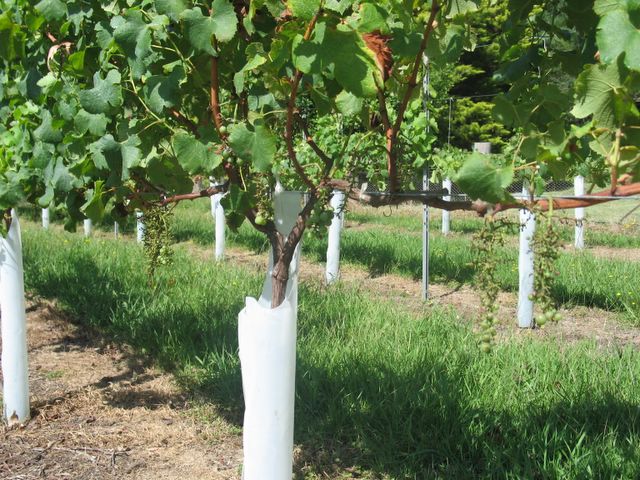
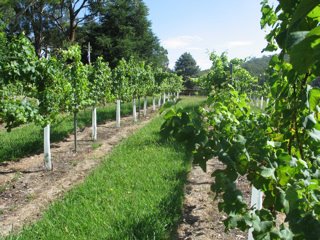
Despite hail damage the previous season, a relatively dry year and some shoot damage by unknown sources but birds suspected, all three new vineyards have progressed nicely.
The Semillon has performed the best with substantial new growth. The cuttings for this block come from another local vineyard where the clone(s) is unknown. Some individual vines are far outperforming others. Whether this is clonal or environmental is anyone’s guess. Cuttings will be taken from these particular vines during dormancy and grown on next season to ascertain the answer.

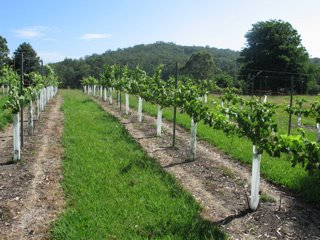
The Semillon Rows
The cordon wire has been filled in most cases with lateral growth ie. potential spurs, on the first half of the new cordon acceptable. The top row has not performed as well due to severe soil compaction at one end and tree competition at the other. This could be overcome next season by digging up these vines during dormancy, completely removing a volume of compacted soil that accommodates major feeder root growth, mixing it with organic matter and replacing it. The vine can be then replanted, cut back and retrained or the better performing cuttings planted. This soil improvement system has worked for a number of the Tempranillo in the same block. The competing trees need to be cut back.
The Tempranillo has also performed well with some problems with tree competition at the lower end of the block. This will require additional soil amelioration. We know the clone of this variety (D8V12) but again there has been a few outstanding performers so the question of clonal variation versus environment will have to be answered. We will repeat the cutting exercise with these as well. One vine in particular is stunted with quite distorted leaves. This could be a viral problem and that vine will be destroyed and replaced.

The Tempranillo Rows
The Pinot Noir growth has been even (MV6 clone) but considerably less vigorous than the other two. This is a typical characteristic of the variety.
Whether there has been enough growth for spuring can only be assessed at the end of the season. It could be that they will need to be cut back to 2 buds and retrained.
It is said that Pinot Noir needs deep, friable, mineral rich, moist soil. Thick clay sub soils and lean sandy top soils do not deliver the best results. We have the latter here.
Good quality fruit is produced in cool humid regions (Burgundy, Yarra Valley, Mornington Peninsula, New Zealand), not in hotter climates where color and phenolic components are inadequate. We have the latter here.
So it is evident we will have trouble theoretically producing a decent (complex, multi layered) wine from our Pinot. It might just be a source of grapes for an acceptable summer Rose’.
However we are trying other cultural techniques to improve quality.
We are planting the vines close together (1mx3m) or 3333/ha. In France they can be planted at a density of 10,000/ha or 1mx1m. This higher density planting reduces vigor and limits the vine’s fruit production. Some say that yield should be around 750g per vine, or in our case 2.5 tonnes/ha. to achieve good quality.

The Pinot Noir Block
Clonal selection is important. There are around 30 clones of Pinot Noir available in Australia. Vines need to be fruitful but produce even sized bunches with small berries. Shoots should not be too vigorous. MV6 seems to fit this bill but its performance is very site specific and we have yet to full ascertain what this clone will do in our environment.
Canopy management is also important. Vertical Shoot Positioning (VSP) and avoidance of leaf shading is essential prevent acid imbalance, herbal flavor development and poor phenolic composition.
So it is an interesting experiment to grow this variety on this site in this climate.
You don’t have to be crazy to be a viticulturalist but it helps.

Thursday, February 02, 2006

Birds!

Birds are a continual problem for the grape grower. They eat or partially eat the ripening fruit as well as feed on new shoots. Not only does this reduce the current and next year’s yield but can also lead to major disease outbreaks eg. Botrytis
The major culprits in our area are the satin or bowerbird, the pied currawong and most members of the parrot family (sulphur-crested cockatoo, galah, lorikeet, rosella, king parrot). These are all native species.

Bunch Damage
Luckily we have, as yet, no problems with the silver eye, Indian myna or starling.
The area surrounding the vineyards is heavily wooded with native forest so there are plenty of places for the birds to roost.

Shoot Damage
There are any number of ways to try to prevent bird attack. These include audio and visual deterrents of all sorts, both mechanical and electronic, netting, chemical pesticides and of course shooting. All have advantages and disadvantages.
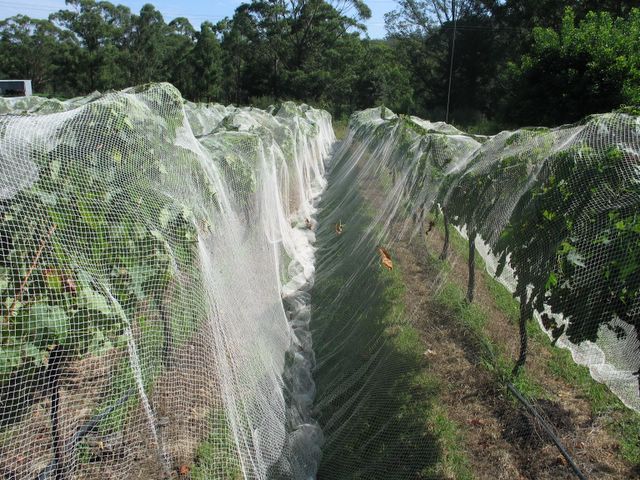
We have used netting here for many years. It is not 100% effective as birds can sit on the net and peck at the berries through the mesh.

Netted Vines
They also have the happy knack of finding every hole or opening in the netting and getting through, particularly the satin bird. I would estimate that crop losses with netting properly installed run at around 10-15%.
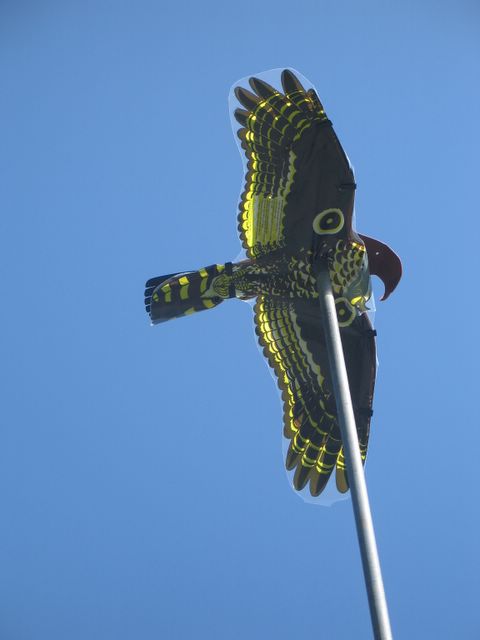
This year we have installed a Hawk Bird Scarer. It is a plastic replica of a Goshawk which, in our case, is mounted on a tall pole at the end of the Cabernet Sauvignon vineyard.

Mounted Hawk Bird Scarer
The theory is that birds of all types have an in-built fear of this particular predator. Because the Goshawk hovers before striking its prey the static nature of the replica is no disadvantage. In even a slight breeze the replica wings and tail move in a very realistic way. It is recommended to change the replicas position every two weeks or so.
The Goshawk also attacks birds that are flying, roosting and eating on the ground and apparently potential prey are aware of this. It will be interesting to see how affective this measure is.

The Hawk Bird Scarer
We also have a second one which will be strung high above the new vineyards between two or three tall trees on strong fishing line. This will allow more realistic movement as well as the ability to easily move its position over the vineyards.
In the meantime growth in the new vineyards continue at pace. Recent rain has produced a considerable flush. Even the Pinot Noir is looking good.
The summer holidays are finally over and school is back in. The town has emptied out most of the tourists. The only stragglers are the university students with their classes beginning in March and the DINK’s who obviously want a quieter child free holiday. It’s a pleasure to go into town now. No traffic jams, plenty of parking and room to move in the supermarket.
The South Coast Wine Show judging was held at the end of January in Milton. There were 137 entries from the Southern Highlands, Shoalhaven Coast and South Coast regions. Medals and awards will be presented at a dinner on the 10th February. The public tasting was well attended with almost 100 people turning up.