Tuesday, May 08, 2007

Melbourne

It was an early morning departure as we headed across country, by-passing Canberra, and onto the Hume Highway at Yass for our trip to Melbourne for a photographic convention. With a few stops on the way to eat/drink/refuel and change drivers it took us around 10 hours. The Hume is four lanes nearly all the way now, has a 110km/hr speed limit and with virtually no traffic was a dream run. The new Albury/Wodonga by-pass has just been opened and this saves at least 30 minutes.
We arrived in town at peak hour and had to deal with not only heavy traffic but trams and the eccentric Melbournean "hook turn" where, to make a right hand turn, you pull over to the left and wait for those lights to turn green. There is a method in the madness. The trams behind you don't get held up.

Our hotel was near the convention centre and the Crown Casino which has forty restaurants, cafes and snack bars.
The first night we ate at Neil Perry's Rockpool Bar and Grill. Neil has the Rockpool, a famous Asian restaurant, in Sydney but I have never been there due to its prohibitive pricing. So it was nice to experience the Perry touch with a more reasonable bill.
The place was hard to fault. The room itself was beautifully set out, the service seamless and the food wonderful. We had sushi and grilled prawns as starter, roasted grass fed dry aged rib eye beef on the bone as a main and I endulged in a caramelised apple tart with vanilla bean ice cream to finish. This was all washed down with a Sauvignon Blanc from the Loire Valley and a Chianti to die for.
Sorry Dr. Brett! Will start that diet next week.

Next morning we walked into the CBD and had a coffee and sambo breakfast. Then we explored some shops at the "Paris End" of Collins Street and some of the old Victorian shopping arcades that have been beautifully restored. After that we hopped a tram to the National Gallery of Victoria and spent some time viewing the many treasures in there.

Lunch was a lottery but we chose well, a Japanese Restuarant in Federation Square.
Then it was back to the casino for some gambling. As usual there were no winnings.
Later that night we went back to the Jasmine Thai Restaurant for dinner.
This had to be the worst Thai meal I have ever been served. Completely inedible!
Their web site states: With expert preparation, perfect cooking and serving of the finest quality Thai Cuisine; you can expect superior freshness, exciting taste and a dining experience that will guarantee you will bring your friends back with you next time!
Grounds for suing for false advertising I think.
Next morning, K went of to the photographic convention and I went looking for some wine making equipment at my favourite store. Talk about toys for wine boys! Ended up with two additional tanks that just fitted in the back of the car and had the potential to rattle for the entire 1000km trip home.
I was born in Melbourne and spent the first 10 years of my life there so it was interesting to revisit some of my old childhood haunts. On the way to have dinner with relatives, we passed my old house. It still looked exactly the same although the neighborhood streets seem a lot narrower and distances a lot shorter than from a kid's perspective.
Next morning we headed up into the Dandenong Ranges. This line of 600m high hills is an hour's drive out of Melbourne and is a combination of touristy villages, National Park and rural residences. There is a great view from the top overlooking the city and surrounding districts. When I was 6, my parents went to Europe (it was a 6 week ship voyage each way in those days)and I was at a boarding school in this area for around 9 months. I found the old one teacher school I went to which brought back memories of walking to class in the snow and not being able to eat lumpy porridge.
Part of the area has been maintained as mountain ash forest.

These gum trees (eucalypts) are the largest flowering plants in the world and can grow to 100m (330ft) high. It's a wonderful area with deep gullies full of giant tree ferns and tumbling waterfalls. It is home to the lyrebird and other Australian forest wildlife.

Back in the city we headed to Lygon Street, Carlton which is the Italian part of town. Here is an amazing choice of restaurants, coffee bars and shops. We picked a cafe at random and had a great meal al fresco while watching the passing parade.

That night we went to K's first Australian rules football game at the Telstra Dome. The Sydney Swans were playing the North Melbourne Kangaroos. The Swans were originally South Melbourne but got transferred to Sydney in the 1980's after the club fell on hard times.

I have been a Swan's supporter all my life so it was great to see them play again. Unfortunately they let the Kangaroos get too far ahead and despite a stirring fightback in the last quarter, they failed to overhaul them.
But I think K is hooked on the game and there may be a few trips to Sydney in store to see the Swannies play again. And we do get live telecasts of their games via satellite.
Next morning it was back on the Hume heading north. We took a small detour to Brown Brothers winery at Milawa for lunch at their great restaurant and took time out for a tasting of their experimental wines which consist of small plantings of less well known grapes from Spain, Italy and Portugal among others.

We especially liked their Tempranillo and Barbera as well as Viognier.
Needless to say the rattling tanks were joined by rattling bottles for the rest of the trip home.

Saturday, April 28, 2007

Battling Bloody-minded Bureaucrats

Dealing with bureaucrats at any time is difficult. Dealing with public service bureaucrats is a nightmare.
Here is a typical example.
The highway that runs past our property is Route 1 that basically links the entire coastal region of Australia, a distance of over 14,500km.
Our section runs between Sydney with Melbourne, a trip of around a 1000km and is the second busiest route for that sector.
The road's condition however is abysmal.
It is in most cases a narrow winding two lane highway with sections of passing lanes of varying length at varying distances. It has also numerous old and narrow bridges.
Improvements are slow with the major Sydney to Melbourne route, the inland Hume Highway (Route 31) attracting the most funding with most of its length now a four lane freeway.
As a result many people are killed or injured on the Princes Highway and its northern continuation to Brisbane, the Pacific Highway.
The state government is slowly trying to improve the highway as funding becomes available.
One project set down is the replacement of the old bridge across the creek that runs through our property and the elimination of dangerous bends directly to its north.
A neighbour of ours and his young son were lucky not to be killed there when a truck shunted them at 100km/hr while they were waiting to cross oncoming traffic into their property on New Years Eve 2005.
The highway is bounded by private property on the western side and a National Park on the eastern.
The National Park was, up unto a few years ago, State Forest but was "gifted" to the people under certain conditions. One of those conditions was that a 20m corridor for future road improvements be maintained.
There is another 20m right of way on the private land.
Despite the fact that the route through the National Park will produce a straighter road, the government instrumentality concerned, the RTA, had decided to resume 2ha. of my neighbour's land (10% of his property) and build the new bridge and road there because it is a few meters shorter and therefore cheaper. But it will still have a bend.
They are using the old environmental impact excuse not to use the eastern option.
This is plainly a joke.
The National Park is home to the endangered swamp oak flood plain and a remnant is situated near the bridge. But there are 15000ha of swamp oak flood plain left in NSW. The area lost to the road would be at the most a few hundred square metres. Not only that, the land involved is currently home to a rest stop and picnic area and is severely degraded.
The community is up in arms about this and letters of protest have been flying, meetings have been held and the media is giving it great coverage.
The RTA and National Parks initially ran for cover and hoped the whole situation would go away.
But it didn't.
They then tried bullying tactics saying the law was on their side and they would do what they considered best. No discussion would be entered into.
This only made the protest louder and more aggressive.
The three levels of government came on board in support with members of the local council, the state seat member and the federal seat member demanding a sensible resolution to this situation.
The RTA and National Parks were finally flushed out of hiding and forced to hold a public meeting to explain their decision.
The local hall was overflowing with people from the community interested to hear their reasoning.
And what a group of stereotypical government workers these public servants were!
To think out tax money could go in wages to such incompetents!
They spoke a language of legalise, legislationise and environementalise and really were not of this world. They had no concept of how their decision impacted on the community. Theirs was a world of black and white, no grey and doing things "by the book".
This attitude only increased the resolve of those present at the meeting which at times became extremely heated.
The RTA and National Parks were left in no doubt that there was a need to revisit this decision and revise it.
They agreed to the former.
Whether we will have decision in our favour is still up in the air.
This fight is not over.....not by a long shot.

Tuesday, April 24, 2007

Better Safe than Sorry

One of the hazards associated with being in the wine industry is the potential for drink driving.
Apart from wine dinners and tastings there are always the impromptu tank and barrel samplings in the various wineries visited.
Normally we run a designated driver system for social events with the DD limited to 1-2 glasses and a ‘swirling and spitting’ system for the tastings to be able to keep under the legal 0.05g/100mL BAC limit.
In our part of the world it is very difficult miss the random breath testing (RBT) stations that the police set up as there is only one major road running through our area. This crosses a number of bridges which are the perfect places for RBT.
They are there on a regular basis at any time of the day or night and one would have to be pretty stupid to think they will be lucky enough to avoid them all the time.
A great number of people get caught in the morning after particular heavy nights despite the fact it has been many hours after the last drink. It is this situation that concerns us the most.
One solution to the problem would be to have your own breathalyser testing unit. In the past these have been quite expensive and unreliable.
Recently however, our state driving association, the NRMA, got together with a producer of breathalysers who also supply the police department and have released a hand held unit suitable for general use at a reasonable price and which complies with Australian standards.
We bought one.

It is simple to use and only needs to be sent back to the manufacturer every 6 months (or after 300 tests) for recalibration at a reasonable cost.
We have been running some tests at home after drinking our dinner wine and results have been (excuse the pun) a little sobering. It is obvious that reaching the legal limit of 0.05 without feeling at all impaired is quite easy. Half a bottle of 13.5% alcohol wine drunk over an hour will do it for me even with food. Obviously it would be less for a female.
It is also interesting to note that a test sooner than 10 minutes after the last drink can produce a false reading, BAC can rise for up to 2 hours after the last drink and it can take 10 hours or more for a high BAC reading to return to zero ie. the morning after problem!
It was also mentioned that the unit will not respond to a BAC greater than 0.30!!!!!!
As if!
While not relying on the results 100% it will be an added level of security to have this unit in the glove box of the car.

Friday, April 13, 2007

Vintage 2007

Refractometer readings of a vineyard sampling showed the Cabernet sauvignon to be at a sugar level of around 12° Baume. The older vine leaves were starting to turn red which is suspected to be a result of a phosphorus deficiency in the soil (low pH) rather than the onset of autumn. Also a few bunches were beginning to shrivel which was more evidence that the vines had run out of "puff". So it was time to pick.

Easter Monday seemed a good time to start so under sunny blue skies, after the morning dew had dried off, we started hand harvesting. It is always fun battling the spiders, bees and ants as well as other creepy crawlies that have taken up residence in the vineyard over the last six months. And all the time you are concentrating on not cutting one of your fingers off.

Buckets were soon filled without incident and transferred to the "winery" otherwise known at other times of the year as the garage.
Hence our unofficial wine appellation classification of Vin de Garage.

Crusher / Destemmer and Fermenter
Here we have all the necessary basic equipment to make wine. But there is none of the high technology and sophistication of a modern winery. Therefore we rely on quick processing, good equipment hygiene and a detailed technical knowledge of winemaking techniques to protect the product from possible spoilage during the vinification phase.

The bunches were tipped into the crusher/destemmer where they are run through rollers to gently break the berry skins. The berries are then "beaten" off the stalks by rotating paddles and the crushed destemmed grapes fall through a stainless steel screen into the open fermenter.
Must in Open Fermenter
The stalks are ejected through the end of the machine and are eventually returned to the vineyard as mulch. Too many stalks in the ferment produce off flavours in the finished wine.

Tests on the resultant juice by refractometer and hydrometer confirmed a Baume reading of 12.0° . This means the wine will have an alcohol content of around 12%.
pH or acidity activity was 3.7. Acid levels are important as this determines the taste balance of the wine as well as how well certain additives eg. sulphur do their job. Acid levels can be increased (and pH reduced) by the addition of tartaric acid which is one of the naturally occurring acids in grape juice. The other main one is malic acid. Warm climate grapes are usually low in acidity and we keep the pH of our red wine between 3.5 and 3.6 by acid addition. Red wines usually have lower acidity than whites.
Another important measurement of acidity is titratable acid (TA) measured in g/L tartaric acid and sometimes called, wrongly, total acid.

Essential Winemaking Tools:
pH meter, hydrometer, refractometer
In Europe, sugar can be added at specified levels to grape juice to increase the final level of alcohol of wine. This is necessary as climatic conditions do not always allow grapes to ripen enough and wines of low alcohol are thin and insipid.
In the New World eg. Australia and the USA, the addition of sugar is prohibited. However in Australia the addition of grape juice concentrate (made by freezing the juice and removing the water as ice) is allowed but our warm climate most years guarantees grapes ripening to the required level. It should be pointed out that not all varieties are allowed to ripen to the maximum possible sugar level. New thinking has developed the flavour ripe theory where some grapes are picked at a lower sugar content according to the wine style being made eg. Semillon in the Hunter Valley of NSW is picked at between 10.0° and 11.0° Baume to produce a typical Hunter style. The same grape in Western Australia is allowed to ripen to 13.0° + Baume producing a bigger fruitier wine with less varietal characteristics. Some viticulturists even look at seed ripeness to determine when grapes should be picked.

Yeast and LAB Cultures
Back in the winery, sulphur was added to protect the must (grape skins, seeds and juice) from oxidation and wild yeasts before a controlled fermentation begins. This is done by adding a calculated amount of potassium metabisulphite at very low ppm rates.
A calculated amount of a commercial dried wine yeast (Saccharomyces cerevisiae) is then rehydrated in warm water. There are many wine style specific strains of that species available and this year I am trying a Bordeaux strain. Wild yeasts are present in all vineyards and they too can ferment the wine. But wild yeast fermentation is fraught with danger eg. slow or stuck fermentation and off flavours. Some say wild fermentation gives a wine special character. Maybe one day I will be brave enough to try it.
A lactic acid bacteria (LAB) culture was also rehydrated. This is added to the wine to initiate malolactic fermentation (MLF) where the bacteria convert the rather harsh malic acid in the grapes to the softer lactic acid. This also stabilizes the finished product. MLF can occur at any time but usually after the wine is made and is in storage.
It is essential that MLF occurs before bottling as a by-product of the reaction is carbon dioxide. This can make the bottled wine ‘fizzy’ and a bit musty tasting and can even blow the corks out of the bottle.

Disassembled Crusher Destemmer
The yeast and the LAB were then added to the must. The yeast metabolises the sugar in the grape juice turning it into alcohol and carbon dioxide. This takes some time to begin especially since the added sulphur initially inhibits the yeast.
But after a while the sulphur is "bound" to the red pigments in the grape skins and fermentation starts in earnest with increased temperature and obvious foaming. The crushed grapes release their juice as the alcohol level rises and the skins start to float to the surface. This layer is called the cap.
The carbon dioxide produced is now what protects the wine from oxidation. Another result of increased alcohol is the extraction of the red colour and tannins from the skins. Almost all grape juice whether from white or red grapes is clear with only the skins giving it colour. It is therefore necessary to keep pushing the cap down into the fermenting juice to extract as much colour and tannin as possible. This is done 4-6 times a day. Purple hands and arms result.
But there is nothing like the smell of fermenting wine up close.
Red wine is usually stored in oak barrels which, during controlled ageing, impart an oaky flavour to the wine. Wine barrels are very expensive, around $1000 for a hogshead (300L), so a cheaper way to get oak character is to add mini staves to the ferment. The two main types of oak are American and French. Like the barrels the staves are available in varying degrees of charring or toasting. This time I used medium toasted French oak in keeping with the Bordeaux style.

Oak Staves
After 7 days enough colour and tannins have been extracted from skins and it was time to drain the still fermenting wine off them.
Basket Press
We use the winepress for this, bucketing the must into the press basket and transferring the free running wine into a variable capacity stainless steel tank. The lids of these tanks float on the wine surface and seal by an inflatable tube.

Then the skins remaining in the basket are pressed slowly and thoroughly extracting more wine which has increasing levels of tannins and colour as the pressure increases. These pressings are also added to the tank along with the oak staves already removed from the ferment.
The skins that are left in the press (the marc) are almost dry and form a solid "cake" which is dumped back onto the vine rows as a fertiliser/mulch.

The wine is now left to finish fermentation and begin the settling process where solids begin to "fall out" and wine starts to clarify. We know when fermentation has finished when the Baume reading is below zero ie. no sugar is left.
The wine will then go through a number of racking processes where the clarifying liquid is separated from the settled solid residue. There are a number of settling aids eg. bentonite, but I prefer to let things happen naturally, albeit much slower, as any additions tend to strip the flavour. During this time oxidation can be a real problem so we will keep the wine under a blanket of carbon dioxide in the sealed tank. Any addition of sulphur, the normal antioxidant, at this stage would inhibit MLF.
VC Stainless Steel Storage Tank
So that’s the story so far. More on the progress of our 2007 vintage later.
White wines are made a little differently but that will be a blog topic for next year’s vintage.

Sunday, April 08, 2007

A Busy Few Weeks

This month has been a month of interior decorating and property maintenance while waiting for the Cabernet sauvignon to ripen.
The former has involved a lot of painting, not with conventional paints, but a lime wash. This type of coating has a life of its own and the finish is very dependent on climatic conditions, particularly temperature and humidity, and the "brush load" during application. We weren’t happy with the result the first time which then meant resealing the walls and starting again!
But it was worth it in the end. The rooms look great.
We are reliant solely on rain on the farm for domestic water use. We used to have four 10,000L galvanised steel tanks that stored water from roof runoff. The water is then supplied to the house via a pressure pump from the main tank which is replenished, when levels become low, from the other three. However one had succumbed to old age and rusted out, another was completely destroyed in a hailstorm some years ago and the main tank was showing major corrosion problems. Under normal rain event conditions we could survive on 20,000L but the drought has caused us to self impose pretty severe water restrictions. It doesn’t appear that an improvement in rainfall which for the last five years has been running at 50% annual average will be forthcoming.
So we bit the bullet and decided to revamp the entire water supply infrastructure. This meant new guttering on all the buildings and three new tanks.
We decided to use high density polyethylene tanks this time to overcome any potential corrosion problems. These PE tanks are a one-piece design, made with a rotational moulding system to produce a strong, hygienic and long lasting rainwater tank. They are made with a centre pole for further strength and safety. Apart from being corrosion proof they have excellent impact resistance and come in an extensive range of colours.

We selected heritage green to fit in with the surrounds. Our 10,000L tanks were the smallest that Bushman produce in their rural range but it still took three of us to get them off the 20m long semi with trailer that delivered them and roll them into position. One of our neighbours is a plumber and he and a roofer mate took only a day and a half to replace all the guttering and downpipes and connect up the tanks. We put up with being completely "waterless" for that time reverting to a bucket delivery system and cold outdoor bucket showers. Lucky it is still relatively warm.

The poor condition of the main tank became evident after we pumped any useable water into one of the spare tanks and took an axe to it. Rusty fine mud, just like lava, covered the bottom in a thick layer. It made the tank so heavy we had to cut the wall and top off to move it. Unfortunately I had the job of getting rid of the ‘lava’.
Now all we need are some heavy downpours to fill the empty tanks. We could always get a tanker in but who wants chlorinated town water "contaminating" pure rainwater.
In the years I have been here I have slowly repaired or replaced all the fencing on the property by hand. Apart from one boundary fence with which I have an ongoing dispute with a neighbour about the type of replacement, I am nearly finished. I won’t go into details other than to say he has horses and I have cattle and he wants a much fancier fence than I am willing or legally bound to share payment for. A temporary electric fence is doing a great job so far. None of the animals. horses or cows, like a 5000V zap through the nose.

So it was great to get the last falling down paddock divider ripped out and replaced with a new four-strand barbed wire, wooden post and star picket fence.
It looks like we will be picking the grapes and making wine within a week and that will obviously be the topic of my next entry.

Thursday, March 08, 2007

Harvest Time

Harvest time is with us and we have already picked the Semillon. Baume was around 11.0 so we are making a Hunter Valley style of this variety ie. low alcohol, fruit driven.
The drought conditions during the season had caused considerable leaf drop with these newer vines so there was little hope of getting the grapes riper without running the risk of more sunburn and/or fungus attack. Since we had had considerable rain late February/early March (too late, unfortunately, for the vines) the risk of bunch fungus was very real. There were some signs of botrytis emerging so the decision to pick was made.
A similar situation existed with the Tempranillo and Pinot Noir so these were picked two weeks later together with some Cabernet from partially defoliated vines growing in shallower soil.
These were all crushed together, sulfured and left on the skins for 24 hours. Then the free run juice was drained and combined with very light pressings to make a rose'. Baume was 11.5.
Both the white and red are being fermented under temperature controlled conditions in a cool room to preserve the fruit flavour.
The remainder of the Cabernet Sauvignon has good leaf cover and will be left to ripen over the next month. Current Baume is around 10.0 and our target is between 12.5 and 13.5.
Meanwhile in South Dakota, the blizzards continue.
Am I glad I am not there? In a way but it sure looks pretty.

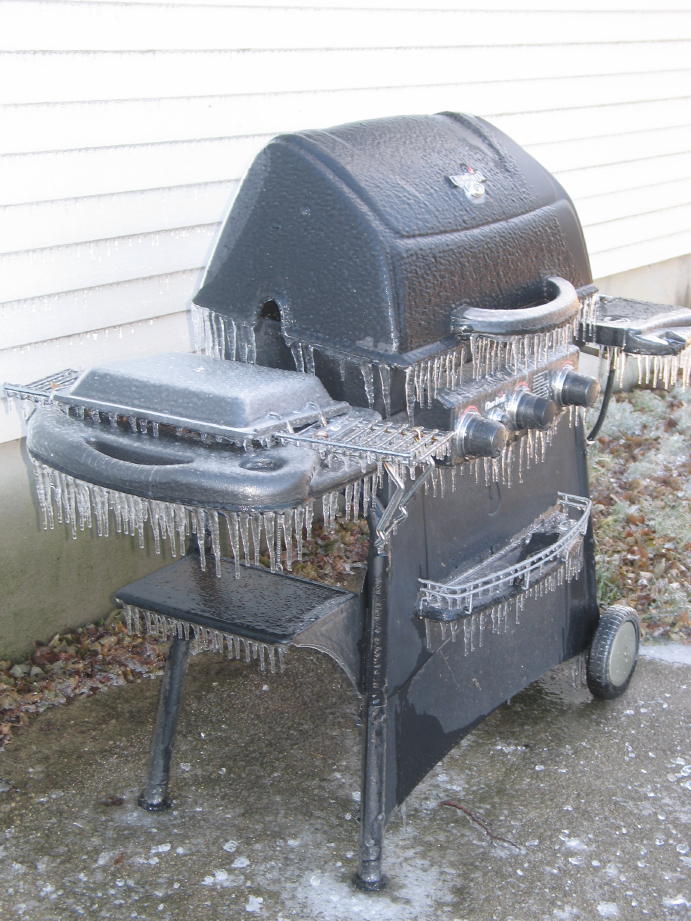
Still impossible to bar b q in that sort of weather.


BBBBBBRRRRRRRRRRRRRRRRRRRRR!!!!!!

Saturday, February 17, 2007

About Grape Bunches

Vine identification, ampelography, is based on the morphological characters of the growing tips, shoots and leaves as well as those of bunches and berries.
In a December 2005 blog, we looked at the various leaf characteristics of the vines growing in our small vineyard.
Now with harvest almost upon us, it's time to look at bunch shapes of those same varieties and how the berries fill them.
Tempranillo has large well shouldered, well filled to compact bunches with berries that are variable in size shape and which have a heavy bloom.


Semillon has medium, conical bunches which are well filled to compact. Berries are rather small round to short oval and juicy. Bunches are very easily damaged.


Pinot Noir bunches are small cylindrical and winged. Because they are very compact, the small short oval berries are often pressed out of shape.


Chardonnay bunches are rather small, cylindrical generally with a wing well filled to compact with small round berries.


Cabernet Sauvignon bunches are rather small, conical often winged and loose to well filled. The small round berries detach easily (shattering).

The 2007 South Coast Wine Show

The 2007 South Coast Wine show took place on Australia Day. Judges David Morris and David Lowe tasted 155 entries from 25 vineyards and wineries from the Shoalhaven Coast and Southern Highlands Regions and South Coast Zone. For the first time, as part of a training program, associate judges were invited to attend both white and red sections of the show.
Gold Medal Pinot Noir
Seventy seven medals comprising six gold, fourteen silver and fifty seven bronze were awarded. The gold medal winners were Coolangatta Estate 2006, 2004, 2001 and 2000 Semillons as well as McVitty Grove 2005 Black Label Pinot Noir and Cherry Tree Hill 2005 Riesling.
This was another successful show with a record number of entries. Judges commented on the increasing quality of the wines submitted.
The following day separate exhibitors' and public tastings took place where wine makers had the opportunity to discuss their results with the judges. This is an integral part of improving the regions' wine quality.
Silver Medal Cabernet Sauvignon
The public tasting attracted a record crowd who enjoyed two hours of good wine and food.
The Wine Show Presentation Dinner took place in early February and was well attended with excellent venue and food provided by Bannisters Restaurant and the opportunity to taste some of the gold and silver medal winning wines.
All medal winning wines will go on display at the Milton Agricultural Show in early March.

Monday, January 15, 2007

Christmas and New Year in the USA

It was indeed a long flight to the USA this time. After 7 hours to Singapore and a 3 hour layover, I connected to a 16 hour direct flight to Los Angeles. The latter flight, however, was quite comfortable as Singapore Airlines have configured their long haul Airbus 340-500 to executive economy which gives passengers a lot more room. The food and entertainment were also excellent. They even have a stand up bar down the back where you can stretch your legs, enjoy a few drinks and snacks and swap travel stories with other passengers. After a night in a very comfortable hotel at LAX I continued my journey to Sioux Falls, South Dakota via Denver. Luckliy I missed out on the blizzard caused three day shutdown of Denver airport a few days later. Some people never made it to their Christamas Day destination.
It only took a walk out of the airport into a freezing cold car park to remind me it was winter in the Northern Hemisphere. Not that any snow was about, it was just a grey day with a brown landscape, frozen rivers and ponds and a temperature well below zero. We stayed a few nights in town to do some Christmas shopping and then headed north to the family home.

Preparations for Christmas were in full swing but we took time off for a limo ride around Sioux Falls to see all the Christmas lights. Some people go all out. There were some tremendous sights from simply religious to kitschy over the top Santa spectaculars. Mid western Americans really get into the season's celebrations. No catering to any religious minority there. It's a full on Christmas! People wear themed t shirts and electronic ear rings, some radio stations play 24 hour Christmas songs and even the gravestones in the cemetries had lights and/or wreaths on them as did the roadside accident memorials.

My request for snow was looked upon with some scepticism by the locals. Instead we had a minor ice storm which turned the landscape into a sparkling fairyland and the roads into death traps.
Outdoor activity is severely restricted due to the weather conditions, especially sport. But we managed to keep active with a few games of ten pin bowling. This is better known as "get the foreigner drunk" and turns into a game of 20 pin bowling with a moving head pin as the consumption of MJD seems to increase with every frame.
Christmas day was fun with all the family (20+) turning up for a lunch of roast turkey, honeyed ham, mashed potato, corn casserole and a lot of other goodies.

We all took part in the "greed game". Simply explained this is where everyone brings a few presents of useful and sometimes quirky nature. These are put into the centre of the room and are "won" by tosses of a dice. Once all are distributed and shown off, another round of dice tossing allows these presents to be "stolen" from each another. Needless to say my coverted electric toothbrush was to disappear a number of times (Thank you, Melissa who is now off my friends and family list!). At least I ended up with a decent bag of Caribu coffee and an ice scraper (something you really need in Australia!).
After Christmas, we took advantage of rather mild weather (zero degrees) and headed up to Minneapolis for a few days to see more family and had fun there too. Great food and drink and not the least, great company.
Back in South Dakota, we had a night out at the local casino run by the local Latoka tribe. I won a bit on the slots and saw an old rocker from the 70's, Eddy Money (no, I hadn't heard of him either) make a complete arse of himself on stage. Why don't they know when to quit. He was so p'd he could hardly stand up. But his fan club loved him and one young lady (about 25) got escorted from the auditorium after flashing her boobs at him. Actually that was the best thing that happened at the concert.

It snowed on New Years Eve. Not a lot but enough to turn the countryside white, clean and beautiful....well, in my eyes anyway. We had a small get together with plenty of wine and snacks and eventually hit the sack around 1:30am.

The week after we wound down catching up with family and friends and hit a few of the post holiday sales. Over the three weeks, apart from good home cooking, we ate a bit of Mex,a few Perkin's brekkies (pancakes to die for), lots of Culver's burgers (and frozen custard - chocolate, of course)and a great steaks at Foleys and the Texas Roadhouse.

Despite these endulgences hardly any weight was put on. You gotta believe me!
All too soon it was time to head back home. This time I did the Sioux Falls-Denver-LAX-Singapore-Sydney route in one hit, forty hours door to door. Never again! Am getting too old for these sorts of marathons.
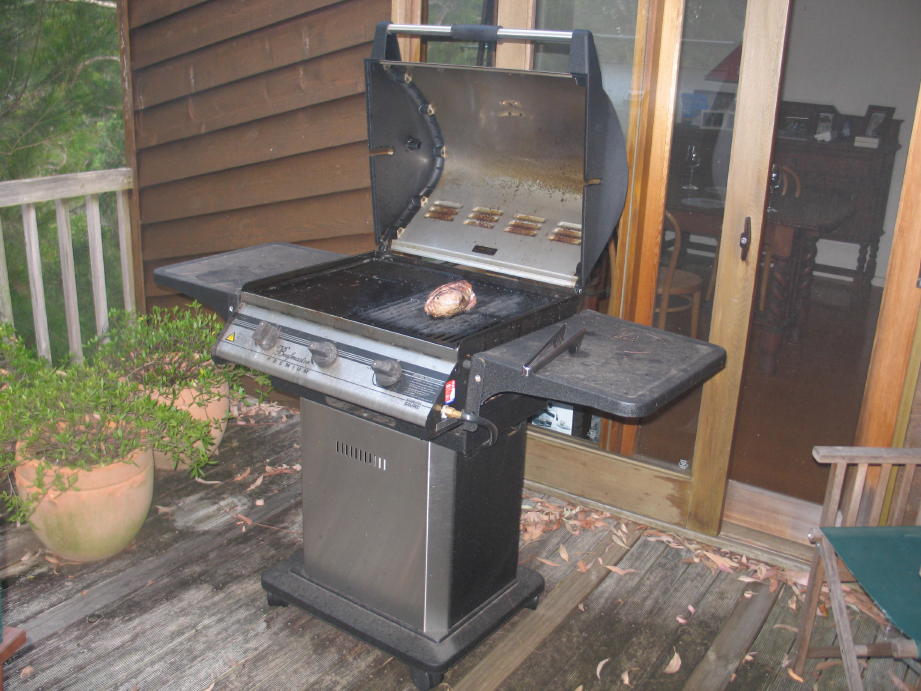
At least it was good to get back to a warm climate and be actually able to open a bar b q that was not frozen or snowed shut, cook a steak, drink a red wine and soak up summer, all alfresco, without freezing essential parts of the body off.

Now it's back into work on the farm. Luckily the weather had been hot and relatively dry while I was away so there is no hint of fungus in the vines. The downside of that is that the younger vines are suffering from a water shortage with premature ripening and leaf drop evident. There is no spare water in the dams to irrigate so they will have to tough it out this year.
Climate change is a fact of life these days. One has to deal with the changed conditions. I ordered three additional 10,000L house tanks. There is a 12 week delivery delay so obviously others are coming to realise that you need to be prepared for what is coming also.

Saturday, December 09, 2006

December 2006

The drought continues in the south east. The newer grapevines are suffering as their roots have not yet made it into the deep subsoil. Leaves are turning yellow and dropping. Nothing much can be done as the water left in the dams is needed for the stock.
Two new calves arrived. One was basically abandoned by her mother so had to hand feed her for a few weeks. I locked the both of them in the yards to bond and forced the little one to suck while her mother was locked in the race. The ploy worked. Eventually the milk came on and the little one was soon strong enough to go back with the herd.
Am off to celebrate Christmas in cold South Dakota, USA in a few days. Will be a long trip as I have cashed in some frequent flyer points and have to go to and from Los Angeles via Singapore. That's 7 hours in the wrong direction.
Compliments of the season to all my readers (if there are any!)

Sunday, November 05, 2006

The Sonoran Desert - A Retrospective

I started preparing this story during my stay in Tucson but time got away and I have only now got around to finishing it.
There are four major deserts in North America; the Chihuahuan Desert (Northern-Central Mexico and southwestern Texas), the Sonoran Desert (southern Arizona and northern Mexico), the Mojave Desert (Southern California, Baja California, and western Arizona), and the Great Basin Desert of Utah and Nevada with isolated pieces extending as far north as southern British Columbia.
The deserts of North America are characterized as either "hot desert" or "cold desert". The Sonoran, Mojave, and Chihuahuan Deserts are classified as "hot deserts", and the Great Basin Desert as "cold desert".
The Sonoran Desert is an arid region covering 120,000 square miles in southwestern Arizona and southeastern California, as well as most of Baja California and the western half of the state of Sonora, Mexico. Subdivisions of this hot, dry region include the Colorado and Yuma deserts.
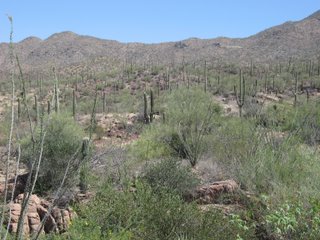
Sonoran Desert Landscape
This is the hottest of the North American deserts, but a distinctly bimodal rainfall pattern produces a high biological diversity. Winter storms from the Pacific nourish many West Coast annuals such as poppies and lupines, while well-developed summer monsoons host both annuals and woody plants originating from the south. Freezing conditions can be expected for a few nights in winter.
Trees are usually well developed on the desert ranges and their bajadas. Often abundant on these well-drained soils are Little-leaf Palo Verdes, Desert Ironwoods, Catclaw and Saguaro.
The understory consists of three, four or even five layers of smaller woody shrubs. Tall chollas may occur in an almost bewildering array of species. The alluvial lowlands host communities of Desert Saltbush, wolfberry and bursage. On coarser soils, Creosote Bush and bursage communities may stretch for miles. Where the water table is high, Honey or Velvet Mesquite may form dense bosques or woodlands.
Other species are restricted to alkaline areas. Stream sides may be lined with riparian woodlands composed of Arizona Ash, Arizona Black Walnut, Fremont Cottonwood and various willows, with a dense understory of Arrow-weed, Seepwillow and Carrizo. The Sonora Desert is rich in animal life as well, with many species in all groups derived from tropical and subtropical regions.
The western part of the Sonora Desert (sometimes called the "Colorado Desert") is closer to the source of Pacific storms and is noted for spectacular spring flowering of ephemerals when there is winter-spring rainfall. However, the western portion is relatively depauperate, lacking many of the species such as the Saguaro that depend on good summer rainfall.
Reference: http://www.desertusa.com/du_sonoran.html
The desert vegetation in and around Tucson was varied and particularly interesting to one who had an interest in horticulture and who had never been in a desert environment before.
The following describes the most obvious and prolific plantlife in the area.
Two species of palo verde commonly occur in the Southwest: the foothill, yellow or littleleaf palo verde and the blue palo verde. Palo verde, Spanish for green wood or stick, describes the plant’s greenish branches and trunk.
Both species are spiny, green, multi-trunked, deciduous trees. Foothill palo verdes only reach about 7m in height and have more yellowish bark and duller yellow/white flowers. Blue palo verdes top out at 12m. Their twigs and young branches are bluish-green, as are the leaves, which are larger than the foothill variety. Pods contain from one to eight seeds, with one being far more common than eight. The foothill species pods have narrow waists between the seeds, which are lentil sized. Blue palo verde seeds are slightly larger and flatter, with thicker, harder shells.
The blue palo verde species grows primarily in washes. It requires more water than the foothill species, which grows more commonly in the uplands. The blue species occurs principally in fine soils, and the foothills species, in coarser soils. Foothill palo verdes often live for over 100 years and may reach 400 years. In contrast, blue palo verdes grow faster and die sooner, rarely reaching the century mark.
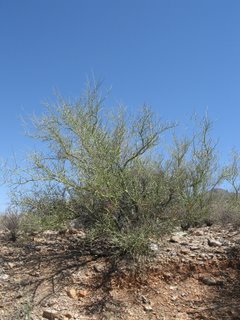
Palo Verde
During their short flowering seasons, both species are clothed with thousands of five-petaled yellow blossoms. They attract numerous pollinators, including beetles, flies and social and solitary bees.
The trees can photosynthesize through their green bark, an important adaptation for a tree that drops its leaves during the warm season and in response to fall cooling. Palo verdes also drop stems and branches to combat drought.
Palo verdes serve as nurse plants for saguaro cacti by providing a canopy – in effect, a microhabitat – which offers warmth in winter and shade in summer. The slower-growing, longer-lived cactus will eventually replace its one-time protector.
Reference: http://www.desertusa.com/mag01/aug/papr/palov.html
The Ocotillo is a bajada resident that can be relied on to bloom annually, even without leafing in particularly dry springs. It is an inverted, funnel-shaped desert plant with several woody, spiny, whip-like, straight branches angling outward from the base and rising as high as 7m.
Red flowers are 12mm to 25mm in length, with five short lobes curled back into 25cm clusters. They appear at the ends of branches March through June or later, depending on rainfall.
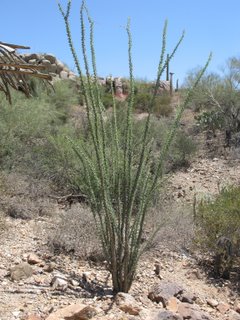
Ocotillo
Ocotillo are leafless most of the year, except immediately after rain; the leaves then quickly wither after the soil dries out. These narrow, oval leaves are about 2 inches long, appearing in bunches above spines.
Mature plants have as many as 75 slender branches (canes). Planted in rows, Ocotillo become living fences.
Reference: http://www.desertusa.com/nov96/du_ocotillo.html
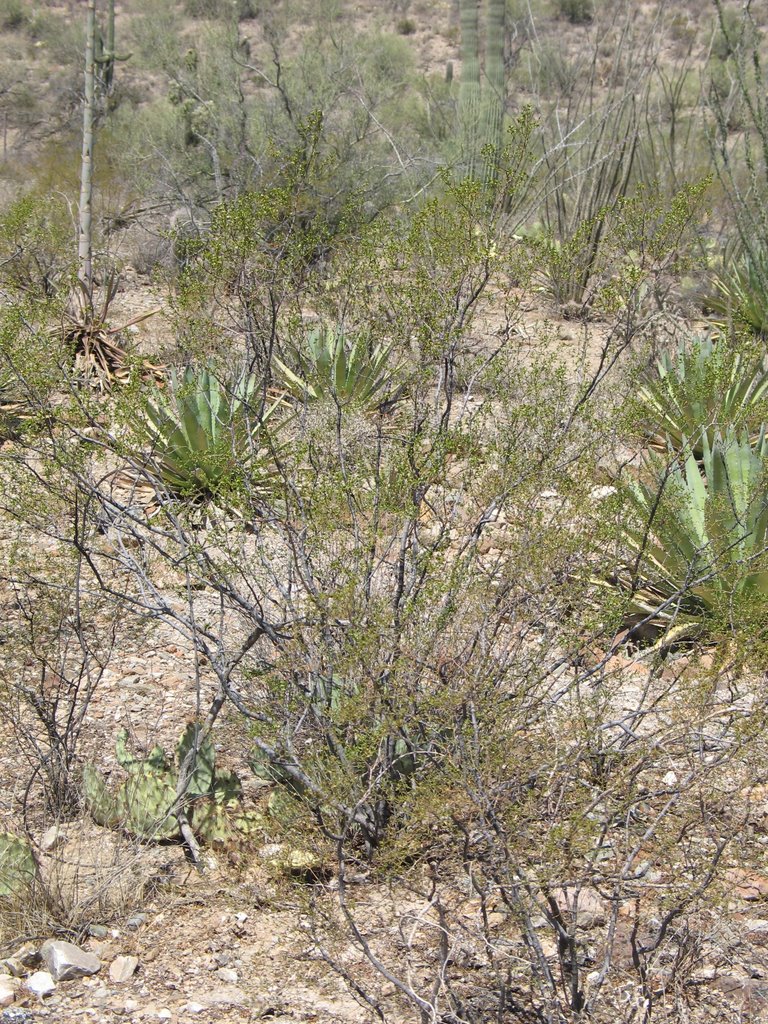
The Creosote Bush is the most characteristic feature of North America's hot deserts. It is one of the best examples of a plant that tolerates arid conditions simply by its toughness. It competes aggressively with other plants for water, and usually wins, accounting for its prevalence in many arid locations of the southwest.
This medium-to-large evergreen shrub has numerous flexible stems projecting at an angle from its base. It is usually less than 1.5m high, but can grow to 4m heights with abundant water.
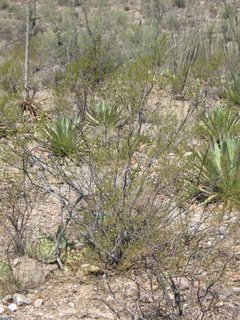
Creosote Bush
Its small, pointed, yellow-green leaves have adapted to conserve water and dissipate heat. The bush may lose some of these waxy, resinous leaves during extreme drought, but never loses them all. These leaves are especially pungent after a rain, and have been used as antiseptics and emetics by native peoples. Its foliage provides refuge for crickets, grasshoppers and praying mantids.
Flowers are 25mm wide twisted, yellow petals bloom from February-August. Some individuals maintain flowers year round. After the Creosote blooms the flower turns into a small white fuzzy fruit capsule that has 5 seeds.
Reference: http://www.desertusa.com/creoste.html
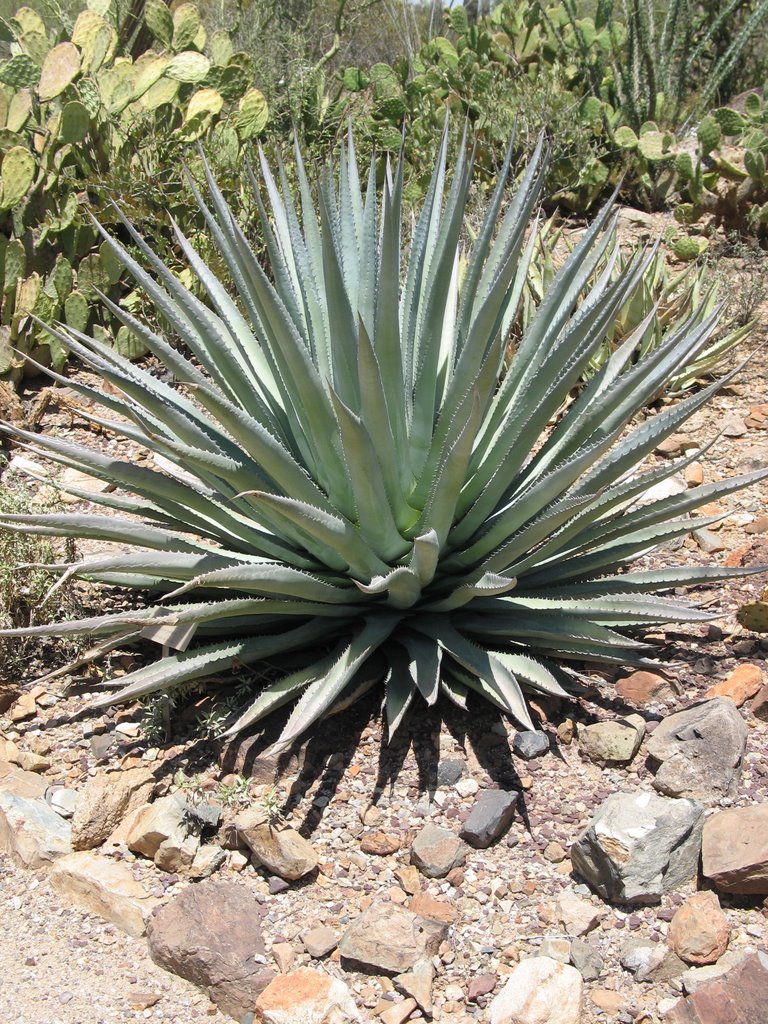
Over 300 species of Agave have been described, but only about 200 are currently recognised. They are succulents but not cacti. Most species are monocarpic, although a few can flower several times during their life. This differentiates them from the Yucca which although very similar in appearence, flowers annually. The flowers are "perfect" with both male and female parts. Many species of Agave are bat pollinated and produce musky perfumes as attractants. Others produce sweeter odours to attract insects.
Most Agaves consist of rosettes of thick, hard, rigid leaves often with marginal teeth and usually with a lethally sharp terminal spine. Prolific vegetative growth and offsetting at the base of the plant or through stolons, usually maintains a clump of plants thus compensating for loss of flowering rosettes. A few species remain solitary, relying on seed production for survival of the species.
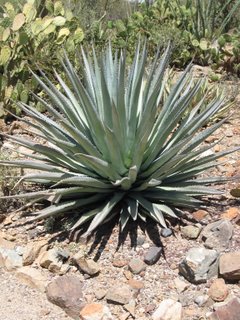
Agave
Carbohydrates stored in the core of several species of Agave were fermented by native Americans to make a beverage called pulque which was used in religious ceremonies. Distillation of a similar ferment made from the developing Agave flower bud is the basis for modern production of Mescal. Only if made from the Blue Agave within the Tequila region of Mexico can the distillate be called Tequilla.
Reference: http://www.succulent-plant.com/agave.html
All but one species of cacti are native to the New World and their habitat extends from Canada to Argentina. All cacti are succulents but not all succulents are cacti.
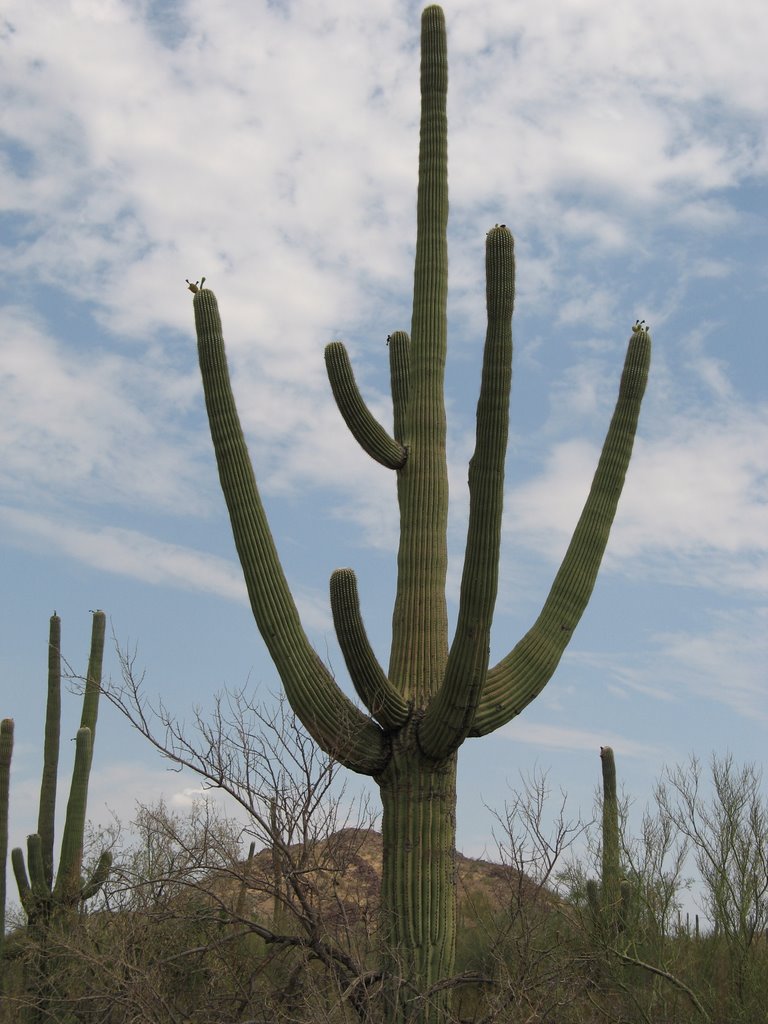
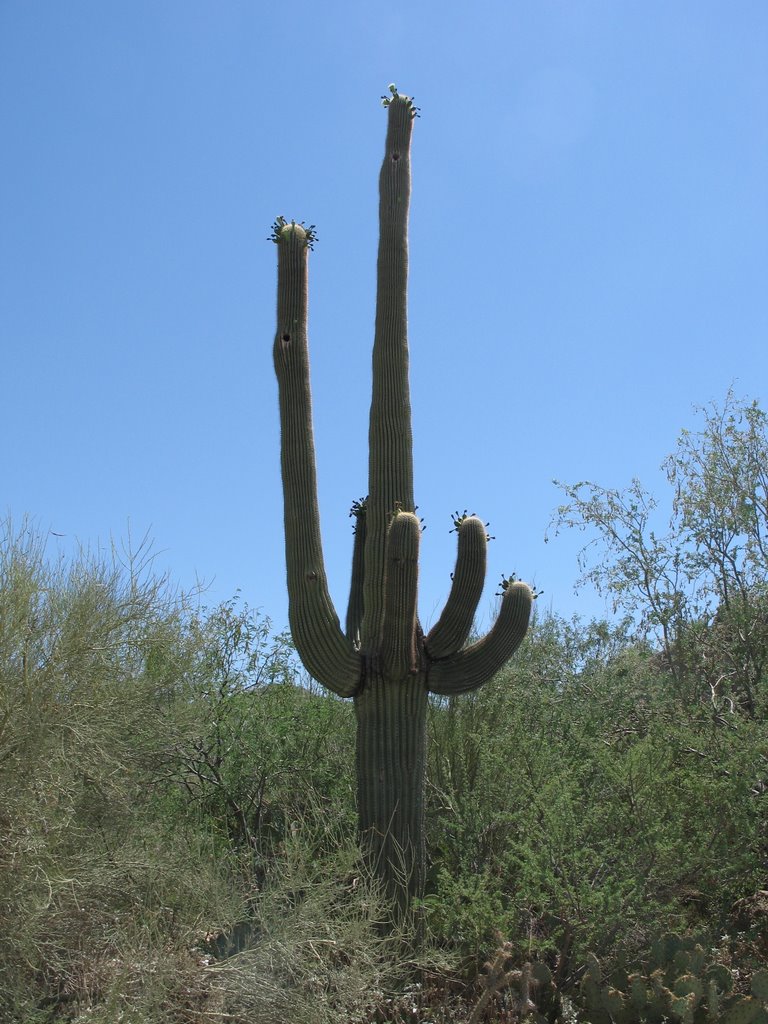
The magnificent Saguaro Cactus, the state flower of Arizona, is composed of a tall, thick, fluted, columnar stem, 45 to 60 cm in diameter, often with several large branches (arms) curving upward in the most distinctive conformation of all Southwestern cacti.

Sagauro Cactus
The skin is smooth and waxy, the trunk and stems have stout, 2-inch spines clustered on their ribs. When water is absorbed , the outer pulp of the Saguaro can expand like an accordion, increasing the diameter of the stem and, in this way, can increase its weight by up to a ton.
The Saguaro grows very slowly, perhaps an inch a year, but to a great height, 5 to 15m. The largest plants, with more than 5 arms, are estimated to be 200 years old. An average old Saguaro would have 5 arms and be about 6m tall.
The Saguaro has a surprisingly shallow root system , considering its great height and weight. It is supported by a tap root that is only a pad about 1m long, as well as numerous stout roots no deeper than 30cm, emanating radially from its base. More smaller roots run radially to a distance equal to the height of the Saguaro. These roots wrap about rocks providing adequate anchorage from winds across the rocky bajadas.
The slow growth and great capacity of the Saguaro to store water allow it to flower every year, regardless of rainfall. The night-blooming flowers have many creamy-white petals around a tube about 10cm long. Like most cactus, the buds appear on the southeastern exposure of stem tips, and flowers may completely encircle stems in a good year.
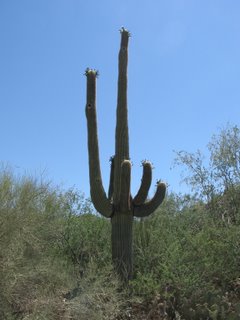
Sagauro Cactus in Flower
A dense group of yellow stamens forms a circle at the top of the tube; the Saguaro has more stamens per flower than any other desert cactus. A sweet nectar accumulates in the bottom of this tube. The Saguaro can only be fertilized by cross-pollination -- pollen from a different cactus. The sweet nectar, together with the color of the flower, attracts birds, bats and insects, which in acquiring the nectar, pollinate the Saguaro flower.
The oval, green fruit ripens just before the fall rainy season, splitting open to reveal the bright-red, pulpy flesh which all desert creatures seem to relish. This fruit was an especially important food source to Native Americans of the region who used the flesh, seeds and juice. Seeds from the Saguaro fruit are prolific -- as many as 4,000 to a single fruit -- probably the largest number per flower of any desert cactus.
Reference: http://www.desertusa.com/july96/du_saguaro.html
Cholla cactus represent more than 20 species of the Opuntia genus (Family Cactacea) in the North American deserts. Cholla is a term applied to various shrubby cacti of this genus with cylindrical stems composed of segmented joints. These stems are actually modified branches that serve several functions; water storage, photosynthesis and flower production.
Like most cactus, chollas have tubercles, small wart-like projections on the stems from which sharp spines, actually modified leaves, grow. But chollas are the only cactus with papery sheaths covering their spines. These sheaths are often bright and colorful, providing the cactus with its distinctive appearance.
Opuntia are unique because of their clusters of fine, tiny, barbed spines called glochids. Found just above the cluster of regular spines, glochids are yellow or red in color and detach easily from the pads or stems. Glochids are often difficult to see and more difficult to remove, once lodged in the skin.
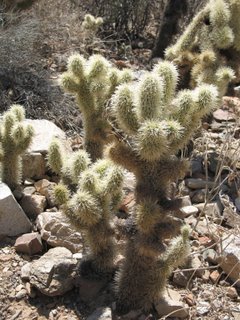
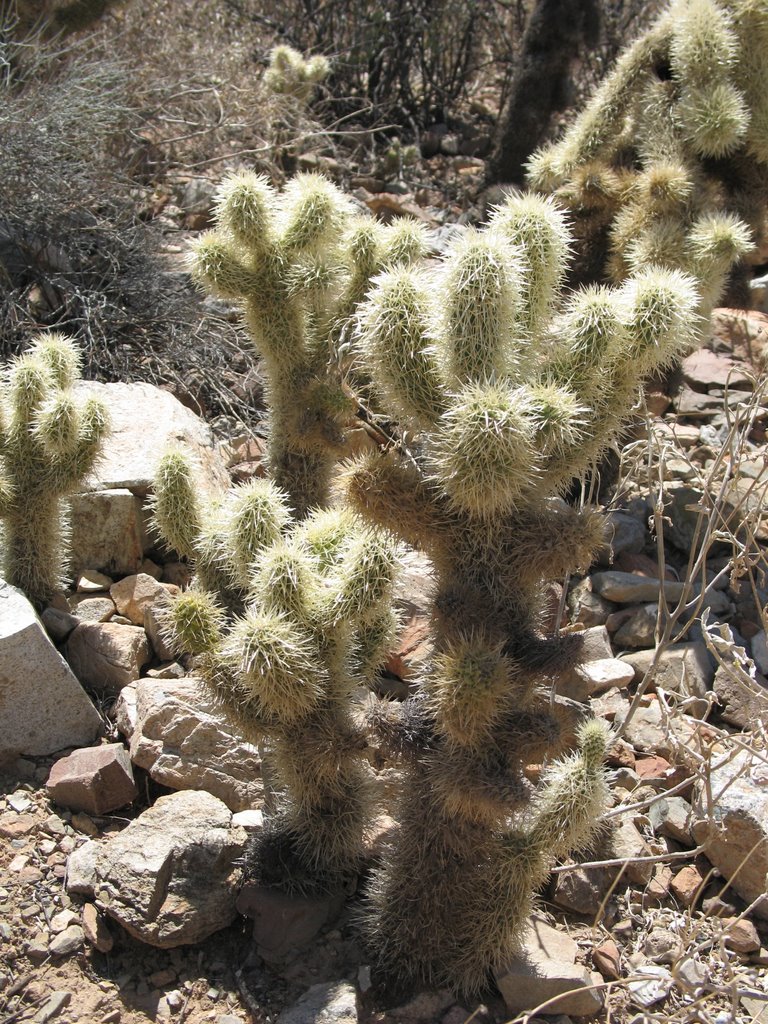
Teddy Bear Cholla
Most cholla cactus have orange or greenish-yellow flowers with a variety of colors, even among the same species. Most species bloom April through June, depending on local conditions. Stems and joints vary in width, length, shape, and color, as well as in the profusion of spines and glochids. Chollas may appear as ground creepers, shrubs or trees, varying in height from less than a foot (Club or Devil Cholla) to as much as 5m (Chain-Fruit Cholla).
Teddy Bear or Jumping Cholla is said to resemble the fuzzy arms and legs of a Teddy Bear, it can be distinguished by its dense, straw-colored spines and yellow to green flowers.
Reference: http://www.desertusa.com/mag99/may/papr/chollas.html
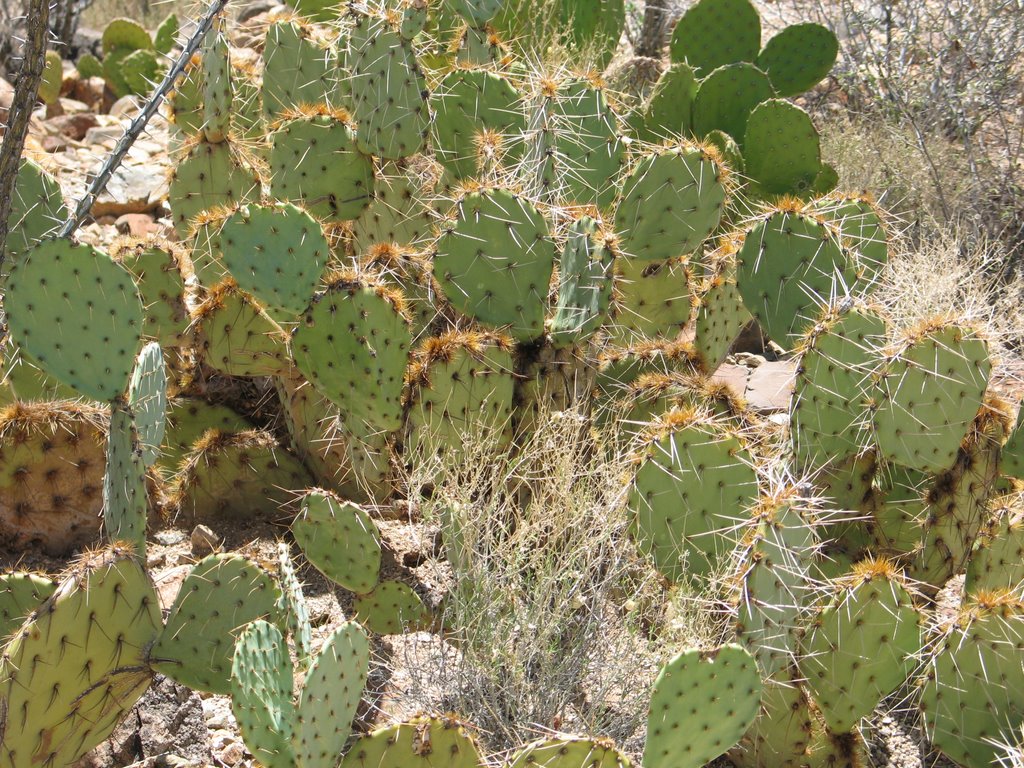
Prickly pear cactus represent about a dozen species of the Opuntia genus (Family Cactaceae) in the North American deserts. All have flat, fleshy pads that look like large leaves. Like other cactus, most prickly pears have large spines, modified leaves, growing from tubercles which are small, wart-like projections on their stems. Members of the Opuntia genus are unique because of their clusters of fine, tiny, barbed spines called glochids. Found just above the cluster of regular spines, glochids are yellow or red in color and detach easily from the pads. Glochids are often difficult to see and more difficult to remove, once lodged in the skin.
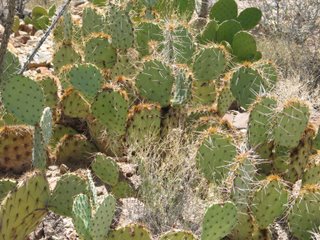
Prickly Pear
The fruits of most prickly pears are edible and sold in stores under the name "tuna." Prickly pear branches (the pads) are also cooked and eaten as a vegetable. They, too, are sold in stores under the name "Nopalito."
Reference: http://www.desertusa.com/magoct97/oct_pa/du_prkpear.html
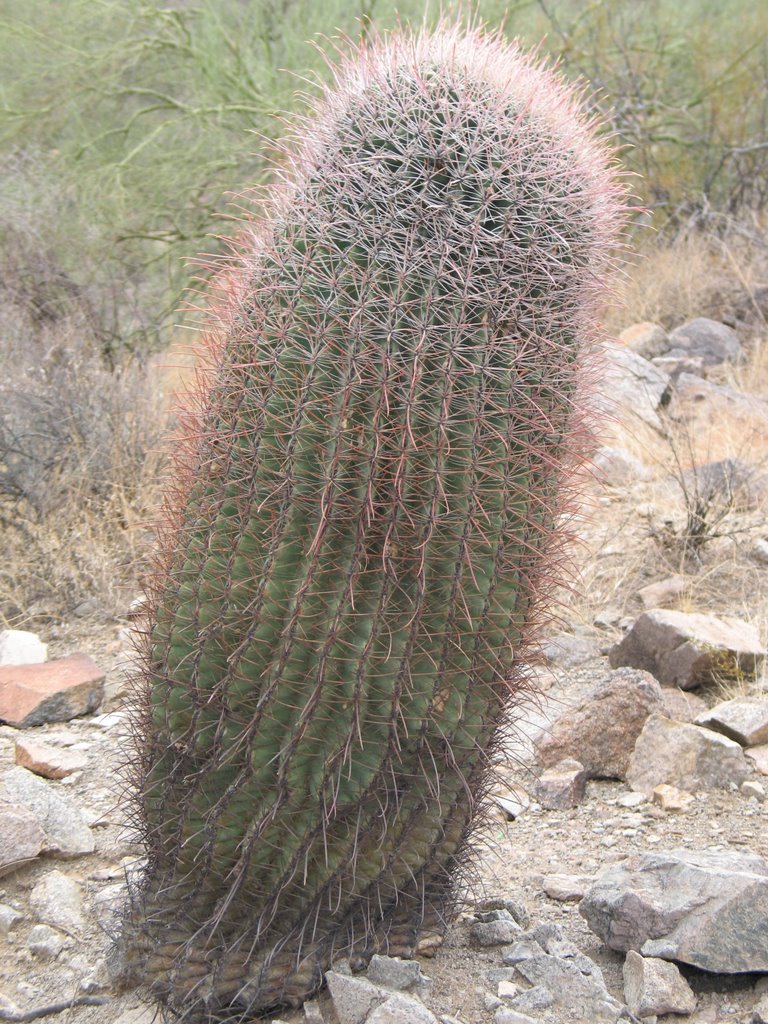
Ferocactus, meaning "fierce or wild cactus,"are always cylindrical or barrel shaped and are usually among the largest cacti of the North American deserts. All members of this genus have prominent ribs and are fiercely armed with heavy spines. In some species, one or more central spines are curved like a fishhook, accounting for the common name Fishhook Barrel Cactus.
Barrel Cactus flowers always grow at the top of the plant. They bear no spines and only a few scales. Fruits become fleshy and often juicy when mature, but are not usually considered edible.
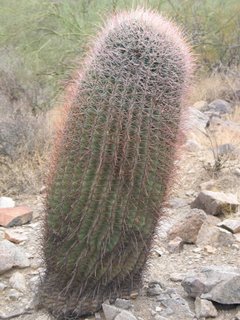
Fish Hook Barrel Cactus
Native Americans boiled young flowers in water to eat like cabbage and mashed older boiled flowers for a drink. They also used the cactus as a cooking pot by cutting off the top, scooping out the pulp and inserting hot stones together with food. The spines were used as needles, awls and in tattooing.
The pulp of barrel cactus has been widely used for making cactus candy (thus one of its common names, Candy Barrel Cactus), but this has also accounted for its destruction and, therefore, protected status in many areas.
Reference: http://www.desertusa.com/mag99/june/papr/barrelcactus.html
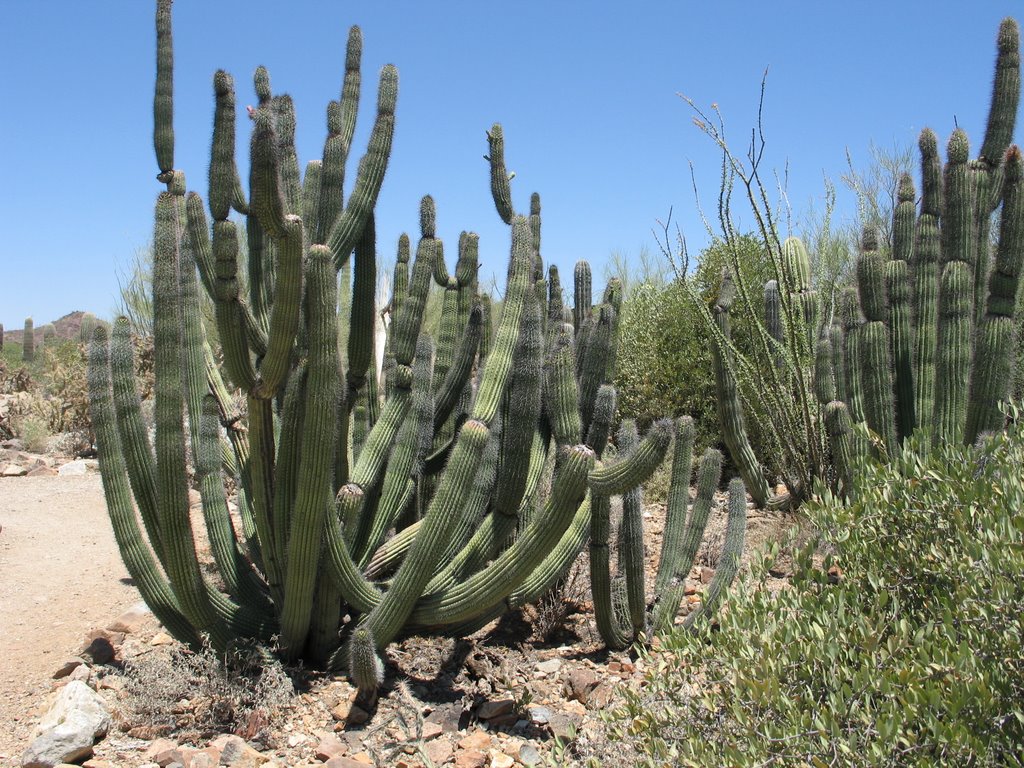
Organpipe cactus is a columnar cactus which is the second largest in the U.S.A (next to the Saguaro) growing as tall as 8m. Instead of having a central stem, however, a cluster of 5 to 20 slender branches grow from a point at ground level and curve gracefully upward.
These water-storing trunks are about 15cm in diameter and have 12 to 17 deep-green, rounded ribs. The areoles are set close together with 9 or 10 brown radial spines that turn gray with age.
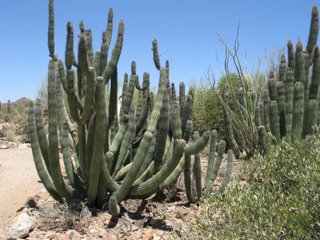
Organpipe Cactus
Fruits lose their spines at maturity, opening to display an edible red pulp. This fruit has provided a food source to Native Americans for centuries. The pulp can be eaten as is, made into jelly or fermented into a beverage.
Reference: http://www.desertusa.com/aug96/du_organpipe.html