So now I am in the process of trying another DIY system.
Wednesday, January 07, 2009
Frogs
So now I am in the process of trying another DIY system.
Saturday, January 03, 2009
The New Year
Farm duties are somewhat mundane with a continued weed spraying project, rotation of the cattle into various paddocks to keep the grass down, vegetable garden tending and of course vine spraying and green pruning.
There has also been plenty of reading, beach walking and sports viewing going on.
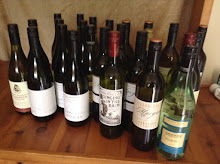
And there has already been a little bit of wine drinking as you can see from the side bar.
I mentioned there that the Brokenwood Graveyard Shiraz 2002 was outstanding. We had this with a special New Years Eve meal. A wine buff should chase down a bottle or two of this.
http://www.brokenwood.com.au/wines/
I am happy with most of the 2008 vintage. The Pinot Noir is excellent, the Semillon passable and the Cabernet Sauvignon is still very young but has potential. We "lost" the Tempranillo rose' to oxidation. If all goes well I will be entering one or two of these wines in the Milton Show in March.
The 2009 vintage will be on us soon enough!
Summer has been a strange mixture on the south coast so far with hot steamy days followed by a succession of really cool ones and plenty of rain. I don't think I have seen the area greener for over a decade.
We have had a few good thunderstorms with spectacular displays of lightning and sometimes simultaneous wall shaking thunder. These have kept the water tanks full.
I had a wander around the garden today to see what flower pictures I could take to put in this entry. Not a lot around. One plant in flower however is a wild passion fruit. It has hundreds of buds. I put the camera on macro and managed to capture a bee coming in for a landing on one of its blooms.
Tuesday, December 30, 2008
Christmas Holidays on the South Coast
Most of the year we have access to plenty of deserted beaches within twenty minutes drive of us, the closest a few minutes across the main road. During school and public holidays there is an influx of visitors and we see more people on the beach. The "worst" time is the Christmas break where our population quadruples with temporary residents and visitors on summer holiday. Apart from crowded beaches, the roads are jammed with sometimes long delays, parking and shopping in town becomes a nightmare and prices increase. The normal lay back nature of the area seems to disappear with a more "frantic" atmosphere prevailing. I guess people from the city want to wring every second of leisure time out of their 3 -4 weeks annual leave. But when this translates into someone behind you continually bumping their cart into your legs in a supermarket check out line going nowhere it does test your patience a little.
We try not to be selfish and are greatly aware that the area needs this annual economic boost to get through the leaner times of the year. So we grit our teeth as we head to our favourite beaches and try to avoid the masses and their beach tents, umbrellas, beach chairs, screaming kids, football, cricket and volley ball games, kite flying, boom boxes, empty bottles and rubbish left as well as unattended dogs that crap everywhere. And why, when you do find a relatively secluded spot at the furthest end of the beach, does a family arrive and park themselves a metre from you? But it's only for a month or so. By mid February they will all be gone leaving all those tourist dollars behind. OK, have had my annual whinge and leave you with a video view of a couple of our beaches, pre Christmas holiday rush, and best wishes for 2009.
Wednesday, December 17, 2008
Lizards
By far the biggest family is skinks (Scincidae) which has well over 300 species in it. Skinks make up over 50% of all Australian lizards.
We believe we have what are Eastern Water Skinks (Eulamprus quoyii) living around the house. They grow to about 30cm (1 ft) long and eat a whole range of insects.
They have been breeding quite well over the years and are quite numerous and like to lie on the warm verandas, steps and footpaths especially in the afternoon. Once you are used to them (and know that sudden scuttle is not a snake), it's nice to have them around. They seem to be used to us too either completely ignoring us or pretending they are invisible when we step over them.
Yesterday some movement in the backyard caught my eye. At first I thought it was a small dog , cat or possum in the garden but then it "took off" when I approached.
It was a huge goanna or monitor lizard about 2m (6ft) long that had been eating a dead bird in the garden. He ran up the nearest tree, their normal defence mechanism.

I have seen many in the bush around us as well as racing across the road (or worse, squashed onto it) but this was the first one I had seen so close to the house.
The co driver was NOT impressed! But I thought she had been here long enough now to know about such things and did not keep it a secret (like the 3m (9ft) python I came across in the shed a few years ago).
Goannas are predatory lizards with sharp teeth and claws. They prey on small animals; insects, lizards, snakes, mammals, birds and eggs and are eaters of carrion and are attracted to rotting meat.
They are not really dangerous, preferring to escape than attack but when cornered can be a bit of a problem.
For more info (and a great picture) on Goannas click on: http://www.walkaboutpark.com.au/index.php?id=228
Monday, December 15, 2008
Surf
We were promised a 4 metre swell as the intense low pressure system that caused all our wind problems moved east over the Tasman Sea towards New Zealand. This would have meant some of the big wave breaks in our area would have started working which is always exciting. Many previous unridable breaks have now been conquered due to the advent of "tow in" surfing and it is amazing to watch these brave if somewhat foolhardy souls pull into some pretty big waves.
But it was not to be. The waves were a fair size but not the giants expected. The above video was shot at a place called "Guillotines" near us. Shallow and rocky but capable of holding a good sized swell this break is for experienced sufers only. A small group of board riders and belly boarders were enjoying themselves before the holiday crowds hit the coast next week.
Sunday, December 14, 2008
Unseasonal Gales
Victoria bore the brunt of it but we on the south coast of New South Wales had 12 hours of westerly gales with gusts reaching 80km/hr at times.

There was a lot of tree damage in the area.
I did a quick inspection of my boundary late on Saturday evening when it was safe to venture out and found a number of trees down over fences.
The tree damage around the house was quite extensive as well. It was surprising to see some trees had been snapped off well up the trunk.
Friday, December 05, 2008
Turtle or Tortoise
Their main predators are large birds, large fish and foxes.
Tuesday, November 25, 2008
A Google View
We have used all three to plan trips or simply find a store in the part of a city or town we are not familar with. We use the maps to plan routes and print them out so we can find our way, Satellite to check out places of interest and Street View to have a look at potential accommodation and the even the neigbourhoods it is in.
View Larger Map
Above is a Google Satellite picture of our area. You can zoom in or out and navigate around using the buttons on the top left corner. Check out where we live and even further afield. Almost the whole world is available with the swipe of a mouse or the click of a button. Have fun!
Friday, November 21, 2008
The Vegetable Garden
We buy heaps of lettuce, tomatoes and various herbs every week so we decided that growing these would not only save a bit of money (have you seen what's happening in the stock market lately?????) but more importantly provide us with very fresh organically grown pesticide free produce.
So it was a matter of spraying off all the weeds that had taken over while the garden had been laying fallow, digging it over, adding soil conditioner to improve water holding capacity as well as lime and blood and bone fertilizer.
We also decided that pumpkin, squash, zucchini (courgettes) and cucumbers might also be a good idea seeing they are easy to grow and are relatively disease resistant.
We also selected two types of tomato, capsicums (red peppers), basil and rocket (arugula)
and half a dozen different types of lettuce which we will plant every two weeks or so to ensure a continuous supply.
Of course we have to protect the whole area from kangaroos, possums, parrots and satin birds which means enclosing the area with a wire netting fence and covering it with some spare vineyard netting.
On our back veranda we also have a potentially good supply of rosemary, more basil, chives and oregano.
Thursday, November 06, 2008
Skin Cancer
The SunSmart UV Alert:
The Famous "slip, slop, slap" Campaign:
Slip on clothing that provides a barrier between UV rays and the skin.
Slop on sunscreen, 30SPF or greater
Slap on a hat that shades the face, eyes and neck.
Then added to this was
Seek Shade which is one of the most effective ways to protect against the sun's UV rays.
Saturday, November 01, 2008
Wine Faults
Oxidation: The most common wine fault. It is caused when oxygen comes in contact with the wine during vinification or is a result of poor sulphur addition management. Phenolics in the wine are oxidised causing a loss of colour, flavour and aroma which produces a so called "flat" wine.


Lactic Acid Bacteria (LAB): While LAB is useful in coverting the harsher malic acid in wine to lactic acid during malolactic fermentation, it can also produce wine faults. Wines that have not undergone malolactic fermentation may be contaminated with LAB which can result in refermentation of the wine. Wines then become turbid, swampy and slightly effervescent.

Refermentation: This is caused by yeasts refermenting the residual sugar present within bottled wine. The most common culprit is the standard wine fermentation yeast, Saccharomyces cerevisiae. The main problems associated with the fault include turbidity, a slight carbonation and some coarse odours.
Monday, October 20, 2008
Wine Shows
Silver medal 17.0 – 18.4 points
Bronze medal 15.5 – 16.9 points

Palate means the taste and the "feel" of the wine in the mouth and involves the combination of textures, flavors, weight and overall structure. The wine's balance is the combination of sweetness, acidity and fruit flavours. Structure involves weight, astringency (tannins) and texture which is basically a "feel" or a tactile sensation rather than a flavour.
Friday, October 17, 2008
An Echidna
When we got down there to have a look, we saw that it was an echidna or spiny anteater. They are somewhat rare around here and, together with the platypus, are the world's only monotremes, or egg-laying mammals.
Friday, October 03, 2008
USA 2008 / Heading Home
Six miles west of Cody the highway skirts the huge Buffalo Bill Reservoir and, after travelling through the mountains via some fairly long tunnels at the spillway end, you arrive in the town.

Wednesday, October 01, 2008
Yellowstone National Park
We stayed at the Yellowstone Village Inn in Gardiner just outside the northern entrance to the park with its famous gate.
The Terraces are constantly changing shape and color. Springs which were once active may become dry and lifeless but activity can later resume. Along with changes of thermal activity come changes in color. Fresh travertine is bright white in color and on weathering changes to gray. Bright colored cyanobacteria and algae mats which are dependent upon a stable temperature and a flow of water also change as the microorganisms die creating a bleaker landscape.
One feature of this area was the Liberty Cap, a dormant hot spring cone.
It was formed from a steady flow of hot water emerging from a single source, depositing dense layers of travertine and continued to grow while there was a source of water. Either the hot water spring found a more convenient underground channel to escape through or the orifice became sealed by travertine deposits, so it is now an inactive spring.
After a very early dinner we fell into bed exhausted and wondering what tomorrow would bring.
Next morning dawned bright and clear. I should point out here we had taken our winter clothes and an ice scraper as we had been warned of the possibility of fickle autumn weather in the area.
Well it was in the high 20's/low 30's after a fairly cool start most of the time so our winter gear was definitely excess baggage. The Aspens must have known things would be ok. They hadn't even bothered to start to change color yet.
This time we headed down the east road to Tower Fall.
We took what was described as an incredibly rough (read: normal Australian country road) detour on the Blacktail Plateau Drive in the hope of seeing a bear or two. Others had the same idea. I guess the convoy scared off any wild life. We did see a petrified redwood though, the remnant of a time past when the area was sub tropical and before a huge volcanic eruption turned it to stone 50 million years ago.
After viewing the falls (there are 290 in the park) we climbed back over the caldera via the 2700m Dunraven Pass and headed for Canyon Village.
Here the Yellowstone River drops down into the the Grand Canyon of the Yellowstone first via the 33m upper falls, then the 94m lower falls. Your first stop is right on top of the upper falls to watch it go over the precipice. The noise is deafening.
Then across the river you can get a more conventional view. We walked down part of Uncle Toms Trail to get a view of the canyon itself. The trail goes onto the bottom of the lower falls but the signs warning of the difficulty of the climb put us off a bit.
So instead we headed off to Artists Point for what is considered the classic view of the lower falls and the canyon.
We were not disappointed.
From here we drove along the Hayden Valley where the Yellowstone meanders quietly through meadow like terrain after leaving its source lake. Plenty of buffalo and the odd wolf were to be seen.
Then we came across another thermal area. This one had boiling mud pools and sulphur cauldrons which not only were hot but had a pH of 1.0. Falling in would not have been pleasant. You could even see thermal activity in the river that flowed below us.
Arriving at the lake we turned east and followed the shore for quite a way until we started the climb over the Sylvan Pass and exited the park through the East Entrance. From there it was quite a pleasant drive east to Cody.
Our Yellowstone adventure was over.