Friday, May 29, 2009

Exploring the Shoalhaven Coast / Part 3

The sun rose into a clear sky and all looked promising for a nice day so we prepared to head north for another coastal exploration. But soon dark clouds started to gather and showers were showing up on the weather radar by 9am. The weather bureau also changed its forecast to "occasional showers". So we decided to still head north but only as far as town with the intention of exploring the north and south heads of Ulladulla Harbour.
On the north head is One Track for All, with its four lookouts providing spectacular views of the coast and harbour. It is a cultural trail with the stories of southern Shoalhaven Aboriginal and non-Aboriginal history, told from an Aboriginal prospective, illustrated through many relief carvings and paintings placed around the two loops of the 2km track. This is the work of local Aboriginal, Noel Butler, who sees it as a tool for linking indigenous culture with white history.
Before white settlement this land was occupied by the Budawang tribe, who spoke the Dhurga language, for probably around 20,000 years. They were the first indigenous Australians to be sighted by Captain James Cook, during the first recorded European exploration of the east coast of Australia in 1770, on Koorbrua beach at Murramarang. The tribal area of the Budawang lies from Conjola in the north, Lake George in the West and the Moruya (Deua) River in the south.
The first of the two loops circled north with wonderful views over the harbour entrance to the south point, Warden Head, with the lighthouse prominent.
As with our previous trips I had to do some research on shipwrecks of the area. Despite the fact that Ulladulla is a very safe harbour, the entrance to it is fraught with danger with reefs both to the north and south as well as at Warden Head. Four wrecks were noted. The "Susan" in 1849, the "Currency Lass" in 1851, the "Medina" in 1852 and the "Alfred Edward" in 1882. No loss of life was recorded for any.
A little further on, the view to the north towards Mollymook and Jervis Bay in the distance was just as fascinating . And we were lucky enough to see a pod of dolphins surfing the rolling waves into the rocky shoreline, just pulling out at the last minute to avoid disaster.
As on our other walks, I was interested in the plant life. The north head was covered in a extremely dense growth of stunted mallee like Casuarinas or She-oaks. This genus has a large number of species ranging from small shrubs to 20m high trees. What these were exactly, I was not sure. The foliage consisted of small branchlets with leaves reduced to rings of small triangular scales. Some were in flower with their tiny red spikey blooms.

In the clearings were native grasses, a few Banksias species and plenty of Coastal rosemary (Westringia fruticosa) which was also in flower.

And in a "soak", I came across the rare Christmas bell (Blandfordia nobilis) which was in full flower. Very unusual for this time of year.

The southern loop with views over the harbour and the town contained even more wooden carvings and paintings. Some were sadly faded and in need of restoration. We were informed by a lady, who suddenly appeared out of the bush with a survey form of questions about our opinion of the walk, that plans to do this work were well in hand.
I particularly liked the lookout with its carved balustrade of fish species that swim in the surrounding waters.
And then, as suddenly as we had left it, we were back in 'civilisation' with a great view over the Ulladulla breakwater and the town centre.

With even darker clouds gathering and the odd spit of rain, we decided to throw caution to the wind and head for the north or Warden Head to another nature walk. Here the lighthouse overlooks the ocean from its place high on the vertical cliffs with the surf pounding on the rocks and surging on the hidden reefs below. This a favorite haunt of whale watchers during the seasonal migration both up and down the coast. They should have been around heading north for the winter but it's early in the season and we unfortunately didn't see any.

The lighthouse was built in 1873 and was originally located at the entrance to the harbour.
It was relocated to Warden's Head in 1889.
The light is now battery operated and float charged from 240v mains supply.

(Photograph: Milton Ulladulla and District Historical Society)
This track was not as developed as the others we had been on but some effort had been put into constructing look outs from the steep cliffs over the ocean as well as board walks over the more environmentally fragile areas. To my surprise the vegetation on south head was completely different to that on the north. Here initially it was more like the the coastal heath country that we saw around Jervis Bay.

Many different Banksias and Acacias as well as Hakea were present. Then suddenly after we crossed a small bridge across what is now a dry stream, the country changed again into almost the same type of forest we were in at Monument Beach. Here we found great examples of old man banksia (Banksia serrata)and their seed cones that inspired the Bad Banksia Men in May Gibb's children's stories.
So with rain beginning to fall, we headed back into town for lunch after another successful day's exploration. And this time right on our doorstep.

Friday, May 22, 2009

Geographical Indications (GI)

In 1935, the French initiated the Appellation d'Origine Contrôlée (AC or AOC) system as a way of protecting winemakers, vineyards, and areas from unscrupulous producers who were taking advantage of the better-known names in that country. Although the French AC system can't guarantee the quality of wine, it can control most of the elements that go into making it. This is achieved by applying strict criteria necessary for qualifying as an AC.
These criteria involve the following categories:
- Geographic limits of the production area
- Density of planting
- Pruning style and standards
- Yield per hectare
- Mandatory tasting by a certification panel
- Allowed grape varieties
- Minimum alcohol levels
- Trellis systems
- Vineyard practices
- Winemaking techniques
- Laboratory analysis standards
Wines that meet these criteria are allowed to use the phrase Appellation Contrôlée on their labels while those not following these regulations are prevented from using AC status.
Multiple AC’s can exist within a geographic area of a larger AC. For example, the Pauillac AC is within the Haut-Medoc AC which in turn is within the Bordeaux AC.
The categories below Appellation d'Origine Contrôlée in descending order of quality are vin délimité de qualité supérieure, vin de pays and vin de table.
This ‘French System’ is in place in some form in other countries but so far none seem to be as successful. These include the AVA in the USA, the DOC in Italy, the DOC in Portugal and the DO in Spain.


In Australia we have the GI or Geographic Indication system. A Geographical Indication is an official description of an Australian wine zone, region or sub-region designed to protect the use of the regional name under international law. A GI is similar to the Appellation naming system used in Europe but less restrictive in terms of viticultural and winemaking practices. In fact the only restriction is that wine which carries the GI must include at least 85% fruit from that region.
A zone is an area of land, without any particular qualifying attributes.
A region must be a single tract of land, comprising at least five independently owned wine grape vineyards of at least five hectares each and usually producing five hundred tonnes of wine grapes in a year. A region is required to be measurably discrete from adjoining regions and have measurable homogeneity in grape growing attributes over its area.
A sub-region also must be a single tract of land, comprising at least five independently owned wine grape vineyards of at least five hectares each and usually produce five hundred tonnes of wine grapes in a year. However, a sub-region is required to be substantially discrete within the region and have substantial homogeneity in grape growing attributes over the area.

Our Shoalhaven Coast Wine Region lies in the South Wine Zone a position we share with the Southern Highlands Wine Region to the west. The two areas are climatically different. The Shoalhaven Coast experiences a warm maritime climate while the Southern Highlands is more cool moderately continental due to its higher altitude and distance from the coast. So although in general the same grape varieties are grown in both regions , the wines produced from them can be completely different.

Sunday, May 17, 2009

Exploring the Shoalhaven Coast / Part 2

It was a perfect late autumn morning with a high blue sky and a light offshore breeze as we set off on the 40 minutes drive north to the southern end of Conjola National Park and the Bendelong Point area. I have to admit that although I have lived in the area for 20 years this was the first time I had been to this part of the coast since visiting on a surfing safari from Brisbane on the way to Bells Beach, Victoria with some mates back in 1968!

The park contains a variety of plant habitats including woodlands, heath, tall forest and freshwater swamps. Bendelong is a sleepy little village on the coast and, as holiday homes predominate, is mostly deserted this time of year. We headed for Monument Beach and walked from the car park along a well defined track through predominantly Bangalay sand forest to the beach
A distinguishing feature here were the scribbly gums. The larvae of a very small moth is the culprit producing the markings on the bark of the gumtrees (Eucalyptus sp.) and it is known that there are at least six types of scribble, at least 20 species of eucalypts with scribbles and that there are several species of moths producing scribbles. There are probably many more to be discovered.
Compared to the profusion of wild flowers in bloom in the Jervis Bay coastal heath country we visited a few weeks before (see Part 1), this area was virtually devoid of any color apart from a few Banksia species and the occasional Acacia. Spring is the season for wild flowers in this particular eco system.
However we did come across a most unusual tree which appeared to be in full bloom just outside the local caravan park on the way into town.
Once on the beach we trudged our way north along the undulating and soft sand hills due to a particularly high tide which had taken over most of the walkable sand. In the distance we could see the south head of Jervis Bay and the town of Sussex Inlet glistening in that special autumn sunlight that only seems to occur this time of year. These places are also on our agenda for future exploration.
Our destination this day however was the monument commemorating the wreck of the wooden clipper ship Walter Hood constructed many moons ago out in the middle of nowhere. As with our last trip, it appears that a good shipwreck is an essential part of our adventure. So again we leave it to the NSW Heritage Office to tell the story.
"The Walter Hood left London on 22 January 1870 carrying beer, iron bars, railway irons, cork, cement, wine, salt and theatrical costumes and a large quantity of tiles. It has been suggested that these were replacement tiles for Sydney's St Mary's Cathedral, burnt down in 1865 though there has been no confirmation of this connection to date.
The vessel encountered a heavy storm when turning up the eastern coast of Australia. The gale stripped the vessel of sails and carried away Wilkie, a seaman who was to be the first of many casualties. On Tuesday 26 April, land was sighted amidst mountainous seas. The Walter Hood, in a crippled state, did not have enough canvas left to beat out to sea.
The Walter Hood struck a reef in Wreck Bay and immediately began to break up. Captain Latto was hit by a large wave which swept him to the side of the ship breaking some of his ribs. The Captain was taken to his cabin with the rest of the crew to weather the first of four terrible nights.

Early next morning, the cabin began to fill with incoming seas and the crew were compelled to leave the Captain below and cling to the raised poop deck. The masts soon went over the side as cargo began flooding out of the shattered hull. Fearing certain death on the collapsing deck, members of the crew attempted to swim to the shore. Those remaining on the wreck, many of whom could not swim, watched helplessly as their companions drowned. While some eventually made it to the shore, others died from exposure on the hull. Captain Latto was washed out of his cabin and drowned amidst the wreckage of his ship.
On Friday morning, with the seas abating, some others managed to reach the shore in an exhausted state. The thirteen remaining on the exposed stern had now been without food for three days and nights. In desperation they killed a small dog belonging to their dead Captain, ate its flesh raw and drank the blood.
The passing steamer Illalong was directed to the scene and arrived alongside on Saturday. The 13 survivors were recovered in a desperate state. The bodies of those drowned washed ashore and were buried in a suitably marked spot in the bush. Spectators arrived and fought over the most costly articles of wreckage. It was alleged that the bodies of the drowned were robbed. Casks and bottles of alcohol were stoved in and consumed, adding to the mayhem. Of the 35 hands on board the Walter Hood there were 23 survivors."
Despite this rather sad history, the beach itself was quite beautiful with a wide stretch of sand and a small coastal lake nestled in behind the dunes. But it was obvious from watching the ocean that it was quite a treacherous part of the coastline with submerged reefs creating all sort of currents and sudden wave upsurges even on a day when the swell was not that big.
Back to the car and we stopped off to explore Dee and Washerwoman Beaches as well as the main beach at Bendelong Point, Boat Harbour. All very beautiful, with their own unique features, especially Flat Rock Beach with its tassellated rock shelf formation. And all were deserted.
A few kilometres to the south lies the town of Manyana. Originally called Red Head (a much nicer name), this holiday and residential township sits on two magnificent beaches, Inyadda and Manyana, the latter stretching into the distance to Cunjurong Point and Green Island.

At Cunjurong Point we walked through a very small remnant of littoral rain forest thicket to the lookout with its wonderful view over Green Island, one of Australia's great surfing locations where a long peeling lefthander that can hold considerable size works best in big NE and SE swells. But not today.

On the western side of the headland lies Lake Conjola and its shifting bar where it empties out into the sea. Here we found a very pleasant picnic spot with all the facilities needed to finish a very rewarding and relaxing day of exploration.

Tuesday, May 12, 2009

A May Update

Winter is well on its way. The days are certainly shorter since daylight saving time ended and the nights and early mornings are decidedly cooler. We have been enjoying a fire every night since the beginning of the month. The vines are losing their leaves and some of the exotic trees planted around us have changed colour.
We will be looking to begin pruning in a few weeks.
Our exploration of the coast line was put on hold due to a long lingering bout of influenza in the camp but we hope to resume that activity soon.
The Semillon has been bottled (and is drinking well) and the Tempranillo was blended with the Cabernet due to a lack of any perceivable quality other than great colour. This year's Cabernet has been racked off the fermentation lees and has just completed malolactic fermentation. It has been treated it with egg white to begin the fining process. The Pinot Noir has taken on a extremely unusual taste. Now this could be because the taster's palate has been shot to bits by the 'flu and as a result the '08 Cabernet bottling has been postponed until this clears up and the last minute acid adjustments can be made with some confidence.

The cattle seem fat and happy but now is the time the grass stops growing and the pressure of reduced feed becomes a reality as the cold season progresses. Luckily we have a good supply of lucerne (alfalfa) hay on hand to see us over the lean time. This situation is complicated by the fact that despite good rain over the year there have been little sustained heavy downfalls resulting in run off and the dams are looking a little empty right now. We can divert our house water into drinking troughs if the need be but we have never had to do this before.
Plans for our short holiday to Hong Kong are progressing and we have mapped out a preliminary sight seeing itinerary that involves outlying islands as well as the city. Hopefully A(H1N1) won't put a dampener on our party. That area has been relatively free of any of the current problems but their experience with SARS has made the Chinese administration a little jumpy and their flu prevention/control measures are quite severe. They quarantined a whole hotel with its 200 guests for a week in early May because one of the guests (from Mexico) presented to a local hospital with swine flu symptoms which were later confirmed.

Monday, May 04, 2009

Sulphites in Wine

Most wine labels contain the words "contains sulphites" or "preservative 220 added".
Most people know that this means that sulphur in some form has been added to the wine and some controversy surrounds this. Many suggest they are allergic to this particular chemical and look for preservative free wine.
But there is not a great understanding about the use of sulphur or more properly, sulphur dioxide (SO2), in wine.
Let’s start by saying sulphur was used by the Romans as a wine preservative. It is also a natural by-product of fermentation and wine will always contain some, albeit in its "bound" form, a term we will come to later.
But why add SO2?
Quite simply it has both antibacterial and antioxidant properties, is relatively non toxic and its excess can be detected by smell.
In other words, SO2 can be used in very small quantities to reduce oxidation of grape juice during wine production and to inhibit oxidative and bacterial spoilage of wine during storage.
In Australia the maximum legal addition limit in dry wines is 250 parts per million (ppm) or 250mg per litre of wine. Therefore at its maximum usage a bottle of wine would contain 0.1875g of SO2.

SO2 is generally added to wine in the form of potassium or sodium metabisulphite.
Both these chemicals produce approximately 50% by weight of SO2 in a solution.
In wine it exists in two forms, free and bound ie. some becomes bound to phenolics eg. anthocyanins (wine pigments), flavour compounds and tannins, and some remains unbound ie. free.
The free form is the more effective component.
In turn, the free form consists of molecular (unionised) sulphur dioxide, the bisulphite anion and the sulphite anion with the proportions of these depending mainly on the pH of the wine.
Molecular SO2 is the most germicidal.
The more acid the wine the higher the proportion of molecular sulphur dioxide.
It has been shown that a level of at least 0.8mg/L of molecular SO2 is required in white wine to inhibit oxidation and bacterial growth. To achieve this it is necessary to maintain varying levels of free SO2 not only according to pH but also alcohol content. The higher the alcohol content of a wine the less molecular SO2 is required.
So, as an example, to maintain a 0.8ppm molecular SO2 level in a 12% alcohol white wine of pH 3.4 requires a free content of 32ppm.
SO2 is added on a continual basis throughout the wine’s production, bulk storage and bottling phases so it is necessary to continually monitor the free SO2 level.

In the ‘old days’ we used the ‘Rankine’ or Oxidative/Aspiration Method of determining free, bound and total SO2 but now relatively cheap laboratory machines automatically do it for you.
Now to red wine. As mentioned SO2 binds to phenolics such a wine pigments and tannins. Obviously red wine has a high concentration of these compounds and a considerable amount of SO2 is bound. Measurement of free SO2 in red wine is virtually impossible due to the aspiration of bound SO2 during analysis giving false high readings. Instead recommended SO2 levels for red wine are given as 50-150 ppm of total SO2, depending on circumstances and the pH of the wine.

Sometimes too much SO2 can be added by mistake (believe me this can happen!) and it needs to be removed. This is done by the addition of hydrogen peroxide in very minute quantities. The reaction is the same as that used in the Rankine/Aspiration method for determining sulphur dioxide levels ie. the hydrogen peroxide oxidises the sulphur dioxide to form sulphate and hydrogen ions: H2O2 + SO2 => 2H+ + SO4=
To calculate the required volume of hydrogen peroxide, you have to first determine the reduction in total sulphur dioxide required. The volume H2O2 required is related to the strength of the peroxide solution, which is typically 35%, therefore this must be known. Finally, the volume of juice/wine must be determined. The volume of Z %w/w hydrogen peroxide (in mL) required to reduce the sulphur level by the required amount in (mg/L) in a given volume of wine (L) is calculated as follows: Volume H2O2 = 0.049/Z x (SO2 reduction) x (Volume juice/wine). So that's your wine chemistry fix for the month and maybe even for the year!

Saturday, April 25, 2009

Exploring the Shoalhaven Coast / Part 1

I have lived in the Shoalhaven region for twenty years, the co driver for about eight. We came across a book called Beaches of Jervis Bay and the Shoalhaven (Hymans Publishing, 2006) some years ago and realised how little we had actually seen of our coast line. So we decided last year that we would put one day a week aside during our Autumn/Winter to do some exploring. Sad to say this plan has only just now come to fruition. Well we are pretty busy, you know.

The Shoalhaven begins just south of Gerroa and extends almost to Batemans Bay in the south a distance of some 100 km (62 miles) as the crow flies. Road distances are a lot more due to terrain which on the coast consists of long beaches, lakes, bays and inlets . The regional name was given to the area by explorer George Bass in 1797 when he described the sandy shoals at the mouth of the river of the same name. White settlement of the area began in 1822 when Alexander Berry was granted land on the river.

Our first trip was into the Jervis Bay National Park about an hour and a half drive north of us, more specifically to the small holiday township of Currarong which lies on the ocean side of the north head (Beecroft Peninsula) of Jervis Bay.
National Parks have developed a number of well signed and maintained walking tracks within the peninsula called Abrahams Bosom Reserve. We left the carpark and headed into what became typical sandstone coastal heath country similar to that around the southern Sydney area within Royal National Park. There is almost impenetrable head high bush consisting of Banksia, Hakea and may other native plants and trees bordering the track until it comes out onto the coast, Wilsons Beach, a small stretch of sand protected by Whale Point to the west and Honeysuckle Point to the east.
In 1928, the coastal steamer "SS Merimbula" ran aground on Whale Point.
Here is a report on the incident from the NSW Government Heritage Office.
"At 1 a.m. on the morning of 27 March, the 13 passengers on board were awoken by the grinding impact of the vessel driving onto Beecroft Peninsula.
In heavy rain, the engines were stopped and everybody arrived on deck. The crew battled to free the lifeboats which had become stuck. Rescue rockets were fired but failed to attract attention. The Captain believed the vessel was in no immediate danger and sent the passengers back to the lounge, still with their lifejackets on. There they spent the remainder of the night drinking coffee and eating sandwiches.
Rain continued the following morning as the lifeboats were lowered. The passengers were rowed across to the mouth of Currarong Creek where they found shelter in a fisherman's hut.
Captain O'Connor walked across Beecroft Peninsula to the lighthouse at Point Perpendicular. He then telephoned the Illawarra and South Coast Steam Navigation Company in Sydney to advise them of the grounding. Marine assessors arrived at the wreck site on 28 March and concluded that there was a remote chance of refloating the Merimbula. A salvage vessel was chartered for the operation, however, the Merimbula began to sink on the following day and the attempt was cancelled. The remains eventually slid completely into the sea, only the bow section remaining up on the rocks."
We explored what was left of this bow section and then continued west.

Along the track, the first of the autumn wild flowers were beginning to bloom particularly Banksias with three or four main varieties present.
Among them was Banksia ericafolia
and Banksia serrata (Old Man Banksia). To many Australians, Old Man Banksia is best known as the bad Banksia Man in May Gibbs' stories of Snugglepot and Cuddlepie which were standard reading for us as children.
Even when we grow up, we still look at Old Man Banksia cones a little warily.

There were also a few Mountain Devils, Lambertia formosa, named after the woody fruit they bear (see foreground of picture below) in flower

Next stop was Lobster Bay, a spectacular inlet with a pretty beach and quite a big surf running.
I noticed one lone surfer out on the point. Not what you would consider the safest situation to be in due to the spot's remoteness but some people will do anything to get a wave to themselves.
The track continued on a big loop around the headland or we had the option of returning to the carpark via another track from here. We could both hear the water bottle calling so made the obvious decision, keeping in mind to be better prepared (take food and water!) when we set off on the next leg of our adventure.

On our way back we came across a stand of grass trees (Xanthorrhoea sp.), some of which were in flower and showing off their spectacular spikes.
These remarkable plants have a lifespan of 600 years and are very slow-growing. The trunk takes a decade to form initially and then it's a further 20 years or more before the mass of thin, linear leaves rises above it. From then on, it grows only about 1-2cm (0.4-0.8in) in height per year.
The plant grows to a height of over 4 metres and often has branches. However, the flowering stalk grows at a rate of 2 – 3 cm per day reaching to a height of over 3 metres. Mature plants will result in flowering every 2 – 3 years.

Thursday, April 16, 2009

An April 2019 Update

We had been waiting longer than usual to pick the Cabernet Sauvignon to get it a little riper.
This grape variety always produces a fairly "thin" wine on the South Coast due to our maritime climate and an increased alcohol level seems to offset this a little.
Everyone else in the district had picked theirs a week or two before.
Our main 'enemy' in this endeavour is the weather. Any big rain event increases the possibility of fungal disease, particularly botrytis.
Sure enough on the weekend we had over 50mm of rain.
And the first signs of botrytis began to show within 48 hours.

So we picked on Wednesday. Fruit quality was excellent despite a small amount of shrivel from vines at the shallower soil end of the block.
Juice was at 12.8 deg Baume and pH 3.5 which is a great result.
The harvest was quickly crushed and yeast, MLF culture and oak staves added.
Fermentation did not start until 12 hours later.
I guess this is due to the cooler overnight temperatures that are now in single digit figures.
Autumn is obviously just around the corner.
The Semillon is almost ready for bottling, the Tempranillo is still settling out and the Pinot Noir is doing its thing. Last year's Cabernet Sauvignon is ready for bottling to make way for this years.

Other than that, the Grange co-owner and I did some heavy work during his stay repairing some sections of the cattle yards and removing quite a number of newly growing trees from grazing pasture. However we left quite a number along the creek banks as part of the creation of a wider riparian zone on the property.
Sadly we lost a calf. It was Stretch's mother's second one. I found it in a very bad way after noticing the mother had not moved from the same spot for over 12 hours. The young one had scoured badly and was foaming at the mouth. I think it was snake bite. We did all we could to revive her but to no avail.
A few days later another calf arrived. I watched from a distance. The birth was quick and uneventful.
Another bull!!!!!!
He is already part of the herd. The mother didn't bother hiding him away for the mandatory two weeks.
So the next months will see the continuation of the long term weed eradication program, fence repairing, wine monitoring, a short holiday trip to Hong Kong in June and then pruning.

Saturday, April 04, 2009

Grange

Back in 1950, Penfold's chief wine maker, Max Schubert, travelled to Europe on a wine study tour. During his time in Bordeaux, he discovered the the magic of that region's red wines and how well they aged, some for 40 or 50 years and more.
At that time the Australian wine market consumed less than 10% table wine with the majority being sherry and port.
He returned to Australia determined to make a Bordeaux style table wine that would age gracefully.

Practicality dictated he use Shiraz rather than Cabernet Sauvignon and American oak instead of French for maturation. That affinity between Shiraz and American oak began an Australian school of winemaking which continues today.
He also used a primitive form of refrigeration to mimic the slow fermentation that was typical of a Bordeaux winery in October but definitely not that of an Australian winery in late summer.
In late 1956, a tasting was arranged of the first six vintages of the wine for the Penfold's board, senior management and wine identities in Sydney.
It was a disaster.
The Grange Hermitage (named after the French Region where Shiraz (Syrah) dominates) was ridiculed and its maker humiliated. Prevailing opinion was that it was too extracted and 'big', like a dry port. With a cellarful of what management considered unsaleable wine, Schubert was ordered to cease production just before the 1957 vintage.
But Schubert was determined to prove his critics wrong, and decided to keep making Grange in defiance of Penfold's directive. The 1957, 1958 and 1959 vintages are the so-called "hidden" Granges, made in secret, without new oak as its purchase would have exposed his subterfuge.
When the 1955 won Grange's first gold medal in 1962 the wine was set on its path to Australian and world-wide recognition.
Little more than a year after his death, U.S. Wine Spectator magazine also recognized Grange, naming the 1990 vintage its 1995 Wine of the Year and in 1999 including Grange in its top 12 wines of the 20th century.
For a more detailed account of the Grange story click: http://www.nicks.com.au/index.aspx?link_id=67.700
Shiraz has had its ups and downs in Australia, but Schubert demonstrated convincingly with Grange that this variety is the most natural red-grape companion to the South Australian climate. In every vintage, no matter how difficult, Penfold's winemakers can find enough Shiraz of the right style and quality to make a commercial quantity of Grange.
The "Hermitage" nomenclature was dropped after the 1989 vintage as part of the Australian wine industry's compliance with EU law not to use names describing local wines with a foreign regional connotation.

Today a bottle of 1951 Grange, if you can find one as only 1800 bottles were made, will set you back $A55,000. A vertical tasting selection from 1951 to 2003 recently sold for $A185,000. Back in the late 1960's and early 1970's I saved up and bought one bottle of Grange a year until buying houses and raising a family took priority. Then it cost about 25% of a weekly wage. It still does today. But most people buy it for investment rather than drinking and this inflates the price of some older vintages outrageously. Over the years I have drunk all mine and determined in my old age that I would rather buy 15 bottles of $20 wine than one $300 bottle. But for my 50th birthday a good friend bought me a bottle of the 1990 vintage. We sort of assumed co ownership and have discussed a few times in the last year or two whether we should send it to auction. Indications are we would get around $600! But with the co driver's 50th birthday in April along with the 63rd of the co owner, we decided to drink it!!!!!! This is from the current Penfold's tasting notes: History will record 1990 as one of the great Australian vintages of our generation.The 1990 Penfolds Grange is one of the best yet, with the potential to eventually rival the classic vintages of 1955, 1962 and 1971. Sourced from premium vineyards in South Australia, the 1990 Penfolds Grange is predominantly Shiraz (Hermitage) with a small percentage of Cabernet Sauvignon. With its solid structure and strength of character it will age gracefully and should be carefully cellared for a bare minimum of 10 years, and preferably 25 to 30. Medium-full red/purple colour. It is a beautifully weighted and concentrated wine combining very intense, ripe plummy aromas with smoky vanillin oak. Already, the wine is supremely complex and harmonious, with ripe plum and coffee-like luscious fruit, integrated oak, fine tannins and excellent length. Alc/Vol: 13.5%.

And from Robert Parker in 1995: The 1990 is the greatest, most complete and richest Grange since the monumental 1986. It rivals the 1986, 1982, 1981, and 1980 as the finest "young" Grange. The wine's opaque purple color is followed by a sweet nose of jammy black-raspberry and cassis fruit intermingled with scents of minerals, licorice, and toasty oak. Extremely full-bodied, with that layered, multi-dimensional feel that sets a truly profound Grange apart from just an outstanding one, the wine is fabulously concentrated, unctuous, and with a finish that lasts over 50 seconds. It is oh, so young, and in need of 5-10 years of cellaring. It should last through the first two decades of the 21st century.
The three of us could only concur with the above assessments and agreed it was one of the best red wines we have ever drunk. It went perfectly with a char grilled whole fillet steak (rare) which was then thickly sliced and served with horse radish, potato casserole and slow roasted roma tomatoes garnished with freshly chopped basil.

Tuesday, March 24, 2009

Elkhorn Ferns

Platycerium bifurcatum, the Elkhorn fern, occurs naturally in New Guinea and along the coasts of Queensland and New South Wales.
Platycerium is derived from the Greek words platys meaning "flat" and ceras meaning "a horn", referring to the shape of the fronds.
Bifurcatum means to fork into two branches, again, referring to the shape of the fronds.
The Elkhorn fern is an epiphyte which grows on the trunks and branches of trees.
An epiphyte is a plant that normally grows on another plant for support. It is not parasitic.

Each fern is composed of a mass of plantlets. A plantlet consists of a nest leaf, 12-30 cm wide, lying against the bark of the host tree. The nest leaves of neighbouring plantlets overlap one another and become brown and papery with age.
Fertile fronds 25-90 cm long protrude from each plantlet. Spores are produced on the undersurface of the end segments of each frond with spore producing areas coloured tan brown and have the texture of velvet cloth.
I brought a very small plantlet down from my father's garden about 20 years ago and attached it to a huge silky oak (Grevillea robusta) that grows in our garden. It has certainly has thrived and increased in size since then.
They require a shady area to grow in and need to be kept moist. Thankfully they are not prone to attack from many pests and insects except maybe for scale and mealy bugs. But we don't seem to have a problem with those here. Perhaps this is because we have a huge population of ladybirds living in the area and they are a natural predator. Another major reason for restricting the use of insecticides in the surrounding vine blocks.

This and a close relation, the Staghorn fern (Platycerium superbum) are very popular cultivated garden plants in Australia. There are only two other Platycerium sp. growing in Australia.
Platycerium sp. are subject to special regulations to help protect them in the wild. These laws cover activities such as harvesting, propagating, movement of and trade in whole pants and plant parts. When purchasing the plants in nurseries and elsewhere one has to look for those carrying an official government tag to be sure they have been legally obtained.

Tuesday, March 17, 2009

Vintage 2009 Update

We had picked the Pinot Noir about 10 days ago at 12.5 deg Baume' and 3.6 pH.
Fruit quality was excellent with a minimal amount of botrytis infection which was easily removed.
We did come across a red bellied black snake in the vineyard during picking. He/she was "relocated"...............so to speak.
After open vat fermentation, including second use French oak staves, had just about finished we transferred the wine plus the skins and staves into a sealed stainless steel tank and alcohol macerated for a week under a CO2 "blanket".
This was to try to extract as much colour, natural tannin and fruit and oak flavour as possible.
Warm climate Pinot Noir is notoriously low on the first three components.
The Tempranillo was picked last week at 12.4 deg Baume and pH 3.7.
During the crush, an equipment malfunction caused considerable juice loss but we decided to go ahead with a quick open vat fermentation by adding a fermenter 'accelerator' or yeast nutrient DAP (diammonium phosphate) and a fast yeast culture. This seemed to work and fermentation was extremely rapid.

Yesterday was a busy day.
We racked the Semillon off its fermentation lees and returned it to the tank with an addition of bentonite to begin the clarification process as well as a protective sulphur dose.
Bentonite is a clay that is used in wines as a clarifier. It is possesses a negative electrostatic charge. This attracting charge, along with hydrogen bonding, causes suspended particles in the wine to cling to it as it settles to the bottom of the tank. The clear wine is later racked off the bentonite lees.
We drained and pressed the Pinot Noir and returned the wine to a stainless steel tank with a lactic acid bacteria culture to initiate malolactic fermentation together with a solution of egg white to begin the clarification process.
Malolactic fermentation converts the harsher malic acid in wine to the softer lactic acid. The process also increases the stability of red wine as MLF can occur in the bottle producing an unwanted CO2 "spritz" during storage or worse, "popping" corks and breaking bottles.
Egg white is made into a 10% solution (with a little salt) and is used to clarify red wines.
One egg per 100-200L wine seems to do the trick. The yokes are used for omlettes later.
There are a number of other products which do a similar job eg. milk and casein, PVPP, Kieselsol, gelatin, Isinglass (fish's swim bladder derivative) being the most common. They all have their advantages and disadvantages. We have found that egg white works best for Pinot, not interfering too much with the wine's taste, and it always leaves a hard to disturb deposit on the bottom of the tank which aids the racking process.

We dumped the still fermenting Tempranillo must on top of the Pinot Noir marc and pressed that as well. The result was a dense purple wine due to the very high skin to juice ratio of the must. As expected the pH had risen to 3.9 ( high K+ content of the skins) and this will be adjusted with tartaric acid in due course. This wine will be let finish fermenting and then treated with a MLF cuture and an egg white fining. Whether we let it remain as a stand alone varietal or blend it into our Cabernet Sauvignon is yet to be decided.
Then it was a matter of cleaning up all the containers and equipment and returning the dry pressed skins to the vineyard rows as soil conditioner.

Sunday, March 15, 2009

Cleanskins

Cleanskins is the name given to unlabelled wine.
According to Wine Australia, "a cleanskin normally is defined as a bottle or other package that does not carry, in any form, a label bearing mandatory information. Unlabelled bottles cannot be sold at retail to the public, but unbroken cartons can be sold if the mandatory information appears on the carton in an acceptable form. Cleanskins cannot be exported."
But it is not unusual now to see individual labelled "cleanskin" bottles specifying the grape variety, vintage and region.
The advantage of buying this class of wine is that it is usually very cheap, up to 75% off the medium wine price bracket, and in many cases it can be of very good quantity.
The disadvantage was that there is always a chance of buying a duffer that has to be poured down the sink. And when you have shelved out for a dozen, the saving all but evaporates. Initially most cleanskin purveyors insisted they sell in dozen lots but market forces have dictated they offer now single bottles for pre bulk purchase evaluation hence the individual bottle labelling. Where do cleanskins come from?

During times of wine glut, many wine companies are over stocked. To reduce stocks but not reduce the value of their branded wine by discounting it, they sell bottles unbranded.
So in fact it is possible to buy top class wines at ridiculously low prices.
This is not a new development. In the hey days of the wine cask (bag in a box / Chateau Cardboard) and wine gluts it was possible to buy wine originally intended for the bottle in this type of container.
The cleanskin market in Australia was quite strong for many years but it seems to have waned a little in the last year or two.
I had read that the Marlborough region of New Zealand, famous for its Sauvignon Blanc, was experiencing over production. This was reflected in many new brands and quite competitive prices in our liquor supply stores. In fact New Zealand Sauvignon Blanc is now the biggest selling white wine in Australia finally putting the ubiquitous Chardonnay well and truly in second place after 20 years at the top.
Three of the five top-selling white wines in Australia (of any grape variety) hail from that region. The biggest selling white wine in Australia is Oyster Bay Marlborough Sauvignon Blanc, which has come from nowhere six years ago to about $40 million in retail sales, with 1.7 million litres of the wine poured down Australian throats last year.

The Marlborough 2008 harvest was 195,000 tonnes, up from 121,000 tonnes the previous year. The '09 vintage is on track to set another record.
So I thought that Marlborough cleanskins couldn't be too far away.
And I was right. A few weeks ago in my local wine outlet, there they were, at 50% off branded wines prices.
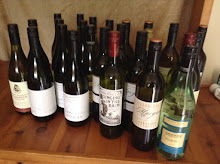
As you can see from our wine consumption in the side bar we are fans of this region/variety.
So we bought a few bottles to trial.
The result?
Not too bad, but not a real bargain. Better to spend a few dollars more on a known brand on discount!

Sunday, March 08, 2009

Rugby

There are four main codes of football played in Australia; Australian Rules (AFL), Rugby Union, Rugby League and Soccer (known to the rest of the world as football).
In the past, these games were played on a distinctly state basis, the southern ones dedicated to "Rules" and the northern ones to the two Rugby's. Soccer has struggled over the years. It has been saddled with ethnic tensions and crowd violence due to the game being mostly played by immigrants and their offspring who have brought their prejudices and "old wars" with them. Naming the teams by their ethnicity did not help the situation either. In the 90's the governing body forced teams to rename according to their location but the teams still have specific ethnic supporter bases and some off field problems still occur.
All codes have now become national with most states having at least one team in their respective competitions .

....................................Photo: Getty Images
I was brought up on Australian Rules football and played it at school and for other outside teams until I was about 16. I also was forced to play Rugby Union at my secondary school.
As the years passed my interest in Australian Football waned as rule changes, team mergers and location transfers occurred with monotonous regularity (eg. South Melbourne became the Sydney Swans), decreasing the game's intensity and my passion for it.
I tried to follow Rugby League for a while but again rule changes "spoilt" the game and player transfers made it hard to maintain team loyalty. Also my team, South Sydney (the Rabbits) was always short on cash and lean on decent players so were mostly on the bottom of the competition ladder and getting 'slaughtered' every weekend.
Rugby Union had strong local competitions in both Sydney and Brisbane and the annual grudge match between New South Wales and Queensland was always a good game. Plus there were international matches when the Australian team, the Wallabies, played New Zealand (the All Blacks), England, France etc.
........................................Photo: Getty Images
So I drifted back to Union.
Most people believe rugby started when William Webb-Ellis picked up a football in 1823 and ran with it, at Rugby School, Rugby, England.
The code of football later known as Rugby Union can be traced to three events: the first set of written laws in 1845; the Blackheath Club's decision to leave the The Football Association in 1863 and; the formation of the Rugby Football Union in 1871.
A new Rugby competition, Super 14, was devised some time ago and consists of 4 teams from Australia, 5 teams each from South Africa and New Zealand.
Following this competition we have the Tri Nation Series between Australia, South Africa and New Zealand. Then there are various so called Test Matches between other Rugby countries from Europe, South America and the Pacific Islands.
And every four years the Rugby World Cup is up for grabs.
As they say....when too much sport is not nearly enough!
The co driver is not sports orientated at all. And having witnessed what they call football in her home country I don't blame her. It's like watching paint dry.
However she began watching Rugby with me on TV a few seasons ago and now has turned into the most rabid fan. And dare I say she is even more enthusiastic than I am!
..............................Photo: Getty Images
We follow the New South Wales "Waratahs" in the Super 14 competition and have bought partial season tickets for their home games this year.
We went to the first game at the Sydney Football Stadium last weekend and watched the Waratahs play the Queensland Reds along with 28,000 other fans.
And we won......just!
Viewing a game live is much different from watching it on TV. You are further from the action and although you can watch replays on the big screen you can get a feeling of detachment. But the atmosphere in the stadium can't be equalled sitting on the living room couch.
I wondered if the co driver would be disappointed.
She wasn't and is looking forward to the upcoming games.