Sunday, December 15, 2019

The Currowan Fire / Part 2

When the winds pushed the fire north and away from us we were anxious to get home but weren’t allowed. We tried a number of times at the road block but were refused. When we heard on Sunday that some residents were being allowed to return we tried again. We came up against an officious cop who said ‘no’ initially but was finally convinced to let us through.
Why they had officials at the road block with no local knowledge of where places actually were, I will never know
Kudos to the co driver who was able to keep my latent lack of respect for police in general (result of 60/70s Vietnam War protest clashes!) in check. My knee is still bruised from all the squeezing.

And lucky we did get through as when we arrived home we found fence posts and a large tree very near our house on fire. If it hadn’t been initially quelled by us and finally put out by the RFS who arrived quickly, I think the house would have been in real danger.


So then with the help of neighbour Bob the highway boundary fence was repaired to a suitable state and an electric fence as back up put in by the co driver and me.
Then we brought the hungry and thirsty cattle back home.
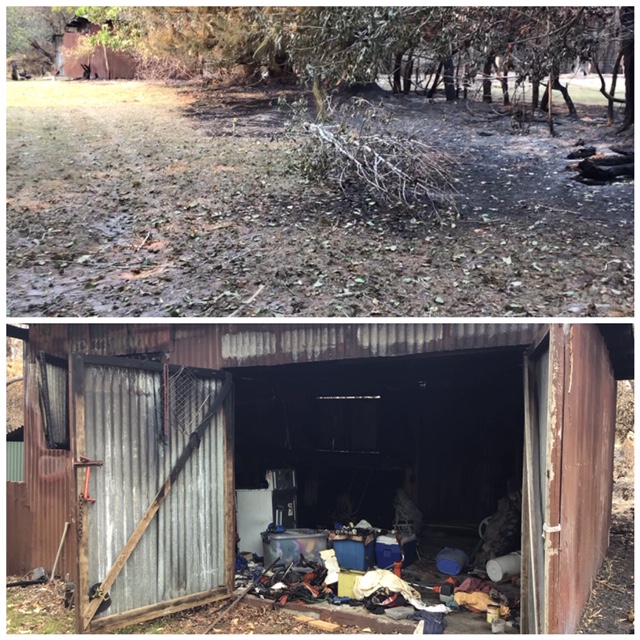
The shed had a lot of tools, power tools, hardware, fishing gear, farm chemicals, paint, a newish stove, my two surfboards (one from 1964) and the daughter’s childhood memorabilia in there. We have been in to check what is salvageable. Not a lot. And the structure is a bit wonky to work in. It creaks menacingly in the wind!

The insurance assessor came on Tuesday and did the survey so now we wait for the nitty gritty on the claim.
In the meantime it is a matter of cleaning up what we can. I really can’t start the fence repairs because of the danger of falling trees and branches. We hear them crashing down in the bush around us on a regular basis. The Australian eucalyptus (gum tree), especially when fire (and drought) weakened, is not called the ‘widow maker’ for nothing.
This fire is not out. It is only contained.
So far it has burnt 86,000ha (213,000 acres)
We were told it could double in size until we get substantial rain. None is forecast until early next year.
It was indeed a sobering community update meeting with around 500 affected attending as the emergency began to subside.The two minute standing ovation for the fire and emergency services at the end of the meeting said it all about the way we all felt about the way they had gone about their business.


Notable for their absence at any of the fire grounds in the state, where so far over 2,700,000ha (6,700,000 acres) has been burnt and 6 lives and 720 homes lost, were the country’s Prime Minister* and the state’s Premier**. But as both lead climate change denying conservative governments what do you expect? Not that we needed to actually see them in person sprouting 'thoughts and prayers' platitudes but some acknowledgement of the dire situation some people have found themselves in would have been appropriate.
A pox on both their houses!


In the meantime, thanks to Mark and Steph up the back, Bob and Jude across the road and Ralph down the way a bit. Their help looking after our property and animals during our enforced absence is much appreciated. Also a shout out to Les who defended our road bridge from the flames in the early hours.
To the two Susans, Warwick and David, your hospitality and empathy for the two evacuees won’t be forgotten. Thanks also to Marg (and her firefighter husband, Tony), Marcia and Annette for their support.
The Evacuation Centre in town organized by the NSW government ran like clockwork and am sure those that took full advantage of the services offered (refuge, food, medical care, pet care, counselling etc) would have no complaints.
The whole community really came together during this crises and the generosity of local businesses and residents was outstanding.


As for the men and women volunteers of the NSW Rural Fire Service (RFS) and in particular the Calderwood Brigade, you are heroes!
This was my fourth fire in the area and by far the worst.
Hopefully it is the last.
Update: 21/12/19
*The Prime Minister snuck out of the country unannounced for a family holiday in Hawaii during this emergency leaving the dullest tool in the shed, National Party leader and deputy PM, Michael McCormack in charge.
Public outcry has shamed him into returning.
Compare and contrast


**The Premier meanwhile has become more visible and connected as this catastrophe develops.

Friday, December 13, 2019

The Currowan Fire / Part 1

What became known as the Currowan Fire impacted the area between Batemans Bay and Ulladulla and west to the great dividing range. After travelling west for a few days, gusty hot dry westerly winds turned it around and drove it east towards the coast.
We knew then we could be in trouble.
 

We prepared the house as best as possible and, when we got four phone calls from Emergency Services in quick succession on the Sunday afternoon, we took their advice and evacuated to a motel in town.
All the coastal villages from Bawley Point to North Durras were also told to leave.
Late Tuesday night, early Wednesday morning our property was impacted.
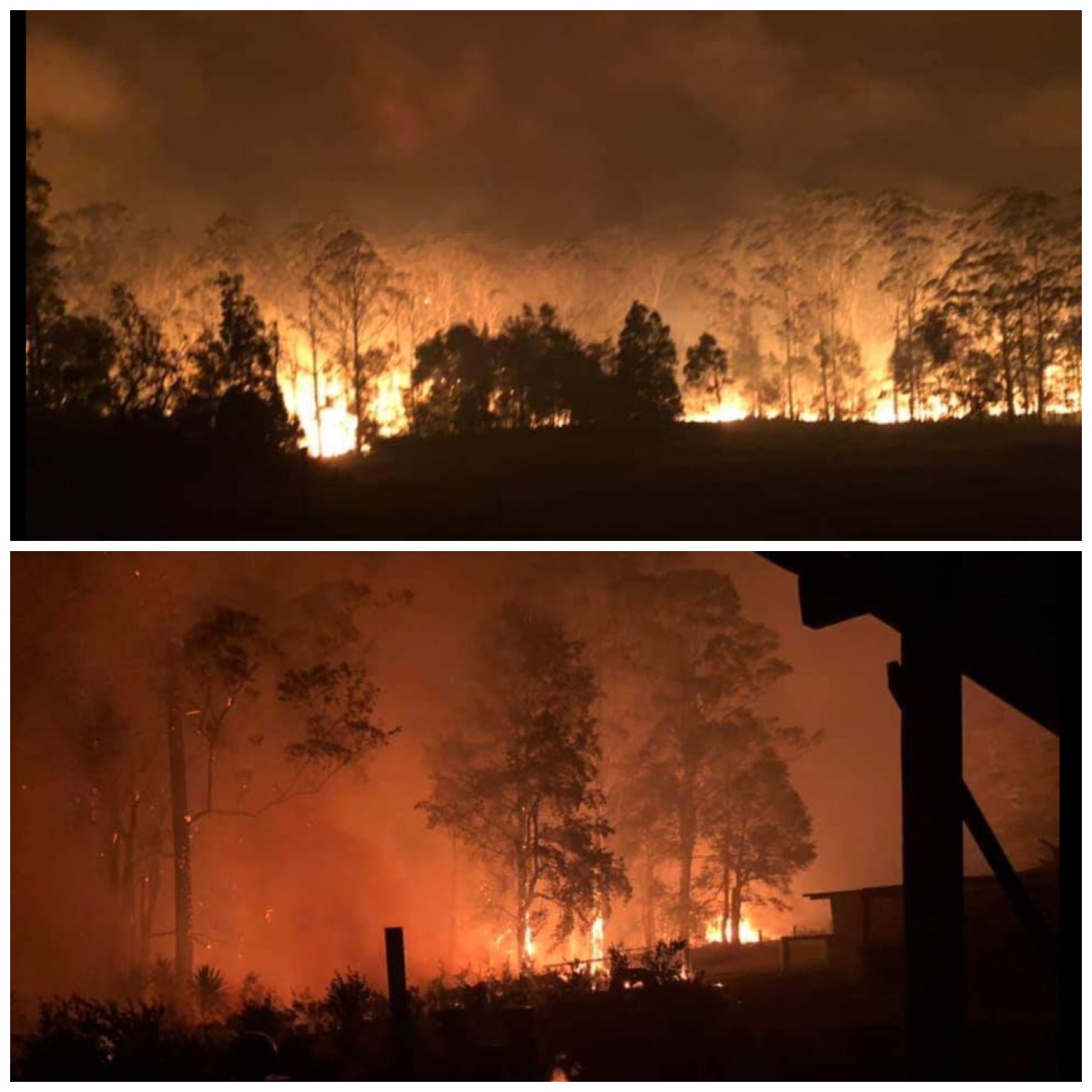
Our neighbours who stayed took the four pictures below as the fire arrived.
It burnt into our northern boundary taking out some of my vines, our storage shed, wood shed, a water tank and vacant chook shed before heading for the studio and house.
Thankfully the Calderwood Fire Brigade was there to defend the property and they did a great job. The flames came within a few metres of the buildings but they were not directly impacted.


The main fire in the meantime roared south down the western wooded area of our property into our southern neighbour and along our creek's riparian corridor to the highway, jumped it and headed into Meroo National Park and the ocean.
The picture below of the fire near our vineyard was taken by one of the firemen.


We had to get our news remotely on what was happening as the highway was closed. Thankfully our neighbours kept us up to date by phone.
A couple of them who had evacuated to a village a few minutes drive to the north came back in on the Wednesday morning and helped put out the numerous spot fires burning around us as well as looking after the cattle. With all our fences now damaged the danger was their getting onto the highway where fire and emergency vehicles were active.


Then on Thursday afternoon another branch of the fire headed towards us but with nothing left to burn immediately cut around and across our northern neighbours’ boundaries and also jumped the highway into Meroo NP.
Then the wind changed to a gusty southerly and drove the NP fire towards Lake Tabourie.
Watch this rather long video of the RFS defending that village. Shows how brave and dedicated these volunteers are. The village was saved with minimal damage.
In the meantime, the coastal villages to our south were under constant ‘attack’. They brought in the big gun flying tankers and other aircraft as well as fighting it on the ground.


Many had stayed in this area against advice and had to be evacuated by sea. The fire did reach the streets of Bawley Point before being repelled.
To be continued........

Saturday, December 07, 2019

Bushfire Update

The fire I mentioned in the previous post turned into a 75,000ha monster.
We had to evacuate last Sunday.
Two fires came through our property on Tuesday and Thursday but the house was saved by the excellent work of the Rural Fire Service.


We have lost fences and our large shed.
We are safe.
The cattle are safe.
Our neighbours are safe.
We are not allowed home yet. Maybe in one or two days.
So consider this an interim post and we will give more details when we get back and get settled.

Sunday, December 01, 2019

Welcome to Summer?

Today is the first day of summer.
Normally we would welcome this as it means some lazy days at the beach, Christmas, cricket tests and long days doing not much. Oh, and the population of the area increasing fourfold for four weeks due to the influx of holiday makers, but we won’t go into that downside of things.
But this year the lead up has been all but calm.
For six weeks it seems the entire east of the state has been on fire. So far over 1.6 million hectares has been burnt out with 660 properties lost and 6 lives taken.
There seems no end. Substantial rain is needed to extinguish the fires and that is not happening or forecast.


Up unto Tuesday we had been spared any trauma as our little pocket of the world was fire free.
But in the afternoon we got word that a fire had broken out in inaccessible state forest and national park just 30km to the south west of us. It was a hot low humidity day with gusty dry winds and we were soon covered in smoke and falling ash which is always an ominous sign. Fires can ‘spot’ well ahead of main front in windy conditions.
Our ‘fire plan’ is to leave when told to by the authorities so we have the basic necessities already packed and ready to be thrown in the car with a few other things.
But as luck would have it, the wind changed later in the evening and the fire headed away from us.
Fast forward to today and ‘our’ fire is still burning but contained. It has grown to almost 7000ha (17000acres).
Hundreds of  firefighters on the ground have done a wonderful job back burning and creating firebreaks. Water bombing has been relentless.
But a week of nasty hot windy weather is ahead of us and with no decent rain forecast we are not out of the woods yet. We have been warned to stay on the alert in case the fire breaks containment lines and heads east again.
So in the interim we have taken time to fire prepare the house by cleaning combustibles out the gutters and removing the (inflammable) plastic leaf guards. In case fire approaches down pipes would be blocked and the gutters filled with water. Two back pack sprayers and my larger trailed battery operated one have been made ready in case we need to combat an ember attack. We can’t rely on electricity being available to run our house water supply system under bush fire conditions.

We know the firefighters would arrive to ‘defend’ our property if under threat like last time even if we are not here. Every little bit residents can do to make their job easier helps.
So here we are, sometimes covered in dense smoke, other times not. We check the ‘Fires Near Me’ app on a regular basis to keep updated and try to carry on our normal daily lives.
Welcome summer? Not yet!
In the meantime we 'enjoy' bush fire suns.

Friday, November 15, 2019

Spring 2019 Eastern Australia Bushfires

Bushfire season came early to northern New South Wales and southern Queensland this year.
Over one million hectares (2.5million acres) burnt to date.
Four deaths.
Over 300 properties lost.
Situation on going with high temperatures, low humidity, high winds and no rain forecast.
So far we in the south of NSW have been spared but it is going to be a long stressful summer if the drought conditions continue.

NSW Bushfire Situation 15th November 2019


Photos:9 News

Sunday, November 10, 2019

What Happened in 1946?

In the World
War Crimes Tribunal held in Nuremberg and War Crimes Trials held in Tokyo.
Bikinis go on sale on July 5th in Paris.
The USA starts Atomic Tests on Bikini Atoll.
Tupperware is introduced to U.S. consumers.
London Heathrow airport opens fully for civilian traffic
Former British Prime Minister Winston Churchill gives his famous "Iron Curtain" speech while visiting the United States.
Microwave Oven invented.
Britain announces it’s granting India’s wish for independence.


First successful motor scooter The Vespa produced.
Movies It’s a Wonderful Life and The Best Years of Our Lives released.
Robert Penn Warren’s All the King's Men, Evelyn Waugh’s Brideshead Revisited and Benjamin Spock’s childcare classic published.
Thomas the Tank Engine first published.
Dolly Rebecca Parton, country singer, was born in Sevierville, Tennessee.


Donald Trump was born in NYC.
Bill Clinton was born as William J. Blythe III in Hope, Arkansas.
The beginning of the Baby Boomers generation.
In Australia 
Government introduces the major post-war immigration scheme while maintaining the so called White Australia Policy. This discriminative policy was progressively dismantled from 1949.
Today, Australia has the world's eighth largest immigrant population, with immigrants accounting for 29% of the population, a higher proportion than in any other nation with a population of over 10 million.


World champion racing driver, Alan Jones, born.
Government forms domestic airline TAA in competition with the private ANA. The former was eventually absorbed by QANTAS, the latter taken over by another privateer, Ansett which eventually went to the wall in 2002 (taking all my FF points with it).
New Zealand defeats Australia 2-0 in a Rugby Union test series (nothing changes much!).


The UN grants Australia trusteeship of the Territory of New Guinea and Territory of Papua.
I was born 10th November around 11pm by caesarean section at St. Andrews Hospital in Melbourne.

Thursday, October 24, 2019

The Drought Continues 2


You’ve probably read a lot about El Niño and the Southern Oscillation Index and its affect on Australian weather patterns.
Now read about new research on the Indian Ocean Dipole which is also having its affect.

Saturday, October 19, 2019

Highway Realignment / Wildlife Protection.

Back in July 2016 I wrote about the new highway realignment near us and how facilities to protect the wild life were put in place.
We have just received notice that government road people will monitor the success of their program over three weeks at the end of this month.
One of the species initially identified as a potential ‘resident’ was the Yellow-bellied Glider. They installed high crossing structures over the highway to help them negotiate it safely.
But now they want to confirm their presence. This animal is a nocturnal marsupial gliding possum that lives in the native eucalyptus forests of eastern Australia.
A ‘Song Meter’ survey will be carried out. This will include two tests that broadcast recorded Glider calls using a megaphone to elicit responses. It has a distinctive growling call that it uses as a means of communication. It has been recorded to have been heard up to 500m away.
We have been ‘warned’ that we may hear bird like sounds between 7pm and 10pm some nights.
There will also be abnormal activity in the area surrounding the highway as the team carries out their work.
Great they are following up.

Saturday, October 12, 2019

Cattle Yard Repairs

The previous owner had installed a considerable cattle handling facility on our property (it was much bigger when he owned it) that included yards, stalls, a crush and a loading race and ramp.
He also had a timber mill on site so the posts and rails used in construction were high quality eucalyptus hardwood.
But over the years some parts deteriorated due to rot and others to termite attack.
We replaced rails with commercial hardwood ones and posts cut from our own trees. The heavier duty posts were supplied by our firewood man, Laurey. Unfortunately (for us) he recently retired meaning a reasonable supply line has dried up.

Over the last few years, the yard deterioration accelerated and a major overhaul became necessary.
When I priced the hardwood rails and posts, I suffered a severe case of sticker shock.
It’s not that we will use the yards to any great extent as our cows are here to stay but it’s good to have them in reasonable condition.
So after some discussion with more experienced cattle men, it was decided that we could go with the significantly cheaper heavy duty H4 CCA treated pine posts and rails. Apart from the much better price, they are simpler to work with being lighter and much easier to drill for bolting or coach screwing especially as we use 130mm and sometimes 150mm M10s. We only snapped one drill bit! And that was in an old hardwood post.
My friend Stirls came down to help and for 5 days we removed and replaced posts and rails.
Getting some of the big old rotting posts out was not an easy job especially when their bases were still in good condition and dug 1m into the ground. Neither was resetting good but heavy hardwood rails to the new pine posts.

So at times it was slow work. With one rain interrupted day, we didn’t get all the planned chores done.
But the essentials are in now in place and the remainder (mostly the race) can be done another time.
We celebrated our achievements, on Stirl’s last day, with a nice lunch of fish, chips and potato scallops at Innes Wharf at Batemans Bay, a favourite of his, thirty minutes drive south.
Neighbour Bob will help me swing a gate off a replacement post sometime next week and all will be good.

Wednesday, October 02, 2019

Daylight Saving Time

Early on this Sunday morning we go onto daylight saving time.
When I say ‘we’, I mean New South Wales and some other Australian states and territories.
But not all.
DST has been around for quite a while.
During World I and II all states and territories observed the time change under defence acts of the constitution.
In 1968, Tasmania became the first state post war to introduce the practice.
In 1971 all states and territories except West Australia and the Northern Territory followed suit. Queensland abandoned the change in 1972.
Australia: UTC Time Zones During DST
 The two recalcitrant states have run trials with DST over the last 40 years.
Public opinion in Queensland is geographically divided with the no’s in the north and west of the state ie. predominantly rural, and the yes’s in the metropolitan south east.
Western Australia had a referendum in 2009 on the issue after a lengthy trial and the no’s won 55:45.
So the upshot is we will have 5 time zones in the country instead of 3 from next weekend until early April 2020.
But the really stupid thing is there will be a time difference between states on the same longitude.
But we have all learnt to live with that. 

Tuesday, September 24, 2019

Strawberries

Strawberry season in Australia starts in July when the farms in the warmer northern parts of the country start sending their fruit to market. It then continues until the following February as warmer weather heads south.
The height of the season seems to be August to October when the huge southern Queensland farms are at their peak production. Fruit quality is excellent and prices are cheap, around $4/kg.


Last year however disaster struck.
Someone was inserting needles into the berries.
This lead to consumers boycotting the product and farmers having to dump tonnes of fruit.
It sent many producers to the wall.


After an intense investigation police found the culprit (a disgruntled employee) and as well as a few copy catters and the industry put in protocols to stop this happening again eg. metal detectors.
Supposedly!


Yesterday we had reports that a needle had again been found.
What is wrong with people?
Last time we didn’t boycott, we just cut the berries to be sure they were safe.
Now we will start doing the same.

Tuesday, September 10, 2019

Spring Bushfires

The ongoing drought has left much of the country extremely dry.
During winter we experienced a higher than normal number of bushfires.
There were a few in our local area, some quite close.
Now in the first weeks of spring it seems like nearly the whole east coast of the country is on fire.


Currently 52 fires are burning in New South Wales with 18 uncontained.
Property has been lost.
Seventy fires are burning in Queensland, again with property loss.
Even rainforest areas are alight for the first time in living memory.
Sadly it seems some of these fires have been deliberately lit.


Thankfully, south of Sydney, we have been spared so far.
Days of high, dry winds that we have experienced over the last weeks would has caused unstoppable firestorms.
All this doesn’t augur well for summer when temperatures are forecasted to be higher than normal and rainfall minimal.

Friday, September 06, 2019

The Lyrebird

There are two species of the ground-dwelling lyrebird in Australia, the Superb and Albert's.
They are well known for the beauty of the male bird's huge tail when it is fanned out in courtship display and their ability to mimic natural and artificial sounds from their environment.
They are among Australia's best-known native birds.
The superb lyrebird is found in areas of rain forest in Victoria, New South Wales, and south-east Queensland. They are apparently in our area but have never seen one.
Albert's lyrebird is found only in a small area of Southern Queensland rain forest. 
They are shy and difficult to approach so not a lot information is known about their behaviour.
We know they feed on the ground and as individuals taking a range of invertebrates as prey including insects.
Lyrebirds are long-lived birds with a life span as long as thirty years. Female superb lyrebirds start breeding at the age of five or six, and males at the age of six to eight.
Males defend territories from other males. These may contain the breeding territories of up to eight females. Within the male territories, the males create or use display platforms. For the superb lyrebird, this is a simple mound of bare soil.
  
     Male and Female Lyrebirds 
 

On these mounds they sing and dance in courtship display for potential mates. The male lyrebird can have several. The female builds an untidy nest where she lays a single egg. The egg is incubated over 50 days solely by the female who also fosters the chick alone.
Lyrebirds sing throughout the year, but the peak of the breeding season, from June to August, is when they sing with the most intensity. During this peak they may sing for four hours of the day, almost half the hours of daylight. The song of the superb lyrebird is a mixture of elements of its own song and any number of other mimicked songs and noises. Lyrebirds mimic with great accuracy the individual songs of other birds and the chatter of flocks of birds as well as other animals such as koalas and dingoes. They are also capable of imitating almost any sound and have been recorded mimicking human sounds such as a mill whistle, a cross-cut saw, chainsaws, car engines and car alarms, fire alarms, rifle-shots, camera shutters, dogs barking, crying babies, music, mobile phone ring tones, and even the human voice. But while the mimicry of human noises is widely reported, the extent to which it happens tends to be exaggerated and the phenomenon is unusual.
If this video doesn't play, try this link and this one
As a young boy, my family used to drive up into the Dandenong ranges behind Melbourne for picnics. We could always hear these birds (along with many others) and sometimes see one. Sixty years on this area is now well developed and the bird's habitat has suffered accordingly.
The lyrebird has been featured as a symbol and emblem many times.
It is on the reverse of the Australian 10-cent coin.


A stylized superb lyrebird appears in the transparent window of the Australian 100 dollar note.
A silhouette of a male superb lyrebird is the logo of the Australian Film Commission.
An illustration of a male superb lyrebird, in courtship display, is the emblem of the New South Wales National Parks and Wildlife Service.

Friday, August 02, 2019

The End of an Era

Just over 25 years ago I planted my first block of grape vines.
They were 100 Cabernet Sauvignon cuttings I obtained from the University of Sydney vineyard on their Orange, NSW campus where I was studying horticulture and where I became interested in viticulture.
Well there were actually 96 Cab Sauv plus 4 Chardonnay which somehow made it into the mix. Despite many unsuccessful efforts to convert them over to Cab Sauv by  grafting, the four remain there today.
As time went on, I increased the vine number to around 400, establishing another two blocks to include Pinot Noir, Tempranillo and Semillon.
Relatively New Cabernet Sauvignon Block in the '90s

Growing wine in our warm maritime climate was always a challenge with fungus diseases always being a threat due to humidity and wet weather, the latter especially, at harvest time.
But with regular spraying of preventative fungicides, and a one in seven good season, we were always in with a chance of having a successful vintage.
Of course that didn’t always happen. To see a year’s work rotting on the vines due to 3 weeks continual rain at vintage time was always a bit depressing.
And not so good wine made from less than good quality grapes due also to wet weather was always disappointing.
Thankfully insect pests were never much of a problem. I don’t think I ever sprayed an insecticide. This allowed the build up of ‘good guy’ predator insect populations in the vineyard that took care of any unwanted invader.
Of course we had problems with birds which we took care of by netting the blocks. And a few years ago we started to have kangaroo problems which have increased substantially as time went on.
Last vintage I was fungicide spraying on a regular basis, not to mention doing green pruning, weed spraying and inter row maintenance and it was taking a toll physically.
Then there was harvest and wine making to consider.
The heat and humidity of summer plus some back problems got me to thinking that it was maybe time to call it a day.
I didn’t harvest the 2019 crop at all and came to the decision during the early part of this year it was time.
Early Days / Pinot Noir & Cabernet


So this winter I will ‘mothball’ all three blocks rather than grub the vines out.
This will allow someone in the future, with some work, to get the vines ‘up and running’ again.
There are a number of ways of doing this and I have chosen the minimal pruning method.
This means cutting the vines back a minimal level rather than prune them right back to a crop producing level. Then the vines will produce lots of small shoots from the numerous dormant buds left on the multiple canes rather than a few strong shoots from two bud canes (spurs) and grow out of control. Over time the vines will self regulate and remain somewhat relatively compact.
The only maintenance then required is mid row mowing to stop them being a snake hiding place.
Sure, the new shoots will be subjected to fungus attack but that will be the price paid.
Then it will be a matter of making sure all the wine making equipment is cleaned well and protected from the environment.
And then that will be that.

Update: The vineyard infrastructure has been dismantled.

Sunday, July 28, 2019

The Drought Continues 1

Back in July 2018  I wrote about the drought that was affecting 99% of our state and linked it to a photo essay from The Guardian that showed how desperate things were for our farmers.
A year on a follow up photo essay shows that things have not improved.
New South Wales Drought Map July 2019


Here on the South Coast we have had minimal rainfall over the last year. 
Despite the odd heavy storm related downpour, our creek is still not running and our dams are still looking a sorry sight.
We have once again started hand feeding our small herd of cattle with $28/bale hay over winter.
Now, while our livelihood does not depend on weather, thirty years of living in a rural environment tends to make one more than sympathetic for the plight of those where it does.
Meanwhile climate change scepticism within much of world leadership runs rampant and they continue to fiddle while Rome (and the Arctic) burns.

Wednesday, July 24, 2019

There's a New Bird in Town

We throw out vegetative kitchen scraps on the garden outside the little house to become compost.
Not much of it makes it that far.
The area has become a gathering place for kangaroos, wallabies and birds, mainly currawongs, magpies and satin birds who enjoy an easy meal.
Lately a large group of black birds has descended on the bounty, scaring away the others in a show of force.
They are larger than a crow, have a white flash on their wings and bright red eyes
A quick Google established that they are the white-winged chough (Corcorax melanorhamphos) which is one of only two surviving members of the Australian mud-nest builders family.


It is only distantly related to the European choughs that it closely resembles in shape, and for which it was named. 
They are easily mistaken for "crows"
Those red eyes become swollen and brighter in colour when the bird is excited.
White-winged choughs are not particularly strong or agile fliers and spend the great majority of their time on the ground, foraging methodically through leaf litter for worms, insects, grain, and snails in a loose group.

A rich find is the cause of general excitement and all come running in to share in it.
This is the behaviour we are witnessing.
They live in flocks of from about 4 up to about 20 birds, usually all the offspring of a single pair.
So they are new around here and we expect to see more of them.