Sunday, January 05, 2020

A Currowan Fire Update / January 5th 2020

As predicted, Saturday 4th January was a very difficult day for all those in and around the fire grounds across the state and over the border in Victoria.
Temperatures were in the high 30s, early 40s and dry winds were gusting from the west.
In fact, western Sydney recorded their highest temperature ever, a staggering 48.9℃ (120℉).
We thought we were fairly safe but at 2pm the power went out and we noticed a significant smoke plume just over the hills to the north of us.
An unburnt area between Lake Burrill and Lake Tabourie had caught fire and was heading once again for the latter village.
Being surrounded by a now large fire break caused by the previous fires we were not in immediate impact danger but any wind change could bring an ember attack.


No power meant no pump so we didn’t have access to any high pressure water.
We spent a few hours watering down the roof and gutters of the house using my battery operated vine sprayer unit and listening to our national broadcaster, the Australian Broadcasting Corporation, for fire updates on the car radio and enjoying a little aircon. The ABC covers much of Australia with city and regional stations and during emergencies dedicates those to providing updates and warnings. Despite all the modern methods of communication these days, old fashioned radio still comes through when the chips are really down. And a good battery operated transistor radio (remember them?) seems to still be essential equipment.


It became apparent from reports we were cut off both to the north and south but still had safe places to go in case the need be.
We were aware a southerly wind change was heading up the coast and arrive it did with a vengeance around 6pm. It howled through the area with gusts up to 90km/hr for around 20 minutes covering us in dead leaves, small branches, dust and ash. While driving the Tabourie fire away from us we knew this would cause problems for a whole lot of people on the northern edges of fires which from reports on Sunday morning it did.
Firefighter’s boots with soles melted off


So there we were again. No power, no mobile phone coverage, no internet. So it was another romantic candle lit dinner of a hard boiled egg and salad wrap, warm beer then early to bed.
I awoke around 3am and had a walk around the house in now very cool conditions to check for spot fires. There were ominous red glows on the distant horizons both north and south and the ash was falling on us like snow.
Today we are still cut off by road in both directions from our two major towns and await advice as to when power and mobile phone (although we do still have a landline) service will be restored*
* restored around 3pm today.

Friday, January 03, 2020

A Currowan Fire Update / January 3rd 2020

As predicted, New Years Eve produced horrific conditions over the fire ground.
High temperatures over 40°C and strong dry westerly winds drove fire into new territory.
The tourist town of Mogo just to the south of us was first to suffer with many buildings lost.
This part of the fire then got into the suburban and out lying areas of Batemans Bay with numerous house losses. It burnt to the beaches there.
North of us the community of Lake Conjola was devastated. People were forced onto the beach and into the water to avoid the inferno. A huge number of homes were lost.
Further south, the town of Cobargo was decimated. In Victoria, just over the border, huge fires consumed east Gippsland. Thousands of holiday makers were forced into the water at Mallacoota and are being evacuated, as I write, by the Australian Navy.
In east Gippsland, a very large rural area, there has been loss of life, loss of property and homes and huge livestock losses.


Despite being warned to stay away from the south coast, huge numbers of tourists flocked to the area for their summer holidays. The fire situation has caught them all with nowhere much to go. Power has been cut, communications are, at best, patchy. Major roads have been cut and as a result there is a lack of food and fuel supplies in all the major centres.
Today the government declared a state of emergency and ordered all non residents out of the area.
Obviously with so much fire around, the major road to the south and north had been opened and closed numerous times. The traffic jams trying to get out of the area are horrendous. We cannot get into town for supplies at all. Our highway between Batemans Bay and Ulladulla is a 55km parking lot. People were sleeping in their cars last night on the road. A normal journey from our area to Sydney is four hours. For many it is taking 24 hours!


This brings us to this weekend.
Conditions are predicted to be worse than New Year’s Eve so we are girding our loins once more.
Theoretically we are safe due to our area being burnt out a few weeks ago. But we have been warned once again to be alert for secondary fires caused by flying embers from the distant fire fronts. Lots of dead fallen leaves are now on the ground and many trees are still smouldering.
So that’s the situation to date.
Obviously there will be more to come.

Wednesday, January 01, 2020

Sunday, December 29, 2019

A Currowan Fire Update / December 29th 2019

The Currowan Fire has merged with another to the north and spawned another to the west.
Total area to date over 250,000ha or 620,000 acres.
The forecast for the coming days is not good.
Temperatures are set to rise above 40 degrees in western Sydney and other parts of the state and north westerly winds are to pick up in coming days.
The Rural Fire Service has forecast "severe and extreme fire danger coming into Tuesday".
There was concern about the progress of fires in southern NSW on Sunday and our Shoalhaven area on Monday and Tuesday.


Emergency services have issued a strong message to tourists planning to visit the Shoalhaven in the lead up to New Year, urging them to reconsider all travel plans due to "deteriorating" bushfire conditions.
Our council said the significantly increased population due to visitors was already "adding to the burden on emergency services and responders".
The major highway from Sydney is being cut continually by fire activity.
The major highway from Canberra has been cut for 3 weeks and due to fire damage is unlikely to be open in less than a month.
This is turning into a disaster for tourism in our area. Many businesses rely on the income generated during the long Christmas/New Year holidays to sustain them during the rest of the year.
There were more than 80 blazes across the state on Saturday evening as a "very high" fire danger warning was in place for much of the east coast. Unfortunately some fires have been deliberately lit and arrests are being made.
There is no rain forecast for the next 10 days.
We are seemingly safe. Nothing much left to burn around here but we have been warned that secondary fires are a possibility and to be alert.

Wednesday, December 25, 2019

Christmas 2019


Christmas Eve dinner was a big bowl of Moules mariniere with crusty bread to mop up the broth followed by fresh tiger prawns with wasabi. Then a scoop of Ben and Jerry’s Triple Caramel Chunks.
Wine: Rapaura Pinot Gris 2019 from New Zealand.
Christmas Day calls to family and friends before opening a bottle of champagne late morning to have with a Christmas lunch entree (starter) of oysters and prawns.
Then as a main, a little later, barramundi on the BBQ with fried potatoes washed  down with Pikes ‘The Merle’ Clare Valley Riesling.
And then, much later, dessert; plum pudding and vanilla bean custard.

Finally a shout out to the over 2000 volunteer men and women fire fighters who are out there today still protecting us and who could not be with their families today. You are all heroes.

Monday, December 23, 2019

Australian Bush Fire Situation / 23rd December 2019

State-by-state breakdown of the bushfire crisis:
Australia:
5 million hectares burnt.

New South Wales
The total area burned in NSW has reached 3.41m hectares, according to the RFS.
110 fires, of which almost 60 are uncontained, are still burning.
Six lives lost.
829 buildings destroyed with another 100 possible over last weekend.
Major Fires: Gospers Mountain blaze (areas hardest hit include Lithgow and along the Bells Line of Road in the upper Blue Mountains); Green Wattle Creek fire (devastating Wollondilly Shire villages of Buxton and Bargo, and wiping out small town of Balmoral);  *Currowan blaze (has hit communities near Nerriga, north of Batemans Bay).
* ‘Our’ fire.

Victoria
Two blazes still burning uncontrolled in Tambo Crossing in East Gippsland and Hotspur, Digby, in the western district.
Bushfires in East Gippsland burning since Thursday

South Australia
Huge fire burning in Adelaide Hills.
One life lost.
25,000 hectares burned within a 127km perimeter.
72 homes confirmed lost along with 404 other buildings and 227 vehicles over the weekend.
Significant losses to crops, including vineyards and hundreds of sheep killed.
Australia’s Christmas Wish

Queensland
About 60 fires burning within containment lines across the state.

Western Australia
Lives and homes threatened by bushfires in Perth’s Hills region around Roleystone, in the city’s south-east and a massive blaze at Yanchep, north of Perth, last week before being downgraded.
Firefighters battled heatwave conditions for much of the six-day fire, saving thousands of properties.
One house and a Yanchep petrol station were destroyed; about 13,000 hectares were burned.

Tasmania
Two bushfires north of Launceston were brought under control at the end of November.

Northern Territory 
NT last saw major fires in September when there were nine active fire grounds.

Source: AAP.

Wednesday, December 18, 2019

New South Wales Rural Fire Service

Following posts on ‘our’ fire, I had a number of inquires about the New South Wales Rural Fire Service (NSW RFS).
The NSW RFS is a volunteer-based firefighting agency and statutory body of the Government of New South Wales.
It is responsible for fire protection in 95% of the land area of New South Wales.
Urban areas are the separate responsibility of the paid Fire and Rescue NSW.
The NSW RFS is the primary agency for responding to bush fires in the state. In addition, they respond to structural fires, vehicle fires, motor vehicle accidents and wide range of other emergencies.
It is the largest volunteer fire service in the world, with over 72,000 volunteer members who are organized into 2,002 brigades.


The service also employs around 900 paid staff who fulfill senior operational management and administrative roles.
The agency attends to approximately 27,000 incidents a year.
It reports to the New South Wales Minister for Police and Emergency.
Equipment:
Engines
• 3,783 tankers
• 62 pumpers
• 59 bulk water carriers
 and 30 Fire boats.
The NSW Rural Fire Service also operates an Aviation Unit and owns and contracts a number of aircraft for firefighting water bombing, reconnaissance, intelligence gathering and transportation.
Other states in Australia have similar organizations.
More detailed information here.
Check out their web site https://www.rfs.nsw.gov.au/

Sunday, December 15, 2019

The Currowan Fire / Part 2

When the winds pushed the fire north and away from us we were anxious to get home but weren’t allowed. We tried a number of times at the road block but were refused. When we heard on Sunday that some residents were being allowed to return we tried again. We came up against an officious cop who said ‘no’ initially but was finally convinced to let us through.
Why they had officials at the road block with no local knowledge of where places actually were, I will never know
Kudos to the co driver who was able to keep my latent lack of respect for police in general (result of 60/70s Vietnam War protest clashes!) in check. My knee is still bruised from all the squeezing.

And lucky we did get through as when we arrived home we found fence posts and a large tree very near our house on fire. If it hadn’t been initially quelled by us and finally put out by the RFS who arrived quickly, I think the house would have been in real danger.


So then with the help of neighbour Bob the highway boundary fence was repaired to a suitable state and an electric fence as back up put in by the co driver and me.
Then we brought the hungry and thirsty cattle back home.
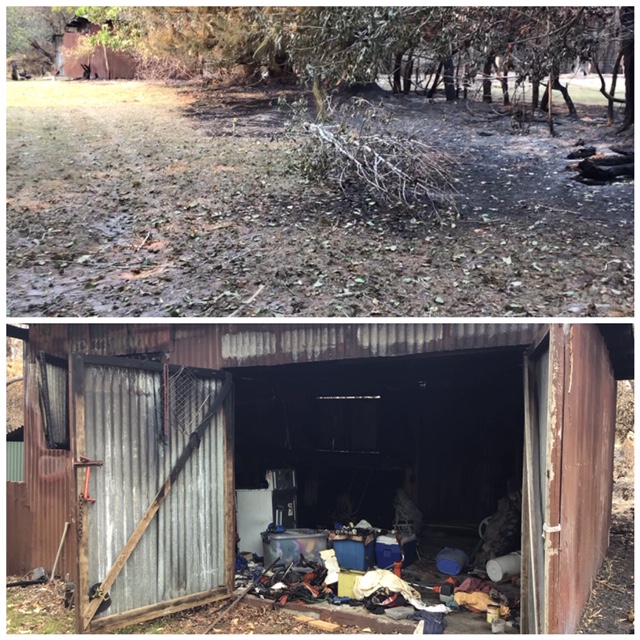
The shed had a lot of tools, power tools, hardware, fishing gear, farm chemicals, paint, a newish stove, my two surfboards (one from 1964) and the daughter’s childhood memorabilia in there. We have been in to check what is salvageable. Not a lot. And the structure is a bit wonky to work in. It creaks menacingly in the wind!

The insurance assessor came on Tuesday and did the survey so now we wait for the nitty gritty on the claim.
In the meantime it is a matter of cleaning up what we can. I really can’t start the fence repairs because of the danger of falling trees and branches. We hear them crashing down in the bush around us on a regular basis. The Australian eucalyptus (gum tree), especially when fire (and drought) weakened, is not called the ‘widow maker’ for nothing.
This fire is not out. It is only contained.
So far it has burnt 86,000ha (213,000 acres)
We were told it could double in size until we get substantial rain. None is forecast until early next year.
It was indeed a sobering community update meeting with around 500 affected attending as the emergency began to subside.The two minute standing ovation for the fire and emergency services at the end of the meeting said it all about the way we all felt about the way they had gone about their business.


Notable for their absence at any of the fire grounds in the state, where so far over 2,700,000ha (6,700,000 acres) has been burnt and 6 lives and 720 homes lost, were the country’s Prime Minister* and the state’s Premier**. But as both lead climate change denying conservative governments what do you expect? Not that we needed to actually see them in person sprouting 'thoughts and prayers' platitudes but some acknowledgement of the dire situation some people have found themselves in would have been appropriate.
A pox on both their houses!


In the meantime, thanks to Mark and Steph up the back, Bob and Jude across the road and Ralph down the way a bit. Their help looking after our property and animals during our enforced absence is much appreciated. Also a shout out to Les who defended our road bridge from the flames in the early hours.
To the two Susans, Warwick and David, your hospitality and empathy for the two evacuees won’t be forgotten. Thanks also to Marg (and her firefighter husband, Tony), Marcia and Annette for their support.
The Evacuation Centre in town organized by the NSW government ran like clockwork and am sure those that took full advantage of the services offered (refuge, food, medical care, pet care, counselling etc) would have no complaints.
The whole community really came together during this crises and the generosity of local businesses and residents was outstanding.


As for the men and women volunteers of the NSW Rural Fire Service (RFS) and in particular the Calderwood Brigade, you are heroes!
This was my fourth fire in the area and by far the worst.
Hopefully it is the last.
Update: 21/12/19
*The Prime Minister snuck out of the country unannounced for a family holiday in Hawaii during this emergency leaving the dullest tool in the shed, National Party leader and deputy PM, Michael McCormack in charge.
Public outcry has shamed him into returning.
Compare and contrast


**The Premier meanwhile has become more visible and connected as this catastrophe develops.

Friday, December 13, 2019

The Currowan Fire / Part 1

What became known as the Currowan Fire impacted the area between Batemans Bay and Ulladulla and west to the great dividing range. After travelling west for a few days, gusty hot dry westerly winds turned it around and drove it east towards the coast.
We knew then we could be in trouble.
 

We prepared the house as best as possible and, when we got four phone calls from Emergency Services in quick succession on the Sunday afternoon, we took their advice and evacuated to a motel in town.
All the coastal villages from Bawley Point to North Durras were also told to leave.
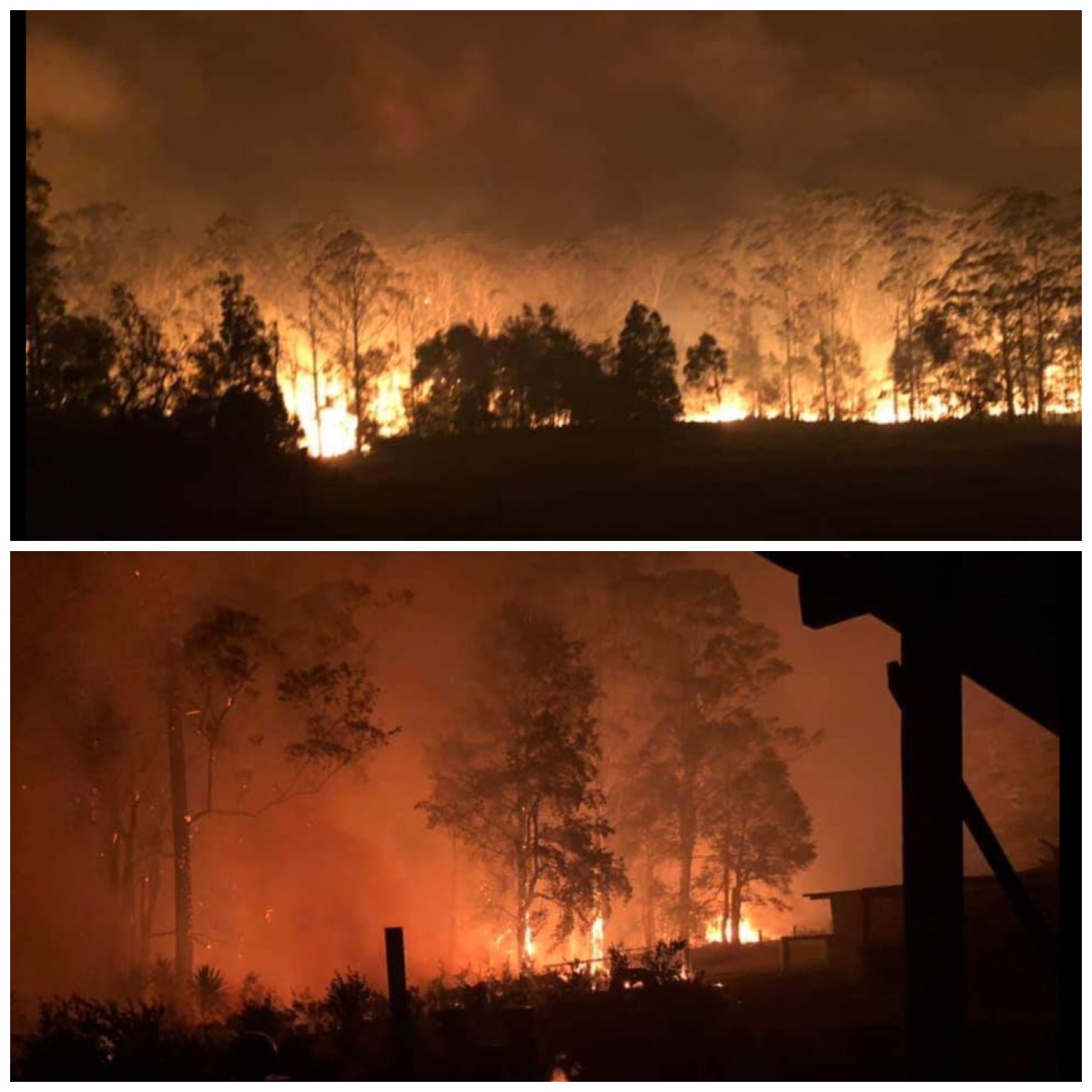
Late Tuesday night, early Wednesday morning our property was impacted.
Our neighbours who stayed took the four pictures below as the fire arrived.
It burnt into our northern boundary taking out some of my vines, our storage shed, wood shed, a water tank and vacant chook shed before heading for the studio and house.
Thankfully the Calderwood Fire Brigade was there to defend the property and they did a great job. The flames came within a few metres of the buildings but they were not directly impacted.


The main fire in the meantime roared south down the western wooded area of our property into our southern neighbour and along our creek's riparian corridor to the highway, jumped it and headed into Meroo National Park and the ocean.
The picture below of the fire near our vineyard was taken by one of the firemen.


We had to get our news remotely on what was happening as the highway was closed. Thankfully our neighbours kept us up to date by phone.
A couple of them who had evacuated to a village a few minutes drive to the north came back in on the Wednesday morning and helped put out the numerous spot fires burning around us as well as looking after the cattle. With all our fences now damaged the danger was their getting onto the highway where fire and emergency vehicles were active.


Then on Thursday afternoon another branch of the fire headed towards us but with nothing left to burn immediately cut around and across our northern neighbours’ boundaries and also jumped the highway into Meroo NP.
Then the wind changed to a gusty southerly and drove the NP fire towards Lake Tabourie.
Watch this rather long video of the RFS defending that village. Shows how brave and dedicated these volunteers are. The village was saved with minimal damage.
In the meantime, the coastal villages to our south were under constant ‘attack’. They brought in the big gun flying tankers and other aircraft as well as fighting it on the ground.


Many had stayed in this area against advice and had to be evacuated by sea. The fire did reach the streets of Bawley Point before being repelled.
To be continued........

Saturday, December 07, 2019

Bushfire Update

The fire I mentioned in the previous post turned into a 75,000ha monster.
We had to evacuate last Sunday.
Two fires came through our property on Tuesday and Thursday but the house was saved by the excellent work of the Rural Fire Service.


We have lost fences and our large shed.
We are safe.
The cattle are safe.
Our neighbours are safe.
We are not allowed home yet. Maybe in one or two days.
So consider this an interim post and we will give more details when we get back and get settled.

Sunday, December 01, 2019

Welcome to Summer?

Today is the first day of summer.
Normally we would welcome this as it means some lazy days at the beach, Christmas, cricket tests and long days doing not much. Oh, and the population of the area increasing fourfold for four weeks due to the influx of holiday makers, but we won’t go into that downside of things.
But this year the lead up has been all but calm.
For six weeks it seems the entire east of the state has been on fire. So far over 1.6 million hectares has been burnt out with 660 properties lost and 6 lives taken.
There seems no end. Substantial rain is needed to extinguish the fires and that is not happening or forecast.


Up unto Tuesday we had been spared any trauma as our little pocket of the world was fire free.
But in the afternoon we got word that a fire had broken out in inaccessible state forest and national park just 30km to the south west of us. It was a hot low humidity day with gusty dry winds and we were soon covered in smoke and falling ash which is always an ominous sign. Fires can ‘spot’ well ahead of main front in windy conditions.
Our ‘fire plan’ is to leave when told to by the authorities so we have the basic necessities already packed and ready to be thrown in the car with a few other things.
But as luck would have it, the wind changed later in the evening and the fire headed away from us.
Fast forward to today and ‘our’ fire is still burning but contained. It has grown to almost 7000ha (17000acres).
Hundreds of  firefighters on the ground have done a wonderful job back burning and creating firebreaks. Water bombing has been relentless.
But a week of nasty hot windy weather is ahead of us and with no decent rain forecast we are not out of the woods yet. We have been warned to stay on the alert in case the fire breaks containment lines and heads east again.
So in the interim we have taken time to fire prepare the house by cleaning combustibles out the gutters and removing the (inflammable) plastic leaf guards. In case fire approaches down pipes would be blocked and the gutters filled with water. Two back pack sprayers and my larger trailed battery operated one have been made ready in case we need to combat an ember attack. We can’t rely on electricity being available to run our house water supply system under bush fire conditions.

We know the firefighters would arrive to ‘defend’ our property if under threat like last time even if we are not here. Every little bit residents can do to make their job easier helps.
So here we are, sometimes covered in dense smoke, other times not. We check the ‘Fires Near Me’ app on a regular basis to keep updated and try to carry on our normal daily lives.
Welcome summer? Not yet!
In the meantime we 'enjoy' bush fire suns.

Friday, November 15, 2019

Spring 2019 Eastern Australia Bushfires

Bushfire season came early to northern New South Wales and southern Queensland this year.
Over one million hectares (2.5million acres) burnt to date.
Four deaths.
Over 300 properties lost.
Situation on going with high temperatures, low humidity, high winds and no rain forecast.
So far we in the south of NSW have been spared but it is going to be a long stressful summer if the drought conditions continue.

NSW Bushfire Situation 15th November 2019


Photos:9 News

Sunday, November 10, 2019

What Happened in 1946?

In the World
War Crimes Tribunal held in Nuremberg and War Crimes Trials held in Tokyo.
Bikinis go on sale on July 5th in Paris.
The USA starts Atomic Tests on Bikini Atoll.
Tupperware is introduced to U.S. consumers.
London Heathrow airport opens fully for civilian traffic
Former British Prime Minister Winston Churchill gives his famous "Iron Curtain" speech while visiting the United States.
Microwave Oven invented.
Britain announces it’s granting India’s wish for independence.


First successful motor scooter The Vespa produced.
Movies It’s a Wonderful Life and The Best Years of Our Lives released.
Robert Penn Warren’s All the King's Men, Evelyn Waugh’s Brideshead Revisited and Benjamin Spock’s childcare classic published.
Thomas the Tank Engine first published.
Dolly Rebecca Parton, country singer, was born in Sevierville, Tennessee.


Donald Trump was born in NYC.
Bill Clinton was born as William J. Blythe III in Hope, Arkansas.
The beginning of the Baby Boomers generation.
In Australia 
Government introduces the major post-war immigration scheme while maintaining the so called White Australia Policy. This discriminative policy was progressively dismantled from 1949.
Today, Australia has the world's eighth largest immigrant population, with immigrants accounting for 29% of the population, a higher proportion than in any other nation with a population of over 10 million.


World champion racing driver, Alan Jones, born.
Government forms domestic airline TAA in competition with the private ANA. The former was eventually absorbed by QANTAS, the latter taken over by another privateer, Ansett which eventually went to the wall in 2002 (taking all my FF points with it).
New Zealand defeats Australia 2-0 in a Rugby Union test series (nothing changes much!).


The UN grants Australia trusteeship of the Territory of New Guinea and Territory of Papua.
I was born 10th November around 11pm by caesarean section at St. Andrews Hospital in Melbourne.