Friday, December 18, 2020

Floods and More Covid

This time last year, a lot of the east coast was on fire.
This year much is flooded.


Torrential rain in northern New South Wales and southern Queensland has caused rivers to rise and towns to flood.
In fact there has been substantial rainfall over a great deal of the country.


Accompanying wind storms have caused big surf and devastating beach erosion.
We missed out on the nasty weather getting around only 30mm of welcome rain.


In other disappointing news Covid has raised its ugly head once more after many days of zero cases with a cluster emerging in northern Sydney. Seventeen cases have been diagnosed in the last 24 hours. 
Immediately other states have invoked quarantine measures on New South Wales. People in that area have been asked to stay home.


With the Christmas holiday season just upon us and city residents heading for their vacations in our region over the next six weeks, this is concerning.
As a safety measure the co driver and I will begin self isolating once more.
The last few weeks of relative ‘freedom’ were nice but we both had the feeling that another outbreak was inevitable. Covid fragments had been showing up in sewerage systems across Sydney and even Batemans Bay, twenty five minutes drive to our south.

Tuesday, December 08, 2020

Australian National Anthem Sung in Aboriginal Language

Our Indigenous population's fight for reconciliation took another very small step forward on Saturday night when the Australian national anthem was sung by a Wiradjuri woman, Olivia Fox, in the aboriginal language of the Eora Nation when the Australian Wallabies Rugby Union team played the Argentine Pumas.
The Eora group of Indigenous people are from the Sydney metropolitan area, where the game took place, 
This was a first for an international sporting event.
There are around 290 to 360 different Australian Aboriginal languages spoken around the country and its islands.
Other nations have Indigenous languages as part of their national anthems eg. New Zealand's anthem is sung in both Maori and English.

Some weren't happy as many consider the national anthem's words to be racist. For instance there has been controversy over the phrase "for we are young and free “ given that Australia is home to one of the world's oldest known civilisations. 
But it was quickly pointed out that the Eora version was not a direct translation
Considering the words were written in 1878 there are obvious outdated references. There have been a number of changes since it finally replaced ‘God Save the Queen’ in 1984. 
The above words will be changed hopefully to “for we are one and free”.
There is entrenched discrimination against Australia's Indigenous population.
While the country's Indigenous population makes up just 3.3% of its 25 million people, they account for more than 25% of its prisoners. 
Indigenous Australians are also almost twice as likely to die by suicide, have a life expectancy that is almost nine years lower, and have higher infant mortality rates than non-Indigenous Australians.

Thursday, December 03, 2020

Hibiscus

Our hibiscus are thriving with the return of warmer weather.
Some are warm temperate species which were already in the garden when I moved in and the tropical ones I brought down from my old home in Queensland. The latter do struggle a bit in our cooler climate here but every now and again they burst into multiple flowers. I made sure they were planted in the warmest and sunniest  parts of the garden.


Tuesday, December 01, 2020

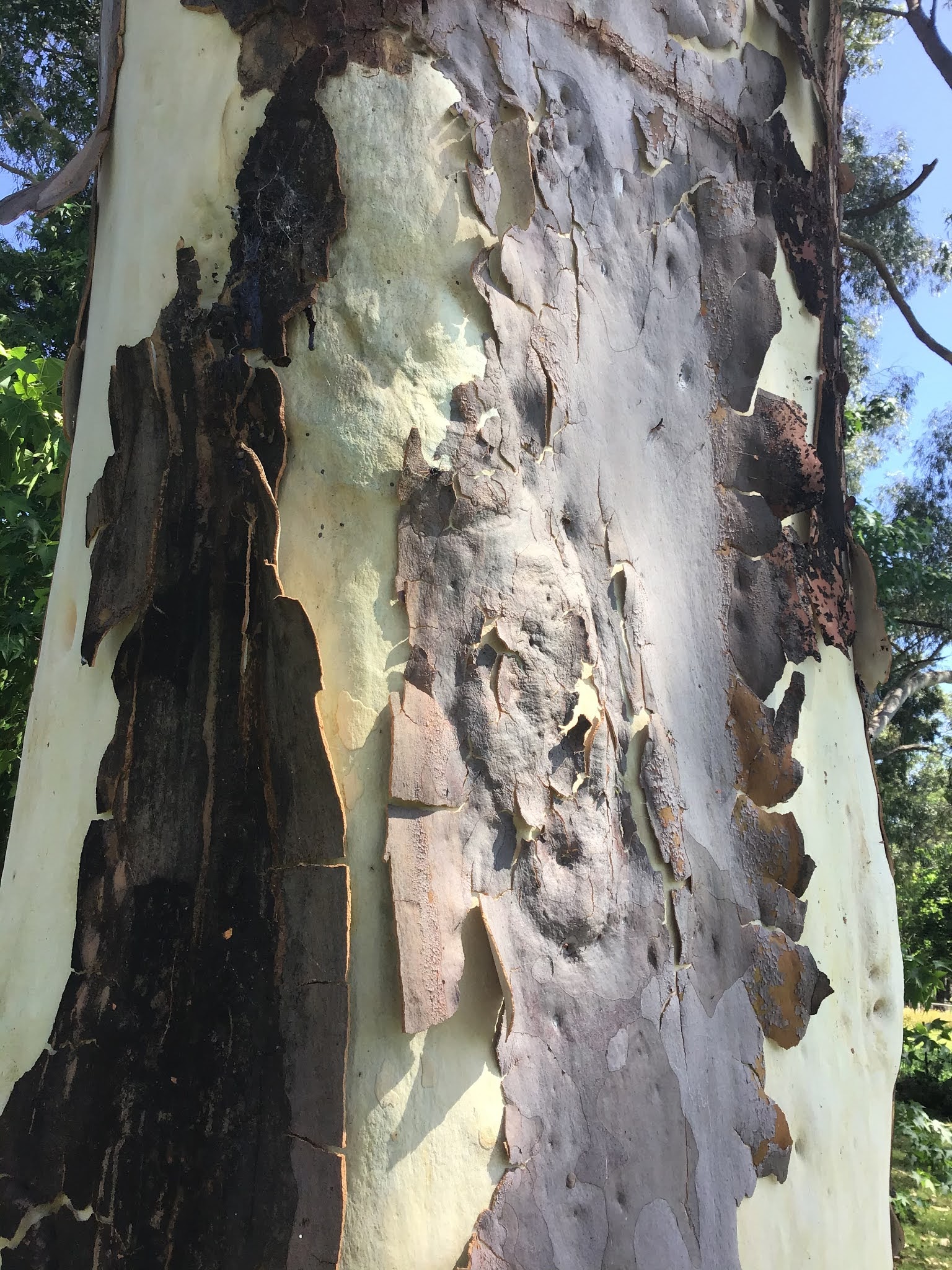
Eucalyptus (Gumtrees) Shedding Bark

There are more than 700 species of eucalypts in Australia with their bark types falling into roughly two categories:
- the shedding smooth type like brittle gums and scribbly gums.
- the persistent rough type of stringybarks, boxes, peppermints and ironbarks.
They are commonly called gum trees but the botanical term eucalypt means well (eu) covered (calyptos)


They are the dominant tree type growing all over the country and are evergreens only dropping some of their leaves when under stress.
The growing season for most eucalyptus is summer. When the trees grow, they put on new sap wood on the outside and expand. As a result most smooth bark eucalypts shed a lot of their bark in the summer months.
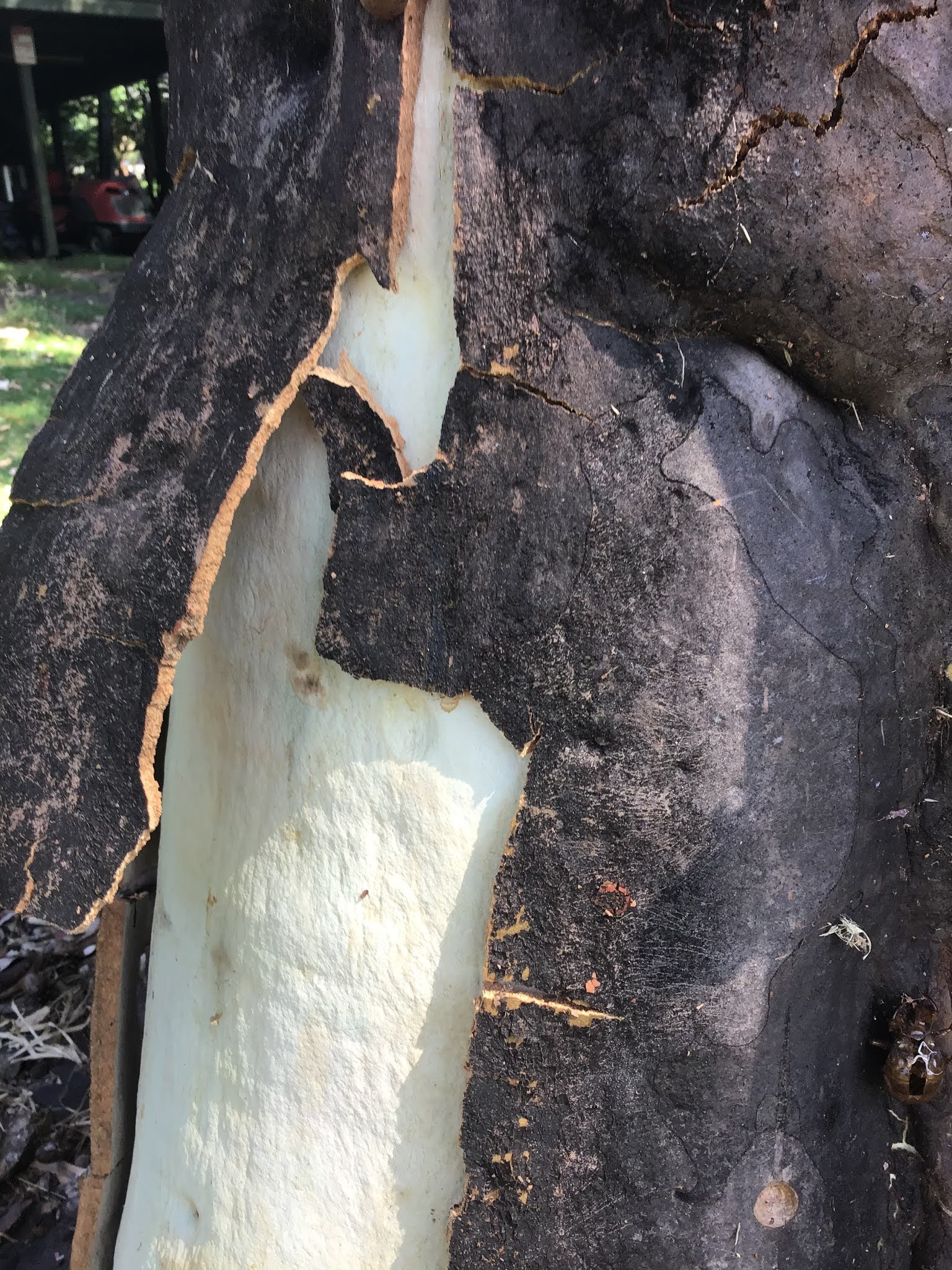
This bark shedding is called “decorticating” and is a normal thing to see, especially with smooth barked gum trees. 


In smooth bark types, the bark comes off in flakes curls or long strips. 
In rough bark eucalyptus, the bark doesn’t fall off as easily, but accumulates in entwined, stringy masses on the tree.
As the bark dries and peels, it often forms colourful patches and interesting patterns on the trunk of the tree. Some trees have striking patterns of stripes and flakes, and the peeling bark may expose bright yellow or orange colours of the new bark forming underneath.


Shedding eucalyptus tree bark may help keep the tree healthy. As the tree sheds its bark, it also sheds any mosses, lichens, fungi and parasites that may live on the bark. Some peeling bark can perform photosynthesis, contributing to the rapid growth and overall health of the tree.
Unfortunately the mass of fallen bark on forest floors contributes to the potential bushfire fuel during the season.

Friday, November 27, 2020

COVID-19 / Australia / 27th November Update

As of today, big fat zeros across the entire country as far as community transmissions are concerned.
Apart from a quarantined cluster in South Australia, the country is virtually Covid free.
Unless something drastic happens, there may be no need for any more Covid updates.
Well done us!


All other states and territories have been Covid free for months.

Thursday, November 19, 2020

COVID-19 / Australia / 19th & 20th November Updates

Just when you think it’s safe to go back in the water, the state of South Australia, after 3 months of no community Covid transmission, has seen the virus ‘escape’ from a quarantine hotel via a cleaner who had had no contact with the ‘guests’.
They assume she must have got it off a contaminated surface somewhere. The virus strain was traced to a ‘guest’ who had arrived from overseas on November 2nd and went directly to quarantine.
So far, 22 cases have been detected.
Their government has enacted an immediate “circuit breaker” which includes a six-day lock down and a further eight days of lesser restrictions in the state.
The rules are listed below. Compare these to what is in place in other countries around the world. Victoria took similar action but not as quickly and for much longer. So far that state has had nearly three weeks of zero transmissions.
Lock downs, while tough for the population and business, work!

All South Australians will have to stay put in their house for six days. Wherever they were at midnight this Wednesday (yesterday) that’s where they have to remain.
All schools will be shut except for children of essential workers and vulnerable children;
Childcare will be open only to essential workers, and shut to everyone else;
People will not be permitted to leave their home to exercise.
Takeaway food will be shut;
Universities will be closed;
Pubs, cafe’s, food courts and other food venues will be closed;
Elective surgery will be closed, except for urgent operations;
Cancer treatment will be closed;
Real estate inspections will be closed;
All outdoor sport and physical activity will not be permitted.
Regional travel is not approved. Holiday houses are closed. Schoolies, which police commissioner Grant Stevens said yesterday was still on, is now off;
Aged care and residential disability care is in lock down;
Factories other than for food and medical products are closed, apart from essential maintenance;
The construction industry is closed;
Weddings and funerals will be banned for six days;
Face masks are required when outside the home, although it’s just encouraged not mandatory as many in SA do not yet have masks;
Families with joint custody arrangements have been asked to find an arrangement that works for the next six days, without moving between houses.

Remaining open:
Supermarkets will remain open for one visit from one person per household per day;
Critical infrastructure — power, telecommunications — will remain open;
Medical services including mental health services will remain open;
Public transport will remain open;
Airport and freight services will remain open;
Petrol stations will remain open;
Banks and financial institutions will remain open;
Post offices will remain open;
Mining, smelting, and large factories will be allowed to continue to operate at a level required to ensure continuity of service delivery or to prevent damage, but not for anything else;
Veterinary surgeons will remain open;
Agriculture workers will be able to move around to ensure the safety, welfare and processing of animals and animal products, like dairy.

Update: No new SA cases reported today, Thursday. In fact there were zero new cases Australia wide.
Update: 20th November: Apparently the decision to lock down was based on information given to contact tracers by an infected person. It has now been established that this contact had lied and the situation, while still serious, was not critical.
So the SA government has revised their strategy and restrictions have been substantially reduced.

As of 12pm today, Friday 20 November 2020 exercise outside of your home with members of your household is permitted.
Masks are not mandatory but are encouraged.
Schools will re-open on Monday 23 November 2020.
As of 12:01 am on Sunday 22 November (Midnight Saturday) we will revert to similar restrictions that were in place on Monday 16 November 2020.
This includes:
1 person per 4 square meters will apply.
All food and beverages will need to be consumed while seated.
No dancing
Updated gathering provision numbers being:
Onsite purchase and consumption of food and beverages- 100 people maximum and no more than 10 people at each table.
Funerals- 50 people maximum
Weddings- 150 people maximum and registration of all guests with SA Health
Religious ceremonies (not including a wedding or funeral)- 100 people maximum
Private gatherings- 50 people maximum
Private residence- 10 people per house (unless more than 10 people permanently reside at the residence)
Personal care workers will need to wear masks.
Gyms are permitted to reopen.

Tuesday, November 17, 2020

A Day Trip South

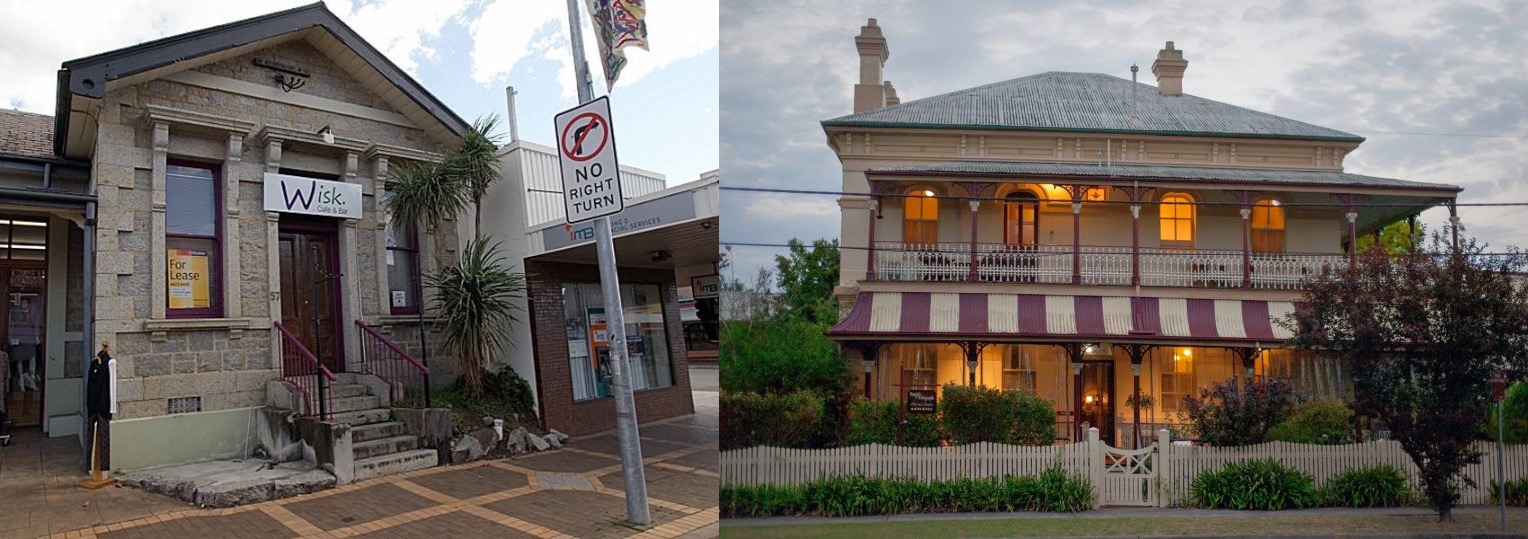
After five days of hard work fencing, Stirls and I decided to have a day off and drove with the co-driver down to Moruya which is about 90 minutes south on a nice river and did some touristy things. Lovely old buildings have been preserved there although their functions are different now eg. a solid granite bank building is now a cafe, the old post office is now a B&B.


There was a gold rush in the area in the mid 1800s so there was plenty of money about in those days.
It’s also the place that they mined the huge granite blocks for the pylons of the Sydney Harbour bridge.
We had coffee at a cafe and it was the first time I had sat in an enclosed commercial place for 7 months. Felt a bit strange at first. But they had the Covid rules in place ie. sign in with phone number and tables spaced well apart, so it was comfortable


Then we headed for Broulee on the coast and dropped the co-driver off at the newly relocated quilt store, Stephs
I knew this area from my surfing days in the 1960s and holidays in the 80s but Stirls had never been there so I gave him a bit of a guided tour of the beaches. It was a lovely day and the water was very blue and clear. Not much surf around however which must have frustrated about 10 guys sitting out at one of the points waiting for waves that hardly ever came.


We picked up the co-driver loaded down, not surprisingly, with parcels and drove the coastal road to Batemans Bay for lunch. This area was hit badly by the fires with people having to evacuate to the beaches. It hasn’t recovered as well as our area so far.
Lunch was fish and chips at our favourite, Innes Boatshed, on the balcony that sits over the water.


This is an institution in the Bay and is very popular. Best fresh fried fish, chips and potato scallops ever. Our fish was flake (shark), which used to be the normal fish and chips fare way back when, but you hardly see it anymore so we grabbed it. Delicious!
They are building a huge new bridge across the Clyde River there. The old one is a lift bridge which causes all sorts of traffic delays when it opens and especially when it gets stuck, which was happening more and more. 


It’s on the second main route from Melbourne to Sydney so they had to do something. I was first at the Bay in 1956, when the family moved from Melbourne to Brisbane and we drove pulling a caravan for four weeks holiday on the way. There was no bridge then, just a punt you drove onto. So I have seen a few changes in this area over the decades.
So that was our day.
Very laidback and relaxing.

Friday, November 13, 2020

COVID-19 / Australia / 13th November 2020 Update

Figures for the country are still looking good.
For instance, Victoria has now gone 14 days without a locally acquired case


All states and territories have agreed to a plan to reopen Australia's internal borders by Christmas, with the exception of Western Australia.
The Federal Health Minister said all COVID vaccines being developed around the world appeared not only to be safe and effective, but were ahead of schedule.
The government has secured agreements for four different vaccines, with a total of 134.8 million doses acquired.
The entire purchasing arrangement will cost the government $3.2 billion.
Any COVID-19 vaccine will be free for all Australians or medicare-eligible visa holders.
The National Cabinet has also agreed to a national COVID vaccination policy, which will prioritise the elderly and people particularly vulnerable to the virus.
So there does seem to be a light at the end of the tunnel for us.
Sadly the same can’t be said for many other countries around the world.

Monday, November 02, 2020

Covid-19 / Australia / Doughnut (Donut) Day

Yesterday Australia recorded its first no community Covid transmissions in 5 months.
Because of the “zero” this is now known colloquially as doughnut day.
Granted this is only a one day snapshot.
But today there are zero cases in Victoria (until recently experiencing a second wave) and one with a known source in New South Wales. All other states and territories are clear.
This is a trend that is encouraging.
The population has been through a lot of pain to achieve this goal what with lockdowns, business and school closures, social distancing, state and international border closures and increasing unemployment just to name a few.


There have been some rumblings about ‘over reaction’ and loss of ‘freedom’, mainly from the conservative side of politics, but support for Covid suppression measures runs high.
In the Queensland state election on Saturday, where restrictions have been quite severe, the incumbent left wing government was returned with an increased majority.
Many of the restrictions stay in place as a safety measure, some more stringent than others depending on the state, but increasingly they are all being relaxed.
It certainly isn’t all over yet. 
All governments are stressing the danger of complacency.
Life definitely has not returned to normal but you get the feeling the country is a little more relaxed.

Sunday, October 25, 2020

COVID-19 / Australia / 25th October 2020 Update

For the first time in months, our major state newspaper today has not led with a Covid story.
That is not to say it has gone away, but things seem to be under control especially in New South Wales with 6 locally acquired (but not mystery) cases this week and none in Queensland.


Meanwhile Victoria had seen a jump in new coronavirus cases with seven being recorded yesterday. This is due to a cluster in northern Melbourne which led to the closure of two schools.
However the number of active coronavirus cases across Victoria has fallen to just 98, the first time that figure has been below 100 since June 19.
The state’s much maligned tough restrictions have definitely had positive results.
So we remain on the alert but a little more comfortable with the situation. 
Life has definitely not returned to normal.
All governments are concerned that complacency might set in with the lifting of many restrictions so the message is still out there: wear a mask, socially distance and wash your hands.
Locally, the first two now seem to be ignored which is a worry with the Christmas tourist invasion just around the corner. 
We are seeing in other parts of the world, especially the USA, the results of dismissing basic preventative measures.

Monday, October 19, 2020

Some Non Covid News

So what’s happening around our place as summer approaches?
Fence repairs and upgrades continue.
Thanks to Stirls for coming down and helping with some major projects especially the remainder of the southern boundary fence.

We replaced the mid western strainer with a more substantial one and increased the stay length to keep it out of a permanent wet zone that contributed to rotting the base of the old one. A more substantial stay was placed at the eastern end strainer and all the unstable and burnt/scorched wooden posts were replaced with steel pickets. Then the wires were re-strained and tied. It was a full two day job but quite enjoyable working in the bush in pleasantly cool sunny weather. 
It is quite noticeable that, along with the tree regrowth, the bird and wildlife are finally returning. We disturbed a number of wallabies each morning and diverse birdsong was with us most of the day. Even the dreaded Koel has returned.


The fires have also created an environment for many new and interesting plants, apart from the flush of weeds, to grow. Some I have never seen before around here. They have probably lain dormant for decades.
We also made a start on revamping the east and northern house paddock fences damaged by the tree removal by replacing strainers and posts.
The only major project left now is replacing the southern house paddock fence.
The new grass out front is thriving after the occasional day of light rain supplementing the hand watering. Almost time to give it its first mow. The backyard grassing project is still in progress.


The shed rebuild continues. It’s going to be a little bit more fancy than first envisaged due to the builder and the co-driver getting their heads together. I may have to have an eight digit key pad lock installed to keep the fabric overflow from the little house (studio) finding its way over there. It will be nice to get all the stuff currently stored in the carport over there both for aesthetic and security reasons.


The pasture is taking a bit of time to get into its spring flush despite the ground moisture level being quite high. I guess we need some more warmer days to kick things off.
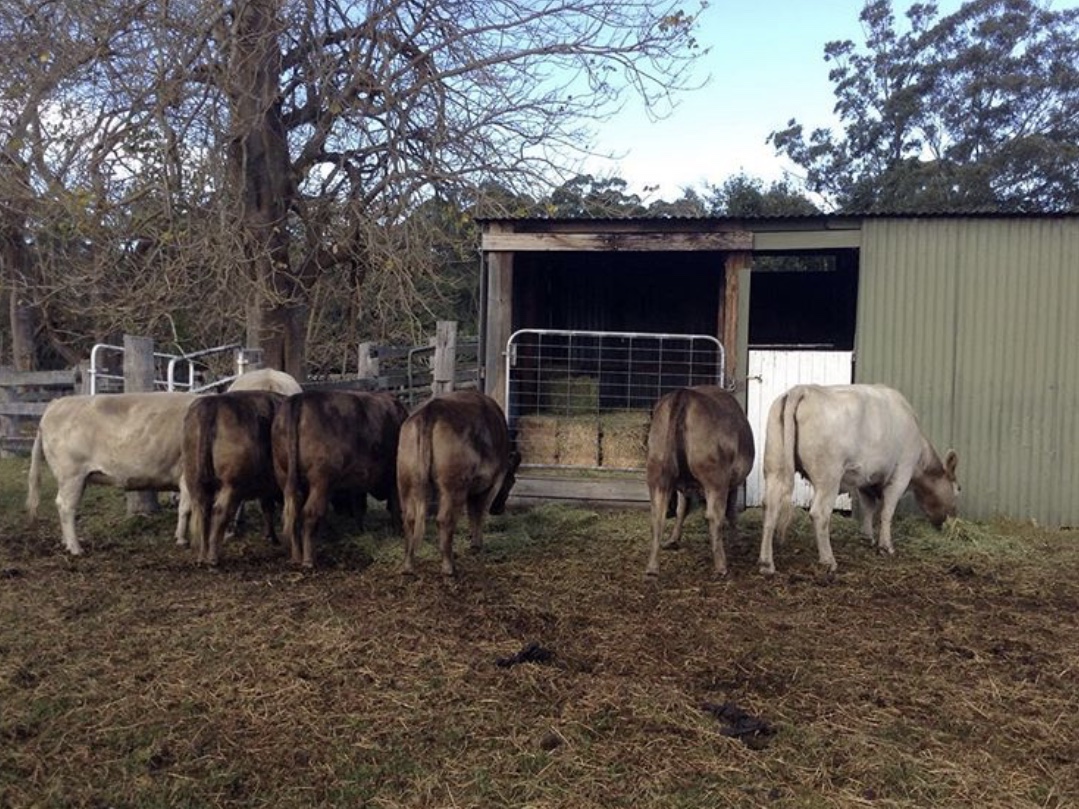
So am still buying hay to supplement the cattle diet. Thankfully it’s recently fallen in price.

Cattle prices are very high at the moment as good rain out west has encouraged restocking after the long drought caused an epic sell down of Australia's cattle herd. Farmers, feedlots and abattoirs are all competing for the smallest cattle herd in 30 years. Australia is now home to some of the world's most expensive cattle.
Not that ours are for sale of course.
So that’s about all our news for now.

Friday, October 16, 2020

Making Bread

This is my 100th post for the year, already over double the normal annual number.
Amazing what a bush fire emergency and a pandemic, forcing one into self isolation, will produce. 
The New York based daughter is making her own bread. They find the normal supermarket offerings there  a bit sweet (I can relate) and artisan breads a little expensive.
So she found a recipe for a no knead bread which she has been encouraging me to try. She has modified it a little by adding oats, flax seeds and pepita (pumpkin) kernels.
So I got all the fixins’ and got my lesson over two days via Skype.


Mixing the dry ingredients with water was very easy. Then it was covered up with GladWrap for 24 hours to let the yeast do its thing.
It tripled in size and was very bubbly.


The next step wasn’t so easy.
I got my instructions and a practical demonstration via Skype ie. “Baking with Kate”, Series 1, Episode 2.
But I think my mixture was too wet and folding it into a ball and wrapping it in baking paper and a tea towel was a real challenge.
But eventually there it sat like a neat parcel for two hours to double in size, which it did, while the oven and the pan heated up to 220℃(425℉) during the last 30 mins.
So then it was a matter of getting it off the baking paper, folding it into a ball again and putting it in the hot pan.
Boy, this was a real struggle. 
It didn't want to cooperate at all, sticking to the paper which began to tear and spreading out all over the place. I fought with it for 5 minutes getting nearly all the dough off and then dumped it unceremoniously into the hot pan and into the oven. No chance of ball folding.


Forty minutes later, off with the lid for another 15 minutes to brown and then out onto a cooling rack.
Actually it didn’t look too bad. 


But in comparison to the daughters (see pic below), not so good.


The big test was next! 
Taste and texture.
After a few hours we cut it in half.
Nice crispy crust, nutty taste but a bit doughy and there were pockets of dry flour.


Oh well, it was a first try.
Next time I will be more careful with the water addition and try to make the dough drier.
But it was really fun to do, especially with the ‘live’ lessons from New York City.

Tuesday, October 13, 2020

COVID-19 / Australia / 13th October 2020 Update

While the Covid second wave surges across Europe and the first wave relentlessly continues in the USA, our figures, though still concerning, have stabilized. 
The state of Victoria still has the highest incidence of cases but nowhere near the peak of their second wave.
It recorded 15 new cases yesterday with no deaths.
NSW advised one new local case in the latest 24 hour reporting period. The state recorded six cases in total, five of which were detected in overseas travellers in hotel quarantine.
Queensland has recorded zero new cases overnight, maintaining the active cases in the state to four. 
All other states and territories report zero cases of community transmission.
Melbourne, Victoria's capital has been easing its lockdown for the past several weeks following a decline in cases. But Victoria's Premier Daniel Andrews says the number of new cases is not yet falling fast enough to ease all of the restrictions that were promised.
Queensland's border with New South Wales is still yet to open.  
Western Australia's borders are closed to the rest of Australia and not expected to be open until April 2021.
The Prime Minister has confirmed Australia will move “very cautiously” to reopen international quarantine-free travel with a “handful” of countries (New Zealand, Japan, Singapore and South Korea), raising the prospect Europe and the United States will be excluded until 2022 unless a Covid vaccine is available.

Meanwhile our government research organization. the CSIRO, has published new research which shows COVID-19 can last up to 28 days on surfaces like mobile phone and ATM screens.
This is much longer than previously thought.
They conducted the experiment at three different temperatures, 20°C, 30°C and 40°C, with the relative humidity kept at 50%. The surfaces used in the study were stainless steel, glass, vinyl, paper and polymer banknotes, and cotton cloth. These are examples of high contact surface areas such as glass on touchscreens and stainless steel doorknobs.
At 20°C, the virus was extremely robust. They were able to recover infectious material after 28 days from the smooth (non-porous) surfaces. These are stainless steel, glass, vinyl and paper and polymer banknotes.
The length of time infectious virus was able to survive on the porous material (cotton cloth) was much shorter. On cloth, they were unable to detect any viable virus past 14 days.


At 30°C infectious virus did not survive beyond seven days on stainless steel, money (polymer banknotes) and glass. However, on vinyl and cotton cloth, infectious material was not detectable beyond three days.
At 40°C virus was inactivated much faster. Infectious SARS-CoV-2 was detectable for less than 16 hours for cotton cloth. While on glass, paper and polymer notes, and stainless steel it was detectable for up to 24 hours, and 48 hours for vinyl.
So guess the lesson here is keep washing and/or disinfecting your hands, don't touch you face and of course wear a mask when social distancing is not possible or practical.

Friday, October 09, 2020

Pikes Wines Virtual Tasting / Great Success

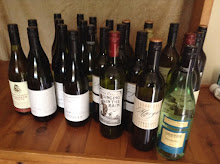
Over the last week we participated in two of Pikes Wines virtual tastings of their new vintages via Zoom.
The first was six whites; the second, three of their Reserve range, two reds and a white.


Without doubt two of the three bottles of the Reserve range were outstanding. I have a small collection of various vintages of the Merle Riesling and E.W.P. Shiraz which will probably now increase, just a little, despite still very high prices substantially discounted on the night. We only drink them on VERY special occasions. I’ll have to think long and hard about the Cabernet. It seemed a bit ‘green’ or herbaceous to us.
Of the whites we were impressed by the Semillon /Sauvignon Blanc blend and the Fiano which was our non Riesling fave of the evening.
As expected my ‘go to’ Riesling, the Traditionale was excellent as usual. This is such a consistent wine, year after year. The co driver is not fond of Riesling which is ok. More for me!
The Olga Emmie Riesling is made in the German Kabinett style ie. low alcohol (8.5%) and sweet (41g/L RS)
We thought, reading the tasting notes beforehand, that this is not our style and probably wouldn’t like it too much.
We were wrong! 
It was light, aromatic and had enough acidity to cut through the initial sweetness. Great with spicy Asian food.
A big surprise!
This was a great innovation by Pikes to replace the annual face to face Roadshow tastings due to Covid.
It saved us a long drive to and an overnighter in Sydney too.
I tried to sow the seeds of it continuing after all this virus kerfuffle is over and was not met with much resistance from the marketing man, but we shall see.

Wednesday, October 07, 2020

COVID-19 / Australia / 7th October 2020 Update

So how is Australia doing with Covid-19?
New South Wales has recorded its eleventh straight day of zero locally-acquired corona virus cases. There were 11 new COVID-19 cases confirmed statewide on Tuesday, all of them returned travellers in hotel quarantine. 
Victoria has recorded 15 new corona virus cases and one new death in the past 24 hours. The 14-day average for new cases statewide is currently 10.9, down from 11.9 on Monday.
The strict lock down laws in that state are having the desired affect but there is still a way to go.


Australian death toll now stands at 895.
Discussions on the opening of state borders is on going. November 1st is the target for NSW and Queensland.
So all in all, despite the severe economic and social price the country has paid as a result of the tough measures invoked, compared to many others it has to be said we have done particularly well.


But the fight is not over yet. 
With summer and the long holiday period approaching all governments are emphasizing the need for caution and the avoidance of complacency. 
Strict social distancing rules are still in place, even on beaches, and heavy fines apply to businesses and individuals who do not comply.
Last night the federal government handed down a budget designed to pull Australia out of the most severe global economic crisis since the Great Depression thanks to the Covid-19 pandemic.
Here’s a summary

Tuesday, October 06, 2020

Grass

My newly seeded lawn has started to shoot, albeit patchy in some parts, as a result of the warmer weather and plenty of watering.
Got me thinking about grass in horticultural terms and how come you can mow it and it keeps growing.
Maybe I should have paid more attention in the plant physiology lectures at school.
Anyway, grasses are monocots ie. their seeds contain a single (mono-) embryonic leaf known as a cotyledon. There are approximately 60,000 species of monocots.
This makes them distinct from the other class of plants, dicots whose seed has two embryonic leaves or cotyledons. There are about 175,000 known species of dicots encompassing most common garden plants, shrubs and trees, and broad-leafed flowering plants.


So how come you can mow grass and it keeps growing when other plants don’t?
A plant produces new cells in a place called the meristem. The production of new cells together with the enlargement (division) of these new cells is the source of growth in a plant.
The meristem of many monocots is in the "crown" of the plant which is right at soil level.
The meristem of dicots is at the end of each shoot.
Therefore if you "mow" the dicot, you cut off the source of growth and new growing points must emerge from buds along the stem. Dormant buds contain inactive meristems which begin growth when the buds above it are removed.
This generally calls for strategic pruning.


With monocots, since the growing point is at ground level, you can cut the tips of the leaves and the meristem just continues producing new cells which enlarge and push the leaf blade up from the bottom.
Therefore, you can mow the monocot grass but not a dicot, if you want the latter to keep growing, that is.

Saturday, October 03, 2020

Cicadas

Cicadas are the sound of summer in Australia.
There are more than 200 Australian species, most of which belong to the one large family, Cicadidae.
Here they spend most of their life underground as nymphs for around 6-7 years.
When the nymph reaches full size it digs its way to the surface and generally emerges about nightfall in late spring or early summer. It then climbs onto a tree trunk or other object and sheds its skin for the last time with the fully-winged adult leaving its old empty nymphal skin behind.
This occurred on our large gum tree (eucalypt) out front a few days ago.


The life of adult cicadas is very short, lasting only a few weeks. After mating, the adult female cicada lays its eggs which hatch into small wingless nymphs.They fall to the ground and burrow below the surface. Here they live on the sap from plant roots for a period which may last several years.
Cicadas are notorious singers. In fact they are the loudest insects in the world. The song is a mating call produced by the males only. 
Some large species such as the Greengrocer/Yellow Monday and the Double Drummer produce a noise intensity in excess of 120 dB at close range which approaches the pain threshold of the human ear.
Many species of cicada sing during the heat of the day.


As kids we used to collect them and keep them as pets for their short lives.
Fierce trading went on to see who could amass the most diverse collection.
Many of their common names were initially given to them by children. As a result cicadas probably have the most colourful common names in the insect world. Some of these include: Black Prince, Double Drummer, Floury Baker, and the Green Grocer or Yellow Monday.
Australian journalist Peter FitzSimons wrote in the memoir of his childhood, “the black prince was valued at three cherrynoses, four floury bakers, five yellow mondays or a thousand green grocers.”