Wednesday, August 17, 2022

Three Australian Musical Icons Die in August.

The Australian music industry lost three icons over 10 days this month.
Archibald William Roach AM was an Australian singer, songwriter and Aboriginal activist. Often referred to as "Uncle Archie", Roach was a Gunditjmara and Bundjalung elder who campaigned for the rights of Aboriginal and Torres Strait Islander people. His wife and musical partner was the singer Ruby Hunter (1955–2010).
Roach first became known for the song "Took the Children Away", which featured on his debut solo album, Charcoal Lane, in 1990. He toured around the globe, headlining and opening shows for Joan Armatrading, Bob Dylan, Billy Bragg, Tracy Chapman, Suzanne Vega and Patti Smith. His work has been recognised by numerous nominations and awards, including a Deadly Award for a "Lifetime Contribution to Healing the Stolen Generations" in 2013. At the 2020 ARIA Music Awards on 25 November 2020, he was inducted into their hall of fame.
Judith Durham AO was an Australian singer, songwriter and musician who became the lead singer of the Australian folk music group the Seekers in 1963.
The group became the first Australian pop music group to achieve major chart and sales success in the United Kingdom and the United States and have sold over 50 million records worldwide. Durham left the group in mid 1968 to pursue her solo career. In 1993, she began to make sporadic recordings and performances with the Seekers, though she remained primarily a solo performer. On 1 July 2015, she was named Victorian of the Year for her services to music and a range of charities.


Dame Olivia Newton-John AC DBE was a British-born Australian singer, actress and activist. She was a four-time Grammy Award winner whose music career included five number-one hits and many other top-ten hits on the Billboard Hot 100 and two number-one albums on the Billboard 200; If You Love Me, Let Me Know (1974) and Have You Never Been Mellow (1975). Eleven of her singles(including two Platinum) and 14 of her albums (including two Platinum and four 2× Platinum) have been certified Gold by the Recording Industry Association of America (RIAA). With global sales of more than 100 million records, Newton-John is one of the best-selling music artists from the second half of the 20th century to the present.
In 1978, Newton-John starred in the musical film Grease, that became highest-grossing musical film ever at the time and whose soundtrack remains one of the world's best-selling albums of all time. It features two major hit duets with co-star John Travolta: "You're the One That I Want" – which is one of the best-selling singles of all time – and "Summer Nights". Her signature solo recordings include the Record of the Year Grammy winner "I Honestly Love You" (1974) and "Physical" (1981).
She battled breast cancer three times, was an advocate for breast cancer research and was also an activist for environmental and animal rights causes.

Thursday, August 11, 2022

COVID 19 / Australia / Current Situation

Cases and deaths for entire pandemic and last 90 days.
This is definitely not over and the outlook is still grim despite vaccination rates ie. 2 doses (85%)
However #3 (55%) and #4 (7%) booster take up has been lagging.
Mask wearing is a thing of the past.


Wednesday, August 10, 2022

Bushfire Memorial

There were tens of thousand of photos taken during our disastrous 2019/20 bushfires from raging infernos, blacken landscapes, firefighting aircraft and units in action to the brave men and women of the Rural Fire Service.
Many of those were feature in my blog at the time.
However one stood out and resonated with me.
It was taken by photographer Alex Ellinghausen of The Sydney Morning Herald and The Age on 29th November 2109 at the western extremity of our Currowan Fire known at the time as the North Black Range fire.
It would eventually consume 40,000 hectares of bushland, threaten the town of Braidwood and destroy at least five homes. It was not declared extinguished until January 28, 2020, two months after it was set off by a lightning strike.
This photo must have caught the eye of many others.

A bronze casting has been made of the image by Andrew Poppleton of Melbourne’s Meridian Sculpture and now stands in a memorial garden in the RFS’s state training academy at Dubbo, honouring all NSW RFS firefighters and contractors who have died in the line of duty.
Chris Montgomery, the subject of the photo, was one of a crew of five sent to fight the North Black Range fire and was at the unveiling.

All photos © Alex Ellinghausen

Tuesday, July 26, 2022

Australia‘s 47th Parliament

Australia’s 47th parliament sat for the first time today.
The new Labor government has an absolute majority in the lower house, the House of Representatives, following the recent election.
The House will have 58 women, including 19 first-term MPs, making 38% of the chamber female. This is the highest proportion of women ever in the lower house.
The upper house Senate reached and exceeded 50% in the last parliament, and will maintain this in the new parliament.


However Labor has just 26 of the 76 seats in the Senate, short of the 39 votes the government needs for a majority.
The Senate crossbench has grown to 18 seats after the recent election.
This means the Labor government will need the support of 13 members of either the crossbench or the Liberal/National Party coalition opposition to pass legislation in the Upper House.
There will obviously be a lot of negotiations going on there over the next three years.
The Australian people also voted in nine new Indigenous representatives in Federal parliament for the current term, alongside two sitting senators. Six members are part of the Labor government, while two are returning senators sitting for the Greens.
For the Liberals it was a case of two in, one out.


The result means an extra four Indigenous voices in parliament between both chambers – three in the House of Representatives and eight in the Senate.
In terms of representation, Indigenous members will account for 10.5 per cent of the 76 Senate seats, and 1.9 per cent of 151 House of Representatives seats.
That leaves total representation at 4.8 per cent, above the Indigenous Australian population of 3.3 per cent.

Sunday, July 24, 2022

Potholes 🤬

It’s been raining virtually non stop here with 1600mm so far this year.
Our average annual rainfall is 1100mm.
This means road surfaces have been deteriorating at a record rate.
Almost 10,000 drivers across NSW have found themselves stranded with a damaged wheel or tyre this month after widespread rain caused more than $1.5 billion worth of damage to roads.


Potholes are a key cause of wheel and tyre damage. Between March and the end of June, Transport for NSW repaired 65,000 potholes on state-managed roads in regional NSW and 10,000 in Greater Sydney. That is on top of the potholes repaired by councils eg. our Shoalhaven CC, on their own road networks.
Councils are responsible for maintaining 90 per cent of the state’s roads. 


The number of potholes in regional NSW has increased by 74 per cent compared to last year.
The NRMA said it had received 9814 calls for assistance from drivers who have suffered wheel and tyre damage so far in July, with almost half of them from outside of Sydney.


Mayor of Shoalhaven City Council Amanda Findley said the rain had exacerbated the road damage suffered in March and its incessant nature was hampering efforts to fix the network.
“It’s completely impossible to get on top of the task, which is frustrating the daylights out of the community,” she said.
Don’t we know it.
Driving around our area, even on the major A1 highway is like a slalom course.

Saturday, July 02, 2022

COVID 19 / Australia / Update

It’s been 6 months since the last update.
In summary, the virus has been running rampant since the state and federal governments rescinded all restrictions early in the 2022.
Cases and resultant deaths have skyrocketed compared to the first two years of the pandemic when restrictions were in place. 
“It’s all over folks” is the official line.
But it’s not.
Despite 95% of the population being vaccinated ie. x2, the new variants are now predominant.
Unfortunately it is older generation which suffering the fatalities as a result.
Below are some stats bearing in mind the Australian population is around 25 million.


Friday, July 01, 2022

Three Daily Word Games

Keeping an old brain active.
Try them!
Octordle is the most challenging.


www.wordle.com

www.quordle.com
www.octordle.com

Tuesday, June 28, 2022

Australian 2021 Census / Some Data

Data from the 2021 census was released today.
Unsurprisingly, with Covid restrictions in place across much of the nation, 96% of people were at home on census night, an increase of 2 million people compared with 2016.
Australia’s overall population increased by 2.2 million, or 8.6 per cent, to 25.5 million between the 2016 and 2021 censuses. The number of Indigenous Australians increased by 25.2 per cent over the same period to more than 812,000.
Almost half of Australians have a parent born overseas and more than a quarter of Australian residents were born outside the country.
Mandarin continues to be the most common language, other than English, with nearly 700,000 people speaking it at home. This is followed by Arabic. Punjabi had the largest increase.


Boomers and Millennials now each account for 21.5 per cent of the nation’s 25.5 million residents.
For the first time, more than 1 million families in Australia are headed by a single parent – and in most cases this parent is female.
Of 5.55 million families recorded in 2021 census data nearly 1.07 million are single-parent families, and in four out of five of those, the parent is the mother.
While Christianity is still the most common religion in Australia, religious diversity is increasing: 39% of respondents identified as Christian in the 2021 census compared to more than half in 2016 and 61% in 2011.
At the same time, more people are identifying as atheist or agnostic. Almost 40% of the population responded “no religion” on the 2021 census, an increase of 10% in the past five years.
Interestingly, while almost 60% of baby boomers reported a religious affiliation, 46.5% of millennials reported having no religion.


The majority of Australians still live in houses, but alternative living arrangements are on the rise: 58,155 filled out the census from a caravan, while 29,369 people were in a cabin or a houseboat and more than half a million were in a high rise apartment.
Of nearly 11 million private dwellings counted in the census, separate houses accounted for 70%, apartments 16%, and townhouses made up 13%.
Two-thirds of households own their home outright or with a mortgage, similar to the rate in 1996. But the proportion of households that own outright has dropped to 31%.


The census data shows more than 8 million people have a long-term health condition, including about 2.2 million (roughly one in 12 people) who have a diagnosed mental illness.
A further breakdown of the data reveals almost 16 percent of the population now have a long-term diagnosis for back pain, which has emerged as the second most common chronic health condition nationally, followed by arthritis.
Diabetes also remained a major chronic health issue with 5.3 percent of the population reporting a diagnosis. Of these, 0.6 percent were Type 1 diabetes and 4.5 percent were Type 2 diabetes.


In the increasingly fraught area of unpaid domestic labour, the 2021 census showed Australian women do vastly more household chores than their male counterparts.


Overall, nearly 1.4 million women said they do 30 hours or more of domestic work a week, compared with 394,995 men.
Twice as many women (nearly 1.7 million) said they did 15 to 29 hours a week of home chores compared with men (nearly 820,000).

Wednesday, June 01, 2022

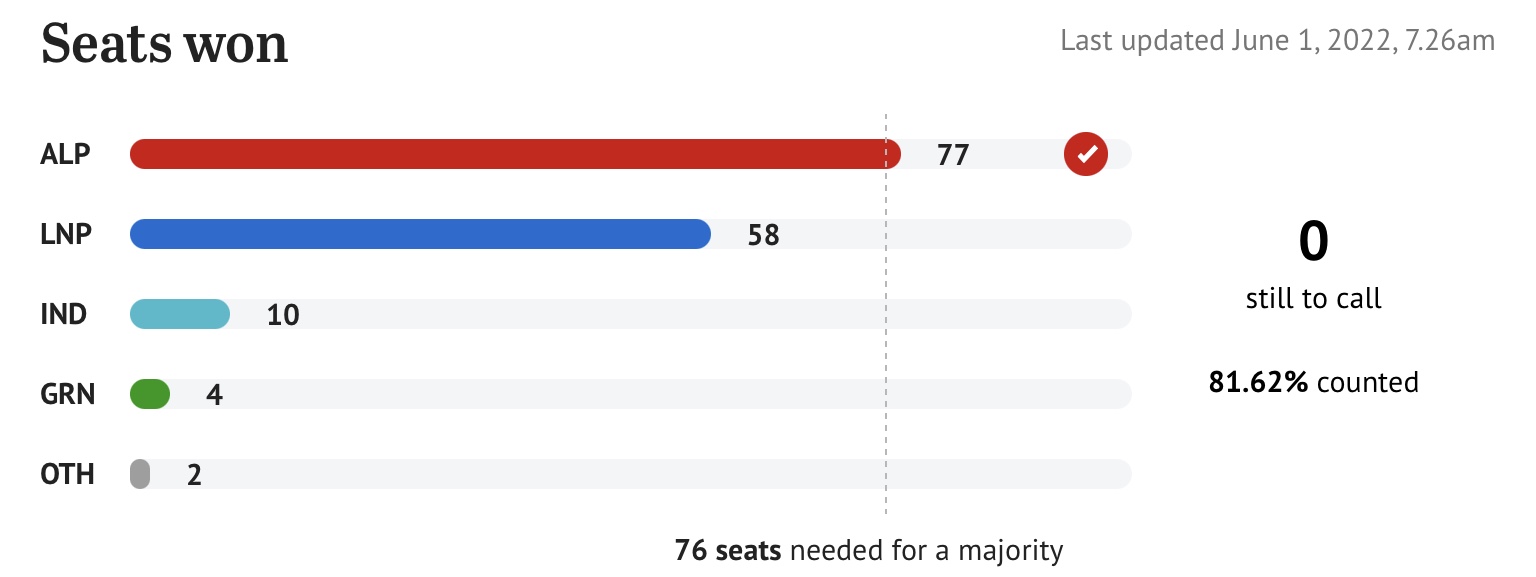
Australia / Change of Government / 23rd May with 1st June Update

On Saturday 21st May, Australians voted for both the House of Representatives and half the Senate.
It had been a long drawn out and somewhat acrimonious six week campaign, particularly from the incumbent conservative coalition, the Liberal National Party (LNP).
They had been in power for nine years and for the last three or so been ‘much on the nose’ under the leadership of probably one of our worst ever Prime Ministers, Scott Morrison.
Their performance during the covid pandemic, disastrous bushfires and floods left a lot to be desired.
They had ‘attacked’ social programs, had pork barrelled their own constituencies, inaction on climate change and gave unnecessary financial support to big business…..among a host of other unpopular moves.
They knew they were in for trouble.
New Prime Minister, Anthony Albanese


The opposition Labor Party (ALP/Democratic Socialists) had played the small target game during the campaign in an effort to let the government sink themselves.
However, they had tried this ploy 3 years ago during the last election and had not got across the line.
So there was always a little bit of doubt how things would go this time. 
But there was no need to worry.
The polling booths closed at 6pm and we knew by 9pm that the Australian population had had enough and that Labor would be in power.
Not quite a landslide, but a win is a win.
What we didn’t know, and still don’t, is if they will be a majority government.
The Greens, others and a new influx of Independents may still hold the balance of power.
Counting continues. Pre poll, postal and absentee votes are still in the pipeline.
Below is the situation as of this morning.

We will update when the situation becomes clearer.
Update: 1st June
The Labor Party has won 77 seats enabling them to form a majority government. 
The new ministry was sworn in today.
Note the number of women!


The major opposition, a coalition between the Liberal Party (don’t be confused by the name, they are conservatives) and National Party (who represent mainly rural seats) has the lowest representation in parliament since they were formed in 1946.
The new government will have quite a job on their hands.
Nine years of conservative rule has left the country in a bit of a mess.


Tuesday, May 31, 2022

Mutant Lemons

We have two lemon trees growing in our yard, both survivors of the 2019/20 bushfires.
They have been growing here for the 30 years I’ve lived here. The life expectancy of lemon trees is a lot more than that, reportedly 50-100 years.
They fruit well some years, not so good others.
The crop is always subject to attack by white cockatoos which we try, mostly unsuccessfully, to scare away. But there are only so many lemons you can eat so during a bumper crop we share.


The trees are left alone which means they are subject to a few diseases, lemon scab being one, which causes the skins to thicken and become a little deformed. Doesn't however affect the juice in any way.
But this year we have had some very strangely shaped fruit, almost looking like co-joined twins.
Is the continual wet weather to blame? 
Who knows.

Thursday, May 12, 2022

Some Farm Stuff 3rd May / 12th May Update

We use electric fences in places where we want to contain our cattle eg. in and around our house paddocks or where we think there may be ‘escape routes’ into the bush.
These have been powered by normal 12 volt car/boat or deep cell batteries.
Obviously these need to be recharged from time to time. This is fine when you don’t have to carry them far.
But one fence is quite remote from a charging point and at the bottom of a steep hill. For this reason I use a deep cell battery here as it lasts considerably longer than the others. Deep cell batteries are very heavy.
Getting it back up the hill, even in a wheel barrow has become a chore. Because of the continual rain getting a vehicle down to the spot is impossible.


This particular fence keeps the cattle away from a possible creek crossing into the bush.
It’s not as though the cattle would ‘try’ the fence every day. They have a good memory of being zapped and normally keep away.
I have considered putting a permanent fence there but the terrain is difficult and the ‘escape’ factor only comes into play when the creek is extremely low which isn’t often these days. Plus the recent floods have made that part of the creek bank extremely steep which is also a deterrent.
So I’ve invested in a solar charged electric fence energiser to do away with portable battery power. It was easy to install on a star picket and is facing due north and should be in full sunlight for most of the day.
According to the blurb it should stay charging for up to 5 days of heavy cloud and takes three days to fully recharge its internal battery, if flat, in full sun.


Outside our boundary fence on the road verge is a strip of land the gets covered in tall grass and weeds.
It belongs to two of our neighbours but they think it belongs to us and we should look after it better ie. keep it neat and tidy.
Anyway about once a year, in autumn, I spray the entire area off with herbicide. 
This year blackberry bushes were very evident amongst the tall grass. This is a declared noxious weed in Australia and, by law, land owners are required to keep it under control.
Normally I use glyphosate on this area but have noticed over the years the blackberry there may have become a little resistant. So this year I used a combination of glyphosate and Metsulfuron-methyl with some added wetting agent.


I have had a lot of successful with the latter on our property on both blackberry and bracken. It also works well on the difficult to control Tradescantia zebrina.
It’s fairly slow acting so don’t expect to see any visible results for a few weeks. The grasses on the other hand should start to ‘yellow’ in around 10 days.
Then we’ll have a nice dead brown verge for the next 6 months or so or until spring when dormant seeds currently in the soil will begin the process all over again.
Update:12th May
Success with grasses and weeds.
Blackberry is ‘lingering’ but signs of senescence at the growing tips. 
But it’s early days yet for them.

Tuesday, May 10, 2022

One Track for All / North Head Ulladulla Harbour

One Track for All is a 3km walking track on the northern headland of Ulladulla Harbour.
We decided to do an early post town cafe breakfast walk up there.
It is a public area which has four lookouts providing spectacular views of the coastline as well as Ulladulla surrounds and harbour. 

The track tells the story of the southern Shoalhaven Aboriginal and non-Aboriginal history from an Aboriginal perspective with carved signs along its length.


The track has been constructed in a way that, from a higher vantage point or from the air, the two halves appear as two large goannas, with four carved platforms for some of the best views of the Ulladulla Harbour.
Unfortunately since our last visit some 13 years ago, many of the carvings have fallen into disrepair or were damaged by fire some time ago. However the views back across the harbour and the northern and southern coastlines are still worth the visit. A little research established that the local council is aware of the deteriorating ‘story telling’ signage is are trying to reconcile the situation with the artist. So far no success.


A few autumn wild flowers were starting to bloom. The environment changes from open forest to thick native bush land, mainly she-oaks (Casuarinas), in places forming long narrow vegetative tunnels.


It was a nice change from our beach walks. Apparently there is another bush walking track on the southern headland starting at the lighthouse. We will have to check that one out too. 

Monday, April 25, 2022

ANZAC Day 2022


They shall grow not old,
as we that are left grow old;
Age shall not weary them,
nor the years condemn.
At the going down of the sun
and in the morning
We will remember them.

Tuesday, April 19, 2022

A Random Vine in the Garden / 19th April Update

A cucurbit vine started growing in our flower garden and headed skywards using our hibiscus plants as support.
It’s obviously come from a random seed.
Whether it’s a pumpkin, zucchini or cucumber who knows although I should know from the leaf shape.
So far it’s only produced male flowers, no female fruiting ones.
Vines employ numerous climbing methods.
They can be divided into four basic types ; twiners, hookers, clingers and climbers.
I think ours is a climber ie. it sends out tendrils that coil rapidly about a potential support upon contact.
The plant’s growing tips are sensitized so that they are constantly "feeling around" for a host with a rotary motion. The tendrils produced by certain plants can be extremely sensitive.


Tendrils are slim, delicate outgrowths, produced in pairs from the leaves or stems. They move back and forth as they elongate with a motion caused by unequal growth rate on the two sides. Once contact is made, the tips form a tight coil about the support.


Plants’ growing characteristics are always very fascinating, to me, anyway.
Will update if any fruit appear.
Technical Notes Source: George Ellison, Nature Journal.

Update: 19th April
Fruit!
Looks like, from the markings, it could be a Kent pumpkin.


Update: 1st May
Sadly both fruits self aborted despite some human pollination intervention.


Thursday, April 07, 2022

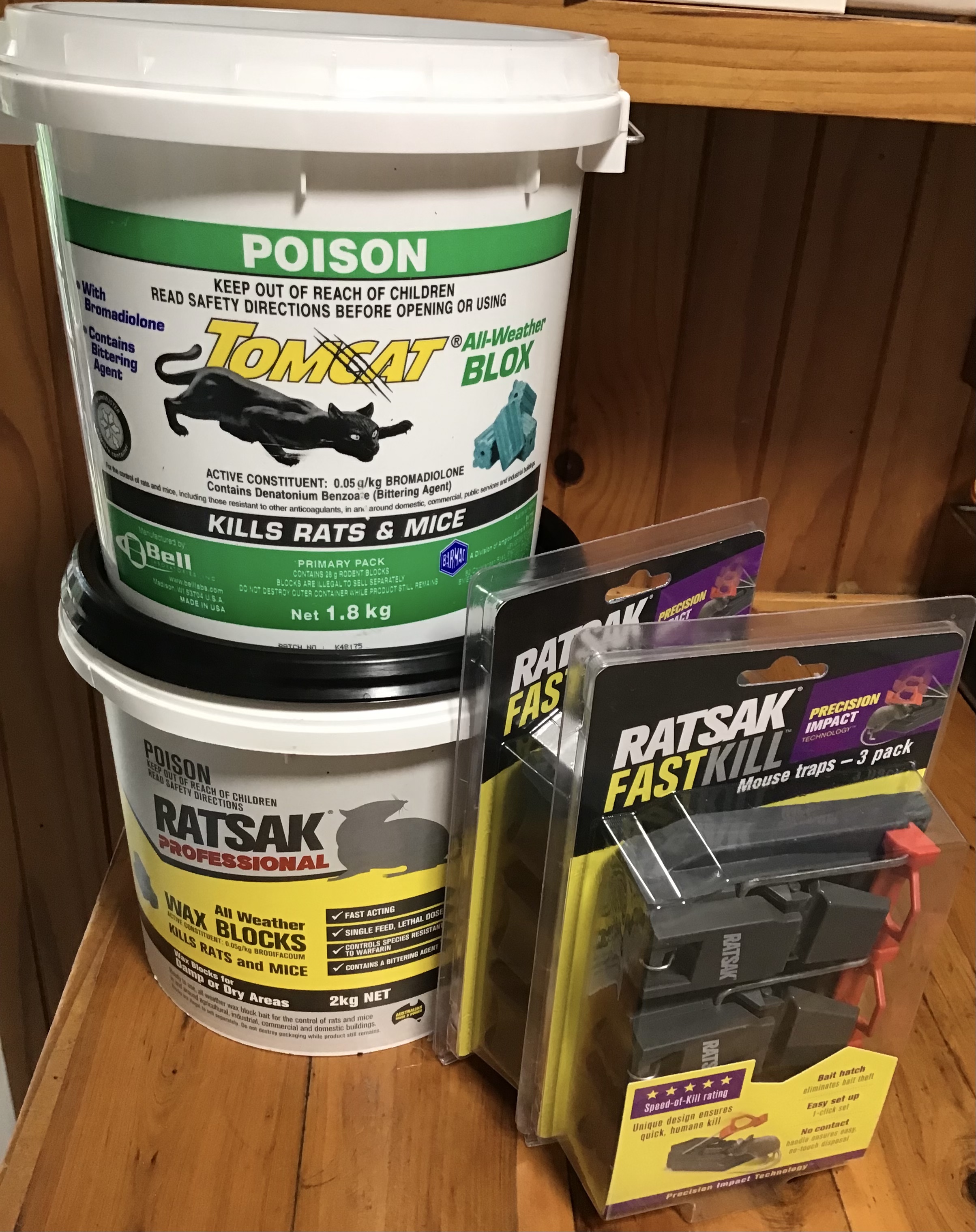
Potential Rodent Invasion

With the continual heavy rain events, it’s being reported that the rodent population is on the move.
Flooded out of their natural habitat, they are looking for shelter in homes.
Following the mouse plague last year, it’s the last thing we want.
With the sound of the rodent Olympics suddenly becoming apparent in our roof space, we acted quickly.


Wax blocks in the ceiling, wax blocks together with traps around the outside of the house.
There was instantly considerable success.
Within a few days all was quiet above.
Now it’s just a matter of monitoring the bait consumption which has already become minimal to non existent.

Friday, April 01, 2022

Kayaking

The co driver had become interested in kayaking.
She purchased a relatively cheap inflatable which was good for a year or so.
Then it started to develop leaks at the seams which, despite numerous efforts, were unrepairable.
It seems that this is a major problem for this category of kayak if not the particular brand.


Time to look at a hard shell sit in kayak.
After much deliberation and a few trial paddles, she settled on a locally made Australis Platypus flat water touring kayak which is ideal for our coastal lake system.
Luckily a local kayaker had one for sale with a rudder and he threw in an inflatable life jacket as a bonus.
To transport it safely we needed to add a kayak cradle to our roof racks and a bow tie down.
Rhino-Rack had what we needed and the cradle kit came with easy to use tie down straps.
The rubberised buckles to prevent vehicle damage were a great idea.


We also purchased a bonnet anchor strap to secure the bow with an additional strap.
The kayak weighs 22kg (48.5lbs) so is difficult for one person to lift onto the racks.
There are numerous YouTube videos offering advice on this problem.
We finally settled on one method which the co driver can do alone.


With a bit of practice and tweaking, the loading problem should not eventually be one.
Once the terrible wet weather that has plagued us for months is gone, it’ll be paddle time on lakes in Burrill, Conjola, Tabourie and maybe even Durras.