Monday, October 16, 2006

Phuket and Singapore

A few days before we were due to leave for Thailand, news came through that tanks had rolled out onto the streets of Bangkok and the army had overthrown the democratically elected but alleged corrupt government while its prime minister was at the the World UN conference in New York. Coups are not unknown in Thailand so after we had found out that the King had virtually sanctioned the action, we knew it was safe to go. As it turned out you would not have known the country was in a little bit of turmoil politically. People were happy and smiling as ever and it was business as usual. There were however a huge number of yellow (the King's color) flags flying which I took as a sign of support for the changed regime albeit a temporary military dictatorship.
It was a very early morning start for the 7 hour flight to Singapore's wonderful Changi Airport (a holiday destination on its own) where we transferred for another 2 hours to Phuket. There we were picked up in our mini bus and taken to the Cape Panwa Hotel.

I first came across this hotel as a setting for a TV cooking show. I was so impressed I went to my travel guru, tripadvisor.com, read the reviews and made a booking to celebrate my 60th birthday.
We were not disappointed and spent eight great days with almost perfect weather despite being the monsoon season. We were accommodated in rooms overlooking the harbour. These were large and well appointed with aircon that worked well and beds that were comfortable. Staff at all levels were friendly, helpful and went out of their way to make our holiday enjoyable.
Sure the hotel is a bit out of the way. But this is a blessing in disguise. It makes for a peaceful holiday especially for families, romantics and old farts like us (some company excluded).
We ate in all the restaurants. Breakfast was little bit of a hit and miss affair as is the case with any buffet. Thai dinners or lunches at the Cafe Andaman was always good. A special Thai dinner at Panwa House was also excellent.
We celebrated the birthday at the Top of the Reef after drinks in Otto's Bar and the staff went out of their way to make the party a success, even providing a surprise bithday cake with candles and hearty staff rendition of the song! The food here is expensive by Thai standards but 50% of what you would pay in Australia at a similar venue. Wine is very expensive in Thailand so we stuck to Singha beer at most venues but as this was a special occasion we enjoyed a good Italian red and French white selected from a broad wine list.
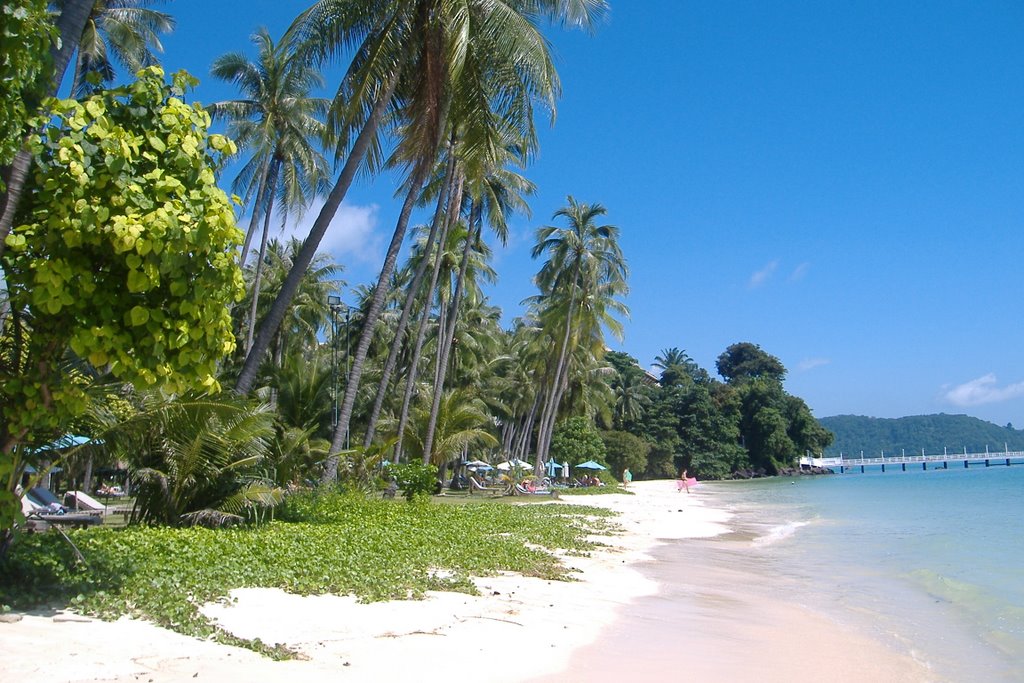
The beach was a focal point for us. Tide charts in the rooms provide the best time for swimming and for us this always appeared to be between 8am. and 2pm. Water was not all that clear (by Pacific Island standards) but warm and clean. Sitting on our lounge chairs under the palms and strategically placed umbrellas with beer in hand (thank you, Manop), was a perfect way to spend most of the day. The tide goes out in the afternoon to reveal a coral reef that is good to explore via a concrete pathway although it's not by any means the Great Barrier Reef.
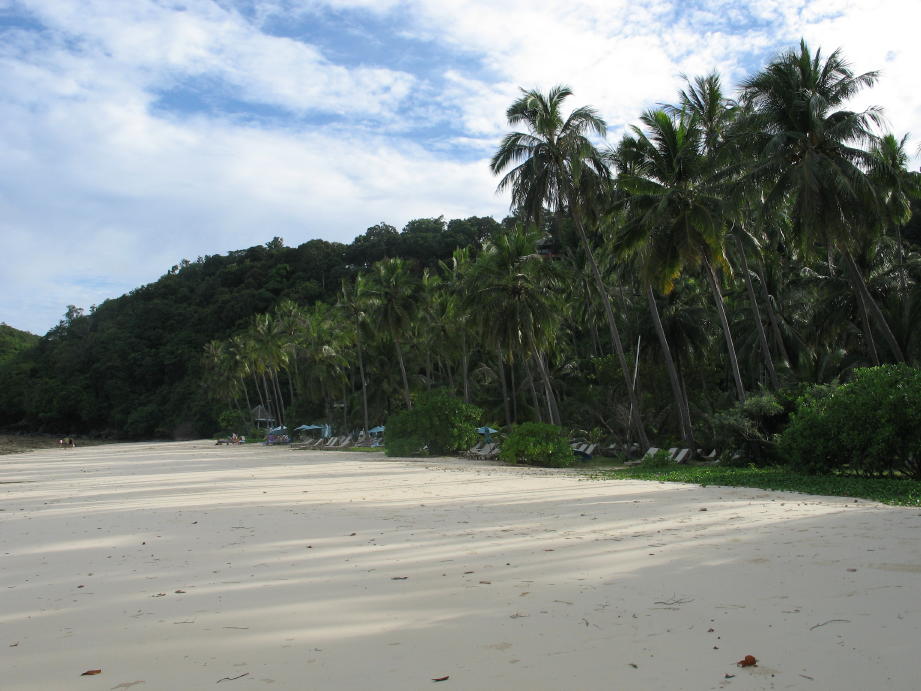
Both swimming pools were kept immaculately clean and with virtually undetectable chlorine levels. Our favourite was the one at the beach, deserted on most occassions.
You have to be a little bit fit to stay at the Panwa. Lots of steps no matter where you go. But it helps work off the food.
We ate a few times at the Sawasdee, a small family restaurant in Panwa Village, just over the hill and reached by hotel shuttle bus. Here was very cheap food of good quality served by a lovely staff. As a person who could eat Thai food every meal I was in foodie heaven! There are prawn cakes, fish cakes and spring rolls among other things as starters, spicy soups and salads, stir fries of chicken, seafood and meat flavored with different herbs and spices, fried rices, noodles, red, green and yellow curries and woked fried seafood just to mention a few dishes. Some come with quite a chilli kick so you have to be a little bit careful. The usual bowl of steamed rice can save your head from being blown off.

Although it was tempting to just chill out at the hotel we did a little bit of touring. Our initial trip was a "orientation tour" of the south part of the island. I have been visiting Thailand since the late 1960's initially on business and for the last 15 years as a tourist. I have grown to respect the Thai people, their culture, gentle humour and way of life. So it was with a little trepidation that I returned to Phuket after a 20 year absence. I have to say that the tourist boom may have done wonders for the island economically but nothing much for the image of Thailand. Off the beaten track, you can still find the essence of the country but on the well trodden tourist routes there is little to attract. Patong the main tourist centre is an ugly town where the beach is a dirty strip of sand covered in thousands of beach chairs where people lie cheek by jowl and listen to jet skis whine their way around the bay. Why anyone would want to spend any time here is beyond me.
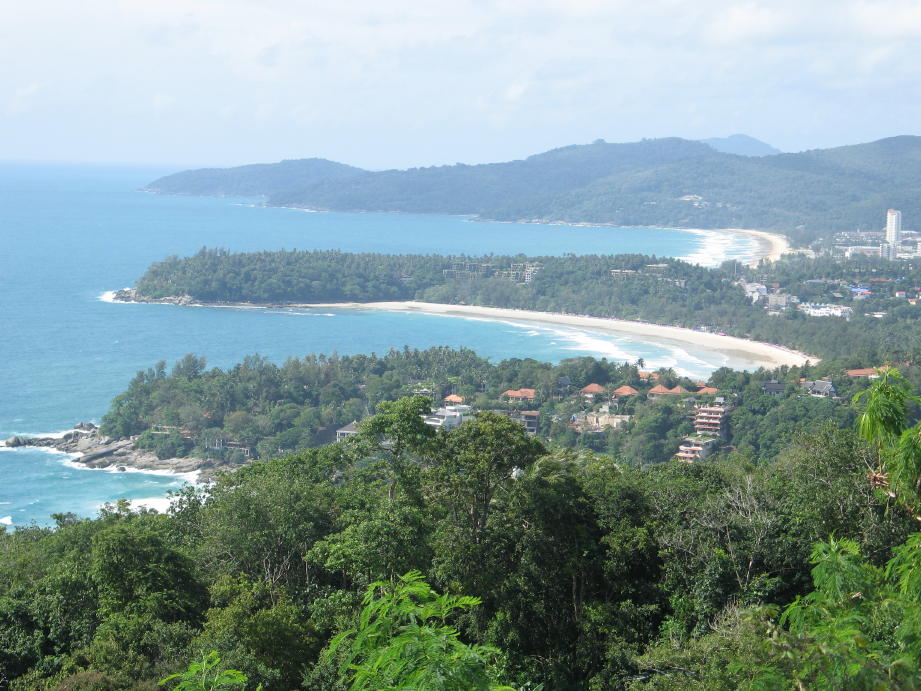
The surrounding coastal area from Kata, Karon and north has been developed to an inch of its life. There was no evidence of tsumani damage and it was here that the worst destruction occurred. It just seemed a pity to me that they hadn't taken advantage of the situation and rebuilt the area in a more environmentally friendly way.
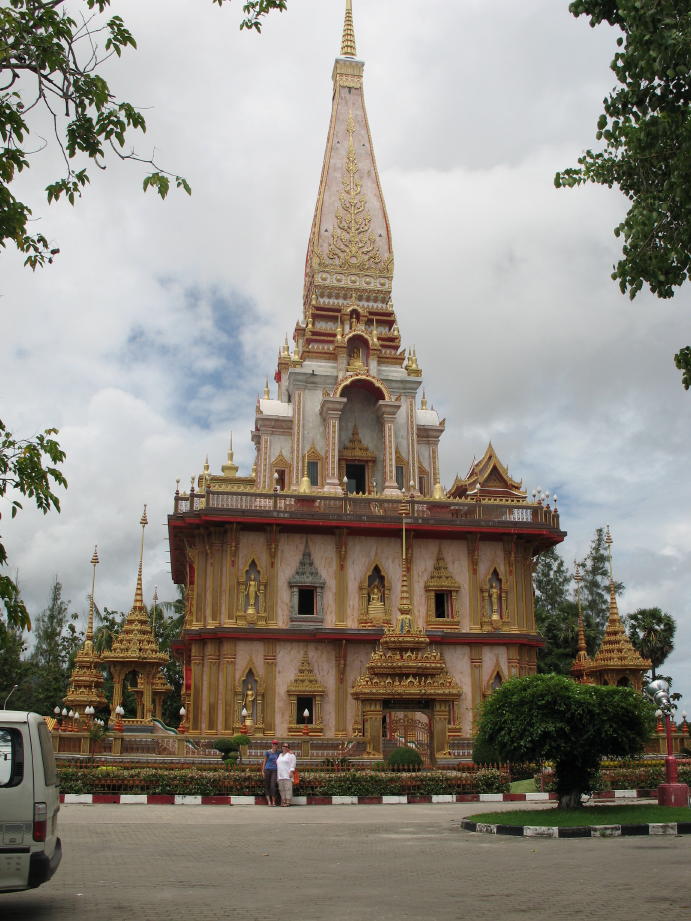
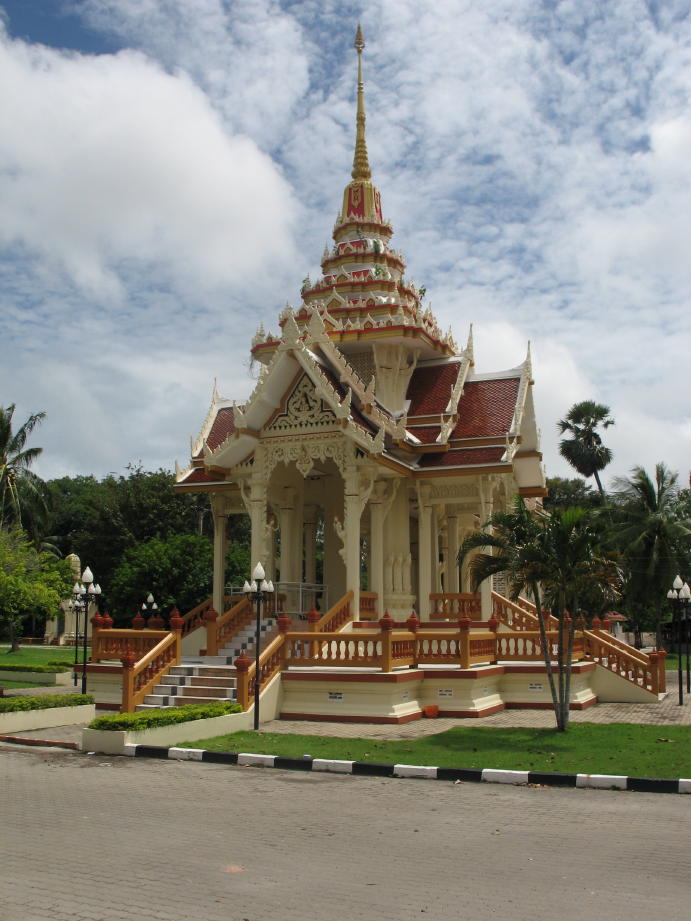
Thailand is predominantly a Buddhist country and a visit to a temple or wat is mandatory. They are always colorfully and extravagantly decorated and accessible by all faiths as long as you are suitably dressed. Wat Chalong was no exception.
This is Phuket’s most important Buddhist temple and is the biggest and most ornate of Phuket’s 29 Buddhist monasteries. The architecture is typical of wats found throughout Thailand.
Wat Chalong is associated with the revered monks, Luang Pho Chaem and Luang Pho Chuang, both of whom were famous for their work in herbal medicine and tending to the injured. During the tin miners’ rebellion of 1876 they mobilized aid for the injured on both sides. They also mediated in the rebellion, bringing the warring parties together to resolve their dispute. Statues honoring them stand in the sermon hall.
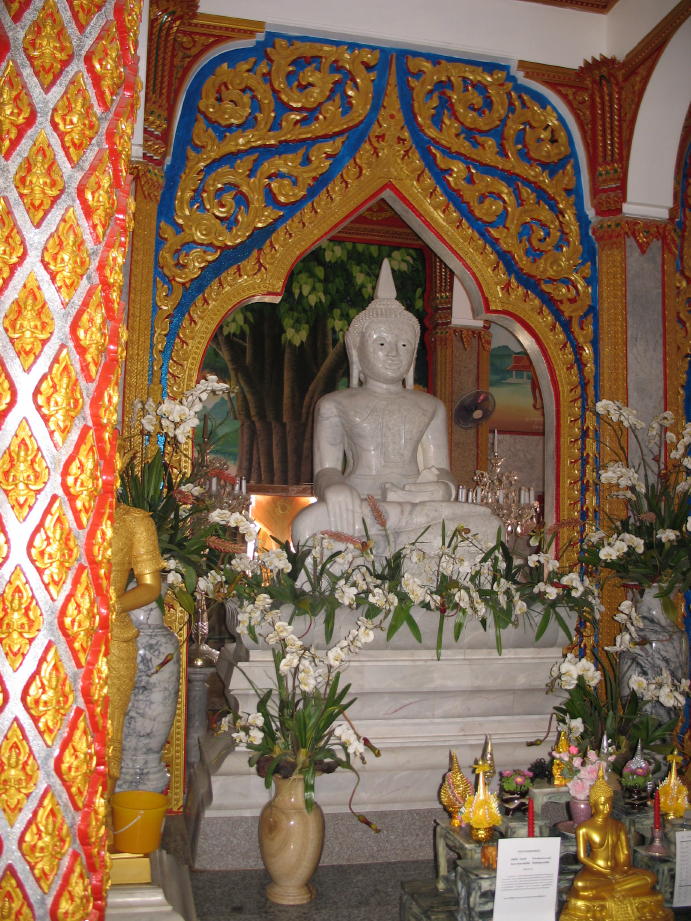
Many Thais come here to be blessed by the monks and receive a good luck charm in the form of a string tied around the wrist, which they believe protects them from injury and illness.
Local Thais and Asian tourists set off fire crackers and ask for the lucky lottery numbers, and have their fortune told. The fire crackers were a little disconcerting at first. Set off in what looked like a huge brick kiln it sounded like gun fire. A sad commentary on the state of the world.

We took the June Bahtra junk day cruise to Phang Nga Bay which is wonderful.The boat was not really a junk but a converted trawler that has been rigged with junk sails and was extremely comfortable.

There were only a few of us on board so we had plenty of room to stretch out as we headed north through glassy calm waters towards the famous limestone islands of the bay. We motored for part of the way and then the sails were raised and we heeled over and the wind took us.

The sheer limestone cliffs jut vertically out of the emerald green water. Over millions of years, the skeletons from a constant rain of marine organisms, plus the chemical precipitation of yet more calcium carbonate build thick layers of sediment.
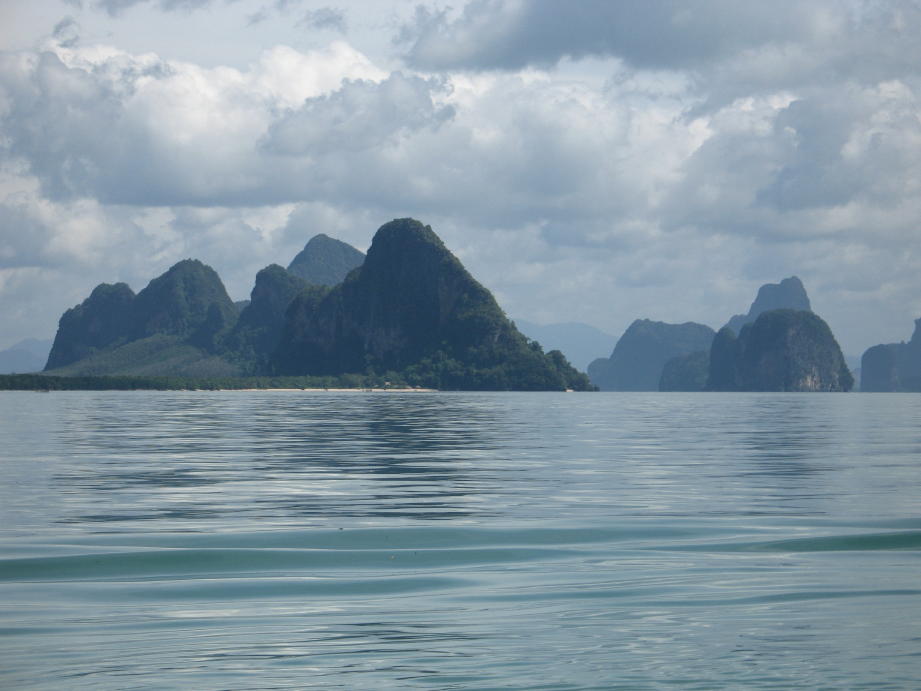
Eventually, the heat and pressure of their own weight turn these strata, hundreds of metres thick, to stone.
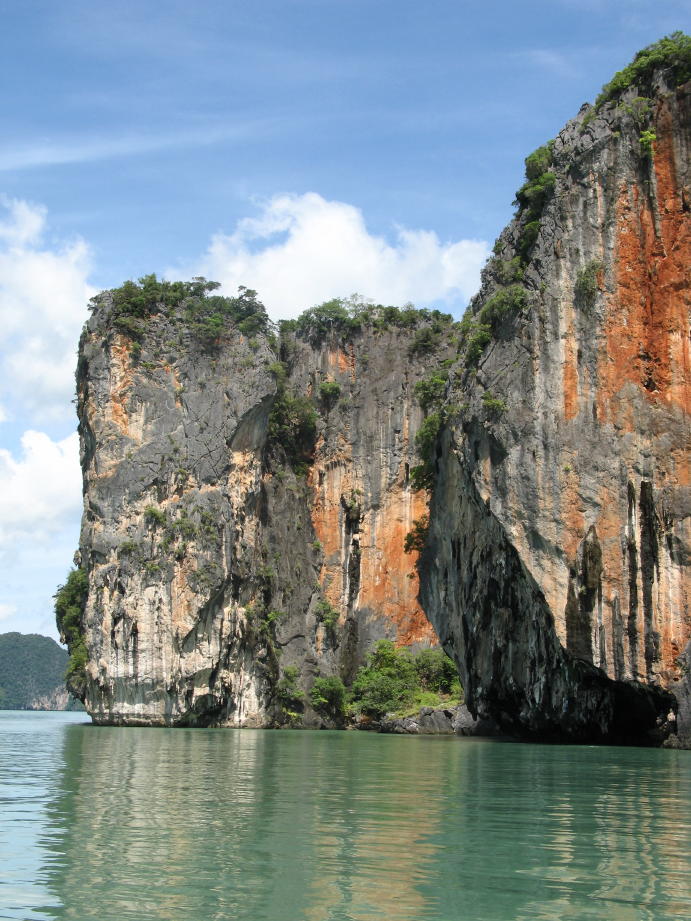
A variety of geological forces have then fractured the limestone beds and pushed up the 40 steep-sided islands that provide the exotic scenery for which this shallow bay is noted. Mineral oxides from various sources paint the vari-coloured streaks that characterise the cliffs.
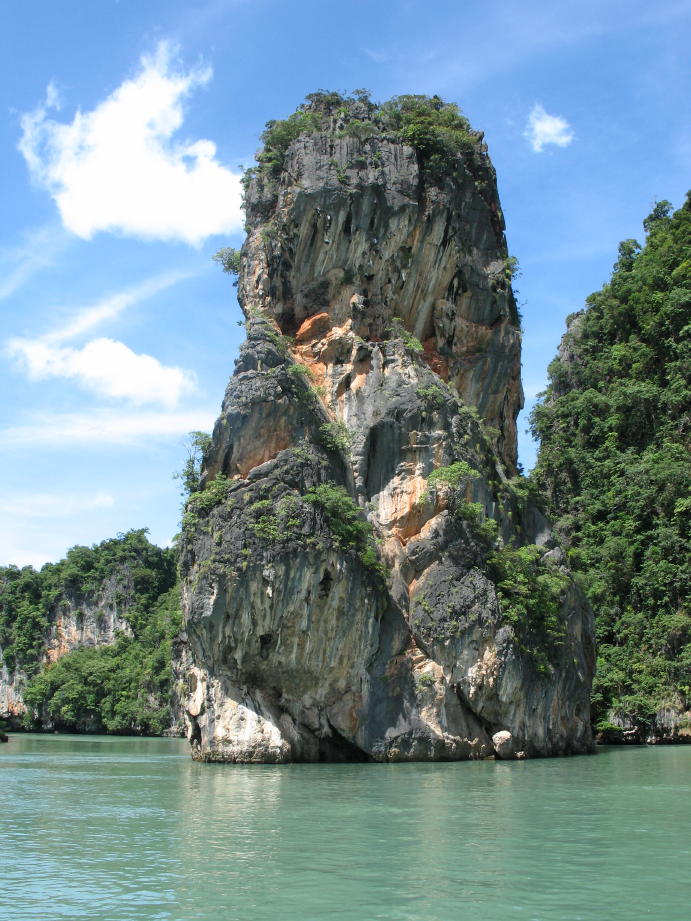
It wasn't many years ago that aerial surveys first revealed the Hong, or "rooms", that lie inside some of Phang Nga's islands. These hidden realms, rich in unspoiled flora and fauna, are collapsed cave systems open to the sky and surrounded by towering limestone walls. They can be accessed by sea-canoeing, where you paddle sturdy inflatable boats through caves (when the tide is right) into the mysterious hearts of islands such as Koh Panak and Koh Hong.
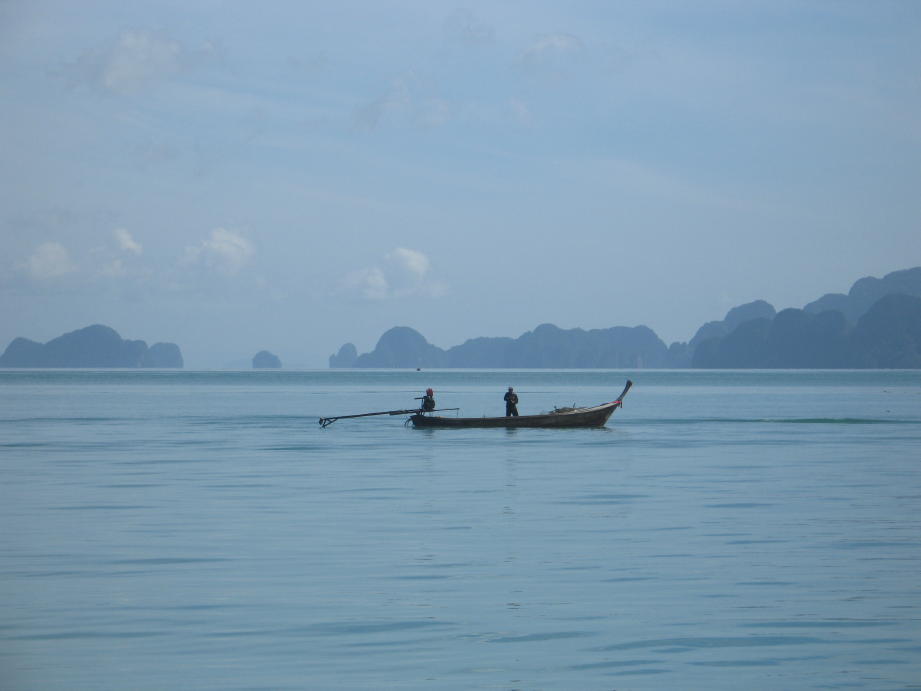
The long tail boat is a typical mode of water transport in south east Asia. It has a distinct narrow and beautifully crafted wooden hull and is powered by the famous longtail engine - basically a car or truck engine with a propeller shaft attached. The longtails can really move when the boatman opens up the throttle. Because a few places of interest were in parts of the bay too shallow for our boat we transferred (with life jackets on) to one of these and sitting on narrow wooden benches sped across the water with wind and spray in our hair. Nothing like the roar of a unmuffled 5L V8 pushing you along to stir the soul, petrolhead or not.
We made a small detour through a huge limestone grotto that is only accessible at certain times of the tide as well as to part of the mangrove forest that surrounds the northern part of the shoreline.
First stop was Koh Pannyi or Sea Gypsy Island. This is an interesting village, the whole of it, including a Mosque, built out over water on stilts and with a giant rock monolith guarding its rear. The inhabitants are of Indonesian origin but have been Thai citizens for generations and are of Muslim faith. They are not really sea gypsies but it makes good tourist propaganda. We were there during Ramadan so the place was very quiet but not so quiet as to prevent them trying to sell us the cheap and nasty souveniers that this type of place is known for. The smell of drying fish and "other stuff" pervades the atmosphere and can be a little off putting to novice south east Asian visitor.
James Bond Island was next stop. This famous landmark, called Koh Ping-gan, first found its way onto the international map through its starring role in the James Bond movie "The Man With the Golden Gun". And this is where they seem to take all of the tourists - all at one time. The entire area surrounding this island with its signature rocky pinnacle is indeed spectacular, but sadly it's covered in souvenier huts and overrun by long tail boat passengers who disembark in great numbers at what seems one minute intervals. A complete waste of time!
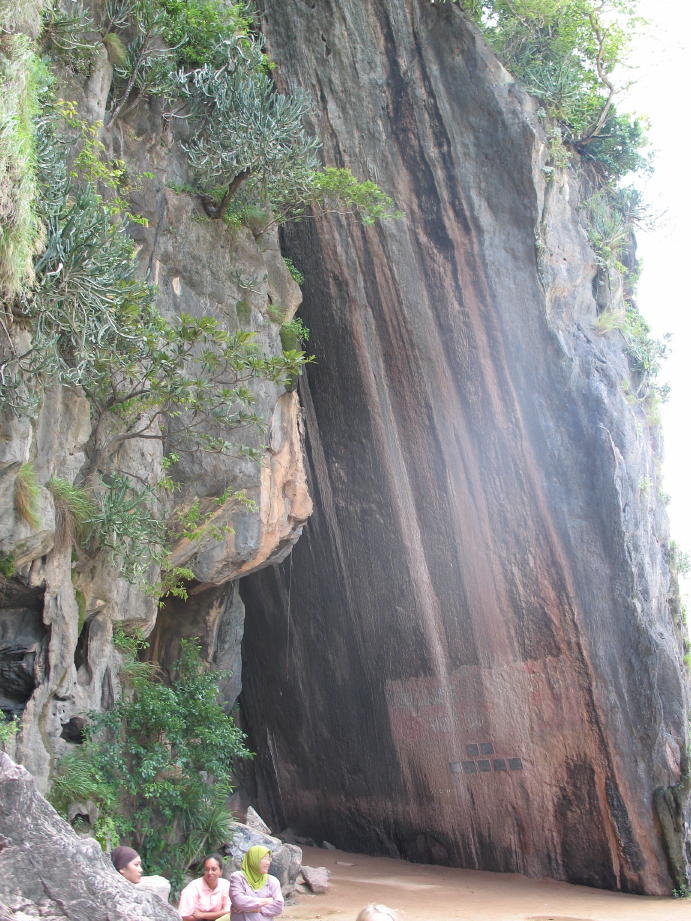
We were however soon back on board our junk, eating a freshly prepared lunch of fish, chicken and rice followed by fresh pineapple, papaya and bananas and heading south for a short stop in a bay where some of us ie. the brave ones, jumped off the boat for a refreshing swim in the warm water. I was more concerned with the strong current than the possibility of sharks!
We had heard that the night markets in Old Phuket Town were worth visiting so off we went one evening to explore. It turned out to be a food market with some of the most unusual things for sale. Some food items were totally unrecognizable. We were about the only westerners there and soon realised there was nothing much for us to buy. But it was an interesting insight at what the local people purchase for their weekly meals.
Our taxi driver had disappeared for the allocated two hours so we set off along the dark narrow streets looking for somewhere to eat and came across a small group of restaurants in the centre of the old town. Anna's was airconditioned and quite modern and served some of the best Thai food we had on the trip. Three courses plus beer and soft drinks and coffee for $A16 a head including tip!
All too soon we were back at the aiport for our short trip to Singapore made even shorter by an unexpected upgrade. Thank you Silk Air!

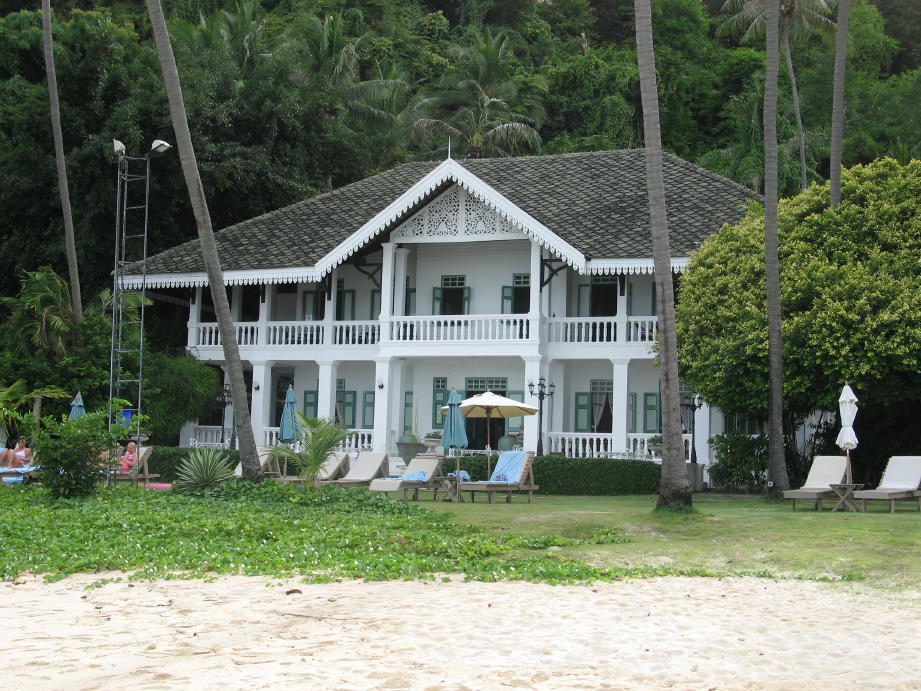
Back on Cape Panwa beach our empty chairs await our return.
Singapore is basically a huge shopping mall and restaurant. This island country is very crowded with a population of 15000 sq.mile accommodated in high rise condos, hotel towers and office blocks. The area is serviced by busy freeways and one of the best (and ever expanding) MRT's in the world. They have done a great job of greening the city with shady street trees and tropical gardens full with lush vegetation and colorful orchids. The city also boasts of numerous museums, art galleries, live theatres, a zoo, a bird park and botanical gardens. There is a fun park, Sentosa, on an outer island which attracts many tourists to its kitschy domain. Singapore also has one of the busiest ports in the world.
The first of my numerous visits here was in 1964. Things have sure changed since then. Under a somewhat ruthless and moralistic totalitarian government and the Chinese work ethic, the country has gone from third to first world in 40 years. Five percent of the population are millionaires. But there has been a price paid for this development. In my opinion that has been the de-asiaisation of the place. Culturally diverse centres like China Town, Little India, Arab Street and Bugis street are now mere shadows of their former selves and are kept in a sanatized form simply for the tourist industry.
Being a couple of degrees north of the equator Singapore is also a sauna. To make things worse, land clearing fires in Indonesia had caused a heavy pall of smoke to settle over the city. But all major shopping malls were well airconditioned and MRT connected so it was almost unnecessary to go outside.
Our main aim for the two days was shopping and eating. Singapore always has the latest in electronics, photographic and computer equipment as well as the largest selection of luxury goods with all major designer names represented. A huge amount of clothing and fabric is also on offer. Unfortunately the high standard of living means that prices are no longer as competitive as they used to be so much of our hard earned stayed in our pockets. But we still managed a great Chinese lunch washed down with Tiger beer at Clark Quay on the Singapore River as well as a wonderful steamed wonton dinner.
We even managed to fit in one last Thai meal before heading for the airport and home.
Monday, September 25, 2006

Spring Vineyard Chores

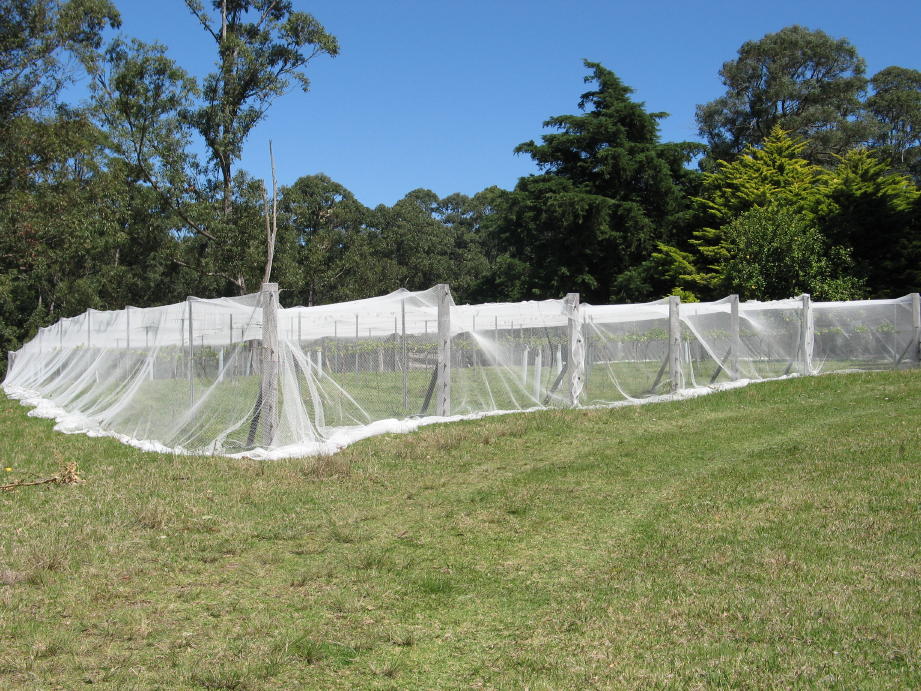
Work in all three vineyard blocks has been intense over the last few weeks. The major project has been the installation of overall netting to exclude wallabies and kangaroos during budburst and shoot growth and, subsequently, birds during the ripening phase. Positive evidence of global warming was budburst occuring at least three weeks early this season. This meant the nets had to be put over as quickly as possible so that not too many buds were lost. Netting has a nasty habit of "adhering" to everything it touches, especially in windy conditions, with swelling buds easily pulled off. Managing the 11m wide lengths of netting is not easy as they have to be stretched at the right tension across top wires and then tied to them by cable ties. The ends and sides are then pegged down under a taught line.
With the help of a friend two blocks were finished in a few days. The remaining block I did myself. This was a very frustrating and lengthy process but a good lesson in patience.

Bud burst and shoot growth have progressed well with good rain early in September providing much needed sub soil moisture.
All four varieties look good. Especially pleasing is the condition of the Pinot Noir which is notoriously difficult to grow.

Summer came early on Sunday 25th September, with 35C temperatures and westerly winds gusting up to 110km/hr. Bad bush fires were burning to the north of us and a large part of the small community had to be evacuated. Luckily, with the brave efforts of the rural fire brigade, no houses were lost but a large swathe of bush burnt from the lake to the beach. Two large caravan parks were also spared.
Hopefully this is not a preview of things to come. Disappointingly, rumours abound that this particular fire was deliberately lit!

Thursday, August 17, 2006

Sioux Falls to Sydney via Port Alberni, BC

All the flights from Sioux Falls to Vancouver were on time and connections were made without problems. I knew it must have been a good day because even the Canadian immigration official was pleasant. And that was a first!
Despite an uncooperative cargo door on our little Dash 8 that was to take me on the 14 minute flight to Victoria, I was not too late and was picked up by friends and driven up the coast three hours north to Port Alberni. It was only a few days before my departure that I learned how far Port Alberni was from Victoria. There were at least two airports closer but at least this way I got to see more of the country side.

Once we left the suburban sprawl of Victoria, the landscape became what I has always imagined. Green tree covered hills, ocean vistas and snow covered mountains. Quite a contrast to Tucson. And it was 20 degrees cooler!
We stopped en route at Chemainus. Once a town that relied solely on its sawmills, it has broken free of its dependence on the logging industry and has become Canada’s largest outdoor gallery with its wonderful life-sized murals. All professionally painted on the sides of downtown buildings, the murals reflect the history and the people of this small town. Chemainus now boasts over 30 of these murals. You can also shop until you drop at over 100 antique dealers. And they had great coffee shops too.

The drive to Port Alberni provides some incredible scenery. Fast running rivers, secluded lakes and forests of giant trees towering above you. MacMillian Provincial Park contains Cathedral Grove. Over 1000 years old, this old growth forest is home to ancient red cedars and majestic 900-year-old Douglas firs.
Next morning we headed into Stamp River Provincial Park to visit the fish ladder and hopefully see some salmon trying to make it up Stamp Falls. The fish ladder was put here to help them circumnavigate the torrent and increase the level of spawning upstream. Despite the fact that a huge number of fish (some whoppers) could be seen congregating in the clear pools below the falls, none were making the attempt to get up further.

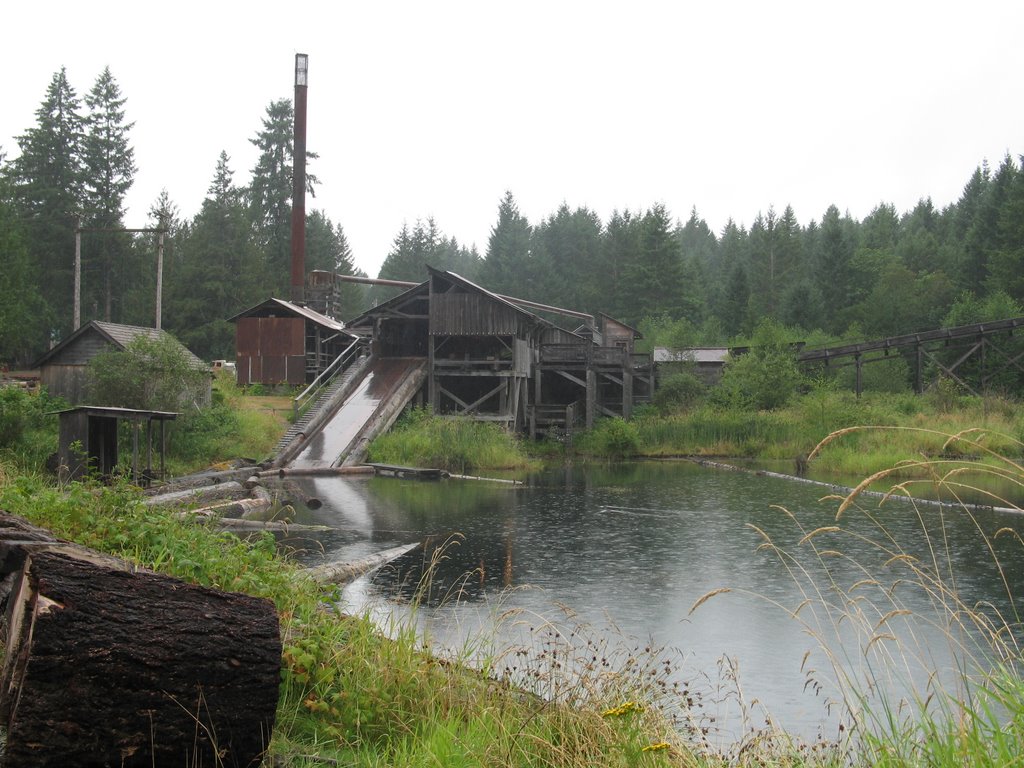
We then visited the McLean Mill National Historical Site to discover the rustic beginnings of BC's timber industry. You step back in time here on a walk through the original camp of the loggers and mill workers, the 1920s era steam mill, the dam, mill pond, and over 30 other buildings. It has been restored to working condition but unfortunately not on the day we visited. A steam train brings visitors up from the town on specific days and it is then the huge old saws get humming.

A small detour took us to the Chase and Warren vineyard and winery. The BC wine industry produces under pretty adverse conditions with a very short growing season, variable weather conditions and potential deer ravages. As a result early maturing whites eg. Gewuerztraminer, Riesling and Pinot Noir is about all they can grow. We tasted the whole range and I was quite surprised at the quality. They say they get the grapes reasonably ripe but they are allowed to add sugar and acid and the vigneron was not too forthcoming on the additions he had made to the wines we were trying. We bought a few bottles for dinner and one to take home to Aus so he did ok from our visit.

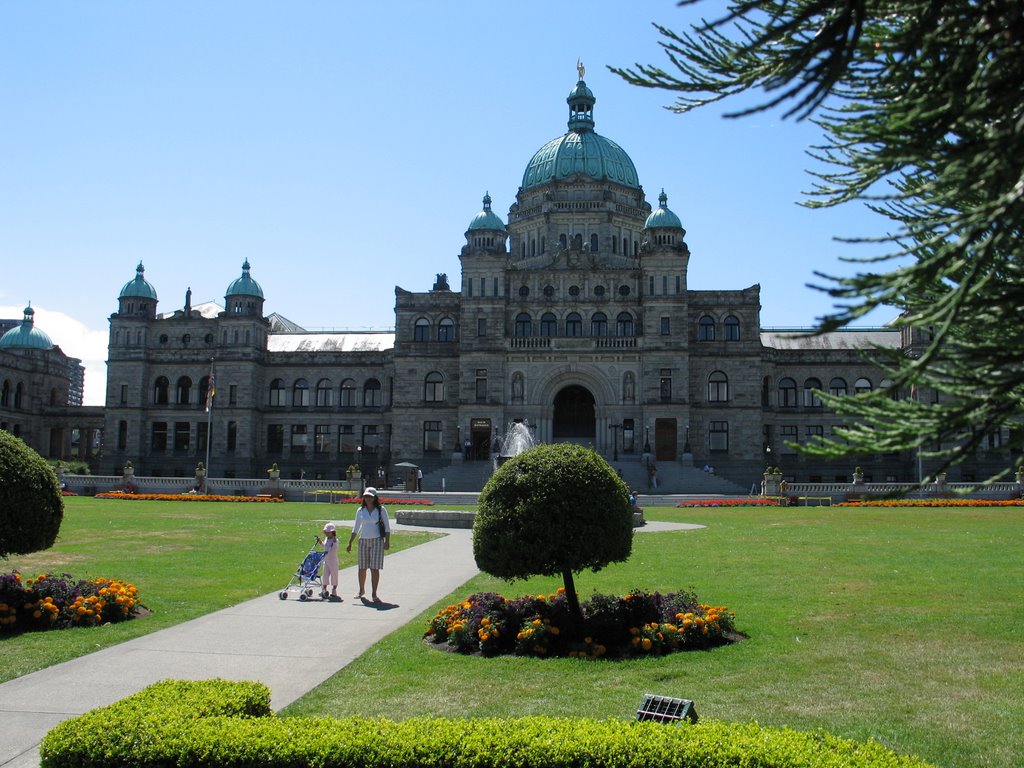
Next morning we drove back down to Victoria. It is a pretty city on the water with some impressive buildings. We only had time for a quick look around and a great lunch, a wild salmon burger, before I had to head back to the airport.
The problem with the London Airport security situation was just starting to filter through as we left Vancouver, so we were virtually unaffected by the new regulations. So it was a pleasant six hour flight to Honolulu for a 2 hour stopover, then a little less enjoyable 10 hour leg to Sydney. Luckily the plane was not that full so I was able to stretch out a bit and sleep for a good deal of the way.

We made it early but because of the silly airport curfew we were forced to circle off shore for quite a while before landing. Then the aircraft was sprayed! I thought that process had been abandoned a decade ago when residual sprays were introduced.
Welcome to Sydney.....cough, cough; splutter, splutter.
You wonder what visitors must think!
Anyway I was soon through customs with my booty of Caribou Coffee, Godiva chocies and and real Canadian maple syrup.
Another adventure was over!

Wednesday, August 16, 2006

Zuni Fetishes

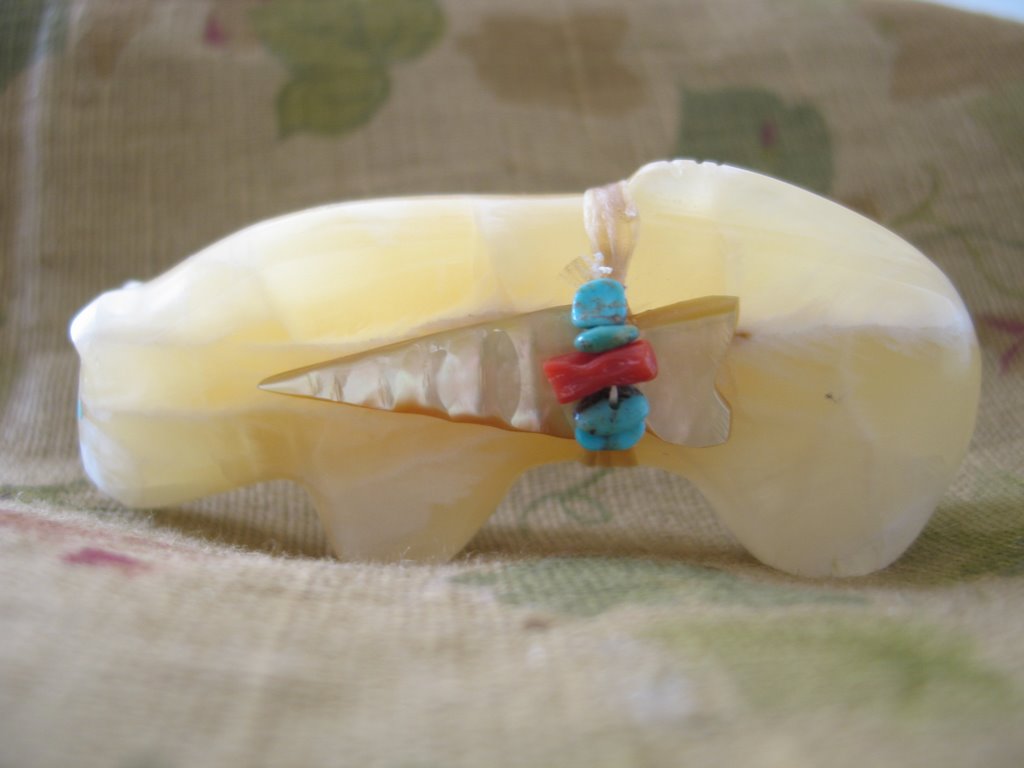
Zuni Fetishes are small (several cm long at most) carvings from various stones, made by the Zuni Indians. These carving serve a ceremonial purpose for their creators, or they can be sold to collectors worldwide. Typically they depict animals such as horses, wolves, bears, buffalo and others. Even insects may be the subject of the artist. Stones could be turquoise, fishrock, jasper, pipestone, marble, even artificial substances such as slag glass.
The artists’ styles are as unique as the artists themselves, and there are many whose works are highly sought after by collectors. Some carvers prefer a delicate, realistic figure that appears to stalk one from a shelf or curio cabinet, and others carve blocky, heavy styles more suitable to ride in a pocket.

Each animal is believed to have inherent powers or qualities that may aid the owner. The wolf for example, provides guidance through life's journeys, while the raven and the horse are thought to have the power to provide healing. A fetish in the shape of a horse might also be carried during travel in hopes of a safe, swift journey.
A fetish may be signed by the carver, or not. Often, though, a fetishes style will be enough to identify the carver as surely as any other mark would. A horse by Abby Quam, for example, is pretty unmistakable. Some carvers have parents, grand parents or children who also carve fetishes. Besides being made from various stones, (each stone also has unique properties) the fetish can be embellished with small beads of bright red coral, shell, or turquoise. They may carry a miniature arrowhead made from shiny abalone shell. These small items, although colorful to the eye, are intended to protect and feed the fetish itself.

On the subject of feeding, it is believed that the fetishes require a meal of cornmeal and ground turquoise periodically. Fetishes may be kept in a clay pot as it is the tradition, although collectors usually like to keep theirs somewhere where they can be admired. Any but the very delicate fetishes could be carried by the owner in a pocket, pouch or bag.

Saturday, August 12, 2006

Escape from Tucson

We made it to Sioux Falls.......just!
After getting up at 4am to get ready for an early departure to Phoenix to get our flight,I noticed it was sprinkling when I was packing the car. By the time we were ready to leave it was bucketing down. We waited about 15 minutes but there was no let up so we left anyway. Our street was like a river with water halfway up our wheels. Our usual way out of town was blocked by a wash running at a million miles an hour, so I tried another way which was also flooded.
So we headed back home, called the airline to change our flights and waited.....and waited. It just didn't stop.
The tv was issuing warnings about flash flooding and dangerous conditions every ten minutes or so. After a few hours we made another attempt. It was still bad but not as dangerous as before. Once we got on the interstate we knew we had made the right decision to wait.There was a huge number of cars that had come to grief spinning out in the wet treacherous conditions and crashing into safety barriers.
We got to Phoenix ok and then had to fill up before returning our car to the rental office. The only gas station we could find was right in the middle of the area where the Phoenix sniper has been operating so it was a little disconcerting filling up the car and watching out for a beige truck that he is supposed to be driving.
Sioux Falls was hot too and also very humid.
I think I like the desert climate better.
During the week we caught up with family and friends. I even made it to a batting cage and had my first hit of a baseball.....medium speed.
On our last weekend, the family threw a a surprise early 60th birthday for me.
We had a ball.
It had a distinct Elvis theme. Lots of nice Elvis orientated presents, a keg of Coors, roasted pork loin and beans and a disco. The more energetic played volley ball, the more sensible sat back and drank beer.
I lasted until midnight, some others until 2:30am!
It was great way to end my USA visit.
So, after a short detour to Vancouver Island, Canada, I would be on my way home.

Tuesday, July 25, 2006

A Weekend in Las Vegas

On our last weekend in Arizona we headed for Las Vegas. I managed to get a good package deal with USAir, which meant a two hour early morning drive to Phoenix to pick up our flight. We checked into our LV hotel, Harrahs, via their airport facility, got the shuttle into town and went straight to our room. Then we headed out in the 44 degree heat to explore.
The Venetian Hotel has a wonderfully kitsch shopping mall modeled on the Grand Canal in Venice. We wandered the “streets”, watched the gondolas ply their trade and had lunch at a nice restaurant, “el fresco” in “St. Marks Square” all the time entertained by wandering minstrels, jugglers and operatic singers. You just have to suspend reality for a while and go with the flow.
http://www.venetian.com/shoppe/tours.cfm
Then it was across the road to The Mirage to pick up our tickets for “Love” and do some gambling. The entry to this hotel is through a huge tropical jungle complete with streams and water falls. Closer inspection reveals that every tree, plant and flower is not real, just plastic and cement. Maybe that is why they call it the Mirage. We had a really good run on the machines. We won $200 which would pay for dinner.
We had cravings for an Asian meal but you have to be careful in the USA as Americanized Asian food can be a disappointment. We decided to try the unfortunately named Tsunami Asian Grill which turned out to be excellent. Spicy sate chicken as a starter and seared tuna salad with soy and sesame oil and seaweed wrapped sambal rice (with a huge kick) filled the bill exactly. All this washed down with a bottle of Italian Pinot Grigio.
What can I say about “Love”? It’s a musical tribute to the Beatles performed by Cirque du Soleil. Presented in the round with digitally remastered music coming in surround sound from 6000 speakers including in your seat, huge screens with high definition projected images, and the most mind bending acrobatics, trapeze, free dance, amazing props and seamless changes in mood you become completely immersed in the experience. It’s impossible to keep track of everything that is going on. It sucks you in and then spits you out. With the permission of the remaining Beatles, George Martin has remixed a number of songs. Are they better? Maybe they lack the rawness and spontaneity of the original but it does them no harm.
If you grew up with the Beatles you can see a subtle history of their lives interwoven into the performance and it’s a little poignant to hear John Lennon and George Harrison talking and fooling about during their recording sessions, the former with his sarcastic wit and the latter with his quiet reason and ongoing attempts to keep the peace.
I doubt whether it will ever come to Australia because of the huge mechanical infrastructure and the necessity to put lots of bums on seats to pay for it all. But if you ever see a special deal air deal to Las Vegas, take it and go see “Love”
http://www.prnewswire.com/mnr/kirvindoak/24410/
Next day we did a bit more gambling, a bit more eating and a lot of people watching. This is the place to do that.
We were delayed on the flight back because it was so hot at Las Vegas Airport, the air compressors used to help start the jet engines could not build up enough pressure. We had to wait for auxiliary units to be brought in.
During this flight it was announced that “it is illegal to congregate around the flight deck door. For the information of passengers the flight deck is at the front of the aircraft”
This gets the “bleeding obvious” award for the entire trip.

Sunday, July 16, 2006

Mission Trail, Tucson

We debated whether to go into Mexico through Nogales or not. Apparently the border crossing can be a bit of a hassle. The only thing you go into a Mexican border town for is cheap grog and medicines as well as local food. We didn’t think we could eat better mex than in Tucson so gave Nogales a miss. As it was on our way out of Tubac on Interstate 19 (a major route from Mexico), we were stopped at a border patrol checkpoint. The car in front had Mexican number plates and the four occupants were given a good old going over. The same officer merely looked at us and waved us through. A blatant example of ethnic profiling?
As the USA is the last world bastion of the imperial measurement system (in some cases their own eg. volume), I was surprised to see that that the I19 was signed (distances/exits etc) in kilometers. American cartographers however couldn’t seem to get their heads around this as a note on my map read “mileposts are in kilometers”. But it must be only a matter of time until they catch up. Road speed signs in some states have both and most grocery items have weight and volume in both.
The Spanish from New Spain (Mexico) came into what is now the USA as conquerors, colonizers or converters or a combination of all three. They were soon joined by the English, French, Portuguese and others as well as eventually Americans themselves to explore, map, exploit and subdue the North American continent. To quote Golay and Bowman “The Exploration of North America” (2003), the stories of these explorers contain elements of heroism, willpower and fortitude in the face of extreme hardship and physical endurance almost unconceivable in today’s world. They contain too elements of lust, greed, meanness, betrayal, rapacious exploitation, armor plated arrogance and unimaginable, sometimes genocidal, cruelty. South West USA has more than its fair share of fascinating stories of exploration including those of de Vaca, de Niza, Coranado and Kino et al.

In 1691 Jesuit missionary, Eusebio Kino founded the Tumacacori mission along with others, Calabazas and Guevavi, on the banks of the Santa Cruz River to convert the Pima Indians to Christianity. The area had an often turbulent history with an Pima Indian revolt, the banning of Jesuits and their replacement by Franciscans, Indian attacks (mainly Apache), Mexican Independence and the Mexican Wars.
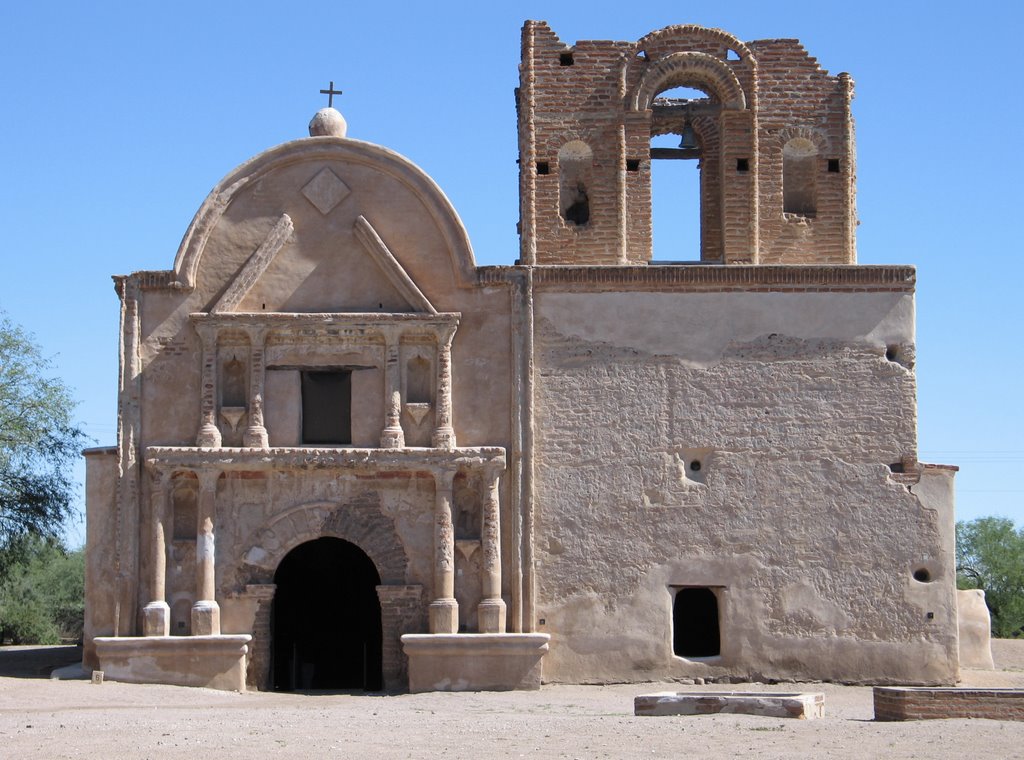
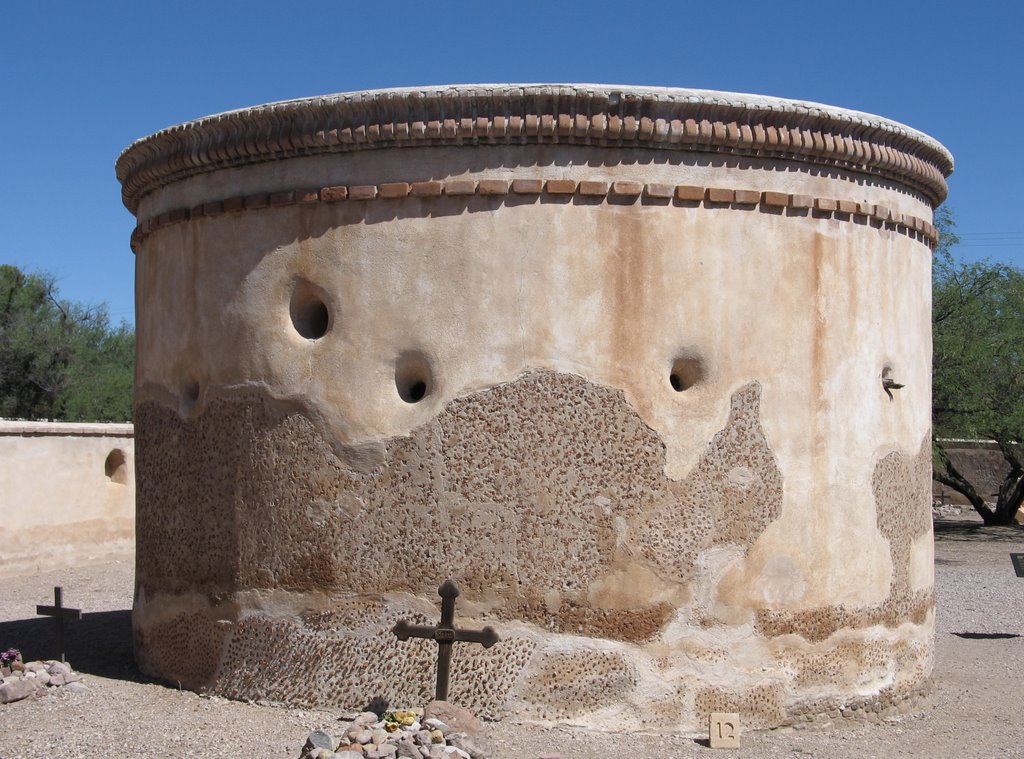
At Tumacacori, the original Jesuit mission church was being replaced when the area, under constant Apache attack, was finally abandoned in 1848. The church was never finished.

Tumacacori National Historic Park has the remains of this mission church, San Jose’ de Tumacacori, an associated cemetery, mortuary chapel and portions of the convento area. There are also the remains of Calabazas and Guevavi but these are not generally available to the public.
We had this place to ourselves and spent a couple of pleasant hours investigating the church, its mortuary, graveyard, storage and living areas. It is a great place for pictures with the clear desert light, high blue sky and shining yellow adobe.
It was here that we saw our first roadrunner. No wiley coyote or acme dynamite in sight!

Tubac is the site of an old fort (presidio) built after the Pima Indians revolted at Tumacacori in 1751, killing more than 100 settlers. Nothing much of this building remains except for some foundations. It was from Tubac that de Anza set out on a number of overland expeditions to California eventually determining the site for the future San Francisco. The town is now an artists’ centre with about eighty specialty shops and restaurants.

Many of these establishments have very classy furniture, jewellery, pottery and artworks. I really liked the $US5000 (gulp!) mesquite timber table for eight but unfortunately it would not have fitted in the overhead locker of the aircraft. The eight chairs were of course extra.
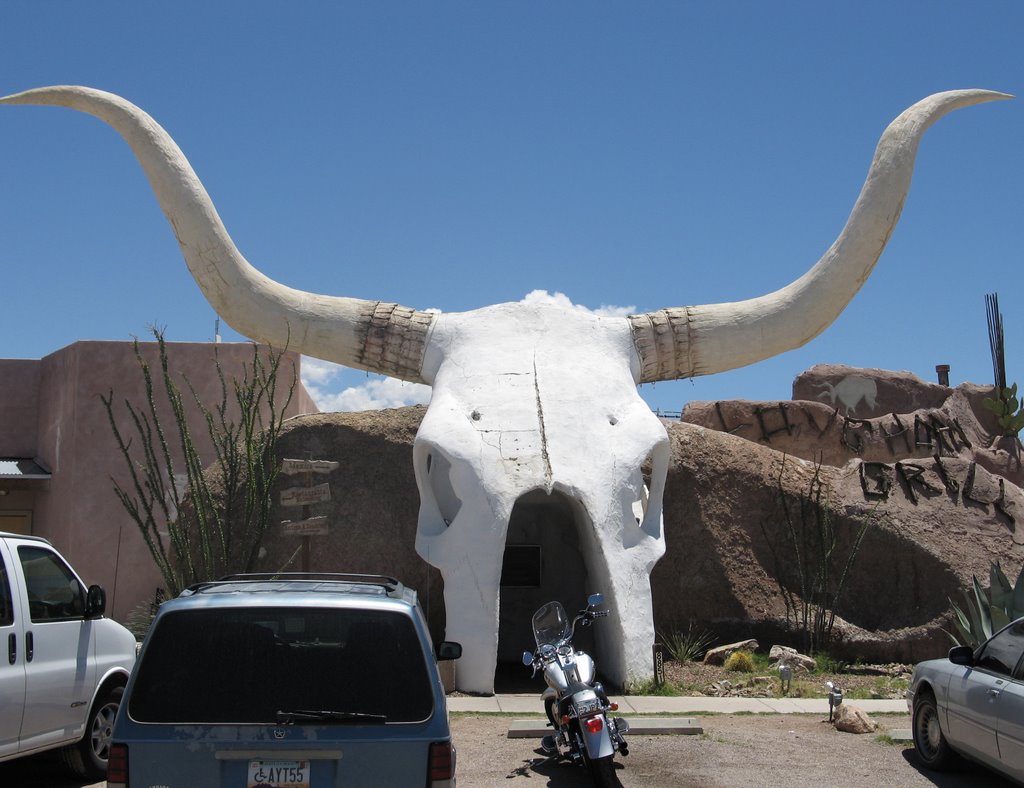
After a cup of cappuccino we headed north with a small detour through to look at the Longhorn Grill (a favorite John Wayne haunt) with its unique entryway.

Next stop was San Xavier de Bac an active Franciscan Mission on the Tohono O’odham Reservation just outside Tucson. This church was completed in 1797 on the same site as a Kino mission and is considered to be the finest example of Spanish mission architecture in the USA.
Unfortunately half the exterior was covered in scaffolding due to an ongoing restoration project so it was difficult to appreciate the symmetry of the building so check out the web site to get a better picture than I could get.
http://www.sanxaviermission.org/Index.html

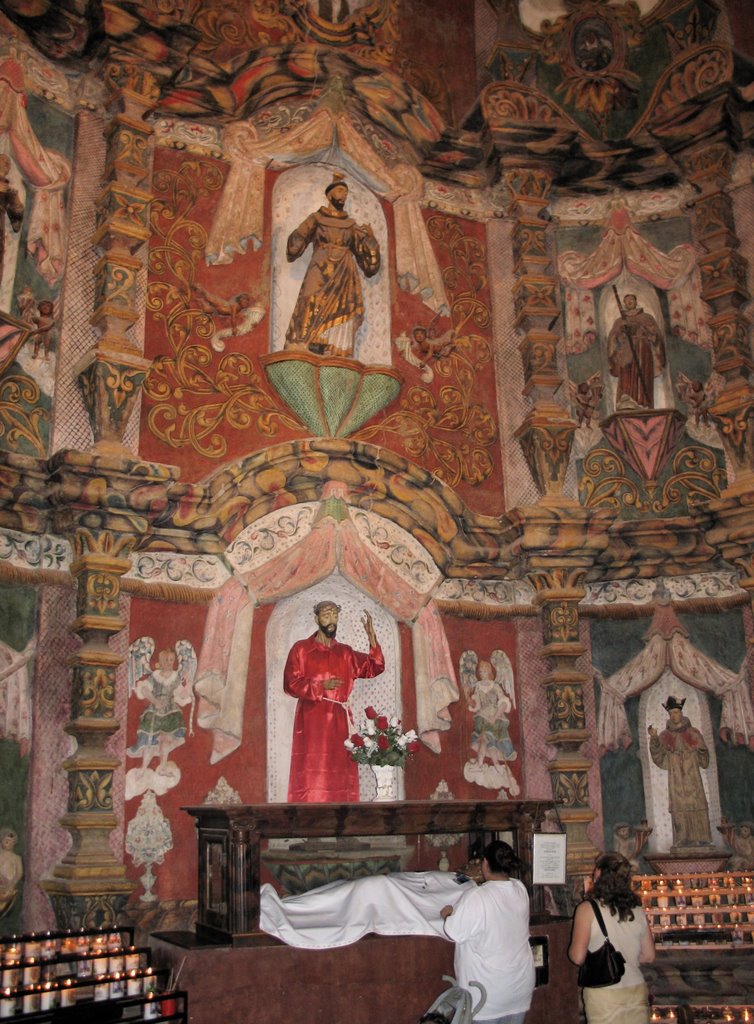
Inside where much restoration had been completed was another matter.
When you enter the massive, carved mesquite wood doors of San Xavier you are struck by the coolness of the interior, and the dazzling colors of the paintings carvings, frescoes and statues. The interior is richly decorated with ornaments showing a mixture of New Spain and Native American artistic motifs. The floor plan of the church resembles the classic Latin cross. The main aisle is separated from the sanctuary by the transept with chapels at either end. The dome above the transept is 16m high supported by arches and squinches.

At least three different artists painted the artwork inside the church. No record of the architect, builders, craftsmen and artisans responsible for creating and decorating it are known. Most of the labor was almost certainly provided by the local Indians and many believe they provided most or all of the artisans as well.

Friday, July 07, 2006

More Tucson

Some more observations on life in Tucson so far.
First off the drivers. Most drive with a mobile phone stuck in their ear so concentration levels are minimal. Speed limits seem to mean nothing, double yellow lines mean cross and pass, stop signs mean only slow down and indicators are auto decoration only. You really have to be careful at major intersections with red light runners. Tucson is number three in the USA for this type of auto death. Phoenix, also in Arizona is number one and Oklahoma City is number two. There are plenty of cops on the road but they never seem to be at the right place at the right time.
The Mexican restaurants are great with cheap, plentiful food and a huge choice. Even this form of fast food is worth trying.
Wine is sold in supermarkets and specialty shops. There is plenty from all over the world to choose from. Australia is well represented but I will avoid “Little Boomey” Shiraz and Chardonnay with its Yellowtail clone label. Chardonnay dominates the white shelves but there are more Pinot Gris and Sauvignon Blancs than last year. Semillon hardly gets a look in. The reds are more evenly distributed over the regular varieties.
The Urban/Kidman wedding got huge coverage here. Now Nicole is an urban mithuth. One amusing news coverage thoughtfully provided English sub titles whenever Australians were speaking. There was even an hour’s program on the Rockhampton girl who disappeared and then reappeared during her murder trial. No sub titles with this one.
I am into baseball again supporting my adopted team, the Arizona Diamondbacks. They are hopeless! I must be a jinx. When we were in Minneapolis I supported the Twins who hardly won a game while I was there. The look on the Diamondback’s coach as his team lurches from disaster to disaster is something to behold. Think the Rabbito’s coach.
I watched the Australia v Italy World Cup match in Spanish. It seemed to me that the Mexican commentator was more upset about the outlandish penalty at the death than any Aussie could be even though the referee was Spanish. I wish I knew what he was saying but I think the ref’s ears must have been burning.

For insurance reasons, we have had to swap over rental cars every two weeks. This gives us an opportunity to ‘test drive’ a few. So far we have had a Chrysler Sebring, the same model convertible (too hot to have the hood down) and now a Chrysler PT Cruiser which is very retro but very cute. The first two had interior boot releases and all doors automatically lock at a certain speed. A sign of the times, I guess. You have to pay before filling at most petrol stations unless you use a credit card at the pump when you get hit with a surcharge. I hear this is just coming in at home and is a bone of contention. Petrol is around $A0.95L. Cheap huh?
Just thought you would like to know that the minimum federal wage in the USA is $US5.15 (A$6.90) an hour and hasn’t been increased for 8 years! State minimum wages vary but not by much more than an additional $US2/hr. With the majority of hospitality staff on these levels, it takes the pain out of tipping, just a little.
Went to the ‘Outback’ restaurant the other night. One of the items on the embarrassingly kitsch Australian menu was Prime Minister’s Ribs. If only that were true!
Despite the Australiana, the food here is really good!
The ‘monsoon’ officially arrived on 28th June. This is heralded by three consecutive daily average dew points above 54°F. Humidity is certainly up, around 30%, and we are subjected to severe afternoon thunderstorms. Rain comes in isolated heavy short downpours and is accompanied by spectacular lightning (4000 strikes were recorded in the city one afternoon) and very loud thunder.
And now for more sights.
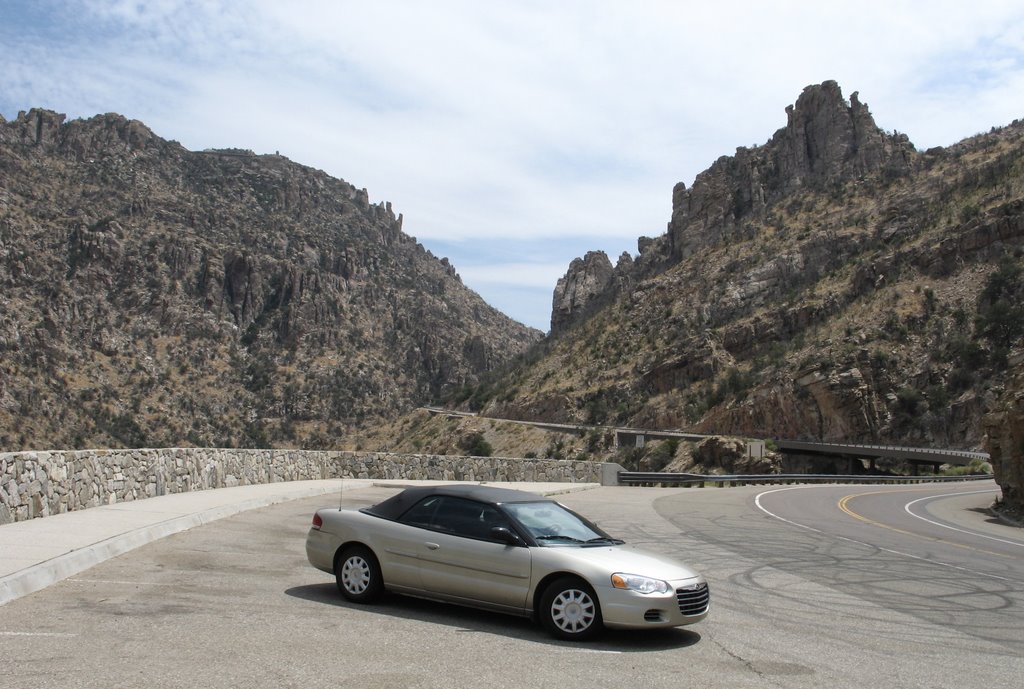
Mount Lemmon is in the Santa Catalina Mountains north of Tucson. The small town of Summerhaven sits near the top at 2500m, an hour’s drive from the city. In summer the mountain is a major camping and hiking area as well as a place to go to escape the summer heat. It can be 20C cooler up there. In winter the area is a ski resort.

The drive up is very spectacular climbing quickly through a variety of environments from desert to cool temperate forest to thick pine forest. They say that the short drive to the top is equivalent to the change in scenery driving from the Mexican to the Canadian borders.
There are many places to stop along the way to enjoy the view over Tucson far below. Unfortunately bad bushfires in northern Arizona had cast a pall of smoke over the whole area and this spoiled the view a little.
The top half of the mountain had been devastated by bushfires in 2003. Summerhaven was all but destroyed. Reconstruction is still continuing and the whole town is a building site. We stopped at a building that had been spared, The Summerhaven Café, for a coffee and a piece of one of their famous fruit pies. Neither was great and the service was appalling, so much so that we did not leave a tip. A first for us!
Pine trees don’t regenerate after fire like the Australian bush so parts of the normally lush forest were quite bare. There is a huge replanting project going on. This is bear and mountain lion country too and there were plenty of warning signs along the road. The ‘nutters’ that ride their bikes up this steep incline and then madly coast back down could be considered the animal version of meals on wheels.
Tombstone lies about 90 minutes south east of Tucson in some pretty desolate country. Even the cactus and the Palo Verde don’t grow here. This is Apache country too. Cochise’s stronghold is only a few kilometers away in the Dragoon Mountains. We didn’t know what to expect here, a genuine historical western town or Disneyland. It turned out to be a bit of both.

The town was established in 1879 after silver was discovered nearby. It was soon a boomtown with a pretty wild history and became famous for the gunfight at OK Corral between the Earp brothers, Doc Holliday and the Clanton and McLaurey brothers.
Allen Street has been closed off to traffic and has been returned to its original dirt state. Many famous old buildings stand there including the Bird Cage Theatre, Big Nose Kates and the Crystal Palace Saloon.
A lot of buildings cater to the tourist trade with souvenirs or questionable reenactments of historical events. Sadly the OK Corral has been “cordoned off” and you have to pay to get in to see a “shootout” show. But this does not detract from the atmosphere of the town which, if you have enough imagination, still belongs to the Wild West.

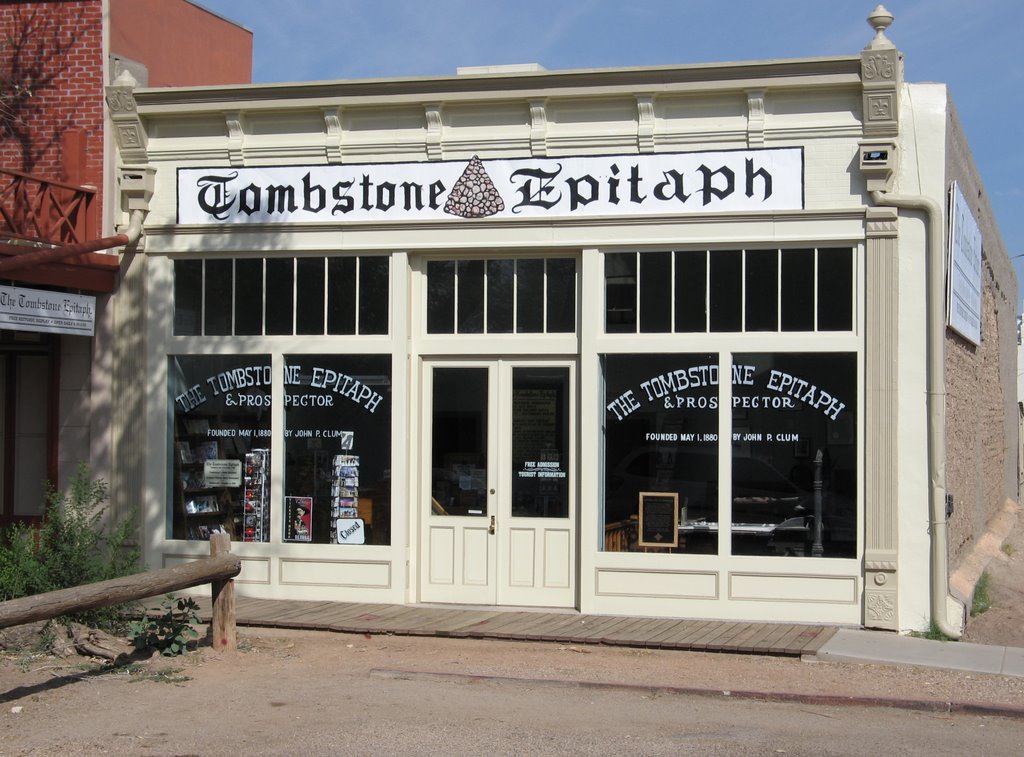
The city hall is a quaint Victorian Western Territory style building that still houses the Marshall, albeit now driving a V8 Ford. The courthouse is very grand and the Tombstone Epitaph Newspaper building still looks like it should. We had breakfast in the Nellie Cashman Hotel. It survives the 1880’s graciously. Nellie Cashman, the Angel of Tombstone, was quite a person. Check out the web site:
http://www.desertusa.com/mag98/may/papr/du_cashman.html
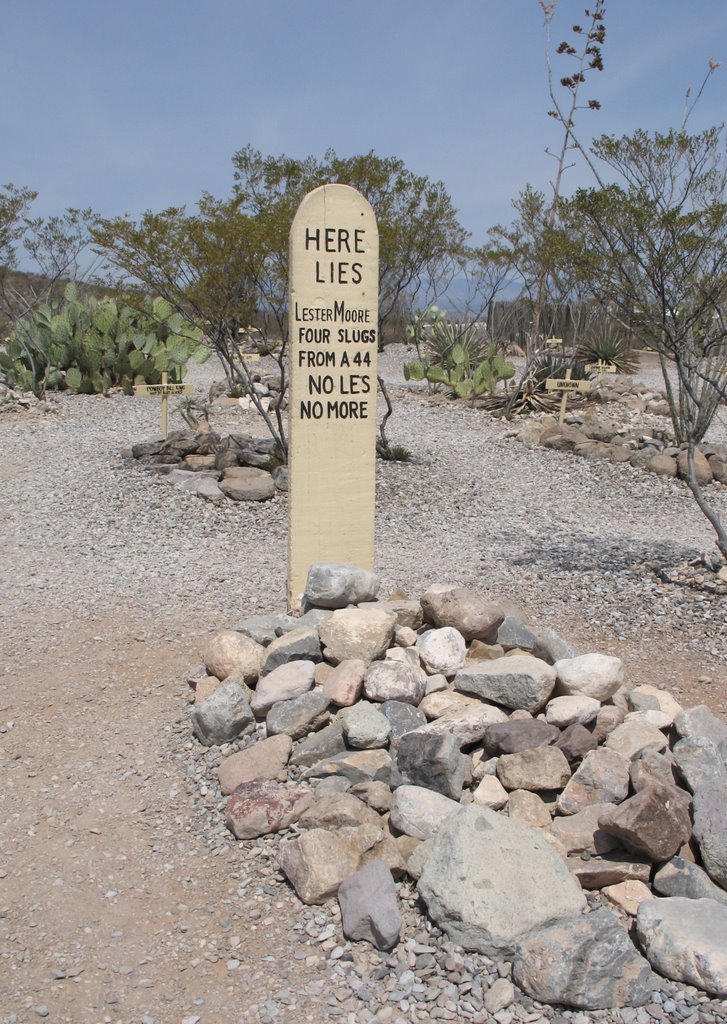
A highlight was a visit to Boothill. This cemetery had been considerably neglected for many years and had almost returned to nature. Some enterprising people had done considerable research and have restored the area. They haven’t tried to tart the place up at all but simply reestablished where the original graves were (within 0.5m) and placed on many of them copies of the original headstones some of which make amusing reading.

For $2 you get a descriptive list of more than 250 graves, who is in them and how they died. You learn more about the area here than you ever would at the reenactments in town.
http://www.americanwest.com/pages/tombston.htm
At the beginning of the 20th century, Bisbee, located just east of the Mule Mountains in southeastern Arizona, was as one of the premiere copper mining towns in the world. The Mule Mountains hid a wealth of gold, silver and copper until the late 1870’s, when a government scout, Jack Dunn, discovered rich ore deposits while chasing Apaches. By 1908, Bisbee, with a population of over 20,000, was Arizona's largest town and "the liveliest spot between El Paso and San Francisco." Homes sprouted from the steep canyon walls and forty saloons and numerous “houses of ill repute” lined Brewery Gulch. The hills surrounding Bisbee produced copper and impressive amounts of gold, silver, lead and zinc. Eight billion pounds of copper were mined. Finally, the deposits were exhausted and with operations were no longer economic, the shaft mines shut down.
However open cut mining started in 1951. They extracted 46 million tons of overburden before reaching the ore bed. It is estimated that over a billion tons of copper was mined from the pit, with good amounts of gold, silver and lead also being extracted. Turquoise was also a by-product of this mining activity. Bisbee turquoise also known as Bisbee Blue, is amongst the finest turquoise found anywhere in the world. Mining operations in the pit ended in 1974.
The remaining hole, Lavender Pit, covers an area of 120ha and is 275 m deep. Vast tonnage of dump rock is spread all around Bisbee and the southeastern Mule Mountains area. This dump material, along with the large open hole of the pit is considered an ecological disaster but it is still an amazing sight.
Bisbee burnt to the ground in 1908 but was completely rebuilt by 1910. The town we visited is that in tact 1910 town with its many fine Victorian buildings. It sits in a narrow canyon with narrow windy streets lined with what are now tourist shops, restaurants and cafés. The major tourist attraction is the old Queen Bee Copper Mine which you can visit, dressed in traditional miners garb, via the old mine train. We called in on a few of the specialty shops and spent some time in a gallery of genuine south west native American pottery, carvings, rugs and baskets. There was some beautiful work here, much of it expensive, but they managed to extract some dollars from one of us.
From here we headed towards Naco on the Mexican border and then, skirting the Coronada national park, back to Tucson.
http://www.bisbeearizona.com/index.php

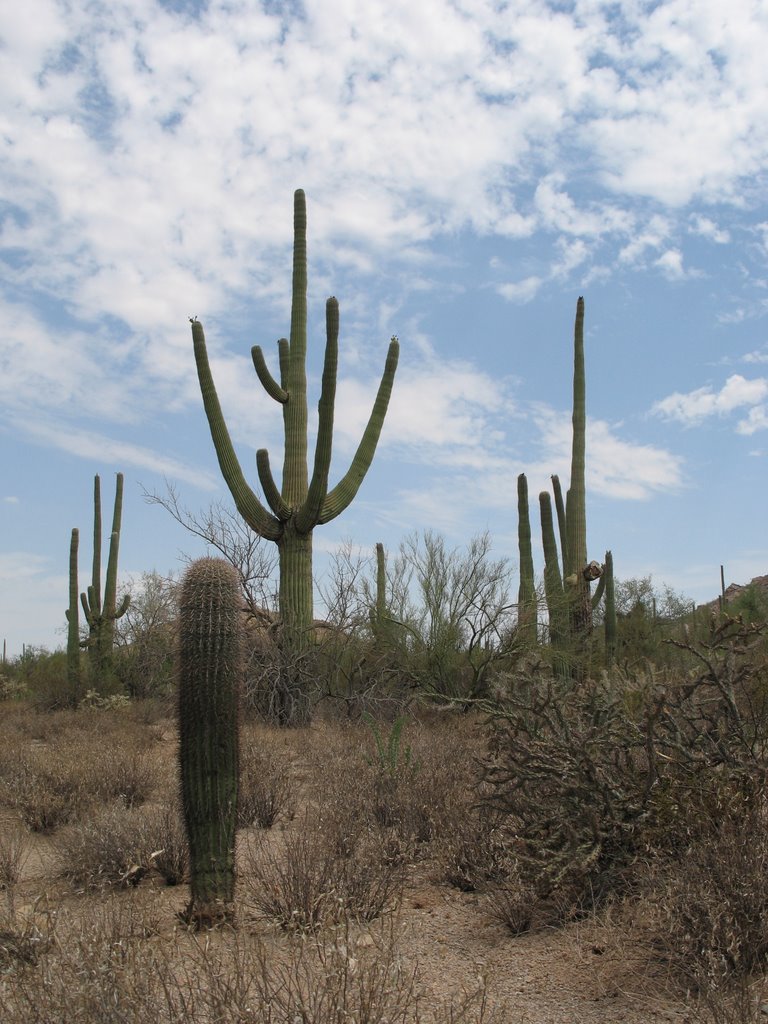
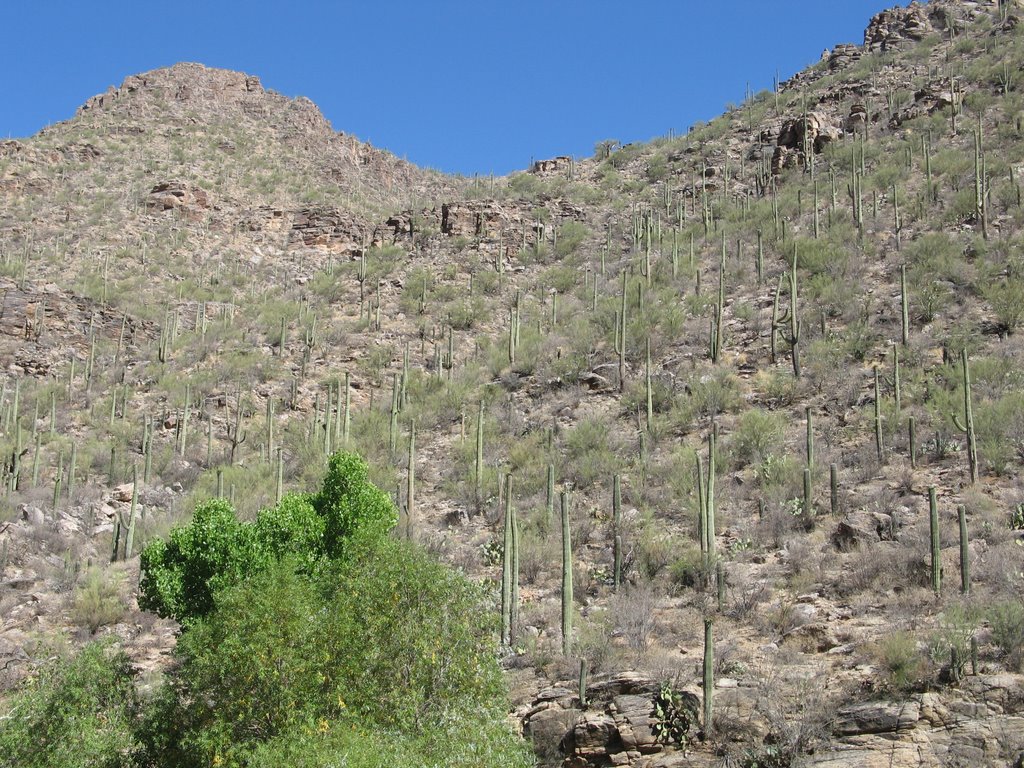
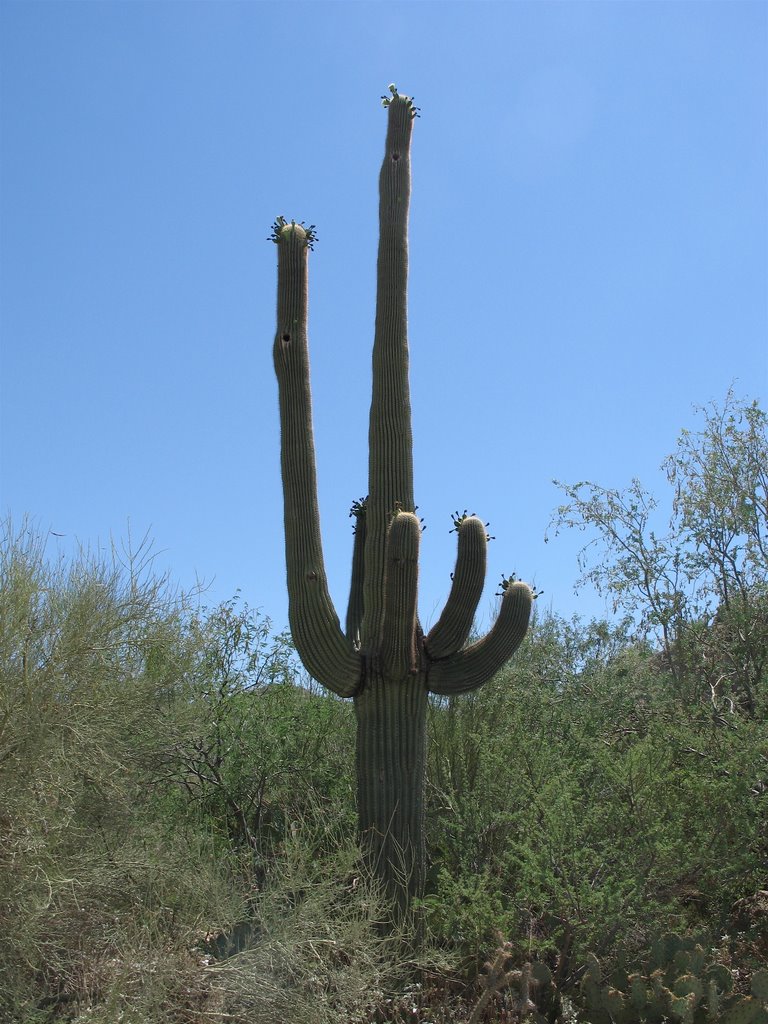
On 4th July we headed over Gate’s Pass to Saguaro National Park West, home of the cactus of the same name and one of the few places in the USA it grows. The well-appointed visitor’s centre only had about 4 groups in attendance. We were encouraged to watch a slide show about the Native Americans’ attachment to the desert which turned out to be quite interesting. The final slide was followed by the screen rising and the curtains opening across a huge glass window looking out over the Sonoran Desert outside. Very spectacular!
The Saguaro cactus flower is a great source of sugar. Collected, boiled down and filtered, a thick red syrup is made. 15kg of flowers will make around 4L.
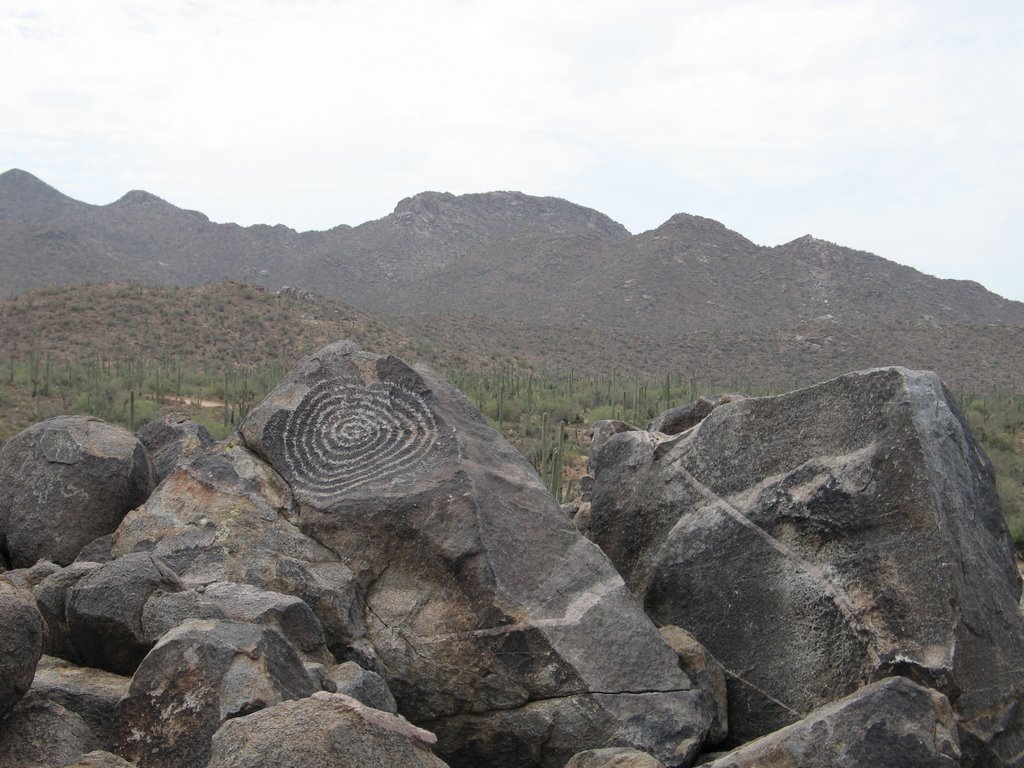
We did the nature walk through some huge cactus plus scurrying wildlife and then drove up a one way dusty track through marvelous desert scenery to Signal Hill. Here the Hohokam (the vanished ones) had left petroglyphs on a very rocky outcrop some thousand years or more ago.
The sign at the beginning of the track warned us of prickly cactus, rattlesnakes, scorpions and Gila monsters and not to put our hands or feet under rocks or hidden places and to look before you step. At the base of the hill another sign said “Rattlesnake Area”. I think they were trying to tell us something. But we soldiered on to the top and it was worth the climb. There were a huge variety of ancient pecked ‘signs” on the rocks. For obvious reasons we didn’t pull up a rock and sit down.

The word is rattlesnakes are active in the cool of the morning and evening and that they “hide” in rock crevices during the heat of the day. The diamond back can grow up to 2m and is very aggressive. So despite the fact they may be hiding you don’t want to disturb one.
Then it was more dusty track and more wonderful desert until we hit the main road. And all this is within 30 minutes of Tucson.
http://www.nps.gov/sagu/

Wednesday, June 28, 2006

Around and About Tucson

Here are the results of our first few weeks’ travels around the Tucson area.
‘A’ Mountain or Sentinel Peak is just a few minutes out of town. The original name of this hill was derived from its function as a lookout point for the Spanish. In 1915, fans of the University of Arizona football team whitewashed a large "A" on its side to celebrate a victory, and the tradition has been kept up ever since. The permanent "A" is now red, white, and blue. The peak is a great place to get an overview of the town's layout as well as have a look at the surrounding desert and mountain ranges.

Sabino Canyon lies at the foot of the Santa Catalina Mountains and the entrance is now basically integrated into the north eastern suburbs of Tucson. A sealed road runs six kilometers into the canyon, crossing 9 stone bridges over Sabino Creek. The creek begins 1800m above the desert floor, in the pine forest that shades the slopes of Mt. Lemmon. It winds its way 16km through the mountain canyons before reaching the desert, where much of it eventually sinks into the ground, adding to Tucson's supply of groundwater.
The only motorized vehicles allowed on the road through the canyon are the shuttles which run every half hour, picking up and dropping off passengers at the nine stops along the way. This gives visitors great, if fleeting, views of the creek, the riparian vegetation, Saguaro cactus on the canyon walls and towering rock formations. It is a lot easier than walking, either up or down, in the heat although there were plenty doing just that when we were there. There were even joggers. At 43°C!

Archaic nomads used the canyon area for thousands of years and hunted small game. The earliest visitors were probably of the Clovis culture 12,500 years ago, and later, as the climate changed, the Cochise culture became dominant about 8,000 years ago.
About 1500 years ago, farmers of the Hohokam culture occupied the canyon but they mysteriously disappeared and were replaced by the Pima and Tohono O'odham Indians, who still inhabit the Tucson area today.
European settlement opened up the area further and the canyon was the scene of many conflicts with the indigenous population. A few attempts were made to dam the creek (hence the road) but the various plans were soon abandoned.
Sabino Creek flows 9 to 12 months of the year, making it unique in the Tucson area. The canyon has good examples of riparian and desert flora. Riparian areas have cottonwoods, willow, walnut, sycamore and ash trees. Foothill plants include Mesquite, Palo Verde, Brittlebush, Saguaro and many other cacti.

Animal life is abundant but not always highly visible. Many birds and other mammals have colors that blend into the landscape while other animals are nocturnal and avoid the extreme heat of the day by foraging for food at night. Some animals that are often found in the canyon are the ground squirrels and White-tailed Deer, Mountain Lion, Bobcat, Coyote, Fox, Cactus Wren, Roadrunners, Canyon Tree Frog and Red-spotted Gila Monsters and rattlesnakes. In fact, due to the incursion of the suburbs, mountain lion ‘incidents’ are on the increase. The canyon has been closed on many occasions due to ‘stalking’ and sadly the offending animals have had to be shot.
The visitors’ centre has worthwhile exhibits on the geology, history and biology of the area.
http://www.desertusa.com/azsabino/sabino.html
The Arizona Sonora Desert Museum is to the west of Tucson near the Saguaro National Park. It is a zoo, natural history museum and botanical garden wrapped up in one and covers about 10ha of Sonoran Desert. They exhibit more than 300 animal species including reptiles, mammals and birds as well as 1,200 kinds of naturally growing plants. There are almost 3km of hot dusty paths traversing the desert but there are shelters and iced water fountains (really!) along the routes. I was particular interested in the reptiles and other nasties and they didn’t disappoint with a large collection of rattlesnakes, other snakes, spiders and scorpions, all alive, but behind glass. There was also a nice collection of regional gems, minerals and fossils as well as a great collection of flowering desert plants.

Animals on display included mountain lions, black bears, deer, wolves, coyotes and javelinas. They well all housed under natural looking conditions and although I am not a fan of zoos this was one of the less cruel looking ones. There was also a walk in aviary, an exhibition of living butterflies, hummingbirds and bees. An underwater cave to watch fish, beavers and otters in their natural habitat was also well worth visiting. Anyone who says Australia is a dangerous place to live because of the wildlife should come here. I think we are way down the list!

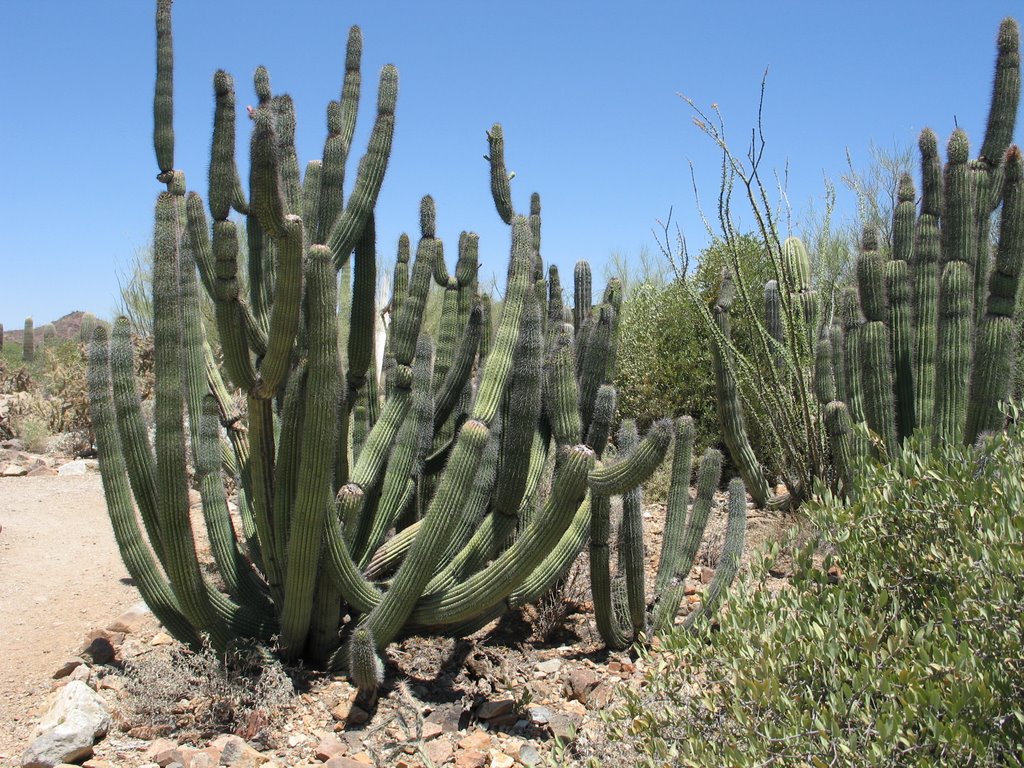
But I guess the highlight is the natural desert with its huge number of plants. I spent a few hours wandering (and sitting in the shade) looking at and reading about these. I especially like the cacti especially the saguaro. Needless to say there were plenty of photos taken.
There are four desert regions in the USA and the museum had set aside part of their area to horticulturally replicate the other three. It is surprising how different the vegetation is and it would be quite easy to know what area you are in by identifying one or two plants. They had also laid down a cactus garden, which supposedly contained every cactus and grass growing in the four regions. All in all a fascinating 3 hours!
http://www.desertmuseum.org/
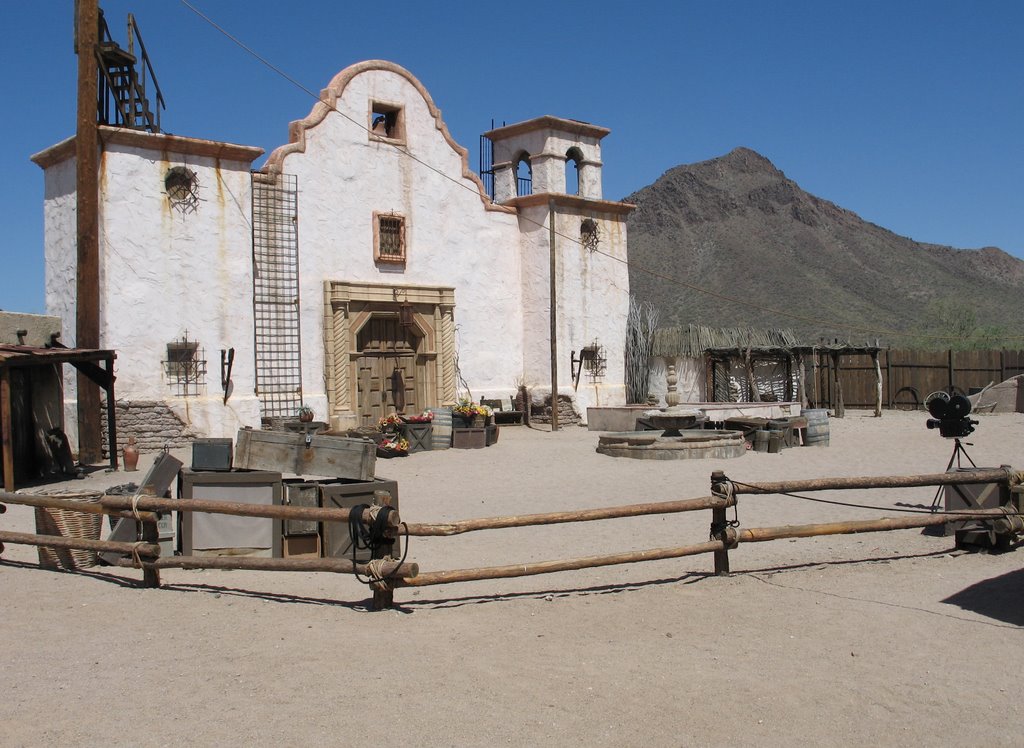
Old Tucson Studios are just down the road from the Desert Museum. They were originally built in 1939 for the movie ‘Arizona’ starring Jean Arthur. There was minimal usage until the 1940’s when ‘The Bells of St. Mary's’ starring Bing Crosby and Ingrid Bergman was made.
During the 1950's, such western classics as ‘Gunfight at the OK Corral’ with Burt Lancaster and Kirk Douglas, ‘The Lone Ranger’ and ‘The Lost City of Gold’ and ‘Cimarron’ (1959) with Glenn Ford were filmed.

John Wayne starred in four movies at Old Tucson Studios and each production added buildings to the town. ‘Rio Bravo’ added a saloon, bank building and doctor's office; from ‘McLintock!’ came the McLintock Hotel; ‘El Dorado’ left a facelift on Front Street; and from ‘Rio Lobo’ came a cantina, a granite lined creek, a jail and Phillip's ranch house.
Other movie productions during those early years include ‘Lilies of the Field’ starring Sidney Poitier, ‘Have Gun Will Travel’; ‘The Outrage’ and ‘Hombre’ with Paul Newman. TV episodes of ‘Bonanza’ and ‘High Chaparral’ were also made there.
In 1971-72 the studio hosted 15 film productions including ‘Dirty Dingus Magee’ with Frank Sinatra and ‘Joe Kidd’ starring Clint Eastwood. Paul Newman returned in ‘The Life and Times of Judge Roy Bean’. Other films during this period include ‘Death Wish’ starring Charles Bronson and ‘The Frisco Kid’ starring Gene Wilder and Harrison Ford, fresh from ‘Star Wars’.
From 1970 to 1980 Old Tucson Studios and its Mescal property hosted 77 film and television productions including, most notably ‘The Three Amigos’ and ‘Little House on the Prairie’, ‘Gunsmoke’, and ‘The Mark of Zorro ’.

The nineties brought ‘Tombstone’, ‘Lightning Jack’ (aaaaahhhhhh!!!!) and ‘The Quick and the Dead’.
All in all this is quite a CV
Unfortunately there was a devastating fire in 1995 and many historic film sets and relics including wardrobe were lost. But is was rebuilt and today the lot is more a theme park than a film set but it is still fun to do the “tour” with a Bill Collins clone who will tell you more than you ever wanted to know about every film made there. I will be watching for the bloopers from now on.
Much of the park was ‘shut down’ due to the season (the temperatures in the dusty streets were brutal). However there were a couple of corny saloon shows, a really good montage of classic western scenes (Westerns were really all the same but who cared) and a really realistic gunfight to finish the day. There was certainly enough going on to fill in three hours.
I decided to head home along Gates Pass Road which leads directly into Tucson rather than take the highway. This was a very spectacular narrow, windy road that snaked through some very beautiful Sonoran Desert countryside.
http://www.oldtucsonstudios.com/
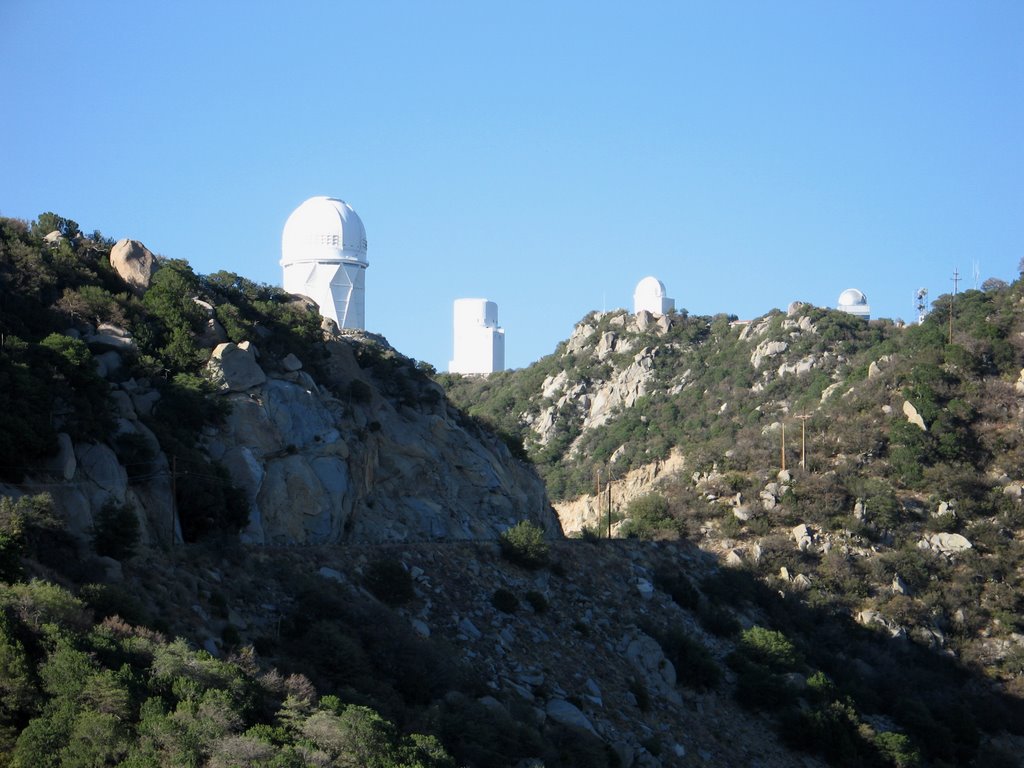
Kitt Peak is a sacred site on the Tohono O'odham Reservation about 90 minutes west of Tucson. The mountain rears just over 1500m out of the desert with a steep 19km climb to the top. The landscape changes as you climb with trees and thick bush taking over from the desert. The 360° view from the top across the desert and other mountain ranges is stunning. At the summit, sits the National Optical Astronomy Observatory, the largest optical observatory in the world with 25 optical and 2 radio telescopes.

One of particular interest is the McMath-Pierce Solar Telescope. This structure includes a tower nearly 33m in height from which a shaft, parallel to the earth’s axis, slants 60m to the ground. The shaft continues deep into the mountain, forming an underground tunnel where the sun is viewed at the prime focus. It is used mainly for the study of sunspots.
We were told to get there around an hour before sunset when we were we given a nice ‘box’ dinner that we ate outside in the cool evening air (yes, at 2150m above sea level it was finally cool) and got to know some of the other 30 participants. Following that, we were given a brief talk about the observatory, astronomy, the universe and our evening’s program.
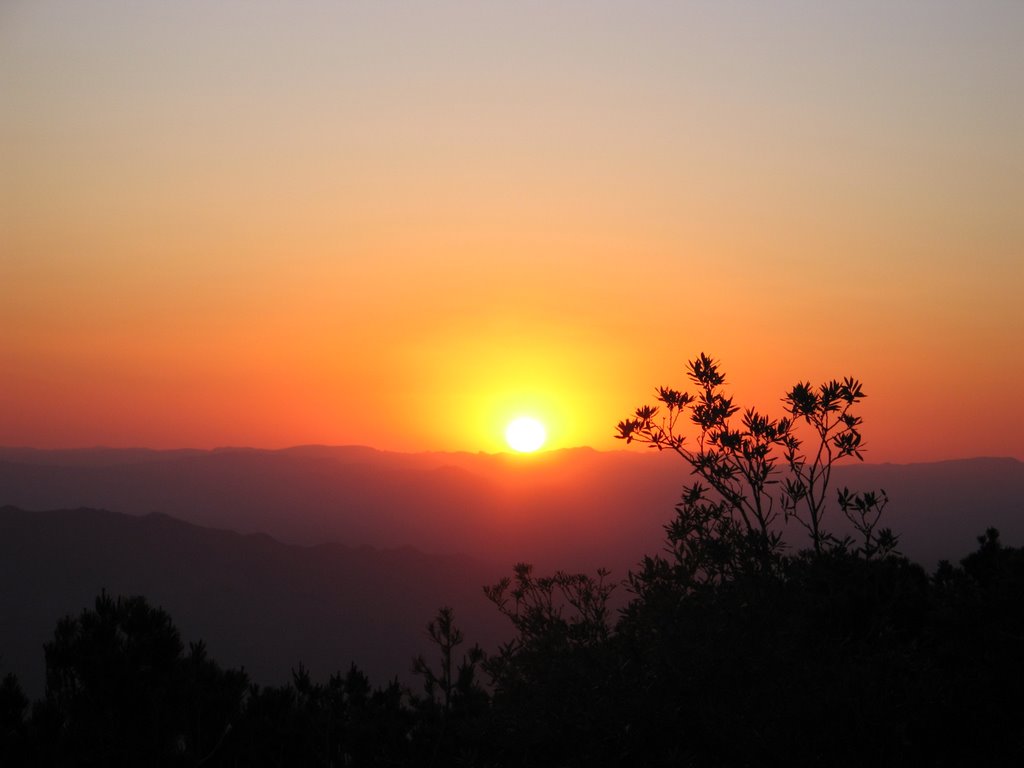
Then it was up to “sunset point” where we watched the most amazing sunset and predicted green flash. From there we were divided up into 3 groups and given powerful binoculars for an introductory ‘tour’ of the northern hemisphere heavens. They even predicted exactly when and where we would see a communications satellite traverse in a bright quick flash. Then it was up into the dome for a look through our computer controlled 0.4m optical telescope.

Our instructor was a professional astronomer, full of knowledge, enthusiasm and humor.
Among many things we looked at were Saturn with its rings and one of its moons, Titan, Mercury and Jupiter with the red spot clearly visible. Out of our solar system we saw, M104 (a spiral galaxy with 200 billion suns, 45 million light years away), M51 (a whirlpool galaxy at 38 million light years), M57 (the Ring Nebula, a remnant of a dead star about one light year across and 2,000 light years away) and finally Albireo consisting of two stars, one yellow, one blue that have formed a binary system 410 light years away.
At around 11pm we lined up our cars caravan style to be lead down part of the mountain by a guide, headlights off so as not interfere with the real scientific work that goes on there. This was a bit of a surreal experience seeing how pitch black the desert is but not at all as nerve racking as it sounds.
Kitt Peak is one of the great unsung tourist attractions of Tucson. Even if you don’t think you are interested in astronomy, you could not help being amazed at what you see and learn here. One thing that stood out was how insignificant us earthlings really are in the scheme of things.
http://www.noao.edu/outreach/nop/