Friday, June 22, 2012

2011 Bordeaux En Primeur

I don't buy much French wine. There is so much good Australian (and New Zealand) wine to try it's hardly  worthwhile struggling through the complicated Appellation d'origine Controlee (AOC) labeling to find a French one that may be OK and value for money. And usually the 'really good stuff' is very expensive.
But the strong Australian dollar has made imported wine a lot cheaper in the last year or so, so there has been much more on offer. We have seen French Sauvignon Blanc from the Touraine region of the Loire Valley for $15 in our supermarket. And under screw cap no less!
One of my wine contacts is offering 2011 Bordeaux En Primeur ie. wine made in late 2011 and still in the barrel. You pay half now and half just prior to delivery, a couple of years from now.
Here are a few examples with their tasting notes.

Chateau Margaux Premier Grand Cru Classe

Administrator Paul Pontallier is nearly embarrassed to explain the amazing success of the 2011 Chateau Margaux, a candidate for wine of the vintage. With the harvest occurring between September 5-20, it was the smallest crop in over twenty years as yields were cut significantly by the drought. The berries were tiny. Moreover, analytically, the 2011 has a higher level of concentration as well as tannins than the 2009. A blend of 86% Cabernet Sauvignon, 10% Merlot and the rest Petit Verdot and Cabernet Franc, only 38% of the harvest made it into the grand vin. The wine offers an inky/purple color, barely noticeable sweet tannin, and a beautiful nose of creme de cassis, spring flowers and lead pencil shavings backed up by fresh acids and good overall structure. This medium to full-bodied effort possesses tremendous personality and character. It rivals what they achieved in both 2010 and 2009, which is virtually impossible to contemplate given the quality of those two vintages.

Chateau Ausone St. Emillion Grand Cru Classe

Not surprisingly, Alain Vauthier’s 2011 Ausone is one of the greatest wines he has produced. I know this sounds impossible, but it is the reason why I spend so much time tasting and reflecting on what is in front of me. The 2011 could turn out to be better than his 2009 – sacre bleu! Probably the wine of the vintage, the 2011 exhibits a murky, inky, blue/purple color as well as an extraordinary nose of creme de cassis, plum sauce, crushed rocks (primarily chalk), acacia flowers and hints of graphite, truffles and damp forest floor. The riveting aromatics are followed by a wine that does not let the taster down in the mouth. Full-bodied with extraordinary purity, oozing richness and well-integrated velvety tannins, acidity, oak and alcohol, this is another superb achievement by Vauthier from this phenomenal site on the decomposed limestone hillsides of St.-Emilion. Possibly the longest-lived wine of the vintage, it should evolve for 30-40 years.

Chateau Lafite-Rothschild Pauillac 1er Cru

A blend of 80% Cabernet Sauvignon and 20% Merlot (harvested between September 3-21), the 2011 Lafite Rothschild came in at 12.6% natural alcohol (considerably lower than in 2010 and 2009). Exhibiting a deep ruby/purple color, lots of crushed rock, red and black currant, forest floor and underbrush characteristics, moderate tannin and medium body, it is built somewhat along the lines of the 1999 and 2001.

All sound very attractive.
And the prices?
Chateau Margaux Premier Grand Cru Classe: $1000 a bottle.
Chateau Ausone St. Emillion Grand Cru Classe: $1489 a bottle.
Chateau Lafite-Rothschild Pauillac 1er Cru: $1175 a bottle.
Sorry, but I don't think so!

Wednesday, June 20, 2012

The Hunter Valley Revisited

It was an early morning drive up to Sydney through some very heavy rain to drop the co driver off at the Sydney Quilt Show at the Darling Harbour Exhibition Centre.
Then I drove further north another ninety minutes to Umina on the Central Coast and Stirl's place.
We headed over to Patonga which is a small village near the mouth of the Hawkesbury River just before it empties into Broken Bay. There is a nice pub here overlooking the beach which serves an OK lunch and good beer.
The Hawkesbury is one of the major rivers of the coastal region of New South Wales. It and its tributaries virtually encircle the metropolitan region of Sydney and is dammed in many places to provide the city's water supply.


Later that evening, the co driver arrived by train and we settled down to a good dinner of roast lamb and vegetables and followed by strawberries and ice cream all washed down with some Knappstein Riesling and Bird in Hand Tempranillo.
After breakfast the next morning, we were on the road to the Hunter Valley, one of Australia's well known vineyard regions. We decided to take the Great Northern Road which follows the old convict road north instead of the Freeway. It's always a nice drive through some pretty farming land as well as some rugged sandstone gorges. Remnants of the convicts' work is still to be seen. Relics such as stone retaining walls, culverts, bridges and buttresses can still be seen along the entire length of the road, most hewn out of the sandstone by pick and shovel
Our first stop was at Wollombi for coffee.


The establishment of this township was directly connected with the construction and importance of the Great Northern Road. Wollombi is pretty small these days but has a number of 19th-century sandstone buildings and timber slab constructed cottages and sheds in a narrow valley junction containing Wollombi Brook and Congewai Creek.
From here it was onto Broke in the Broke Fordwich wine region of the Hunter and our destination for lunch, Margan Estate. This has long been a favourite winery of mine and I have bought much of their Semillon and Verdelho over the years.
We had a quick wine tasting, sampling a vertical tasting of their Semillons from 2011 to 2007.
Lunch was great. Seared tuna with piccalilli, buffalo mozzarella with beets, grilled barramundi, roast duck on lentils and a pepper risotto was accompanied by their Barbera.We finished off sharing a cheese plate.


From there we headed into the Pokolbin region of the Hunter. This is the main, best known and touristy area.
Our first stop was the Small Winemakers Centre which sells a selection of wine from makers too small (or not interested) to have their own cellar doors.
Here we picked up some Thomas Semillon which is always a good drop, even in not so good years.
During our travels around the vineyards it was obvious that a lot of grapes had not been picked this vintage due to the bad weather..
You could see a huge acreage of  mummified berries still hanging on the vines. That made me feel a little better about abandoning my crop this year.


Our final stop was McWilliams Mt. Pleasant. Our main aim here was to track down their Anne Semillon which, thanks to Stirl's contacts in the wine  industry, we had tasted some time ago and never been able to find commercially.
It lies, quality wise, between their well known 'Elizabeth' and the very expensive 'Lovedale' Semillons
There was a rumour that the 'Anne' was actually the overproduction of the 'Lovedale' under another label.
We tasted the two and the consensus was they are not the same wine although the reasonably priced 'Anne" is still a stunner.
Then it was time to head back to Umina. Winter days are short and the co driver who had now assumed driving duties due to our wine consumption, didn't want to tackle the freeway back south in the dark.
Saturday was the co driver's mall day (we don't have any around us) so Stirls and I enjoyed some time at the beach watching surfers carve up some pretty big waves from the warmth of a cafe at Avoca.
Sunday we hit the road home after a pleasant four days away.

Sunday, June 17, 2012

Autumn Colour

We don't get a lot of Autumn colour in Australia. Virtually none of our native trees are deciduous and are green all year round.
But people have planted exotics in their gardens including many deciduous trees. And of course various public parks and botanical gardens have many.
The previous owner of our property planted liquidambers (Liquidambar styraciflua) around the place.
This year they have been particularly colourful.
This rather tall example is on our western boundary and has evergreen natives on either side.


To the left is a silky oak (Grevillea robusta), the biggest of the Grevillea genus which runs to around 250 species. They vary in size from tiny alpine ground covers to this tree which can grow to 30m . This tree is covered in bright yellow toothbrush shaped flowers in spring which attract numerous species of honey eaters as well as parrots.
To the right is a Norfolk Island pine ( Araucaria hetereophylla). Coming from the small island which lies between Australia, New Zealand and New Caledonia, this is a popular tree along urban beach fronts, in parks and in large gardens. Araucaria is a small genus of about 18 species, three of which grow on the Australian mainland ie. the Hoop pine and the Bunya pine. The most famous member of this family is the recently discovered Wollemi Pine.
The rest are distributed around some pacific islands and South America.

Friday, June 08, 2012

Cattle Moving Day

We cut the herd almost in half today.
The bull, four bull calves and two cows went off to greener pastures.
The old cow was a bit hesitant to cooperate but we soon managed to get her loaded with the others.


The race and ramp that Stirls and I had worked so hard on repairing a few weeks ago held up under the strain and no one, human or animal, got injured so it was a successful day.
So we now have a more manageable number of cattle and with a shed full of good hay we are set for the winter.

Wednesday, June 06, 2012

Stormy Start to Winter

The weather bureau predicted that a famous (infamous?) winter south coast low pressure system was forming in the Southern Ocean and to expect damaging winds up to 110km/hr and 100mm rain overnight.
So we battened down the hatches.
Nothing! Overcast and calm the next morning.
But by the time we had driven into town for a few appointments all hell broke loose.
We had 12 hours of driving rain (55mm) and winds up to 106 km/hr!
The bureau got it right, just their timing was out.
At least our 'hanger' finally came down.....without any damage, thankfully.


The storm caused huge amounts of damage as it moved north through Wollongong and the metropolitan area of Sydney where it hit just on 5pm as people were leaving work.
Winds in Sydney were up to 130km/hr. This, together with the highest tide of the year, produced some pretty spectacular surf along the suburban beaches.
It even snowed up on the western slopes of the Great Divide a few hundred km from Sydney..
Further information and pictures here.
The chaos continued north to Newcastle hitting that area as the Australia v Scotland Rugby Test Match started. How they played in these atrocious conditions was beyond me. Unfortunately Scotland ended up getting over the line ahead of the Wallabies with an after the final bell penalty kick.
Hopefully this is not a sign of things to come, weather AND football wise.

Monday, June 04, 2012

Shoalhaven Coast Winter Wine Festival 2012

Every Queen's Birthday long weekend (this year 9-11th June), the Shoalhaven Coast Wine Region hosts the Winter Wine Festival
This year it will be the ninth.
There will be wine and cheese tastings, winery tours, winemakers’ dinners, market stalls, live entertainment, and it is usually a fun couple of days for the whole family.
Participants purchase a festival glass at the first winery they visit and then enjoy wine tastings at 13 wineries from Kiama to Durras and west to Kangaroo Valley.
At our end of the region, the three local wineries will be participating.
On the Saturday, Bawley Vale Estate will have live music in the vines followed by a Degustation Wine Festival Dinner at one of our local restaurants.
On Sunday they will be hosting a jazz band.
Home cooked soups and cheese plates are available both days.


Our friends at Fern Gully Winery will be presenting live music both days and be offering the usual yummy food.
The gourmet pies are my favourite. Either Atlantic salmon and prawns in creamy Chardonnay sauce or slow braised beef with bacon in Port sauce or roast mushroom in Shiraz sauce. Then there is G's homemade sweet potato, carrot and pumpkin soup with damper (camp oven bread).
At Cupitt’s Winery it will be a game of Petanque on the lawn, live music, winery tours and barrel tastings with the winemaker and local produce and homemade preserves on sale.There will also be a Cellar Door Art Exhibition.
Saturday dinner will feature a “Toast to Winter” wine pairing menu with their newly released wines.
On Sunday there is the famous convivial Long Table Lunch ‘Per Molto Tempo’ with live music and wine and cheese trivia with prizes.
It can be a pretty busy weekend for wine lovers.

Thursday, May 31, 2012

How Many Supermarkets Does a Town Need?

There was big excitement in town this week. There hasn't been such a buzz since our one and only set of traffic lights were installed many years ago.
A new shopping complex has opened incorporating a Woolworths supermarket and their liquor store plus a Country Target and ten other specialty shops. And the building has the town's first lifts and travelators!
 
 .


But how many supermarkets does a town of 10,000 people need?
Ok, the population trebles for a few weeks over the summer Christmas holidays and at Easter but hardly a sustainable market for five supermarkets you would think.
But obviously better brains than mine have nutted this all out.
We already have a Coles, an Aldi and two IGAs, not to mention a few smaller IGAs in outlying villages.
Woolworths have an Australian grocery market share of about 43% followed by Coles 37%, IGA 15% and Aldi 3%.
The new Woolies store is certainly bright, sparkly and was well patronized. A quick trip through their liquor store failed to find any bargains however.


Back at Coles, our normal food source, the car park was nearly empty as was the store.
Only one check out lane plus the self checkouts were open. Normally at that time of the day it's very busy. The check out chick said they had taken 'a big hit' since the new store opened but was sure that customers would return once the novelty wore off. We remained 'loyal' to take advantage of the substantial discount Coles were offering to make purchases over a certain amount on a weekly basis over a month. This was obviously their counter to the new store.


I like IGA stores. They are not large, have a friendly staff but their prices are way and above what you can get at Coles and now, I suspect, Woolworths. Their liquor store is marvelous (the manager is a wine buff) but prices are again prohibitive. It is much cheaper to order wine from suppliers on line.
We only use them for the 'forgotten items' when passing by.
Aldi is a German company and has the reputation for 'cheap'.
And they are!
The only problem as far as I am concerned is that they don't have brands you can recognize. Sure the vast majority of their products are Australian made, probably under contract by well known producers but am not willing to take the risk on the quality. They also sell liquor, some at ridiculous prices. A $3 white wine anyone?
The other downside is there is always a huge queue at the checkouts due to low staffing levels which is part of their cost savings. And they make you bag/box your own purchases. We only use them to get a supply of German goodies at Christmas time.


So it will be interesting to see how all this pans out.
When Coles moved into town, a lot of small local businesses like butchers, bakeries and fruit shops went to the wall.
The corporate line is that a lot of new employment will be created. But there is only so much patronage to go around. Surely job gains in one area will mean losses in another.
The other sleeping giant is Costco. They have opened up stores in the east coast capital cities and are seemingly doing well. But I think they are way too big for our town.
Stay tuned for further episodes of "Supermarket Wars".

Sunday, May 27, 2012

Life is Easy on the NSW South Coast

We have had two weeks of glorious weather but on Friday a cold change came through and we were buffeted by strong westerly winds for about 12 hours. No damage, no power outages and our 'hanger' (a big branch in a huge tree near the house torn off by a previous storm but caught in the branches) is still up there!
We have been walking around it for weeks, just in case,  and were sure it would come down this time but, no.
They call some gum trees (eucalyptus) in the country 'widow makers' because of their tendency to drop huge branches without warning, even on still days. Our tree is however a Radiata Pine.


Saturday dawned calm so we headed down the beach after breakfast for a sit in the sun and a read.
What a day!
Magic!
No one around apart from the seagulls.
Some of us, of course, succumbed to the peace, quiet and sunshine.
It was such a good experience, we repeated the whole thing today, Sunday.
And looking at the weather forecast, Monday looks good for another go.


Behind the beach car park, a row of houses is screened by native plants. This year the Banksias have been particularly flowerful.
This wind swept bush is in full flower which is typical for Autumn.


The huge flower spikes are stunning.
To me it looks like the "Giant Candles" cultivar which is a registered nursery plant found originally growing naturally in Brisbane and is mostly likely a hybrid cross between Banksia ericifolia and B. spinulosa.

Thursday, May 17, 2012

Another Date Day

The co driver had an early morning appointment in Nowra so we decided to make a day of it. The town, which is about an hour's drive to the north of us, is the main regional centre of our area and sits on the banks of the Shoalhaven River a few kilometers from where it empties into the ocean. The name means 'black cockatoo' in the local aboriginal language.
It has a population of around 100,000 so is considered by us to be the 'medium smoke' in comparison to Sydney which is 'the big smoke'. There are a number of industries operating there eg. a paper mill and a starch/ethanol plant. The naval air station HMAS Albatross is also located in the area.
There is a bit more choice for shopping and services than in our neck of the woods. So after the appointment was done we spent a bit of time at Spotlight (a fabric store) and the local library.
Then we headed  a bit further north to the little town of Berry for lunch.
Alexander Berry pioneered European settlement in this part of the Shoalhaven region in 1822. The locality was known as Broughton Creek from its beginning in 1825 as a private town and part of a large rural grant holding called Coolangatta. The name was changed to Berry in 1889, following the death of David Berry, Alexander's brother, to honour the Berry family.


Today it is mainly a tourist town full of cafes, antique shops and quirky goods stores although there is still a supermarket, bakery and a butcher to cater for the locals. It is the sort of place people come down to from Sydney for a day trip on weekends. They are currently discussing a controversial highway by pass which will make the town less hectic traffic wise.
We always have lunch at 'The Emporium' which is a deli cum cafe. The coffee is the best around and the sandwiches, salads and quiches are second to none.
I should also mention there is a quilt shop and a fabric shop in the vicinity. While the co driver was doing her thing there, I snuck down the road for a double cone at the ice creamery. Sorry Dr. M!
Then on the way home back through Nowra we stopped at the newish Fish and Meat Market on the recommendation of one of our neighbours.
Wow! A huge range of fresh fish, crustaceans and shell fish plus every cut of meat (beef, pork, lamb, chicken) known to man. This is now a 'must visit' when in that area or coming back from Sydney. We just have to remember to put an esky (cooler) in the car.
We bought some big tiger prawns and some fresh mussels which we opened on the BBQ that night and ate with a home made spicy tomato sauce.
And there are enough prawns left over for another 'go' tonight.

Monday, May 14, 2012

Toys for Boys

When I first bought our property over two decades ago I knew nothing about country life and farming.
My new neighbours were extremely helpful at getting me started, making all sorts of suggestions on how to do things and make life on the land a bit easier.
As it turned out they did have a bit of fun with me at the beginning with one even admitting, much later, sitting out on her verandah to watch me 'doing things' for a bit of entertainment.
One bit of advice was to buy a small tractor, a decent chain saw and a brushcutter as a minimum amount of equipment.
I have never got around to the former as I always felt that 10ha (25acres) was too small for a tractor, the cattle keep the grass down and in any case I could always get a contractor in to do slashing etc.
That is not to say I never, deep down, wanted one. A red Massey Ferguson has always been on my wish list. A red lawn tractor has been a substitute.

The latter two items have however proven indispensable.
Both were Husqvarnas and have been extremely reliable and have gone through a heap of work over the years.
The brushcutter survived its last service 12 months ago, just. The repairman said 'that was it' he could do no more and the next breakdown would be terminal.
So last week it spluttered its last and I was off to the Big Boys Store today for a new one.
Technology has sure gone ahead over the 20 years but prices have surprisingly not altered too much.
So I am now the proud owner of Husqvarna 535RX.
The co driver and I struggled a bit putting it together (some things never change) despite a pretty comprehensive operator's manual but it fired up first go and did a trial slash with ease.

Saturday, May 12, 2012

A Spectacular Visitor

The barque James Craig was built in Sunderland, England in 1874.
Originally named Clan Macleod, her maiden voyage was to Peru.
For 26 years she plied the trade routes of the world carrying general cargoes during which period she rounded Cape Horn 23 times.
In 1900 she was purchased by Mr J J Craig of Auckland and was used on trans-Tasman trade routes as a general cargo carrier.
In 1905 she was re-named James Craig and then a short six years later she was laid up because increasing competition from steam ships made sailing vessels uneconomical. She was then stripped and used as a copra hulk in New Guinea.
After the First World War there was an acute shortage of cargo ships. This gave James Craig a new lease of life after being towed from New Guinea to Sydney for re-fitting.
Her return to service was brief because in 1925 she was reduced to a coal hulk at Recherche Bay, Tasmania.


In 1932 she was abandoned and became beached after breaking her moorings in a storm. She remained beached until 1972 when volunteers from the Sydney Heritage Fleet re-floated her.
In 1973 she was towed to Hobart where temporary repairs were carried out. She was towed to Sydney in 1981 and restoration work commenced. The James Craig's restored hull was re-launched in February 1997.
And on a glorious summer day in February 2001, she hoisted all her 21 sails for the first time in nearly 80 years and is now fully operational
This week she is anchored in Jervis Bay just to the north of us and  is expected to be in the area until next Thursday, taking part in a training program with Australian Defence Force Academy cadets.
You don't get a better sight than a ship under full sail and this is one grand old lady.

Tuesday, May 08, 2012

'Roos in the Top Paddock

 
We have a small family (mob) of three wallabies who have taken up residence in our garden. 
The baby (the joey) was in its mother's pouch when they arrived but was 'kicked out' a few weeks later, seemingly weaned a month or so after that and has grown very quickly.
At first they were quite skittish but now realize we are of little danger to them and they go about their business little perturbed by our coming and going. 
That business is predominantly eating and lying in the sun asleep.
As the weeks pass we can get closer and closer to them without them wanting to dash off.
We won't be encouraging them to become tame or be feeding them but it's nice to have them around.
As long as they don't invite their relations they can stay.

Sunday, May 06, 2012

A Perfect Autumn Day

Warm (22deg), sunny and a high blue cloudless sky with just the hint of an off shore breeze.
Cool mornings and evenings now. We had our first fire last night.


The daughter sent the picture above from one of Sydney's southern beaches this morning.
The forecast looks good for the rest of the week too so shall hit the beach tomorrow.
But for now it's back to cleaning out the shed before settling down in front of the TV for this afternoon's Super Rugby match between the New Zealand Crusaders and the Queensland Reds.

Monday, April 30, 2012

An April 2012 Update

Autumn is usually a nice time of year, cool but not cold and plenty of sunshine.
But not this year, The 'big wet' has continued on from summer.
In fact, all of Australia is officially drought-free for the first time in more than a decade from today.
At least everything is growing well.
Good grass cover in the paddocks is still maintaining my 16 cattle. I will have to select 8 or so to go to market over the next month so I don't have the pressure of winter feeding. All the bulls except the smallest will definitely be on the truck as well as a couple of older cows. I know this is not very farmer like, but sometimes it's a difficult choice.
Pasture weeds, mainly native tussock, are being kept under control by a manual spray program. I need to attack the bracken too but with the powered sprayer. Will have to wait until things get dried on the creek flats before I can do that. Getting the machinery bogged is not a pleasant thought. The window of spray opportunity closes by the end of May as the plants 'shut down' for winter and don't absorb the chemical.
We have the best display of flowers ever in the garden. I know I have shown these off before but one of my father's hybrid hibiscus has been absolutely covered in luminous blooms this year.


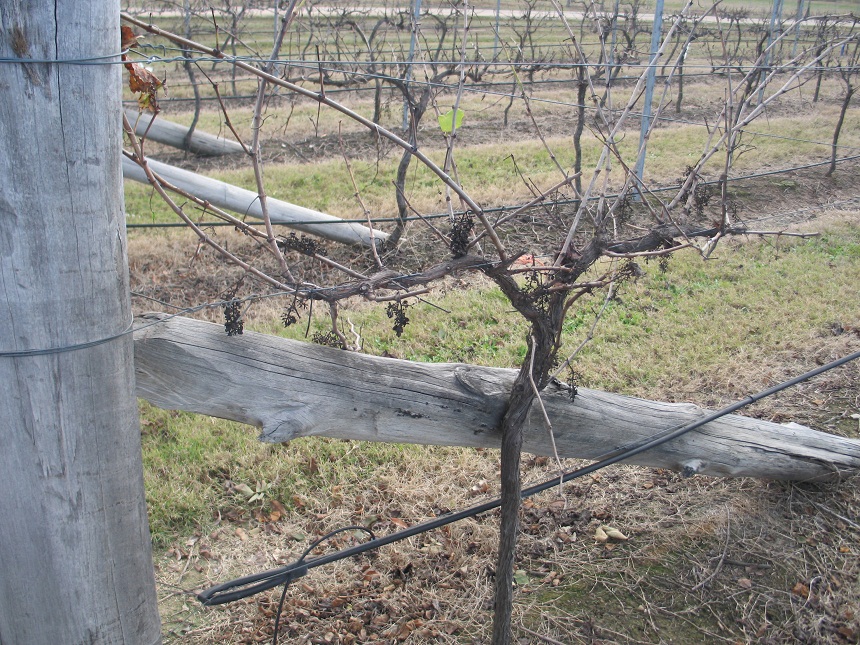
We decided not to pick the Cabernet Sauvignon this year. By the middle of April the bunches had begun to shrivel and the Baume reading was not much past 11.0. So no 2012 vintage at all from this little vineyard.
That's ok as we have plenty of wine left over from last year.
I watched a rural program on TV the other day and saw that many commercial vineyards and especially those with table grapes had had a bad year in New South Wales, many with severely reduced or abandoned crops, so don't feel so bad.
We will do some remedial work on the trellises this winter by increasing the height to allow better shoot (more leaves) growth.
Other than that, not much excitement in the neighbourhood.
The Kings Highway that winds its way over the mountains between us and Canberra (the Australian Capital) was cut again due to a big landslide. This was once a regular occurrence until they put in slip prevention measures but all the rain we have had caused another big one.
The road was closed for a week which has affected local businesses considerably as Canberra people are a major tourist group and it was Australian Capital Territory school holidays.
The alternative routes added another 3 to 4 hours to the usual 2 hours to the coast.
It took almost a week to clear the blockage.
And luckily no one was caught in the slide despite it being a busy road.


We are getting ready for all the winter chores. Stirling is heading south from the Central Coast to help us out.
Jobs include collecting and stacking fallen wood for burn off as a bushfire prevention task, cutting up firewood from decent fallen wood, repairing the cattle yards, race and ramp, cleaning out the stables for the winter hay delivery.
And then there is the continual job of fence repair. Why do trees always fall over fences and not the other way? Part of the butter side down of falling bread puzzle (although Mythbusters did 'bust' that myth)
Decommissioning the vegetable garden is also on the agenda. Yes, we have finally given up! Gail 'up the back' is supplying us with great salad, herbs and vegetables so we defer to her greater horticultural skills.
Stirls, I and the co driver may also indulge in a little good food and wine consumption during his visit.
It won't be too long until the vine pruning has to be done but I usually wait until late in the season to do that as it delays shooting and encourages the grapes to ripen a little later.
Busy days ahead.

Wednesday, April 25, 2012

ANZAC Day

Today commemorates the day back in 1915 during World War 1 when the Australian and New Zealand Army Corps landed on Gallipoli Peninsula, Turkey with other allied forces in a vain effort to capture the Dardanelles in order to keep open the supply route to the eastern front.
The campaign lasted 8 months before the allies were forced to withdraw leaving 25,000 Australian casualties.
But ANZAC Day goes beyond the anniversary of the landing on Gallipoli in 1915. It is the day when all Australians remember who served and died in all wars, conflicts and peacekeeping operations.
Ceremonies are held in cities, towns and villages across the nation. There are the traditional dawn services and wreath layings at the local war memorials. These are followed by parades later in the morning and veterans' reunions in the Returned Soldiers Clubs and pubs for the rest of the day.
Many Australians make the pilgrimage to Gallipoli for this day. There is a huge combined Allied/Turkish ceremony there at dawn which is telecast live back to Australia and New Zealand.
They shall grow not old, as we that are left grow old:
Age shall not weary them, nor the years condemn.
At the going down of the sun and in the morning,
We will remember them.
          Lest we forget

Thursday, April 19, 2012

Some Wine Talk

We drink a fair bit of wine, mostly with meals.
According to my doctor, who is 'on my case' about my cholesterol levels, maybe I drink too much. But that's another story.
The more regular of my readers will have noticed that I list our yearly tipples on the blog side bar with our one to five star rating.
Generally what we drink is rated three star which to us means an enjoyable fault free wine, showing varietal and regional characters which we would be pleased to buy again.
We occasionally have a two or four star with the former put on our 'not again' list and the latter on the 'yes, more please' list.
A five comes along very seldom.
A one star is usually a 'tipper' and goes down the sink after a mouthful or two. Thankfully there are not too many of those. I think there has been one minus 1 star which didn't warrant tasting. One sniff was enough for it to be disposed of.
It is a sad fact of life that four and particularly five star wines are more expensive than we normally budget for.
Our preferred price range is $12-$18 for whites and $15-$25 for reds. Occasionally we get access to some 'bargains' eg. three star $12 reds which is a bonus. Then again we have tasted some expensive (to us) wines that you wonder what all the fuss is about.
Lately we have been lucky enough to score a brace of fours and one five so I thought I might share some more details of those. They are all Australian wines so overseas readers might have some difficulty sourcing them if they were interested in a tasting.

Yering Station Yarra Valley Shiraz Viognier 2008

Shiraz is the most widely planted red grape variety in Australia (46% of total red).
It is sold as a straight varietal, a blend with other red grapes eg. Cabernet Sauvignon, Merlot, Grenache or a combination of those and, even more uniquely Australian, as a sparkling red wine.
Recently there has been a trend to blend Shiraz with a small amount (5%) of the white wine grape, Viognier.
This comes from the Cote Rotie Appellation of the northern Rhone Valley where it is customary to add a small proportion of Viognier to enhance the scent of their Syrah (Shiraz) wine.
Yering Station is a Yarra Valley winery who produces such a blend.
The 2008 is a classic young intense Shiraz Viognier, fragrantly perfumed with loads of dark fruits, spice, pepper, blackberry and violets.
The palate is intense with lots of flavour and fruit showing off the typical Shiraz Viognier characters and just the right amount of French oak. The finish is very long.
I am not really a Shiraz fan but this blend could make me a convert. I have ordered more.
Great with a big hunk of bar-b-q'd medium rare red meat.

Pikes 'The Merle' Clare Valley Riesling 2011

Riesling is a very under rated wine in Australia. I think the reason is the very sweet wines that were marketed under this 'label' for decades.
But Riesling styles have changed and wines from the best cool climate growing areas eg. Clare Valley, Eden Valley and Tasmania are fine, delicate. intensely fragrant and flavoured wines.
Hints of citrus, honeysuckle, blossoms, green apple and mineral are common. With their high acidity and low alcohol, the wines retain a freshness which many other varieties lack. Oak is never used.
Others from slightly warmer areas eg.Barossa, Padthaway and Coonawarra are full flavoured and fruity.
High quality, well structured Rieslings from the Clare and Eden Valley can have considerable longevity and can develop into appealing honeyed and toasty styles.
Pikes is a Clare Valley winery. I have been buying their 'Traditonale' Riesling and some clean skin Riesling from them since our visit there in 2010.
The daughter bought me a bottle of their top of the range "The Merle" for Christmas.
WOW!
Delicate citrus notes of lemon/lime/grapefruit with a hint of the regional slatiness evident on the nose. The palate was delicate, subtle and dry with vibrant lemon/lime flavours built around a slate/mineral acidity that provided length and texture to the wine.
I couldn't get on the phone quick enough to order some more (after consulting with my 'bank manager' of course!)
Goes with any seafood and especially shellfish.

Coldstream Hills Reserve Yarra Valley Pinot Noir 2010

Pinot Noir is regarded as the prince of red grapes and is the red wine of Burgundy as well as a component of Champagne.
But who can afford a Burgundy these days, even the Bourgogne or Village?
We have to go looking for other sources so our search concentrates on Australia and New Zealand.
Even then, it is very difficult to get a really good one at our budget level.
Good Pinot Noir depends on the clone chosen (there are many), climate (it likes cool), the terroir (soil type, slope, drainage, aspect) as well as skilful viticulture (yield control, bunch exposure) and wine making (harvest techniques, whole bunch inclusion, fermentation temperature, oak treatment).
"Getting it all right" costs money and that is passed onto the consumer.
Occasionally we break away from the one dimensional 'cheapies' and Coldstream Hills from the Yarra Valley is one that impressed.
The nose had ripe plum and cherry characters enhanced by gamey notes (missing in the 'cheapies') and a hint of aniseed.
Barrel fermentation has provided additional complexity to the wine.
The 2010 is medium bodied in style with the ripe fruit characters of plum, cherry and gamey notes, predicted by the nose, coming through on the palate and staying with great length together with the fine grained tannins.
The Coldstream Hills tasting notes say "Deep, rich and brooding, the wine demonstrates the power and finesse of Pinot Noir"
I cannot disagree.
Goes with roast lamb or baked salmon or by itself with some good cheese.

T'Gallant 'Grace' Pinot Grigio 2011

Pinot Grigio (Italy) or Pinot Gris (France) is said to be a white mutation of Pinot Noir.
In Australia, both names are used to differentiate between two wine styles produced from the same grape.
Grigio is used for the more austere, lighter, simpler Italian style, Gris for the more complex, full bodied and rich French style.
T'Gallant on the Mornington Peninsula was the the first winery in Australia to seriously pursue the potential of this grape and makes both styles.
I like the dry crispness of 'Grace' (maybe memories of long summer evenings in piazzas in Umbria).
The nose has a freshly cut apple aroma with a bit of lavender and nuts thrown in.
The palate continues with the apple and pears and even a slightly herbal undertone. The crisp acidity creates texture and length.
Great with pork or chicken dishes.

Margan Hunter Valley Semillon 2011


Some may think I have neglected New South Wales in this list but, no.
I grew up on Hunter Valley wines. Semillon is the signature white wine of the region.
It basically comes in three styles; young, aging and aged.
I am not a fan of the latter two but the aged is famous world wide. This variety can ' live' up to 20 plus years old increasing in complexity with a biscuity, malty, honey and toasty richness as it matures.
When young, Hunter Valley Semillon is zesty and bright with positive lemon / lime aromas and flavours, hints of honey and mineral, and a delicate racy acidity onto the finish.

It is seldom, if ever, wooded and is normally low in alcohol between 10.5% & 11.5% although some producers have increased that level with some success.
Margan make my style of Semillon. The 2011 is outstanding with a 12.5% alcohol giving the wine just that extra bit of body without overpowering the fruit.
This is one wine easily drunk by itself.

Tuesday, April 10, 2012

Easter 2012

The daughter arrived for an Easter long weekend visit early on Thursday morning after a 5:30am start from Sydney so she could beat the horrendous traffic that is a scourge at this time of year on most roads out of the city.
We went into town for lunch at her favourite vegetarian restaurant and pigged out on the usual stuff, the harvest burger always being her choice.
That night we had a combined co driver /daughter birthday dinner.
The daughter was a little intimidated at first by her present but soon warmed to it. Who wouldn't want two private surfing lessons from a previous women's world champion?
Fillet steak, potato casserole, and grilled tomatoes were on the menu. This was followed by the co driver's decadent home made chocolate cake. I got out some 'good' wine from the secret stash and we drank Pikes 'The Merle' 2011 Riesling and Coldstream Hills Reserve 2010 Pinot Noir.
Good Friday we headed down the beach. It was a perfect Autumn day, sunny and warm. The downside was the surf was huge and quite dangerous and the Easter holiday crowd were all over.
Then it was home to do some serious mowing. All the rain and warm weather had created a jungle around the house.
Needless to say with three Rugby matches plus a Friday night replay to watch, we had the evening all sewn up.
Saturday involved picking up hundreds of pine cones from under our Radiata pine tree. The black cockatoos descend on the tree this time of year to eat the unripe cones and don't have great table manners. They drop them willy nilly and they are hard on the feet if left lying around.
Then we stacked away our first firewood delivery of the season and headed down the beach for a walk.
Not a great day weather wise but it was nice to walk to one of our favourite headlands and sit and watch the surf roll in.

After handing out the chocolate on Easter Sunday, we had a quiet morning followed by the usual intense game of Scrabble.
Then it was back down to another beach for a long walk and a sit on the rocks. Four huge sea eagles hovered over us in the breeze searching for food. It was low tide so we did a bit of rock pool investigating. Came across one with not only the usual selection of crabs hiding in the crevices and shells gripping on tightly but also abalone, cunji and sea anemones
Roast lamb with roast veg (potato, carrot, pumpkin and beetroot) was on the menu for dinner.
Next morning dawned another perfect day.
High blue cloudless sky, sunshine, no wind and a temperature around 22 degrees.
After a pancake breakfast we headed down the beach.
The crowd had thinned out as many were already heading back to the city to avoid the inevitable highway traffic jams (reported as 10-15km long by the afternoon!).
The surf had dropped to a reasonable level and we had fun catching a few waves and just floating about during the lull in swells. The ocean was crystal clear and the temperature was relatively warm for this time of year.
Then it was home for lunch, another tense game of Scrabble, a sit in the sun and then dinner.
Up early the next morning, the daughter hit the road after brekky.
Our quiet life recommenced.

Sunday, April 01, 2012

Some Recent Reading

I first came across Victoria Bynum after reading State of Jones by Jenkins and Stauffer, a tale of armed unionist resistance in the Confederacy during the Civil War. During further research on that I found that Bynum, a history professor in Texas, had discovered that she had ancestors who had taken part in that resistance movement and had written The Free State of Jones. This was basically the same story as the former but the authors were in conflict as to the veracity of each others' facts.
I read the latter as well as her blog which was quite detailed in debunking the co written history.
I had, in the end, no doubt hers was the more authentic.

This book continues the story of opposition to the secession and the war from within. She tells of active unionism during the Civil War in the Quaker Belt of North Carolina, Piney Woods, Mississippi and Big Thicket, Texas. Many farming communities in the South where slavery was not of economic importance saw no reason to partake in a 'rich man's war, poor man's fight' or be convinced that secession was purely a noble effort to preserve state sovereignty.
And armed resistance was their solution.
Following the defeat of the South the book outlines how, during Reconstruction, the plantation class once again took control of the southern states, perpetuated the myth of the 'Lost Cause' and replaced slavery with segregation which continued into the twentieth century.
This is a more academic book than The Free State of Jones but is a very interesting social and economic history.

In May 1943, an Army Air Force bomber on a search and rescue mission crashed into the Pacific Ocean.
Among the three survivors was Louis Zamperini, champion long distance runner and Olympic athlete.
After over forty days drifting on a raft, fighting off thirst, hunger and sharks the two remaining are finally captured by the Japanese and imprisoned on a tropical island.
After being tortured and deprived of the most basic needs, they are sent to prisoner of war camps in Japan.
Here the maltreatment and humiliation continues up until the bombs are dropped on Hiroshima and Nagasaki.
But it doesn't stop there. It is also a story of post traumatic stress and revenge consuming a man and spiraling his life downwards until a meeting with a famous evangelist stops the descent.
This is a story of great strength, will power, bravery and the will to live.
It is a difficult read in many places with vivid descriptions of man's inhumanity to man.
The author has done considerable research into the plight of the Pacific Prisoners of War from all allied countries both during and after their internment and it is chilling stuff.
Well worth reading.

A biography of an American folk legend where the author attempts to separate the facts from the fiction of this man's life.
So what did Daniel Boone turn out to be?
Woodsman, explorer, hunter, failed businessman, surveyor, Indian fighter, Indian pacifist, reluctant politician, environmental vandal, family man.
A fascinating story of early American exploration of the west and the life of the men and women who suffered all sorts of hardships and dangers opening up an unknown country for those beginning to feel hemmed in by the Appalachian Mountains.
It is also an interesting story of how myths and legends are created and perpetuated.
A good, if rather long, read.

Another war time air crash saga but a lot different from the one above.
In 1945 a group of American military personnel based in Hollandia, Dutch New Guinea, were on what amounted to a joy flight in a C47. They were on their way to see a recently discovered 'lost valley' in rugged mountains where primitive natives threw spears and shot arrows at planes passing overhead.
The plane crashed into a mountainside, killing 21 people aboard. There were three survivors including one WAC.
The story surrounds the survival of these three among a tribe of stone aged cannibals, a squad of paratroopers sent into protect them, their interaction with the local people and an amazing rescue plan to get them all out.
This is a 'can't put it down' book.
I read it in two days and was sad it had to end!