Friday, February 25, 2022

Old Fashioned Milk

I am old enough to remember when milk was delivered by man on a horse drawn cart (like the baker and iceman) early in the morning who ladled out the required amount into a billy left out for that purpose.
Then later it was delivered in glass bottles with foil tops then cardboard containers and plastic bottles.
But a ‘milko’ (milkman) is virtually a thing of the past now.
The milk itself went from unhomogenised to fully homogenised.
And it was always pasteurised.


Raw milk, to my knowledge, has never been commercially available in Australia.
Even cheese made from raw milk, despite protests from some cheese makers, is not permitted. However I see the nearest thing to it advertised on the internet together with a web site for the Australian Raw Milk Movement.
But I have another relationship with milk.
A free milk scheme was first introduced into Queensland state (primary) schools in 1953.
The milk was supplied in one third of a pint bottles. Plain drinking straws were provided.
Inserting the straw into the bottle was challenging as it was almost impossible to open by normal means.
That’s where I came in.
Schools appointed so called ‘milk monitors’ who were provided with a metal spike to pierce the foil top and insert the straw. We were given 15 minutes grace from lessons just before ‘little lunch’ (morning tea) to do this.
It was a most sought after position, second only to ink well monitor which gave you even more class free time. Any misdeeds in class however could lead to dismissal from both positions.
The taste of the free school milk remains vividly in the memory of school children from this era. The milk was never refrigerated and, on a hot Queensland day, the taste it had acquired by 'little lunch' could be sickening. Enjoyment was not improved if you forgot to shake the bottle before consuming and got a mouthful of warm, sometimes lumpy cream. 
Some fortunate children brought flavouring to school to add to the milk to make it more palatable. I remember there were also straws with a flavour infused insert (chocolate and strawberry) that helped to kill the flavour of the souring milk. Later on it was found that many of these inserts contained carcinogenic material.
Parents had to give permission for their child's participation in the scheme which was limited to children under the age of thirteen at the time of application.
Thanks a lot, Mum!
Where was I going with all this?
Oh yes!


Our favourite bakery Lagom, just up the road, sells full cream (none of that 2% crap for me) unhomogenised milk from a dairy at Tilba to the south of us.
It tastes wonderfully creamy if you shake the bottle first to disperse the thick plug of cream that forms at the top. And it has a nice distinctive yellowish colour.
Great on cereal and in a cappuccino for breakfast.
Beats the mass factory produced supermarket stuff hands down.

Tuesday, February 22, 2022

New Car Review / 2022 Subaru Forester 2.5i

Our 2004 Subaru Forester had come to the end of its useful life.
With just under 300,000km on the clock and a leaking head gasket and radiator, it was time to bite the bullet and buy a new car.
We had had little problem over the 17 years probably due to regular servicing and the quality of Subaru build.
The clutch (yes, it was a manual) and water pump had been replaced at 200k when a new timing belt was due plus we had needed a new aircon compressor around two years ago.
Apart from 2 sets of new tyres that was about that. The spare tyre was still original equipment. We had never had a flat.
So what to buy next?
The choices, for us, were Kia Sportage, Mazda CX-5, Toyota RAV4 or another Forester.
We stuck with the Subaru due to its roominess, ease of getting in and out, good all round vision and our past experience.
We contacted a local dealer. With the new car shortages (Covid!) in Australia there were no deals.
That’s the price. Take it or leave it!
Delivery 3 to 4 months.


Surprisingly they offered us a trade-in, albeit minimal, on our old car. It was, for its age, in very good condition.
That saved us trying to get ‘rid’ of it privately.
So after a 3 month wait, we took delivery.
After 3 weeks what do we think?
Automotive engineering has come a long way in 17 years.
There are so many innovative bells and whistles on the new one it was hard initially to come to grips with it all. But we have set up what we think is essential  and will work on others as they come up.
The manual is 600 pages long plus there are additional manuals for the ‘eyesight’ and the infotainment systems. Brain explosion stuff.
The car is very comfortable, has easy access, is powerful enough and is quiet and ‘sits’ on the road and corners (AWD) well.


The auto stop/start was a bit disconcerting initially but we are used to that now.
Also nice to have an automatic. The CVT transmission is seamless.
So we are very happy.
Highly recommended.

Friday, February 18, 2022

COVID-19 / Australia / Final Update.

Most pandemic restrictions including density limits and QR codes will be scrapped in NSW from today.
NSW Premier Dominic Perrottet has announced a raft of measures would be eased 10 days earlier than expected.
From February 25, mask rules will be mandated only on public transport, planes and indoors at airports, hospitals, aged care, corrections facilities and indoor music festivals with more than 1000 people.
More details below.


As our state government (and that of Victoria) now considers the pandemic virtually over this will (hopefully) be my last ever Covid update.
But I have said that before.
Cases and deaths will obviously continue for some time but I guess it’s time to draw the line and get on with our lives.
We will continue to wear masks in public and avoid potential social spreading events where possible until the middle of the year to be on the safe side.
Below are the most recent Australian wide statistics covering the entire pandemic time line so far.


Update: 12th March


Latest Australia Wide Statistics.
  • 26,063 new reported cases: 8911 in NSW, 5499 in Victoria, 3797 in Queensland, 4037 in Western Australia, 2099 in South Australia, 923 in Tasmania, 599 in the ACT and 198 in the Northern Territory.
  • The national death toll is 5591 (+4): Victoria 2645 (+1), NSW 1981 (+1), Queensland 634 (+2), South Australia 222, ACT 37, NT 31, Tasmania 26 and WA 13. (Two Queensland residents who died in NSW have been included in the official tolls of both states).
  • There have been 55,149,115 vaccine doses administered in the national Covid-19 rollout up to Sunday, including 34,594 recorded in the previous 24 hours. Of that total, 34,764,919 have been administered by commonwealth facilities, an increase of 15,603 in the previous 24 hours.
  • State and territory facilities have administered 20,384,196 vaccines, an increase of 18,991 in the previous 24 hours.
  • 96.55% of people aged 16 and over have had at least one dose of a Coivd-19 vaccine and 94.75% are double vaccinated.
  • A total of 12,209,966 people have received more than two doses - with a booster or top-up shot - an increase of 14,145 in the previous 24 hours.

Monday, February 07, 2022

COVID-19 / Australia / 7th February Update


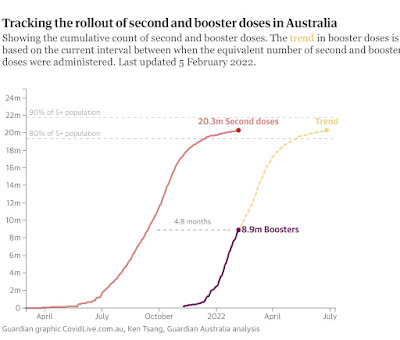
Vaccine Rollout
One of the biggest logistical exercises in Australia’s history, the delivery of coronavirus vaccines to more than 20 million people was slow to start due to supply issues and concerns around the AstraZeneca vaccine.
The government was initially hoping to have 4 million people vaccinated by March 2021 and the entire country inoculated by October. Since then, goals, targets and “horizons” have come and gone.
However, in December 2021 the country had vaccinated 90% of the population aged 16 and over, and begun the rollout of boosters.


Wednesday, January 26, 2022

Australia Day 2022

Today, Australian Day, commemorates the day in 1788 when the First Fleet sailed into Sydney Harbour (Port Jackson) to establish a British convict colony.
As the years have gone on, the actual date of celebration has become more controversial.
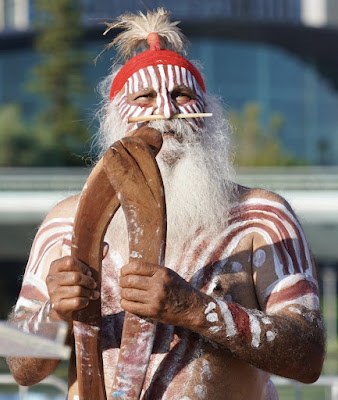
Most Indigenous Australians feel that it celebrates invasion and should be changed to a new date with a different name.
More and more non indigenous Australians are agreeing with them.
We haven’t taken part in any activities for decades and support the cause of the First Nations people.
But for now the status quo will be maintained. There is no political will to make a change.
As one prominent social commentator says “ God, the Australia Day “debate” is tedious. Around and around it goes, same-old-same-old every year.”

Tuesday, January 25, 2022

COVID-19 / Australia / Two Years On

Two years ago today the first case of Covid-19 was detected in Australia.
Back then it wasn’t called that yet.
We had heard about a scary-sounding virus circulating in Wuhan, as the news filtered through that the entire Chinese city was in lockdown.
By the end of that day, we would have our first case, a man in his 50s who had spent time in the city and flown back to Melbourne from Guangzhou six days beforehand.
Two years, 2.29  million cases and more than 3,200 deaths later, here we are.
Since “reopening,” mid December, the country, except for Western Australia which continued restrictions, has experienced a avalanche of cases.
Because case numbers are basically irrelevant now due to changes in test reporting ie. a combination of government PCR and self administered RAT, we have to rely on hospitalisation, ICU, ventilator and, unfortunately, death numbers to assess the current situation.


The number of people hospitalised with Covid-19 in New South Wales (NSW) has now reached an all-time high, dashing hope that those numbers were already on the decline following several hopeful days of numbers.
There are an additional 127 people in hospital with Covid-19 in NSW today, bringing the total to 2,943. However, there are now 183 people in the ICU, a decrease of 13.
Total deaths to date (Tdtd):1139
Victoria has also seen a jump in hospitalisation numbers, with 1,057 now in Covid wards, up from 998 yesterday. There are now 119 in ICU, which remains stable.
Tdtd: 1836
Queensland has confirmed 928 in hospital, 51 in ICU.
Tdtd: 129


In Tasmania, 35 people are in hospital, 3 requiring intensive care.
Tdtd: 16
There are now 67 people in hospital in the ACT, including 3 in the ICU.
Tdtd: 25
In South Australia there are 287 people being treated in hospital, including 32 in ICU and 5 requiring ventilation.
Tdtd: 74
In out state of NSW, the government  quickly saw that complete withdrawal of restrictions was folly after a week and reinstated some.
All too late it seems.
However they will extend current restrictions for another month as the state continues to take a ‘measured response’ (their words) to managing COVID-19 with a focus on a safe return to school and restarting non-elective surgery as soon as possible.
The restrictions rolled over include density limits of two square metres, wearing face masks indoors, no singing and dancing in hospitality.
To say it’s a mess is an understatement.
Experts are predicting a fall in cases next month as omicron runs its course.
We shall see.

Source: Guardian Australia

Monday, January 24, 2022

Wollemi Pine Update

Over the years I have posted about our Wollemi Pine, one in 2007 and the other in 2017.
This year, for the first time, it has flowered.
Because it is monoecious both male and female reproductive cones are on the same tree.
These cones appear at the end of branches, the female cone always growing above the male.


But it’s pretty obvious which is which.
During our bushfires the lower trunk received quite a scorching and it didn’t look well for a few months.


But with a little TLC it’s come back better than ever with luxurious growth emanating from the burnt area.
No wonder this species has survived 200 million years.

Saturday, January 08, 2022

COVID-19 / Australia/ 8th January Update

Officially 250,000 covid cases were reported in Australia since the beginning of the pandemic up until 19th December.
Restrictions were dropped in most states on or around 15th December.
16 days later we hit half a million cases!
More than 38% of those tested in the latest reporting period have returned positive results for the virus.
However official case numbers increasingly become less representative of state and territory’s infection rates after the national cabinet agreed to remove the requirement for PCR testing to reduce the pressure on testing stations and analysis laboratories.


Instead people were encouraged to use self antigen testing ie. if you could find a kit or afford the price gouged cost. Extreme shortages apply.
Yet another government failure!
There has been no way to register a positive rapid antigen test with health authorities, meaning those infections weren’t included in daily case numbers.
Now, well after the horse has bolted, positive antigen test results may be mandated via a government app like the state of Victoria has just introduced.
How this will be enforced is anyone’s guess.
But really, with the whole situation virtually out of control, the only figures that matter, to keep things in perspective, are hospitalisation, ICU and ventilator numbers.


Nothing positive can be said about the governments who have completely abandoned the health of the community in favour of the economy, especially after two years of sacrifice by the population in an effort to keep things under control.
At home, have finally had the first positive contact report in our valley in the 2 years.
Of course we are triple vaxed (not that that seems to be a 100% panacea against omicron) and are self isolating.
Experts are saying this ‘wave’ has two months to run.
We’ll see about that.

Saturday, January 01, 2022

2021 / The Year That Was

Normally at this time of year, I look back on our year as well as significant local and international events.
Last year I did a bit of a photo essay.
But this year?
Not much to report on a year dominated by Covid, other than maybe the attempted January 6th coup in the USA.


Restrictions and lock downs were the name of the game in Australia.
Our biggest trip was to Wollongong, two hours north, for me to have a nose operation (skin cancer) in day surgery. In and out within four hours.
But we milked it a bit staying 3 days, in a nice hotel, for some cafe and restaurant R&R.


Other than Covid there was a minor mouse plague for us which we got on top of quickly. Farmers out west weren’t so lucky. A knock on affect was levees collapsing during recent floods due to mice burrowing into the banks.
But generally we stayed home, went on a few local shopping expeditions, ordered a new car (not yet delivered due to serious supply situation) and got the property looking as best it’s looked for years involving weed eradication, fence repairs/renewals and a complete revamp of the cattle yards.
Now we are in the middle of a severe covid outbreak since the state government, supported by the Feds, decided a ‘let ‘er rip’ policy was in the best interest for the economy and business.
Screw the general population it seems!
So far that policy has somewhat backfired and ‘they’ are all running for cover, not accepting any responsibility and blaming others.


How this will end is anyone’s guess. Hopefully with around 95% of the 16+ population double vaxed and boosters readily available, it will not turn into a major health disaster.
So we head into 2022 with just as much apprehension as we did last year.
New Year’s wishes to all my readers and, above all, stay safe.

Wednesday, December 29, 2021

COVID-19 / Australia / 23rd & 29th December Update

In my blog of 14th December I predicted the removal of Covid transmission prevention regulations the next day was ‘not going to end well’ due to the emergence of the Omicron variant.
And so it came to pass all over the country to the exclusion of Western Australia where restrictions remained.
In our state of New South Wales, cases increased substantially. Today over 5000.
Roughly 80% of NSW Covid cases are now the Omicron variant with more than 70% in the 10 to 39 year old age group.


Testing facilities have been overwhelmed.
Hospitalisation and ICU numbers are trending upwards.
There is a increasing shortage of medical staff in hospitals.


However both the federal and the state governments held their ground on not reinstating even the most basic preventative measures eg. mask wearing and QR check in.
There was substantial disquiet within the population. The government’s mantra of  ‘personal responsibility’ when it came to public health was met with some disdain.
But today some sanity (a rare commodity in this government) prevailed and some restrictions were reintroduced. 
  • From midnight tonight, masks indoors will be mandatory until January 27.
  • Next year, rapid antigen tests will be provided for free, but how that will be rolled out is yet to be determined.
  • QR codes will be brought back in a limited way in low-risk settings.
  • People have been asked to work from home if they can.
  • The one person per two square metres rule in indoor hospitality will be reintroduced from 27 December to 27 January.
  • And people in the state are being asked that, unless they are feeling unwell or they have been specifically told to get a PCR test, don’t get one.
Too little too late?
We’ll just have to wait and see.
But for us it will be self isolating, again, until the end of January.
The farm gate is shut!
Update: 29th December.
The floodgates are well and truly open.
Today 11,201 cases. Hospital admissions increasing.
Cases are now being reported in our local area for the first time since the pandemic began.


Saturday, December 18, 2021

COVID-19 / Australia / 18th December Update

We capped off a week when ‘Covid Freedoms’ kicked in with a huge rise in cases in New South Wales and Victoria, jumps in Queensland and South Australia too, plus a fair bit of general anxiety about what the surge might mean and how much case numbers might grow.
Today’s Covid figure in New South Wales, 2482, is the highest daily total of any state in Australia since the pandemic began.
However with over 90% of the population vaccinated, the true test of the success of the state government’s ‘let her rip’ policy will come in one or two weeks time when the hospitalisation figures are released.
In past waves case numbers and hospitalisation numbers have been in step.
Theoretically this should not be the case this time around.
But it’s been noted that being fully vaccinated but without a booster lowers the resistance to the new variant, Omicron, considerably.


Tuesday, December 14, 2021

COVID-19 / Australia / ‘Freedom Day’ in NSW

As Covid cases in New South Wales continue to rise, the state government has committed to its plan to lift restrictions for unvaccinated residents from tomorrow.
Today, as NSW recorded 804 new cases, the government insisted it had considered all the options but was committed to easing restrictions on Wednesday in order to return the state “back to a full life of normality”.
From Wednesday, unvaccinated people will be allowed back in pubs, cafes, gyms and shops and mask mandates will be eased.
Health authorities are battling to contain an outbreak of the Omicron variant, with a total of 85 cases now confirmed in the state.
From 15th December the following rules apply to everyone regardless of vaccination status: 
  • Masks will only be required on public transport and planes, at airports, and for indoors front-of-house hospitality staff not fully vaccinated
  • QR check-ins only required for hospitals, aged and disability care facilities, gyms, places of worship, funerals or memorial services, personal services, pubs, small bars, registered clubs, nightclubs, strip clubs, sex on premises, and indoor music festivals with over 1000 people
  • No person limit in gyms, indoor recreation and sporting facilities
  • Non-critical retail reopens to all.
  • No person limit for personal services including hairdressers, spas, beauty and nail salons, tattoo and massage parlours.
  • Employers allow staff to work from home at their discretion
  • International travellers who are not fully vaccinated still need to quarantine on arrival for 14 days.
  • No limit to number of visitors in your home.
  • No limit to number of people for outdoor public gatherings.
  • All visitors to residents in aged care facilities and disability homes permitted in line with their policies
  • No person limit in hospitality venues.
  • Singing and dancing is permitted indoors and outdoors for all
  • Travel between Greater Sydney and regional NSW permitted for all
  • Carpooling permitted for all
  • Caravan parks and camping grounds open for all 
  • No person limit for major recreation facilities like stadiums, theme parks and race courses
  • No person limit for entertainment facilities like cinemas and theatres
  • No person limit for information and education facilities like art galleries, museums and libraries
  • No person limit for outdoor public gatherings and recreation
  • Music festivals reopen with 20,000 person limit
  • Amusement centres and play centres open to all
  • Weddings and funerals permitted with no person limit, eating and drinking allowed while standing and dancing permitted for all.
  • Singing and dancing indoors permitted by all.
  • Places of worship open to all.
This is not going to end well, I fear.

Thursday, December 09, 2021

COVID-19 / Australia / 9th December Update

Case numbers are still high and likely to increase with the emergence of the Omicron variant.
However the high vaccination rate is seemingly protecting people the more serious affects of the virus.
Hospitalisations and deaths continue however but at a much lower rate.
Vaccines are now approved for 5-11yo.
Third shot ‘boosters’ are available for the entire population.
The very strict restrictions will virtually all be gone on 15th December. 
The international border is open again but with some restrictions.
You would like to think “it’s all over” but it’s not.


Wednesday, December 01, 2021

La Niña Is Here / 1st December Update

Australia’s Bureau of Meteorology (BOM) has declared a La Niña weather event is under way in the Pacific, bringing the country in line with other agencies and underscoring the prospect of a relatively cool, damp and stormy summer for much of the north and east.
As if we didn’t already know this!*
It’s been a very wet and cool spring so far.
So what is La Niña?
The atmosphere is full of giant circulations which transport, mix and disperse air and energy around the world.


One of these giant eddies is the Walker Circulation.
The Walker Circulation crosses the Pacific Ocean, rising in the west in the warm waters near Australia, pushing up and over the Pacific and descending near South America before racing back across the Pacific to form the trade winds.
La Niña is the term used to describe when the Walker Circulation is very strong.
The western Pacific is even warmer than usual, the trade winds are stronger and all this moist energetic air is pushed onto Australia.
La Niña is therefore typically associated with wetter than average conditions for northern and eastern Australia, particularly in winter, spring and early summer.
The current model outlooks suggest this La Niña will persist until the late southern hemisphere summer or early autumn 2022.
A full rundown on weather predictions from the BOM for the next 6 months is here.
Update: 1st December 
* NSW has recorded its wettest and coolest November ever with rainfall records spanning more than 100 years tumbling in parts of the state.
The Bureau of Meteorology said overall, the state recorded nearly three times the average November rainfall, breaking a previous record from 1917.

Sunday, November 21, 2021

Wine Closure ‘Wars’

Over the years on this blog I have discussed wine closures quite often ie. cork v screw caps.
Because of the high incidence wine spoilage problems associated with cork ie. ‘corking’ caused by TCA ( 2,4,6-trichloroanisole) contamination, the balance has always leant heavily towards screw caps.
Australia was one of the first countries to embrace this technology, first mainly with white wine, then with reds even including expensive top of the range.
It is estimated that around 90% of Australian wine utilizes screw caps.
Other wine producing regions in Europe and the USA were slow on the uptake, even dismissive.
But that has changed considerably over the years. Some imported wine eg. Italian, still use them. Very little French wine in the price bracket I buy in has cork.
Obviously this trend has hit the cork producing countries eg. Portugal, very hard.
And they are fighting back.
I became aware of this when the daughter living in the USA sent me a picture of a bottle of South African wine they were drinking which had a cork twist top closure.
I had never seen one before and did some research.
Obviously I am little behind the times.
The “Helix” cork was developed by the Portuguese cork giant Amorim and is “screw cork” or resealable cork. In practice, these corks are similar to the corks you might find in the top of a whisky bottle as they can be taken out and put back in repeatedly without much effort. But what makes the “Helix” unique is that the cork requires a special bottle with a threaded neck. Matching ridges in the cork allow it to be twisted back into the bottle for an airtight seal after opening. But the “Helix” innovation isn’t new. In fact, Sonoma’s Red Truck Wines became the first U.S. winery to start using the twistable cork way back in 2016. So its rarity in the market place may reflect the uptake of the technology.


Who would be clamouring for a screwcap-cork hybrid?
Probably the biggest argument in support of cork is that it’s supposedly better for aging wine.
However the AWRI (Australian Wine Research Institute) has not examined this specific issue over the longer term but anecdotal observations indicate that red wines develop in much the same manner when sealed with screw caps as they do when sealed with well-performing corks. There are numerous red wines from Australia and New Zealand from early 2000s vintages onwards sealed with screw caps, which invariably demonstrate that this is the case.
There is also the ritual of uncorking the bottle, and the “pop” heard as the cork is released. This was, in the past, considered parts of the wine experience.
The “Helix”does this too.
But is this still part of the wine experience?
I don’t think it is any more, in this part of world anyway.
But more importantly Amorim has achieved a major technological breakthrough to become the world’s first cork producer to deliver natural cork stoppers to winemakers with a non-detectable TCA guarantee*
Known as NDtech, the technology greatly enhances Amorim’s quality control measures by screening individual cork stoppers on the production line to eliminate the risk of corks contaminated with 2,4,6-trichloroanisole reaching winemakers.
Two of the world’s leading wine industry research facilities, Hochschule Geisenheim University and The Australian Wine Research Institute (AWRI) have been engaged to independently validate the performance of NDtech.
Australian wineries are among the first to be offered corks that have undergone NDtech screening.
Will this all mean a huge resurgence of the cork closure?
I doubt it.


* A non-detectable TCA guarantee means that if any TCA remains in a cork it is below the detection threshold of 0.5 nanograms/litre.

Thursday, November 18, 2021

Our Hydrangeas Are Not Blue

The hydrangeas outside the ‘little house’ (studio) were a mess.
Due to neglect by the resident horticulturalist, they had become tall and straggly. Under pressure from the co driver I gave them a real good haircut, almost a buzz cut, last autumn and this season they have come back bushy and flowering like crazy.
But how come the flowers are pink?
The pH of our soil is around 4.5 ie. acidic which means they should be the more desirable blue. 
Some are trying to be.
The pH scale ranges from 0 to 14. Acid soils have a pH of 6.5 or less. A pH of 7 is neutral. Alkaline soils have a pH of 7.5 or more.
Hydrangeas grow best in soil that has a pH of 5.2-5.5. The soil element that turns hydrangeas blue, is Aluminium. At low pH if Aluminium is in the soil it becomes soluble and more ‘available’ to plants even possibly to the point of being toxic.


Aluminium is typically present in ironstone rich soils and those in which the dominant clay mineral is kaolinite. Sandy soils like ours contain little aluminium so while being strongly acidic, there is little influence on turning the flower colour to blue.
Maybe we could add Aluminium sulphate to the soil but that seems a bit OTT when we are happy with the colour the flowers are.

Saturday, November 13, 2021

Another Annoying Weed / Fleabane

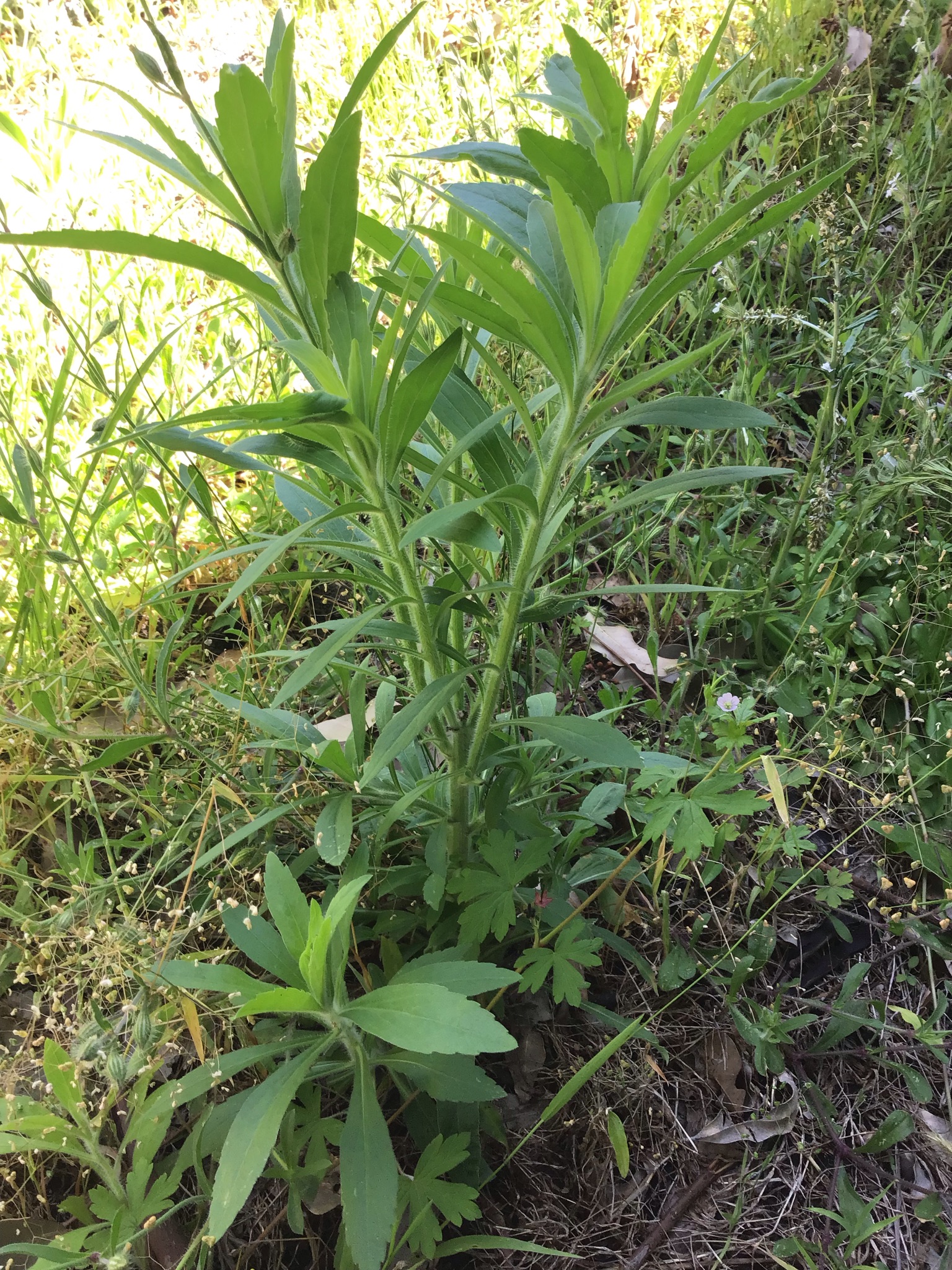
We have been inundated with a newish weed, fleabane (Conya spp).
Originally from America, fleabane is usually found invading disturbed sites, bushland edges and roadsides and can tolerate poorly drained areas. But it’s in our pasture and wooded bush land.
There are seven fleabane species naturalised in Australia
Among these species, flaxleaf fleabane, tall fleabane and Canadian fleabane are the three most common, with flax leaf predominant.
They are annual herbs growing up to 2 m in height which form a rosettes first and then erect stems.
Leaves are generally soft, hairy and coarsely toothed with a single stemmed flower stalk with flowering heads. 


Flower heads are fluffy and white around 1 cm wide and seeds are achenes (a hard dry fruit containing a single seed) approximately 5 mm long with a tuft of fine hairs.
Flowers appear in summer followed quickly by seeds which are dispersed by wind and water run off.
Suggested control measures are bagging seed heads and removing them from site and pulling smaller plants or digging out tap root.
Both these are impractical on large properties.


We have resorted to spot spraying with good old glyphosate despite confirmed resistance of the weed to this herbicide.
‘Our’ weeds succumb in two to three days.
This process is a little tedious but good exercise.
Fleabane will reshoot and germinate after fire so follow up is required where seed may have been left in the soil.
This has been the cause of our (and many other properties) problem, even two years after the fires.
Am sure we will have to do more than one pass to get them all.

Thursday, November 11, 2021

Australia / Severe Weather Warnings / Flooding

Virtually the whole country is today under weather warnings, many places for severe conditions and possible flooding.
It’s been raining here for a week and it looks like it may get worse.


We don’t need anymore rain thanks.
Temperatures for November have been very low also.
Most unusual.