We have two lemon trees growing in our yard, both survivors of the 2019/20 bushfires.
They have been growing here for the 30 years I’ve lived here. The life expectancy of lemon trees is a lot more than that, reportedly 50-100 years.
They fruit well some years, not so good others.
The crop is always subject to attack by white cockatoos which we try, mostly unsuccessfully, to scare away. But there are only so many lemons you can eat so during a bumper crop we share.
The trees are left alone which means they are subject to a few diseases, lemon scab being one, which causes the skins to thicken and become a little deformed. Doesn't however affect the juice in any way.
But this year we have had some very strangely shaped fruit, almost looking like co-joined twins.
We use electric fences in places where we want to contain our cattle eg. in and around our house paddocks or where we think there may be ‘escape routes’ into the bush. These have been powered by normal 12 volt car/boat or deep cell batteries. Obviously these need to be recharged from time to time. This is fine when you don’t have to carry them far. But one fence is quite remote from a charging point and at the bottom of a steep hill. For this reason I use a deep cell battery here as it lasts considerably longer than the others. Deep cell batteries are very heavy. Getting it back up the hill, even in a wheel barrow has become a chore. Because of the continual rain getting a vehicle down to the spot is impossible.
This particular fence keeps the cattle away from a possible creek crossing into the bush. It’s not as though the cattle would ‘try’ the fence every day. They have a good memory of being zapped and normally keep away. I have considered putting a permanent fence there but the terrain is difficult and the ‘escape’ factor only comes into play when the creek is extremely low which isn’t often these days. Plus the recent floods have made that part of the creek bank extremely steep which is also a deterrent. So I’ve invested in a solar charged electric fence energiser to do away with portable battery power. It was easy to install on a star picket and is facing due north and should be in full sunlight for most of the day. According to the blurb it should stay charging for up to 5 days of heavy cloud and takes three days to fully recharge its internal battery, if flat, in full sun.
Outside our boundary fence on the road verge is a strip of land the gets covered in tall grass and weeds.
It belongs to two of our neighbours but they think it belongs to us and we should look after it better ie. keep it neat and tidy.
Anyway about once a year, in autumn, I spray the entire area off with herbicide.
This year blackberry bushes were very evident amongst the tall grass. This is a declared noxious weed in Australia and, by law, land owners are required to keep it under control.
Normally I use glyphosate on this area but have noticed over the years the blackberry there may have become a little resistant. So this year I used a combination of glyphosate and Metsulfuron-methyl with some added wetting agent.
I have had a lot of successful with the latter on our property on both blackberry and bracken. It also works well on the difficult to control Tradescantia zebrina. It’s fairly slow acting so don’t expect to see any visible results for a few weeks. The grasses on the other hand should start to ‘yellow’ in around 10 days.
Then we’ll have a nice dead brown verge for the next 6 months or so or until spring when dormant seeds currently in the soil will begin the process all over again.
Update:12th May
Success with grasses and weeds.
Blackberry is ‘lingering’ but signs of senescence at the growing tips.
One Track for All is a 3km walking track on the northern headland of Ulladulla Harbour.
We decided to do an early post town cafe breakfast walk up there. It is a public area which has four lookouts providing spectacular views of the coastline as well as Ulladulla surrounds and harbour.
The track tells the story of the southern Shoalhaven Aboriginal and non-Aboriginal history from an Aboriginal perspective with carved signs along its length.
The track has been constructed in a way that, from a higher vantage point or from the air, the two halves appear as two large goannas, with four carved platforms for some of the best views of the Ulladulla Harbour. Unfortunately since our last visit some 13 years ago, many of the carvings have fallen into disrepair or were damaged by fire some time ago. However the views back across the harbour and the northern and southern coastlines are still worth the visit. A little research established that the local council is aware of the deteriorating ‘story telling’ signage is are trying to reconcile the situation with the artist. So far no success.
A few autumn wild flowers were starting to bloom. The environment changes from open forest to thick native bush land, mainly she-oaks (Casuarinas), in places forming long narrow vegetative tunnels.
It was a nice change from our beach walks. Apparently there is another bush walking track on the southern headland starting at the lighthouse. We will have to check that one out too.
A cucurbit vine started growing in our flower garden and headed skywards using our hibiscus plants as support. It’s obviously come from a random seed. Whether it’s a pumpkin, zucchini or cucumber who knows although I should know from the leaf shape. So far it’s only produced male flowers, no female fruiting ones.
Vines employ numerous climbing methods.
They can be divided into four basic types ; twiners, hookers, clingers and climbers. I think ours is a climber ie. it sends out tendrils that coil rapidly about a potential support upon contact. The plant’s growing tips are sensitized so that they are constantly "feeling around" for a host with a rotary motion. The tendrils produced by certain plants can be extremely sensitive.
Tendrils are slim, delicate outgrowths, produced in pairs from the leaves or stems. They move back and forth as they elongate with a motion caused by unequal growth rate on the two sides. Once contact is made, the tips form a tight coil about the support.
Plants’ growing characteristics are always very fascinating, to me, anyway. Will update if any fruit appear. Technical Notes Source: George Ellison, Nature Journal.
Update: 19th April
Fruit!
Looks like, from the markings, it could be a Kent pumpkin.
Update: 1st May
Sadly both fruits self aborted despite some human pollination intervention.
The co driver had become interested in kayaking. She purchased a relatively cheap inflatable which was good for a year or so. Then it started to develop leaks at the seams which, despite numerous efforts, were unrepairable. It seems that this is a major problem for this category of kayak if not the particular brand.
Time to look at a hard shell sit in kayak.
After much deliberation and a few trial paddles, she settled on a locally made Australis Platypus flat water touring kayak which is ideal for our coastal lake system. Luckily a local kayaker had one for sale with a rudder and he threw in an inflatable life jacket as a bonus. To transport it safely we needed to add a kayak cradle to our roof racks and a bow tie down.
Rhino-Rack had what we needed and the cradle kit came with easy to use tie down straps. The rubberised buckles to prevent vehicle damage were a great idea.
We also purchased a bonnet anchor strap to secure the bow with an additional strap. The kayak weighs 22kg (48.5lbs) so is difficult for one person to lift onto the racks. There are numerous YouTube videos offering advice on this problem. We finally settled on one method which the co driver can do alone.
With a bit of practice and tweaking, the loading problem should not eventually be one. Once the terrible wet weather that has plagued us for months is gone, it’ll be paddle time on lakes in Burrill, Conjola, Tabourie and maybe even Durras.
NASA had created a Climate Spiral showing monthly global temperature anomalies (changes from an average) between the years 1880 and 2021. Whites and blues indicate cooler temperatures, while oranges and reds show warmer temperatures. It can be seen global temperatures have warmed from mainly human activities as time has progressed. As a result of global warming, climate change has created scenarios where dangerous weather events have become more frequent or severe. This summer in eastern Australia, a severe weather event resulted in record flooding. This follows the disastrous drought and heat induced bushfires of 2019/20. However it seems the severe wet weather is not over yet.
The Bureau of Meteorology has urged residents in flood-prone areas to remain vigilant as an estimated 100mm is set to fall along the NSW coast, including Sydney, from late today (Wednesday) in a weather event that could lead to flash flooding.
More than 150mm of rain is predicted over the seven days until next Wednesday from about the Illawarra region (that’s us) to Moreton Island in Queensland.
Rivers and water catchments across the state’s east coast have not had enough time to dry out since the flood emergency at the start of the month, and therefore are at greater flood risk, even with a small amount of rain. The root zone soil map below shows how saturated the east coast is.
Meanwhile, the wet weather looks set to linger until later this year with trade winds still stronger than average in the western Pacific, delaying the weakening of the weather system.
Update: 30th March
And so the predictions have come to pass, but even worse than envisaged.
The Northern Rivers district only a few weeks ago devasted by floods, is having to cope with more. The town of Lismore is being evacuated again as waters top the levees.
We have no idea how much rain has fallen there as the weather station was destroyed in the last flood.
But nearby Ballina has recorded 300mm in the last 24 hours following 150mm the day before.
That’s around a total of 1400mm (55 inches) in the last two months.
And it continues to rain the entire east coast from Brisbane to the Victorian border.
We here have had more than our annual rainfall in 3 months ie. +1000mm or 39 inches.
It was time to visit the nation’s capital, Canberra, again after three and a half years, the last two of which were due to covid isolation. The mission was to ‘test’ a few electronic pianos. The co driver’s current one is old and has begun to play up (excuse the pun) and is non repairable. She had a number of potential brands/models on her list but due to a severe shortage of instruments in Australia and indeed world wide (again covid related), retailers have had little stock. But we got word some models on her list had arrived, so off we went in the new car’s first long journey over the mountains.
After only 30 minutes something new appeared. They are building a replacement bridge across the Clyde River at Nelligen!
Who knew? Not us.
The car performed well going up and over Clyde Mountain pass. There were plenty of roadworks on the way as the recent torrential rain had caused some damage. This meant delays so the trip turned into 3 hours all up.
Sadly the affects of the 2019/20 bushfires are still obvious. What was once thick verdant rain forest on the eastern escarpment is now patched with black and grey. Recovery is slow but happening however. Tree ferns were the first to regenerate.
The co driver spent time at Better Music, a very impressive business, discussing and test playing some pianos while I walked to outdoor sports store nearby to pick up some kayak rack accessories.
She appeared 90 minutes later with the news she had ordered a Kawai which will be delivered and installed in a few weeks.
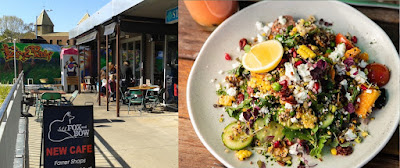
On the recommendation of the sales guy, we headed into suburban Canberra for lunch at Fox and Bow to celebrate. There were a few false turns getting there. Canberra can be a bit of a rabbit warren for outsiders.
We both enjoyed a Casablanca salad and good coffee. On the way home we stopped at historic Braidwood for a quilt shop visit.
The business has recently changed hands and the disorganised chaos and clutter of the previous owner has gone which impressed the co driver immensely. As per usual purchases were made. Then it was an uneventful drive down the mountain and home.
The bridge is held together by six million Australian-made hand-driven rivets supplied by the McPhersons company of Melbourne. My father was with this company his whole Australian working life. My mother was among the 300,000 crowd at the opening of the bridge in 1932 and said she witnessed Francis de Groot bolting up on a borrowed former racehorse and slashing the ribbon with his sword, declaring the Bridge open.
De Groot was a leading member of the New Guard, a right-wing militia group disenchanted with the Premier Jack Lang’s (a socialist) decision to open the Bridge himself, instead of the Governor who was the Queen’s representative.
Current connection with the bridge:
We live just a short drive away from the Moruyaquarry which was the source of the granite facing for the bridge pylons.
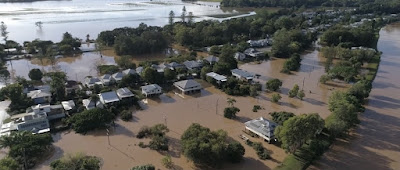
After flooding the capital of Queensland, Brisbane, the ‘rain bomb ‘ system moved slowly south towards Sydney, while dumping another huge amount of rain on the Northern Rivers district of New South Wales. Some places had their annual rainfall in 24 hours. One weather station recorded nearly 800mm (31inches). Murwillimbah on the Tweed River was inundated. The town of Lismore is situated on Wilsons River, a tributary of the Richmond, one of the three Northern Rivers. It has had flooding before. But this time it has been devastated.
Water rose in the town 2m (6ft ) above the previous record level to 14.5m (47.5ft). People were trapped in the houses the water rose so quickly and some had to get into their roof space and cut through the roof to await rescue. The flood waters moved south into the Richmond inundating towns like Woodburn and even Ballina at its mouth.
We were under a severe weather warning here but the system seemed to falter just north of Sydney and then turn inland. We got plenty of rain however, nearly 200mm (8 inches) over 3 days and our creek came up with the lower paddock flooding. But that was short lived as the coastal lake our creek runs into was opened up by the huge surf (5m/16ft waves) and the water quickly drained away. If I can hear the surf at our place, I know it’s big! But we got continual heavy showers for days after. Our total for this weather event was around 500mm (20 inches) Everything is very very soggy.
But thankfully we were spared the disaster those up north endured.
Western Sydney had bad floods as a result of the system with half a million people on evacuation orders. That area is on the flood plain of two major rivers and, despite them being dammed, torrential rain always causes problems. The dams were full this year and they had to release water for safety reasons, causing problems downstream.
We here have now had our annual rainfall in less than 6 months. This has been the wettest and coolest summer I can remember.
Experts are warning there will be a spike in funnel-web spider sightings across Sydney and environs as wet conditions create perfect conditions for them to thrive. Male funnel-web spiders leave their burrows in search of a mate and can sometimes end up in homes or gardens.
The wet weather over the past weeks is expected to bring an increase in the number of spiders wandering about. Their natural habitat is rainforests but private well-vegetated gardens also make a perfect home. Sydney funnel-webs prefer cool, damp places like the laundry, garage or shoes left on the ground. People are advised not to not leave washing and clothing on the floor and if shoes/boots are left outside it’s best to give them a tap before "putting your foot in blindly".
The Australian Reptile Park , just north of Sydney, is the sole supplier of the lifesaving antivenom and request anyone (very carefully) catching a spider to bring it to them for ‘milking’.
Since the introduction of the program, there has not been a single death due to a deadly funnel-web. They advise if you're to get bitten by a funnel-web spider, to stay as calm as possible and apply a pressure immobilisation bandage and get to hospital as quickly as possible.
On Wednesday 23rd February the Bureau of Meteorology warned that an area of low pressure over the south coast of Queensland was dragging in moisture from the Coral Sea to the north and then lifting it over the coastline. On Thursday large areas of south-east Queensland were placed under a warning for intense rainfall and thunderstorms that will cause flooding.
On Friday, the area of cooler air in the upper atmosphere drifts into the low pressure trough and starts to deliver record-breaking downpours over Brisbane and its surrounds. On Saturday torrential rain hovers over the Brisbane region feeding the city’s Wivenhoe Dam which is filling at an incredible rate. On Sunday Brisbane wakes up to major flooding.
There is a “rain bomb” over the city. Prime inner-city areas precinct are underwater. There are scenes of devastation in low-lying suburbs, along creeks, and in the river itself where pontoons break free and ferry terminals are littered with smashed boats and debris.
There are up to 15,000 homes flooded in the city, with 1,544 people in evacuation centres in the south-east. Trains are cancelled, bus services limited, the main Bruce Highway is closed at multiple locations and 51,000 people are without power. At least 3,600 homes are flooded in Gympie on the Mary River to the north.
Some 612mm of rain fell on the city between 9am Friday and 6pm Sunday – the highest three-day total in records dating back to 1840. The previous record was 600.4mm in 1974. But that’s not the end if it. As the weather system moves south, and Brisbane starts the clean up, there is devastation in northern NSW as Wilsons River rises two metres above previous flood records, inundating the town of Lismore. On Tuesday morning evacuation orders are issued for South Ballina. (To be continued)
Our normal fire wood supplier had no stock this year.
The fallout from the 19/20 bushfires is still with us causing shortages.
Demand is high as people like us had their stockpiles burnt plus potential sources on the ground from fallen trees and branches were also destroyed.
We did have a small stockpile made up of old partially burnt wooden posts and rails put aside during our post bush fire fence replacement phase but certainly not enough for this winter.
I have always noticed over the years a huge pile of firewood for sale at a local nursery near Milton called Gardenhaven.
Quality looked fair albeit a bit pricier than we are used to but there was little alternative.
Turns out it was at least 25% cheaper than in Sydney!
I ordered 6 cubic metres on a Saturday morning and it was delivered at lunchtime.
Top marks for service.
It was dumped in a pile in our backyard within a short wheelbarrowing distance of our woodshed.
There was obviously a lot of stacking to do.
I looked at that as part of a keep fit or rather getting back in shape campaign.
The co driver and I worked on stacking an hour (10 load target) or so a day in the relative cool of the morning.
A few days heavy rain kept us from our target but finally a week after delivery it was all put away.
There was very little useless residue and a small quantity usable kindling in the pile.
I am old enough to remember when milk was delivered by man on a horse drawn cart (like the baker and iceman) early in the morning who ladled out the required amount into a billy left out for that purpose. Then later it was delivered in glass bottles with foil tops then cardboard containers and plastic bottles. But a ‘milko’ (milkman) is virtually a thing of the past now. The milk itself went from unhomogenised to fully homogenised. And it was always pasteurised.
Raw milk, to my knowledge, has never been commercially available in Australia. Even cheese made from raw milk, despite protests from some cheese makers, is not permitted. However I see the nearest thing to it advertised on the internet together with a web site for the Australian Raw Milk Movement. But I have another relationship with milk. A free milk scheme was first introduced into Queensland state (primary) schools in 1953. The milk was supplied in one third of a pint bottles. Plain drinking straws were provided. Inserting the straw into the bottle was challenging as it was almost impossible to open by normal means. That’s where I came in. Schools appointed so called ‘milk monitors’ who were provided with a metal spike to pierce the foil top and insert the straw. We were given 15 minutes grace from lessons just before ‘little lunch’ (morning tea) to do this.
It was a most sought after position, second only to ink well monitor which gave you even more class free time. Any misdeeds in class however could lead to dismissal from both positions.
The taste of the free school milk remains vividly in the memory of school children from this era. The milk was never refrigerated and, on a hot Queensland day, the taste it had acquired by 'little lunch' could be sickening. Enjoyment was not improved if you forgot to shake the bottle before consuming and got a mouthful of warm, sometimes lumpy cream.
Some fortunate children brought flavouring to school to add to the milk to make it more palatable. I remember there were also straws with a flavour infused insert (chocolate and strawberry) that helped to kill the flavour of the souring milk. Later on it was found that many of these inserts contained carcinogenic material. Parents had to give permission for their child's participation in the scheme which was limited to children under the age of thirteen at the time of application. Thanks a lot, Mum! Where was I going with all this? Oh yes!
Our favourite bakery Lagom, just up the road, sells full cream (none of that 2% crap for me) unhomogenised milk from a dairy at Tilba to the south of us.
It tastes wonderfully creamy if you shake the bottle first to disperse the thick plug of cream that forms at the top. And it has a nice distinctive yellowish colour. Great on cereal and in a cappuccino for breakfast. Beats the mass factory produced supermarket stuff hands down.
Retired life on a small hobby farm and now removed vineyard on the south coast of New South Wales, Australia, is never dull. Share some of our day to day experiences at home as well as on trips away in Australia and around the world.
The blog is formatted for tablet devices.




.png)