Sunday, July 14, 2024
More Cattle Yard Renovations
Tuesday, June 18, 2024
War on the Arum Lily
Saturday, June 01, 2024
Batemans Bay / Sculptures for Clyde
The event includes outdoor and indoor sculpture exhibitions plus local high school student sculpture works.
The sculpture winning the acquisitive award will be permanently positioned in the Batemans Bay Sculpture Walk along the Clyde River foreshore.
Below is a preview.
More are available on this YouTube link.
Wednesday, May 29, 2024
20 Years of Blogging.
Friday, May 03, 2024
War on Weedy Sporobolus Grasses (WSG)
- Giant Parramatta Grass (Sporobolus fertilis) is long-lived grass usually growing 70–160 cm tall, but occasionally reaching up to 2 m in height. It forms large tussocks up to 40 cm across.
- It is native to the Indian sub-continent (India and Sri Lanka), eastern and south-eastern Asia (China, Japan, Korea, Taiwan, Myanmar, Indonesia, Malaysia, the Philippines and Papua New Guinea) and some islands in the western Pacific.
- It is a vigorous, persistent and invasive grass that is well adapted to a wide range of climatic conditions.
- GPG is a particularly serious problem in pastures in the wetter areas on the north coast of New South Wales, but has the potential to invade much of eastern Australia.
- It is of low palatability and significantly reduces the productivity and carrying capacity of pastures.
- GPG also invades native grasslands, open woodlands, conservation reserves and wetlands. It replaces native plants in these habitats and can eventually change the community structure of, and threaten the biodiversity of, native grasslands and rangelands
- The use of a pressurised wick wiper to selectively apply herbicide to Giant Parramatta Grass is probably the most useful tool in managing this species.
- Originally from Southern Africa, Parramatta Grass (Sporobolus africanus) is a tough perennial tussock grass that grows to a height of 50–70 cm and reproduces from seed.
- Occurs as a weed in moist areas such as degraded pasture, roadsides and waste areas.
- Occurs in all states and territories of Australia especially in coastal areas.
- Its presence can seriously reduce pasture production and is so tough it can loosen teeth of grazing animals.
- It may be controlled by cultivation and the use of herbicides.
However, on the north coast of New South Wales there appeared to be a native soil fungus, Nigrospora oryzae, that did.
![]() |
| SOIL Trooper logo |
Thursday, April 25, 2024
ANZAC Day 2024
Friday, April 05, 2024
Bridge Repair
Monday, March 11, 2024
Wine Cork Taint / Removal by Cling Wrap (Saran/Glad)
The term is short for cork-tainted, the chief culprit being a chemical chlorine compound called 2,4,6-trichloroanisole (TCA), although there are others.
TCA imparts an unpleasant, musty smell and taste.
It can infect cork through a number of pathways.
Cleaning chemicals and disinfectants used in a winery or cork forest are possible causes.
But it’s not always the cork that carries the TCA.
It can be in the staves of a barrel or even the timber in the winery.
A single, tainted barrel can ruin an entire batch if its contents are carelessly blended.
But rumour has it that cling wrap eg. Saran/Glad can come to the rescue.
The idea is that you put cling wrap in the wine by either pouring the wine into a jug and letting it soak with it for a while or push some cling wrap into the bottle.
Nope….doesn’t work!
The Australian Wine Research Institute’s senior oenologist, Adrian Coulter, confirms that cling wrap doesn’t remove cork taint and published scientific work backs this up.
Polythene or polyethylene (PE), the world’s most manufactured plastic, does, in fact, remove cork taint from wine, but it has to be 100 per cent pure, food-grade PE.
Cling wrap contains various polymers other than PE.
Pure food-grade PE can only be obtained from manufacturers and is not generally available to the average Joe.
The best insurance against wine taint is simply buy screw-capped bottles.
Friday, February 09, 2024
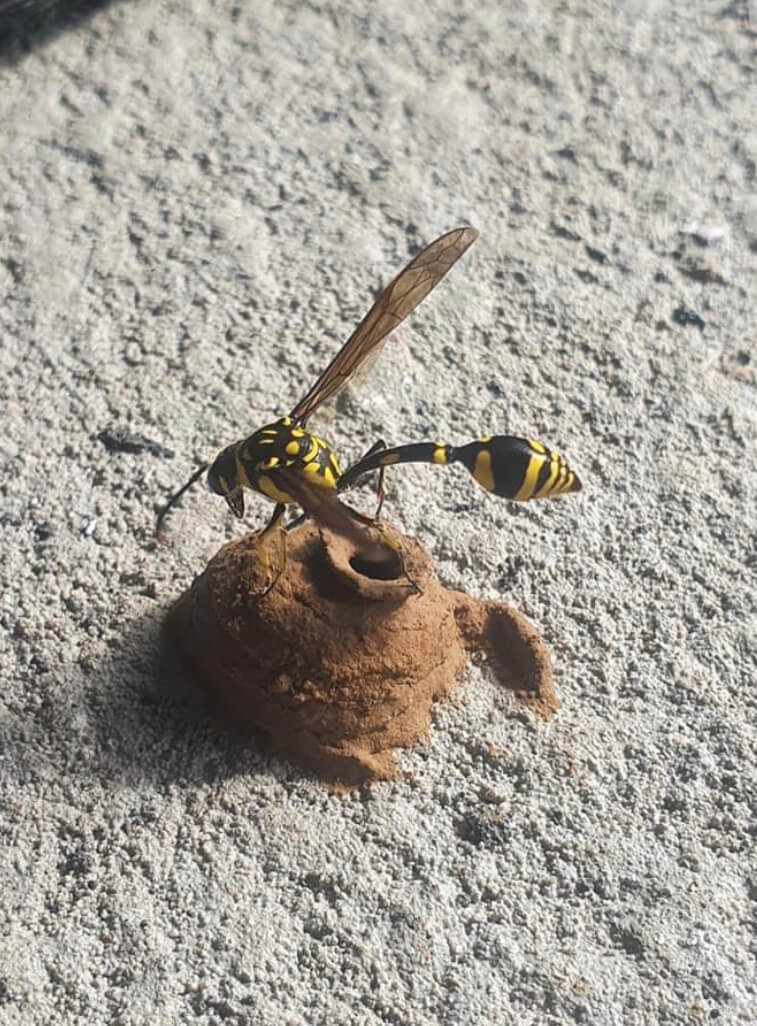
Mud Dauber Wasps and Air Conditioner Units
One of the most remarkable skills of mud dauber wasps is their nest-building ability.
Females carefully construct nests using mud, hence the name “mud dauber.” The nests are typically composed of several cylindrical chambers stacked together, with each chamber housing a single egg and a paralyzed prey item for the developing larva to feed on.
The daubers employ a unique technique where they gather mud from moist areas, which they mix with their saliva to create a pliable substance for constructing the nest.
As solitary insects, mud dauber wasps do not form colonies. However, it is not unusual to see multiple nests built by different individuals in close proximity to one another. Male mud daubers often establish territories near these nests, exhibiting territorial behavior to attract females for mating.
We have these nests all over our house, mainly on the brickwork. There’s no real reason to get rid of them. The wasps are not aggressive and they keep our insect population down.
The only problem we’ve had in the past is their building of nests in our air conditioning units’ drain hoses. Easily fixed by inserting fly screen wire.
A week or so ago, the outdoor unit of one of our split aircons started vibrating quite violently.
We call the service man who began taking it to pieces.
And what did he find?
The mud dauber wasps had made nests on the inside rear cavity of the plastic exhaust fan causing it to be unbalanced.
Who would have thought that?
He didn’t.
He’s used to snakes, rats and mice causing aircon problems in this area.
Anyway, all fixed.
For great service call Jake at Kings Point Air Conditioning Pty Ltd.
Wednesday, February 07, 2024
A Weekend Away / Sydney & Central Coast
There the co driver and I parted ways and I caught another train around 2 hours north to Woy Woy.
It’s scenic trip through rugged bushland and across the very wide Hawkesbury River.
Some of the stations on the way are very small. You have to be on a certain carriage of the train to get off. One was so small you had to go to the rear of the train and tell the guard you wanted to get off there. No one did…going or coming back.
My friend of 55 years was at the station waiting to pick me up and drive me to his relatively new town house.
I hadn’t been there before as he usually visits us.
That night we had a nice bbq steak and two bottles of very good wine over a few hours.
On Sunday after breakfast he took me to his favourite coffee shop and then we walked along the beach front. It was turning out to be a very hot humid day so we continued the ‘tour’ by car.
It was nice to revisit the area. Hadn’t been there for years. The view over Broken Bay from the lookout was pretty spectacular despite the heat haze.
Then a butterflied leg of lamb on the bbq with more good wine for dinner before a 50 over game of cricket between Australia and the West Indies on TV.
Next morning we had breakfast and another cafe coffee before he dropped me off at the station for my trip back to Sydney.
The co driver had a great time by all reports.
She said the Ludovico concert at the opera house was amazing.
She also attended the Banksy Exhibition at Sydney Town Hall and went to the Elvis Jukebox musical at the beautiful old heritage listed State Theatre.
I met up with her at Central Station and we had lunch at a small cafe nearby which I’d found on Google and which was excellent proving all the reviews correct.
Then we caught to train to Kiama connecting immediately with the motor rail back to Berry to pick up the car for the hour and a bit drive home. Video of return trip here.
A very pleasant long weekend but, as always, good to get home.