Cabernet Sauvignon is a 'late' variety of
Vitis vinifera.
This means it is one
of the last to shoot and last to ripen during a vintage.
For us bud burst is late September/early October and we usually harvest late March or even early
April.
We therefore run the gauntlet, in our coastal area with its warm
maritime climate, of possible wet late summer/early autumn months.
Too much rain means
juice dilution which means lower sugar levels which translates into lower
alcohol content of the resultant wine.
It also means the risk of fungus diseases eg. botrytis is significantly higher.
Picking these grapes too early leads to thin
uninteresting red wines with a distinct vegetative flavour so we always try to keep
the spray programme up to date and monitor potential bad weather events in an
effort to keep the grapes on the vines as long as possible to reach our 'sugar goal' of
13.5° Baume.
This vintage we had the driest, hottest summer on record. A little relief came in February with some welcome but not totally disastrous
rainfall.
March however was a completely different story.
366mm fell over
18 of the first 26 days (a third of our average annual rainfall!).
The berries within the
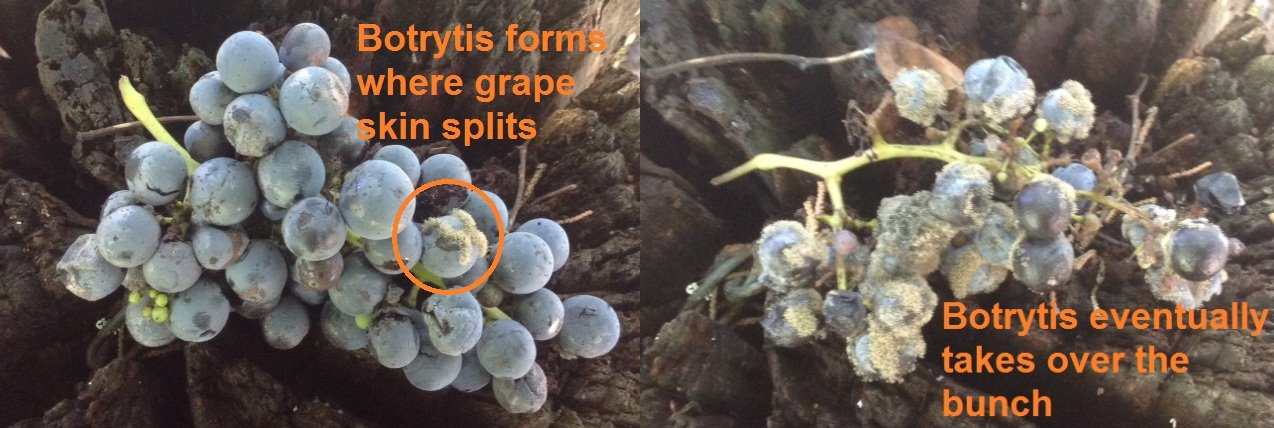
bunches swelled, split and burst and then shrivelled. Expressed juice is open invitation for
botrytis and there was quickly evidence of it.
What to do with vineyard tests showing only a Baume of 10° to 11°?
One path was just to leave to grapes on the vine and
forget harvest.
Another was to harvest early and 'fix' the sugar level and try to
make a Rose'.
Chaptalization is the process of adding white cane sugar to juice to
increase the Baume level.
This is a normal procedure in Europe when seasons
prevent grapes ripening to a satisfactory level.
The practice is banned in
Australia for commercial wines.
Increased sugar levels here can be achieved legally by adding
grape juice concentrate.
This is available in different grape varieties and
comes with a sugar level of around 35° Baume.
Unfortunately it comes in large containers and is
very expensive for us amateur non commercial wine makers.
Of course you can
make your own concentrate if you have the right equipment.
Grape juice can be
frozen and the ice formed removed (the juice is 80% water).
What remains is a
high sugar grape concentrate.
Another method is to boil the grape juice to remove the water.
So I made to decision to add sugar in an
effort to salvage a hard year's work in the vineyard knowing that the wine
produced could be of very inferior quality. Sugar ripeness of grapes is not the only
criteria for good wine. Less than optimally ripe grapes have other negative
influences.
Approximately 20g/L cane sugar will increase Baume by one
degree.
So we harvested very selectively discarding or leaving poor quality bunches
hang. This took place over two days as we were continually interrupted by rain. I estimate we would have been lucky to have taken off 50% of what was originally a large and high quality crop.
Then
we destemmed and crushed into an open fermenter and only then were able to accurately test the Baume
level. Vineyard testing almost always produces a higher result.
It was 10°
pH 3.6
So we needed to add 40g/L to get it up to 12.0° ie. potentially 12% alcohol, which is fine for the Rose' style. We decided to aim for a Spanish style rosado ie. crisp, a little fruity yet dry.
We immediately initiated fermentation by addition of white wine yeast and
DAP.
After a few hours maceration we were happy with the colour achieved so transferred the must to the press to drain the juice off the skins, stalks and seeds.
Here it was
very lightly pressed and the
resulting free run juice was transferred into a stainless steel tank. We didn't want a strong
colour, just what naturally came from the skins from those few hours of soaking, and definitely no tannin.
From then on the Rose' was treated
like a white wine.