Friday, July 04, 2008

The Cook Islands - Rarotonga

It was a cold winter's morning in Sydney when we headed to the airport for our 3 hour flight across the Tasman to Auckland. Then, after a one hour wait in transit, it was another four and half hours to Rarotonga in the Cook Islands. We arrived to balmy 26C at 10:30pm on the night before we left! Sometimes the international dateline thing can be very confusing. Immigration and customs formalities were quickly and smilingly dealt with at the small international airport and we were soon on our shuttle and heading for our hotel.
The 15 islands of the Cooks fall into two distinct groups scattered over two million square kilometers of the Pacific Ocean, roughly half way between Fiji and Tahiti.
Rarotonga is the capital and lies in the southern group as did our ultimate destination, Aitutaki.
Total population of the group is around 13,000 and declining. Some islands only have a very small number of inhabitants. I noticed in the phone book that Palmerston Island, population 60, only had two phones, both public. Tourism is the main industry with 80,000 visitors annually.

The country is uniquely Polynesian with an independant government in free association with New Zealand. This means that all Cook Islanders carry New Zealand passports and that country takes responsibilities of foreign affairs and defence.
Maori is the official langauge but English is commonly used.
The southern group consists of the volcanic Rarotonga and a number of raised reef, atoll and sand-cay islands. Rarotonga is about 32 km around and is fringed by an amazing lagoon which is protected from the huge Pacific swell by a coral reef. Within the lagoon are small unihabited islands called motus.

The island interior is very rugged with thick jungle and craggy volcanic mountains. It can be accessed only by walking tracks and to a limited extent by four wheel drive. There is quite an adventure tourism niche being developed for that area. The island has one main road which circles the narrow coastal plain. The main township is Avarua which is a thriving little place with lots of restuarants, cafes, jewellery stores (black pearl culture is a major industry) and tourist clothing shops and of course commercial and government buildings.

We arrived at our hotel, the Moana Sands, which sat right on the beach, around midnight. We could just see the waves breaking on the reef in the moonlight and it was great to hit the sack with the roar of the surf in our ears. We were anxious to see what daylight would bring us.
And below is the view from our balcony!

After breakfast we attempted a beach walk but strong winds thwarted our efforts so we headed back to the room for some reading and possibly some TV viewing on the nation's one channel.
The Cooks are a devoutly Christian community and Sunday is basically a closed day. Very few shops and restaurants are open and public transport runs on an extremely limited timetable early in the morning and late afternoon.
Luckily for us our hotel had one of the few restaurants open, the Pawpaw Patch, and they run a Sunday night BBQ which is very popular with residents and visitors. They offered grilled steak, sausages and fish with a huge range of salads as well as some good old fashioned desserts I have not seen since I was a kid. All this was washed down with a good New Zealand Sauvignon Blanc. Entertainment was an island string band who played some great stuff. It was also the first restaurant I had ever been to where they say grace before serving the meal. And it was here that K was introduced to Ika Mata. This is chunks of raw fish, usually tuna (but can be other) which is is marinated in lime juice, has onion, chilli (and sometimes cucumber and tomato) added and is served cold with coconut cream. This was to become one of her favourite starters during the trip.
We sat at a table with a young Californian couple on their honeymoon. He was a computer nerd (in the nicest way) and she was a nurse of Korean origin who had gone to the USA to study and never returned home. They had an interesting story to tell about conflict of cultures and the reaction of her family to her total change of life. Reminded us in a small way of another couple we were well acquainted with.
Next morning we were up bright and early and, after brekkie, we were on our way back to the airport to catch our flight to Aitutaki.

Friday, May 30, 2008

Semillon

The history of the Sémillon grape is difficult to establish. It is known that it first arrived in Australia in the early 1800's. It was once considered to be the most planted grape in the world, although this is no longer true
Sémillon is relatively easy to grow and has vigorous vines which can easily produce ten to fifteeen tonnes of grapes per hectare if not kept under control. The grape berries are thinned skinned, small, round to oval and greenish colored. It is fairly resistant to disease, except for rot. The grape ripens early in warmer climates. Due to the thin skin there is a risk of sunburn in hotter climates as well as splitting after heavy rain. It is best suited to areas with sunny days and cool nights.
Sémillon is one of only three approved white wine varieties in the Bordeaux region. The grape is also key to the production of sweet wines such as Sauterne
In Bordeaux it is blended with Sauvignon blanc and Muscadelle. When dry, it is referred to as Bordeaux blanc and is permitted to be made in the appellations of Pessac-Léognan, Graves, Entre-deux-mers and other less-renowned regions. In this form, Sémillon is generally a minor constituent in the blend.

However, when used to make the sweet white wines of Bordeaux (such as those from Sauternes, Barsac and Cérons) it is often the dominant variety. In such wines the vine is exposed to the "noble rot" or what may be called the "positive affect" of Botrytis cinerea which reduces the water content of the fruit, concentrating the sugar present in its pulp. In this case Botrytis cinerea causes the grapes to shrivel and the acid and sugar levels to intensify.
In Australia, Semillon is produced both as dry unwooded and wooded table wines and as botrytis affected "stickie" dessert wines. In the Hunter Valley of New South Wales, Semillon is made into an initially subdued unwooded wine of relatively low alcohol (10-11%). But with bottle age it developes into a full flavoured toasty honeyed wine which is a style unique to Australia.
This year we made our first 100% Semillon from our relatively young vines.
It has been in the tank now maturiung for 4 months and is just starting to develop the typical Semillon nose ie. grass/hay/apples. Alcohol level is around 10.5% and intially we were quite concerned at it's high acidity. But on storage there has been quite a precipitation of tartrate and TA has dropped and pH has increased. We will be ready to bottle in a month or so.


Monday, May 26, 2008

Moths

We have our fair share of moths that are attracted by our lights.
One of the most famous visitors is the bogong moth. Last year they arrived in their millions and our windows were covered for nights on end.
They have been known to completely shut down the electical circuts of multi storey buildings, shutting off air conditioning units and standing passengers in lifts. In our captital city, Canberra, it became necessary to turn off all public building and street lighting to prevent blackouts.
As larvae, the insects live in the soil across southern Queensland and the western plains of NSW. In spring the moths follow the Great Dividing Range, heading to the Snowy Mountains to avoid summer's heat. There they hibernate in caves, up to 17,000 every square metre.
Aborigines once visited the caves to collect the moths, which are rich in protein and fat.
According to one study, 100 grams of bogong moth abdomen has three times the fat, and almost twice the kilojoules, of a similar portion of a Big Mac.
On their southern trek westerly winds often blow the moths off course and over the mountains and into coastal areas. This is when we see them but thankfully not every year.
A few weeks ago we had another moth visitor I had not seen before. They were not in huge numbers but were the size of a small bird. They stayed a few nights and then disappeared.
For identification I sent off a picture to the moth guru at the University of Sydney who said it was Chelepteryx chalepteryx or the white stemmed wattle moth.

He was so impressed with my picture it is now on his web site.
It is considered a large moth with a wing span of an adult male up to 10cm (4 inches).
We can only guess that the caterpillar feeds on the local wattle trees (Acacia sp.) that abound in this area.

Tuesday, April 22, 2008

End of Vintage 2008

The second week of April we decided that the Cabernet Sauvignon had gone about as far as it could go. The weather, reflecting a most difficult season for years, was still against us with periods of constant rain. We were running the increasing threat of diluted juice and disease outbreak.
The harvest was completed in under a day with a minimum of fuss. There were some very small outbreaks of botrytis spotted and, given the good yield of the total vineyard, the affected bunches were simply dropped.

The crush went without problems and the resultant juice had a sugar level of 12.5 Baume and pH of 3.7, an excellent result considering the season.

The yeast and MLF cultures were quickly added to the must and fermentation started within 24 hours.
It was quite a vigourous ferment which meant the desired higher temperature for red wine ferments (25-30 degrees), which improves color extraction, was achieved.

We added French oak staves to the ferment to give the final wine its oaky character without having to go to the expense of oak barrel storage later in the winemaking process.

We also made a concerted effort to punch the cap down at least 4 times a day in an effort to extract as much colour and tannin as possible.
This resulted in the infamous "purple hands" syndrome that most winemakers suffer from during vintage and is a constant source of surprise to those people in the supermarket line.

Due to the vigour of the ferment, we monitored the reducing sugar level with a refractometer on a daily basis.

And finally the more accurate hydrometer test showed that the ferment was over after a week and it was time for pressing.

So it was into the press.

The free run wine was run off and the remaining skins were given a good "squeeze" to extract the remaining wine with its higher color/tannin component.

And both free run and pressings were added together in the tank so the fermentation lees could settle out and MLF could hopefully begin.

This is a critical time in red wine production as MLF (malolactic fermentation) can only be initiated in the absence of sulphur. So the wine is virtually unprotected from oxidation at this stage. We sparged the wine with CO2 and sealed the tank to minimize this risk.
So now it's a matter of waiting and monitoring MLF progress before we can start the clarifying/racking process.

Monday, March 31, 2008

Shoalhaven Coast Wine Region

The Shoalhaven Coast wine region stretches from near Kiama in the north to Batemans Bay in the south and west to the escarpment. It is part of the South Coast Wine Zone, a much bigger area, extending from Lake Macquarie to the Victorian border and west to the Great Diving Range.
A designated wine region is a legal entity under government legislation similar to the Appellation system in France. However it is much less restrictive than the French system in terms of viticultural and winemaking practices. In fact the only restriction is that wine which carries the regional name must consist of a minimum of 85% of fruit from that region. This protects the integrity of the label and safeguards the consumer.
To be assigned a GI ( Geographical Indication) the application has to prove that the whole area concerned has certain similar climatic, geographical and geological conditions. To some this might be considered the "terroir" of the area.
The Shoalhaven Coast is subjected to a warm maritime climate which is probably one of the most difficult climates to grow grapes in. It means hot and wet summers which encourage fast ripening, dilution of grape sugar, reduction of varietal character, low grape acidity and, worst of all, increased threat of disease particularly downy and powdery mildews and botrytis.
Of course a good viticulturalist manages his/her vineyard as best as possible to minimise the impact of the climate. Vine rows are designed to be well ventilated by the prevailing winds to help them dry out and the canopies are usually trained to vertical shoot positioning (VSP) with well spaced spurs for similar reasons. Most vineyards are well drained.
A protective spray programme is also essential to limit the impact of disease.

Of course variety selection is also important.
No one (well, almost no one) would consider growing Pinot Noir or Riesling, distinctly cool climate varieties, in the area.
White varieties Semillon, Verdelho, Chardonnay and Sauvignon Blanc do reasonably well. The more unusual Arneis also looks promising. Reds such as Shiraz and Cabernet Sauvignon do ok too. There is also some Merlot and Cabernet Franc grown.
Chambourcin has also found a niche in the area. This is an unusual grape for Australia as it is a complex hybrid produced in France by Joannes Seyve. The grape’s parentage is unpublished but would be based on considerable number of American species of Vitis and the European Vitis vinifera.
The variety shows excellent disease resistance and has found a home wherever a warm humid climate makes conditions a little more difficult for growing grapes eg. the Shoalhaven!
The wines made from this grape show good colour, acidity, tannin and no unpleasant hybrid flavour.
It is also very versatile. Wineries in the Shoalhaven Coast make dry and sweet red wines, sparkling reds, rose’ and vintage ports from this grape.
In the 2008 South Coast Wine Show wines in the Chambourcin class won four bronze medals.

The Shoalhaven Coast Wine Industry Association represents most of the vineyards in the area.
They are an active group promoting the region at every opportunity.
A major event is the Shoalhaven Coast Wine Festival which takes place every Queen's birthday long weekend in June.
Not only is there wine tasting but entertainment, art and photographic exhibitions and food events also take place.
We hope to see as many of you as possible enjoying South Coast hospitality over those three days.

Sunday, March 23, 2008

Tempranillo

Tempranillo is a red wine grape variety of Vitis vinifera and is native to Spain.
Its name comes from the Spanish "temprano" which means early and refers to the fact that it ripens a few weeks earlier than most Spanish red wine grapes.
Until recently it was suspected that Tempranillo was related to Pinot Noir, but genetic studies tend to discount this possibility.
Tempranillo is the main grape used in the red wines of Rioja, Spain.

It has a thick skin and grows best at relatively high altitudes, but it also can tolerate a much warmer climate.
To get elegance and acidity out of Tempranillo, a cool climate is needed. But to get high sugar levels and the thick skins that give deep color you need heat.
The lower acidity associated with low-altitude growth is most often remedied by blending with higher acid grapes eg. Grenache or Granciano. Here in Australia we are allowed to add acid.
Pests and diseases are a serious problem for this grape variety, since it has little resistance to either.
The grape forms compact, cylindrical bunches of spherical, purplish black fruit with a colourless pulp. The fruit is very dark in colour and forms a bead-like sphere.

The wines can be consumed young, but the most expensive ones are aged for several years in oak. The wines are ruby red in colour, with aromas and flavors of berries, plum, tobacco, vanilla, leather and herb.
A few years ago I had the thought that maybe this variety would be good to grow in Australia and went to Rioja for a few weeks on a "study tour".
The Rioja region is very beautiful and the three main grape growing areas are very geographically distinct, the mountainous Rioja Alta, the rolling hills of Rioja Alavesa and the flatter river valley of Rioja Baja.

These three regions produce three different styles of Tempranillo because of the climatic and soil differences.
Red wines are classified into four catagories depending on age and length of oak storage. From the young "Rioja" through "crianza", "Rioja Reserva" and the wonderful "Rioja Grand Reserva".
The region also makes white wine (Viura, Malvasia) and crisp fruity rose' (rosados). It was the latter that took my fancy during the tour. We never see them in Australia as they are always drunk very young and virtually straight out of a barrel. I don't think many see a bottle.
Nothing quite like sitting in the shade of huge trees on a ancient square in some old Riojan village with a plate of slow roasted lamb and a jug of cold Tempranillo rose' on a blistering hot day.

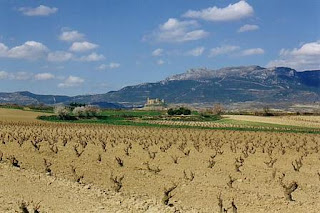
The vineyards were quite unique. Instead of the usual trellised rows I was used to, the majority were grown as bush vines in some of the most inhospitable soil I had ever seen.
The winegrowers of the region were somewhat bemused at a lone Australian poking around and asking lots of questions. My lack of Spanish and in general their lack of English proved a bit of a hurdle but most went out of their way to help. I remember one bizarre conversation in my English accented German and a vigneron's Spanish version.

The wine centre of Rioja is the town of Haro with its extensive and informative wine museum. Here you can visit numerous wineries (Bodegas) and taste a huge variety of local wines at cafes', restaurants and wine shops.
So the upshot of all this was that eventually I planted some vines.
They turned out to be a bit fickle. Despite growing like weeds with huge canopies, they have not so far been great with yields. Maybe it's the clone, D8V12, but in Australia we dont have much choice. It's either that or nothing!
Some experts suggest they have to be a few years old before they start producing to their full capacity.
The first year I blended the small quantity off into a Pinot Noir rose'.
This year with another small quantity harvested I have decided to make a varietal rose'.
It was brought in at around 12.5 Baume and the expected high pH 3.8.
Fermentation on the skins lasted only for 6 hours before I decided enough colour had been extracted when the juice was drained off and fermentation finished. It has been racked off the lees and is now settling. When clarified we will adjust the acidity and bottle.
Will let you know the results in due course.

Tuesday, March 11, 2008

Pinot Noir

Pinot Noir is the variety used to make the best red wines of Burgundy as well as being a principle component of Champagne.
It is a very old and variable variety and similarities between it and the wild grapes that grew in Europe before cultivation of the high yielding selections can still be seen.
There is said to be 200 clones (genetic mutations) of Pinot Noir. Some say there is possibly 1000. In France there are 50 certified and 15 significantly propagated.
In Australia, there are around 30 clones available.
At Termeil Creek we chose the MV6 clone.
Wines made from Pinot Noir from hot areas tend to be uninteresting and lacking in colour and flavour.
This is the result of ripening too fast
Cool climate fruit on the other hand that ripens slowly can make wines of distinctive varietal flavour which are highly sort after.
The goal is to make a wine of cherry, red plum colour, with a nose showing primary red/black berry characters followed up by an aroma, after ageing, of hay/earth/mushroom/cedar or so called "forest floor"
The palate should be complex with layers of flavour unfolding with a viscous, velvety mouth feel with low to medium tannins. The finish should be soft and long. The influence of oak should be subtle.
Pinot grows well in most soil types. They tend to do well in heavier clay loams and silty clay loams with good drainage.
In Burgundy the soils are 30-40% clay and predominantly limestone based. There they are planted at high density, 10,000 vines/ha (1m x 1m) to encourage root competition with a resulting intensity of flavour.

At Termeil Creek we have a warm maritime climate, shallow sandy soil over sandstone, and a hot ripening season………all of which says "don’t plant Pinot Noir" a rule which every grape grower in the area has followed in the past.
Good enough reason for me to try.
So I planted 100 vines at a spacing of 1m x 2m.
In an effort to overcome the climatic problems I planted the rows east/west of the cooler southern side of a hill. Not much I could do about the soil type.
Vines are trained to a unilateral cordon and are spur pruned. This will limit their yield.
Last year we had a small amount of fruit which was blended away into a rose’
A lot of people commented on the "strawberry" nose of that wine. To me this was the Pinot component expressing itself.
So this year we had a lot more fruit and are making a varietal Pinot Noir.
Baume level of the juice was 12.5° , pH 3.4 and TA 9g/L all which fall in the required range. Whether flavour and phenolic development have been good we will have to wait and see.
Certainly the ferment smells wonderful.
It is nearly finished and will be drained off, pressed and with pressings added be left to clarify naturally in an effort to maintain as much flavour as possible. We have introduced the slight flavour of French oak with staves added to the ferment.

Friday, March 07, 2008

Wine Packaging

A few posts ago I discussed the development of the screw cap as a replacement for corks for wine bottle closures. But there is more to the wine packaging question.
For the small amateur winemaker, the use of glass bottles is an expensive and time consuming pursuit.
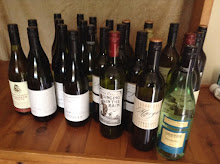
Obtaining small quantities of new bottles is almost impossible because of the virtual monopoly of the local producer and going through their distributorships is not at all cost affective. So we are forced to use recycled units. This involves washing, sterilizing and delabeling.
Granted the re use of screw capped bottles has reduced the necessity for corks but there was a need to consider alternatives to the glass bottle as well.
Some time ago I looked at using recycled PET bottles for my wine. It became obvious that soft drink bottles were unsuitable due to the flavour/odour/colour absorption of the original contents by the container.
But the use of PET bottles that had contained unflavoured mineral water, both still and carbonated, was a possibility.
I did a trail, bottling the same vintage in both containers and standing the PET bottles upright on top of the refrigerator for a year thus exposing them to ambient light and fluctuating temperatures. The glass bottles were stored normally.
After that time I did a comparative tasting.
The result.....no discernable difference in either colour or flavour.
So this year I bottled the majority of the 2007 vintage in PET. My "consumer base" was a little concerned but have come to realise that due to the quick consumption of the product there is little to be worried about.
Granted it looks a bit strange, but after all, it's the taste in the end that counts.

Then low and behold, in this month's issue of The Australian and New Zealand Grapegrower and Winemaker magazine there is an article on the use of PET bottles for wine containers.
It would seem that due to environmental concerns eg. "food miles" and "carbon footprints", the alternatives to glass are being considered by the industry.
The airline industry is already using PET 187 mL wine bottles because of the weight saving and this has caused interest to increase in other consumer markets.
Results of marketing research has shown that wine in a 750 mL PET bottle compared to traditional glass, reduces packaging weight per litre by 84%, uses 19% less energy, produces 78% less solid waste and emits 52% less greenhouse gas.
And research into the affect of shelf life of the product has also been initiated.
So there is a definite move in that direction. What will the traditionalists say?
Modesty prevents me from saying I am ahead of my time.

Tuesday, March 04, 2008

Wine Shows

In previous posts I have mentioned the South Coast Wine Show, details of which can be found at http://www.southcoastwineshow.blogspot.com/
This is only open to commercial wineries but was spawned from the long running amateur winemaking competition at the Milton Agricultural Show nearly 10 years ago.
The latter continues and I decided this year to enter some wines, two Cabernet Sauvignon vintages and a Pinot Noir/Tempranillo/Cabernet Rose' in the Milton Show.
Wonder upon wonder, the 2007 Cabernet Sauvignon won first prize in the red wine section.

This is no big deal but it is good to know that the judges appreciated the wine style and above all could not pick up any obvious wine faults.
We had only bottled it a week before the show and had hoped it had settled down a bit after that "trauma".
On speaking to the judges later, it turned out that the Rose' was also under consideration so that augers well for this year's vintage.
The Semillon has been made and is in the tank settling after being racked off the lees. The Pinot Noir will be picked and crushed tomorrow (weather permitting) and the Tempranillo is not far away. I am still considering whether to make another rose' out of that or try for a varietal red.
The Cabernet Sauvignon will sit on the vines for a few more weeks and is likely to be picked just after Easter or maybe early April. I would really like to get it really ripe this year despite the terrible season and produce a wine with a resultant higher alcohol than the previous vintage.

Thursday, February 21, 2008

"Stretch" Update

The calf, now named Stretch, because of what Dr. Bob and I did to him during delivery is still alive and well.
He is now walking well despite still swollen knuckles and is quite active.

His mother doesn't really want to know him so we are doing a combined bottle feed and a maternal force feed by tying her up with some hay as a distraction so she can't escape his greedy sucking.

Yesterday he escaped from the yard and came up to the house for a visit.

He follows me around like a dog.
I think I am in for big trouble with this one.

Sunday, February 17, 2008

More Cow Problems

After 15 years of virtually trouble free births we had another "stuck" one yesterday.
One cow had given birth early in the morning and both were doing fine but I noticed another was missing. That afternoon there was still no sign of her so I set off in search.
Sure enough there was the heifer under a tree by the creek in quite a deal of distress.
Dr. Bob was quickly on the scene and thought she needed immediate attention. The front feet and part of the head of the new calf was visible but there were no signs of any life.
So we did the "pull trick" once again and it was really stuck. The heifer was trying to help but she was exhausted and eventually fell to the ground. This seem to relax her a little and we managed to get the little bull calf out.

Amazingly there were some signs of life. Dr. Bob weaved his magic and we eventually got the little thing breathing.
The mother recovered enough to stand but her baby couldn't. We had done a little bit of "damage" to his front legs during the pull.
We managed to get some milk from the mother and the calf sucked it down from a bottle.
Bob thought he had a 50:50 chance of surviving. His head and tongue were badly swollen.
Next morning I went down to the yards and he was trying to stand, very wobbly, but at least he was alive.

I mixed up some calf formula and put him between my knees to drink. After he got the first taste he was away!!!!!
At lunchtime he drank another litre.
I tried to get him onto his mother but she just kicked him away.
Post natal depression?
He was still wobbly so had no chance to persist.
At dinner time he drank another litre. We managed to get his mother tied up and encouraged him to suck but I think the formula had done the trick. He just wasn't hungry.
At least she didn't kick this time.

We shall try again tomorrow morning.
The major problem right now is that he thinks I am his mother!!!!!!!!
So it is a matter of urgency to get the mother/son bond going so I am not saddled with three feeds a day for the next 3 months.

Monday, February 11, 2008

Vintage 2008 Begins

The weather on the South Coast of NSW has been very unsummer like. We have had very cool, even cold days, with lots and I mean LOTS of rain. The drought is officially over....in the south east, anyway.
This has caused havoc with the vintage all along the coast.
Grape sugars are not developing, thin skinned varieties eg. Semillon, are splitting and it is a constant battle to keep fungus, especially botrytis, at bay.
So we decided to pick our Semillon early.
Sugar level was around 10.5 Baume which means a wine around 10.5% alcohol, low by most standards. This is commonly known as a Hunter style as that particular famous wine growing valley north of Sydney suffers from the same climatic problems that we do and they have been picking their Semillon early off and on for decades. This is a unique wine which shows, early on in its life, grassy apple like qualities with obviously good acidity. However it ages amazingly to a toasty honey like flavour. It can have a bottle life of up to thirty years.
Picking started on a cloudy but fine day and we managed to get around 230kg of relatively clean fruit from our four rows.
I had never made white wine in my vineyard before and it was quite a steep learning curve being responsible for all aspects.
White juice is more sensitive to oxidation than red and it is necessary to take specific steps to prevent that from happening.
The right quantities of sulphur dioxide and a co antioxidant, ascorbic acid (vitamin c) have to added at the right time and levels constantly monitored.
This involves quite a deal of laboratory work.
Other additives include DAP a yeast nutrient to help avoid "stuck" fermentations and pectic enzymes which assist in releasing the juice from the crushed grapes.
We also added bentonite to the juice. This is a clay that is used to clarify the wine after fermentation and it is better to add it in at an early stage in the process so as to avoid an additional step that could encourage oxidation.
The grape bunches went through the crusher/destemmer quite easily compared with Cabernet Sauvignon thanks to the thin skins and we achieved a very good juice yield.
This free run juice was immediately drained off from the crushed grapes (the must) through a basket press and the remaining skins, seeds and pulp (the marc) were given a light pressing to extract more. We avoided a hard pressing so as not to include any tannic materials that would show up in the wine later.
The marc was returned to the vineyard as a soil conditioner.
The juice was then transferred to stainless steel tanks and innoculated with a specific yeast culture. There are plenty of wild yeasts on the grapes that could do the job but this is fraught with danger as some can be slow, others can cause off flavours and some even spoil the wine.
Fermentation started about 24 hours later and is continuing.
The problems of grape growing in the Shoalhaven Coast region was a hot topic at the South Coast Wine Show Presentation Dinner last Friday night, especially as it was sometimes difficult to hear the speeches over the roar of rain on the restaurant roof.
All the details of the wine show as well as results can be found on:


Thursday, January 10, 2008

Veraison

Véraison is a French term but has been adopted into viticultural English. The official definition of véraison is "change of colour of the grape berries" and signifies the change from grape berry growth to ripening.
Red grapes turn from green to red (anthocyanin pigment formation), white grapes from green to yellow (carotene and xanthophyll pigment formation).
Fruit development occurs in two distinct growth cycles separated by a period of little or no growth as part of a double sigmoid curve pattern. The first is the green stage where rapid cell division takes place and high levels of malic and tartaric acid are produced. Then during the "rest" period embryonic development within the seed occurs. This is followed by rapid water intake and cell enlargement but little or no cell division with a resultant softening, accumulation
of sugars and metabolism of acids.

Water is the main component of a grape berry with between 70 and 85% present.
Two sugars, glucose and fructose account for around 90% of the soluble carbohydrate in grape juice.
There are also traces of alcohols such as ethanol and glycerol.
Along with tartaric and malic acids (90%) citric, lactic, succinic and acetic acids occur in very small amounts.
The two main groups of phenols are tannins and anthocyanins.
Mineral nutrients include K and N (amino acids, ammonium ions and proteins).
Small traces of compounds that account for the flavour and aroma of wine eg. terpenes and methoxypyrazines along with hundreds of yet unidentified compounds are also present.
Technical ripeness is usually defined as a correct balance of sugar, pH and acidity. This is very dependent on climate conditions and most times an imbalance of these three criteria occurs.
For example, warm climates produce grapes of a higher sugar level but lower acidity. Cool climate grapes the opposite.
Also to be considered are aromatic maturity (varietal and fermentation aroma precursors) and phenolic maturity (tannin concentrations) which are also climate related.
To catch these three maturity indices in sync is always the aim but hardly ever achieved.
One has to strike a happy balance.
In Australia we can always add acid during the winemaking process but adding sugar is not allowed. So sugar levels, aromatic and tannin maturity are closely monitored during ripening.
Sugar ripeness is determined by taking samples of grapes from a cross section of the vineyard as the ripening process progresses and testing the juice of a combined crush with either a hydrometer or by refractometer.
Sugar levels are commonly designated in degrees Baume or Brix.
1° Baume = 1.8° Brix
We use Baume here as it also indicates the potential alcohol level of the finished wine eg. 12° Baume = 12% alcohol (v/v).

pH meter - hydrometer - refractometer
pH is measured by a pH meter and indicates the hydrogen ion activity of the acid. This is an important number as it will determine the addition rate of various chemicals during the wine making process eg. sulphur dioxide.
Titratable acidity (TA) indicates the concentration of the acid present in g/L (tartaric acid).
Not all varieties of grapes ripen at the same time.
Here we expect the Pinot Noir and Tempranillo to be ready early February, the Semillon a little later that month and the Cabernet Sauvignon some time in April.

Wednesday, January 09, 2008

Doctor Bob to the Rescue

We had been expecting that one of our cows was about to calve so we weren’t surprised to hear much bellowing from the herd the other night.
Normally Murray Greys cows give birth quite easily and I have not had too many worries over the years especially since the bulls put over them have never been too large.
All day I noticed one cow was missing so in the afternoon I went looking.
I found her in quite a distressed state with two additional legs hanging out the back.
I could not see a head so suspected a breech birth.
Winning Trainer Bob is a cowman from way back so I went in search of his expertise.
He had a look and was sure that the calf was in the correct position but decided that the cow looked a little exhausted needed some "help".
So we enticed her up into the yards where we attached baling twine to the two additional legs and pulled out a quite big and breathing bull calf much to the relief of its mother and us.
She was soon doing all the motherly things and he was up and standing within 30 minutes. We just had to make sure she would allow him to suck. And it did seem like she was ok with him.
I kept them in the yards overnight just to make sure both are ok and this morning it would appear she is still allowing him to drink. She is eating well.
This is good as we have had to hand rear two calves in the past, one whose mother died and another whose mother would at first have nothing to do with her offspring. Not only is this time consuming but also these two calves matured with considerable behavioural problems. I have heard this is common result of hand rearing.
I will give them another 24 hours under surveillance and then let them back with the others.
I don’t think it will be too long until another one turns up as well.
Winning Trainer Bob will now be known also as Doctor Bob.

Wednesday, January 02, 2008

Winning Trainer Bob

Across the road from us live our neighbours and good friends, Bob and Judy.
Bob is the owner of the Termeil Creek Tavern (and beer garden) which is usally open from 4pm to 7pm during summer and shorter hours during winter.
You are always assured of a drink there.....as long as you bring your own.


It's a good place to flip over empty bucket (topped with a hessian feed bag for comfort) and sit and have a chat about the goings on in the local area with a background of country or rock music or horse racing broadcasts blaring out from an antique radio. You even get a log fire in the cooler months. In fact rumour has it that one of Bob's favorite sayings is "there is nothing like the smell of an open fire in autumn".
Bob trains race horses.
I would have to say horse racing is Bob's passion.
He travels all over the south east with his horses to the various country meetings. Sometimes we are lucky enough to be able to watch a race on TV.
When we go over there for dinner, nothing is more certain than being encouraged to watch a video recording of his latest race........numerous times.
Sometimes, when Bob has been away, I have helped out with the feeding of the horses.
They probably eat better than we do. Each has a specific diet made of all sorts of exotic bits, pieces and potions. They are like elite athletes.
We always remember Bob's first win. There were great celebrations!
He officially became known as "Winning Trainer Bob".
Well, sad to say these wins were few and far between and he was slowly demoted.
"Sometimes Winning Trainer Bob" became "Seldom Winning Trainer Bob" and ultimately "Hardly Ever Winning Trainer Bob".
We met Bob on the way out yesterday on yet another trip with his horse float in tow.
Bega this time for New Years Day meeting!
We saw him arrive home too, very late in the evening and wondered how he had gone.
This morning we were greeted with the news that his "Winning Trainer Bob" status had been restored.


And he had a trophy to prove it.
So it will be a week of celebrations at the Tavern.
It is not easy to miss the location.
Check out the sign.


Everyone is welcome!
It's Bob's shout!

Tuesday, January 01, 2008

To Screw or Not to Screw

There is a misconception in many wine consuming countries that a bottle closed with a screw cap indicates cheap wine. While this may have been true when the screw cap first made its appearance back in the 1970's, nothing could be further from the truth now.
But why would you need to replace cork as a closure for a wine bottle?.
The answer is simple.
Trichloroanisole or TCA, commonly known as cork taint or "corking".
Contamination by this compound leaves the wine tasting musty and dull. It is formed when chlorine used for bleaching reacts with mould already growing in the cork. The average wine drinker is sensitive to the compound and can detect it even at dilutions of six parts per trillion. TCA can occur in several areas of a bottling facility, such as drains and barrels, but corks pose the biggest problem.
It is believed that up to 10% of the world's wine is affected.

The cork industry has failed to address this problem satisfactorily and the search for alternative closures has been initiated.
One answer has been the synthetic ‘cork’, which is already widely used. But some wine tasters complain of ‘plastic taint’ and many consumers find them difficult to remove from the bottle.
The screw cap concept of the 70's has been developed further. The capsule system is made up of a screw cap, a long printable skirt and a liner specifically designed for contact with wine. The glass bottle used with the system has a screw thread beginning at 2.8mm below the neck top and the closure is re-drawn to avoid leakage.
Two types of liner give an element of control over the desired permeability of the seal. The Saranex liner is made from layers of polyethylene, PVDC (polyvinylidene chloride) and expanded polyethylene, whereas the Saran film etain has a layer of tin sandwiched between PVDC, white kraft and expanded polyethylene. This tin layer means that it is much less permeable than the Saranex liner and less oxygen is allowed to enter the bottle.
Wine companies tend to use the Saran film etain liner for wines stored for longer periods of up to 10 years, with the Saranex intended for storage of between two and five years.
It is clear that white wine sealed by a screw cap is protected from oxidation and the threat of cork taint. Comparative tastings of the same white wines under cork and screw cap have shown the latter to be fresher and more consistent.

The question of ageing of red wines under screw cap is one that is regularly raised.
There is a school of thought that minute quantities of oxygen leeching into the wine over years through a cork contributes greatly to the ageing properties of the wine.
Another school thinks that it is the oxygen already in the wine that aids ageing and that any oxygen ingress from outside leads to premature oxidation. It has also been suggested that much of the ageing process takes place anerobically.
Thus it is surmised that a red wine under a screw cap will age at the same rate as a one under a perfectly corked one.........without the threat of "corking".
Because so little premium red wine has been sealed under screw cap so far, practical results are not yet available.
But more and more are becoming available, particularly in Australia and New Zealand, so it is obvious that the wine industries in those countries have full confidence in the screw cap closure.