Friday, August 13, 2010

A Trip to South Australia 2 / Broken Hill to Flinders Ranges

After 3 hours driving through flat semi arid desert country, the Barrier Range starts to appear on the horizon. This is the location of Broken Hill, the ‘Silver City’ and a new time zone despite the fact we are still in New South Wales. Very isolated from the east coast and Sydney, the city considers itself part of South Australia and Adelaide its contact with the outside world.

First explored by Europeans in 1841 (Aborigines had lived here for 40,000 years), this area soon became pastoral land. By the 1860’s most of the small farms had failed and it became a huge holding owned by the ‘cattle king’ Sir Sidney Kidman. One of his boundary riders, Charles Rasp, was a amateur geologist and collected a few rock samples from a broken hill during his patrol of fences on Mount Gipps station (ranch) which he thought had some potential. Assay results were positive and he and a syndicate of six others filed a mining claim. In 1885 they struck a rich vein of silver. The lode would turn out to be an arc 7.5 km (4.5 mi) long and 250m (275 yds) wide. It is the largest and richest ore body of its kind in the world already yielding $100 billion worth of silver, lead and zinc with no end in sight.

The population of this new town mushroomed to 20,000 within eight years of this find and soon the main street, Argent, which runs parallel with the ore loaded hill, The Line of Lode, boasted numerous fine public buildings as well as many of the sixty licensed hotels that had also sprung up.
Chronic water shortages were offset by water carrying camel trains led by their Afghan drivers. The camels were subsequently let loose, became feral, and have become quite a problem in the outback since. The water supply difficulties were finally resolved in 1952 with a 109km (68 mi)pipeline from the Menindee Lakes on the Darling River.
Conditions for the miners were terrible. They suffered all sorts of lung diseases and heavy metal poisoning. Hundreds were killed underground. Industrial unrest lead to the formation of one of Australia’s strongest union movements, the Barrier Industrial Council, which is an affiliation of eighteen unions. The miners went on strike in the 1920’s for better safety, health and wage conditions and stayed out for 18 months. They won in the end and were the first in the country to be awarded a 35 hour week. At the height of mining activity in the 1950’s, 6000 men worked underground there. It is still very much a union town with the Trades Hall and the Social Democratic Club (The Demo) prominent in the main street. There is also a monument in the town square to the women who stood by their men during the troubled industrial times.
Broken Hill is also home to the Royal Flying Doctor Service that provides medical care to the outback and the School of the Air which provides education via radio to the remote mining and aboriginal communities as well as outback rural properties.

It's difficult to forget you are in a mining town with the huge mullock heaps that dominate the skyline. We drove up onto the one above the Line of Lode. They have built a restaurant up there as well as a a miner's memorial to the 900 or so who lost their lives underground and another to the only two whose bodies have never been recovered after a rockfall in 1902.
It's an impressive view over the surrounding countryside from this vantage point.

In complete contrast is the development of a very strong arts movement in the city. "The Brushmen of the Bush" were five artists who started painting the starkly lit outback images back in the 1960's. Today there are at least 50 painters, photographers, sculptors and potters with 27 or so private galleries and studios to visit. In addition there is the impressive public Regional Art Gallery chock full of work for local and indigenous artists.
One of the original five was the late Pro Hart. He has been a favourite of mine for many years although all I could afford was a signed print back in the early '70's. He had many styles but I liked his outback country life scenes which are painted in naive form. These have lots of characters going about their business and always, if you looked closely, some amusing mini scenes eg. like the drunk Santa Claus lying in the dusty street outside a pub in one of his Bush Christmas paintings. His horses always have wheels! He is very Bruegel like in his depiction of every day life.

We visited his gallery which hangs a host of his paintings and shows off some huge outdoor sculptures. And his studio is exactly the way it was on the day he died in 2006. Pro was born in Broken Hill and was a miner. He took up painting to preserve his sanity after 19 years of long days underground. "Discovered" in 1962, he eventually dedicated the rest of his life to art. He experimented with sculpture, etchings, silkscreen and giclees. He worked with oils, acrylics, watercolours and used layering, chiaroscuro, glazing and alla prima. Always the eccentric, he dropped paint from hot air balloons, fired paint out of cannons as well as blowing up sheet metal with black powder and turning the results into sculpture. He also loved music and taught himself to play a huge pipe organ which takes pride of place in the gallery. He was very fond of Bach. He also collected cars, especially Rolls Royce and Bentleys and did some pretty amazing things to some of them. The co driver has never been a fan of his work but I think she may be a convert now after seeing many of his other styles.
About 25km out of the city lies the ghost town of Silverton which was initially spawned by a gold and silver rush in 1883. In 1888 the first privately owned railway in Australia linked the town to Broken Hill. However the ore soon ran out and by 1900 most of the 3000 inhabitants had up and left for Broken Hill, many taking their houses with them via jinkers pulled by camels, bullocks and donkeys. It's strange to see the few permanent solid stone buildings sitting among blocks of vacant land and dusty streets.
Most people have seen Silverton and surrounds whether they know it or not. It has been the set for such movies as "Mad Max" and "Priscilla, Queen of the Desert" as well as many TV series and advertisements. The only pub in town has Mad Max's car parked in its lot.

The town has a few artists and artisans eking out a living from the tourists and I noticed that Mad Max Museum was being built. Even further west at the edge of the mountain range lie the Mundi Mundi Plains. There is really nothing between here and the central Australian deserts. It must be one of the flattest places on earth. I swear I could see 'the curvature"

We drove a little further on looking for the Umberumberka reservoir and realised that once we had left the bitumen and were on a straight red dirt road disappearing over the horizon, we were on the wrong track. A quick check of the map saw we were on the 'road' to Cameron Corner (where the states of Queensland, New South Wales and South Australia meet) some 500km away with no fuel, no habitation and probably no water in between. We quickly turned around.

Back in the the city we had heard about 'The Sculpture Symposium' so headed out of town once more around 10km. On a lonely hilltop called Sundown on 1st April 1993, in an area to become known as the Living Desert, 12 international sculptors began work on 53 tonnes of sandstone floaters that had been transported there. Seven weeks later the work was finished. To see these sitting on the skyline as the sun starts to set in the clear outback air is truly impressive and worthy of a separate blog entry which will come in due course.


It became apparent when walking around this area that the desert was indeed living. Flowering plants, shrubs and trees were everywhere. Another separate blog entry one day!
On the road out from the sculptures we suddenly saw a carpet of red ahead of us.
Sturt Desert Peas! And coincidentally the state flower of South Australia.


But it was time to hit the road west again.
Desert soon gave way to arid scrub and crossing the South Australian border we were soon across Goyder's Line and into rich green rolling hills. This was obviously wheat, sheep and eventually wine country.
We made a stop at Burra. It's hard to imagine that this tiny little sleepy town was, from 1845 to 1877, the site of one of the richest copper mines in the world with 5000 residents. Cornish, Welsh, Scots and English, 1600 of whom lived in dugouts cut into the banks of Burra Creek, extracted the ore by hand.
The mine opened again in 1970 and operated by open cut until 1981.
It was here that the co driver experienced her first Cornish pastie while she looked with envy at my South Australian specialty, a pie floater ie. the traditional Australian meat pie sitting in a plate of thick green pea and ham soup and usually covered with tomato sauce (ketchup). I know what you foreigners are thinking but it tastes delicious. Honestly!
Then it was onto the Clare Valley and our wonderful accommodation in Watervale for a few days.
The entire Clare Valley wine region covers only a length of 35km and ranges between 5 - 10km in width and produces just over 1% of Australia's wine. It is broken up into five sub-regions ie. Sevenhill, Clare, Watervale, Polish Hill River and Auburn. The Clare is prime Riesling country and nearly every winery in the valley produces it. The climate has a lot to do with the its success. The area experiences a continental climate with long hot days and cooling nights in summer which contribute to the flavours and the crisp acid retained in the wine. The valley is one of mainland Australia's coolest wine-growing regions. It was here, towards the turn of the last century, a collaboration of local winemakers saw all Clare Valley Rieslings put under Stelvin screwcap seals to minimise any chances of defect which was a watershed moment for the Australian and maybe the world's wine industry.
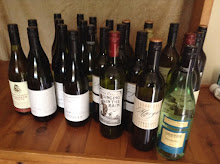
We tasted and bought this variety from Pikes, Annies Lane and Crabtree. The area's Sauvignon Blanc and Pinot Gris were also interesting so some of those went in the back of the car too.
Our special lunch was at Skillogalee. Wild rabbit terrine and wild barramundi was for me while the co driver settled for a caramelised onion, goat's cheese and tomato tart followed by a duck based pasta dish. All this was washed down with one of their winery's excellent 2010 Riesling.
Clare Shiraz has an excellent reputation too but I was more interested to try their new plantings of Tempranillo. They are achieving good early results with this variety too.

The oldest winery in the Clare is Seven Hill. Established by the Jesuits in 1851 to produce altar wine, it has been making premium table wines for many years. It is a very pretty area with the church and immaculately kept gardens set amongst the vines. They have some of the oldest vines in Australia that were planted before 1860. The winemaker, Brother John May conducts tours of the grounds and winery two days a week and the tasting room and museum is open Monday to Friday.

After a couple of days in this beautiful region we realised we had not allocated enough time to do it justice. There is more there than just wine. But we had to move on. So heading north through the Mount Remarkable National Park which lies at the southern end of the Flinders Ranges and down onto the coastal plain through Horrocks Pass we suddenly saw the ocean, or rather Spencer Gulf, for the first time for a week. Then it was onto Port Augusta at the tip of the gulf to pick up supplies for our trip into the Flinders Ranges and to find an illusive quilt shop on the co driver's list. This we did at the junction of the Princes, Eyre and Stuart Highways. We has come as far west as intended. Perth and the Indian Ocean were 3000km further west across the Nullabor Plain and Darwin was 2700km north through the red centre. Stocked up with goodies, we headed into the mountains towards Wilpena.

Tuesday, August 10, 2010

A Trip to South Australia 1 / Termeil to Broken Hill

For a change, this year, we decided to explore some of our own country rather than go overseas. Although I had been to Adelaide in South Australia many times for business, in another life, there were a few places there I had had on my 'bucket list' for a long time. The fact that the state is the major producer of wine in the country hadn't escaped my attention either. We began our drive west early as we had a long way to go the first day.

Up over the Great Dividing Range on a cold frosty morning and by passing the Australian capital, Canberra, the car thermometer showed 0° C. Signs of things to come, we thought, as we headed inland. From Yass we crossed the Murrumbidgee River at Gundagai and basically followed its course into Wagga Wagga for lunch and then eventually to another old river port of Nerrandara to stay the night. We had to make sure we were carrying no fresh fruit or vegetables because the Murrumbidgee Irrigation Area and Sunraysia are big fruit growing areas and are fruit fly exclusion zones. Big fines apply for non compliance. I was surprised to see that none of the quarantine barriers were manned nor were we stopped for a random check. Next morning we left the rolling hills of the eastern Riverina and expected to enjoy the flat treeless Hay Plains but ran into thick fog which we drove through for hours. Hay was a nice town for a big country breakfast with a lot of well preserved late 19th century buildings.
Suddenly an hour later we were into bright sunlight and a cloudless blue sky outside another old river port of Balranald on the edge of mallee country where the Murrumbidgee turns south to join up with the Murray. The Mallee is an area named after several species of Eucalyptus which grow in a short multi trunk form from a huge root ball in sandy marginal country.

Another hour on and we were back in civilisation. Huge areas of vineyards and fruit orchards suddenly appeared at Euston and it was here we had our first glimpse of the Murray River. Sunraysia is wine and table grape country. They produce over 95% of the nation’s sultanas and raisins as well as 20% of the wine here. Citrus (21%), almonds (55%) and olives (33%) as well as huge amounts of vegetables are also produced.

Then it was over the river border into the state of Victoria and the main town of Mildura.
The area was once a pastoral lease but this failed and was taken over by the American Chaffey brothers in 1887 at the request of the Victorian parliament to establish a model irrigation settlement based on their success with a similar project in Ontario, California. The Mildura Irrigation Colony was formed and a thriving fruit and vegetable growing industry was established by pumping water up from the Murray in steps by steam driven pumps and irrigating 13000 ha (33,000 acres) of what was previously unproductive mallee land. The area now covers well over 50,000 ha.
The Chaffey brothers wanted to make the town a vibrant community. Their plans included many visionary concepts. Prominent locations were made available for churches and facilities for clubs were encouraged. Parks and town transport were well considered and resulted in the beautiful central Deakin Avenue, one of the finest thoroughfares in Australia. Lanes and streets were well laid out in grid form and Mildura is one of the few places in Australia where you will find the American system of naming streets by numbers.

Many fine old buildings remain including the restored original pastoral homestead as well as the Chaffey home 'Rio Vista'.
The lifeblood of the city is the river and, in the past, it was also the main transport route. Wool, timber and produce was brought down the Murray, Darling and Murrumbidgee Rivers by paddle steamer via Mildura on the way to the coastal ports 880km (550 mi) downstream in South Australia. The return journey brought up the necessary supplies for the developing towns along the Murray/Darling System.
We of course could not resist a paddle steamer tour down the river for a few hours through some pretty beautiful scenery with huge river gums lining the bank and a rich bird life.
The rivers in the old days however were only navigable for 4 to 6 months a year due to varying water flows. A series of locks and weirs were planned for the entire system to control water levels and allow year long navigation but only a few were put in before the development of railways signalled an end to river transport. Normally our tour would have taken us through Lock 11 but it was down for maintenance. At least we got to have a look at it from downstream.
The river is used mainly for recreation these days. Fishing is very popular and anglers seek out the Murray Cod which can grow up to 50kg (110lbs). The New South Wales border runs along the southern bank of the river so although you may be standing in Victoria to fish, you are casting into NSW waters so need a NSW fishing licence. Water skiing and power boat racing are also popular as is the hire of house boats for self guided cruises down the river. There are some pretty fancy ones available with five double bedrooms downstairs and a kitchen and huge entertainment area up.
Another reason for visiting Mildura was Stefano's Restaurant. Celebrity chef Stefano De Pieri, an Italian immigrant, chose Mildura 17 years ago as a place to show off his command of culinary traditions adjusted to local produce. And what a meal it was! A fixed five course menu with
dishes changed daily at the whim of the chef. We had grilled scallops on the shell with bread gratin, slow roasted pork belly with braised lentils and cabbage, hand made gnocchi with gorganzola, braised magret duck with celeriac mash and snow peas and finally caramel panna cotta with blood orange. The wine list read like an oenology encyclopedia. I finally selected a Montepulciano Sangiovese which went great with the first four courses.
The Murray-Darling Basin is one of Australia's largest drainage divisions and covers approximately one million square kilometres or one-seventh of the continent. It stretches from Queensland's channel country through NSW to the Australian Alps, Victoria's north-east and the Riverina, and on into South Australia's Riverland and the Coorong at the mouth of the Murray.
About 85 per cent of all irrigation in Australia takes place in the Murray-Darling Basin, which supports an agricultural industry worth more than $9 billion per annum.
The long-term productivity and sustainability of the Murray-Darling Basin is under threat from over-allocated water resources, salinity and climate change.
Water use in the Basin has increased five-fold in less than a century. The problems caused by over-allocation have been exacerbated by severe drought and the early impacts of climate change. There is insufficient water to maintain the Basin's natural balance and ecosystems, resulting in a marked decline in its ecological health.
In agreement with the affected states, there are Commonwealth plans being instigated that will hopefully not only stop but reverse this critical situation.
About 30 minutes drive out of Mildura at Wentworth, the Darling joins the Murray. It is interesting to compare a picture today of that area with one of yesteryear.
Driving out of Wentworth directly north 300km to Broken Hill, we took a short detour to the Perry Sandhills. Finally we were in what seemed like outback country.
According to geologists, these sand hills originated after an ice age (40,000 years ago) and are formed by wind erosion over thousands of years. The hills are a unique land formation of 160ha (400 acres) of continuously shifting sand dunes. Skeleton remains of giant mega-fauna (kangaroos, lions, emus and wombats) have been found there. Aboriginal tribes used this area to camp and hunt. Evidence of this is still being uncovered as the sands drift.

Located near the car park is a single Murray River Gum tree in the middle of the sand. We climbed the dunes and walked in under the canopy of the Red Gum which is possibly more than 500 years old. The sand over time has completely covered the trunk, perhaps 5 to 6m (15 to 20 feet) and we found ourselves in the canopy of this age old tree, a fantastic experience! The sand hills were used as a bombing range during WWII. Now, the area is utilised as backdrop for many films, TV shows and ads, theatre/music presentations
But there was no time to dilly dally here as we had to make the "Silver City" well before dusk to reduce the danger of wildlife collisions eg. kangaroos, camels, emu as well as wandering cattle and sheep.
Luckily we had filled up with petrol at Mildura as the only roadhouse on the route, halfway up the highway at Coombah, had run out. But they still had cold drinks!

Thursday, August 05, 2010

Some More Reading

As you might gather we are still not home yet, so we must be enjoying ourselves on the road.
Here are a few more books to consider.

The armed rebellion known as the Eureka Stockade in the gold fields of Ballarat, in the state of Victoria, Australia on 3rd December 1854 was brought about by grievances over the high price of mining items, the expense of a Miner's Licence, taxation without representation and the actions of the government and its police and military.
While the events which sparked the rebellion were specific to the Ballarat gold fields, the grievances had been the subject of public meetings, civil disobedience and deputations across the various Victorian gold fields for a number of years.
Although swiftly and violently put down by the government forces, the Eureka rebellion was a watershed event in Australian politics.
The preceding years of agitation for the miners' demands combined with mass public support in Melbourne for the captured 'rebels' when they were placed on trial, resulted in the introduction of full male suffrage for elections for the lower house in the Victorian parliament.
The role of the Eureka Stockade in generating public support for these demands beyond the goldfields resulted in Eureka being identified with the birth of democracy in Australia.
This book covers the lead up, the conflict and aftermath in great detail with some wonderful pictures.

More of coffee table book than a read. Beautifully presented and illustrated 160 page celebration of Abraham Lincoln's life from childhood to assassination. A feature of the book are removable reproductions of important documents including his letters, draft speeches, marriage licence, Civil War telegrams etc.
I bought this from the bargain table in Borders, Minneapolis last trip for $3.00.
I saw it in Borders, Sydney, a few weeks ago all wrapped up securely in plastic for $87.00!

Yes, THAT Jimmy Buffett! A light adventure novel full of shallow characters as well as implausible plot and subplots . Good fun but when you have finished it you might ask, why did I bother!
Maybe he should stick to singing!

A history of the Australian Wine Industry from the arrival of the first fleet in 1788 with its small cache of vine cuttings to the present day, well, 2002. It is a tale of the characters who have populated the wine industry as well as the multi billion dollar businesses that now dominate it.
Probably a book for the wine buff only.

Monday, July 26, 2010

Some Reading

By now we are well into our South Australia trip and out of range. So to prevent the blog from being dead in the water, I have pre-dated some entries that cover a few books read over the last months, some of which can be recommended.
An amusing story of Canadian couple's search for and development of a vineyard in Tuscany. Lots of quirky characters that are normal for stories like this about rural Italy and an enjoyable light read.

A light hearted account of the demise of Pluto from planet to plutoid.
It's amazing how the scientific world can get its collective knickers in such a knot and drag a great cross section of the population including children along with it. Obviously Walt Disney has a lot to answer for!
I have seen Neil deGrasse Tyson on television a few times and he writes like he talks. He is a wonderful communicator with a great sense of humour, quite the antithesis of the stereotypical boffin.
This smallish book is a quick read and gives such a simplified explanation of the structure of our solar system that it is worth reading for that alone.

A story of Australian Infantry action against the Japanese forces in New Guinea during World War II where they thwarted the enemy's attempt to take Port Moresby with a land based attack across the Owen Stanley Ranges via the Kokoda Track. From July 1942 to January 1943, they drove the Japanese back over the mountains to their landing point at Buna in some of the bloodiest fighting seen in the Pacific. This hard won victory surely prevented the Japanese from establishing a base for the invasion of Australia. The story of hardship and sacrifice and goes down in ANZAC legend along with that of Gallipoli.
This is a history book written in novel style and difficult to put down.

A detailed history of slavery and the development of the Abolition Movement in the USA up until the outbreak of the Civil War. It concentrates on the evolution of the network of escape routes, the Underground Railroad, set up by those sympathetic to the cause, that allowed thousands to find new lives in the 'free' states, albeit still fraught with danger, as well as in Canada where free actually meant free.
Some of the stories of man's inhumanity to man can be quite distressing but at the same time those of great heroism and dedication of both black and white to rid the country of "a fundamental moral evil" are inspiring .
Another history book that is character driven and extremely readable.

Saturday, July 17, 2010

An Early July Update

All the grape vine pruning has been done and the cuttings burnt. The netting has been repaired and the winter weeds in the mid rows sprayed off. We are ready for the next growing season.
The 2010 Tempranillo and Semillon have been bottled. I 'lost' the Pinot Noir again! That's two vintages in a row. I have no idea what I am doing wrong. Back to the books. The 2010 Cabernet will spend another 6 months in the tank on French oak staves.
Most of the tussock (Poa labillardierei) has also been sprayed and is dead or dying. We have started on the bracken fern (Pteridium esculentum) eradication. This will probably take another year to complete. The spray used is systemic and very slow. The plant needs to absorb it through the very waxy leaves (fronds) and 'send' it to the roots and rhizomes in order to kill itself. This takes time especially during the colder winter months when many plants virtually shut down.

A few fallen trees have been converted into supplementary firewood. Wet weather has held up a few other tasks which we can get to in the spring.
The car has been in for a major service so we are ready to hit the road for our trip to South Australia.
It will be a two day drive to get to Mildura where we will really begin our adventure. It is near here the Darling River meets up with the Murray River.

The Murray-Darling Basin covers 1,061,469 square kilometres or approximately one-seventh of the total area of Australia (7,692,024 square kilometres).
It contains over 40% of all Australian farms, which produce wool, cotton, wheat, sheep, cattle, dairy produce, rice, oil-seed, wine, fruit and vegetables for both domestic and overseas markets. As Australia's most important agricultural region, the Basin produces one third of Australia's food supply and supports over a third of Australia's total gross value of agricultural production.
The three longest rivers in Australia all run through the Murray-Darling Basin. They are the Darling (2740km approx) the Murray (2530km long) and the Murrumbidgee (1575km long).
We are also looking forward to seeing some of the outback, albeit the fringes, around Broken Hill and then via the wine region of the Clare Valley to Wilpena Pound.

From there we will head south towards the capital of South Australia, Adelaide, and then into the wine regions of the Adelaide Hills and McLaren Vale.
Then it will be onto the coast at Victor Harbour and down the Coorong to Robe. From here we will visit the important wine region of the Limestone Coast and in particular the famous 'terra rossa over limestone' strip of the Coonawarra.
We could be buying the odd bottle or two of red here.
After visiting the crater lakes at Mt. Gambier, it's onto the Great Ocean Road towards Melbourne, the capital of Victoria, and eventually home.

Monday, July 12, 2010

A Little Winter Colour

Camellias always add a splash of colour in our garden during winter.
We have Camellia japonica hybrids/cultivars:


as well as Camellia sasanqua:


And for those trivia buffs out there, the tea we drink comes from the dried leaves of Camellia sinensis.
There was another burst of colour around us, albeit quick, with a partial rainbow after a rainstorm a week or so ago.

Tuesday, July 06, 2010

The Weed Inspector Visits

The local weed inspector, employed by the Shoalhaven Council, came for a 'visit' the other day.
The council has a list of noxious weeds which the law requires landowners control.
He had had a report that Giant Parramatta Grass had been seen in our vicinity and was doing the rounds to see how big the infestation was.
We walked all over our property and apart from a few juvenile blackberry plants we found nothing. I really try to keep most weeds under control even the ones not on the noxious list.
The blackberry (Rubus fruticosus) is a Weed of National Significance. It was deliberately introduced into Australia in the mid-1800s as a horticultural plant, but early on it was recognised as a serious weed. It is now regarded as one of the worst weeds in Australia because of its invasiveness, potential for spread, and economic and environmental impacts. The plant infests about 8.8 million hectares of temperate Australia.

It has invaded the banks of watercourses, roadsides, pastures, orchards, plantations, forests and bushland throughout temperate Australia. On farms blackberries reduce pasture production, restrict access to water and land, and provide food and shelter for pest animals such as foxes. Other impacts are increased fire hazards caused by the large amount of dead material present in blackberry thickets and a substantial decrease in property values where heavy infestations occur.
He was back a few hours later to say he had found Giant Parramatta Grass (Sporobolus fertilis) by the roadside and in a neighbour's property and that we should be keeping an eye out for it next season as it seeds profusely and easily.
This weed favours sites with compacted soil, such as road verges and tracks, but it will also invade pasture and sandy coastal sites. It has very low feed value, and being very tough, can loosen the teeth of stock feeding on it.

He also said there was African Lovegrass (Eragrostis curvula) in the vicinity. This weed thrives on sandy low nutrient soils, by the roadside, on reserves and over-grazed pasture. It can also invade forest along tracks. It is avoided by livestock and replaces more palatable species in grazed pasture. It is highly flammable and creates a fire hazard.

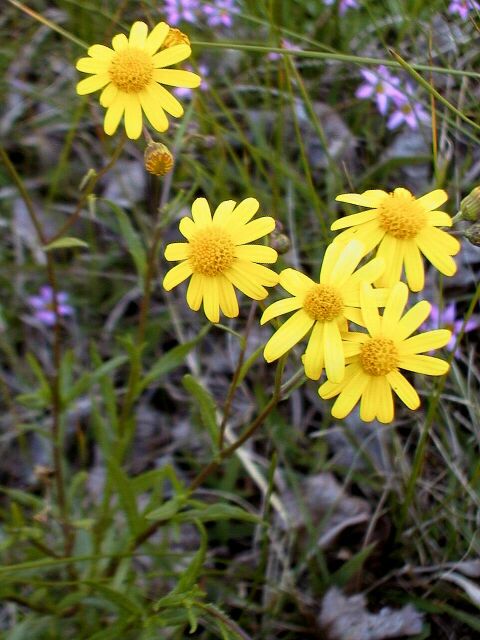
Another of his main concerns was Fireweed (Senecio madagascariensis). I had had an outbreak of this some years ago (I think it came in with hay) but had not seen it for a couple seasons. It took me three years to get rid of the outbreak. It was a matter of physically pulling out each plant during its growing season and then bagging and burning the collection.
It is toxic to stock eventually causing fatal liver damage. It is not readily grazed except by sheep and goats which tolerate the toxins better than other stock. Each plant can produce hundreds of seeds and density in pasture can become very high, greatly reducing carrying capacity.
Apparently the area around Ulladulla is the only one in the Shoalhaven now entirely free of this curse. The pasture around Nowra can be a sea of yellow during the flowering season.
Guess it will only be a matter of time until we are fighting against it on a regular basis.