Monday, March 31, 2008

Shoalhaven Coast Wine Region

The Shoalhaven Coast wine region stretches from near Kiama in the north to Batemans Bay in the south and west to the escarpment. It is part of the South Coast Wine Zone, a much bigger area, extending from Lake Macquarie to the Victorian border and west to the Great Diving Range.
A designated wine region is a legal entity under government legislation similar to the Appellation system in France. However it is much less restrictive than the French system in terms of viticultural and winemaking practices. In fact the only restriction is that wine which carries the regional name must consist of a minimum of 85% of fruit from that region. This protects the integrity of the label and safeguards the consumer.
To be assigned a GI ( Geographical Indication) the application has to prove that the whole area concerned has certain similar climatic, geographical and geological conditions. To some this might be considered the "terroir" of the area.
The Shoalhaven Coast is subjected to a warm maritime climate which is probably one of the most difficult climates to grow grapes in. It means hot and wet summers which encourage fast ripening, dilution of grape sugar, reduction of varietal character, low grape acidity and, worst of all, increased threat of disease particularly downy and powdery mildews and botrytis.
Of course a good viticulturalist manages his/her vineyard as best as possible to minimise the impact of the climate. Vine rows are designed to be well ventilated by the prevailing winds to help them dry out and the canopies are usually trained to vertical shoot positioning (VSP) with well spaced spurs for similar reasons. Most vineyards are well drained.
A protective spray programme is also essential to limit the impact of disease.

Of course variety selection is also important.
No one (well, almost no one) would consider growing Pinot Noir or Riesling, distinctly cool climate varieties, in the area.
White varieties Semillon, Verdelho, Chardonnay and Sauvignon Blanc do reasonably well. The more unusual Arneis also looks promising. Reds such as Shiraz and Cabernet Sauvignon do ok too. There is also some Merlot and Cabernet Franc grown.
Chambourcin has also found a niche in the area. This is an unusual grape for Australia as it is a complex hybrid produced in France by Joannes Seyve. The grape’s parentage is unpublished but would be based on considerable number of American species of Vitis and the European Vitis vinifera.
The variety shows excellent disease resistance and has found a home wherever a warm humid climate makes conditions a little more difficult for growing grapes eg. the Shoalhaven!
The wines made from this grape show good colour, acidity, tannin and no unpleasant hybrid flavour.
It is also very versatile. Wineries in the Shoalhaven Coast make dry and sweet red wines, sparkling reds, rose’ and vintage ports from this grape.
In the 2008 South Coast Wine Show wines in the Chambourcin class won four bronze medals.

The Shoalhaven Coast Wine Industry Association represents most of the vineyards in the area.
They are an active group promoting the region at every opportunity.
A major event is the Shoalhaven Coast Wine Festival which takes place every Queen's birthday long weekend in June.
Not only is there wine tasting but entertainment, art and photographic exhibitions and food events also take place.
We hope to see as many of you as possible enjoying South Coast hospitality over those three days.

Sunday, March 23, 2008

Tempranillo

Tempranillo is a red wine grape variety of Vitis vinifera and is native to Spain.
Its name comes from the Spanish "temprano" which means early and refers to the fact that it ripens a few weeks earlier than most Spanish red wine grapes.
Until recently it was suspected that Tempranillo was related to Pinot Noir, but genetic studies tend to discount this possibility.
Tempranillo is the main grape used in the red wines of Rioja, Spain.

It has a thick skin and grows best at relatively high altitudes, but it also can tolerate a much warmer climate.
To get elegance and acidity out of Tempranillo, a cool climate is needed. But to get high sugar levels and the thick skins that give deep color you need heat.
The lower acidity associated with low-altitude growth is most often remedied by blending with higher acid grapes eg. Grenache or Granciano. Here in Australia we are allowed to add acid.
Pests and diseases are a serious problem for this grape variety, since it has little resistance to either.
The grape forms compact, cylindrical bunches of spherical, purplish black fruit with a colourless pulp. The fruit is very dark in colour and forms a bead-like sphere.

The wines can be consumed young, but the most expensive ones are aged for several years in oak. The wines are ruby red in colour, with aromas and flavors of berries, plum, tobacco, vanilla, leather and herb.
A few years ago I had the thought that maybe this variety would be good to grow in Australia and went to Rioja for a few weeks on a "study tour".
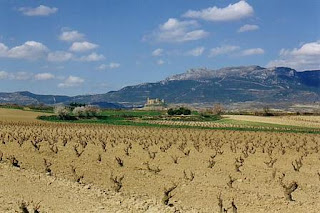
The Rioja region is very beautiful and the three main grape growing areas are very geographically distinct, the mountainous Rioja Alta, the rolling hills of Rioja Alavesa and the flatter river valley of Rioja Baja.

These three regions produce three different styles of Tempranillo because of the climatic and soil differences.
Red wines are classified into four catagories depending on age and length of oak storage. From the young "Rioja" through "crianza", "Rioja Reserva" and the wonderful "Rioja Grand Reserva".
The region also makes white wine (Viura, Malvasia) and crisp fruity rose' (rosados). It was the latter that took my fancy during the tour. We never see them in Australia as they are always drunk very young and virtually straight out of a barrel. I don't think many see a bottle.
Nothing quite like sitting in the shade of huge trees on a ancient square in some old Riojan village with a plate of slow roasted lamb and a jug of cold Tempranillo rose' on a blistering hot day.

The vineyards were quite unique. Instead of the usual trellised rows I was used to, the majority were grown as bush vines in some of the most inhospitable soil I had ever seen.
The winegrowers of the region were somewhat bemused at a lone Australian poking around and asking lots of questions. My lack of Spanish and in general their lack of English proved a bit of a hurdle but most went out of their way to help. I remember one bizarre conversation in my English accented German and a vigneron's Spanish version.

The wine centre of Rioja is the town of Haro with its extensive and informative wine museum. Here you can visit numerous wineries (Bodegas) and taste a huge variety of local wines at cafes', restaurants and wine shops.
So the upshot of all this was that eventually I planted some vines.
They turned out to be a bit fickle. Despite growing like weeds with huge canopies, they have not so far been great with yields. Maybe it's the clone, D8V12, but in Australia we dont have much choice. It's either that or nothing!
Some experts suggest they have to be a few years old before they start producing to their full capacity.
The first year I blended the small quantity off into a Pinot Noir rose'.
This year with another small quantity harvested I have decided to make a varietal rose'.
It was brought in at around 12.5 Baume and the expected high pH 3.8.
Fermentation on the skins lasted only for 6 hours before I decided enough colour had been extracted when the juice was drained off and fermentation finished. It has been racked off the lees and is now settling. When clarified we will adjust the acidity and bottle.
Will let you know the results in due course.

Tuesday, March 11, 2008

Pinot Noir

Pinot Noir is the variety used to make the best red wines of Burgundy as well as being a principle component of Champagne.
It is a very old and variable variety and similarities between it and the wild grapes that grew in Europe before cultivation of the high yielding selections can still be seen.
There is said to be 200 clones (genetic mutations) of Pinot Noir. Some say there is possibly 1000. In France there are 50 certified and 15 significantly propagated.
In Australia, there are around 30 clones available.
At Termeil Creek we chose the MV6 clone.
Wines made from Pinot Noir from hot areas tend to be uninteresting and lacking in colour and flavour.
This is the result of ripening too fast
Cool climate fruit on the other hand that ripens slowly can make wines of distinctive varietal flavour which are highly sort after.
The goal is to make a wine of cherry, red plum colour, with a nose showing primary red/black berry characters followed up by an aroma, after ageing, of hay/earth/mushroom/cedar or so called "forest floor"
The palate should be complex with layers of flavour unfolding with a viscous, velvety mouth feel with low to medium tannins. The finish should be soft and long. The influence of oak should be subtle.
Pinot grows well in most soil types. They tend to do well in heavier clay loams and silty clay loams with good drainage.
In Burgundy the soils are 30-40% clay and predominantly limestone based. There they are planted at high density, 10,000 vines/ha (1m x 1m) to encourage root competition with a resulting intensity of flavour.

At Termeil Creek we have a warm maritime climate, shallow sandy soil over sandstone, and a hot ripening season………all of which says "don’t plant Pinot Noir" a rule which every grape grower in the area has followed in the past.
Good enough reason for me to try.
So I planted 100 vines at a spacing of 1m x 2m.
In an effort to overcome the climatic problems I planted the rows east/west of the cooler southern side of a hill. Not much I could do about the soil type.
Vines are trained to a unilateral cordon and are spur pruned. This will limit their yield.
Last year we had a small amount of fruit which was blended away into a rose’
A lot of people commented on the "strawberry" nose of that wine. To me this was the Pinot component expressing itself.
So this year we had a lot more fruit and are making a varietal Pinot Noir.
Baume level of the juice was 12.5° , pH 3.4 and TA 9g/L all which fall in the required range. Whether flavour and phenolic development have been good we will have to wait and see.
Certainly the ferment smells wonderful.
It is nearly finished and will be drained off, pressed and with pressings added be left to clarify naturally in an effort to maintain as much flavour as possible. We have introduced the slight flavour of French oak with staves added to the ferment.

Friday, March 07, 2008

Wine Packaging

A few posts ago I discussed the development of the screw cap as a replacement for corks for wine bottle closures. But there is more to the wine packaging question.
For the small amateur winemaker, the use of glass bottles is an expensive and time consuming pursuit.
Obtaining small quantities of new bottles is almost impossible because of the virtual monopoly of the local producer and going through their distributorships is not at all cost affective. So we are forced to use recycled units. This involves washing, sterilizing and delabeling.
Granted the re use of screw capped bottles has reduced the necessity for corks but there was a need to consider alternatives to the glass bottle as well.
Some time ago I looked at using recycled PET bottles for my wine. It became obvious that soft drink bottles were unsuitable due to the flavour/odour/colour absorption of the original contents by the container.
But the use of PET bottles that had contained unflavoured mineral water, both still and carbonated, was a possibility.
I did a trail, bottling the same vintage in both containers and standing the PET bottles upright on top of the refrigerator for a year thus exposing them to ambient light and fluctuating temperatures. The glass bottles were stored normally.
After that time I did a comparative tasting.
The result.....no discernable difference in either colour or flavour.
So this year I bottled the majority of the 2007 vintage in PET. My "consumer base" was a little concerned but have come to realise that due to the quick consumption of the product there is little to be worried about.
Granted it looks a bit strange, but after all, it's the taste in the end that counts.

Then low and behold, in this month's issue of The Australian and New Zealand Grapegrower and Winemaker magazine there is an article on the use of PET bottles for wine containers.
It would seem that due to environmental concerns eg. "food miles" and "carbon footprints", the alternatives to glass are being considered by the industry.
The airline industry is already using PET 187 mL wine bottles because of the weight saving and this has caused interest to increase in other consumer markets.
Results of marketing research has shown that wine in a 750 mL PET bottle compared to traditional glass, reduces packaging weight per litre by 84%, uses 19% less energy, produces 78% less solid waste and emits 52% less greenhouse gas.
And research into the affect of shelf life of the product has also been initiated.
So there is a definite move in that direction. What will the traditionalists say?
Modesty prevents me from saying I am ahead of my time.

Tuesday, March 04, 2008

Wine Shows

In previous posts I have mentioned the South Coast Wine Show, details of which can be found at http://www.southcoastwineshow.blogspot.com/
This is only open to commercial wineries but was spawned from the long running amateur winemaking competition at the Milton Agricultural Show nearly 10 years ago.
The latter continues and I decided this year to enter some wines, two Cabernet Sauvignon vintages and a Pinot Noir/Tempranillo/Cabernet Rose' in the Milton Show.
Wonder upon wonder, the 2007 Cabernet Sauvignon won first prize in the red wine section.

This is no big deal but it is good to know that the judges appreciated the wine style and above all could not pick up any obvious wine faults.
We had only bottled it a week before the show and had hoped it had settled down a bit after that "trauma".
On speaking to the judges later, it turned out that the Rose' was also under consideration so that augers well for this year's vintage.
The Semillon has been made and is in the tank settling after being racked off the lees. The Pinot Noir will be picked and crushed tomorrow (weather permitting) and the Tempranillo is not far away. I am still considering whether to make another rose' out of that or try for a varietal red.
The Cabernet Sauvignon will sit on the vines for a few more weeks and is likely to be picked just after Easter or maybe early April. I would really like to get it really ripe this year despite the terrible season and produce a wine with a resultant higher alcohol than the previous vintage.

Thursday, February 21, 2008

"Stretch" Update

The calf, now named Stretch, because of what Dr. Bob and I did to him during delivery is still alive and well.
He is now walking well despite still swollen knuckles and is quite active.

His mother doesn't really want to know him so we are doing a combined bottle feed and a maternal force feed by tying her up with some hay as a distraction so she can't escape his greedy sucking.

Yesterday he escaped from the yard and came up to the house for a visit.

He follows me around like a dog.
I think I am in for big trouble with this one.

Sunday, February 17, 2008

More Cow Problems

After 15 years of virtually trouble free births we had another "stuck" one yesterday.
One cow had given birth early in the morning and both were doing fine but I noticed another was missing. That afternoon there was still no sign of her so I set off in search.
Sure enough there was the heifer under a tree by the creek in quite a deal of distress.
Dr. Bob was quickly on the scene and thought she needed immediate attention. The front feet and part of the head of the new calf was visible but there were no signs of any life.
So we did the "pull trick" once again and it was really stuck. The heifer was trying to help but she was exhausted and eventually fell to the ground. This seem to relax her a little and we managed to get the little bull calf out.

Amazingly there were some signs of life. Dr. Bob weaved his magic and we eventually got the little thing breathing.
The mother recovered enough to stand but her baby couldn't. We had done a little bit of "damage" to his front legs during the pull.
We managed to get some milk from the mother and the calf sucked it down from a bottle.
Bob thought he had a 50:50 chance of surviving. His head and tongue were badly swollen.
Next morning I went down to the yards and he was trying to stand, very wobbly, but at least he was alive.

I mixed up some calf formula and put him between my knees to drink. After he got the first taste he was away!!!!!
At lunchtime he drank another litre.
I tried to get him onto his mother but she just kicked him away.
Post natal depression?
He was still wobbly so had no chance to persist.
At dinner time he drank another litre. We managed to get his mother tied up and encouraged him to suck but I think the formula had done the trick. He just wasn't hungry.
At least she didn't kick this time.

We shall try again tomorrow morning.
The major problem right now is that he thinks I am his mother!!!!!!!!
So it is a matter of urgency to get the mother/son bond going so I am not saddled with three feeds a day for the next 3 months.

Monday, February 11, 2008

Vintage 2008 Begins

The weather on the South Coast of NSW has been very unsummer like. We have had very cool, even cold days, with lots and I mean LOTS of rain. The drought is officially over....in the south east, anyway.
This has caused havoc with the vintage all along the coast.
Grape sugars are not developing, thin skinned varieties eg. Semillon, are splitting and it is a constant battle to keep fungus, especially botrytis, at bay.
So we decided to pick our Semillon early.
Sugar level was around 10.5 Baume which means a wine around 10.5% alcohol, low by most standards. This is commonly known as a Hunter style as that particular famous wine growing valley north of Sydney suffers from the same climatic problems that we do and they have been picking their Semillon early off and on for decades. This is a unique wine which shows, early on in its life, grassy apple like qualities with obviously good acidity. However it ages amazingly to a toasty honey like flavour. It can have a bottle life of up to thirty years.
Picking started on a cloudy but fine day and we managed to get around 230kg of relatively clean fruit from our four rows.
I had never made white wine in my vineyard before and it was quite a steep learning curve being responsible for all aspects.
White juice is more sensitive to oxidation than red and it is necessary to take specific steps to prevent that from happening.
The right quantities of sulphur dioxide and a co antioxidant, ascorbic acid (vitamin c) have to added at the right time and levels constantly monitored.
This involves quite a deal of laboratory work.
Other additives include DAP a yeast nutrient to help avoid "stuck" fermentations and pectic enzymes which assist in releasing the juice from the crushed grapes.
We also added bentonite to the juice. This is a clay that is used to clarify the wine after fermentation and it is better to add it in at an early stage in the process so as to avoid an additional step that could encourage oxidation.
The grape bunches went through the crusher/destemmer quite easily compared with Cabernet Sauvignon thanks to the thin skins and we achieved a very good juice yield.
This free run juice was immediately drained off from the crushed grapes (the must) through a basket press and the remaining skins, seeds and pulp (the marc) were given a light pressing to extract more. We avoided a hard pressing so as not to include any tannic materials that would show up in the wine later.
The marc was returned to the vineyard as a soil conditioner.
The juice was then transferred to stainless steel tanks and innoculated with a specific yeast culture. There are plenty of wild yeasts on the grapes that could do the job but this is fraught with danger as some can be slow, others can cause off flavours and some even spoil the wine.
Fermentation started about 24 hours later and is continuing.
The problems of grape growing in the Shoalhaven Coast region was a hot topic at the South Coast Wine Show Presentation Dinner last Friday night, especially as it was sometimes difficult to hear the speeches over the roar of rain on the restaurant roof.
All the details of the wine show as well as results can be found on:


Thursday, January 10, 2008

Veraison

Véraison is a French term but has been adopted into viticultural English. The official definition of véraison is "change of colour of the grape berries" and signifies the change from grape berry growth to ripening.
Red grapes turn from green to red (anthocyanin pigment formation), white grapes from green to yellow (carotene and xanthophyll pigment formation).
Fruit development occurs in two distinct growth cycles separated by a period of little or no growth as part of a double sigmoid curve pattern. The first is the green stage where rapid cell division takes place and high levels of malic and tartaric acid are produced. Then during the "rest" period embryonic development within the seed occurs. This is followed by rapid water intake and cell enlargement but little or no cell division with a resultant softening, accumulation
of sugars and metabolism of acids.

Water is the main component of a grape berry with between 70 and 85% present.
Two sugars, glucose and fructose account for around 90% of the soluble carbohydrate in grape juice.
There are also traces of alcohols such as ethanol and glycerol.
Along with tartaric and malic acids (90%) citric, lactic, succinic and acetic acids occur in very small amounts.
The two main groups of phenols are tannins and anthocyanins.
Mineral nutrients include K and N (amino acids, ammonium ions and proteins).
Small traces of compounds that account for the flavour and aroma of wine eg. terpenes and methoxypyrazines along with hundreds of yet unidentified compounds are also present.
Technical ripeness is usually defined as a correct balance of sugar, pH and acidity. This is very dependent on climate conditions and most times an imbalance of these three criteria occurs.
For example, warm climates produce grapes of a higher sugar level but lower acidity. Cool climate grapes the opposite.
Also to be considered are aromatic maturity (varietal and fermentation aroma precursors) and phenolic maturity (tannin concentrations) which are also climate related.
To catch these three maturity indices in sync is always the aim but hardly ever achieved.
One has to strike a happy balance.
In Australia we can always add acid during the winemaking process but adding sugar is not allowed. So sugar levels, aromatic and tannin maturity are closely monitored during ripening.
Sugar ripeness is determined by taking samples of grapes from a cross section of the vineyard as the ripening process progresses and testing the juice of a combined crush with either a hydrometer or by refractometer.
Sugar levels are commonly designated in degrees Baume or Brix.
1° Baume = 1.8° Brix
We use Baume here as it also indicates the potential alcohol level of the finished wine eg. 12° Baume = 12% alcohol (v/v).

pH meter - hydrometer - refractometer
pH is measured by a pH meter and indicates the hydrogen ion activity of the acid. This is an important number as it will determine the addition rate of various chemicals during the wine making process eg. sulphur dioxide.
Titratable acidity (TA) indicates the concentration of the acid present in g/L (tartaric acid).
Not all varieties of grapes ripen at the same time.
Here we expect the Pinot Noir and Tempranillo to be ready early February, the Semillon a little later that month and the Cabernet Sauvignon some time in April.

Wednesday, January 09, 2008

Doctor Bob to the Rescue

We had been expecting that one of our cows was about to calve so we weren’t surprised to hear much bellowing from the herd the other night.
Normally Murray Greys cows give birth quite easily and I have not had too many worries over the years especially since the bulls put over them have never been too large.
All day I noticed one cow was missing so in the afternoon I went looking.
I found her in quite a distressed state with two additional legs hanging out the back.
I could not see a head so suspected a breech birth.
Winning Trainer Bob is a cowman from way back so I went in search of his expertise.
He had a look and was sure that the calf was in the correct position but decided that the cow looked a little exhausted needed some "help".
So we enticed her up into the yards where we attached baling twine to the two additional legs and pulled out a quite big and breathing bull calf much to the relief of its mother and us.
She was soon doing all the motherly things and he was up and standing within 30 minutes. We just had to make sure she would allow him to suck. And it did seem like she was ok with him.
I kept them in the yards overnight just to make sure both are ok and this morning it would appear she is still allowing him to drink. She is eating well.
This is good as we have had to hand rear two calves in the past, one whose mother died and another whose mother would at first have nothing to do with her offspring. Not only is this time consuming but also these two calves matured with considerable behavioural problems. I have heard this is common result of hand rearing.
I will give them another 24 hours under surveillance and then let them back with the others.
I don’t think it will be too long until another one turns up as well.
Winning Trainer Bob will now be known also as Doctor Bob.

Wednesday, January 02, 2008

Winning Trainer Bob

Across the road from us live our neighbours and good friends, Bob and Judy.
Bob is the owner of the Termeil Creek Tavern (and beer garden) which is usally open from 4pm to 7pm during summer and shorter hours during winter.
You are always assured of a drink there.....as long as you bring your own.


It's a good place to flip over empty bucket (topped with a hessian feed bag for comfort) and sit and have a chat about the goings on in the local area with a background of country or rock music or horse racing broadcasts blaring out from an antique radio. You even get a log fire in the cooler months. In fact rumour has it that one of Bob's favorite sayings is "there is nothing like the smell of an open fire in autumn".
Bob trains race horses.
I would have to say horse racing is Bob's passion.
He travels all over the south east with his horses to the various country meetings. Sometimes we are lucky enough to be able to watch a race on TV.
When we go over there for dinner, nothing is more certain than being encouraged to watch a video recording of his latest race........numerous times.
Sometimes, when Bob has been away, I have helped out with the feeding of the horses.
They probably eat better than we do. Each has a specific diet made of all sorts of exotic bits, pieces and potions. They are like elite athletes.
We always remember Bob's first win. There were great celebrations!
He officially became known as "Winning Trainer Bob".
Well, sad to say these wins were few and far between and he was slowly demoted.
"Sometimes Winning Trainer Bob" became "Seldom Winning Trainer Bob" and ultimately "Hardly Ever Winning Trainer Bob".
We met Bob on the way out yesterday on yet another trip with his horse float in tow.
Bega this time for New Years Day meeting!
We saw him arrive home too, very late in the evening and wondered how he had gone.
This morning we were greeted with the news that his "Winning Trainer Bob" status had been restored.


And he had a trophy to prove it.
So it will be a week of celebrations at the Tavern.
It is not easy to miss the location.
Check out the sign.


Everyone is welcome!
It's Bob's shout!

Tuesday, January 01, 2008

To Screw or Not to Screw

There is a misconception in many wine consuming countries that a bottle closed with a screw cap indicates cheap wine. While this may have been true when the screw cap first made its appearance back in the 1970's, nothing could be further from the truth now.
But why would you need to replace cork as a closure for a wine bottle?.
The answer is simple.
Trichloroanisole or TCA, commonly known as cork taint or "corking".
Contamination by this compound leaves the wine tasting musty and dull. It is formed when chlorine used for bleaching reacts with mould already growing in the cork. The average wine drinker is sensitive to the compound and can detect it even at dilutions of six parts per trillion. TCA can occur in several areas of a bottling facility, such as drains and barrels, but corks pose the biggest problem.
It is believed that up to 10% of the world's wine is affected.

The cork industry has failed to address this problem satisfactorily and the search for alternative closures has been initiated.
One answer has been the synthetic ‘cork’, which is already widely used. But some wine tasters complain of ‘plastic taint’ and many consumers find them difficult to remove from the bottle.
The screw cap concept of the 70's has been developed further. The capsule system is made up of a screw cap, a long printable skirt and a liner specifically designed for contact with wine. The glass bottle used with the system has a screw thread beginning at 2.8mm below the neck top and the closure is re-drawn to avoid leakage.
Two types of liner give an element of control over the desired permeability of the seal. The Saranex liner is made from layers of polyethylene, PVDC (polyvinylidene chloride) and expanded polyethylene, whereas the Saran film etain has a layer of tin sandwiched between PVDC, white kraft and expanded polyethylene. This tin layer means that it is much less permeable than the Saranex liner and less oxygen is allowed to enter the bottle.
Wine companies tend to use the Saran film etain liner for wines stored for longer periods of up to 10 years, with the Saranex intended for storage of between two and five years.
It is clear that white wine sealed by a screw cap is protected from oxidation and the threat of cork taint. Comparative tastings of the same white wines under cork and screw cap have shown the latter to be fresher and more consistent.

The question of ageing of red wines under screw cap is one that is regularly raised.
There is a school of thought that minute quantities of oxygen leeching into the wine over years through a cork contributes greatly to the ageing properties of the wine.
Another school thinks that it is the oxygen already in the wine that aids ageing and that any oxygen ingress from outside leads to premature oxidation. It has also been suggested that much of the ageing process takes place anerobically.
Thus it is surmised that a red wine under a screw cap will age at the same rate as a one under a perfectly corked one.........without the threat of "corking".
Because so little premium red wine has been sealed under screw cap so far, practical results are not yet available.
But more and more are becoming available, particularly in Australia and New Zealand, so it is obvious that the wine industries in those countries have full confidence in the screw cap closure.

Thursday, December 27, 2007

Vineyard Insect Pests

We don’t see a lot of insect pests in the vineyard. During the season there is some evidence of caterpillars but usually not enough to warrant spraying. A quick squeeze between the fingers during other vineyard operations eg. shoot positioning, is all that is needed.
From our experience there are three potential problems.
One of these is the caterpillar of the vine hawk moth (Hippotion celerio). They are a grey green colour with a spine on the upper rear end of the body and grow to about 6cm. They can cause rapid defoliation.
Because of their colour they are hard to spot but during routine inspections of the vines a trained eye can see activity on the leaves.
The grapevine moth caterpillar (Phalaenoides glycine) grows to about 5cm and is black with transverse white markings and several red spots. It is easier to notice. These can also quickly defoliate vines if not controlled.

By not spraying for insect pests on a regular basis we have allowed a population of natural predators to build up in the vineyard. These include shield bugs, lacewings, ladybirds, wasps and spiders.
If we needed to spray we would always select the biological control Bacillus thuringiensis (BT) eg. Dipel, as it selectively kills caterpillars and does not harm their predators.
Chemical sprays such as carbamates and organophosphates would soon wipe out any populations of natural enemies.
Another potential pest is the blister mite (Colomerus vitis). They are about 0.2mm long and cannot be seen with the naked eye. They live on the underside of the leaves and produce blister like galls which bulge from the upper surface.

Luckily the application of wettable sulphur for powdery mildew also controls the mite.
Even if it didn’t, there are predatory mites which build up in an insecticide free vineyard who take care of the problem eg. Typhlodromus doreenae.
Leaf galling can have a detrimental affect on the growth of young vines but is little consequence on mature vines.
The sight of leaf galls could frighten the inexperienced grape grower who might think this is a sign of grape phylloxera (Daktulosphaira vitifolii) which is regarded as the world’s worst grape pest.
This aphid like insect is a native of North America that lives in and feeds on the roots of native American grapes of which there are about 20 species. These eg. Vitis riparia, V.rupestris, V.labrusca, V.berlandiera have become resistant to the insect over thousands of years.
Unfortunately the European grape (Vitis vinifera) is not resistant and the importation of the pest into Europe in the mid 1800’s all but wiped out the wine industry in the Old World at that time.
It came to Australia too but has been confined to certain areas of the country eg. Rutherglen, King Valley, Goulburn Valley, Corowa and the Sydney basin.
We are just south of Sydney and our wine growing region has been inspected many times by the Department of Agriculture over the last few years and we have basically been given the all clear and are designated a phylloxera free zone.

Phylloxera can reduce productivity and eventually kill a vineyard in a very short time. Nymphs feed on the roots which form fleshy yellow galls. These cut off the nutrient flow to the vine. Unlike its native host, leaf galls seldom form on the European grape so root inspection to a depth of 0.5m is required in suspect areas mainly from November to March.
There is no known economic cure.
Vineyards in infested areas survive by grafting Vitis vinifera scions onto American grape rootstock.
There is a concerted effort Australia wide to prevent the pest from spreading, so far, successful. Although it will only spread naturally to around 2km, man’s activity is the main danger with it being spread by the illegal transfer of plant material, on fruit, on machinery, on harvest equipment and even tourists’ shoes and cars.
Quarantine and disinfection rules apply to infested areas and there is a constant vigil by growers outside these areas to put in place procedures that minimise the threat.
In this area many vineyards have set up exclusion zones with signs up asking people not to walk among the vines and the reason why. There seems to be almost 100% acceptance of this “rule”.

Thursday, December 06, 2007

Some Grapevine Diseases

With all the rain we have been having lately, our thoughts turn to disease prevention.
There are a large number of fungal, bacterial and viral diseases which can attack grapevines.
We have to deal with three of the most common fungal diseases here.
Downy Mildew (Plasmopara viticola) is the most prevalent and is spread by rainfall.
It attacks leaves, shoots and berries and will quickly defoliate a vine leading to entire crop losses.
Primary infection takes place after 10:10:24 conditions occur ie. at least 10mm of rain at a temperature 10C or more, over 24 hours.
The fungus survives as spores for 3 to 5 years in old infected leaf material in the soil and, with rain, are splashed onto the foliage. If the spores remain wet long enough the disease begins to develope.
This shows up as "oil spots" on leaves (see top picture)

Spores form under the oil spot and show up as a "white down" (lower picture). If conditions are right, secondary infection occurs from these spores and the spread of the disease becomes quite rapid.
Downy mildew can be controlled by the spray application of various chemicals either pre infection or post infection. In a damp maritime climate like ours, we prefer the pre infection strategy. This involves spraying at least every two weeks from when the shoots are 10cm long or at shorter intervals if rain conditions prevail.
There are two groups of spray chemicals, those with single site activity which act on only one site within the fungus organism or those with multi site activity which act on more than one site within the fungus. Overuse of the former group can lead to small mutational changes in the fungus which in turn can lead to the fungus being resistant to that particular chemical.
We use the relatively safe and multi site copper oxychloride as our main preventative for downy.
In the unlikely event that infection does occur we use phosphorous acid, which is also multi site, as a curative.
Powdery mildew (Uncinula necator) is also common and attacks leaves, shoots and bunches. It is evidenced by an ash grey to white powdery growth on both the upper and lower surfaces of the leaves which eventually distort and shrivel.

The disease also attacks the bunches with the same ash grey/white powder showing up on the berries and stalks.
Crop losses can occur but more importantly, bunches with as little as 5% disease may be rejected by wineries as the disease causes off flavours in wine.

Powdery mildew spores hide in the buds of dormant vines. Mild cloudy weather and low light in the canopy encourage development of this disease. It does not need a lot of rain to spread.
There are no approved post infection sprays so a two weekly application of a protective spray from budburst is necessary. Again there is a multiple choice of chemicals from the two groups. We use the relatively safe and multi site active wettable sulphur.
Botrytis or grey mould (Botrytis cinerea) is a common bunch rot in regions with warm, wet conditions but it can also attack shoots and leaves.
Large crop losses can occur and infected grapes will cause off flavours in wine.
It should be mentioned here that not all botrytis infection is bad. Under some conditions, the fungus takes hold and dehydrates the bunches increasing the sugar content without causing rot. This enables very sweet dessert wines with their traditional marmalade favour caused by fungus enzymes to be made eg. Sauterne in France or in Australia, Noble One et al. The disease is then known as noble rot. Conditions on the south coast hardly ever allow for this and it is too much of a risk to hold off spraying just in case they might.

The disease hides in decaying plant debris such as dead canes and mummified fruit. Spores are spread by wind and find a place in the developing bunch flowers. Once the bunch has "closed" and wet weather and high humidity occurs the disease spreads rapidly. There are virtually no curative sprays and it is essential that a protective spray be applied at very definite times of bunch development ie. 80% capfall (towards the end of flowering) and again just before bunch closure (just before the berries have stopped growing and become 'squished' together in the bunch). We use chlorothalonil for this purpose, again, multi site active but a bit "nasty".
This chemical is also a protectant against downy mildew so we can replace the copper with it at these two spray times.
All the chemicals we use are compatible so it is possible to mix them in the one spray application.
Lucklily we dont see other diseases like Phomopsis or Black Spot in the area.
But the three we have are quite enough.

Tuesday, December 04, 2007

A Busy Month

The vines have been jumping out of the ground due to the amount of rain we have been getting. This has meant lots of spraying, green pruning, shoot positioning and interrow mowing. At the same time I have been videoing all the activities for my upcoming classic. I had never before realised how time consuming all the viticultural activities are. And videoing yourself doing them can be a logistical nightmare. With most the vitcultural activites "in the can" and the winemaking ones to go early next year I think the video will be a two bags of popcorn and potty break epic. It's already 18 minutes. There has been a suggestion I make two versions, one for those with passing interest and one for those with more. I think all DVD players have fast forward buttons so it will be a warts and all production although I agree there is room for some tighter editing.
So all you out there be ready for "From Vine to Wine" due for release mid 2008 but maybe earlier if I decide to exclude pruning.

The election is over. Australia has a new government. The conservatives were given a huge whopping with the prime minister of 11 years (and a political career of 30) losing his seat. Hopefully now we can return to being a society as well as an economy.
The publicity campaign for the wine show has been going well. So well in fact that I have been asked to do a similar job for the Shoalhaven Coast Wine Festival which takes place on the Queen's Birthday long weekend in June 2008. Eleven wineries offer tastings, culinary events, music and other entertainment over the 3 days. This year's festival was a success despite atrocious weather so they are hoping for a huge turnout next year. It will be my job to be in touch with the print and electronic media to make sure it is. You can follow progress on www.shoalhavencoast.com.au
Meanwhile the traveller has returned from 3 weeks in the USA and preparations for Christmas have begun. It will be a quiet one for us. My daughter and her partner are heading for the UK so there will be just we two indulging in an early morning swim at the beach on Christmas morning followed by oysters, prawns, Balmain bugs and maybe a lobster for lunch. And of course plum pudding for the traditionalist. And there might be a bottle or two of Sancerre plus Noble One hidden away somewhere to help wash it all down.
So for all you who have been complaining about the lack of activity on this blog, there is your update!

Tuesday, November 06, 2007

A Little Bit About Some Things

The country is having a federal election on 24th November and the campaign is in full swing. Money is being thrown at the voters with gay abandon by both parties. After 11 years of conservative rule, the feeling is there might be a change. But Australian voters are notorious for succumbing to the "political" bribe and in the past have been willing to ignore many social aspects of the life we should be leading in this country in favour of a fatter wallet.
One interesting fact to come out of the information overload that is an election is the demographic of where we live on the south coast.
Our electorate, Gilmore, is described as covering 5,529 sq.km on the NSW south coast. Based in the agricultural Shoalhaven River Valley, its main population centres are Nowra-Bomaderry, Kiama, Milton-Ulladulla and Batemans Bay. The small coastal communities that dot the electorate are popular destinations for retirees, and holiday makers after a cheap secluded holiday.
And another fact that surprised me was that according to the 2006 census, 21.6% of the population of Gilmore is aged 65 and over, the highest proportion in the country, and the median age of 45 is also the highest in the country.
It certainly doesn't feel like "coffin dodger" territory to me.
Two good web sites to check out the South Coast are:
www.southcoast.net.au
www.southcoast.com.au
The South Coast Wine Show is coming up in January. I am on the organising committee which is a subsiduary of the Milton Rural Show. There is a bit of resistance to enter the electronic age in order to publicize the two events but we are slowly getting there. We will be registering domain names for future use as a start. In the meantime we have established a blog to give the wine show some image. Check it out.
www.southcoastwineshow.blogspot.com
We have had plenty of rain over the last week. The vines will appreciate this and the growth spurt is very noticable. Luckily I keep an eye on the long range weather forecast and was able to spray in time. The crop load at this early stage looks good. If we can get a good fruit set and keep the fungus out as well as get good ripening conditions in the new year it may be a bumper vintage. Not much to ask really.
Flushed with the success of my first DVD, I have begun another project. I will be documenting the entire growing season in the vineyard from budburst through harvest to wine in the bottle.
It has been fun so far.
Hopefully it will remain so.

Monday, October 22, 2007

Coffee

Finding a good cup of coffee can become an obsession, especially cappuccino. As you travel around, you experience lots of bad, some good and very few "wow" cups, the latter in the most unexpected places. Around us, Pilgrims at Milton fall into this "wow" category as do a little sandwich shop in the local arcade in town and a deli in Berry.
It becomes a challenge to match these at home.
The components of a good cappo are the quality and volume of the expresso shot, the volume and temperature of the milk and the consistency and volume of the foam.
The first step is to find a decent expresso machine. These range from relatively cheap manual machines to extremely expensive fully automatic models.
To make an expresso, hot water has to be forced through ground coffee at a pressure of around 900 kPa (9 Bar). The perfect expresso results in a 30mL shot from 10g of coffee in 25 seconds.
Yes, this is all documented. I kid you not!
The expresso needs to show good crema ie. a red/brown foam which sits on the surface and is a mixture of vegetable oils, proteins and sugars. Not enough or light coloured crema means under extraction and a weak brew, too much dark brown crema means over extraction and bitterness.

So with a little research, we decided on a semi automatic Sunbeam coffee machine which is barista designed but with only a few bells and whistles.
He who cannot program a mobile phone cannot in all likelihood program a coffee machine!
A barista is a professional coffee maker. Our local technical college runs a barista course as part of its catering and hospitality certificate. They actually got a government subsidy to run the program!
It was not long out of the box when we realised that a well calibrated coffee machine is not the only key to success. To produce the "ultimate" expresso, the grind of coffee as well as the pressure of tamping ie. how hard the coffee is squished into the filter basket, is also a key factor.
Of course the former needed a Sunbeam coffee grinder with multiple settings (sound of cash register ringing…..again) as every type of coffee grinds differently.

Correct tamping is only achieved by trial and error and eventual reproducability by the operator.
Next is the coffee itself. We were always partial to the Caribou expresso blend which we brought home with us from the mid west of the USA but as this ran out quite quickly (despite the quantity imported sometimes raising eyebrows at customs…. "opening a grocery store are we, sir?") we were forced to find a locally available favourite. After numerous test tastings of local and imported brands, we eventually settled on Lavazza Qualita Oro from Italy.
The basis of most coffee drinks is the expresso shot. Lattes, mochas, flat whites etc. are all a matter of adding milk, which has been heated in some way, in a certain proportion.
A cappuccino is made up of one third expresso, one third steamed milk at a temperature of 75° C and one third microfoam ie. the consistency of whipped cream
A big no no is scalded or burnt milk as well as foam with large bubbles. The foam is created on the surface of the milk while passing steam through it to heat it up. The milk jug needs to be held on a 35° angle and turned in a way so the milk spins. A barista will know when the right consistency and temperature is achieved by the change of the sound of the steam passing through the milk and how hot the jug feels (again, I kid you not). Those temperature gauges you see clipped to the sides of the jugs at Starbucks et al are for amateurs.
Last but not least are the cups. They have to be the right size, have the right lip feel and have comfortable handles.
And don’t forget the chocolate sprinkled on the top.
Yes, I know. Quite a production for a humble cappo……but in the end, worth it!

Wednesday, October 03, 2007

And Now for Something Completely Different

We decided it was a good idea to use the video facility in my Canon G6 digital camera to take a few clips of the area we live in, put them on a CD, and send them to family members who couldn't ever get to come down this way to see us.
Granted the quality of these would not be great in comparison to a proper video camera but viewed via Windows Media Player (or the Mac equivalent) on a computer they should be good enough.
So we have had a lot of fun deciding on what clips to take on the farm and the surrounding area and actually getting them done. We took turns at shooting and/or narrating and reckon we have collected a pretty good overview of where we live.

The camera has a basic editing function so we have been able to eliminate most of the bloopers.
Then it is just a matter of downloading the clips from the camera to the computer and then transferring them to a CD.
The only disadvantage was the fact that the presentation would be made up of whole lot of single clips.
The other night I was trolling through the programs on my relatively new computer looking for something when............. BINGO!
I found Windows Movie Maker is on there!!!!!!!!
Not only can you combine all the clips into one but you can edit, add transitions, titles, credits, all sorts of visual affects and even music.
We have had a lot of fun doing this.
Due to this discovery, our little collection of clips has now turned into a 15 minute epic!
Cecil B. deMille eat your heart out.
We are in post production right now and expect distribution early next week.
And now because the file is so large we will have to burn DVD's.
I know you can hardly suppress your excitement in South Dakota.....but try!