Sunday, May 22, 2011

Goodbye, Old Friend.

Australians tend to keep their cars for quite a long time.
But this must be some sort of record.
Neighbour Bob has a 1987 Ford Falcon which has racked up 546,000 km (341,250 miles).
It has been relegated to a work horse for many years now, helping Bob carry his tools of trade around many rural properties as well as his rods to the beach for fishing trips.
He was aware that she was fast wearing out and his fears were confirmed during the last annual registration inspection when the mechanics said although they will pass it one more time not to bother bringing it back again.

The "Bobmobile" as it is known around here reacted to this news by developing a huge oil leak and internally destroying her power steering system.
So on Tuesday it's off to the wreckers.
There will be an appropriate wake that evening at the Tavern.
The number plates will obviously be transferred to the replacement vehicle.

Sunday, May 15, 2011

Burning Off

Australia is very prone to bush fires especially during summer.
Our valley borders a national park and a state forest so we are surrounded by a potential fire hazard.
As some of my readers know, we were threatened by an out of season bush fire back in August of 2009.
To reduce the hazard, the local Rural Fire Brigade carries out 'cool burns' in the parks and forests around us to reduce the 'fuel' level during autumn and winter which is considered the low risk time.
Property owners are also encouraged to reduce fuel levels and burn fire breaks when it is safe to do so
.

So Neighbour Bob and I decided to burn a fire break strip along the road bordering our properties. I had sprayed it all off with herbicide a few months before and cut down all the saplings.
This morning we had light winds and a bit of dew so we went ahead.
It all went to plan with no dramas. Bob kept guard on one side with a shovel in case any 'residents' who had been hiding there made a break for it. There were none.
I patrolled the fence line with a sprayer to put out any fence posts that caught alight.
There are plenty more of these jobs to do over the next few months. I have burn off piles ready all over the place.

Sunday, May 08, 2011

Old Friends

Last week we had a quick visit from Pam and Bruce who live in Brisbane, Queensland.
I first met them in 1957 at my primary school there when we moved from Melbourne.
So I guess they are my oldest friends.
We certainly shared a great number of adventures together during our 'formative years'.
Bruce continued onto secondary school with me and became part of our surfing group.
Pam did her own thing overseas for a while but eventually came home.

We have kept in contact over the years since I moved away in 1968 and have visited one another sporadically.
Funny though that no matter how long it's been between contacts, we pick up the threads of our lives so quickly.
We had a fun day (and night) catching up on all the gossip about family, mutual friends, acquaintances and our travel adventures.
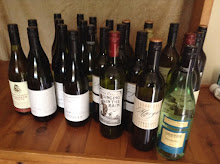
To say the wine flowed would not be an exaggeration.
And today is their 40th wedding anniversary.
Congratulations, guys!

Sunday, May 01, 2011

pH Day

pH is the measure of the acidity or basicity (alkalinity) of an aqueous solution.
Pure water is neutral and has a pH of 7.0
Solutions with a pH of less than 7.0 are acidic, more than 7.0 are alkaline.
In wine production we usually work with pH levels between 3.0 and 4.0
In practice white wine should have a pH between 3.1 and 3.4 and red wines 3.3 to 3.6
Why is this so important?
From a drinking point of view, acidity accentuates the fruitiness and balance of wine.
However from a oenological point of view, the 'correct' acid levels have a bearing on the antimicrobial and antioxidant properties of the sulphur dioxide that is added to the wine as well as encouraging growth of desirable micro organisms, inhibiting microbial spoilage and aiding in the clarification process.

While sulphur dioxide is added to wine, it's the molecular sulphur content of the 'free portion' of that addition, as opposed to the 'bound portion', that is most affective.
The amount of molecular sulphur is dependent on acidity
Therefore simply put, the lower the pH, the more molecular sulphur is available to do its work.
Our wine region is considered 'warm' in viticultural terms.
This means the grapes ripen relatively rapidly with an associated degradation of acid.
In general all our grape juice, in particular the reds, can have a low acidity in wine terms (pH of around 3.5 to 4.0) at harvest. And pH becomes even higher during the fermentation process as well as after malolactic fermentation.
In Australia we are allowed to add acid to compensate for this.
So to get our juices and ultimately our wine to the correct pH level, tartaric acid is added. This acid is a natural acid component of the grape juice in any case.
But we need to know first what the pH of the wine is.
This is done with a pH meter.
There are some pretty sophisticated pieces of equipment around but we use a basic hand held unit.

First job is calibration. This is carried out using two commercial solutions of known pH, in our case, 4.0 and 7.0.
Once the unit is calibrated, the wines are tested.
Then, when the pH is known then, we can estimate the amount of acid to be added.
And I mean estimate.
There is no formula relating to acid addition and pH drop due to the 'buffering' capacity of wine which we wont go into here.
So it's a matter of adding acid in progressive amounts from 4 to 1 g/L until the required level is achieved. Doing a test run on a 1L sample initially will give some indication however.
The acid is dissolved into a minimum amount of water and added to the wine.
So I did this with three of the four 2011 wines as the Semillon at pH 3.4 was ok.
After a few hours or so I tested them again. And as usual they all needed more.
So the task was repeated until satisfactory levels were reached.
So what about titratable acidity (TA) I hear some of you ask.
I can say I used to do it but eventually questioned the necessity so now rely on pH (and my palate) only.

Monday, April 25, 2011

Easter 2011

To us Easter is hot cross buns on Friday and chocolate eggs and/or bunnies on Sunday.
The co driver had never seen HCBs before her travels to Australia. They are a UK thing with a bit of an interesting history.
She likes the newer chocolate chip version while I prefer the traditional spiced currant and raisin type.
They have been available in our supermarkets for months now, almost as soon as the Christmas decorations were taken down. Some bakeries produce them year round.
Sort of spoils the uniqueness of them but, hey, that's the way things are these days.
Easter is also crowded beaches, long supermarket queues and traffic snarls trying to get around and especially into town.
The big deal in town is the Blessing of the Fleet Ceremony and Easter Parade on the Sunday morning followed by Beach Games in the afternoon and finally fireworks around the harbour just after dark. There is always a range of carnival rides, displays and activities throughout the afternoon and plenty of live entertainment.
This year at home we had a female invasion.
The daughter brought down some friends she had met on her travels, one from Mexico and one from the UK.

Four to one is a bit of an unfair ratio but I survived.
Isabel made us wonderful Mexican food and Andrea kept us entertained by her amusing stories of teaching English in China over the last year or so.
Both leave for home soon. Come back to see us sometime!
And yes I know the daughter 'owes' us more Italy trip reports.
She is "getting around to it".

Wednesday, April 20, 2011

Sunday, April 17, 2011

Jerusalem Artichokes

Neighbour Gail, up the back, has a huge permaculture garden.
She supplies us with the freshest salad vegetables and herbs on a weekly basis.
She is also growing a few unusual things.
One, for us anyway, is Jerusalem Artichokes.
Having not come across these before we did some research on how to cook them and found out that they are a native plant of North America. The tuberous root is the part of the plant eaten.

We also read that they contain inulin which cannot be broken down by the human digestive system and this can cause flatulence.
In fact Gerard's Herbal, printed in 1621, quotes the English planter John Goodyer on Jerusalem artichokes as saying "which way soever they be dressed and eaten, they stir and cause a filthy loathsome stinking wind within the body, thereby causing the belly to be pained and tormented, and are a meat more fit for swine than men."
Believe us this is more than true!
Be warned!

Wednesday, April 13, 2011

Vintage 2011 Ends

We picked the Cabernet Sauvignon which came in at 12.1 Be' and 3.7 pH.
The fruit was in pretty good condition.
The grapes were crushed and inoculated with same Italian red wine yeast culture that was used on the other reds. French oak mini staves and MLF culture were added to the must.
Fermentation began within 12 hours.
After a week of punching down the cap four to five times a day, the wine was pressed and drained and the free run together with the pressings transferred to a stainless steel tank.

The oak staves were recovered from the marc and added back into the wine.
The marc was returned to the vineyard rows.
The wine was allowed to settle for a week and then racked off the fermentation lees. We established that MLF was complete so the wine was sulphured and egg white added to begin the fining process.
In the coming weeks and months, all the 2011 wine will be racked off their fining lees, sulphur added and in the case of the reds, pH adjusted.
The Semillon should be ready to drink by June and the reds by the end of the year.
Hopefully 2012 won't be as difficult a year, viticulturally, as this one has been.

Saturday, April 09, 2011

Black Cockatoos

Everyone is pretty familiar with the Australian white or sulphur crested cockatoo. They are a favourite pet around the world. Its range extends throughout the northern and eastern part of the mainland as well as Tasmania. Its popularity as a cage bird has increased its range as these birds either escape or are released deliberately in areas where they do not already occur. The species has become a pest around urban areas where it uses its powerful bill to destroy timber decking, railings and panelling on houses. I once saw one for sale in the USA in a pet shop at a price that I estimated that sometimes I could have around half a million dollars sitting in the surrounding trees. They are particularly fond of our lemons. The black cockatoo is less well known however.

There are five species with a number on the endangered list eg. the red tailed black cockatoo. We have visits from the yellow tailed black cockatoo which is a pretty large bird and is easily identified by its mostly black plumage with most body feathers edged with yellow. It has a yellow cheek patch and yellow panels on the tail.
They love to eat the new pine cones from our huge radiata pine growing beside the guest house. They have a distinctive mournful call and fly about in flocks of around ten or so. They always remind me of a squadron of Lancaster bombers, with their slow cumbersome flight.
When they descend upon our tree there is always some chaos. Lots of noisy screeching and squabbling over the cones and a definite lack of table manners as they drop the half eaten fruit onto the metal roof.
Sometimes it sounds like a machine gun going off.

Monday, April 04, 2011

Jude's Jelly

The Lilly Pilly (Syzygium sp.) is a genus of rain forest trees growing in Australia and South East Asia. They come in all sizes and have been adapted well to cultivation and are seen in a lot of gardens and as street trees.
Most have dark green glossy foliage with red to bronze coloured new growth and lots of colourful flowers in summer and eventually small round fruit in bunches during autumn.
We have them growing in profusion, wild, along our creek banks. Ours usually have bunches of white fruit. What this exact species is, is hard to say.
One of our ex neighbours planted many of these trees (species again not known) around his property boundary.

This year due to all the rain they have fruited prolifically. Huge bunches of purple berries are weighing down the trees.
We 'oldies' in the neighbourhood realized what a bounty this was.
So neighbour Judy was out collecting them to make Lilly Pilly jelly.
And how delicious is it!
Took me back to my childhood as we had a tree growing in our backyard and my mother always made jelly from the fruit.

I guess this brings up the jam/jelly/jello language issue.
Jam to us is any fruit boiled up with water and sugar and allowed to set, then eaten on bread or toast ie. the USA jelly. Also sometimes called conserve here while the result of this process with citrus fruit is called marmalade.
Jelly to Australians is first and foremost the dessert made from flavoured gelatin ie. the USA jello.
Another jelly to Australians is jam that has been strained through a cloth during the cooking process which produces a clear fruit spread eg. Jude’s great Lilly Pilly jelly.

Sunday, April 03, 2011

A Nocturnal Visitor

When you are being lazy and not taking the garbage and recycling to the bin, expect to have an alternative clean up service arrive during the night to help out. In this case it was a brush tailed possum. He/she showed no fear. Guess the taste of a week old rye bread crust was just too good to resist. There are lots of these little guys living around us. We just have to make sure they don't find their way into our roof space during the winter. One took up residence in the top of the chimney of the guest house one year and was not happy at being physically removed. I now have a spare pair of thick leather elbow length gloves should anyone want to try this.

Saturday, April 02, 2011

Fish, Milk, Eggs and Nuts in Wine?

For those that bother to look closely at wine labels, it may be a surprise to see sometimes written there in the small print 'may contain traces of fish, egg, milk and nut products'.
What's this all about?
Newly fermented wine contains a lot of solid material in suspension. This can settle out naturally but will generally take a long time. To make the process quicker a process called 'fining' is used.
Fining means the addition of either natural or synthetic materials to wine to clarify and stabilize it. Particles in suspension are carried down with the fining agent to form a deposit on the bottom of the holding vessel, in our case a tank. The clarified wine is then racked (decanted) off this layer.
Historically, a wide variety of agents have been used for fining eg. ox blood, egg whites, milk casein, fish bladders, horse gelatins, seaweed, clay and others. In fact, almost any protein will work to some extent by binding to other proteins and forming the solid deposits.
During the prebottling filtering stage most of the remnants of these fining agents are removed but minute quantities can remain. In this litigious age however, wine companies will put a warning on their labels to cover themselves.
Here we use bentonite, a special clay, to fine white wine. Not only does it aid in clarifying the wine but it also removes heat unstable proteins which can cause hazes in the finished bottled wine. We make up a water slurry of the material based on 0.8g/L wine and add it to the ferment.
I guess this clay is not an allergen so it's never mentioned on labels.
For fining red wine we use egg white which is carefully mixed into a solution with water and a little salt which helps dissolve the protein. One egg white/200L wine seems to do the trick. The yokes we use in omelettes.
Other wineries in the area use milk to clarify their white wines. Here it is the casein content that does the work.
Isinglass is made from the swim bladders of certain fish and is also used to fine white wines.
So what about nut products?
This was new to me also.
It is allowed to add tannin to wine, predominantly reds, that are lacking it. Tannins come from the grape skins (and seeds and stalks) as well as the oak and give that dry puckering feeling in the mouth after swallowing red wine. They are an important component as they help give the wine structure and texture. Most tannin products used in the industry are grape derived but some are indeed tree nut derived eg. chestnuts.
Hence the allergen warning for the latter, not the former.

Thursday, March 31, 2011

An Autumn Morning at the Beach

The strange weather continues. A few days fine, a few days raining. It looked quite threatening with dark skies on Wednesday but we headed down to the beach for a swim and a walk.
However the ocean was very rough so a swim was out.
Everyone else must have thought it was a non beach day as there was only us plus a few seagulls.


That afternoon there was bright sunshine, blue skies and temperatures around 30 deg C!
So much for the weather bureau's forecast of cool and cloudy.

Monday, March 21, 2011

Autumn Flowers

In celebration of the Autumn Equinox, here are some flowers currently blooming in our garden.


Sunday, March 20, 2011

Malolactic Fermentation (MLF)

Grape juice and the resultant wine contains quite a number of acids, the main ones being malic and tartaric.
The amount of acid in a wine is known as titratable acid (TA) and the acid strength is known as pH. Acid is an important component of wine contributing to taste (balance) as well as the chemical reactions that take place during the wine making process both natural and winemaker induced.
Malic acid is very tart and somewhat unstable in wine.
To improve the acid taste and increase the stability of wine it is prudent to convert this malic acid into the softer and more stable lactic acid, particularly in red wine.
This is done by introducing lactic acid bacteria (LAB) either as a culture or by natural means from the bacteria already present in the winery.
We use an Oenococcus oeni culture which is added to the fermenting must.

These little fellas (the white ones) get to work 'consuming' the malic acid and turning it into lactic acid and carbon dioxide. The evolution of this gas is the reason the process is called a 'fermentation'.
Improved wine stability comes about from not letting this process happen when the wine is in the bottle with obvious dire results ie. blown out corks and shattered glass.
MLF however will not take place in the presence of sulphur dioxide which is added to wine as an antioxidant and antibacterial agent. You see this as 'Preservative (220) Added' written on a wine label. This means we have to leave the wine unprotected until the MLF process is complete.
This is always a bit of a nail biting time in a simple Vin de Garage winery so this is the reason we add a culture ie. to get the process going and finished as quickly as possible.
The only sure way to detect if MLF has occurred is with a paper-chromatographic test.
In the meantime Vintage 2011 continues with the Semillon racked off the fermentation lees (dead yeast cells) and bentonite (clay used for stabilization and clarifying) residue and sulphuring. Now we just wait until all the remaining solids settle out and the wine clarifies. This may necessitate another racking or two plus sulphur additions.
The Tempranillo has gone through MLF and has been racked off the fermentation lees, sulphured and egg white added to begin the clarification process.
We are waiting for the Pinot Noir to complete MLF.
It continues to rain and rain. So far the Cabernet Sauvignon is holding up but experience has shown that a 'collapse' of bunches can occur virtually overnight eg. splitting.
So we are ready to pick at a moment's notice. It could be we are forced to make Rose' from this grape variety this year.
Only time will tell.

Monday, March 14, 2011

Vintage 2011 Continues

We have picked the Pinot Noir which came in at 13.5 Baume and pH 3.5
There were small patches of botrytis which were easily handled so it was not a bad result for a difficult year.
I am trying a new red wine yeast this year. It is an Italian strain of Saccharomyces cerevisiae and was supposed to be a fast fermenter that brings out the flavour of red grapes.
It worked well on the Tempranillo and is fermenting the Pinot Noir quickly too.
The ferment gets quite hot, around (30+deg C), which helps extract plenty of colour from the skins. Light coloured Pinots are always an inherent problem. But to prevent it getting too hot meant punching down the cap (mixing the skins that float to the top of the fermenting wine, due to the carbon dioxide being released, back into it) a few more times a day than normal including a late one just before bed and an early one before breakfast. I will let it sit a while in the sealed tank after fermentation finishes in an effort to extract more colour.
The malolactic fermentation culture and oak chips have already been added to the wine at this stage.
I have always used a wine yeast culture for fermenting wines ie. commercial strains of Saccharomyces cerevisiae.

This yeast quickly dominates the fermentation while repressing wild yeasts. This ensures a reliable and predictable fermentation.
However different S. cerevisiae yeast strains can have differing physiological and fermentative properties. This means the actual strain of yeast selected can have a direct impact on the finished wine so it's good to try different ones.
Yeasts are normally already present on grape skins ie. the grey bloom. Fermentation can be done with these endogenous "wild yeasts", but this procedure can give unpredictable results, which depend upon the exact types of yeast species present.
A lot of wine makers experiment with wild yeast fermentation. They are said to produce atypical flavour profiles and/or increased complexity in wines. With my relatively primitive production set up there would be a risk of wine spoilage using this method.
But one day it might be one worth taking.

Thursday, March 10, 2011

Vintage Helpers

During harvest four hands are always better than two.
The co driver is now an expert picker and all round cellar hand.
No longer does she complain about being covered in spiders and bugs as she makes her way down the rows snipping off bunches and quickly filling buckets.
And she is a deft bucket handler and stalk remover at the crusher/destemmer too.

The clean up process after crushing is very important. Getting rid of the residue of stalks and spilled grapes stops the usual invasion of annoying vinegar flies and helps prevent the development of wild yeasts within the winery area.
Cleaning the equipment to be ready for the next crush is similarly important.
I usually do this in the backyard. There is always a pile of grapes washed out of the crusher.
My cleaning staff of bower birds and currawongs is always waiting in the surrounding trees and at the ready to make short work of those. After all, the netting has been preventing them getting to the ripening grapes for weeks.
But this morning we had a new member of staff at work. Life in the country is great.

Tuesday, March 08, 2011

Vintage 2011 Begins

With the weather still not cooperating and forecasts predicting a wetter than normal Autumn under the influence of La Nina, we bit the bullet and started harvest.
First off was the Tempranillo. Fruit quality was down on previous years as was yield.
Sugar level was 12.5 degrees Baume' and pH 3.5.
Under the circumstances we were not too disappointed. A higher Be' (with a resultant higher final wine alcohol level) would have been nice however.

The Semillon came in at 11.5 Be' which is acceptable for wines made from this variety of white grape. The pH was 3.4
The fruit has been affected by botrytis much of which we managed to manually sort through and discard. It will be interesting to see if that fungus has any affect on the resultant wine quality particularly its oxidation 'resistance'.
Anyway, both are currently fermenting away and there is the usual fragrant smell wafting around the house.
Next we will be turning our attention to the Pinot Noir.
The Cabernet Sauvignon has a long way to go as yet.