Thursday, May 27, 2010

Rain!

Just when I had started transferring water from a spare tank into our main one and was considering another whinging post about the lack of rain, the heavens opened up on Wednesday and dumped 75mm on us in 12 hours. My little rain gauge could hardly cope.
Tanks were overflowing, dams were filling, water was pooling in the paddocks and even the creek had some water in it although one has to be a real optimist to say it is flowing.
We missed out on the main downpour, however. In the 24 hours to 9am yesterday Moruya, an hour's drive to the south of us on the coast, received 145mm. This was its highest May daily fall in nine years.
The Bureau of Meteorology says the rain event was caused by a trough across the country and a low pressure system in the Tasman Sea.
Rubbish!
I say it was caused by my washing of the car a few days ago, one of two such annual events.
And we are expecting more on the weekend.
Send her down, Huey!*

*'Huey'. Australian Slang. A jocular name for the powers above used when encouraging a heavy rainfall, good snow or good surf. Also, 'Hughie'.

Saturday, May 22, 2010

Sometimes Size Does Matter

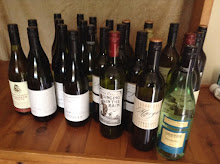
"Uncle" Stirls retired from his job is the liquor industry a few weeks ago. Among the farewell presents he received were many bottles of good wine and a few came in magnums ie. 1500mL or the equivalent of 2 standard bottles.
The bigger the bottle the better the wine is supposed to age. The proportion of air in the ullage space to the volume of wine is lower in bigger bottles. Ageing is therefore slower.
He brought down a magnum of Lawsons 1999 Padthaway Shiraz for us to share.
A nice soft fruity and spicy wine, quite high in alcohol (14%), that went great with our pepper steak.
The magnum got me thinking about the bottle sizes that wine comes in and off the top of my head I could think of about five, especially when it came to champagne.
But when I did some research I found there were a lot more.

Volume (litres).....................Bottle
........0.1875 ...................................Piccolo
........0.25.......................................Chopine
........0.375......................................Demi
........0.378......................................Tenth
........0.5.........................................Jennie
........0.620......................................Clavelin
.......0.750.....................................Standard
........0.757......................................Fifth
.........1.5........................................Magnum
.........2.25......................................Maree Jeanne
.........3.0........................................Jeroboam
.........4.5........................................Rehoboam
.........5.0........................................Franzia
.........6.0........................................Imperial or Methuselah
.........9.0........................................Mordechai
.......12.0........................................Balthazar
.......15.0........................................Nebuchadnezzar
.......18.0........................................Melchior
.......20.0........................................Solomon
.......25.0........................................Sovereign
.......27.0........................................Primat
.......30.0........................................Melchizedek

Bottles also come in different shapes and colours which can help identify the wine style and region (mostly in Europe) of the wine. But that is maybe a subject for another post.

Friday, May 21, 2010

When Is a Native Plant Not a Native Plant?

Living is a rural area we are able to buy a large range of items at roadside stalls and ex farm gates. Things like fruit, vegetables, eggs, wine, honey, firewood, plants, horse and cow poo, puppies, kittens and pet birds all come to mind.
Australian wild flowers are another.
However the vast majority of the latter offered for sale are Proteas.
While a beautiful flower, they are NOT Australian.
They are an indigenous and national flower of South Africa. The South African cricket team is even named after it.

Why the confusion (or deception)?
Proteas are a member of the Proteaceae family whose ancestors grew in Gondwanaland 300 million years ago
Taxonomically, Proteaceae is now divided into two subfamilies: the Proteoideae, best represented in southern Africa, and the Grevilleoideae, concentrated in Australia and South America. Africa shares only one genus with Madagascar, whereas South America and Australia share many common genera. This indicates these continents separated together from Africa before they separated from each other.
The Australian family consists of Banksia, Embothrium, Grevillea, Hakea, Dryandra, Watatah and even the nut bearing Macadamia.
Below is a picture of a Banksia. The likeness to the Protea, especially with the leaves, is obvious.
I guess because tens of thousands of native plants are growing in the bush and their flowers are there for the taking (not from National Parks, of course) the vast majority are of no commercial value cultivation wise. The Proteas on the other hand are not wild and have to be 'farmed'.
That is not to say Australian natives are not cultivated in some areas for cut flowers. Many of the more 'showy' species are. They include the Western Australian Banksias, Kangaroo Paws, Geraldton Wax, Boronia and the New South Wales Waratah (below).

Monday, May 17, 2010

Another Hunter Valley Trip

The co-driver had enrolled in a day seminar in Newcastle which lies at the mouth of the Hunter River, about 160km north of Sydney. It is the second biggest city in New South Wales and the biggest coal exporting port in the world.
About an hour’s drive to the west of the city is the Hunter Valley wine region. So after dropping the co-driver off for her 9am start, I headed for the region’s centre, Cessnock, to begin a Semillon buying tour. There are plenty of wineries to visit in the area ranging from the old family owned through to the large corporate as well as smaller boutique operations. The area also caters to the tourist crowd as it is only a couple of hour’s drive from Sydney. There are plenty of places to stay, eat, buy non wine produce as well as play golf on some pretty swish courses.
My first stop was McWilliam’s Mount Pleasant Estate. This pretty vineyard is situated on the slopes of the Brokenback Range and was established in 1921 by legendary winemaker, the late Maurice O’Shea.
Vines however were first planted in this area in 1880.

The Griffith based McWilliam family, already a famous Australian wine company, purchased a half share of Mount Pleasant Estate and encouraged O’Shea to continue with his winemaking style and creations. McWilliam’s acquired the remaining share in 1941. The winery is famous for its Semillon and Shiraz, the signature wines of the Hunter.
Next on my visit list was the Small Winemakers Centre which carries a range of boutique winery stocks. I was specifically after some Thomas Wines 2009 OC Semillon that is picked a little riper than the normal Hunter Valley Semillon and therefore has a fuller mouthfeel but still maintains the traditional citrus/mineral flavours. This wine never disappoints no matter what the vintage.
Then it was onto Tyrrell’s Wines. This property was established in 1858 and a winery built in 1863. It is still in the same family’s hands today.
Murray Tyrrell took over in 1959 and witnessed and catered to the change in Australia’s wine drinking habits during the next 20 years. He was always an advocate of the Hunter and always had a lot to say about how things should and shouldn’t be done in the wine industry. He wore the badge of ‘Mouth of the Hunter’ with some pride. He embraced a lot of new technology and rejected much. The winery is a perfect example of this. For example, rows of stainless steel tanks but open wax sealed cement fermenters, side by side and a barrel room still with its orginal dirt floor. He is credited with introducing both Chardonnay and Pinot Noir to the Australian wine industry. I had the privilege of having a few breakfasts and dinners with him during Hunter wine events over the years and he was always fun to be with. He died in 2000 and I found a staff memorial to "The Boss" hidden away in some very old Shiraz vines with his beloved Brokenback Range as a backdrop.

By this time the whole area was filling up with the weekend tourist crowd and tasting room staff were starting to get hassled. Serious wine conversations then take second place to sales. So I decided to head even further west another 35 km to the Broke-Fordwich sub region of the Hunter.
Here I called in on the Krinklewood Vineyard. The 20ha vineyard is comprised of classic Hunter varieties of Semillon, Chardonnay, Verdelho & Shiraz, with younger plantings including Viognier, Mourvedre and Tempranillo. This vineyard is grown under biodynamic principles. Can I taste a difference? Not really.
I was the only visitor so got the full attention of the nice Kiwi cellar lady. I was only there to get some Semillon but was pressed into trying their Verdelho, Chardonnay, white blend (Wild White) as well as a blended Rose’.
Their Semillon is very light in alcohol, 9.8%, and the wine displays ripe citrus flavours, a tight acid line with a refreshing finish. Just what I like. I couldn’t resist their Verdelho either. This wine has lifted aromas of melon fruits and citrus. It has a soft, ripe, fruit driven palate which is perfectly balanced by a long crisp acid finish.
I managed to ‘escape’ before the reds were brought out!

Then it was onto the Margan Estate. I have been a customer of theirs for many years and they have just moved their sales operation and restaurant out to Broke from the lower Hunter. It is a very impressive set up.
The 2009 Semillon is again one of the riper styles. It displays a bouquet of fresh lemon and lime with hints of fresh hay. The palate is long, lively and textured with balanced acidity and a long finish.
The 2009 Verdelho is a blend of three wines made from grapes from the same block harvested at different times of the vintage. It displays a fragrant lifted bouquet of citrus, tropical fruits and some spice. The palate is a combination of citrus and tropical fruits with a touch of spicy green apple. The clean acidity ensures a long crisp finish. Couldn't resist this one either!

By this time the back of the car was filling up with boxes so an economic rational decision was made to head back to Newcastle a bit earlier than planned.
But this turned out not to be such a bad idea.
I ended up at Nobby’s Beach just out of town at the mouth of the river for a relaxed afternoon sitting in the sun with a good book.
At least the bank didn't call me this trip to ask whether I was still in possession of my credit card!

Tuesday, May 11, 2010

Roses

Roses have traditionally been planted at the end of vine rows. The plant is susceptible to the same fungal diseases as grapevines, mainly downy and powdery mildews, and their planting is supposed to give an early indication of a fungal attack and allows management to apply curative chemicals to the vines.
Most vineyards however apply fungicides systematically so the use of roses is now generally for aesthetic reasons only. On a recent trip to the Hunter Valley wine region I came across some pretty blooms at the Tyrrell's Vineyard


Friday, April 23, 2010

An April Update

All is fairly quiet at home now our visitor has gone. We are not doing a lot out of the ordinary and have slipped back into our 'lazy' south coast lifestyle with ease. As a result the pics below are of some autumn flowers from our garden rather than any activities.

Well, according to the calendar and some of our trees and plants it is autumn but the climate god don't know this yet. Today is 27 deg C and the ocean is still warm enough for swimming.
Around this time of year I usually get stuck into the more physical farm jobs because it's cooler. Early morning is fine for this but then we both hear the call of the beach around 10am as the day heats up. I have been spraying off the dreaded tussock in the paddocks.
It's a pretty mindless task and it takes the spray around a week to show any affects so it's a matter of doing the area in patches and then going back to tackle those missed. I could use a marker dye in the back pack but people in the supermarket tend to stare at you if you are a bright fluoro pink colour. Also it's snake activity time with their establishing territories before hibernation so you have to be careful where you tread. We found one in the garage the other morning. As much as I don't really like doing it he is now in snake heaven. They should read the rules: "being within 200m of the house is prohibited".

We have started fishing again mid afternoon when the tide is right. It's great to be down the beach early evening this time of year. Surf is never really big and it's virtually windless. And the gutters and holes are full of Australian salmon. Not too good to eat but one heck of a sports fish. I took down a rod with too light a line last night and was broken off five times. Have increased the hardware for this evening's encounter.
The co driver went to the tackle shop this morning on her way home from the gym to pick up some gear for me. I got the inevitable phone call from the proprietor wanting to know what it was I actually wanted. I don't think things started well when she asked on entering the shop, "are women allowed in here?"
Wine wise things are also quiet. Everything we made this year is in the tanks 'doing their thing'.
Planning for our South Australia trip is well in hand. Looks like we will be away around four weeks in July/August and will have to drive over 5000 km. We will be covering the western plains of New South Wales, the fringes of the outback at Broken Hill and Wilpena Pound, the wine regions of the Murray Irrigation Area, Clare Valley, Adelaide Hills, McLaren Vale and Coonawarra as well as the beaches of the Fleurie Peninsula and the Limestone and Shipwreck Coasts.

Monday, March 29, 2010

A March Update

A few trips to Sydney this month due to our visitor and a birthday party. A few more next month too due to a 65th, a medical appointment and our visitor's departure. I think that is more trips up that way in a month than is usual for the whole year!
Anyway, we have had the opportunity to confirm that living down the south coast is far more preferable than in the city......any city.

The daughter had a lovely 30th at Ripples on Chowder Bay with 16 of her closest friends and family. During the weekend, we showed Crystal around some of the northern harbourside suburbs and the CBD, particularly Circular Quay and The Rocks ie. the original Sydney. The daughter took her to a couple of southern city beaches , including Bondi, and managed to fit in some Sydney nightlife the following weekend. They apparently ran the gauntlet of a few bars between the gay end of town and the red light district! But seriously, Kings Cross/Darlinghurst is not as 'bad' as it used to be and the carnal activities are concentrated in one area and generally can be avoided. And there are always plenty of people around until the late wee hours.
During the last weekend while the girls 'played', we headed up to "Uncle" Stirls place at Umina and investigated a bit more of the Central Coast while he was at work. The Entrance is an old fashioned Australian sea side town and they have done a lot to preserve that atmosphere. We enjoyed fish and chips and a hamburger by the water and watched the world go by.

On the wine scene we have picked the Cabernet. It came in at 12.0 Baume which is satisfactory. We had some additional help with this last harvest of the year which made things easier and had it all done before lunch. It was good timing as the rain set in once we returned from the 'big smoke'.
The must is currently bubbling away in the fermenter.

Monday, March 22, 2010

'My' Tree Has Gone

Across the highway from us is Meroo National Park. It used to be Termeil State Forest and had been logged for many years previous to its change of status, so much in fact, there is little old growth forest left.
Timber is a major industry in our part of the world with the main wood harvested coming from the spotted gum or Eucalyptus maculata. Left to its own devices the tree can grow up to 50 metres in height and 1.4 metres in diameter. It is normally tall and straight and easily recognised by its smooth, dimpled bark which is shed in summer, producing a mottled cream and grey 'spotted' appearance.
The timber makes good tool handles because it is very strong and is able to take shock. It is also ideal for heavy construction work in housing, piles, power poles, shipbuilding, weatherboards and flooring.
On the road into Meroo Head opposite our road stood a very big example of this type of tree. I often admired it as a survivor because it was obviously old growth but had been spared the axe and chainsaw. This was due perhaps to to its very peculiar shape that made it pretty useless as timber.
But the other morning I saw it had come down over the road and had been cut up to allow traffic through. The dreaded borers had finally done it irrepairable damage.
I got out the tape measure and found it had a radius of around 1.1 meters. Averaging out the width of the growth rings and doing some mathematics I estimated it to have been around 250 + years old.

Sad to see it lying there in pieces now but the road to Meroo Head will suddenly have a pretty imposing gateway well into the future

Friday, March 19, 2010

"Our" Beach

Just about opposite the entrance to our road, across the highway, is the track to Meroo Head and Termeil Beach which are part of the Meroo National Park. Considered 'our' beach, we hardly ever go there due to the chronic poor state of the road and the usually dangerous swimming conditions.
But it is a pretty beach, very wide, quite isolated and quiet except during holiday times when the campers descend on the place in their hundreds.
At the northern end behind the sandhills lies Termeil Lake into which our creek empties, when it is running that is. Over the headland to the south is Meroo Lake. Both are part of the estaurine lake system that is an important part of the south coast environment.
Within the headland is a secret cove. It is a great place to be during the winter when the southerly winds are blowing. Facing north it captures the sun for most of the day and turns into a virtual oven which is great on those cold days. It is protected from the surf by a small reef littered with deep rockpools.

We took Crystal for a visit and enjoyed a few hours soaking up the sun and walking the beach.

Thursday, March 18, 2010

Another Day, Another Beach

Today we headed for my favourite beach. Known to surfers of the area as 'Sandmines' because of an old and now long gone sand mining operation in the vicinity, it is more properly known as Racecourse Beach.
South of Bawley Point and quite a walk in from the road, it is a great year round surfing spot. In summer, the nor' easter blows off shore and the sand banks here can hold a wave of good size. I have ridden it at 3m (10ft). It usually has both left and right peaks and sometimes these extend down the beach from the headland.
Today only a few surfers were there and the swell had increased considerably since yesterday. Despite not being a top class surf most were having fun.
The beach is on the southern fringes of the Murramarang Aboriginal Area of 60 ha and comprises the headland of Murramarang Point, sand dunes along Murramarang Beach to the north and part of a small lagoon.
The Aboriginal area protects the largest complex of middens on the south coast and is one of only three archaeological sites on the south coast dated to the Ice Age. It contains a dense concentration of stone artifacts and shell, mammal, fish and bird bones. The variety of tool types including rare bone tools illustrate a long history of occupation.

The area was a meeting place for a number of Aboriginal tribes until after settlement of the country by Europeans and is part of a cultural landscape linked to other places along the south coast. Burials took place on the headland and the area is said to have been the site of a massacre during the late nineteenth century. The Aboriginal area has very high traditional and contemporary cultural significance to Aboriginal people and is managed in accordance with the wishes of the Aboriginal community to protect this significance.
A walking track has been built through the area and a detailed interpretive brochure is available. It is an interesting place to spend a few hours. But we chose not to do the walk this time round as I have found it to be a little bit 'snakey' during the summer and Crystal is not orientated quite yet to deal with all Australian wildlife.
However we enjoyed a few hours watching the guys do their thing before heading home.
By the way this is the place where my ashes will be scattered when the time comes, just off the rocks in the above picture.

Wednesday, March 17, 2010

A Favourite Beach

We have around 20 beaches to choose from, all within a 20 minute drive from home. We usually choose one based on swell and wind direction. Most are deserted during non holiday time.

We have been visiting a few with Crystal during her stay with us. Shell Beach is one of my favourites. Protected from the north easterly sea breeze that predominates during summer, the water always seem bluer and the sand whiter than others. And the surf is usually pretty good too. The rocky headland has plenty of rockpools to explore with lots of sealife. This is where we went on Wednesday afternoon.

Sunday, March 14, 2010

March So Far

The co-driver is a quilter. Before meeting her I didn't know much about quilting apart from what I had seen in the movie "How to Make an American Quilt".
But in South Dakota pretty much all her family and friends are involved. And I must know just about every quilt shop in that state plus those in Northern Iowa and Nebraska, Minnesota and even Grey Bull, Wyoming! And of course when travelling around Australia we are always armed with a list of quilting stores on the route we are taking.
Anyway, the point of this story is that about 7 years ago she began a quilt that was influenced by the colours and light of her adopted country. It is finally finished and it is beautiful!
Niece Crystal arrived a week ago from co driverland and we have been introducing her to the quiet life we lead.
Despite the weather being a little uncooperative at the beginning of her visit (we refuse to complain about the rain), we have beached it a few days and introduced her to ocean swimming and the surf. We have also found some native animals to be up close and personal with as well as investigated some of the shops in the towns in our vicinity. She has also been trying out a few typically Australian food items including meat pies and hot crossed buns and even tried an oyster. The latter did get the thumbs down. However a traditional roast lamb dinner passed with flying colours. And whether she likes it or not she has been subjected to quite a few rugby games.

My wine stash has also been taking a bit of a beating but there is plenty left in the tanks. All the new wines are looking good. No joy at the Milton Show as far as wine awards this year however will try harder next time. I think the 2010 Tempranillo looks like an exceptionally good one.
The five bulls went off to market with little drama. The 'girls' don't seem to miss them. Average price was $1.05 kg so was satisfied with that.
This weekend we are heading to Sydney for the daughter's birthday and a bit of sight seeing around Sydney.
This will give the two ladies a chance to do some real shopping!

Wednesday, March 03, 2010

Winter Olympics Wrap-up

We have been somewhat glued to the TV watching seventeen days of Winter Olympics.
The coverage we received from our four dedicated satellite channels was outstanding. We got every event 'live' during our day from early in the morning and replays during our evening, all commercial free. They even gave us the option of watching the four channels at once on a split screen. This was, even for us, a little OTT.
The co driver really enjoyed all forms of figure skating although I think at the end she had bit of blade indigestion. But then again she was almost immovable for the final "Gala Event". I liked some of it although I found the ice dancing a bit repetitive. Lots of arm waving.
We also liked the downhill, ski jumping, ski cross, board cross, aerials and half pipe. Despite the tragic beginning to the luge/bobsleigh events this was probably the most exciting for me. The skeleton riders must be some of the bravest athletes in the world.
I struggled with the hockey but guess you have to grow up with it to be a real fan. I got a very distraught e-mail from a Canadian friend after the USA beat them in the initial round.
Luckily the Canadians eventually won the gold medal so I didn't have to put him on suicide watch!

Now an admission. I was enthralled by curling! Loved every moment. High drama in slow motion. To some it's like watching paint dry or grass grow but not to me.
How did Australia do?
Two golds, Torah Bright in the half pipe and Lydia Lassila in the aerials, and a silver for Dale Begg-Smith (an ex Canadian) in the moguls.
There were also nine top-10 performances in what will go down as Australia's most successful Winter Olympics.
Not too bad a result.
The Australian Institute of Sport is an Australian Government sponsored body set up to train elite athletes. It offers 38 sport programs in 29 sports, with a varying number of scholarships offered annually to Australia’s finest sportsmen and sportswomen. In 1998 it set up a winter sports program which has resulted in the country having some success, albeit small, in the Winter Olympics and associated Winter World Cup events.
Vancouver did a wonderful job and the mountain areas looked stunning most days before the weather closed in.
Now we can’t wait until 2012 for the London Summer Olympics but first, there is the Rugby World Cup in New Zealand in 2011.

Sunday, February 28, 2010

A February Update

The second rain event dumped 140mm on us bringing the total to 220mm for two weeks. Finally the ground seemed to get saturated with puddles forming, run off beginning and the dams filling. Still our creek refuses to run but the spring has burst back into life. According to the weather bureau it has been the wettest February in 8 years.
So for the time being our water problems are over.
Below is a weather radar shot of our area during that week. It’s been a long time since we have seen that kind of picture.
We have picked, crushed and pressed the Tempranillo which came in at 13.0° Baume which is right on my preferred sugar specification. I guess the rain didn't affect it much from a juice dilution point of view. However there was some shrivel as a result of the drought induced leaf loss earlier in the season as well as some botrytis, so ‘it was time’.
The Pinot Noir has been pressed with egg white added to settle the solids and French oak chips to impart an oaky flavour. We are just waiting for malolactic fermentation (MLF) to take place so we can add sulphur to stabilise the wine and then let time and chemistry do its work.

MLF is a process where lactic acid bacteria convert the harsh malic acid in the wine to softer lactic acid. This will normally occur naturally but I had added a lactic bacteria culture to the juice before fermentation to help things along. It’s better to have this happen during bulk maturation in a tank or barrel rather than in the bottle. At worst exploding bottles can occur due to the build up of carbon dioxide. In the "old days" corks were just pushed out of the bottle but now with screw caps a mini bomb has been created. Apart from that no one wants to drink fizzy or ‘prickly’ dry red wine. It is a wine fault. There is quite a complicated test to determine when MLF has taken place but I just use the fact that carbon dioxide is generated (bubbles) and an increase of pH as indicators.
The major problem here is that process will only take place in the absence of sulphur so the wine is unprotected for a while. We attempt to overcome this by ensuring the tank is well sealed and there is no ullage.
The Semillon has finished fermentation and we have added 50ppm sulphur to prevent oxidation. We will wait a while until the lees (dead yeast cells and other solids) settle then rack the wine off to begin the clarification process.
We have bottled last year’s Cabernet and put one aside with a 2009 Semillon and 2008 Cabernet/Tempranillo blend to enter in the Milton Agricultural Show wine competition in early March.

I took delivery of 40 bales of lucerne hay, which will be our winter feed supplement. It is a bit early in the year to be thinking about this but the price and quality were too good to pass up. Neighbour Bob has taken my cattle into one of his paddocks to get it eaten down before he does some remedial work on it. That will fatten up the five bulls that are going to market on 1st March.
So there is a lot happening. The co-driver’s niece, Crystal, arrives in a few weeks from the USA and it looks as though she will be enjoying some early autumn weather. There is a definite feeling of that in the air already some mornings. The days are still getting to the 30° C mark so there is still plenty of beach time left. The next three months are our favourites on the South Coast weather wise.

Saturday, February 20, 2010

The South Coast Wine Show 2010

It's over for another year. Medals and Awards were presented at a special dinner at Cupitt's Winery on the 5th February. Menu with accompanying medal winning wines was:
Canapé Selection (served with pre-dinner drinks)
Freshly Shucked Oysters with Red Wine Vinegar & Eschallot
Peking Duck Pancakes
Caramelized Onion, Goats Cheese & Rosemary Pizetta (vegetarian)
Centennial NV Methode Champenoise Centennial Bong Bong Rose
Entrée
CITRUS CURED OCEAN TROUT with Pickled Cucumber Salad
Two Figs Chardonnay 2009
Coolangatta Semillon 2005
Tertini Riesling 2005
Main Course
PASTURE FEED BEEF Confit Leek and Horseradish Veloute
Belgrave Park Shiraz 2008
Coolangatta Tannat 2008
Bawley Vale ‘Bawley Storm’ Blend 2008

Dessert
CHOCOLATE MOUSSE CAKE with Berry Sorbet
or
VANILLA THYME BLUEBERRY TART
Tertini Reserve Noble Riesling 2008
Fern Gully Vintage Port 2009
Plunger Tea or Coffee


Summary of entries, top medals and awards:
164 entries from 25 Vineyards & Wineries.
10 from Southern Highlands Wine Region.
10 from Shoalhaven Coast Wine Region.
5 from South Coast Zone.
7 GOLD 13 SILVER 64 BRONZE
TOTAL: 84 medals
.
SPECIAL AWARDS:
Trophies for Best Wine of Show, Best White Wine, Best Wine Made from Grapes Grown in Shoalhaven Coast:
Coolangatta Estate 2001 Semillon - Gold Medal (Class 5 Dry White Wine – Semillon – any vintage)
Trophy for Best Red Wine:
Coolangatta Estate 2008 Tannat - Gold medal(Class 15 Dry Red Wine – Blends & Other Varieties – any vintage)
Trophy for Best Wine Made from Grapes Grown in Southern Highlands:
Tertini Wines 2005 Riesling - Gold Medal (Class 4 Dry White Wine – Riesling – any vintage)
Trophy for Best Wine Made in a Shoalhaven Coast Winery:
Two Figs Winery 2009 Chardonnay - Gold Medal(Class 8 Dry White Wine – Chardonnay – any vintage )

OTHER GOLD MEDALS:
Coolangatta Estate Semillon 2006
Coolangatta Estate Semillon 2005
Sally's Corner Wines Chardonnay 2008

BEST IN CLASS:
Class 5 Semillon – Coolangatta Estate 2001 Semillon
Class 8 Chardonnay – Two Figs Winery 2009 Chardonnay
Class 9 Sweet White Wine – Tertini Wines 2008 Reserve Noble Riesling
Class 10 Rose`- Centennial Vineyards 2009 Bong Bong Rose`
Class 15 Dry Red Wine - Blends & Other Varieties – Coolangatta Estate 2008 Tannat

A full list of detailed resuts can be found on the wine show web site.

Saturday, February 13, 2010

Vintage 2010 Begins

We had around 80mm of rain in the first week of February. Not enough to produce any run off but plenty to get the botrytis fungus (grey rot) going in the grapes. It is especially difficult to control even with protective sprays in grape varieties with "tight" bunches ie. where the grape berries are pressing up against one another eg. Pinot Noir, Semillon, Chardonnay etc. Any excess swelling caused by water absorption (through the vine roots) can cause the berry to split and the fungus to take hold. There was also some concern that the rain might have also diluted the juice but I had a theory that the soil is so dry it would be absorbing the water and binding it quicker than the grapes roots could take it up. So we picked the Pinot Noir on a hot (30° C) and steamy (95% RH) day before the next rain event which had been forecast in a few days time. There was some botrytis but nothing serious. It seemed to be in patches. This may be because of the uneven budburst and that when these particular vines were sprayed, along with the rest of the vineyard, they had already passed the critical spray time criteria ie. at 80% capfall and just before bunch closure.

Baume reading was 12.0° so my dilution theory could have been right. Who knows!
We crushed and inoculated with a yeast culture that evening. It was bubbling away less than 24 hours later. The smell of fermenting Pinot Noir is like violets. Wonderful!
So we are out there every 4 hours or so ‘punching’ the cap down ie. mixing the skins that rise to the surface, because of the carbon dioxide evolved, back into the fermenting juice. This increases the extraction of colour and tannins as well as prevents skin oxidation.
The following day we hit the Semillon. Another really sultry day and again some evidence of botrytis so we were right to pick. I added the slightly unripe fruit from some ‘rogue’ Chardonnay I have growing in my Cabernet Sauvignon block. They came inadvertantly with the original cuttings and despite my lame attempts over the years to graft Cabernet onto them, they remain Chardonnay. I don’t spray the Cabernet block for botrytis (the chemicals are a bit 'nasty' to use when not really needed) and this was obvious from the condition of some of the Chardonnay bunches. The really bad ones were cut and dropped.

Botrytis (Botrytis cinerea) is a problem in winemaking because the fungus imparts an oxidative enzyme, Laccase, to the juice. It is resistant to sulphur, oxidises many phenols, is stable in wine and can bring about serious and permanent browning and oxidation. Split grapes also encourage other damaging moulds and yeasts as well as acetic acid bacteria (vinegar!).
Of course there are two sides to every story and botrytis, when called and performs as ‘noble rot’, imparts desirable characteristics to some of the world’s great sweet dessert wines. Unfortunately the climatic conditions in our area are seldom really conducive for this situation to occur. However a neighbour of mine made some botrytis Chardonnay last year and won a bronze medal for it at this year's wine show.
The Semillon was crushed that afternoon and after letting the added pectin enzymes do their juice extraction task, we pressed and transferred the juice to a stainless steel tank. This year we only pressed lightly so the wine will be mainly based on free run juice. I thought because of the low Baume 10.0° (and thus 10% alcohol wine), a minimum of extracted phenolics would enhance the wine.

The yeast culture was rehydrated and added. Because sulphur was added (50ppm + 50ppm ascorbic acid) during the crushing process to protect the juice from oxidation, fermentation will be delayed for a while. Once the sulphur starts getting bound and the ‘stronger’ yeast cells take over then we should see some action in the next 24-36 hours.
That was a 10 hour day of hard work for the co-driver and me. Not only does it involve picking and processing but pre crush equipment cleaning and disinfecting and the post crush clean up.
As a result we fell into bed pretty early, fairly much exhausted.
Harvest Festival 'drinkies' would have to wait until another time.

Wednesday, February 10, 2010

The Winter Olympics

Competing first in 1936, Australia has participated in all Winter Olympics except St Moritz in 1948.
Kenneth Kennedy was the sole Australian in the 1936 Winter Olympics at Garmisch- Partenkirchen, where he came in 29th in the speed skating.
In 1952 there were nine Australian winter Olympians, with Colin Hickey ranked 10th in the 500 metre speed skating. By 1960 the team had grown to 31, but this fell off to three in 1968, slowly increasing since then to eight in 1976 when Colin Coates was 6th in the 1000 metre speed skating, to 11 in 1984 and 23 in 1992.
Australia’s first Winter Olympics medal, a bronze, was won by Steven Bradbury, Kieran Hansen, Andrew Murtha, Richard Nizielski at Lillehammer, Norway in 1994 in the men’s 5000 metre short-track relay speed skating event. Zali Steggall earned Australia’s first individual medal in 1998 with a bronze in the slalom event.
In 2002, Steven Bradbury won gold in the 1000 metre short-track speed skating ie. after running last for most of the race and eventually crossing the finish line first after the rest of the field crashed on the last bend.

"Doing a Bradbury" is now a part of Australian English and obviously means coming from behind to win. Alisa Camplin won gold in the aerials event too, making Australia the only southern hemisphere country to have ever accomplished gold at a Winter Olympics.
Australia sent 40 athletes to compete in 10 sports at the 2006 Games in Turin—a record number of participants and events for the nation. For the first time, there was a stated aim of winning a medal, and this goal was achieved when Dale Begg-Smith won the gold medal in men’s freestyle skiing. Alisa Camplin gained her second medal, a bronze in the aerials event.
This year in Vancouver we have about 40 athletes.
As you can imagine winter sports are not mainstream in this country although we do have a number of skiing areas in the mountains of New South Wales and Victoria.
But sport is sport and our satellite TV company has offered four channels of continuous live broadcast of all Olympic events over the seventeen days. Normally I would be happy to watch some highlights on the daily news but the co-driver loves her figure skating so we have 'invested'.
We do have some difference of opinion on whether figure skating is actually a sport. She says it definitely is. I think it's more entertainment and I always have a problem with competitions that are based on subjective criteria, in this case judges' opinions (and bias). Higher, faster, longer, more goals etc. I understand. I know diving, boxing, gymnastics et al all fall under this system. Anyway this subject always creates a lot of banter and I am sure it will come up a few times over the next two weeks.
Anyway suffice to say we will be glued to the TV for a while. I am looking forward to the speed skating as well as all those luge type events, not to mention figure skaters falling over.
There is also a conflict of interest as the Rugby season also starts on the same day and the cricket competition continues.
AAAAAHHHHHHHH....when too much sport is not nearly enough!

Thursday, February 04, 2010

Vintage 2010

Harvest is dependent on the ‘ripeness’ of the grapes. Ripeness can mean a number of things. Sugar ripe is when the grape juice has reached a certain sugar concentration. Sugar level of the grape juice determines the eventual alcohol content of the wine. Flavour and aroma ripeness is when the taster of the juice determines that the juice has the potential to produce wine that will have the necessary varietal characteristics. Phenolic ripeness refers to the changes in the tannins that occur in grape skins, seeds and stems. The ‘ripe’ tannins become less bitter tasting and softer, and the methoxypyrazine levels decrease, making the grapes (and resultant wine) taste less green or herbaceous, particularly important in red wines.
Phenolic ripeness lags behind sugar ripeness and in warm climates, like ours, it is important that we keep an eye on both. We know that we normally achieve adequate sugar ripeness and generally don’t want to produce ‘big’ alcoholic wines so it’s important to watch the tannins closely and not let the grapes get too sugar ripe.
How do we go about monitoring this situation?
We know from experience approximately within a few weeks when the grapes should be ready. At first we walk the rows randomly selecting berries from bunches and testing them separately on a refractometer for sugar levels just to get a feel for the overall state of the vineyard. Later, in addition to this, we start tasting the grapes, inspecting the stalks for colour change and looking at and ‘cracking’ the seeds. Finally when we believe that harvest is imminent ie. when we think the phenolics are ripe, we take a sampling of grape berries from the whole vineyard in quite an organised way eg. every 4th vine, a berry from the back, front, top and bottom of a bunch, crush them and sugar test the juice either with a refractometer (right) or alternatively a hydrometer (centre 2), just to confirm sugar ripeness.

At this stage we usually look at acid levels, mainly pH, with a pH metre (left) as well as titratable acidity (TA). But as these two can be adjusted during the wine making process with acid additions it is not that critical.
Sugar levels in grape juice are determined by a number of scales which are based on the SG (specific gravity) of liquids where distilled water equals 1.0. Grape juice is basically a solution of water and sugar (fructose + glucose). The higher the SG, the denser the liquid thus the higher the sugar content.
Other scales include Oechlse, Baume and Brix where 1.1 SG = 100 Oe = 13.1 Baume = 23.7 Brix.
Measurements are temperature dependent and needs to be accounted for.
I like Baume because it indicates the potential alcoholic content of the wine after fermentation.
But I always use SG to determine when fermentation is finished ie. when all the sugar has been converted into alcohol by the yeast as the SG of the solution is then usually less than 1.0 and a SG hydrometer is a little more accurate at those low levels.
So that is where we are at the moment, waiting for the weather to clear a little (yes! It has been raining) so we can get into the Pinot Noir, which is ready, and start Vintage 2010.