Wednesday, January 26, 2011

My Summer Holiday Reading

It has been a very wet and cloudy summer so far this year. Not a lot of beach time.
But with a big stash of books on hand it was good to catch up on some reading.
Here are a few books that I enjoyed.

Peter FitzSimons is a journalist, an ex Wallaby (Australian Rugby player) and a prolific writer with twenty one books so far to his credit. He is predominantly a biographer. This time however he has written about growing up on a citrus orchard in the Peats Ridge area just north of Sydney during the 1960s.
An entertaining book written in his usual humorous style full of characters synonymous with the Australian bush and that era. The hardships and discomforts of country life are tempered by family love and support. Many of the scenarios reminded me of my childhood even though it was in suburban Melbourne. And, yes, it was indeed a simpler time.

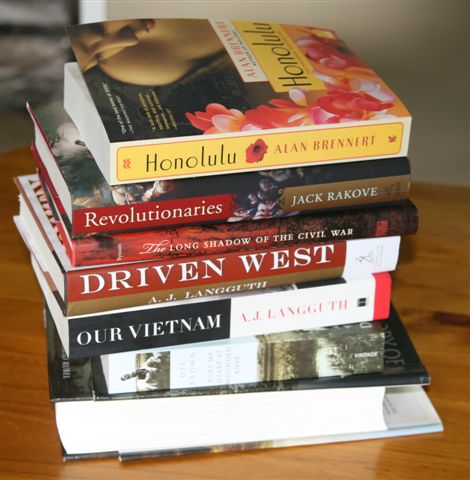
Andrew Jackson...hero or villain? He was certainly a man of contradictions. A supporter of slavery and Indian removal on one hand, and on the other, a reshaper of American politics, including popular campaigning techniques, media manipulation and engagement of citizens in the process. He transformed both the American presidency and the nation he led during his two turbulent terms in office.
The book covers all the usual ground, Eaton affair, the Bank Wars, Federal Import Tariffs and Nullification as well as the many personal and political conflicts with the other major players of the time.
However there is plenty of new material gleaned from personal papers in the Hermitage archives.
Can be read as a history book or an historical novel.
A good follow up to the above Andrew Jackson book covering the sorry tale of native American tribes' forced removal from the east to the mid west over a number of presidential administrations. It is a story of greed, betrayal,and racism vividly told in the typical Langguth character driven style. I found the story of internal tribal conflict over Removal particularly interesting and not one generally well known.

A work of fiction which includes some actual real life characters eg. Father Damien, woven into the story. It's a tale of the leper colony on Moloka'i, Hawaii with a little bit of Hawaiian political history and centuries-old Hawaiian religious beliefs and mythology thrown in.
An easy read and with a 'hard to put down' status.

Saturday, January 15, 2011

Back Up!

It seems I am destined to buy computers with a four year shelf life.
My HP laptop started doing 'funny things' a few months ago and, from experience, alarm bells started ringing.
So I started to back up my files.
Then all went quiet and I thought it was just a false alarm.
But no, a few days ago............POOF!
The dreaded blue screen.
Optimistically I took it into the repair shop. I always do this and always I get bad news and a bill for $50.
This time was no different.

So now I have a new one. Not another HP (you have had three chances, guys) but a Toshiba.
Learning a new operating system, Windows 7, reloading other programs and reestablishing 'favorites' is a time consuming task.
At least I have my precious files including photos and word documents.
The only exception are emails. I looked at backing these up a few times but it was a quite a convoluted procedure which I sadly postponed. But at least I had backed up my email address book.
So the lesson to be learned from all this is BACK UP!

External HDD's are cheap and easy to use. USB sticks even more so.
Put aside an hour or so every week or two and just do it!

Friday, January 14, 2011

The Queensland Floods

This is all happening 1000km or so to the north of us so we are unaffected. The Northern Rivers of New South Wales are also in flood.
It has been devastating for all concerned with many lives lost.

The Brisbane Times Newspaper is the best web site to catch up with all the details as well as some pretty grim pictures.
But as usual, Australians meet adversity head on with a little humour.

A statue of Rugby League football hero, Wally Lewis, outside the Brisbane football stadium is dressed appropriately.

Thursday, January 13, 2011

The Daughter's Italy / Part 2

My travel companion Ms. B, and I landed in Naples airport on a humid afternoon with a long and unbeknown to us, convoluted trip ahead of us. We had challenges you see. Not only did the trip from Naples to Positano involve various planes, trains and automobiles, but in true family form I was H-u-n-g-o-v-e-r. Yes, with a Capital H. I had been out partying until 1am in my old Cambridge stomping ground and then I couldn’t sleep because I was paranoid about missing my flight. Polish vodka + old friends + early morning flight = Travel nightmare!

Something to remember when visiting Naples, well actually – strike that, make it ALL of Italy is that the male population are not backwards in coming forward. You could have heard a pin drop and the necks cracking as we collected our luggage and made our way to the bus. I hurriedly explained to the incredulous Ms. B that we were not about to get mugged by the group of mafia looking types that followed us, but they were simply staring because we were WOMEN. You know.. because Italy doesn’t have any women – right?
After navigating the connections that took us to the dizzying heights of Positano we disembarked the bus with a sigh of relief. I should have known that Italian bus drivers could drive one handed along sky high cliffs, while arguing with a passenger in addition to talking on his mobile phone. Believe me, my friend, The Hangover (yes, at that stage it was still with a Capital H) was tagging along in full force.

There’s always a problem with taking the bus in Italy. Knowing which stop to get off at – we knew we were in Positano… we could even see our hotel… but what separated us from it was about 1000 steps down to it (who knew we should have waited another stop?). So off we trudged. In the rain. With our suitcases. And a new friend who became a fixture in our Positano stay. Randy the dog (I will leave it up to you to deduce how he came to earn his name.. along with his girlfriend…. Mandy).
A pizza, a few glasses of Chianti and a generous serving of gelato in one of the seaside restaurants soon set things straight (and farewelled the Hangover – Hurrah for small mercies!).

I had one thought as we watched the sun slip into the sea…
Italy….. I really, truly, unashamedly love you.

Saturday, January 01, 2011

Looking Back at 2010

A Happy New Year to all my readers.
Looking back, I guess the major highlight of 2010 was the breaking of the seven year drought. With the La Nina influence in full affect, rain came to most of Australia. Lake Eyre filled, even the Todd River in Alice Springs flowed and metropolitan dams that were down to twenty percent or less capacity are now over flowing. In fact a lot of NE Australia is now in flood.
Our dams and tanks are certainly full.

Weather also produced one of our year’s low lights when a horrific wind storm in early September battered us for 24 hours bringing down trees and leaving us without electricity for 3 days. Luckily there was no one hurt or house damage done.
Our decision to stay home and travel was a good one. The journey through western New South Wales into South Australia to the fringes of the outback and back through coastal Victoria was a highlight of the year.

We backed this up with a trip to northern Queensland and the Great Barrier Reef with American family in September. The day we spent snorkeling on the outer reef was magic!

Politically, our first woman Prime Minister, who came to power during a party coup, was re-elected for another term albeit as head of a minority government.
Australia had missed out on the worst of the global financial crises but the poor situation in North America and Europe continued to influence our stock market which bounced along at a regular level for most of the year. At least it is well above its lowest levels of a few years earlier.
The big news was the strength of the Australia dollar with it being worth more than the US dollar for the first time since it was floated in the early 1980s. Its strength was also reflected in record levels against the Euro. How long will this last is anyone’s guess but our currency is noted for being an investment ‘plaything’ so we just have to take advantage while we can. Certainly the high level reduces the competitiveness of our export industries eg. minerals, which are a major component of our economy.

So what are our plans for 2011?
First off we will enjoy the rest of summer, mainly at the beach, and then get through harvest. Then we will look at some travel plans for later in the year. With our strong currency the USA or Europe (or maybe both!) look tempting. But with the success of staying home to travel in 2010, southwest Western Australia and Tasmania are also on the radar.
So much to see, so little time!

Thursday, December 30, 2010

Spiders

Australia has its fair share of spiders and a lot of them are quite nasty.
We have in our area the funnel-web and redback whose bites can be lethal. The white tail and mouse spiders are not too pleasant either.
But we don't see too many of these on a daily basis.

The black house spider is however quite prevalent. It prefers dry habitat areas and secluded locations and is commonly found in window framing, under eaves, gutters, in brickwork, sheds, car ports and among rocks and bark. Electric lights attract their main food source of moths, flies, mosquitoes and other insects so they tend to congregate on our front and back verandahs as well as in the garage. Their bites can be painful but not lethal.

The St. Andrews Cross spider is also common. This spider with its brown and yellow striped markings is a web-weaver usually found in summer in garden areas around the home. It is considered beneficial as it spins a large web to snare flying insects, such as flies and mosquitoes. They are non toxic and non aggressive. There are a lot of these in the vineyard.
An adult Huntsman spider may have a body length of up to 20 mm. It's the diameter including legs may reach 45 mm. The first 2 pairs of legs are longer than rear two. This spider is hairy, buff to beige brown colour, with dark patches on it's body.

The spider prefers to live under the flaking bark of trees, under flat rocks and under eaves or within roof spaces of buildings.
It often wanders into homes and is found perched on a wall. They are shy, timid spiders able to move sideways at lighting-fast speed. We usually 'relocate' the ones we find inside.
We always have plenty of these around.

Saturday, December 11, 2010

Why is the Surf SO Cold?

It's almost mid December.
It's summer.
Daytime temperatures are getting up into the high 20s.
Then why is the ocean so cold? Jumping into 15-16 degree water is no fun.
This is winter stuff.
Finally we had an explanation from my surf report web site today.
Coastalwatch.com report that "The coldest water is pretty much isolated between the mid north coast (around Port Macquarie) and the south coast (Eden/Bateman’s Bay) anomalous to what we expect for summer and a La Nina season.
This summer is not living up to its reputation. We have just endured the wettest spring on record, the wettest start to summer, and sea surface temperatures have been fluctuating around 16-17 degrees(DECC, MHL) during the last week of November and the first few weeks of December, the lowest recorded temperature was below 15 degrees. The East Australian Current travels south down the east coast sending warm water down to Tasmanian waters from QLD, however BOM sea surface maps show the current is flicking offshore just south of Port Macquarie transporting warm water offshore.
During La Nina cycles the east coast of Australia is expected to experience warmer wetter conditions and persistent onshore winds. Relentless ENE and NE winds blowing at a parallel angle to the coast drive ocean currents south and offshore, due to the Coriolis Force. The centrifugal motion of the Coriolis effect causes water to move to counter-clockwise in the southern hemisphere i.e. away from the coast.
Persistent onshore wind conditions result in Ekman transport, the term for when surface water is pushed away at the ocean surface and is then replaced by colder water from the depths offshore."
So there you have it.
We can only wait and hope.
Meanwhile it's fun to watch the newly arrived tourists running down the beach for their first plunge of their holiday....and then obviously wishing they hadn't.

Friday, December 10, 2010

BOOKS!

I love books.
Reading has always been a passion. So much to learn, so little time.
Nothing like the smell of a bookshop and especially a newly opened book.
But books are really expensive in Australia due to Parallel Import Restrictions (PIR's).
Under the PIRs, if a novel or textbook is published in Australia within a certain time limit of it being published elsewhere in the world, booksellers cannot import and sell stocks of the same book from UK, the US or Asia. This enables rights holders to charge prices (or obtain royalties) in the Australian market with the certainty that they cannot be undercut by commercial quantities of imports of the same titles.
This means in the USA, the same book can be 50% or more cheaper than in Australia. Needless to say when we are in the USA, we stock up to our airline baggage allowance limit.

Then there is Amazon.com
Both the co driver and I keep a running list of books that we are interested in. These are usually gleaned from reviews, references in other books, author interviews on TV, web sites and word of mouth.
When we have a sufficient amount, we order from Amazon. Ten or more books including airfreight costs are still around 50% cheaper than we can get here. The near parity $A/$US exchange rate is also a help.
The government is not interested in collecting tax on such small value imports (they have a $1000 limit) so that saves us another 10%.
Our last shipment arrived yesterday. It is always like Christmas opening the box.
And that smell!
Can't wait to get started on them!

Monday, December 06, 2010

The Daughter's Italy / Part 1

Italy. My credit card’s Achilles’ Heel but always and forever my happy place. Numerous visits to the home of creamy gelato, heavenly pizzas, rolling Tuscan hills, azure seas and lecherous men have not quelled my fascination and love for a country that lies 14,000km from my home.


I barely speak the language. "Non parlo molto Italiano" is my favourite Italian phrase and get-out-of-jail-free card (see lecherous men above). I don’t seem to actually do all that much when I am there apart from shop for beautiful handbags, drink wine and meander around the countryside…. Oh… and I eat…
I eat A LOT in Italy. One afternoon after a third Nocciola gelato (hazelnut ice-cream) I pondered how many gelatos a day was considered excessive. I mean – you have to have one mid-morning to quash those hunger pangs as you peruse the shops (glorious lunchtime aromas of garlic, oregano and basil start wafting through the air – it’s a killer). Then comes the post lunch gelato – always a must – you need to help all that pasta, cheese and bread digest don’t you? Last, but definitely not least is the post dinner gelato. This is enjoyed while practicing the art of "la passeggiata". This is a great evening ritual in Italy. Everyone strolls gently (slow! think slow!) through the main streets of the old town. Italians tend to dress up in their latest designer gear (seriously though, when don’t they dress up??) and tourists are usually easy to spot in their dusty jeans and Converse (yes, me). I love that la passeggiata is where budding romances are displayed as well as newly purchased shoes and handbags. So, after some lengthy consideration I have come to the conclusion that 3 gelatos are just right (because anymore would be just plain greedy – right????).

Friday, December 03, 2010

Introducing a Guest Blogger

It's still raining here. Most outside activity has been put on hold. This means blog subjects are a little hard to come by.
But there is a solution at hand. The daughter has just completed a five week tour of Italy and France and has offered to share some of the highlights.
Here's what she originally wrote in the offer to help her old man out:
.
I’m not going to lie to you. I am the first to admit that the idea was not very original – especially since it came to me while flicking through a copy of 'Eat, Pray, Love'. I thought to myself “If you could go anywhere in the world this very second, someplace that would make your heart sing and your lips smile wide - where would you go?”.
Without a moment of hesitation, the answer came to me.
One word. Three syllables. Italy.
So now she is busy writing her story. I have seen the pictures and now wait expectantly for the tales behind them.
Hope you will all enjoy them too.

Saturday, November 20, 2010

A New Grape Variety?

There are two ways of propagating plants. One is sexually by seed, the other is asexually by vegetative means eg. cuttings, grafting, budding, layering are some of many.
One of the problems with sexual propagation is that in many cases a seed will not produce an exact ‘copy’ of the female parent due to its heterozygous nature.
On the other hand vegetative propagation will ensure an exact 'copy' of the parent.
Last year I found a grape seedling growing in a remote part of the garden. One can only assume the seed was deposited there by a bird and it came from one of the five varieties of grapes I grow here.
So I dug it up and planted it in a pot.
This year it has grown extremely well.
And the resultant vine is quite a puzzle .
The leaves of the new vine (top) look pretty much like Cabernet Sauvignon (bottom) with medium deeply five lobed leaves and the petiolar sinus cut right into the veins at the base. The only other vine that I know of with the latter characteristic is Chardonnay but its leaves are three lobed and very much different in shape.

The most distinguishing feature of the new vine however is its red shoots and red leaf veins and none of the established vines here have that.
Do we have a new variety here?
Will the fruit be red or white?
Next year I will plant it out and wait to see what eventuates.

Friday, November 05, 2010

Some Early November Musings

We have had over a week of rain!
And it still continues.
Good for the grass, vines and dams but limits the amount of outside work you can do as well as visits to the beach.
So in an effort to ward off a bout of cabin fever I will ramble on a bit, horticulturally.
The spring flower displays continue to impress. Our very old and large bottlebrush (Callistemon sp.) is having a bumper year. It is just covered in flowers.
This genus is doing well all over our area. It is a very popular garden plant. Most flower spikes are red but there are white, yellow and purple varieties as well. A rare one is green but have not seen one of those around here.

Back in 2007 I blogged about my new Wollemi Pine (Wollemia nobilis).
When a small stand of these trees was found in a remote part of the Blue Mountains near Sydney sixteen years ago, it was seen to have certain characteristics of the 200-million-year-old family Araucariaceae but was not similar to any living species in the family. Comparison with living and fossilised Araucariaceae proved that it was indeed a member of that family. Fossils resembling Wollemia and possibly related to it are widespread in Australia, New Zealand and Antarctica but Wollemia nobilis is the sole living member of its genus. The last known fossils of the genus date from approximately 2 million years ago.
The location of the trees is still a closely guarded secret but thousands of clones have been cultivated for public sale.
Ours is still growing well in a pot, albeit a bigger one, and now quite tall. It is a fascinating plant to watch, especially in spring.
The trunk growing point as well as those of the branches are covered initially in wax (probably evolved for cold climate protection) which is then discarded as new branches/leaves start to form.


There is an interesting discussion about this tree on the Royal Botanical Gardens web site.

Wednesday, October 27, 2010

The Great Barrier Reef / A Video

This video was taken by the company marine biologist during our "Wavelength" cruise to the outer Great Barrier Reef in September.

Saturday, October 23, 2010

Grevilleas

In another life I had an Australian native plant garden. They were supposedly low maintenance and not so water dependant. However to keep them looking good, this was all a myth.
The one genus I got to enjoy growing were Grevilleas.
They are a very diverse group of of about 360 species of evergreen flowering plants in the Proteaceae family. The species range from prostrate shrubs less than 0.5 m tall to trees 35 m tall.
They have an amazing range of foliage and flower forms as well as flower colour.
Many Grevilleas interbreed freely and extensive hybridisation and selection of horticulturally desirable attributes has led to the commercial release of many cultivars which increases considerably the range of plants available.
Maybe the wet winter has encouraged the flowers this year or maybe I have been unobservant in the past but this year's displays in the gardens around us are magnificent.


Sunday, October 17, 2010

An October Update

Spring is really here despite a two day return to winter with rain and windy conditions. There was also some snow on the mountains. All the fruit trees are in blossom and budburst is over with all four grape varieties now well into shoot growth. The fact that the Pinot Noir was shooting in August only enforces the global warming argument. I think from memory that budburst is now three weeks ahead of what it was when I first planted vines around 15 years ago.
So that all means there is plenty of work to do around the place.
Spraying has begun mainly against downy mildew. A neighbour of mine who runs a commercial winery has not sprayed for powdery mildew for years and has had no problems. This year I will try the same. It is a bit of a risk as there is no 'cure' for this disease but anything to reduce the number of sprays and chemical impact on the environment is welcome. Not that I use too much nasty stuff. Copper oxychloride used against downy mildew is approved for organic vineyards as is wettable sulphur against powdery mildew. Phosphorus acid as a downy curative is also ok. Chlorothalonil used against botrytis isn't too good but there are really no effective sprays of lower toxicity.
Calves have started to arrive. So far everything has gone well. Grass is growing well too after all the rain we had over winter so the new mums will be well nourished eating for two.
A friend and I worked on the fallen trees produced by the big storm for two days solid. We eventually got the fences repaired and and started clearing the accessible trunks and branches. From a distance it's as though we did no work at all. It's a huge job. They will never be completely cleared. At least we have a few year's firewood already.
And the black snake that seemed to have taken residence in that area has apparently moved on due to all our activity.
It was one of the biggest I have seen around here for quite a while so will be keeping an eye out despite the recent no show.
Other than that all the tourists have gone home after the October school holidays and we have a few month's peace until the real invasion starts in mid December for the long summer break well into January.

Friday, October 08, 2010

The Commonwealth Games

Currently we are enjoying live telecasts on six dedicated channels from Delhi, India, of the Commonwealth Games. They run for just under two weeks.
Every four years, members of the Commonwealth of Nations get together for a huge sporting event.
This is the 19th time they have been held and 6800 athletes and officials from 71teams are attending to compete in 17 sports.

It’s great to see so many smaller less wealthy nations competing. The qualification criteria are not as strict as for the Olympic Games so it gives many athletes the chance to experience the ‘big time’ although their performances may not be world class. In fact it is very rare for a world record to be achieved in any of the events. As well as many Olympic sports, the Games also include some sports that are of British origin and are usually played only in Commonwealth countries. These include lawn bowls, rugby and netball.
The Commonwealth of Nations has its roots in the British Empire which eventually became the British Commonwealth before its final transition. It is an intergovernmental organization of 54 independent member states. All but two of these countries were formerly part of the British Empire.

Sixteen members of the Commonwealth recognise the Queen Elizabeth II as their head of state, including Australia. The majority of members, thirty-three, are republics and a further five have monarchs of their own.
It is interesting to note that the four Home Nations of the UK ie. England, Scotland, Wales and Northern Ireland send separate teams to the Commonwealth Games. Individual teams are also sent from the British Crown dependencies of Guernsey, Jersey and the Isle of Man. This is in contrast to the Olympics where all these combine to represent ‘Great Britain’. The Australian external territory of Norfolk Island also sends its own team, as do the Cook Islands and Niue, both two states in free association with New Zealand.
Australia usually does pretty well in this competition and has for many years won the highest number of medals.

Sunday, October 03, 2010

Some Fish of the Great Barrier Reef


All these pictures were taken by Wavelength Charters who sail out of Port Douglas to the outer reef on a daily basis (weather permitting).
We can highly recommend them as a snorkel only trip to the Great Barrier Reef.