Wednesday, October 24, 2012

Refrigeration in the Wine Industry

No, not getting the bottle of white wine cold before drinking but keeping the juice (must) and wine cool during the production process ie. grape delivery, crushing, fermentation, pressing, transfer, storage.
Modern wineries use refrigeration units to keep their white fermenting musts cool.
This encourages desirable aroma and flavour compounds. The target is usually between 10°C and 16°C.
The temperature of grapes coming in from the vineyard during harvest in summer can be a lot higher than this, so cooling is almost always necessary.
But what about the more primitive 'Vin de Garage' operations like mine?
How do I keep the ferment cool without going to a huge (and unwarranted) equipment expenditure?
Adding dry ice has been suggested. This would have the additional advantage of adding carbon dioxide as an oxidizing protectant but it always involve the danger of taste taint and it is not the safest thing to handle (burns and asphyxiation).
Putting a small tank inside a larger one and filling the void with an ice or ice/salt mix has been suggested together with insulating the outside tank with a flexible foam sleeve. Logistically all possible but no real temperature control.
Adding ice in containers to the actual must is another suggestion. This could be viable as long as the containers were sanitized and secure so any melt water did not get into the wine.
Searching on the net I found plenty of information on the affects of ice addition to water and the resultant cooling affect.
One formula was able to calculate final temperature based on original weight and temperature of water and weight of ice added.


I decided to test this out. So I added a specific amount of ice (1000g) contained in a sealed mineral water bottle to a specified amount of water (6000g) and noted the temperature drop. It fell 6°C in one hour and remained there for about 3 hours before starting to rise.
The result was considerably higher than the formula predicted . I guess ambient conditions were to blame.
However this method is indeed worth pursuing and I will try a full scale experiment with water in a wine tank soon.
Temperature could be adjusted by the addition and removal of bottles. Maintenance of the required temperature would depend on the number of bottles required. That is the great unknown at this stage.

Sunday, October 14, 2012

An Unseasonal Weather Event

We had 24 hours warning that an intense low pressure system was forming off the coast and that there would be torrential rain and gale force winds.
So we spent the day battening down, cleaning out gutters and putting things away.
And wooooosh......... in it came!
Over 300mm (12inches) of rain in 36 hours accompanied by 95km/hr wind gusts.
In a tropical zone it would have been a category 1 cyclone (hurricane).
Our creek soon broke its banks and flooded the bottom paddock. Some trees came down.
The surf was huge.
Up in the mountains there was snow down to 700m. Some roads were closed.
But it went as quickly as it came.
And amongst it all a new calf was welcomed into the world. Mother and son are both doing well.
Back to typical spring weather now, sunny, warm and humid.
It's a bit soggy around here but won't take long to dry out.


                      All the grapes needed respraying after all the rain including the Cabernet Sauvignon for the first time.
Again with copper and sulphur but this time with a downy mildew curative in combination just in case.
I use phosphorous acid (Agri-fos 6oo) as a downy mildew curative. It is the world’s only fully systemic downy fungicide, moving easily up and down in the vascular fluid of the vine after rapidly moving away from sprayed tissue.
PA is usually not used in commercial vineyards which export wine. Most countries have a strict MRL (maximum residue limit) which can be met with proper applications but both China and Canada have a no tolerance level. Keeping grapes separate for different wine export markets is almost impossible so it's easier not to apply the chemical at all.
It's a very effective fungicide and the Australian wine industry is working with both countries to have reasonable MRLs introduced. I believe they are making some headway.

Wednesday, October 10, 2012

Even More Spring Flowers

Nashi
Bottlebrush

Apple

Wisteria
Peach

Pear

Wednesday, October 03, 2012

Waratahs

There are four species of Waratah. They belong to the Proteaceae family which is a group of flowering plants found in the southern hemisphere. Members of that family native to Australia include Banksias, Grevilleas and the Macadamia nut.
The Protea from South Africa is also a member.
The best known Waratah is probably Telopia speciosissima which is the state flower of New South Wales.


                  They grow wild on 3m high shrubs with typical leathery leaves in the sand stone gullies around Sydney.
They are very sought after as cut flowers with prices reaching $20 a stem.
For that reason, they are now hard to find in the wild due to poaching. Even plants growing in private gardens have flowers stolen off them.
Stealing flowers in the wild threatens the survival of some populations. If Waratahs are torn off, they will not flower through the next season and seeds are prevented from returning to the bushland, They take five years to flower from seedlings. The species has already disappeared from some of the more 'rural' suburbs.


Our vineyard friends down the road have one shrub. This year it has been flowering profusely.
Telopia means 'seen from afar' and speciosissima means 'beautiful'.

Monday, October 01, 2012

Vintage 2013 Continues

Warm weather and some sporadic rain have encouraged pretty rapid shoot growth of the Pinot Noir.
In viticulture talk it had reached growth stage E-L 12 ie. five to six leaves unfolded with inflorescence clearly visible.
The E-L system designates the phenological stages of grapevine development described by Eichhorn and Lorenz and there are 47 of them.
A simpler system is the modified Baggiolini one which is limited to 15 stages ie. A to O.
In that case the Pinot Noir was at F
It was time for the first spraying.
In my opinion it is essential in the early stages of growth to protect the vines from both downy and powdery mildew, especially in a warm maritime climate like ours.
Then again there is another school of thought that believes only curative sprays should be applied ie. spray only after a weather event that would be conducive to the development of those diseases. However while there are suitable curative sprays for downy mildew, there are none that are really effective for powdery mildew.
After last year's disaster with a modified version of a curative spray program, it was a no brainer to apply protective sprays this season.


Against downy mildew (Plasmopara viticola), I use the copper based spray copper oxychloride. The dried copper spray droplets sit on the leaf surface and slowly release a supply of cupric ions.
These are picked up by the fungus spores and travel through their cell walls to eventually disrupt cellular enzyme activity. Copper sprays are not systemic ie. they don't get into the plant's sap system and get translocated around the plant. They are surface sprays. Droplets remain static so as the vine grows, additional sprays must be applied to protect new growth as well as replenishing the already sprayed areas. Under normal circumstances this is done approximately every two weeks. Rain events shorten the spray intervals.
Against powdery mildew (Uncinula necator), I use a micronised wettable sulphur powder.
Despite sulphur usage dating back some 180 years the mode of action still remains unclear.
Actual contact of the sulfur particle with the fungus is necessary before fungicidal action can occur. There is some debate as to whether vapour inhibits spore germination. The jury is still out on that one.


                      A sulphur spray forms a protective barrier on the plant surfaces. This barrier kills fungi by interfering with cellular respiration preventing it from accumulating the materials and energy it needs to survive.
Sulphur also keeps the vines clear of blister mites (Colomerus vitis). Although I have never seen them here, they are in the area.
Blister mites feed on the under-surface of leaves and cause very obvious blisters on the upper surface of leaves and white or brown hairy growths within the raised blisters on the lower surface of leaves.
Damage by the mite is more unsightly than economically consequential.
As with copper, sulphur sprays need to be reapplied on a regular basis.
Both copper and sulphur can be mixed and applied at the same time.
A little care has to be taken with sulphur sprays. Application at temperatures above 30C and high humidity can lead to phytotoxicity problems on young growth.
As far as shoot development is concerned, the Semillon is a little behind the Pinot Noir and the Tempranillo slightly behind the Semillon.
We are just now getting Cabernet Sauvignon bud burst.

Saturday, September 22, 2012

Pikes Wines Come to Town

A few years ago we visited the Clare Valley in South Australia and enjoyed the wines there.
The Clare is a cool climate area and is famous for its white wines, especially Riesling.
One of the wineries that took our fancy was Pikes. While there we joined their wine club to take advantage of specials offered during the year together with free freight and have been buying their Rieslings, including some excellent clean skins, and Pinot Gris ever since.
To celebrate the release of their 2012 wines they took their tasting room 'on the road' and we were invited to join them at Revisi's Hotel at Sydney's famous Bondi Beach.


It was a nice venue and I guess around 50 people turned up to taste the new vintage whites as well as some older wines including their reserve reds.
And they served some pretty good canapes during the night as well.
The 2012 "Traditionale" Riesling was of the usual high standard. The reserve "Merle" Riesling, while typically steely dry, seemed to lack something on the middle palate compared to previous years. But this is a very young wine just out of the tank and initial impressions can be deceiving.
The Pinot Gris was also of high standard.


             We have never ventured much into Pike's range of reds although the Clare can produce some good ones as we found out on our 2010 trip.
We thought the reserve Sangiovese and Shiraz particularly tempting and with the rather large discount and free delivery on offer for this night only, we succumbed to ordering a few bottles.
I am happy to say that my wine budget so far this year has not been exceeded.
Am still well within my end 2019 limit.

Monday, September 17, 2012

Some Occupational Hazards of the Vineyard

Working in and around the vineyard can have its wildlife problems.
I am ever on the watch for snakes. There are red belly blacks around and while quite timid they can become aggressive when cornered or trodden on early in the season when they are a bit slow getting out of the way.
We had the first of the season in our back yard the other morning, a big one, about 2m long. A bite from them is an immediate emergency drive to the hospital.
Also ticks, leeches and wasps can be a bit of a nuisance.
It's only when you are doing some digging that another danger becomes apparent.


                     I found a suspicious hole the other day when doing some remedial work on the post stays and poured some dilute acid down. This morning I found a dead spider by the hole.
It was either the really venomous funnel web spider or perhaps a mouse spider. It's hard to tell the difference.
Both can give you a nasty bite and the funnel web is renowned for its highly toxic and fast acting venom.


The male of Atrax robustus, the Sydney Funnel-web Spider, is probably responsible for all recorded deaths (13) and many medically serious bites. However no deaths have been recorded since the introduction of an anti venom in 1981. In the picture below you can see the quite large fangs.


Some mouse spiders have a very toxic venom too and a bite can be potentially as dangerous as that of the funnel web. Fortunately funnel-web spider anti venom has proven effective in cases of mouse spider bite.
We are aware that the antivenin is carried by our local hospital.
A further inspection found a few more holes around the place so really it is a matter now of being a little bit vigilant and wearing gloves when working around the places where they may live.

Monday, September 10, 2012

Bud Burst / Vintage 2013 Begins

With Spring in the air the early grape varieties have stirred into action.
Bud swell (woolly bud) is the first thing you notice and then bud burst.
The Pinot Noir is followed by the Semillon with the Tempranillo close behind.
The later variety Cabernet Sauvignon is a few weeks behind those.
Over the years this event  has been getting earlier and earlier.


I estimate that in the 15 years I have grapes in the ground, bud burst is now 3 weeks earlier than  it originally was ie.irrefutable evidence of climate change.
September is usually our windiest month. The westerlies can howl for days on end. Father's Day 2010 was the worst we have had with gusts up to 120km/hr.
This year however is not far behind. One week in and we have had days where winds have gusted to 70km/hr plus.
This can damage or blow the new shoots right off the vine.


But so far so good.
When the shoots are around 10cm long it will be time for the first fungicide spray.
Then the work will start in earnest.

Monday, September 03, 2012

Wednesday, August 22, 2012

Thursday, August 16, 2012

A Fishing Trip to Narooma

The co driver had a quilting class in Moruya about an hour’s drive south so, after dropping her off, I continued on for another 45 minutes to Narooma to do a bit of fishing.
It turned out to be a pretty nasty day with a cold howling southerly wind so, looking for some protection from the elements, I headed down to the small harbour.


 Narooma sits at the entrance to Wagonga Inlet which now empties into the sea through a man made breakwater. The bar is notorious for boating accidents and this day it was in full flight with huge waves crashing over it. No one would be heading out to sea this day except maybe for Marine Rescue.
The view from the end of the breakwater along the rugged coast was quite beautiful despite the bad conditions.


Out to sea, about 8km offshore, is Montague Island.
This is a unique NSW south coast destination being a nature reserve which is accessible only by boat for day tours or for an overnight stay in the island's accommodation in the restored lighthouse keepers quarters.
The island lies within the Batemans Marine Park and features thousands of years of ongoing Aboriginal heritage and over 125 years of lighthouse history.


The lighthouse was built in 1881 and automated in 1986 and then demanned in 1987. It is 21 metres tall and the light is 80 metres above sea level with a nominal range of 20 nautical miles (37 km)
It has the state’s largest little penguin colony, approximately 12,000, as well as a fur seal colony. The seasonably variable wildlife includes Crested Terns and Shearwaters (mutton birds).
Obviously the rough conditions had upset the local seals. There were a few splashing about in the relative calmness behind the sea wall and one was even asleep on the rocks.


I headed back to the wharf and spent a few hours casting into the boat channel.
Suddenly my line went taught and it took some effort to reel it in. But it was deadweight. Seaweed or a snag of some sort I thought.
But no, it was huge red octopus!
I had no chance with the light gear I was using to get it up onto the wharf so thought I might have to cut the line. Finally after quite a struggle with much squirting of water and black ink, he managed to get himself free.
So it was sausages for dinner, not calamari.

Monday, August 13, 2012

The Olympic Games Wrap Up

Well, it's all over!
Two weeks of great sport, a few upsets, the usual controversy and, as always, a little bit of scandal.
London did a great job and thankfully the English summer didn't live up to its reputation.
Our satellite television coverage could not be faulted. Every sport, every heat and final, every medal presentation covered over eight channels. For us the action was live throughout the night and into the early morning due to the 9 hour time difference with replays during the day.
Despite all good intentions we did not manage one overnighter. We are getting old!
My favourite moments?
Usain Bolt, the Jamaican sprinter burning up the track in the 100m, 200m and 4 x100m relay, the latter in world record time.
Kenya's David Rudisha's 800m win in world record time dragging everyone behind him in the race to personal bests and national records.
USA swimmer Michael Phelp's four golds and two silvers in the pool to add to his previous impressive collection.
Australian junior athlete Steven Solomon, controversially picked to run the 400m over more fancied runners who qualified for both semi final and final with personal best times. One to watch for the future.


Australia did not do as well as expected. We really never do. Fifteen gold were predicted but that was always a big ask.
We ended up with 7 gold, 16 sliver and 12 bronze medals and number 10 in the rankings.
We always have high hopes for many athletes and somehow take it personally when they don't perform.
But this time round, the media really got stuck into many of them.
For some reason 'A Silver' was considered a failure. It was obvious from many comments that the general public did not share this view.
It took our long jumper, Mitchell Watt, a silver medal winner to give the media a bit of a serve about their attitude.
So now we wait on the dust to settle and the inevitable post mortems.
But for me it's what happens on the track, in the pool, on the field etc. that counts, not the bean counters' performance analysis.
Only another four years to go until Rio!
Can't wait!

Wednesday, August 01, 2012

August Update

Life as we know it has come to a bit of a standstill. Over the next two weeks we will become nocturnal beings glued to the television for all the excitement of the Olympic Games in London.
But we have worked extremely hard over the last month getting things on the farm in order so we could take some time off.
The spray program against the bracken seems to have gone well with huge amounts dying off over the last few months.


Because of our late nights we needed extra firewood so we have been attacking some of the larger fallen trees around the place.
Cutting it up with the chain saw is an easy job but splitting it into usable size is a harder one.
I am well supervised by the co driver who obviously has inherited some lumberjack skills from somewhere and is sensitive to the dangers of dealing with big trees, even those lying on the ground.
Suffice to say that one did roll suddenly (luckily away from me) during the cutting so her concern is justified.


We also revamped the Pinot Noir vineyard. The initial netting height was too low making it uncomfortable to work under and somewhat limiting the growth of the vines. It was also in two pieces which meant constant repair work along the seam.
So with the help of Stirls, we took off all the old (and rotting) netting, put in higher stakes and threw one piece of 10m wide netting to cover the whole area. Now we can work in comfort and the vines will be able to grow longer shoots ie. extra leaves, to improve their fruit ripening capability.


 Stirls also helped in the clean up/burn off which gets rid of all the non usable fallen timber and is part of a bush fire prevention tactic recommended by the authorities. This is a huge job and he will be back soon to continue. We need to do as much as we can before fire restrictions come back on on the 1st October.
And last but not least, the vegetable garden has been dismantled and will be left to return to grass. I managed to salvage a lot of star pickets during this exercise despite it meaning a lot of extra work. But as my father used to say "many a mickle makes a muckle". 
Phew! Enough work already!
Where is the remote?

Saturday, July 28, 2012

Marmalade Making 101

Following up on the citrus season blog, the co driver armed herself with various recipes, a boiler, fruit, sugar and jars for her first attempt at marmalade making.
After looking at the recipes, it was decided that the double cooked version might be a little too adventurous for a first attempt so she settled on a mixed fruit version.
The oranges, lemons and grapefruit were all finely sliced and added with water to the boiler.
Pips, discarded peel and pith were put into a muslin bag and also put in.
After a few hours of boiling the sugar was finally added.
Now came the hard part.
When will it be ready? No one wants runny jam.


 The pectin test is the conventional way.
There are varying ways of doing this. After a few unsatisfactory attempts, we finally settled on the method in the Australian Women's Weekly Cook Book published way back in the dark ages! All the measurements are imperial in the book which is a little disconcerting at first for us who have struggled for the last 45 years to forget all that stuff. No problem for the co driver however who is by now well and truly bimetrological.
So she put some saucers in the fridge and after 30 minutes spooned a little jam onto one and then back in the fridge. A few minutes later she ran her finger through the jam until finally by saucer #5 it was gelling and crinkling to the touch.
Then she waited a thin skin began to form on the jam in the boiler (this ensures the fruit pieces stay in suspension in the jar) then filled the jars that had been sterilizing in the oven.
Then on with the lids!
This morning I had some on toast!
Delicious!
Now she is ready for the double cooked version.

Tuesday, July 24, 2012

The Mystery of American Cherries

A little while ago I mentioned that USA cherries were in local supermarkets and were very cheap.
They have become even cheaper.
Last week we paid the equivalent of around $US4.00 lb.
I sent my dedicated shopper spy in the mid west of USA out to find the prices there.
They range between $US2.49 - $3.49 lb on special but the normal price seems to be $US4.00 lb or maybe a little higher


So how come they can be exported all the way to Australia (you would have to assume by airfreight), go through all the rigours of quarantine inspections/treatments and then be distributed around the country for about the same price?
Are the good citizens of the USA subsidizing our out of season cherry consumption?
Not that I am complaining.
They are just great!

Saturday, July 21, 2012

Citrus Season

Winter is citrus season. The supermarkets and fruit shops are full of oranges, mandarins, grapefruit, tangelos, cumquats etc.
But every self respecting gardener in our area has a citrus tree of some sort.
Our neighbours have oranges, limes  and grapefruit and next door Gail makes some of the best double cooked marmalade in the state, maybe even the country.
We have three lemon trees just loaded with fruit this year.


There is one problem with our lemons though.
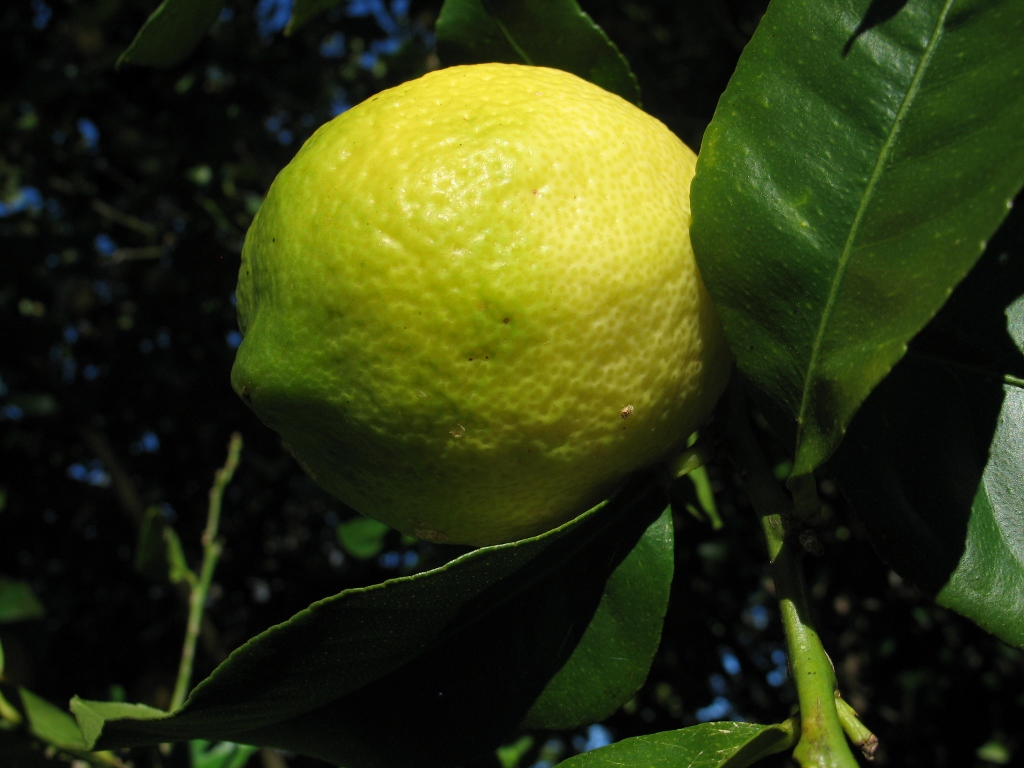
They look a little funny. They are a bit distorted with spiky skins and scabby marks.
This is a result of being infected with citrus scab (Elsinoe fawcettii). This fungus causes the fruit to distort and grow very thick skins.
It also attacks the leaves and twigs of the trees.


To combat the disease, regular sprays of a copper based fungicide are needed. Our Ag Department says that by neglecting to spray the trees they will eventually stop producing and eventually die, probably after 10-12 years.
But really, the juice and flesh of the fruit are unaffected and it is such a hassle spraying against this disease ie. getting the timings right, I just don't bother. Our trees have been flourishing for 20 years plus!
And surprisingly some fruit is completely unaffected.


Gail says she is too busy to make her marmalade this year (a young son just at school plus a one year old can do that to you) but she has agreed to give the co driver her marmalade recipe plus some oranges so she can have a try.
Will keep you posted on the result.

Tuesday, July 17, 2012

Mother and Daughter Doing Well

Plants propagate in a number of ways, either naturally eg. seed or with man’s assistance eg. cuttings.
Sexual reproduction by seed generally does not produce a daughter plant with same characteristics as the mother plant although there are plenty of exceptions particularly in cereal crops eg. lines.
Asexual or vegetative reproduction however does and the daughter plant is always an exact replica of its mother.
Examples of asexual reproduction include cuttings (stem, leaf, bud and root), grafting and budding, layering (simple, mound, air) all of which are mostly carried out by man.
But plants can also reproduce vegetatively themselves eg. runners, suckers, crowns, bulbs.
We have a very old Camellia plant (C. japonica) growing in our garden.


It produced a sucker (adventitious shoot) which was growing about 1m away from the mother on her horizontal root system.
So as an experiment, I chopped it off leaving a piece of the mother plant root attached, dug it up and replanted it in a pot.
It grew well for a couple of years and this winter it produced its first flowers which, surprise surprise, are exactly the same as its mothers.

Saturday, July 14, 2012

Trip to Orange / Part 3

Sunday morning broke cold and crisp but sunny and we headed out to the Ophir area just north of Orange.
Gold was first discovered here in 1851 and was the first major gold find in Australian history. There is still a working mine in the area.
It's a pretty place in the gorge where the Summerhill and Lewis Ponds Creeks meet and there are walks for those who want  to explore the old workings and tunnels. But you need to keep to the tracks. Old shafts abound and not all are documented.
For the old miners, who worked around 500 claims, the gold ran out 10 months after the initial discovery and all that is left of the township now are remnants of some buildings and a grave yard.


Back in Orange we sought out the new Charles Sturt University Winery tasting rooms. The University in Wagga Wagga has its own vineyards and a working winery as an essential part of their Viticulture and Wine Science degree courses. They not only use their own grapes, including those grown on the Orange campus, but also bring in fruit from other cool climate areas of New South Wales. These include the Hilltops region around Young through to Tumbarumba in the Snowy Mountains and down to Gundagai.
The nicely appointed tasting rooms had just opened with an enthusiastic crew in place so we got right royal treatment tasting all the way through their range from sparklings, whites, reds to rose'. We didn't venture into their fortified range.
An early advocate of screw cap closures, the university now puts all its sparkling wine under crown seal replacing the wired cork ( Mon dieu! Sacrilège!!!!)
We liked their 2011 Sauvignon Blanc made from fruit grown in their Orange campus vineyard, the 2007 Cabernet Sauvignon/Merlot made predominantly from Hilltops fruit, 2009 Cabernet/Shiraz from Orange and 2010 Tempranillo from Tumbarumba with its minimalist "T" label.
And getting a 25% discount for being an alumni member was icing on the cake. Since its inception in 1977, the CSU winery has been awarded over 28 trophies, 98 gold, 18 silver and 483 bronze medals in national wine shows.


The next stop was Ross Hill Wines on the slopes of Mt. Canobolas. They had two wine ranges, one fruit driven and one with a little more winemaker's input. The winemaker, Phil Kernery, was running the cellar door and it was interesting to listen to his philosophy.
'Good wine starts in the vineyard' was a catch phrase not high on his list.
We tasted through both ranges and appreciated in this case the complexity that the winemaker's input can introduce. In many cases I have found that too much of it, especially in the whites, can overpower the fruit in a negative way. But that was not the case here. The Pinnacle 2011 Pinot Gris and Sauvignon Blanc were simply wild yeast fermented yielding wines of intensity, complexity, fine texture and length.
The Pinnacle 2010 Pinot Noir was naturally fermented by wild yeasts, macerated on skins for 4 weeks and matured in 25% new French oak for 10 months. A very light style but the intensity of flavour and the length were amazing.
The Pinnacle 2010 Shiraz for me, was the red wine of the trip.
The tasting notes say " hand picked and naturally fermented by wild yeasts in small open fermenters at our brand new Wallace Lane winery, matured in small French oak for eighteen months, this wine is powerful, aromatic and densely layered, showing the capacity of the Orange region for growing multi dimensional reds of great character"
Can't argue with that!


During our discussions, we found out that Ross Hill makes Hedberg Hill's wines and that there was stock of the late harvest Riesling we liked so much being prepared for release in their cool store. Phil called Peter up and we 'bid' for two bottles on a cash basis.
Peter kindly agreed.
So after a tour of the winery that was the end of our wine tasting adventure. We wanted a simple meal that night so found a new Japanese restaurant in town, Mr.Sushi King which, despite the hokey name, fitted the bill exactly.
Next morning we headed home via Canowindra through more beautiful country to Cowra and then basically back along the route we had come with all our booty clinking away in the back of the car.

So with our Hunter Valley trip a few weeks ago and now this one, we are well stocked up.
Plenty of wine to put down and lots for current drinking.
Life is pretty good!