Tuesday, October 13, 2020

COVID-19 / Australia / 13th October 2020 Update

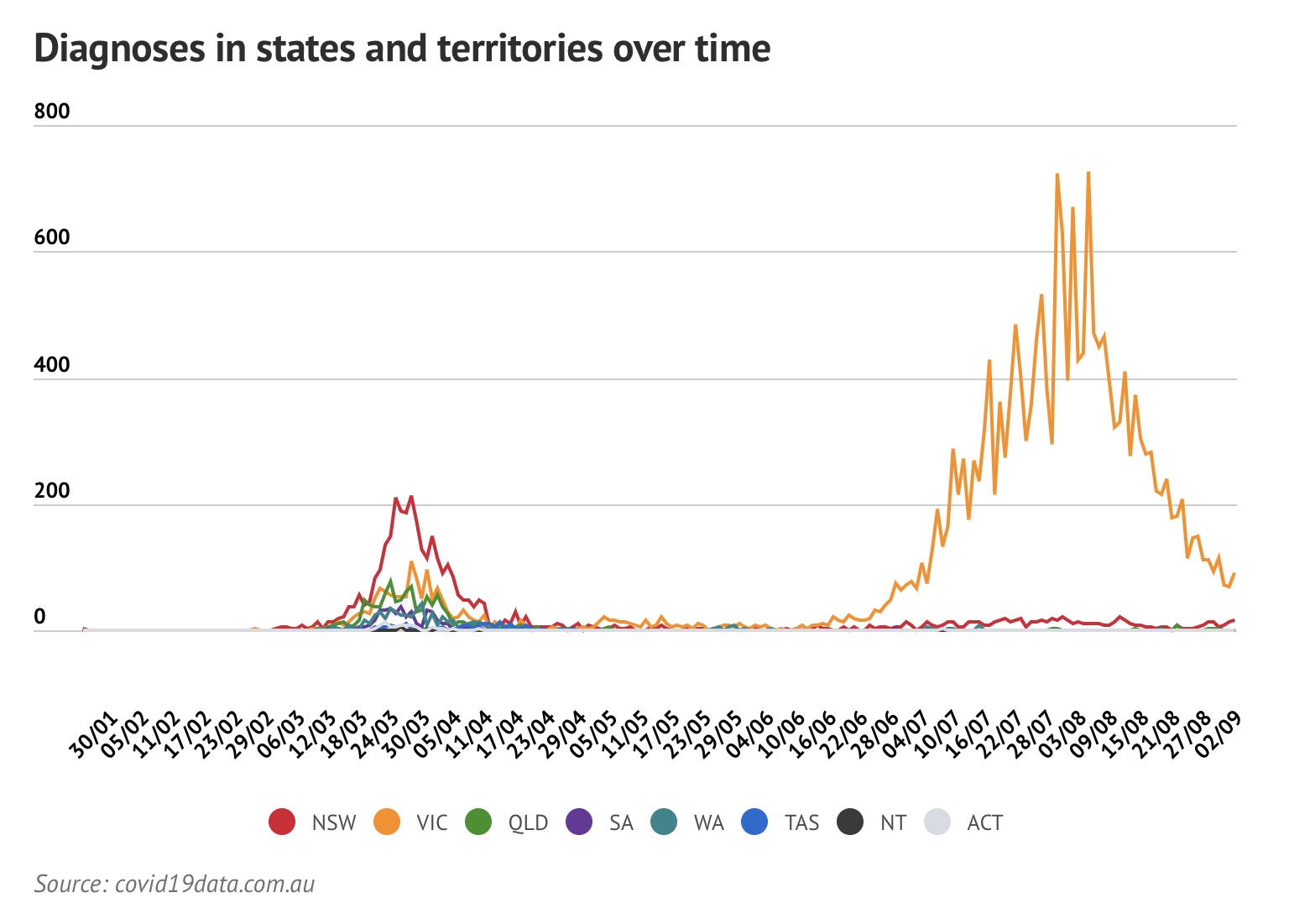
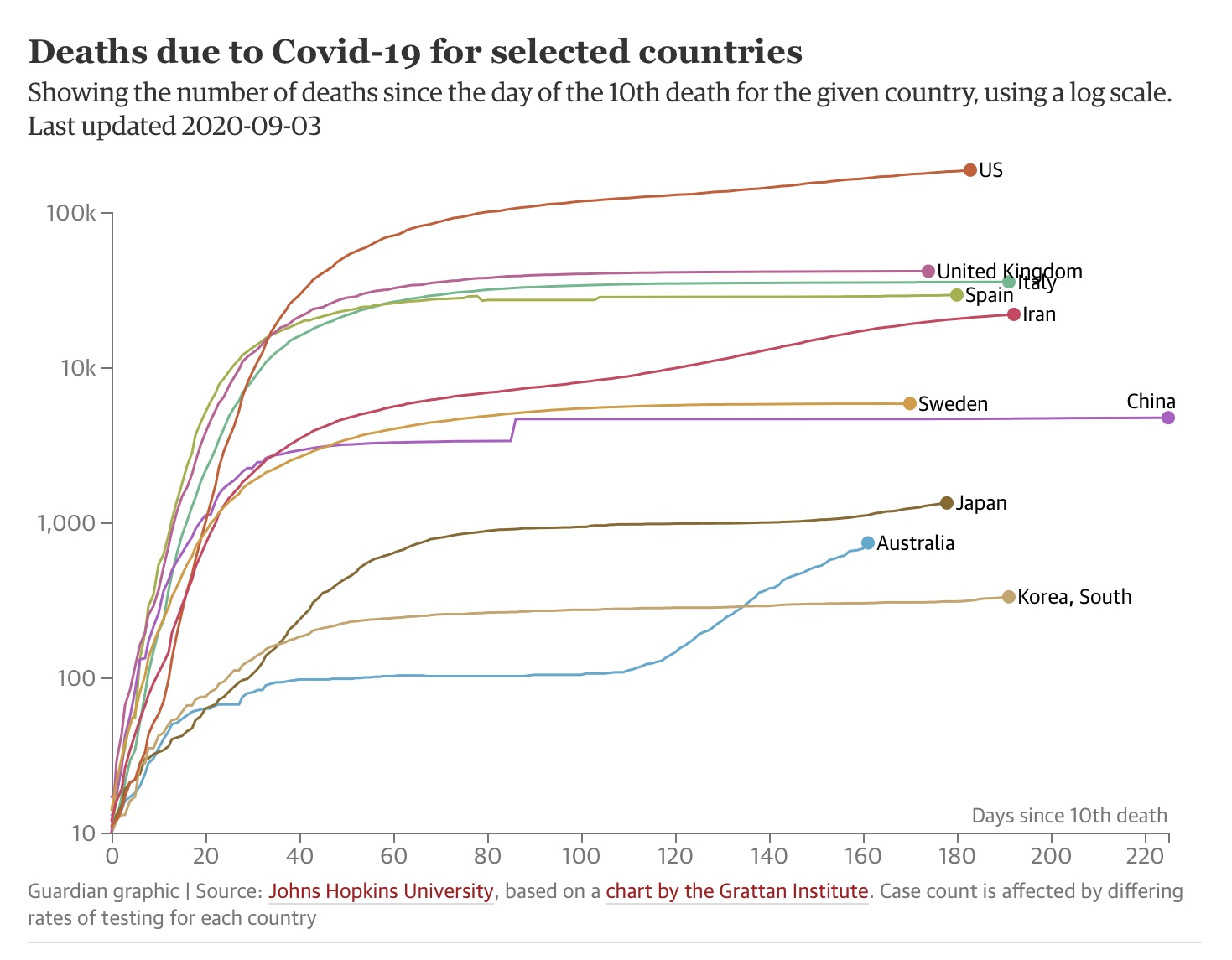
While the Covid second wave surges across Europe and the first wave relentlessly continues in the USA, our figures, though still concerning, have stabilized. 
The state of Victoria still has the highest incidence of cases but nowhere near the peak of their second wave.
It recorded 15 new cases yesterday with no deaths.
NSW advised one new local case in the latest 24 hour reporting period. The state recorded six cases in total, five of which were detected in overseas travellers in hotel quarantine.
Queensland has recorded zero new cases overnight, maintaining the active cases in the state to four. 
All other states and territories report zero cases of community transmission.
Melbourne, Victoria's capital has been easing its lockdown for the past several weeks following a decline in cases. But Victoria's Premier Daniel Andrews says the number of new cases is not yet falling fast enough to ease all of the restrictions that were promised.
Queensland's border with New South Wales is still yet to open.  
Western Australia's borders are closed to the rest of Australia and not expected to be open until April 2021.
The Prime Minister has confirmed Australia will move “very cautiously” to reopen international quarantine-free travel with a “handful” of countries (New Zealand, Japan, Singapore and South Korea), raising the prospect Europe and the United States will be excluded until 2022 unless a Covid vaccine is available.

Meanwhile our government research organization. the CSIRO, has published new research which shows COVID-19 can last up to 28 days on surfaces like mobile phone and ATM screens.
This is much longer than previously thought.
They conducted the experiment at three different temperatures, 20°C, 30°C and 40°C, with the relative humidity kept at 50%. The surfaces used in the study were stainless steel, glass, vinyl, paper and polymer banknotes, and cotton cloth. These are examples of high contact surface areas such as glass on touchscreens and stainless steel doorknobs.
At 20°C, the virus was extremely robust. They were able to recover infectious material after 28 days from the smooth (non-porous) surfaces. These are stainless steel, glass, vinyl and paper and polymer banknotes.
The length of time infectious virus was able to survive on the porous material (cotton cloth) was much shorter. On cloth, they were unable to detect any viable virus past 14 days.


At 30°C infectious virus did not survive beyond seven days on stainless steel, money (polymer banknotes) and glass. However, on vinyl and cotton cloth, infectious material was not detectable beyond three days.
At 40°C virus was inactivated much faster. Infectious SARS-CoV-2 was detectable for less than 16 hours for cotton cloth. While on glass, paper and polymer notes, and stainless steel it was detectable for up to 24 hours, and 48 hours for vinyl.
So guess the lesson here is keep washing and/or disinfecting your hands, don't touch you face and of course wear a mask when social distancing is not possible or practical.

Friday, October 09, 2020

Pikes Wines Virtual Tasting / Great Success

Over the last week we participated in two of Pikes Wines virtual tastings of their new vintages via Zoom.
The first was six whites; the second, three of their Reserve range, two reds and a white.


Without doubt two of the three bottles of the Reserve range were outstanding. I have a small collection of various vintages of the Merle Riesling and E.W.P. Shiraz which will probably now increase, just a little, despite still very high prices substantially discounted on the night. We only drink them on VERY special occasions. I’ll have to think long and hard about the Cabernet. It seemed a bit ‘green’ or herbaceous to us.
Of the whites we were impressed by the Semillon /Sauvignon Blanc blend and the Fiano which was our non Riesling fave of the evening.
As expected my ‘go to’ Riesling, the Traditionale was excellent as usual. This is such a consistent wine, year after year. The co driver is not fond of Riesling which is ok. More for me!
The Olga Emmie Riesling is made in the German Kabinett style ie. low alcohol (8.5%) and sweet (41g/L RS)
We thought, reading the tasting notes beforehand, that this is not our style and probably wouldn’t like it too much.
We were wrong! 
It was light, aromatic and had enough acidity to cut through the initial sweetness. Great with spicy Asian food.
A big surprise!
This was a great innovation by Pikes to replace the annual face to face Roadshow tastings due to Covid.
It saved us a long drive to and an overnighter in Sydney too.
I tried to sow the seeds of it continuing after all this virus kerfuffle is over and was not met with much resistance from the marketing man, but we shall see.

Wednesday, October 07, 2020

COVID-19 / Australia / 7th October 2020 Update

So how is Australia doing with Covid-19?
New South Wales has recorded its eleventh straight day of zero locally-acquired corona virus cases. There were 11 new COVID-19 cases confirmed statewide on Tuesday, all of them returned travellers in hotel quarantine. 
Victoria has recorded 15 new corona virus cases and one new death in the past 24 hours. The 14-day average for new cases statewide is currently 10.9, down from 11.9 on Monday.
The strict lock down laws in that state are having the desired affect but there is still a way to go.


Australian death toll now stands at 895.
Discussions on the opening of state borders is on going. November 1st is the target for NSW and Queensland.
So all in all, despite the severe economic and social price the country has paid as a result of the tough measures invoked, compared to many others it has to be said we have done particularly well.


But the fight is not over yet. 
With summer and the long holiday period approaching all governments are emphasizing the need for caution and the avoidance of complacency. 
Strict social distancing rules are still in place, even on beaches, and heavy fines apply to businesses and individuals who do not comply.
Last night the federal government handed down a budget designed to pull Australia out of the most severe global economic crisis since the Great Depression thanks to the Covid-19 pandemic.
Here’s a summary

Tuesday, October 06, 2020

Grass

My newly seeded lawn has started to shoot, albeit patchy in some parts, as a result of the warmer weather and plenty of watering.
Got me thinking about grass in horticultural terms and how come you can mow it and it keeps growing.
Maybe I should have paid more attention in the plant physiology lectures at school.
Anyway, grasses are monocots ie. their seeds contain a single (mono-) embryonic leaf known as a cotyledon. There are approximately 60,000 species of monocots.
This makes them distinct from the other class of plants, dicots whose seed has two embryonic leaves or cotyledons. There are about 175,000 known species of dicots encompassing most common garden plants, shrubs and trees, and broad-leafed flowering plants.


So how come you can mow grass and it keeps growing when other plants don’t?
A plant produces new cells in a place called the meristem. The production of new cells together with the enlargement (division) of these new cells is the source of growth in a plant.
The meristem of many monocots is in the "crown" of the plant which is right at soil level.
The meristem of dicots is at the end of each shoot.
Therefore if you "mow" the dicot, you cut off the source of growth and new growing points must emerge from buds along the stem. Dormant buds contain inactive meristems which begin growth when the buds above it are removed.
This generally calls for strategic pruning.


With monocots, since the growing point is at ground level, you can cut the tips of the leaves and the meristem just continues producing new cells which enlarge and push the leaf blade up from the bottom.
Therefore, you can mow the monocot grass but not a dicot, if you want the latter to keep growing, that is.

Saturday, October 03, 2020

Cicadas

Cicadas are the sound of summer in Australia.
There are more than 200 Australian species, most of which belong to the one large family, Cicadidae.
Here they spend most of their life underground as nymphs for around 6-7 years.
When the nymph reaches full size it digs its way to the surface and generally emerges about nightfall in late spring or early summer. It then climbs onto a tree trunk or other object and sheds its skin for the last time with the fully-winged adult leaving its old empty nymphal skin behind.
This occurred on our large gum tree (eucalypt) out front a few days ago.


The life of adult cicadas is very short, lasting only a few weeks. After mating, the adult female cicada lays its eggs which hatch into small wingless nymphs.They fall to the ground and burrow below the surface. Here they live on the sap from plant roots for a period which may last several years.
Cicadas are notorious singers. In fact they are the loudest insects in the world. The song is a mating call produced by the males only. 
Some large species such as the Greengrocer/Yellow Monday and the Double Drummer produce a noise intensity in excess of 120 dB at close range which approaches the pain threshold of the human ear.
Many species of cicada sing during the heat of the day.


As kids we used to collect them and keep them as pets for their short lives.
Fierce trading went on to see who could amass the most diverse collection.
Many of their common names were initially given to them by children. As a result cicadas probably have the most colourful common names in the insect world. Some of these include: Black Prince, Double Drummer, Floury Baker, and the Green Grocer or Yellow Monday.
Australian journalist Peter FitzSimons wrote in the memoir of his childhood, “the black prince was valued at three cherrynoses, four floury bakers, five yellow mondays or a thousand green grocers.”

Wednesday, September 30, 2020

Bushfire Season 2020/21 Starts

The Bushfire Season in our area started a month earlier than usual on 1st September. This means it’s time to our get our action plan ready by revising our evacuation strategy and packing up and storing some essentials for a quick getaway. Then there’s the small things like cleaning the leaves out of gutters.
It also means we are restricted to how we use fire to prepare the property. Unrestricted burn offs are prohibited and need a permit from the authorities. These permits lay out strict rules of how and when to burn.
We of course have a huge fire break around us after the December/January fires and despite some vigorous regrowth in the bush I think we are pretty safe this year.
The fire situation in the western states of the USA resonates with all of us who went through the trauma earlier this year of course.
So far this year, more than 8100 California wildfires have burnt 15,000 square kilometres, destroyed more than 7000 buildings and killed 26 people.
Most of the losses occurred after a myriad of dry lightning strikes in mid-August ignited a massive outbreak of fires.
Fire worries were also developing on Monday across Southern California although it was unclear how strong predicted Santa Ana winds would be. Heat and extreme dryness were expected to be problematic nonetheless.


Conditions were also hot, dry and windy in parts of Arizona, where the Sears Fire in Tonto National Forest north of Phoenix has grown to more than 36 square kilometres since it erupted on Friday afternoon. Authorities reported zero containment.
Australia is sending 55 specialised firefighters to California mainly in leadership roles for up to a month.
They include operational commanders to supervise teams on the ground, as well as heavy plant supervisors to work with crews that clear land to make fire breaks.There has also been a request for a small group of specialised aircraft managers.
Of course this exchange has its problems with the rampant Covid situation in the USA. 
Special measures have been introduced to protect our firefighters from infection.
2020 marks the 20th year of the exchange of firefighters between Australia and the United States.
A little bit of good news for us is the Bureau of Meteorology (BOM) has declared a La Niña event has developed in the Pacific Ocean, which could bring cooler days and more rainfall across much of Australia through spring.


La Niña is the cool phase of the El Niño Southern Oscillation and associated with cooler than average sea surface temperatures in the central and eastern tropical Pacific Ocean.
La Niña events typically form in autumn and winter and reach their peak in spring and early summer.
The last La Niña occurred from 2010-2012 and brought widespread flooding and record rainfall. The BOM said its modelling currently suggested the latest event would be strong but would not reach the same intensity.
The BOM also said that the Indian Ocean Dipole was also in negative territory and five out of six surveyed models indicated it would remain in a negative phase during October.
Both La Niña and a negative Indian Ocean Dipole typically increase the chance of above average rainfall across much of Australia during spring.
An active La Niña would also reduce the bushfire risk this season slightly, but would not eliminate it.

Monday, September 28, 2020

100 Beach Challenge Revisited

Our Shoalhaven Council compiled a list of local beaches back in 2017 as part of its 100 Beach Challenge.
This was designed to get Instagram obsessed visitors to look beyond the much publicised and overcrowded stretches of sand such as Hyams and Greenpatch in Jervis Bay.
Three years on, COVID-19 and the ‘keep a towel distance apart' rule makes spreading out along the coast more important than ever, especially over the current school holidays and eventually Christmas.
As a result they have resurrected the 100 Beach Challenge.


Saturday, September 26, 2020

Post Tree Removal Remedial Work

Both tree removal projects (bushfire and storm damaged) left a considerable mess.
Heavy machinery and lawn/grass don’t mix especially in the latter removal case where the ground was still very wet from the storm that brought those trees down.


The contractor had removed or burnt, on site, all of the large timber but some biggish surface roots and branch remnants remained.
If we were going to level off, repair and reseed the areas affected, all this debris had to go.
So it was barrow load after barrow load onto the burn pile that had been kept alight for 10 days.
Then our council invoked an early bushfire season date and we could no longer burn. Sure, you can get a permit but the hoops you have to jump through getting it and complying with conditions are not worth the trouble.
So we started a new pile that will be burnt during winter next year.


Then it was a matter of filling in holes and levelling out the various areas and reducing some slopes to make future mowing easier and safer. Luckily due to the excavations for the new shed, we had a big pile of good sandy loam top soil to do that job. It should provide an excellent friable bed for the lawn seed to germinate and grow quickly.


Our soil has a pH of around 4.5 ie. it’s acidic. The native grass in our area has obviously adapted to that over the millenniums but commercially available grass grows better in soil with pH 6.0 to 5.5. We had considered using turf (sod) from our native pasture but it was just too big a job to cut and re-lay.


So we limed the cleared areas at a rate 2kg/10m² to hopefully increase pH at least one unit. This is not a quick fix but a slow chemical process that will eventually pay dividends.
Once the preparation was done, it was time to sow.
We mixed the lawn seed (30g/m²) with the starter fertiliser (22g/m²) and distributed it over the finely raked soil bed in both directions, raked it in gently and then watered lightly. 


We used a Hortico drought resistant blend with 38% Perennial Ryegrass, 27% Annual Ryegrass, 20% unhulled Couch, 8% Creeping Red Fescue and 7% Kentucky Bluegrass.
The starter fertiliser is a slow release type made especially for new lawns.
It will be interesting to see how this works out as I have never done this before. In a past life, I have only used rolls of turf for new lawns.


So with the removal of the southern house paddock fence and bushfire damaged trees, our backyard has doubled in size. This obviously means more mowing but easily done on the ride-on. The remaining large tree stumps will be a sculptural type feature. Grinding them out would have added substantially to our bill.
The removal of seven trees in total has altered our surroundings completely. Our outlook in two directions is now very different and more open.
We have decided, after the initial ‘shock’, that is not such a bad thing.

Tuesday, September 22, 2020

COVID-19 / Australia / 22nd September 2020 Update

Australian figures are somewhat under control. The main contributor to the second wave, Victoria, now seems to have the situation in hand due to extremely strict lockdown rules in the capital and immediate surroundings. The regional areas of that state do not have a problem.
Three of our local businesses, a club and two restaurants had to close because a tourist from Sydney who tested positive on his return had visited those establishments.
This will be an ongoing problem for our area which sees throngs of tourists, with little regard for social distancing or mask use, turning up every weekend. Next week is the beginning of two weeks of school holidays which will exacerbate the situation even more.
Borders are still closed but rezoning the NSW/Qld and NSW/Vic borders on a regional basis is under discussion.


Meanwhile just a dozen countries have recorded no cases of COVID-19. Most of them are Pacific island nations, directly to Australia's east.
Each country's government quickly closed borders to international travel at the start of the pandemic.
The first to seal its frontier was the Marshall Islands. Samoa, Tonga, Kiribati, Palau, Micronesia, Tuvalu, Nauru, Vanuatu, Cook Islands and the Solomon Islands, followed. Six months on, when most of the world is ravaged by the corona virus, these island nations remain virus free
Eighty per cent of islanders live rurally, many with no connection to the global economy or the tourism industry.
The resumption of international tourism would present an enormous health threat but add little to their material living standards.


In desperation to restart revenue streams, French Polynesia opened its borders to French and American tourists in July. 
It's a decision that has ended in disaster. 
The first wave recorded between 62-69 cases of COVID-19. So far the second wave has recorded 1130 cases and the French territory's first two deaths.
Many indigenous Tahitians opposed the reopening, but were overruled by their French administrators. 
It highlights an uncomfortable truth ie. the most infected Pacific communities have been in territories ruled by metropolitan powers, such as the US territory of Guam, French Polynesia and Indonesian-ruled West Papua.

Saturday, September 19, 2020

Fatso, the Fat-Arsed Wombat.

Wombats are short-legged, muscular marsupials that are native to Australia. They are about 1m (40 in) in length with small, stubby tails and weigh between 20 and 35kg (44 and 77 lb). They dig extensive burrow systems with their rodent-like front teeth and powerful claws. One distinctive adaptation of wombats is their backward pouch. The advantage of a backward-facing pouch is that when digging, the wombat does not gather soil in its pouch covering its young.
Although mainly nocturnal, wombats sometimes venture out to feed on cool or overcast days. They are not commonly seen, but leave ample evidence of their passage, treating fences as minor inconveniences to be gone through or under and leaving distinctive cubic poo. Hit one on the road and it can do lots of damage to a car. We see the occasional road kill around here but have never seen one in the bush. Our neighbour thinks he has some around the creek but has only seen burrows.
All this brings us to the Sydney 2000 Olympic Games and its mascots.
Olly (kookaburra), Syd (platypus) and Lizzie (echidna) were selected but the public was ambivalent about the trio and they soon were subjected to considerable ridicule.

Which in turn brings us to ‘Rampaging‘ Roy Slaven and H.G Nelson, the alter egos of John Doyle and Greig Pickhaver, well known locally for their satirical sports commentating on radio and as well as their TV programmes eg. Club Buggery. People actually turn their TV sound off and watch games while listening on the radio. Their football commentary show (both Rugby League and Australian Rules) called The Festival of the Boot was, without fail, hilarious. A newer programme is called Bludging on the Blindside is just as funny.
In 2000 the Olympics television broadcaster, Channel 7, gave Roy and HG a nightly post Games show called The Dream. They were let loose to make the trivial serious and the serious trivial.The show was a raging success and had cult following and became essential viewing for two hours from 11pm.
They too were not happy with the official mascots and introduced us to Fatso, the Fat-Arsed Wombat as a more suitable replacement.
Fatso too became a raging success and despite rumblings from the Australian Olympic Committee virtually took over the unofficial mascot role, even making it onto the dais for some medal presentations.

As a result of his popularity a small statue of Fatso was placed outside the stadium with other Olympic memorabilia.
But about 10 years ago he was stolen and never recovered.
But in a rare piece of good news in 2020, Fatso is coming home.

The Sydney Olympic Park Authority has seen fit to mark the 20-year anniversary of the Games by commissioning a new statue and putting the big-bottomed marsupial back on his public shrine, where he belongs.

Friday, September 18, 2020

Dwarf Grapevines Fruit All Year

Australia's national science agency, the CSIRO, discovered a naturally occurring dwarfing gene in a very old wine grape variety and cross bred it into table grapes to create microvines.
An unexpected by-product of the dwarfing gene is it allows the vine to continuously fruit, if provided the right conditions.
Initially the discovery was used as a research tool, allowing scientists to breed different varieties with special traits in a shorter amount of time but they are now considering its commercial application.
In Australia, the fresh grape season runs for six to seven months, starting in November, peaking in February and March, and closing in May.
Australia is then a significant importer of grapes from the United States from June to December.
Now, with an opportunity to supply fresh grapes all year round, both domestically and internationally, the CSIRO is looking for businesses partner.

The vines small stature and continuous fruiting made them ideal for greenhouse operations and could be trained to grow vertical or laterally, similar to tomatoes.
When microvines are grown in a greenhouse, the control conditions allow the plants to the continuous flowering and fruiting all year round.
The plants are only dwarf in vine size and their yield is comparable to field-grown table grapes.
The berries are slightly smaller than the big ones seen in the shops, but are not an abnormally small.
There are a number of other benefits to micro vines. The greenhouses can be used in areas where the land is not suitable for field crops, while also offering protection from weather and pests.
They offer flexibility to rotate varieties, and their rapid growth means farmers wouldn't lose time planting or switching to others varieties, with a microvines fruiting in six months as opposed to three years for field-grown grapes.
The CSIRO is even considering introducing the microvines to nurseries to be sold as household plants.
They may not have the same continuous production, but would be great in a small pot plant on the balcony or in the home garden.
Source: Jamieson Murphy (National Rural Affairs reporter) FarmOnline National.

Thursday, September 17, 2020

COVID-19 / Australia / 17th September 2020 Update


The second wave in Victoria seems to have been stemmed by the Level 4 restrictions in and around Melbourne.
 But there are still small clusters erupting in the three eastern states' capitals.
State borders are still closed.

Tuesday, September 15, 2020

Sydney Olympics 2000

Today, 15th September, is the 20th anniversary of the opening of the Sydney Olympics in 2000. The official film of the opening ceremony has just been released on YouTube.
It has taken some time! 
Warning: The video runs for 4+ hours

Those not lucky enough not to score seats in the stadium for the ceremony sat glued to their TV screens and watched the most amazing spectacle produced and directed by Ric Birch.
The following sixteen days saw Sydney put on a memorable party which won’t be forgotten by anyone who attended. The city has never been so welcoming, friendly and open hearted, not to mentioned so well organized.
Nothing seemed to go wrong. Even the city transport system held up under the strain. Forty seven thousand volunteers ensured everything ran smoothly at all venues.
The NSW government realised that in this sporting mad nation a huge number of people would miss out on getting tickets to events and spent $50 million setting up ‘live sites’ around the city so people could watch events on big screens as they happened.
To say they were well attended is an understatement. 
See pic below:


I managed to get two tickets, both morning sessions for preliminary heats at the track and field stadium so got a small taste of the excitement. Sad to say I saw the Australian women’s 4x100m relay team drop the baton on the second exchange and get eliminated in the first round.

First off, being parochial, some of the highlights for Australians were:
Cathy Freeman (400m track), men’s 4x100m and 4x200m freestyle relay swimmers, swimmer Ian Thorpe plus the women’s field hockey and water polo teams. More pics here
Then of course from other countries, Marion Jones who was the biggest American star of the Games. However she would be stripped of all five of her medals, including golds in the 100m, 200m and 4x400m relay, after a 2007 admission that she used performance-enhancing drugs leading up to Sydney.
Norway upset the reigning Olympic and World Cup champion USA 3-2 with a sudden-death goal in the 102nd minute.

USA’s Michael Johnson won his final individual Olympic race (men’s 400m), the last of four Olympic gold medals over three consecutive Games.
Great Britain's Steve Redgrave won his fifth consecutive Olympic gold medal for the coxless four rowing. 
And on more personal levels, Equatorial Guinea’s Eric Moussambani, a wild card, swam alone in the first heat of the 100m freestyle, struggling to complete the distance, eventually touching the wall in 1:52.72, the slowest time in Olympic history and becoming known forever as Eric the Eel.
As the founder of the modern Olympics, Baron Pierre de Coubertin, said "The most important thing in the Olympic Games is not winning but taking part; the essential thing in life is not conquering but fighting well."
Then there was Australian race walker Jane Saville who, a hundred meters out from walking across the finish line first, suffered heartbreak when disqualified from the 20km race. She had however been warned twice before for an illegal gait.
So for us locals it was little wonder that when the then IOC president Juan Antonio Samaranch declared Sydney "the best Games ever," there was no argument.
Sadly because of COVID-19 the 2020 Tokyo Olympics have been postponed until next year.
Us sporting nuts can only hope that they will come to fruition.
Update: 
They turned on the relocated Olympic cauldron, now outside the stadium, for the day. 
Nice touch.


Friday, September 11, 2020

Pikes Wines / Virtual Tasting

Pikes Wines in the Clare Valley, South Australia, is one of our favourites.
We first visited them during our trip down that way many years ago.
We buy a lot of their Riesling, a few whites and some of their premium Riesling and reds every year.
They have a Winery Members Roadshow tasting of their new releases annually where they offer pre release purchase at special prices at nice venues in each of the capital cities.
Obviously, this year is very different. With all the various travel restrictions, border closures, and event capacity limitations, it has become evident that they will not be able to conduct the Members Roadshow in the conventional way. They are therefore embracing the ‘new way’ and will be conducting it in a virtual format this year.


They have created four separate sample packs and will host online tasting sessions of each pack, via Zoom, at various times in the 2nd and 4th week of October.
The four packs are whites, reds, mixed whites and reds and their premium reserve range which have been offered at more than reasonable prices.
We have booked for the whites and reserve tastings and the wines are on their way. Hopefully the over stretched postal service will get them here in time.
We hear that all sessions are nearly booked out.


Opening six bottles of wine at one time for just the two of us might appear to be a bit of a challenge but am sure we are up to the task. We have had many years training.
But seriously, they should keep well in the fridge for more than a few days until we eventually get to them.
This will be a first for us and it will be interesting to see how it goes.

Tuesday, September 08, 2020

Australian Bushfires / Arson / Setting the Record Straight

Back in January, with the inferno at its height, the right wing media ie. the Murdoch Press and Sky News ( Australia’s Fox News) told us that climate change had nothing to do with the fires, it was fire bugs who were the cause and cited an arson arrest number of 183.
That story went around the world, seized on by the Murdochs’ London Sun, tweeted in America by Donald Trump Jr, rehashed by Fox News star Sean Hannity on his website, and promoted on Fox News as the real cause of the fires.
Even the right wing politicians in our government jumped on the band wagon.
Craig Kelly, a Federal Government MP said “with the majority of these fires we’ve had unprecedented numbers of people being arrested and charged with arson offences. Now arson is not caused by climate change.”


George Christensen, another government MP said “the cause of the fires is certainly man made, it’s just not man-made climate change. It’s man-made arson that, to me, almost borders on terrorism.”
The New South Wales Bushfire Inquiry’s very recent 460-page report has a table listing all the significant bushfires in the state last season.
The table lists 32 major fires and finds that debris burning started three, power lines started two, equipment and a shredded tyre started another two, one was undetermined and all the rest (including ‘our ‘ Currowan fire) were caused by lightning strikes.
And the number started by arson? 
None. Zero. Nada. 


There were suspected cases of arson in some areas, but the report makes clear “these were a very small proportion of the area burnt”.
ABC News crunched the numbers and came to the conclusion that only about 1% of the land burnt in New South Wales during the bushfire season can officially be attributed to arson.


The Victorian police came to the same conclusion saying there was no intelligence to indicate that the fires in East Gippsland and north east Victoria have been caused by arson or any other suspicious behaviour.
So, have any of these media outlets or politicians reported that important news and corrected the record?
Of course not!