So we have taken a double delivery of wood from our local woodman, Laurie, and Jim and Jackson, the hardware guys, have installed our new wood heater.
It may look a small pile of wood to some but eucalyptus hardwood is extremely dense (Air Dry ρ around 1000kg/m3) and burns slow and hot (can be 100% Relative Heat Available/Unit Volume) unlike softer woods (radiata pine 500kg/m3 and 45%).
Eucalypts or 'gumtrees' are native to Australia. There are over 700 species. Around us are the Sydney blue gum, the grey ironbark, blackbutt, stringy bark and yellow box to name a few.
Most make great firewood and are collected by licensed companies or individuals who take it from the harvest residue left in state forests. Most operators cut and split the fire wood to size. Some even supply round and split posts for fencing.
We will probably start evening fires around June and need a similar amount of wood delivered to get us through until end of September. We usually only have the fire going 24/7 for three weeks or so during that period.
Of course I have a bit of fallen timber and old fence posts to cut up to supplement the supply.
Saturday, May 07, 2016
Monday, May 02, 2016
Bobal
Vitis vinifera cultivars form the basis of the majority of wines produced around the world. All of the familiar wine varieties eg. Chardonnay, Shiraz et al belong to Vitis vinifera, which is cultivated on every continent except Antarctica and in all the major wine regions of the world.
There are currently between five and ten thousand varieties of Vitis vinifera grapes though only a few, in comparative terms, are used for wine and table grape production.
From previous posts and our 2016 wine list you may have noticed we lately have extended our tasting experience to include more overseas wines.
Our preference for Rioja Tempranillo has encouraged us to look for that grape from other Spanish regions.
And we have found a few. One was a blend of Tempranillo and Bobal.
Bobal?
Had never heard of that variety before.
Spain has over a hundred native grapes, both red and white.
Bobal is a red grape variety of Vitis vinifera native to the Uteil-Requena region in Valencia where it accounts for about 90% of the vines grown there.
The name derives from the Latin bovale, in reference to the shape of a bull’s head.
According to the data from the Spanish Vine Registry, Bobal is the third most planted variety in Spain with 90,000 ha (8%), coming behind Airen 305,000 ha (27%) and Tempranillo 190,000 ha (17%).
The must produced from the grape is normally high in colorants and tannins and is suitable both for aging and for blending with other varieties.
We found the Tempranillo Bobal blend much to our liking both in the Reserva and Superior classifications.
There are currently between five and ten thousand varieties of Vitis vinifera grapes though only a few, in comparative terms, are used for wine and table grape production.
From previous posts and our 2016 wine list you may have noticed we lately have extended our tasting experience to include more overseas wines.
Our preference for Rioja Tempranillo has encouraged us to look for that grape from other Spanish regions.
And we have found a few. One was a blend of Tempranillo and Bobal.
Bobal?
Had never heard of that variety before.
Spain has over a hundred native grapes, both red and white.
Bobal is a red grape variety of Vitis vinifera native to the Uteil-Requena region in Valencia where it accounts for about 90% of the vines grown there.
The name derives from the Latin bovale, in reference to the shape of a bull’s head.
According to the data from the Spanish Vine Registry, Bobal is the third most planted variety in Spain with 90,000 ha (8%), coming behind Airen 305,000 ha (27%) and Tempranillo 190,000 ha (17%).
The must produced from the grape is normally high in colorants and tannins and is suitable both for aging and for blending with other varieties.
We found the Tempranillo Bobal blend much to our liking both in the Reserva and Superior classifications.
Monday, April 25, 2016
ANZAC Day 2016
They shall grow not old, as we that are left grow old.
Age shall not weary them, nor the years condemn.
At the going down of the sun and in the morning,
We will remember them.
Age shall not weary them, nor the years condemn.
At the going down of the sun and in the morning,
We will remember them.
Lest We Forget
Tuesday, April 12, 2016
Winter Is Coming
Winter is coming or so the calendar says.
But last Wednesday it was 35°C (95°F) which was the hottest April day on record.
Thankfully some normalcy now has returned and it feels a little bit more like autumn.
The exotic trees are just starting to change colour and will soon be dropping their leaves. The native ones never do. They are always green.
Winter around here is not so severe as in other places we have been.
Yes, South Dakota, I am looking at you!
It can be zero (32°F) in the morning and we do get a few frosts but never any snow. But it usually warms up to around 18°C (65°F) during the day
A really cold day is maximum 10°C (50°F).
So preparing for the cooler days and nights is not such a big task.
We make sure we have a good supply of firewood and that the combustion stove used to heat the house for a few weeks is in good order. This year we took the plunge and decided to get a new one. The firebox in the old one was getting pretty rusty and wasn’t worth doing any more maintenance on. I was surprised when going through the paperwork that it was 17 years old.
So our local hardware store will be able to supply and install the same brand and (updated) model.
We decided to replace the entire flue system as well.
It is also time to get the ride-on fully serviced as it appears grass growth is slowing down.
The mower centre in town picks it up and delivers it back within a few weeks good as new after a hard year's work mowing and sprayer towing.
We also have to look for a supply of lucerne (alfalfa) hay to feed the cattle towards the end of the season. Our paddocks are all native grasses and there is no winter growth at all.
Other jobs will include weed spraying eg. tussock, bracken, thistle and blackberry.
Of course we will be doing the usual burn offs. Reducing the potential bush fire fuel load for next summer is always an important defense strategy. Fire restrictions are usually reduced between April and September so land owners can get this done. However this year it has been so hot and dry, April still has restrictions in force. Big fines for non compliance although I have noticed that national parks and state forest authorities have already commenced controlled burns in our area, one even on the 35° day!
There will also be the usual fence maintenance. The cooler days are great for getting stuck into that.
And of course the vines will need pruning.
Busy! Busy! Busy!
But last Wednesday it was 35°C (95°F) which was the hottest April day on record.
Thankfully some normalcy now has returned and it feels a little bit more like autumn.
The exotic trees are just starting to change colour and will soon be dropping their leaves. The native ones never do. They are always green.
Winter around here is not so severe as in other places we have been.
Yes, South Dakota, I am looking at you!
It can be zero (32°F) in the morning and we do get a few frosts but never any snow. But it usually warms up to around 18°C (65°F) during the day
A really cold day is maximum 10°C (50°F).
So preparing for the cooler days and nights is not such a big task.
We make sure we have a good supply of firewood and that the combustion stove used to heat the house for a few weeks is in good order. This year we took the plunge and decided to get a new one. The firebox in the old one was getting pretty rusty and wasn’t worth doing any more maintenance on. I was surprised when going through the paperwork that it was 17 years old.
So our local hardware store will be able to supply and install the same brand and (updated) model.
We decided to replace the entire flue system as well.
It is also time to get the ride-on fully serviced as it appears grass growth is slowing down.
The mower centre in town picks it up and delivers it back within a few weeks good as new after a hard year's work mowing and sprayer towing.
We also have to look for a supply of lucerne (alfalfa) hay to feed the cattle towards the end of the season. Our paddocks are all native grasses and there is no winter growth at all.
Other jobs will include weed spraying eg. tussock, bracken, thistle and blackberry.
Of course we will be doing the usual burn offs. Reducing the potential bush fire fuel load for next summer is always an important defense strategy. Fire restrictions are usually reduced between April and September so land owners can get this done. However this year it has been so hot and dry, April still has restrictions in force. Big fines for non compliance although I have noticed that national parks and state forest authorities have already commenced controlled burns in our area, one even on the 35° day!
There will also be the usual fence maintenance. The cooler days are great for getting stuck into that.
And of course the vines will need pruning.
Busy! Busy! Busy!
Friday, April 01, 2016
Vintage 2016 / Some Climate Data
Here is some basic climate data for Vintage 2016 for our region.
For those interested in a very detailed and informative discussion about the influence of climate on grape growing and wine quality, then this GuildSomm article is for you.
Monday, March 28, 2016
Vintage 2016 / Final Update
We picked the Cabernet Sauvignon on 24th March.
This was a week earlier than planned but the weather forecast for that coming week was for substantial rain every day (which didn't eventuate in our local area but to the north) so we 'bit the bullet'. The co driver and I got through the rows in about four hours. The yield was about average.
Fruit was in excellent condition. No sign of any disease, a little sunburn on the more exposed bunches and some shrivel in the bunches at the shallower ends of the rows as we have had little rain in the last month.
Baume 12.5° (acceptable)
pH 3.75 (good)
The grapes were immediately crushed/destemmed and DAP (15g/hL), tartaric acid (1g/L) then yeast (20g/hL) added.
The yeast is rehydrated in ten times its volume of water at 40°C for 20 minutes. A little sugar is added to 'get the culture going'. This mixture is then dispersed and thoroughly mixed into the must (juice plus skins).
Fermentation began within 12 hours.
From then it will be the usual process ie. plunging the cap down every 6 hours or so until fermentation is finished (5-7 days), some post fermentation maceration to optimize colour and tannin extraction (a week), pressing, fining (egg white), racking and eventual bottling.
Normally we use oak staves in the ferment and during maturation to impart oak character to red wine.
This year we are revisiting the use of a very concentrated oak powder which is added towards the end of the maturation phase. Our previous experience with this method was not entirely successful but armed with more information on the process we thought we would try again. It is certainly cheaper and easier in a vin de garage operation.
Meanwhile the previously processed Semillon will soon be ready for filtering and bottling and the Pinot/Tempranillo blend will spend another 9 months or so in the tank "doing its thing" before we bottle.
This was a week earlier than planned but the weather forecast for that coming week was for substantial rain every day (which didn't eventuate in our local area but to the north) so we 'bit the bullet'. The co driver and I got through the rows in about four hours. The yield was about average.
Fruit was in excellent condition. No sign of any disease, a little sunburn on the more exposed bunches and some shrivel in the bunches at the shallower ends of the rows as we have had little rain in the last month.
Baume 12.5° (acceptable)
pH 3.75 (good)
The grapes were immediately crushed/destemmed and DAP (15g/hL), tartaric acid (1g/L) then yeast (20g/hL) added.
The yeast is rehydrated in ten times its volume of water at 40°C for 20 minutes. A little sugar is added to 'get the culture going'. This mixture is then dispersed and thoroughly mixed into the must (juice plus skins).
Fermentation began within 12 hours.
From then it will be the usual process ie. plunging the cap down every 6 hours or so until fermentation is finished (5-7 days), some post fermentation maceration to optimize colour and tannin extraction (a week), pressing, fining (egg white), racking and eventual bottling.
Normally we use oak staves in the ferment and during maturation to impart oak character to red wine.
This year we are revisiting the use of a very concentrated oak powder which is added towards the end of the maturation phase. Our previous experience with this method was not entirely successful but armed with more information on the process we thought we would try again. It is certainly cheaper and easier in a vin de garage operation.
Meanwhile the previously processed Semillon will soon be ready for filtering and bottling and the Pinot/Tempranillo blend will spend another 9 months or so in the tank "doing its thing" before we bottle.
Wednesday, March 23, 2016
Another Trip (The Last?) to the Hunter Valley
First day of the trip was from the south coast through Sydney to the central coast to stay overnight at Stirls.
The drive through Sydney is always a pain. Lots of heavy traffic and multiple hold ups. This time it took around 2 hours from the south to the north of the city.
But Stirls had a good dinner and nice wine waiting so all was good in the end.
Next morning we headed for the Hunter and over the next two days visited a few wineries for tastings and wine purchases.
The Hunter is best known for Semillon (both young and aged), Shiraz, Chardonnay and the up and coming Verdelho.
Our main aim was to taste the latest release (2015 vintage) of Semillon and Verdelho.
The samples of both varieties were excellent. We succumbed to some cellar aged Semillon (2007) at Mt. Pleasant as well.
As usual we bought a little bit more than planned.
We visited
McWilliam's Mt. Pleasant
Oakvale
Margan
Thomas
Drayton's Family Wines
We had a very nice long lunch at the Muse Kitchen at the Keith Tulloch Winery and stayed over night at the Grand Mercure Vintage which was very comfortable.
Then it was another night at Stirls before stopping off in Sydney for yet another over-nighter to celebrate the daughter's birthday at Billy Kwong.
This restaurant is run by celebrity chef Kylie Kwong where she showcases her immigrant-Chinese background by marrying traditional Chinese cooking with many native Australian ingredients. This creates an unusual but yummy fusion of flavours.
We decided on the banquet menu which couldn't be faulted. The wine list was also extensive and quite eclectic.
Now why would we consider this to be our last trip to the Hunter area?
The first major plantings in the Valley were established in 1825 when James Busby, widely considered the father of Australian wine, purchased vineyard land between the settlements of Branxton and Singleton.
Stirling and I first visited the Hunter Valley in the early 1970s. We were both members of the now defunct Rothbury Estate established by Len Evans, a Brit who migrated to Australia in 1955 and, who it is said, "advanced the cause of wine in Australia more than any other individual." There we attended wine dinners, pre release tastings and wine education days.
There were fewer wineries about then but some of those that were had been establish for a long time eg. Wyndham Estate (1848), Draytons (1853), Tyrrells (1858), Mt Pleasant (1921).
In our earlier visits tasting rooms were rustic and the people there were usually family members or old time employees. You got to talk to the viticulturists and winemakers. You stayed in an old fashioned motel or country pub. Wine prices were in general cheaper than you could get in the city for the same bottle.
As time went on the area became more accessible (better roads) and more touristy with many more attractions than just being a wine region eg. golf courses, chocolate factories, olive oil plantations, breweries, themed flower gardens to name a few.
Major hotel chains built luxury accommodation and B&Bs sprung up everywhere. Destination weddings and business conferences became big business.
We really began to notice the change over the last decade or so.
This time round the tasting rooms, even in the older places, were all polished wood, glass and chrome. The people serving the minuscule tastings were sales people with a set patter. Some even want to charge for a tasting. Even where I am a winery member I could buy the same wine cheaper by mail order through companies like Dan Murphy. Prices for food ($25 for a hamburger or $21 for a green leaf salad, anyone?) and accommodation have gone through the roof.
I was looking for a word to describe the vibe we found in the Hunter this time around. I came up with slick: deftly executed and having surface appeal or sophistication, but shallow or glib in content; polished but superficial; glib.
I try not to be one of those "back in the good old days" people but in the case of Hunter Valley visits I think I am 'done'.
The drive through Sydney is always a pain. Lots of heavy traffic and multiple hold ups. This time it took around 2 hours from the south to the north of the city.
But Stirls had a good dinner and nice wine waiting so all was good in the end.
Next morning we headed for the Hunter and over the next two days visited a few wineries for tastings and wine purchases.
The Hunter is best known for Semillon (both young and aged), Shiraz, Chardonnay and the up and coming Verdelho.
Our main aim was to taste the latest release (2015 vintage) of Semillon and Verdelho.
The samples of both varieties were excellent. We succumbed to some cellar aged Semillon (2007) at Mt. Pleasant as well.
As usual we bought a little bit more than planned.
We visited
McWilliam's Mt. Pleasant
Oakvale
Margan
Thomas
Drayton's Family Wines
We had a very nice long lunch at the Muse Kitchen at the Keith Tulloch Winery and stayed over night at the Grand Mercure Vintage which was very comfortable.
This restaurant is run by celebrity chef Kylie Kwong where she showcases her immigrant-Chinese background by marrying traditional Chinese cooking with many native Australian ingredients. This creates an unusual but yummy fusion of flavours.
We decided on the banquet menu which couldn't be faulted. The wine list was also extensive and quite eclectic.
Now why would we consider this to be our last trip to the Hunter area?
The first major plantings in the Valley were established in 1825 when James Busby, widely considered the father of Australian wine, purchased vineyard land between the settlements of Branxton and Singleton.
Stirling and I first visited the Hunter Valley in the early 1970s. We were both members of the now defunct Rothbury Estate established by Len Evans, a Brit who migrated to Australia in 1955 and, who it is said, "advanced the cause of wine in Australia more than any other individual." There we attended wine dinners, pre release tastings and wine education days.
There were fewer wineries about then but some of those that were had been establish for a long time eg. Wyndham Estate (1848), Draytons (1853), Tyrrells (1858), Mt Pleasant (1921).
![]() |
| The Old |
In our earlier visits tasting rooms were rustic and the people there were usually family members or old time employees. You got to talk to the viticulturists and winemakers. You stayed in an old fashioned motel or country pub. Wine prices were in general cheaper than you could get in the city for the same bottle.
As time went on the area became more accessible (better roads) and more touristy with many more attractions than just being a wine region eg. golf courses, chocolate factories, olive oil plantations, breweries, themed flower gardens to name a few.
Major hotel chains built luxury accommodation and B&Bs sprung up everywhere. Destination weddings and business conferences became big business.
We really began to notice the change over the last decade or so.
This time round the tasting rooms, even in the older places, were all polished wood, glass and chrome. The people serving the minuscule tastings were sales people with a set patter. Some even want to charge for a tasting. Even where I am a winery member I could buy the same wine cheaper by mail order through companies like Dan Murphy. Prices for food ($25 for a hamburger or $21 for a green leaf salad, anyone?) and accommodation have gone through the roof.
![]() |
| The New |
I try not to be one of those "back in the good old days" people but in the case of Hunter Valley visits I think I am 'done'.
Monday, March 21, 2016
The ALDI Wine Experiment / Part 3 / More Results
-Corte Carista Chianti Classico 2013-
This DOCG wine is made by Castellani Spa and is produced from a blend of Sangiovese (90%) and Cabernet Sauvignon (10%) grapes grown in the vineyards of the Chianti Classico appellation, the most ancient Chianti area.
Tasting Notes: The only wine of the six closed with a cork.
Brick red colour with just a purple tinge. Full varietal aroma of cherry Sangiovese on the nose. Light bodied with hints of the fruit on an earthy background on the palate with well balanced acidity and soft grape and oak tannins. Little if any length.
I would call this wine Chianti Lite.
Probably the least liked wine of the six but still reasonable value at $10.
-Loire Valley Sauvignon Blanc 2014-
I believe this wine comes from the Villebois Wines in the Loire who make Sauvignon Blanc under the appellations of Sancerre, Pouilly Fumé, Touraine and IGP Val de Loire.
Sauvignon Blanc is said to have originated in Bordeaux, France. There it is used to make dry and sweet white wines (Sauternes) and is often blended with Semillon.
Wine making in the Loire is characterized by a general avoidance of barrel aging and malolactic fermentation although some winemakers have begun experimenting with both. Chaptaliziation is allowed and can help wine makers compensate for under ripeness of the grapes in some years.
The region is known for its crisp Sauvignon Blancs.
Tasting Notes: Light golden/green colour. Almost tropical fruit nose with passionfruit coming through. For us more used to (or tired of) New Zealand Sauvignon Blancs with their herbal/green pepper/grassy nose, this was a pleasant surprise.
This promising introduction was followed up on the palate with passionfruit/gooseberry predominating together with a well balanced zesty acidity and lengthy minerally finish.
A REAL bargain at $8.
-Neve Nelson Pinot Gris 2015-
I couldn't track down the source of this wine either.
The Nelson Wine Region lies on the north coast of New Zealand's south island a few hours drive from the Marlborough region.
Pinot Gris is said to be a mutant clone of Pinot Noir. In many cases wine made from it can have a pink hue.
It probably originated in Burgundy.
In Italy the grape is known as Pinot Grigio. There, the grapes are often harvested early to retain the refreshing acidity and minimize some of the overt-fruitiness of the variety, creating a more neutral flavor profile.
In comparison the Gris style wines tend to have moderate to low acidity, high alcohol and an almost "oily" texture that contributes to a full-bodied nature. This is the style mainly grown in New Zealand.
Tasting Notes: Light golden colour with just a hint of pink. Distinct honeyed nose. Full bodied with a stone fruit (nectarine) flavours evident on the palate with a good medium acid balance and long fruity finish.
Amazing value at $8.
Conclusion: I admit I was surprised. The ALDI wine selection we chose was exceptional value for money.
None of the wine was at 'special occasion' level but for every day drinking paying 50% of what you normally pay for wine can't be sneezed at.
We will continue to work our way through their offerings and even may try the $4s.
This DOCG wine is made by Castellani Spa and is produced from a blend of Sangiovese (90%) and Cabernet Sauvignon (10%) grapes grown in the vineyards of the Chianti Classico appellation, the most ancient Chianti area.
Tasting Notes: The only wine of the six closed with a cork.
Brick red colour with just a purple tinge. Full varietal aroma of cherry Sangiovese on the nose. Light bodied with hints of the fruit on an earthy background on the palate with well balanced acidity and soft grape and oak tannins. Little if any length.
I would call this wine Chianti Lite.
Probably the least liked wine of the six but still reasonable value at $10.
-Loire Valley Sauvignon Blanc 2014-
I believe this wine comes from the Villebois Wines in the Loire who make Sauvignon Blanc under the appellations of Sancerre, Pouilly Fumé, Touraine and IGP Val de Loire.
Sauvignon Blanc is said to have originated in Bordeaux, France. There it is used to make dry and sweet white wines (Sauternes) and is often blended with Semillon.
Wine making in the Loire is characterized by a general avoidance of barrel aging and malolactic fermentation although some winemakers have begun experimenting with both. Chaptaliziation is allowed and can help wine makers compensate for under ripeness of the grapes in some years.
The region is known for its crisp Sauvignon Blancs.
Tasting Notes: Light golden/green colour. Almost tropical fruit nose with passionfruit coming through. For us more used to (or tired of) New Zealand Sauvignon Blancs with their herbal/green pepper/grassy nose, this was a pleasant surprise.
This promising introduction was followed up on the palate with passionfruit/gooseberry predominating together with a well balanced zesty acidity and lengthy minerally finish.
A REAL bargain at $8.
-Neve Nelson Pinot Gris 2015-
I couldn't track down the source of this wine either.
The Nelson Wine Region lies on the north coast of New Zealand's south island a few hours drive from the Marlborough region.
Pinot Gris is said to be a mutant clone of Pinot Noir. In many cases wine made from it can have a pink hue.
It probably originated in Burgundy.
In Italy the grape is known as Pinot Grigio. There, the grapes are often harvested early to retain the refreshing acidity and minimize some of the overt-fruitiness of the variety, creating a more neutral flavor profile.
In comparison the Gris style wines tend to have moderate to low acidity, high alcohol and an almost "oily" texture that contributes to a full-bodied nature. This is the style mainly grown in New Zealand.
Tasting Notes: Light golden colour with just a hint of pink. Distinct honeyed nose. Full bodied with a stone fruit (nectarine) flavours evident on the palate with a good medium acid balance and long fruity finish.
Amazing value at $8.
Conclusion: I admit I was surprised. The ALDI wine selection we chose was exceptional value for money.
None of the wine was at 'special occasion' level but for every day drinking paying 50% of what you normally pay for wine can't be sneezed at.
We will continue to work our way through their offerings and even may try the $4s.
Tuesday, March 15, 2016
Snakes
Australia has a reputation that all our wildlife is out to kill us and the population survives purely due to good luck.
I am a little bit bemused about this especially when visiting the USA and being confronted with this perception.
We don't have animals which are a danger. No bears, no mountain lions, no bison, no moose, no wolves.
We have crocodiles, they have alligators.
We have nasty spiders (Funnel Web), so do they (Recluse).
We both have the same kinds of sharks (Great White).
We have kangaroos on the roads, they have deer.
They have nasty snakes, so do we.
But wait a minute, when it comes to snakes we do take the prize.
There are around 140 species of snakes in the country. Huffington Post listed the twenty five most dangerous in the world. Australia accounted for twenty one of them
Here is the list in descending order of venom toxicity (* = non Australian)
Inland taipan
Eastern brown snake
Coastal taipan
Eastern states tiger snake
Reevsby inland tiger snake
Beaked sea snake
Western Australian tiger snake
Chappell Island tiger snake
Death adder
Gwardar or western brown snake
Australian copperhead
Indian cobra*
Black mamba*
Dugite or spotted brown snake
Papuan black snake
Yellow-banded snake
Rough scaled snake
King cobra*
Blue-bellied black snake
Collett’s snake
King brown or mulga snake
Red-bellied black snake
Small-eyed snake
Spotted snake
Eastern diamond-back rattlesnake*
Now, many of these are in specific and remote areas and others have a larger distribution range.
The one we deal with here is the red bellied black snake. They are very common in the south east coastal part of the country and grow up to 2m in length.
The snake primarily preys on frogs, reptiles and small mammals. They also eat other snakes, including those of their own species.
They are normally timid and try to escape when approached. They only become aggressive when cornered or threatened. They have a habit of thinking they can't be seen in longer grass when escaping and stop and just lie there. This is when you can step on them which provokes a reaction. This is especially common in spring when they are waking up from hibernation and are a bit slow.
Our main 'defence' is keeping the grass short around the house and surrounding areas. We have established a 200m buffer zone. Inside that zone they are "relocated". Anywhere else we just walk around them or wait for them to move on.
I occasionally come across them in the vineyard blocks mainly when they have been entangled in the netting.
When this happens they are humanely dispatched.
When working in the paddocks we normally wear boots and jeans as a precaution. No putting hands down holes or sitting on logs before a thorough check.
But don't think the farm is alive with these creatures. We probably see a dozen a season in various locations and we have learnt to live with them.
And the local hospital has a good supply of anti venom.
I am a little bit bemused about this especially when visiting the USA and being confronted with this perception.
We don't have animals which are a danger. No bears, no mountain lions, no bison, no moose, no wolves.
We have crocodiles, they have alligators.
We have nasty spiders (Funnel Web), so do they (Recluse).
We both have the same kinds of sharks (Great White).
We have kangaroos on the roads, they have deer.
They have nasty snakes, so do we.
But wait a minute, when it comes to snakes we do take the prize.
There are around 140 species of snakes in the country. Huffington Post listed the twenty five most dangerous in the world. Australia accounted for twenty one of them
Here is the list in descending order of venom toxicity (* = non Australian)
Inland taipan
Eastern brown snake
Coastal taipan
Eastern states tiger snake
Reevsby inland tiger snake
Beaked sea snake
Western Australian tiger snake
Chappell Island tiger snake
Death adder
Gwardar or western brown snake
Australian copperhead
Indian cobra*
Black mamba*
Dugite or spotted brown snake
Papuan black snake
Yellow-banded snake
Rough scaled snake
King cobra*
Blue-bellied black snake
Collett’s snake
King brown or mulga snake
Red-bellied black snake
Small-eyed snake
Spotted snake
Eastern diamond-back rattlesnake*
Now, many of these are in specific and remote areas and others have a larger distribution range.
The one we deal with here is the red bellied black snake. They are very common in the south east coastal part of the country and grow up to 2m in length.
The snake primarily preys on frogs, reptiles and small mammals. They also eat other snakes, including those of their own species.
They are normally timid and try to escape when approached. They only become aggressive when cornered or threatened. They have a habit of thinking they can't be seen in longer grass when escaping and stop and just lie there. This is when you can step on them which provokes a reaction. This is especially common in spring when they are waking up from hibernation and are a bit slow.
Our main 'defence' is keeping the grass short around the house and surrounding areas. We have established a 200m buffer zone. Inside that zone they are "relocated". Anywhere else we just walk around them or wait for them to move on.
I occasionally come across them in the vineyard blocks mainly when they have been entangled in the netting.
When this happens they are humanely dispatched.
When working in the paddocks we normally wear boots and jeans as a precaution. No putting hands down holes or sitting on logs before a thorough check.
But don't think the farm is alive with these creatures. We probably see a dozen a season in various locations and we have learnt to live with them.
And the local hospital has a good supply of anti venom.
Thursday, March 10, 2016
The ALDI Wine Experiment / Part 2 / Some Results
-Peter Mertes Mosel Riesling 2014-
Riesling is a white grape variety which originated in the Rhein region of Germany.
This particular wine comes from the nearby Mosel area.
The Peter Mertes Company, based in Bernkastel-Kues, appears to be quite diverse in its wine interests and claims to be Germany's leading winery.
This wine is classified as Qualitätswein bestimmter Anbaugebiete (QbA) so is the lowest level of the German Quality Wine category so can be considered an every day quaffer.
Tasting Notes: Light golden colour. Stone fruit with a slight hint of citrus on the nose. We noticed that Riesling expressed itself this way in Austria. Must be a European climatic influence thing as Riesling in Australia is predominantly citrus especially in the cooler regions.
Despite the low alcohol (11.0%), the wine had good mouth feel, a very slight spritz and reasonable fruit/acid balance. Not a great deal of length however. We found that initially the acidity was dominant but balance improved when the wine was allowed to 'warm up' a little.The back label suggested 12°C. I think we tend to drink white wine too cold in this country (and our reds too warm).
QbA wines are allowed to be chaptalized and one suspects this could be the case here given the high acidity.
Not a stunner, but for $10 a great value summer quaffing wine.
-Baron Amarillo Rioja Reserva 2010-
The Reserva classification in Rioja is the second highest tier. The classifications however are not an indication of wine quality, just how they have been aged. Reservas can vary in price from the teens to the hundreds of dollars
This wine was made by Bodegas Isidro Milagro one of the top 10 wineries in Spain. Their winery is in Alfaro, Rioja.
Tasting Notes: Deep ruby red colour. Oakey nose with little fruit apparent. Light to medium-bodied, with some hint of cherries and blackcurrants on the palate but the oakiness dominates. Fine tannins and medium length oaky finish. Passable at the price ($10) but not the best Rioja Reserva I have tasted at similar price levels.
-Kaiora Bay Central Otago Pinot Noir 2014-
I was not able to track down the maker of this wine. Central Otago on the south island of New Zealand is the world's southern-most commercial wine growing region. It is best known for Pinot Noir which accounts for about 70% of the plantings.
Tasting Notes: Dense red colour with just a hint of purple. It is still a young wine. The first thing you notice on the nose is a distinct earthy aroma not the usual strawberry fruit driven one normally associated with the cheaper end of the Pinot market. This complexity follows through on the palate with good fruit, fine tannins and reasonable length. An above average Pinot for this price bracket ($15)
Riesling is a white grape variety which originated in the Rhein region of Germany.
This particular wine comes from the nearby Mosel area.
The Peter Mertes Company, based in Bernkastel-Kues, appears to be quite diverse in its wine interests and claims to be Germany's leading winery.
This wine is classified as Qualitätswein bestimmter Anbaugebiete (QbA) so is the lowest level of the German Quality Wine category so can be considered an every day quaffer.
Tasting Notes: Light golden colour. Stone fruit with a slight hint of citrus on the nose. We noticed that Riesling expressed itself this way in Austria. Must be a European climatic influence thing as Riesling in Australia is predominantly citrus especially in the cooler regions.
Despite the low alcohol (11.0%), the wine had good mouth feel, a very slight spritz and reasonable fruit/acid balance. Not a great deal of length however. We found that initially the acidity was dominant but balance improved when the wine was allowed to 'warm up' a little.The back label suggested 12°C. I think we tend to drink white wine too cold in this country (and our reds too warm).
QbA wines are allowed to be chaptalized and one suspects this could be the case here given the high acidity.
Not a stunner, but for $10 a great value summer quaffing wine.
-Baron Amarillo Rioja Reserva 2010-
The Reserva classification in Rioja is the second highest tier. The classifications however are not an indication of wine quality, just how they have been aged. Reservas can vary in price from the teens to the hundreds of dollars
This wine was made by Bodegas Isidro Milagro one of the top 10 wineries in Spain. Their winery is in Alfaro, Rioja.
Tasting Notes: Deep ruby red colour. Oakey nose with little fruit apparent. Light to medium-bodied, with some hint of cherries and blackcurrants on the palate but the oakiness dominates. Fine tannins and medium length oaky finish. Passable at the price ($10) but not the best Rioja Reserva I have tasted at similar price levels.
-Kaiora Bay Central Otago Pinot Noir 2014-
I was not able to track down the maker of this wine. Central Otago on the south island of New Zealand is the world's southern-most commercial wine growing region. It is best known for Pinot Noir which accounts for about 70% of the plantings.
Tasting Notes: Dense red colour with just a hint of purple. It is still a young wine. The first thing you notice on the nose is a distinct earthy aroma not the usual strawberry fruit driven one normally associated with the cheaper end of the Pinot market. This complexity follows through on the palate with good fruit, fine tannins and reasonable length. An above average Pinot for this price bracket ($15)
Saturday, March 05, 2016
The Milton Show 2016
The annual local rural show has rolled around again.
Nothing much new happening with the usual exhibits and events taking place.
The co driver received one first, two seconds and two highly commended for her quilt entries.
This year it wasn't raining which was a big surprise for everyone.
Instead it was hot and very steamy.
Because of this we didn't last long at the venue. No sitting about enjoying the ring events, horses and cattle.
Autumn is late this year, making up for the summer that never was.
Nothing much new happening with the usual exhibits and events taking place.
The co driver received one first, two seconds and two highly commended for her quilt entries.
This year it wasn't raining which was a big surprise for everyone.
Instead it was hot and very steamy.
Because of this we didn't last long at the venue. No sitting about enjoying the ring events, horses and cattle.
Autumn is late this year, making up for the summer that never was.
Tuesday, March 01, 2016
The ALDI Wine Experiment / Part 1
ALDI is the well known German supermarket chain which has over 400 stores in the eastern states of Australia.
It opened its first four stores in Adelaide, South Australia, last month and has plans for up to fifty in South Australia and Western Australia.
There is one in our town.
They are well known for cheap grocery prices and have carved out a 12% market share in that sector. However they have predominantly private brand products and our experience is, apart from commodities, quality can be variable.
They also sell wine, beer and spirits.
Some wine is extremely cheap; down to $4 bottle. They source from all over the world but again, despite coming from recognized regions and having fancy names, they are 'Made for ALDI'.
This is not a unique situation as the other two major supermarket chains, Coles and Woolworths, have a myriad of own brands too. Rather than labeling these wines “Woolworths Shiraz” or “Coles Chardonnay”, the wines look like they are a winery owned brands.
Details of this perceived 'deception' are here.
However we have found a few Coles branded wines to our liking but they are certainly not as cheap as ALDI's.
Friends have occasionally brought bottles of ALDI wine for dinners and they have been fine. Some have even won medals at wine shows.
It opened its first four stores in Adelaide, South Australia, last month and has plans for up to fifty in South Australia and Western Australia.
There is one in our town.
They are well known for cheap grocery prices and have carved out a 12% market share in that sector. However they have predominantly private brand products and our experience is, apart from commodities, quality can be variable.
They also sell wine, beer and spirits.
Some wine is extremely cheap; down to $4 bottle. They source from all over the world but again, despite coming from recognized regions and having fancy names, they are 'Made for ALDI'.
This is not a unique situation as the other two major supermarket chains, Coles and Woolworths, have a myriad of own brands too. Rather than labeling these wines “Woolworths Shiraz” or “Coles Chardonnay”, the wines look like they are a winery owned brands.
Details of this perceived 'deception' are here.
However we have found a few Coles branded wines to our liking but they are certainly not as cheap as ALDI's.
Friends have occasionally brought bottles of ALDI wine for dinners and they have been fine. Some have even won medals at wine shows.
So we thought we would buy a selection and give them 'a go'.
We decided that we should buy by region and select its best known varietal.
Mosel (Germany) Riesling $10
Rioja (Spain) Tempranillo $10
Chianti (Italy) Sangiovese $10
Loire (France) Sauvignon Blanc $8
Central Otago (New Zealand) Pinot Noir $15
Nelson (New Zealand) Pinot Gris $8
Apart from the Pinot Noir the price levels are about half of what we would normally pay for an every day wine. But I just couldn't bring myself to try any of the $4 selection.
We decided that we should buy by region and select its best known varietal.
Mosel (Germany) Riesling $10
Rioja (Spain) Tempranillo $10
Chianti (Italy) Sangiovese $10
Loire (France) Sauvignon Blanc $8
Central Otago (New Zealand) Pinot Noir $15
Nelson (New Zealand) Pinot Gris $8
Apart from the Pinot Noir the price levels are about half of what we would normally pay for an every day wine. But I just couldn't bring myself to try any of the $4 selection.
We shall do some serious tastings over the next few weeks.
Results will be posted in due course.
Wednesday, February 24, 2016
Vintage 2016 / Update 3
-Semillon harvested.
Baume 11.5°
pH 3.4 (satisfactory)
50ppm SO2* and ascorbic acid at crusher.
DAP added before yeast inoculation.
-Tempranillo harvested.
Baume 12.5°
pH 3.8 (high)
-Pinot Noir harvested.
Baume 12.3°
pH 3.9 (high)
Due to the small yield we crushed and then 'sulphured' the Tempranillo sealing it in a tank. We waited until the Pinot Noir harvest when we combined both varieties and fermented them together.
The red blend needed pH adjustment to 3.6 with tartaric acid.
Other additions apart from yeast were DAP and a MLF culture.
After 3 days the Semillon had not commenced fermentation. I went over my SO2 addition* and realized I had miscalculated and added too much.
Due to its antimicrobial effect this can retard fermentation or prevent it entirely.
So I decided to try the very tricky process of adding hydrogen peroxide. This converts the SO2 to a sulphate. It is also a very strong oxidizing agent and can ruin a batch of juice/wine very easily. So it is best to do it in stages while monitoring the resultant SO2 levels being careful not to reduce it to lower than 5ppm.
There is a specific formula and process for this operation. Details are here.
Then I added what was a 'stuck fermentation' level of yeast ie.4 times the normal, and fermentation started in 12 hours.
Note to self: be more careful with the maths next year!!!!
The Cabernet is enjoying some drier warmer weather and we don't expect to harvest until late March.
Baume 11.5°
pH 3.4 (satisfactory)
50ppm SO2* and ascorbic acid at crusher.
DAP added before yeast inoculation.
-Tempranillo harvested.
Baume 12.5°
pH 3.8 (high)
-Pinot Noir harvested.
Baume 12.3°
pH 3.9 (high)
Due to the small yield we crushed and then 'sulphured' the Tempranillo sealing it in a tank. We waited until the Pinot Noir harvest when we combined both varieties and fermented them together.
The red blend needed pH adjustment to 3.6 with tartaric acid.
Other additions apart from yeast were DAP and a MLF culture.
After 3 days the Semillon had not commenced fermentation. I went over my SO2 addition* and realized I had miscalculated and added too much.
Due to its antimicrobial effect this can retard fermentation or prevent it entirely.
There is a specific formula and process for this operation. Details are here.
Then I added what was a 'stuck fermentation' level of yeast ie.4 times the normal, and fermentation started in 12 hours.
Note to self: be more careful with the maths next year!!!!
The Cabernet is enjoying some drier warmer weather and we don't expect to harvest until late March.
Sunday, February 14, 2016
Champagne or is It?
Today is Valentine's Day and I guess there will be a considerable amount of Champagne drunk.
But will it be real Champagne?
There was a time when any sparkling white wine from most anywhere was called Champagne.
With a few exceptions that practice has now been stopped and the real stuff can only come from the Champagne region of France produced under the rules of that appellation.
Let's look at some of the processes for making a sparkling wine.
But will it be real Champagne?
There was a time when any sparkling white wine from most anywhere was called Champagne.
With a few exceptions that practice has now been stopped and the real stuff can only come from the Champagne region of France produced under the rules of that appellation.
Let's look at some of the processes for making a sparkling wine.
- The initial step is to select a single wine or blend (Chardonnay, Pinot Noir, Pinot Meunier etc.) that has been specifically made for sparkling wine production. Usually it is white but can be pink.
- For a really cheap sparkling:
- Bubble carbon dioxide through the base wine in a refrigerated pressure tank.
- Filter.
- Bottle.
- For a little more upmarket sparkling:
- Place base wine in a refrigerated pressure tank, add sugar and yeast. The yeast ferments the sweetened wine. The carbon dioxide evolved from this secondary fermentation is absorbed by the cold wine.
- Filter.
- Bottle.
- For an even more upmarket sparkling:
- Yeast and sugar are added to the base wine in a bottle
- After secondary fermentation occurs in the sealed bottle, the now sparkling wine is transferred under pressure to a tank.
- Filter
- Bottle (in a different bottle).
- The traditional and best (and most expensive) way of making a sparkling wine eg. Champagne:
- Yeast and sugar are added to the base wine in the bottle it will be eventually sold in.
- Secondary fermentation occurs in the temporarily sealed bottle eg. crown seal
- After some time, the bottle is manually turned in a rack twice daily and gradually brought to the upright position (neck down). The lees from the fermentation process eventually settle in the neck of the bottle leaving the remaining wine clear. This is called remuage (riddling) and takes about 3 weeks.
- To remove this deposit, the neck of the bottle is immersed in a freezing solution which freezes the lees plug into a solid mass. The seal is removed and the internal pressure in the bottle expels the plug. This is called disgorgement
- The bottle is then topped up with some of the same wine and a sugar/wine solution. This is called dosage or liqueuring.
- Bottle is corked and wired although at least one Australian producer now uses a crown seal.
This process is called Methode Champenoise or Methode Traditionnelle (traditional method).
It
should be pointed out here that only Champagne can be legally labelled Methode Champenoise. Producers of similarly produced sparkling wines elsewhere usually use the term Methode Traditionnelle or Traditional Method.
Spain uses Cava, Italy designates it Spumante and South Africa uses Cap Classsique. An Italian sparkling wine made from the Muscat grape uses the DOCG, Asti and from the Glera grape the DOCG, Prosecco. In Germany, Sekt is a common sparkling wine.
There are also semi sparkling wines ie. wines made with less bottle pressure. These include the German spritzig, Italian frizzante and French pétillant wines.
Australia, Italy and Moldova produce red sparkling wines. In Australia, these are often made from Shiraz.
There are also semi sparkling wines ie. wines made with less bottle pressure. These include the German spritzig, Italian frizzante and French pétillant wines.
Australia, Italy and Moldova produce red sparkling wines. In Australia, these are often made from Shiraz.
Saturday, February 06, 2016
The Piano
No, not the New Zealand movie but the one in our house.
I have known it all my life. It belonged to my mother.
She used to play by ear, never having had a lesson in her life.
I don't think many days went by without her playing anything from pop to classical.
The piano came with us when we moved from Melbourne to Brisbane.
It was there I remember a blind man coming at least once a year to tune it.
When Mum died, my father tried to self learn. He wrote numbers on the keys in pencil which were still there when it eventually came down to our Sydney home as part of the daughter's inheritance.
Then it came down to the South Coast.
It has always been a bit of 'a pain'. Being iron framed it is extremely heavy and was always expensive to move (removalists surcharged by the step!). It has cracked every wall it has stood against.
So here it has been for nearly 30 years, an untuned and a somewhat unloved ornament and picture shelf.
No one wants old pianos it seems. Looking through Sell and Buy ads it appears like they range from $100 to 'if you can move it, it's yours for nothing'.
The co driver had found some uses on the Internet for unwanted pianos eg. out door planters. This idea shocked the daughter somewhat. That, and it as a source of a bonfire.
Anyway, one day not so long ago, the co driver revealed she had taken lessons as a child and proceeded to bang out a few tunes. Looking for a diversion from quilting, sewing and knitting, she thought she would like to resume playing.
But it was obvious the piano needed a tune.
We asked around and got a recommendation for a tuner. A young man turned up and gave it the once over.
Yes, it was in good condition, repairable (sticky keys), tunable and had a nice tone.
An hour or so later music filled the house. He could really play.
He said piano tuning was a full time job and there were a few in the area. Who knew?
So the co driver now sits down for an hour or so a day honing her piano playing skills.
I did some research on the piano itself. It's branded Karl Steinmeyer - Berlin.
There is no such piano maker listed, the nearest being a Karl Steinmayer
It seems many piano manufacturers were trying to cash in on the obvious quality of German made pianos around the turn of the 20th century. Ours could be of Australian manufacture from the now defunct Berlin Piano Company in Sydney.
I have known it all my life. It belonged to my mother.
She used to play by ear, never having had a lesson in her life.
I don't think many days went by without her playing anything from pop to classical.
The piano came with us when we moved from Melbourne to Brisbane.
It was there I remember a blind man coming at least once a year to tune it.
When Mum died, my father tried to self learn. He wrote numbers on the keys in pencil which were still there when it eventually came down to our Sydney home as part of the daughter's inheritance.
Then it came down to the South Coast.
It has always been a bit of 'a pain'. Being iron framed it is extremely heavy and was always expensive to move (removalists surcharged by the step!). It has cracked every wall it has stood against.
So here it has been for nearly 30 years, an untuned and a somewhat unloved ornament and picture shelf.
No one wants old pianos it seems. Looking through Sell and Buy ads it appears like they range from $100 to 'if you can move it, it's yours for nothing'.
The co driver had found some uses on the Internet for unwanted pianos eg. out door planters. This idea shocked the daughter somewhat. That, and it as a source of a bonfire.
Anyway, one day not so long ago, the co driver revealed she had taken lessons as a child and proceeded to bang out a few tunes. Looking for a diversion from quilting, sewing and knitting, she thought she would like to resume playing.
But it was obvious the piano needed a tune.
Yes, it was in good condition, repairable (sticky keys), tunable and had a nice tone.
An hour or so later music filled the house. He could really play.
He said piano tuning was a full time job and there were a few in the area. Who knew?
So the co driver now sits down for an hour or so a day honing her piano playing skills.
I did some research on the piano itself. It's branded Karl Steinmeyer - Berlin.
There is no such piano maker listed, the nearest being a Karl Steinmayer
It seems many piano manufacturers were trying to cash in on the obvious quality of German made pianos around the turn of the 20th century. Ours could be of Australian manufacture from the now defunct Berlin Piano Company in Sydney.
Monday, February 01, 2016
Vintage 2016 / Update 2
We are now at or well into the veraison stage for all varieties.
That is when the grapes have stopped cell growth and start to change colour with sugars developing and acids reducing.
This means for the early varieties, harvest is not far away.
We now become even more concerned with the weather.
Too much rain, apart from increasing disease potential, will cause juice dilution (reduced sugar levels) and the possibility of grape berry splitting. The latter is particularly concerning for the thinner skinned varieties like Semillon and the tightly bunched varieties like Pinot Noir. Splitting is an open invitation for the fungus disease Botrytis to take hold.
So what is our weather data so far this season?
November: 95mm over 11 days (average: 84mm over 9 days)
December: 47mm over 8 days (average: 69mm over 8 days)
January: 265mm over 15 days (average: 86mm over 9days)
Yes, January is a bit of a disaster.
It has apparently been the wettest in three decades.
There is a very strong El Niño affect in place. We have been subjected to very intense thunderstorms virtually every second day which dump a lot of rain on us in very short time spans. Weather Bureau warnings of strong winds, potential large hail and flash flooding for the state are a daily occurrence.
We have tested the Baume (sugar level) of both Semillon and Tempranillo. We are a few degrees short of an acceptable level in both. A taste and seed maturity test of the Pinot Noir confirmed it needs more time and a formal test is a week or so away. The late variety Cabernet Sauvignon won't be subjected to testing for at least another 3 weeks or so.
The birds have now become aware of the bountiful supply of food behind the netting and are looking for every way of getting in. So far one or two have been successful and it's a constant battle to find and patch up the holes. They, especially the satin birds, are very resourceful and inspect all the vulnerable areas eg. joins, on a continual basis. The currawongs swing back and forth on the netting sides using their long beaks to sneak a berry or two.
That is when the grapes have stopped cell growth and start to change colour with sugars developing and acids reducing.
This means for the early varieties, harvest is not far away.
We now become even more concerned with the weather.
Too much rain, apart from increasing disease potential, will cause juice dilution (reduced sugar levels) and the possibility of grape berry splitting. The latter is particularly concerning for the thinner skinned varieties like Semillon and the tightly bunched varieties like Pinot Noir. Splitting is an open invitation for the fungus disease Botrytis to take hold.
So what is our weather data so far this season?
November: 95mm over 11 days (average: 84mm over 9 days)
December: 47mm over 8 days (average: 69mm over 8 days)
January: 265mm over 15 days (average: 86mm over 9days)
Yes, January is a bit of a disaster.
It has apparently been the wettest in three decades.
There is a very strong El Niño affect in place. We have been subjected to very intense thunderstorms virtually every second day which dump a lot of rain on us in very short time spans. Weather Bureau warnings of strong winds, potential large hail and flash flooding for the state are a daily occurrence.
We have tested the Baume (sugar level) of both Semillon and Tempranillo. We are a few degrees short of an acceptable level in both. A taste and seed maturity test of the Pinot Noir confirmed it needs more time and a formal test is a week or so away. The late variety Cabernet Sauvignon won't be subjected to testing for at least another 3 weeks or so.
![]() |
| Currawong and Satin Bird |
The birds have now become aware of the bountiful supply of food behind the netting and are looking for every way of getting in. So far one or two have been successful and it's a constant battle to find and patch up the holes. They, especially the satin birds, are very resourceful and inspect all the vulnerable areas eg. joins, on a continual basis. The currawongs swing back and forth on the netting sides using their long beaks to sneak a berry or two.
Tuesday, January 26, 2016
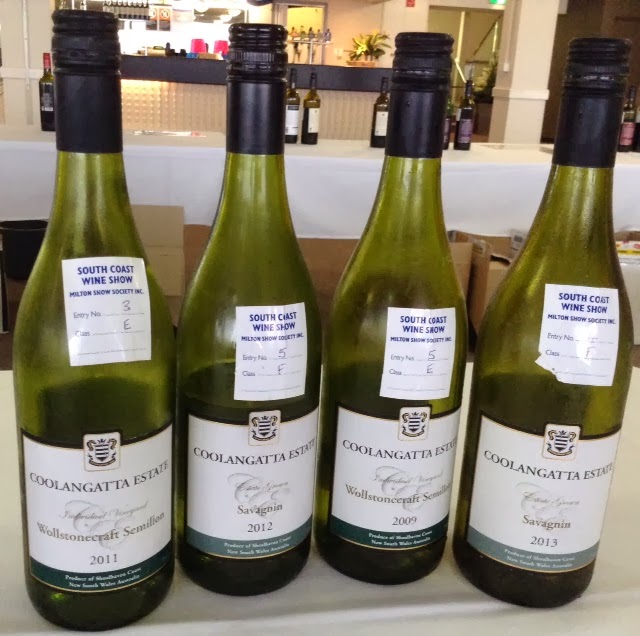
South Coast Wine Show 2016
The South Coast Wine Show is over for another year. This was the 17th.
There were 111 entries from 13 vineyards and wineries.
8 Gold, 10 Silver and 42 Bronze medals were awarded. That is a success rate of just over 50%.
Two new classes were added this year ie. white and red wines made in the region from grapes outside the region. Both attracted good support and resulted in quite a number of medals.
Previously, entries were restricted to wines made with 85% of grapes from the region.
Of course not all of those wines are actually made in the region. Due to a lack of winery infrastructure or a lack of capacity of local contract wineries, many vineyards send their grapes elsewhere to be vinified.
A prime example is the multi award winning Coolangatta Estate who send their grapes to Tyrrell's Wines in the Hunter Valley, a few hundred kilometers to the north, to be made into wine.
The public tasting on the day after the judging was well attended despite the horrific weather.
The NSW coast has been subject to wild thunderstorms and torrential rain for several days at a time over the last month.
From a grape growing point of view, with harvest just around the corner, this situation is definitely not wanted.
But I digress.
Full details of the Wine Show can be found here.
There were 111 entries from 13 vineyards and wineries.
8 Gold, 10 Silver and 42 Bronze medals were awarded. That is a success rate of just over 50%.
Two new classes were added this year ie. white and red wines made in the region from grapes outside the region. Both attracted good support and resulted in quite a number of medals.
Previously, entries were restricted to wines made with 85% of grapes from the region.
Of course not all of those wines are actually made in the region. Due to a lack of winery infrastructure or a lack of capacity of local contract wineries, many vineyards send their grapes elsewhere to be vinified.
The public tasting on the day after the judging was well attended despite the horrific weather.
The NSW coast has been subject to wild thunderstorms and torrential rain for several days at a time over the last month.
From a grape growing point of view, with harvest just around the corner, this situation is definitely not wanted.
But I digress.
Full details of the Wine Show can be found here.
Thursday, January 21, 2016
The Australian Citizenship Ceremony
Australia Day is the 26th January but our local council, a few years ago, changed the Australian Day Citizenship and Awards Ceremonies to the week before. Due to increased numbers of attendees at the ceremonies, Council
thought hosting a more formal evening separate from the more relaxed and recreational Australia Day celebrations was a better option.
From what we experienced this evening it was the right decision.
This year the event was in our nearby town so there was no need to travel an hour or so north to the administrative hub, Nowra, and back in the busy holiday traffic.
So, along with 40 others from all over the world, the co driver took the final step in her commitment to becoming an Australian citizen by taking the pledge and receiving her certificate from the Mayor, Joanna Gash, in front of around 200 people.
It was a constant source of amusement to everyone that so many of the British conferees had taken so long to become citizens. One had lived here 64 years!!!!! Of course there are historical reasons for this but nevertheless they were all given a light hearted ribbing by the audience and even by the mayor herself who was originally from Holland.
The ceremonies were followed by nibbles and drinks.
But where did the new Australian celebrate the occasion? At a Thai restaurant of course. Fish cakes, chicken satay, sweet potato curry with prawns and stir fried chicken with chilli jam, dried chilli and cashews.
Now we are busy applying for an Australian passport (her permanent residency visa was immediately cancelled on citizenship being formalized) just in case we need to travel urgently.
She will also be registering to vote as soon as possible in case the current 'terminally ill' government calls an early election. Voting at all levels of government is compulsory in Australia.
From what we experienced this evening it was the right decision.
This year the event was in our nearby town so there was no need to travel an hour or so north to the administrative hub, Nowra, and back in the busy holiday traffic.
So, along with 40 others from all over the world, the co driver took the final step in her commitment to becoming an Australian citizen by taking the pledge and receiving her certificate from the Mayor, Joanna Gash, in front of around 200 people.
It was a constant source of amusement to everyone that so many of the British conferees had taken so long to become citizens. One had lived here 64 years!!!!! Of course there are historical reasons for this but nevertheless they were all given a light hearted ribbing by the audience and even by the mayor herself who was originally from Holland.
The ceremonies were followed by nibbles and drinks.
But where did the new Australian celebrate the occasion? At a Thai restaurant of course. Fish cakes, chicken satay, sweet potato curry with prawns and stir fried chicken with chilli jam, dried chilli and cashews.
Now we are busy applying for an Australian passport (her permanent residency visa was immediately cancelled on citizenship being formalized) just in case we need to travel urgently.
She will also be registering to vote as soon as possible in case the current 'terminally ill' government calls an early election. Voting at all levels of government is compulsory in Australia.
Subscribe to:
Posts (Atom)