Saturday, August 06, 2016

The Rio Olympics

The opening ceremony of the Olympic Games in Rio takes place today, August 6th at around 9am our time.
419 athletes across 26 sports will represent Australia at the Games. The Team comprises 263 rookies with the youngest athlete, footballer, Ellie Carpenter at 16 and Mary Hanna, equestrian, at 61, being the eldest. She is participating in her 5th Games.
The Team consists of more women (212) than men for the first time in history.
Both the co-driver and I enjoy various parts of the competition but as is usual with most Games our time zone makes 'live' viewing a little difficult. This time we are 13 hours ahead of the host country.
Most of the day competition will be from our midnight through to the early morning. We will be able to watch the evening events, however, during breakfast.We might have to rely a lot on replays for the day sessions.
Another problem is we only have satellite TV reception via a paid provider and the local free to air commercial channel with the Olympic telecast rights is not available to us.
We can however watch their three dedicated Olympic channels via our computers and hopefully be able to Chromecast to our TV if our internet connection speed is up to it. Our ADSL link can be a bit flaky at times.
All part of the joys of rural living!
Another non technical problem is the local channel tends to be a bit nationalistic with its coverage. Sometimes you wonder if any other country other than Australia is participating. It is not always easy to get to see the world's best in action.
Hopefully all goes well for Rio. There have been considerable logistical and construction problems for city in the lead up. And we won't mention the Russian doping scandal.
We wish them luck and hope the vibe is as good as it was in Sydney for the two weeks way back in 2000.

Thursday, July 28, 2016

Flying Foxes

There are four species of flying foxes native to Australia.
The one we see around here is the grey headed flying fox and is found in the temperate south-eastern forested areas of Australia, principally east of the Great Dividing Range ie. the coastal strip between Bundaberg in Queensland south to Geelong in Victoria.
Adults have an average wingspan up to 1m (3.3 ft) and can weigh up to 1kg (2.2 lb).
They live in a variety of habitats including rain forests, woodlands and swamps. During the day, individuals reside in large roosts called colonies or 'camps' that can consist of hundreds to tens of thousands of individuals.
Grey-headed flying foxes form two different roosting camps, summer and winter.
Summer camps are used from September to April. In these camps, they establish territories, mate and reproduce.

Winter camps are used from April to September. Here the sexes are separated and most behaviour is characterized by mutual grooming. Summer camps are considered "main camps", while winter camps are referred to as "transit camps".
Around dusk, the flying foxes leave the roost and travel up to 50 km a night to feed on pollen, nectar and fruit from around 190 plant species.
Grey-headed flying foxes, along with the three other Australian flying fox species, fulfill a very important ecological role by dispersing the pollen and seeds of a wide range of native Australian plants.
They are now a subject of serious conservation concern.
Early in the last century, the species was considered abundant, with numbers estimated in the many millions. In recent years, however, evidence has been coming to light that the species is in serious decline.
They face several threats, including loss of foraging and roosting habitat as well as mass die-offs caused by extreme temperature events.
As well their roosting and foraging habits bring the species into conflict with humans where they suffer from direct killing in orchards and harassment and destruction of roosts.

Why am I talking about this?
Well sometimes these animals decide to set up their camps in urban areas.
There was once a big one in the Sydney Botanical Gardens in the CBD (downtown).
Unfortunately for some of the inhabitants of Batemans Bay, a major town just to the south of us, the flying foxes set up camp in and around a golf course and a man made parkland area filled with native trees in the middle of suburbia. Numbers were estimated at 100,000 ie. about a quarter to a fifth of the entire national population.
The noise, the smell and the continual 'rain' of guano made life very difficult for a large number of residents.
They obviously wanted them 'moved on'.
This of course brought out the 'green army' who wanted the status quo preserved. Obviously they didn't live in the area affected.
However the federal government, after some delay, enacted special environmental powers to solve the problem and the state government contributed $2.5million to set a dispersal plan in motion.
Apart from removing the vegetation from the 'camp' area, extremely loud industrial noise combined with smoke and bright lights has been employed in an effort to make the area where the flying foxes roost to be as 'uncomfortable' as possible
It's early days yet but that plan, so far, seems to be working.
We just hope they don't move up this way although we are aware there has been a 'camp' in the Brooman Forest a fair distance away to the south west of us for some time.

Thursday, July 21, 2016

Things That Make You Smile

We all get through life using a lot of 'things'.
Some we take for granted and others we don't know what we would do without them.
I have a few of the latter eg. the ride on mower, chainsaw, fence wire twitcher and iPad.


The co driver has her Pfaff and  iPod.
Some of these are obviously expensive.
But there are a few things we use that were cheap and, for us, indispensable.
The co driver has her needle threading 'machine' and her brass quilting stiletto.


Mine is my jar opener.
Most of us have struggled opening jar lids. To prevent strained wrists we have all used the tap with a knife or run under hot water methods.
And there are a whole lot of fancy devices, some quite expensive, to get the job done.
But we found a plastic lever action 'tool' for under $10.
Called a Jarkey, just fit it under the lip of the lid and tweak.
Voila!
The seal is instantly broken and the lid easily unscrews.
Haven't come across a jar yet that has resisted this method.
Every time I use it, it makes me smile.

Saturday, July 16, 2016

Our New Highway Section / Wildlife Protection

I have mentioned in previous posts that the major highway at the end of our road was going through a $21m reconstruction with the removal of a dangerous curve and the building of a new 100 year flood bridge.
After eighteen months, of what turned out to be minor disruption, work is virtually complete. It makes the section a lot safer and, even better, we now have a dedicated turn off lane onto our road.
We were puzzled by some strange looking structures that were included in the work.
All has now been revealed thanks to some investigative reporting by Jessica McInerney from of our local paper the Milton Ulladulla Times.
Our valley is surrounded by national park which the highway runs through. As part of the upgrade, fauna crossings have been built to provide safe passage for wildlife.
A fauna underpass at the northern end of the project has been designed to provide a safe crossing for kangaroos, wallabies, bandicoots and echidnas.
A fauna fence has been built on both sides to funnel the animals towards the underpass.
Photos: Jessica McInerney (MUT)


Two canopy rope bridges and several glider poles have been installed to connect either side of the road.
Research has shown these bridges band poles have been successful in helping animals including the yellow-bellied and squirrel gliders safely cross other major highways.
Photos: Jessica McInerney (MUT)


Eighty six nest boxes have been installed to compensate for the loss of 36 trees during the construction.
These are designed to provide potential habitat for some species including microbats, gliders, possums and birds and will be monitored for five years.
Photo: Jessica McInerney (MUT)


Glider experts from the Southern Cross University were engaged throughout the project to advise on the design, location and height of the canopy rope bridges and glider poles.
Nice to see that the fury and not so fury are being looked after although it is a pity the foxes and rabbits will also be able to take advantage.
We see plenty of roadkill on a daily basis around this way so any reduction is welcome.

Tuesday, July 12, 2016

A Trip to Sydney

The daughter and Nick are moving to New York. They fell in love with the place a year ago on their honeymoon and decided to see if they could move there for a time. Australia has an agreement with the USA whereby those with suitable qualifications and skills can work in the country. Nick has already been there for a few weeks, finding an apartment in Brooklyn, and working on an E3 visa.
The daughter leaves next week on her E3D visa. She has a few USCIS hoops to jump through but will eventually be allowed to work as well.
We went up to Sydney to say goodbye and to help a little with some moving chores. Everything is going into storage although we did score a few fancy appliances to 'look after'.
The visit turned into a bit of a dining out fest.
For lunch we went back to Sake on the Rocks.
This restaurant specializes in modern Japanese cuisine.


We decided to sit at the bar for our meal and watch the talented kitchen staff go about their craft. The sushi chefs have amazing knife skills.
Our meal consisted of:
-Sashimi appetizer
-White-soy snapper thin slices of sashimi snapper | sesame seeds chives yuzu juice | white-soy dressing.
-Steamed prawn dumplings shumai | spicy ponzu
-Wagyu dumplings ginger | chive | spicy sour dipping sauce
-Pan seared ocean barramundi cone bay ocean barramundi butter soy sweet ponzu | buckwheat | tomato salsa
This was all washed down with a glass of Jim Barry's Clare Valley Riesling.


It was a hugely enjoyable meal with attentive service in very pleasant surroundings.
The Rocks is the area of original settlement of Sydney and is now a popular tourist precinct filled with hotels, pubs, bars, coffee shops, restaurants and the inevitable souvenir shops. Lots of the old buildings and warehouses remain. There is also a really good market with high quality hand made goods set up at weekends.The place was really buzzing especially since the very large cruise ship, Carnival Spirit, was moored right 'next door' at the international terminal in Sydney Cove.


That night we headed into the newly 'revived' inner Sydney suburb of Chippendale to LP's Quality Meats.
American Bar B Q restaurants are a relatively new addition to the Sydney foodie scene. This is one of the best.
Luke Powell (the LP) has worked at some of the best restaurants in Australia and overseas. It was at Blue Hill at Stone Barns in upstate New York, USA that Luke became fascinated with the smoking and curing of meat and decided to bring that skill to Sydney diners.
A Southern Pride Smoker shipped straight from Tennessee is their production unit and it sure does serve up some mighty fine dishes.
We selected:
-Applewood smoked ocean trout with crème fraîche, dill and capers.
-Smoked Beef short rib
-BBQ chicken with paprika and dill rub (only a half!)
Mash and gravy plus roasted carrots with harissa and almonds were the sides
The dessert to die for was pouding chomeur with vanilla ice cream.
Roll us outta there!!!


They had a very eclectic wine list with the vast majority of makers unknown to me.
We selected a Between Five Bells wine.This winery is owned by a group of guys with various wine backgrounds. Their inspiration is a) "the classic field-blend red wines of California, with their flare, deliciousness and wild, rich flavours" and b) "the wines of the central and southern Rhone Valley, where, if you look past the big names, reside some of the most natural, rustic, slurpable Shiraz and Grenache based wines anywhere in the world".
The 2014 H-cote is a blend of the Italian varieties Nero d’Avola and Negroamaro from a Heathcote (Victoria) vineyard which was fermented on their skins as well as skins of Pinot Gris.


This a very straight forward but drinkable wine that went well with the strong flavours of the food. They say it is a wine that shows silk, spice, savoury and gulp-able flavours. We couldn't argue with that.
So next morning, after breakfast and a bit more furniture dismantling, we said our goodbyes and headed back home.
We are planning to visit New York in May next year to catch up with the kids.

Wednesday, July 06, 2016

Book Reviews / July 2016

Duke Kahanamoku was always considered the father of Australian surfing having ridden his heavy redwood board in front of hundreds of amazed spectators at Freshwater Beach, Sydney in 1914.
But Phil Jarratt dispels this myth and many others in That Summer at Boomerang.
Written in the style of a non-fiction novel the book covers Kahanamoku's early life in a Hawaii where his tiny community of Waikiki "eked out a living from the sea or in small market gardens'' while a small number of planter barons built their mansions.
This was the end of the 19th century with the world of Hawaiian royalty fading and indignities endured as control of their islands was wrested from them.
The book covers his prowess as world record breaking and Olympic champion swimmer (he competed in three) and his life as a lifeguard, actor and finally long term Honolulu sheriff.
The bulk of the book, however, deals with his visit to Australia and New Zealand for three months in 1914.


It covers the well known legend of his association with the young Australian beach girl Isabel Letham and the moment when she rides the wave with Kahanamoku which is immortalized in standard surf histories as well as his exhausting swimming competition tour through both countries.
                           The Duke at Waikiki and Freshwater Beach                                        


Surfing was my choice of recreation for over 40 years so whenever I am in Honolulu I always wander down to the Duke's statue at Waikiki ( I know it's facing the wrong way) to pay my respects. When reading this book I was surprised to find out there is also a statue at Freshwater. And the USA government has issued a stamp in his memory which I have in safe keeping.


Whether you liked or loathed his politics, liked or loathed his movies, John Wayne stands out as a dominant Hollywood star of his era and is unquestioningly king of "the Western" genre with a career spanning 50 years and more than 175 movies. 
John Wayne: The Life and Legend is lengthy biography well researched, detailed and basically non judgmental.
It traces the life of Marion Robert Morrison from his birth in 1907 in Winterset, Iowa (Bridges of Madison County country) through his nomadic childhood and 'apprenticeship' in minor roles to his stardom in Stagecoach and the dozens of other films that followed.
Apparently he altered his life's story, claiming to have become an actor almost by accident when really he had studied drama and wanted to act for most of his youth.


Many family members as well as friends and associates have offered previously unpublished reminiscences for this biography. In addition details from his production company's activities shed light on Wayne's business affairs.
And of course he married three times, all to Latina women, and conducted a lengthy affair with Marlene Dietrich.
The detailed analysis of Wayne's relationship with John Ford, the director with whom he's most associated and who made some of Wayne's greatest films is particularly interesting for the film buff.
A long book but never a tedious one.
Recommended!
As follow up to the above I came cross Company of Heroes by Harry Carey Jr., an actor who worked closely with both Wayne and Ford. His name might not ring a bell but the face is surely familiar.
Coming from an acting family, parents Harry and Olive Carey, he appeared in over ninety films and numerous TV series.


It is an interesting insider's look at Hollywood by someone who is not a big star but was privy to all that went on, off and on the screen.
Another one for the movie buff.
The Road from Coorain is an autobiography of the early life of Australian born Jill Ker Conway.
Brought up on an isolated 12900ha (32,000 acre) sheep station (ranch) in far western New South Wales with only two brothers for company, she became, by age seven, an important member of the workforce. She herded and tended the sheep, checked boundary fencing and lugged heavy farm supplies around. She was schooled entirely by her mother and a country governess.
Life was tough there especially during the seven years of drought. Following the accidental death of her father, her mother struggled on for another three years before the family moved to Sydney.


There Jill  immersed herself in academia while dealing with an ever increasingly emotionally volatile mother and other family tragedies.
On graduation she found that the Australia of the late 1950s was not ready for women to take a leading role in business, academic or diplomatic positions so she set off for the United States where she achieved great success at institutions such as Harvard, MIT and Smith College and on boards of major commercial businesses.
She has received thirty-eight honorary degrees and awards from North American and Australian colleges, universities and women's organizations.
This is a fascinating book about life in rural and city Australia in the mid 20th century.
Unreservedly recommended.


The picture above is from Google and shows the type of country the beginning of this book is set in.
'Flat" is a word that comes to mind. We have driven over similar country when heading west from Sydney to Adelaide. You swear you can see the curvature of the earth especially on the Hay Plains.
It is also reminiscent of the prairie country of the western Dakotas.

Saturday, June 25, 2016

The Big Storm / Aftermath 2

We like the beach in winter.
Usually deserted, it's a great place to find a spot out of the wind and in the sun to do a bit of quiet reading.
But now it is a little depressing to see 'our' beach in such a mess.
But there is an alternative. A few kilometers further south another favorite has been relatively undamaged by the storm although the parking lot was inundated and large rocks were washed off the breakwater onto the boat tramp.
Maybe the off shore islands helped break up the monster north easterly swell that resulted from the gales.

This is Kioloa and is home to one of the many Marine Rescue stations dotted along the NSW coast.
It provides a vital link in the chain of marine safety services between Ulladulla and Batemans Bay, maintaining radio watch and patrol over that stretch of water assisted by its offshore rescue vessel Kioloa 20.

Kioloa 20 is capable of responding to marine emergencies at short notice and provides peace of mind for over 200 amateur fishermen who venture out to sea in their small boats as well as coastal shipping.
Kioloa with its 'satellites' Merry Beach and Pretty Beach, is a sleepy little village during non holiday times. Numerous kangaroos roam the streets, sleep in the shade of the trees or provide entertainment for the few occupants of the camping grounds and caravan parks.
Life sure does move at a leisurely pace during the off season.

Friday, June 17, 2016

The Big Storm / Aftermath 1

"Our" beach before the storm.

And after.

Where did all those rocks come from?
Obviously buried for a long time as we have never seen them before.
It will take some time for the sand to come back, but it will......eventually.
Another east coast low with heavy rain and strong winds is predicted for this weekend.
We have just finished repairing all the flood damaged fences caused by the last storm so hopefully the next one won't be so bad.
Update 21/6: We only had steady rain amounting to 29mm on Sunday. The predicted gales did not arrive.
Today, the shortest day of the year, is clear and sunny. Predicted maximum temperature 18°C (65°F).

Tuesday, June 14, 2016

Queen's Birthday Long Weekend 2016

Although Elizabeth II's real birthday is 21st April, most states in Australia celebrate the occasion on the second weekend in June.
"Celebrate" is probably the wrong word. Apart from the rabid monarchists, she gets little thought over the period. The only official events I can think of are the Trooping of the Colour at the Royal Military College, Duntroon and the announcement of the Birthday Honours by the Governor General.
For most Australians it's just another welcome holiday.
She is 90 years old and has been Queen of Australia for 64 of those.
The line in our old national anthem, but still the British one, 'long to reign over us' certainly is apt.
While the Republic debate in Australia still rumbles on in the background, there are more important social and economic issues going on at the moment.
I think when Charles eventually ascends the throne there will be renewed calls to break our ties with the monarchy. We will just have to wait and see.
So what happened locally during the three days?
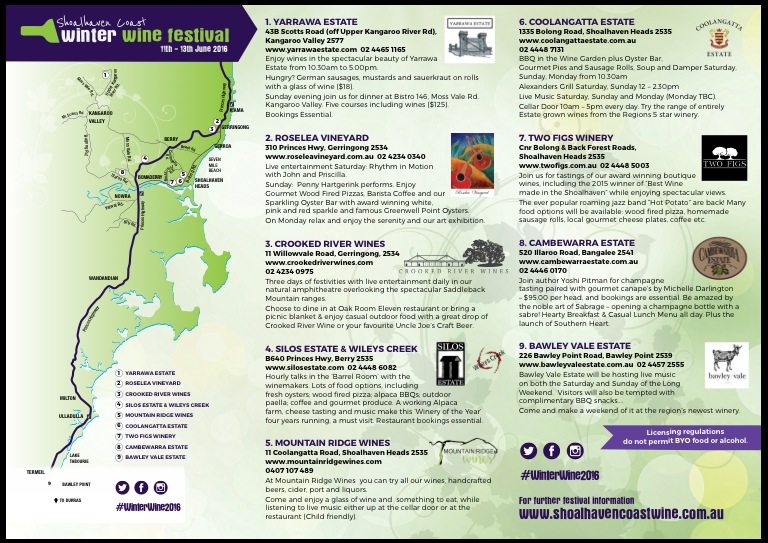
The biggest event is the Shoalhaven Coast Winter Wine Festival.
It's popularity has been growing each year.
It is estimated that around 15000 people visited the various wineries this year. Most of these are concentrated in the north.
Down our end of the region it was however slim pickings. Our friends down the road have closed their winery to enjoy a retired life and, for some unfathomable reason, the biggest winery, Cupitts, decided not to participate in the festival this year. Instead they offered alternative arrangements to celebrate their 9th anniversary.
This left only one, Bawley Vale Estate to hold the fort festival wise. At this stage we have no information as to how they fared.
click to enlarge


In town the Milton Quilters held their biennial Fabulous Threads Exhibition. It was as popular as ever with over 80 quilts on show. I was press ganged into helping with the set up and pull down which involves considerable work but a free lunch. The co driver participated as well as helped out, 'white gloving' it for a few hours. There was no competition apart from viewers choice.
There were all sorts of hand made articles for purchase and the Milton-Ulladulla Men's Shed had beautiful woodwork items for sale. And of course there were vendors with their fabric (bolts and fat quarters), patterns, sewing supplies and notions. I know it's a bit sad I can speak some 'quiltlingo'.
Want some more?
OK then...mismatched points, puckers, FMQing, jelly roll, binding, basting, WIP/UFO.


Then there were the usual regional markets which are very popular. Sadly the Milton Scarecrow Festival was cancelled due to a lack of organization volunteers. A revival of this popular family event is planned for next year.
Our area was packed with visitors over the three days. They enjoyed superb winter weather with constant sunshine, little wind and warm daytime temperatures in the high teens. Quite a contrast to last weekend.
I don't ever envy them their very slow stop start drive home to Canberra or Sydney on crowded roads on the Monday.

Friday, June 10, 2016

A Little History Washed Away in the Storm

At the height of the storm last weekend the swell at Bawley Point,'our' beach, averaged a height of 6m (20ft), with occasional rogue waves recorded at 11m (36ft). This, combined with a exceptionally high tide and storm surge, washed away what was known as the Bawley Gantry.
The gantry has been a landmark on the headland for ever. It was a great place to fish from and a fun place for kids to jump off.
Many happy hours have been spent there.

When this area was first settled back in the early 1800s the main occupation was timber getting. Huge stands of red cedar, black butt, spotted gum, messmate, stringybark, ironbark and mahogany were logged and shipped to Sydney or Ulladualla where a thriving ship building industry had been established.

The main means of transport was coastal shipping. The country was too rough for proper road building and logs were transported from the forests, east by bullock drays, to the coast along rough tracks. Here sawmills had been built on headlands that offered reasonably protected port facilities.


One such mill was built at Bawley Point in 1892 and operated, sometimes under great economic and logistic problems, until 1922 when it burnt down. The milled timber was shipped by means of punts which were lifted by a crane into the water from the gantry and towed out to the ship’s side.
Apart from some foundations the gantry was the last remnant of the mill.
The old crane was washed away in a big storm in 1974.
What's left of the gantry high and dry in the sand dunes


Monday, June 06, 2016

The Big Storm

Our autumn was the warmest on record.
There had been little rain for months.
All to do with La Nina and El Nino said the experts.
But an 'east coast low' was about to change things.
These winter low pressure systems are quite common and are usually a bit windy and can dump a fair bit of rain on us.
But this one was a doozy.
The Bureau of Meteorology began issuing warnings on the Thursday.
Fierce winds of Category 2 cyclone (hurricane) intensity and torrential rain began hitting the south coast of Queensland on the Friday and extended all the way down to Tasmania, a distance of over 2000km (1300ml) by the weekend.
Storm swell breaking against cliffs Sydney eastern suburbs


Result was lots of building damage, flooding, electrical and communication outages, cancelled flights, huge seas with the inevitable beach erosion with some houses being washed into the sea and, sadly, a number of deaths. Why do people try to drive through flooded creeks?
We think we missed out on the worst of it with winds gusting only to 70km/hr and rainfall of 300mm.
We experienced some flooding when our creek broke its banks and a huge branch came down, just missing the house, but hitting one of our water tanks. No damage but a bit of a difficult clearing job.
This extreme weather event of course brought up the global warming/climate change debate again. 
My take on this?
Climate is weather measured and averaged over a period of time.
La Nina and El Nino are ocean events which have always happened and have always had an effect on global weather, just as other similar long standing events have.
But normal weather patterns which have always happened are intensified dramatically as the seas and atmosphere warm.
Heat is energy and just as with any system the more energy put into it, the more energy comes out.
So normal events like this one become over time more and more extreme as everything warms up.
Look how many years in the last two decades were the warmest on record. All the warmest years happened in the last decade or so.
Update 9th June: Tree successfully cleared from tank. No damage. A miracle!
The huge surf opened up the coastal lake our creek runs into so the flood waters dissipated within 2 days. The paddocks have dried out amazingly quickly. Small amount of fence damage caused by flood debris which is easily fixed. A few trees down which will be turned into fence posts and/or next year's firewood.
Unfortunately the storm on its trek south has caused some havoc in Tasmania with severe flooding and loss of life.

Sunday, May 22, 2016

Banksias

As usual many species of Banksia are flowering at this time of year.
But it seems like the flower spikes are more numerous and bigger this year.
The picture below is from 'our' beach.
It is a fine example of Banksia ericifolia or spinulosa or maybe a hybrid of the two known as 'Giant Candles'.


The old seed cones bring back memories of the Bad Banksia Men in Snugglepot and Cuddlepie, a series of children's books written by Australian author May Gibbs around 1918 which used to give us nightmares as kids.


Sunday, May 15, 2016

Saturday, May 07, 2016

Getting Ready for a Warm Winter

So we have taken a double delivery of wood from our local woodman, Laurie, and Jim and Jackson, the hardware guys, have installed our new wood heater.
It may look a small pile of wood to some but eucalyptus hardwood is extremely dense (Air Dry ρ around 1000kg/m3) and burns slow and hot (can be 100% Relative Heat Available/Unit Volume) unlike softer woods (radiata pine 500kg/m3 and 45%).

Eucalypts or 'gumtrees' are native to Australia. There are over 700 species. Around us are the Sydney blue gum, the grey ironbark, blackbutt, stringy bark and yellow box to name a few.
Most make great firewood and are collected by licensed companies or individuals who take it from the harvest residue left in state forests. Most operators cut and split the fire wood to size. Some even supply round and split posts for fencing.


We will probably start evening fires around June and need a similar amount of wood delivered to get us through until end of September. We usually only have the fire going 24/7 for three weeks or so during that period.
Of course I have a bit of fallen timber and old fence posts to cut up to supplement the supply.

Monday, May 02, 2016

Bobal

Vitis vinifera cultivars form the basis of the majority of wines produced around the world. All of the familiar wine varieties eg. Chardonnay, Shiraz et al belong to Vitis vinifera, which is cultivated on every continent except Antarctica and in all the major wine regions of the world.
There are currently between five and ten thousand varieties of  Vitis vinifera grapes though only a few, in comparative terms, are used for wine and table grape production.
From previous posts and our 2016 wine list you may have noticed we lately have extended our tasting experience to include more overseas wines.
Our preference for Rioja Tempranillo has encouraged us to look for that grape from other Spanish regions.
And we have found a few. One was a blend of Tempranillo and Bobal.
Bobal?
Had never heard of that variety before.
Spain has over a hundred native grapes, both red and white.


Bobal is a red grape variety of Vitis vinifera native to the Uteil-Requena region in Valencia where it accounts for about 90% of the vines grown there.
The name derives from the Latin bovale, in reference to the shape of a bull’s head.
According to the data from the Spanish Vine Registry, Bobal is the third most planted variety in Spain with 90,000 ha (8%), coming behind Airen 305,000 ha (27%) and Tempranillo 190,000 ha (17%).
The must produced from the grape is normally high in colorants and tannins and is suitable both for aging and for blending with other varieties.
We found the Tempranillo Bobal blend much to our liking both in the Reserva and Superior classifications.

Monday, April 25, 2016

ANZAC Day 2016


They shall grow not old, as we that are left grow old.
Age shall not weary them, nor the years condemn.
At the going down of the sun and in the morning,
We will remember them.

Lest We Forget

Tuesday, April 12, 2016

Winter Is Coming

Winter is coming or so the calendar says.
But last Wednesday it was 35°C (95
°F) which was the hottest April day on record.
Thankfully some normalcy now has returned and it feels a little bit more like autumn.
The exotic trees are just starting to change colour and will soon be dropping their leaves. The native ones never do. They are always green.
Winter around here is not so severe as in other places we have been. 

Yes, South Dakota, I am looking at you! 
It can be zero (32°F) in the morning and we do get a few frosts but never any snow. But it usually warms up to around 18°C (65°F) during the day
A really cold day is maximum 10°C (50°F).
So preparing for the cooler days and nights is not such a big task.
We make sure we have a good supply of firewood and that the combustion stove used to heat the house for a few weeks is in good order. This year we took the plunge and decided to get a new one. The firebox in the old one was getting pretty rusty and wasn’t worth doing any more maintenance on. I was surprised when going through the paperwork that it was 17 years old.
So our local hardware store will be able to supply and install the same brand and (updated) model.
We decided to replace the entire flue system as well.

It is also time to get the ride-on fully serviced as it appears grass growth is slowing down.
The mower centre in town picks it up and delivers it back within a few weeks good as new after a hard year's work mowing and sprayer towing.
We also have to look for a supply of lucerne (alfalfa) hay to feed the cattle towards the end of the season. Our paddocks are all native grasses and there is no winter growth at all.
Other jobs will include weed spraying eg. tussock, bracken, thistle and blackberry.
Of course we will be doing the usual burn offs. Reducing the potential bush fire fuel load for next summer is always an important defense strategy. Fire restrictions are usually reduced between April and September so land owners can get this done. However this year it has been so hot and dry, April still has restrictions in force. Big fines for non compliance although I have noticed that national parks and state forest authorities have already commenced controlled burns in our area, one even on the 35
° day!
There will also be the usual fence maintenance. The cooler days are great for getting stuck into that.
And of course the vines will need pruning.
Busy! Busy! Busy!

Friday, April 01, 2016

Vintage 2016 / Some Climate Data

Here is some basic climate data for Vintage 2016 for our region.


For those interested in a very detailed and informative discussion about the influence of climate on grape growing and wine quality, then this GuildSomm article is for you.