Sunday, May 30, 2021

COVID-19 Update / Australia / 27th, 29th & 30th May

So here we go.....again!
A man spent two weeks in hotel quarantine in South Australia and returned to Victoria in early May and then tested positive.
In the last day, we have seen 12 linked new cases in Victoria, bringing the total number of cases linked to that SA hotel quarantine breach to 26.
One of those people is in an ICU, on a ventilator, and in not a very good way.
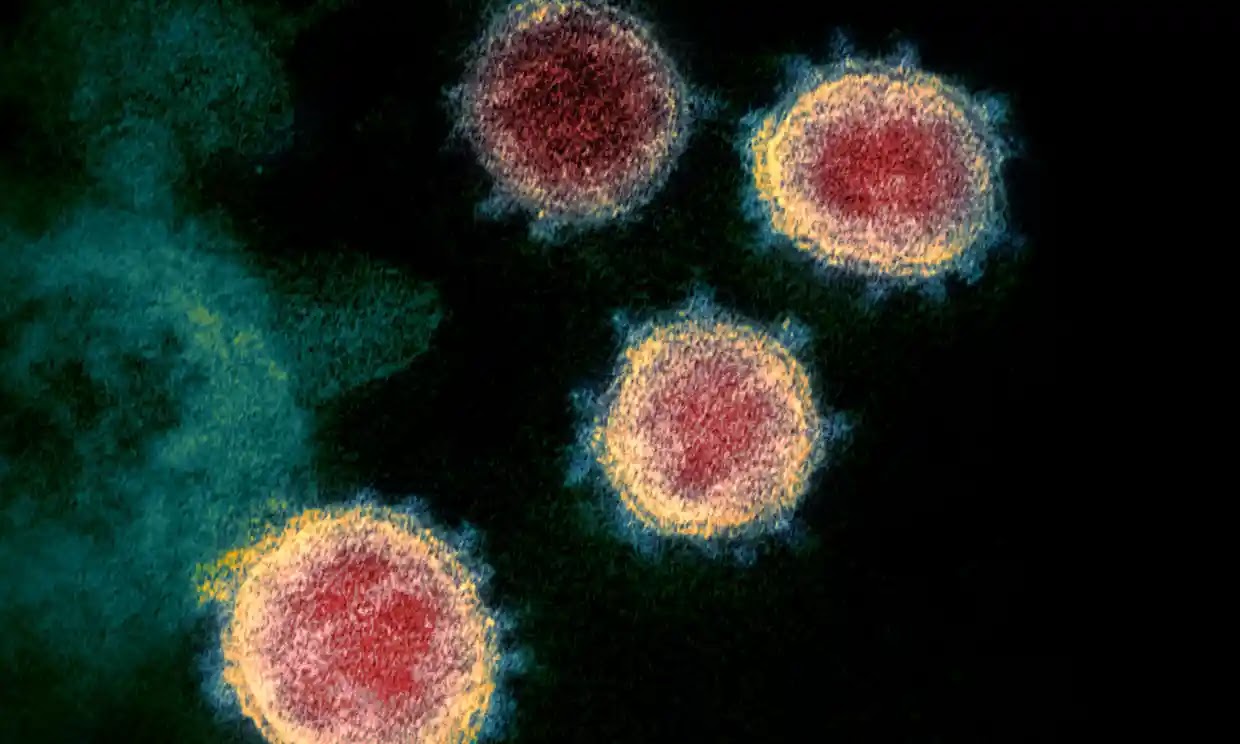
In the last day, evidence is they are dealing with a highly infectious strain of the virus which is running faster than they have ever recorded.
There are at least 10,000 primary and secondary contacts who are being isolated.

Therefore from midnight, Victoria will go back into lockdown - for the fourth time.
People can leave the house only for five reasons: caregiving, essential shopping, exercise, essential work and to get vaccinated
A single household can invite only one person into their bubble.
All non-essential stores are to close.
Take-away is still OK.
Masks must be worn everywhere.
Major sporting events will continue, without crowds.
More than 150 sites (including private homes) have been identified as exposure sites.


So South Australia, the Northern Territory, Western Australia, Queensland and Tasmania have now closed their borders to Victoria, or to parts of Victoria.
New South Wales has also released new health advice for Victorian travellers:
Anyone travelling to NSW who has been in Victoria after 4pm today (Thursday) must follow the stay-at-home measures that will apply in Victoria, which were announced by the Victorian government this morning.
As we have mentioned before, hotel quarantine ‘escapes’ have been the major source of outbreaks. While quarantine is federal responsibility, they have so far left it up to the states to manage.
Of course despite rumblings that is a dereliction their duty, they have been quite happy to let this situation ‘run’ to avoid any backlash when situations like this arise.
Time may be running out for them however after this latest outbreak.


Update: 29th May
Today, Saturday, the number of active locally acquired coronavirus cases in Victoria is 35. All are linked to the latest cluster.
There were 56,624 test results received on Friday - the highest single number of tests completed in a day in Victoria since the pandemic began.
There are now 15,000 Victorians in isolation after potentially being exposed to virus.
The 7 day lockdown continues.
Update: 30th May
Five more cases reported overnight.
As of May 28, just under 15 per cent of the population had received their first vaccination dose and about 1.3 per cent had been fully vaccinated, according to The Age ’s COVID-19 vaccine tracker, which is based on federal and state health department figures.
Australia, which Mr Morrison our Prime Minister once claimed was “front of the queue”, ranks 119th in the world for the percentage of its population that has been fully vaccinated.
This is an appalling statistic.

Thursday, May 27, 2021

A Late Autumn Date Day

The co driver had to pick up some shoes she had ordered from a little boutique in Moruya so it’s was a good opportunity to have another date day in that area.
The Dowry is a cute little shop full of quirky bits and pieces as well as nice women’s clothing. 


But for me the building is the highlight. It’s an old bank building constructed in 1905 in the Federation style whose facade has been well preserved.
Then, on the way to lunch, we had to of course pass a quilt shop and, surprisingly, make a stop.
Stephs was originally in Moruya but moved to Broulee, a small coastal village nearby, and is doing well there.


Then it was onto Mossy Point just to the north and the cafe there that is situated in the area’s old general store.
It was good to try a new place and it did not disappoint. Great atmosphere, excellent service and delicious food and coffee.


The pulled pork burger with pickled red cabbage, kewpie/sriracha mayo on a toasted bun with lots of beer battered chips was very yummy.
We then took the scenic rural route into Batemans Bay. 
It was my turn to spend a little. 


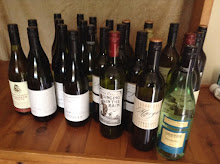
I always enjoy half an hour at Dan Murphy’s looking through their international wine collection and stocking up on some French, Italian and Spanish bargains.
They came to the party once again.
So then it was home to light the fire, sit back and relax after a great day out and wait for the super blood moon eclipse. 


Photo:@scott.portelli 


Tuesday, May 25, 2021

Grapes in Late May?

The co driver came home the other day with a bag of white table grapes from the supermarket.
Grapes in May I thought? That’s very late in the year.
They were branded Autumn King.
So I did a bit of investigation.
Autumn King is a late-season white seedless table grape developed by David Ramming and Ronald Tarailo of the USDA-ARS in Parlier, California.
The cultivar, formerly known as C10, was released in 2006 and resulted from the cross of USDA selections A61-20 x B99-131. The parentage of Autumn King is complex and includes Agadia, Blackrose, Calmeria, Cardinal, Divizich Early, Italia, Maraville, Muscat Hamburg, Muscat of Alexandria, Perlette, Sultanina and Tafafihi Ahmur.
The only informative video I could find was American.
Check out the size of the bunches and the high trellising system.  

The cultivar produces medium-sized (0.5 kg), conical to cylindrical- shaped bunches that are medium to well filled. The natural berry size of Autumn King is quite large and without gibberellin or girdling, berry weight can average 8-9 grams or more. Berries are cylindrical to ovoid in shape, and have medium to firm flesh and skin. The berries contain 2-3 aborted seeds which are inconspicuous when eaten and the flavor is described as sweet and neutral.
Autumn King ripens mid-September through to November or about eight weeks after Thompson Seedless, the predominant white table grape.
That’s the USA seasonal range; delete 6 months (or add) for us down under.
There are four licensed Autumn King grape growers in Australia, all in North Western Victoria.

Thursday, May 20, 2021

The Mouse Plague

The mouse plague out in western New South Wales in the grain belt has been going for months.
No end is in sight.
We have had a tiny outbreak here on the coast but nothing at all like these poor farmers and their families have experienced
Below is a video for the Australian Broadcasting Commission (our PBS) from their rural program Landline which covers this disaster.

Wednesday, April 28, 2021

Port Arthur Massacre 1996

Today marks 25 years since the 1996 Port Arthur massacre.
At the time, the attack was considered the world’s worst mass shooting, with 35 people killed and 23 injured at the historic convict ruins tourist site on the Tasman Peninsula in Tasmania.
It remains Australia’s most deadly massacre.
It was this massacre that prompted an overhaul of Australia’s attitude towards gun control under the prime minister of the day, John Howard.
Laws, the National Firearms Agreement or NFA, were brought in banning rapid-fire guns from civilian ownership, tightening requirements for firearms licensing, registration and safe storage, and establishing a government buyback of semi-automatic and pump-action rifles and shotguns.
More than 650,000 weapons were destroyed, potentially almost halving the number of gun-owning households.


In the 22 years after Port Arthur, there were no mass shootings (defined as shootings in which five or more people – not including the perpetrator – are killed), compared to 11 in the 20 years before Port Arthur. Average annual firearm-related deaths dropped from 3.6 per 100,000 population in the 17 years before Port Arthur to 1.2 per 100,000 in the 17 years after.
Yet this is not a total success story.
More than two-thirds of firearm deaths in Australia are suicides.
The other area of firearm violence that has received little attention is domestic and family violence.


While the proportion of Australians owning guns has dropped by about half between 1997 and 2020, the number of registered firearms in Australia now exceeds 3.5 million.
International studies show domestic partner homicides are up to 12 times higher when firearms are accessible while suicide rates are up to 19 times higher.
The National Firearms Agreement that contributed to reductions in firearm violence was however never fully implemented and has been chipped away at in various parts of Australia over the past 20 years.
Public complacency has been exploited by powerful pro gun lobby groups which undermines Australia’s successes in gun control.

Tuesday, April 27, 2021

COVID-19 / Collateral Damage

I have been with the same bank for decades, since my first housing loan way back in 1973.
But when internet banking became the norm, I hardly ever visited a branch except maybe to pick up some foreign currency for an overseas trip every two years or so.
And I can’t remember the last time I wrote or received a cheque.
Nevertheless, it came as a surprise that the bank is closing down its branch in our town.
Apparently the pandemic and its social distancing ramifications convinced people who were holding out that on line banking was not so bad after all.


Face to face banking fell to an all time low which had initiated the company’s decision.
There is a good chance our bank won’t even have an ATM in town.
Ours is not the only branch or indeed other banking companies’ branches suffering the same fate across the country.
Our area has a population of approximately 17,000 and is serviced by quite a few banks and building societies, all with charge free ATMs so I guess ours won’t be missed too much.
Our nearest branches will now be 30 minutes south and 60 minutes north away. 
I am sure this won’t be the only changes in our future daily lives caused by Covid.

Sunday, April 25, 2021

ANZAC Day 2021


They shall grow not old,
as we that are left grow old;
Age shall not weary them,
nor the years condemn.
At the going down of the sun
and in the morning
We will remember them.


Saturday, April 17, 2021

Magpie Crimes

We are in the middle of a mini mouse plague here. 
Only one in the house so far (caught in a trap) but we see them outside regularly and can hear scurrying in the roof at times. 
Our friends in the area are experiencing the same.
What with the mouse plague out west and now a problem here, mouse/rat bait is at a premium. There are no supplies anywhere around. We have been forced to order it on the internet and you have to be quick there too. Limited supplies run out quickly.


We use the wax blocks. They are moisture resistant and therefore good for outside and are easy to throw into the roof cavity from the manhole.
We went through one bucket (55 blocks) in just over a week!
I couldn’t believe each day so many blocks had completely gone. Mice couldn’t carry them and rats would  also have difficulty. 
Maybe possums? But no dead ones around. 
Maybe our resident bower bird, who loves blue things, was using them to decorate his bower. But no, nothing in there either apart from some of our blue clothes pegs and blue milk bottle tops.


Then the other day I spied the culprit.
One of our resident magpies had a block in his beak and the co driver caught one of them stealing a block off our front veranda.
They were hopefully using them to decorate their nests, not eating them.
I didn’t know they liked blue things. A quick check of Google came up with nothing apart from an article in a northern NSW paper about a magpie nest decorated with blue baling twine.


So now we are laying out the exterior baits after sunset and collecting them early morning.
Obviously this is a bit of a pain but with the bait shortage and resultant inflated price, not to mention possibly saving magpie lives, it’s something we have to do.

Monday, April 12, 2021

COVID-19 / Australia / Vaccine Rollout / Update 30th March & 12th April

There’s an Australian saying involving brothels that is related to someone or some organisation who is hopeless.
To clean that saying up, let’s just say the Australian government “couldn’t organise a beer in a brewery”  when it comes to Covid vaccine distribution.
About 4 million Australians were to be vaccinated by the end of March. By this Wednesday, about 312,502 doses had been administered.
The government has shifted from promising all Australians would be vaccinated by October, to saying everyone would receive their first dose by October.
There is no doubt that the vaccine rollout is one of the most complex, logistically challenging undertakings that has faced the Australian government.
And yes, it has been complicated further still by factors outside of the government’s control. International supply of the AstraZeneca vaccine has been restricted by the European Union, which has blocked hundreds of thousands of doses reaching Australia.
But GPs across the country, already fatigued from the strain placed on them during the pandemic, have seethed with frustration in the past two weeks, as the government moved to the second stage of its vaccine rollout, phase 1b.


That frustration began last Wednesday, when the government blindsided many GPs by publicly telling Australians to flock to a new government website, which checked their eligibility for the vaccine and then linked roughly 6 million eligible patients with about 1,000 GP clinics currently activated to distribute the vaccine.
Naturally, GPs were immediately inundated with calls.
But with no vaccine supply to speak of, most simply could not book patients in.
Shipments were promised last week, before the start of phase 1b on Monday,
Some simply didn’t show up.
In some cases, vaccines were showing up, but needles and disposal containers were not.
Granted there is less urgency in Australia than in other nations as we seemingly have the Covid situation under control.
Yet that is the very reason the government has repeatedly said that Australia has had time to plan its rollout, and conduct it carefully and with efficiency.
That time afforded to Australia allowed it to set targets that now seem laughable.
The nation is now dependent on local manufacturing of the AstraZeneca vaccine through CSL, which began releasing 830,000 doses for use last Tuesday.
Us phase 1b people live in hope.
Source:Guardian Australia 
Update: 30th March
My first shot is due next week!!
Update: 12th April
I had my first shot last week. No reaction apart from a sore arm.
In the broader picture, the brown stuff has hit the whirly thing with a case of blood clotting in a younger recipient of the AZ vaccine in Melbourne.
This reaction has been noted in a number of cases overseas and has proved fatal in a few.
Granted the figures are very very low but it has caused some re thinking here.
The government has decided that AZ should only be given to the +50 population although this is not mandatory. It comes down to personal choice.
Given there are virtually no replacement vaccines available, the rollout has been thrown into disarray.
Of course the government spin machine is working overtime.


The ‘everyone totally vaccinated by October’ boast was abandoned with the new message ‘all Australians will have a dose by the end of the year’ only to be quickly replaced by ‘we have not set, nor have any plans to set any new targets for completing first doses’.
Forty million doses of the Pfizer vaccine are supposedly in the pipeline. But who knows when/if they will arrive.
It seems it will be well into 2022 until the country is totally vaccinated.
No wonder plans for an early federal election have been put on the back burner.
People aren’t happy!


Sunday, April 04, 2021

Easter 2021

With relaxing of the COVID restrictions Australia wide and the reopening of state borders, people are on the move again.
Our area has always been a major holiday destination, but this year with the Easter long weekend combined with school holidays, we have been inundated with ‘touros’.
Good for the local economy, not so much for the amenity of the area.
Traffic is on the highways has been relentless. Sadly, a single car accident just down the road from us took 3 lives very early on Saturday morning. Probably fatigue related.


As a result of the ‘invasion’, we stock up on food a few days before Good Friday, shut the gate, and lock ourselves away for 5 days or so. This also gives the cattle a chance to really eat down the grass around our house paddock uninterrupted. They have been doing a great job so far.
This year the co driver’s birthday fell on Easter.
We celebrated with fresh oysters and tiger prawns, prawn cutlets to fry, BBQ’d fresh salmon and a bottle of Italian Prosecco.
There were even some prawn leftovers to make up a big wok full of nasi goreng for the next night.
I consumed numerous hot cross buns on the Friday (as well as the days (weeks?) before) and then, as a substitute for chocolate eggs, Maltesers on Sunday. 


Weather has been of the perfect Autumn kind ie. cool mornings, warm sunny days, little wind but it seems we are in for more rain later on in the week.
That’ll top up the house tank again.

Friday, March 26, 2021

Another (longer) Trip to Wollongong

Finally the non stop rain abated a little at home on the Sunday and we decided to make an early afternoon dash, 2-3 hours up the highway to Wollongong in preparation for removing a skin cancer on my nose by a Mohs specialist surgeon.
Forty five minutes into the trip, down came the rain again.
It was torrential in parts with the windscreen wipers at full blast hardly making a difference.
But we finally made it into the city and checked into the Adina Apartment Hotel.
We had booked a studio room that had everything we needed for a three day stay.
There were lots of restaurants close by. We decided on Greek at Litani’s for dinner and the meal was excellent.


Up early next morning and the co driver dropped me off at the day surgery hospital.
Comprehensive check in system, much of it, of course, COVID related.
Then I got all gowned up and after some preliminary tests, it was up on the table, injected with a local anaesthetic and the first excision of the cancer made.
Then back to the waiting room while they ‘looked’ microscopically at the bit they had taken.
Good news...they got it all with the first cut.


So back on the table and the wound was sewn up and the area repaired.
The co driver picked me up and we headed off for lunch. 
We found a great spot, Lee and Me in the main street. The BBQ pulled pork burger was excellent as was the atmosphere of the cafe.

However the afternoon wasn’t too pleasant for me. The area was quite painful as the anaesthetic wore off, but some analgesics soon deaden the pain.
In the evening we headed across the road to a Lebanese manoosh pizza cafe, the Zaatar Hut.
They use flat bread as a base and had the choice of Lebanese or more traditional Italian toppings.
We selected the latter.


It was pouring rain on Tuesday morning so we went under the hotel to the Nutrition Station cafe for brekky. 
Again an excellent meal, really friendly staff and great coffee.
The co-driver’s corn and zucchini fritters with beetroot hummus and cherry tomatoes was delicious.
I stuck with the bacon, egg and spinach breakfast burger.


The rest of the day was spent in the room reading and interneting.
Dinner was across the road at Samaras Lebanese restaurant where we chose the mixed platter for two to experience a cross section of the cuisine. We liked everything apart from the falafel. The pink pickles were also a bit strange. It’s BYO so we got to drink one of our own wines for minimum corkage. Then we indulged in too much ice cream in a small specialist store, which seemed to have 100 flavours, just down the road

It finally stopped raining that evening.
Next morning arrived with blue skies and sun.
After breakfast at the Coffee Club Cafe and it was down the road a bit to Kiama via the 'scenic route' past industrial Port Kembla to get the dressing taken off at the doctor’s surgery.
We were early for the appointment so swung by the blowhole again. A huge was surf running and the blowhole was performing. There’s a nice lighthouse on the point too.
The nose looked a bit of a mess but staff were happy with the result and say it will settle down in time and with a little daily home treatment. Stitches come out next week.
Then it was homeward bound.


There was no obvious flood damage at home, the creek was back within its banks and all cows accounted for.
Good to be back home..

Wednesday, March 24, 2021

The Bushfire Season Over / Updated 20th, 21st, 22nd, 23rd & 24th March

 
The heavy rains forecast statewide this weekend will bring an end to what was already the least active bush fire season in a decade. 
NSW has recorded fires in just one per cent of the area burnt in the record 2019-20 season, the Rural Fire Service said. 
Severe weather and flood warnings have been issued for parts of New South Wales. 
Our area is likely to receive 100-200 millimetres between today and the weekend, with the heaviest falls likely on Saturday. 
The burst of autumn rain comes as the La Nina weather pattern in the Pacific “is on its last legs”.
Sea-surface temperatures are back in a neutral range but the atmosphere is still in a mode favouring wetter-than-average conditions for eastern NSW into April. 
The soaking rains mean that the fire season will officially come to an end on 31st March. 
It’s the first time for a long time, there has been no extensions of fire restrictions anywhere in NSW.
It’s the quietest fire season since 2010-11. 
Figures compiled by the Rural Fire Service show that, between July 1 and the end of February, the area burnt in the state was 57,138 hectares, or just 1 per cent of the 5,490,504 hectares burnt during the comparable period in the previous year. 
There were 5132 fires or fewer than half the tally of 11,482 a year earlier. 
In the 2020-21 fire season to date, there have been no Class 3, or Section 44 bush fires that 
trigger a so-called bushfire emergency. 
That’s also the first time a decade without one. 
Good news!
Update: 20th March
Towns along the NSW North Coast, including Port Macquarie and Taree were inundated by floodwaters today as rivers broke their banks.
Huge amounts of rain fell in the region between 9am on Friday and 5am on Saturday, including 373mm at Delward, 343mm at Redoak (Stewarts River), 320mm at Logans Crossing, 280mm at Kindee Bridge, and 264mm at Wauchope. (250mm = 10 inches)


So far in our area we are experiencing fairly strong winds but have only received 40mm rain.
However the system is moving south and we could see substantial falls overnight.
Wet weather is expected to continue battering the state until mid-next week.
Update: 21st March
The deluge continues. 
We have had another 40mm. 
However things are much worse to our north.
Western suburbs of Sydney are being evacuated as the city’s main water supply dam overflows. This is now considered a 1 in 50 year event.


Virtually the whole of New South Wales is being affected by this system. No relief from the rain is expected until Wednesday.
Update: 22nd March
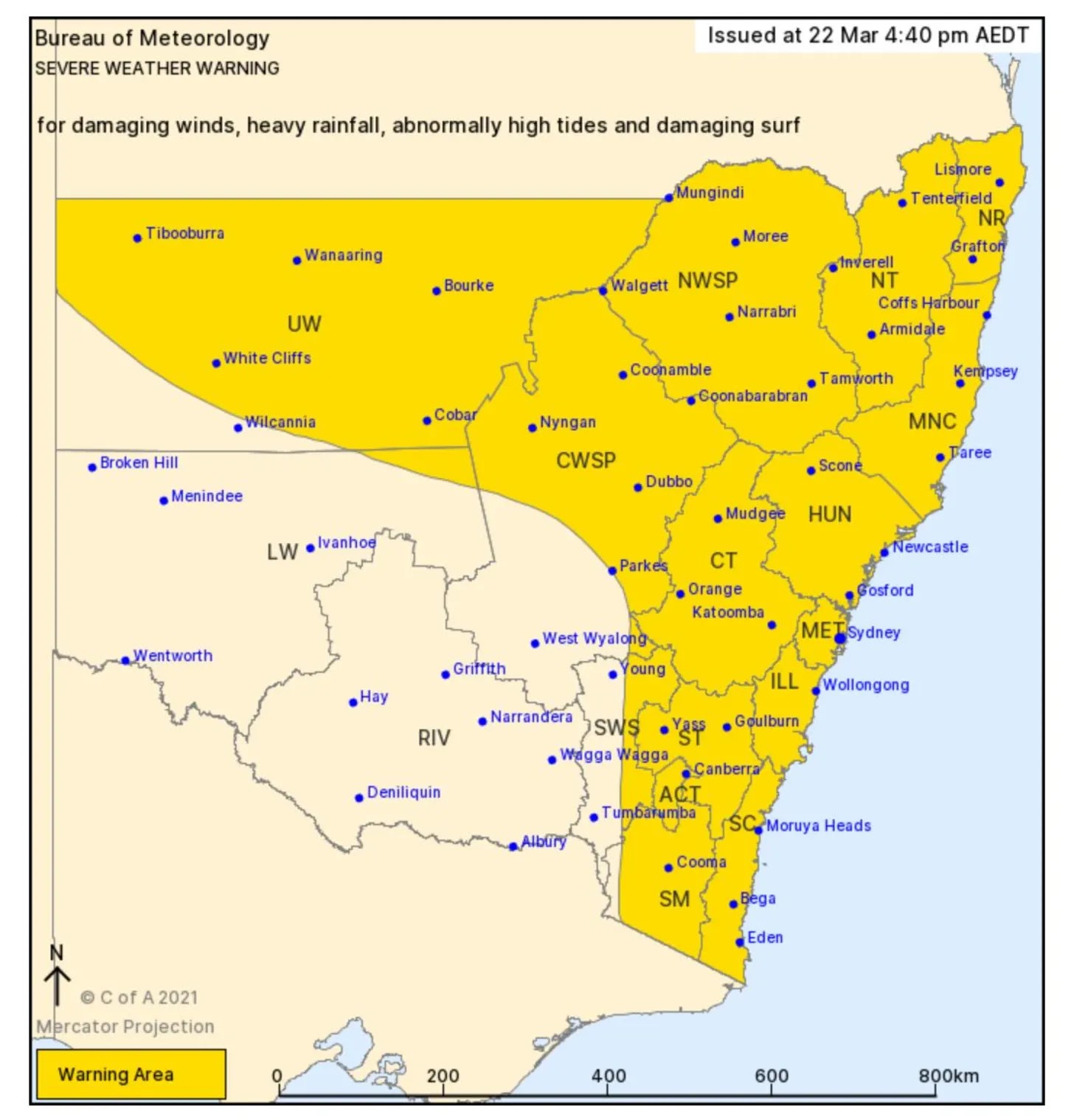
The Bureau of Meteorology has updated its severe weather warning, with heavy rainfall stretching from the Northern Rivers to the South Coast tomorrow.


Heavy rainfall will then extend to areas of the ACT, South Coast, Snowy Mountains and Northern Tablelands during Tuesday. There is an enhanced risk with any thunderstorm activity.
That’s us in the south.
Update: 23rd March
The rain has finally stopped.
We had just over 50mm today making a total of 200mm (8 inches) over 4 days. 
We got off pretty lightly compared to others.


Our creek is up and flooding and we’ll have some fencing damage but it will be minor.
This was a huge weather system covering an area the size of Alaska. 
For some it was a 1 in 100 year event.
Update: 24th March
There are sunny blue skies today but the flood waters out west and along the mid-north coast have not yet receded.
Fifteen thousand people remain on alert to evacuate and 18,000 people have already evacuated.


As of this morning more than 950 people have been rescued from flood waters by the State Emergency Service, which has received more than 11,000 calls for help. Some 280 schools remain closed and 9,500 claims have been lodged with insurance companies.
So we will finalise this post here unless something drastic happens in the meantime.

Tuesday, March 16, 2021

Watch Out Wascally Wabbits

On Christmas day 1859 Thomas Austin, a self-made wealthy settler, released 13 European wild rabbits on his estate, Winchelsea, Barwon Park, Victoria. They had been specially collected and sent to him by a relative in England.
By the late 1940s the rabbit population had rapidly increased to 600 million.
Initial tests on myxomatosis, a rabbit-specific virus, that took place in 1943 had been inconclusive.
However trials restarted in 1950.


Initially the new trials looked to be a failure but rains in December 1950 produced more mosquitoes, the vector that spread the virus and the disease spread at an incredible rate.
An animal that had thrived better than any other introduced mammal in the world was now dying out at record speed.
However, rabbits began developing a resistance to myxomatosis and something new was needed.


The deadly calicivirus was released in 1995/96
Here, South East Local Land Services with the support of local land managers and local councils, will release the Rabbit Haemorrhagic Disease Virus known as RHDV1-K5 (RHDV), the Korean variant of the existing virus already widespread in Australia, throughout our area this month.
It will be the fifth release of RHDV nationally since 2017, and the third here on the South Coast.
Since then there has been an estimated 42 per cent reduction in the feral rabbit population in NSW.
We have not seen rabbits on our place for years. When I first moved here they were everywhere. We would surface bait, fumigate burrows with phosphine or as a last resort shoot to keep them under control.
Myxo and calici were a godsend.
But the word is they are slowly becoming immune to the calicivirus.


Pet rabbit owners on the South Coast are being urged to vaccinate their pets before the latest control program rolls out.
The effect of rabbits on the environment has been catastrophic. They can survive on almost any plant matter: shoots, herbs, grasses, grains, leaf buds.
The long-term result of rapidly reproducing rabbits is overgrazing by an extremely large population, which can lead to a collapse of indigenous plants and the native animal species that eat them.
Excessive grazing also leads to soil erosion, which affects pasture yields and water quality.
It is estimated that rabbits cost the Australian economy more than $200 million per year. 

Wednesday, March 10, 2021

Yet Another New Weed

In past posts I have mentioned how the 19/20 bush fires had caused a whole raft of new species of weed growth in the burnt areas.
We had got rid of those with herbicide treatment and with substantial rain and even flooding had expected the pasture to reclaim the affected areas.
But no!
Another plant unknown to us began to take over those bare areas and was especially thick along the riparian zone.
So once again we "attacked" with herbicide over a number of weeks with almost total success.
But what was this plant?
Internet searches failed to find it so I emailed a picture to our local land services department and got an answer back the next day.
Turns out to be a native plant commonly known as Indian Weed with the scientific name, Sigesbeckia australiensis.

According to habitat data, it grows in moist and shady places, particularly on creek and river banks. That's us!
It is also prevalent in eucalypt woodland, vine forest and the margins of rain forest, on a range of soils and at altitudes from sea level to at least 1050m. 
It is considered a minor weed of disturbed ground and agricultural systems.
So what is a weed?
A weed is any plant which has a negative impact and requires human action to control it. The negative effects of weeds can be on the environment, economy, human health, or the amenity of gardens and landscaping. 
Weeds can also be a native or introduced species.
Native plants are usually considered weeds when they move from their natural habitat to a new area and begin to take over. Again that was us.