Sunday, February 17, 2013

Cabernet Sauvignon and Its Parents (and Grandparents)

All European wine grapes are the same species ie. Vitis vinifera.
It is widely conceded that this cultivated species came from the wild race subspecies Vitis sylvestris found over southern Europe and western Asia.
The different varieties we are familiar with today are a result of centuries or probably millennia of natural cross pollination.
Many wine grapes are also the result man made crosses even to the point of crossing different wine grape species.
Up until recently is was not possible to tell what the origin of the current wine grape varieties were.
But with DNA profiling  the puzzle is slowly being unravelled.
It is estimated there are over 10,000 grape varieties with around 1500 being used for wine production. Only a small percentage have been genetically analyzed.
I have spent the day in the Cabernet Sauvignon block, green pruning, spraying, mowing and net mending.
I got to wondering where this variety, which is the classic Bordeaux red wine grape, came from and did some research.


 Surprisingly it turns out that Cabernet Sauvignon is not so old.
It was a chance crossing between Cabernet Franc and Sauvignon Blanc in a French vineyard some time during the 17th century.
Cabernet Franc is a very old variety and is said to be selected from wild vines.
Sauvignon Blanc on the other hand is a natural cross of Traminer and Chenin Blanc.
Traminer is one of the oldest European varieties and is said to be selected from wild vines.
Chenin Blanc is indigenous to the Loire Valley (Anjou), France and is reputed to have been in that area at least since the 9th century.
So there you have it.
Many countries are researching and developing hybrids. Our CSIRO already have a few in the field and in production eg. Tarrango (Touriga Nacional x Sultana) and Taminga ( a cross of a previously created crossing Merbein 29-56 and Traminer).
And the natural evolution also continues outside the realm of hybridization. Two different coloured Cabernet Sauvignon grapes are indigenous to Australia.
A chance discovery of pinky bronze fruit on a Cabernet Sauvignon vine in 1977 provided Cleggett Wines the opportunity to propagate this single cane cutting (called a sport in horticultural terms) at their Langhorne Creek (South Australia) vineyard.
This Bronze Cabernet Sauvignon grape is registered as Malian.
Several years later in 1991 through the same process of nature a White Cabernet Sauvignon grape was identified and subsequently registered as Shalistin.

Wednesday, February 13, 2013

Preparation for Vintage 2013

The main pre-vintage task is to get all the equipment clean as well as check out the integrity of some components. The acid environment of the wine making process can be harsh on tank seals, piping, gaskets and plastic airlocks
This includes the crusher, fermenter, basket press, tanks and even the picking baskets and shears.
While we cleaned up thoroughly after last vintage, a year's (and in our case 2 year's) dirt and grime can build up and everything needs to be pulled apart and done again.
It is absolutely critical to have good winery cleanliness and sanitation as dirty equipment does nothing but invite unwanted bacteria and yeasts to spoil the wine.
There are three important words used for getting equipment ready for clean winemaking.
The terms cleaning, sanitizing and sterilizing are used interchangeably.
But all three mean very different things.
Cleaning refers to the physical removal of visible dirt, grunge and old wine deposits. This is usually done with a hose with a jet spray, scrubbing brushes, scouring pads and old towels plus lots of detergent and elbow grease.
Sanitizing means doing something to equipment to reduce the microbial load to an acceptable level ie. killing spoilage microorganisms with heat or a chemical solution.
Sterilizing is another step altogether and one that goes beyond the scope of anything that can be done practically in a winery environment ie. making it completely free of bacteria or other microorganisms.
Sanitizing takes place just before equipment use.


The most common sanitizing solution used in small wineries is a strong sulphite solution.
I usually dissolve 3g potassium metabisulphite and 12g of citric acid in 4L of water. This yields about a  500 ppm solution of sulphur dioxide (SO2) which is very effective as most wine spoilage microbes are sensitive to it at this concentration.
The acid addition essentially makes the sulfur dioxide more effective ie. the SO2 consists of molecular (unionised) sulphur dioxide, the bisulphite anion and the sulphite anion with the proportions of these depending mainly on the pH.
Molecular SO2 is the most germicidal.
The more acid the solution,  the higher the proportion of molecular sulphur dioxide.
All the physically clean surfaces are rinsed well, let dry and then sprayed with the sulfur/citric acid solution. After it has been in contact for about 5 to 10 minutes the surfaces are rinsed again with clean water.
And then we are ready to go.

Saturday, February 09, 2013

The Mystery May Be Solved.

This year we lost three calves out of the six born.
We have never had such a high mortality rate.
The vet said it was the very wet season that had caused a tick plague and that young animals were very susceptible to the tick toxin.
We received our rural rates notice the other day. This comes from a state government instrumentality that deals with pasture protection and livestock health, sales and transport.
Their newsletter had very an interesting article.


There has been an outbreak of  the Ikeda variant of Theileriosis (bovine anaemia) on the south coast.
This disease is caused by Theileria orientalis a vector borne blood parasite.
Bush ticks, among other biting insects, are believed to be a common transmitter of the disease.
Calves are very susceptible succumbing from between 6 and 16 weeks of age.
Most the symptoms listed were noticed in our calves including the sudden death of apparently healthy ones.
There is no treatment.
Prevention is the cure.
Keeping the animals healthy by drenching for fluke and worms as well as feed supplements is one way.
Pour on insecticides/repellents during the tick season is another.
We will be ready next season.

Wednesday, February 06, 2013

Vintage 2013 / Harvest Gets Closer

We have been busy testing the grapes for ripeness.
Ripeness can mean a number of things. To most, sugar ripeness is the criteria. This means when the sugar level gets to a certain stage that produces a wine with suitable alcohol content then it's ready.
To others there is flavour ripeness to also consider. That is when the grape is exhibiting its typical varietal characteristics. To get both these happening at the same time is the goal.
My first ripeness runs are simple ie. walks around the rows with sample tastings from a selection of berries from random bunches. It's easy to tell when the sugar level is not quite there. There are 'green' flavour characteristics with a distinct malic acidity showing through.
During follow up walks, I look at the stalk of the bunch for colour change (brownish rather than green) and during a taste for sweetness look at the seeds for maturation (again dark rather than green), then I test the juice which I squeeze onto a hydrometer.


This gives me the sugar level in Baume' (a degree of density) which in turn gives me an indication of the final alcohol content of the wine ie. 13 deg Be' should be around 13% alcohol.
We look for a level between 13.0 and 14.0 deg Be' with the exception of Semillon when around 11.5 deg Be' suits the wine style we like to make.
This is a good indication when a final test should be made.
The final test is more exhaustive. We take a larger representative sample ie. grape berries from the top, bottom, outside and inside of many bunches, crush them and let the juice settle before testing.
We usually find that at harvest the Be reading is always about 1.0 deg below that of the test.
Some think pH (acidity) is also a critical test.
In warm climates like ours, pH will always be high ie. outside the required range for wine making.
We can adjust that with acid addition (allowed in Australia) during the wine making process.
So it looks like we will be harvesting the Tempranillo, Semillon and Pinot Noir in the next week or two.
The Cabernet has a long way to go. It will be late March, I suspect, before it is ready.

Tuesday, January 29, 2013

Tropical Cyclone Oswald

On 17th January, an area of low pressure developed over the the Gulf of Carpentaria several thousand kilometers to the north of us. The system quickly organized and strengthened into a tropical cyclone early on 21st January.
Although a relatively weak storm, Oswald produced torrential rain over much of Queensland causing extensive flooding, severe winds and even tornados.
In what is considered a strange set of circumstances the now intense low storm moved south down the east coast of Australia leaving chaos in its wake


                     Late last night it hit us with torrential rain and rather high, but not high as predicted, winds. We were warned of possible 100km/hr plus.
We have had nearly 150 mm of rain in 2 days. The dams and tanks are full and the creek is running again.
The surf is HUGE with 10m swells off the coast.
Needless to say the potential drought is over and, even better, the bush fires are out.
 

Monday, January 21, 2013

Grapevines / Heat Damage

A couple of days of 40C deg plus and some fierce drying winds have taken their toll on the grapevines.
When you take into consideration that the official temperatures are taken in the shade it's not hard to imagine what the exposed temperatures would be. Some estimates are 10-20 degrees higher.
Plants draw moisture up from the soil via their roots and expel it mainly through their leaves in what is known as transpiration.
When the rate of transpiration exceeds the rate of absorption the plant comes under stress.
The plant tries to compensate by closing the stomata in its leaves to prevent water loss but under extreme conditions of heat, air movement and low humidity this is not always possible.
This is when the leaves start to wilt or droop. If a plant reaches permanent wilting point (PWP) it will more than likely die.


The lack of moisture in the leaves makes them susceptible to burn. We noticed this happening with the grapevines very early in the heatwave as we have had very little rain and the soil moisture content is very low.
A couple of days later the leaf damage was more than obvious.
These damaged leaves will eventually die and fall.
A reduction in the number of leaves will affect the ability of the vine to ripen the fruit.


But the leaves weren't the only plant part affected. The fruit was also dehydrated by the heat with considerable raisining of the bunches.


All this will probably mean a considerable reduction in yield.
This is very disappointing as the vintage this year had been progressing well and harvest is or, maybe now, was only a few weeks away.
The worst affected is the Pinot Noir followed by the Tempranillo.
The Cabernet seems to have weathered the storm a little better as the vines are much older and the roots a lot deeper.
Only time will tell.

Friday, January 18, 2013

Another Scorcher

OK, these hot days can stop now.
We have had enough.
The temperature here reached 43.8 degC at 2pm.
The cool change didn't arrive until 5pm when the temperature dropped to 23 deg C within an hour .
We had headed down the beach in the morning for a swim but it was even too hot down there.
The poor garden is suffering too, the lawn turning brown and the grapevines are drooping.
Am sure we will have leaf and bunch burn on the outer rows.
In Sydney it reached just under 46 degC, which equaled the all time high record set in 1939.
Now for "our fire".


It became active again but thankfully the winds stayed down and its containment has been preserved on the southern side.
It has now burnt out 9100 ha.
Fires in the west of the state are still burning with 50 properties lost. At last count there were 90 with 30 uncontrolled. The largest has burnt out 52,000 ha.
And to finish off a great day, the gusty southerly wind obviously caused problems with the power supply. So we headed into town for dinner and have just now returned with the power finally restored.
So that's it for my whinge of the day.

Thursday, January 17, 2013

Brooman Revisited

Last year, around this time, the co driver's quilting group met at Brooman on the Clyde River for a family day.
This year we did the same but with a twist.
We all met at the Clyde River Berry Farm first.


It was a fairly bone jarring drive over the mountain range into the river valley along a route we have never taken before. This area is predominantly state forest and the dirt roads are used for transporting timber out and get pretty chewed up by the big trucks. And  since we haven't had much rain, it was very dusty as well.


The berry farm produces mainly blueberries but has a range of others as well including strawberries, raspberries and loganberries. It is a commercial farm which has PYO facilities for the tourists who flock to our area for the summer holidays.


The blueberries here are all low chill Florida high bush cultivars developed in the USA way back when but improved to the current standard by Ralph Sharpe of the University of Florida in the 1950s.
While doing my horticultural course I did my thesis on blueberry production and fully intended that the farm would be a commercial blueberry enterprise. Suffice to say it didn't happen for all sorts of economic and technical reasons.


                   We spent about an hour walking the rows, picking the fruit and having a sneaky taste now and again.
Then we headed for the weigh in. The cost was about half of what we pay in the supermarket.
It seemed we overdid it a bit with 2.5kg but we will freeze most of them for muffin and smoothie production.
And the Farm makes the best berry ice cream cones there too. Worth the trip just for one of those.
Then it was onto our friends' place on the river at Brooman for a picnic lunch and a bit of a fish.
It was a total reprise of last year ie. wonderful setting, warm sunny weather, great company, good food........and no fish, not even one bite!


Wednesday, January 09, 2013

A Scorching Day (with Final Bushfire Update)

A so called 'dome of heat' had formed over central Australia. This is not unusual at this time of year as it's summer but the temperatures were some of the highest on record with almost 50deg C (122deg F) being reached in some parts.
Due to a set of unusual weather patterns 'the dome' moved east and south.
The small island state of Tasmania which is normally the coolest in the country experienced extreme temperatures and the inevitable bushfires with more than 100 homes being lost in the south of the state.


Yesterday was our turn.
The bushfire warning was cranked up to "catastrophic" and we had messages delivered to us the night before via our landline and mobile phones to activate our bushfire survival plan.
We knew we were in for a bad day early in the morning. The temperature at 7am was already 32 deg C (90 deg F) and the wind was gusting strongly from the west.
By midday it was 40 deg C (104 deg F) and the winds were 70km/hr north westerly. The perfect storm.
We were aware a relatively small fire had started a few days ago to the north west of us and they had been working hard to contain it. Unfortunately the conditions turned it into a raging out of control inferno as it headed east towards the small beach side villages of the Sussex Inlet area.
This is about a 45 minute drive to the north of us.
We kept track of things through the excellent Rural Fire Brigade web site and were ready to 'hit the road' if necessary.


The main road north was soon cut and the residents who had not already left were sent to evacuation centers.
It was a pretty chaotic day up there.
Lots of pictures and stories from our local paper on this link.
As long as we didn't see smoke we knew we were ok.
At 6:30pm the long awaited southerly change came in. The temperature dropped 20 degrees in 15 minutes.
The fire up north is still burning today but conditions have eased. The Sussex Inlet villages are no longer in danger but the highway is still closed. This bush fire has a 44km perimeter and has burnt out an area of over 3,800 hectares.
There were over 140 bush fires burning in the state of New South Wales yesterday with around 20 threatening life and property. There is still a total state wide fire ban today.
This is summer in Australia and I don't think we have seen the last of the fires this season.
Update 10/01/13: The above fire is still not under control. Today 100 personnel, 8 helicopters and 27 fire trucks were involved in the fire fighting effort. So far 6500ha have been burnt but there has been limited property damage and no loss of life.
Conditions are expected to deteriorate over the next two days with higher temperatures predicted.
Update 12/01/13:  An earlier than expected southerly change today has helped firefighters get the upper hand in containing the blaze which has now burnt out more than 8400 hectares in the Jerrawangala area.
Around 175 fire fighters, with 31 tankers, are still working to contain the blaze over the 100km perimeter.
With them are 7 aircraft and about 10 heavy machinery units who will be working to strengthen containment lines throughout the day.
The really good news for fire crews was containment lines had held over night and the fire hadn't crossed through a former military range in the rugged and mostly inaccessible north west area which is scattered with unexploded bombs.The containment lines on the eastern side of the fire, near the Princes Highway, were holding and the threat to communities in and around Sussex Inlet had eased.
The cooler conditions expected to continue tomorrow and Monday.


Update 13/01/13: Much cooler weather (low 20s) with southerly winds bringing in the high humidity and even a suggestion of light showers. Can imagine the firefighters in our area are happier. "Our fire" is still considered out of control with the western front now in inaccessible country and being water bombed by aircraft. Eastern front which has been our main worry is contained. The cooler weather is expected to last a few more days then heating up again by late next week.
However a series of lightning strikes in the north of New South Wales have sparked 45 new bush fires.
Across the state 130 fires are now burning, 30 of which are not contained. Temperatures in that region have been in the 40s.
Moomba in the far northeast of South Australia yesterday recorded a maximum temperature of 49.6 degrees, which makes it the highest temperature recorded in Australia in 15 years.


Update 15/01/13: It appears that the threat from the fire has now abated. We have had some rain and the southerly wind stream, apart from bringing in much needed humidity, has pushed the fire to the north west. The eastern perimeter which was our main worry is contained. But the fire is not out and more hot weather and the wrong wind could change this situation.
Meanwhile out west of the state the fire situation is dire. Lots of property and stock losses.

Monday, December 31, 2012

2012 In Retrospect

It’s been a relatively quiet year for us.
There was no international travel but we had a few weeks away locally with one trip to Melbourne in Victoria and another to Orange via Canberra in New South Wales.
It was good to explore some wine regions (and quilt shops) in those places and en route.
Plenty of trips to Sydney as well for family and medical reasons. As far as the latter is concerned all was good.
On the sporting front we enjoyed the London Olympic Games immensely. Our satellite TV coverage was excellent and it was great to see the best, instead of just Australian performances which seem to be the focus of the free to air channels.
Rugby was another matter. Our local state team, the Waratahs, played very badly all year and the Australian Wallabies weren’t much better. The former team will have a new coach in 2013 but regrettably  the latter won’t. Australia is stuck with the incumbent New Zealander! Could be more of the same for the national team in the upcoming season and with the British and Irish Lions Tour looming this is not a good thing to contemplate.
Our national cricket team has had a patchy year in all forms (Test, One Day, T20) of the game. But they are in rebuilding mode. In 2013 we again face the poms in England in a test series which is always a good battle.
Life on the farm has not been too fraught with problems. The 2012 vintage was a disaster. Continual wet weather hampered all efforts to keep the fungus out of the grapes. We eventually threw in the towel and decided not to harvest. Things are looking better for 2013.


We had a good calf drop in spring but sadly have lost two so far. It’s been a very bad year for ticks (wet weather related) and vets in the area have been aware they are taking their toll on new born farm animals including cattle, alpacas and goats. Nothing much can be done against this apparently. The paralysis tick is also particularly fatal for dogs and cats so lots of pour on and tick collars being sold.
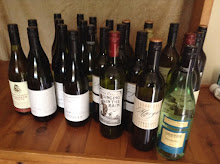
As you can see from our wine list, a considerable range was consumed this year. Not too many bad ones.
The highlights this year were the wines out of the Orange wine region, the Hunter Valley Semillons and Verdelhos , the Clare Valley Rieslings as well as the Victorian Pinot Noirs. We are so spoilt for choice both from a local and imported point of view. And prices are still very good. The strong Australian dollar has hampered exports so suppliers are trying to get rid of excess stocks on the local market. For the same reason, imported wine has never been so cheap.
We shall continue our evaluation into 2013. It's a tough job but someone has to do it.
So that's another year gone.
We look forward to the new one.
All the best to my readers.

Saturday, December 22, 2012

Christmas 2012

Obviously the world didn’t end on the 21st so we shall continue on with life on the beautiful south coast of New South Wales.
Our Christmas this year will be, as usual, minimalist.
We have planned a seafood lunch with a couple of really good bottles. When there are just the two of us I can access my secret stash! The only concession to a traditional Christmas lunch will be a big slice of plum pudding for me. The co driver still thinks of that as poison especially when slathered in custard.
Prawns, oysters, scallops and mussels (with some old Hunter Valley Semillon or maybe a nice sparkling Tasmanian Chardonnay/Pinot Noir .....or both) and maybe a piece of salmon from the BBQ (with a Mornington Peninsula or Yarra Valley Pinot Noir) might be on the menu. And just maybe a small glass of sticky with the pud.
We are lucky to have a really good fish shop in town called, you guessed it, “Lucky’s”. After all, Ulladulla was once a major fishing port. He has the freshest and best all year 'round. Getting into the shop on Christmas Eve can be bedlam with queues forming outside at 6am. We go late the day before.
 "Mate, it's the same stuff you will get the next day" says Lucky who makes a fortune at this time of year but can never come to grips with the mentality of the last minute rush.


We had the annual valley party last weekend at one of the neighbour’s places. It was, as always, a fun evening with good food, a little bit of wine and lots of laughter. The evening started off pretty hot and humid, typical December weather, but the southerly, known as ‘the doctor’ around here, came in after about an hour and the temperature dropped 10 degC which made for an even more pleasant evening.
The forecast for Christmas day is not that good with cloud and showers predicted, minimum 17 degC maximum 23 degC. However this is better than being below zero and up to our necks in snow like other places we know.
We were going to hit the beach early for a swim before the hordes arrive and then retire to the peace and quiet of home. We shall see.
A happy Christmas to all my readers.

Sunday, December 09, 2012

Grapevine Growth

It's amazing how fast grapevines grow.
From the pictures below you can see their development from early September to early December.
This year the Pinot Noir seems to have developed much larger leaves than normal and certainly more vigorous shoot growth. This may be the result of our wet spring and plenty of residual soil moisture.
We have been green pruning fairly severely already in order to thin out the fruitless shoots. This allows more air circulation around and through the canopy to help prevent fungus.
A less dense canopy also allows better spray penetration.
In addition it also prevents shading ie. allows more sunlight onto the leaves and bunches to assist in the ripening process. This means increased sugar levels (higher resultant wine alcohol), increased colour in red grapes, increased tartaric acidity and overall better varietal flavour.


Meanwhile the Pinot Noir bunches are developing. They have reached the 31st stage according to the Eichhorn and Lorenz system ie. berries pea size, bunches hanging down. The berries will continue to 'swell' until they are touching. This is known as bunch closure. Some varieties 'close' more than others. Chardonnay for instance has very tight bunches while those of Cabernet Sauvignon are more open. Tight bunches always have problems with botrytis in wet conditions and it is always essential to get a preventative spray on before bunch closure as a follow up to the first at 80% cap fall.


 Grape berries follow a double sigmoid growth curve. The initial phase of growth results from cell division and expansion. Then the growth slows. This  is known as the lag phase. This is not a physiological growth stage, but an artificial designation between the two growth periods of the berry, the second of which is ripening. This is signalled by veraison or colour change.

Thursday, November 29, 2012

A November Update

Summer is here on some days, not on others.
But the few hot and muggy days remind us what is ahead over the next three to four months.
We are just waiting for the ocean to warm up a bit before we start our daily surfing adventures.
The grapes are all growing well. We have managed to keep the spray program to schedule with no thanks to the weather bureau's forecasts. I can't think of another period where they have been so consistently wrong.
Working under the increased net height has been a godsend so all the work involved with that was worth it. And the power sprayer is also proving to be a great investment.
I am a bit surprised at the lack of fruit on the Tempranillo and the Pinot Noir. Maybe that has something to do with the poor season we had last year which may have caused the lack of initiation of fruitful shoots. I need to go back into the text books to find out for sure but what is there is there.
We may have to produce a Pinot/Tempranillo blend this year to get a reasonable quantity of wine from these two varieties.
On the other hand the Cabernet Sauvignon is loaded with flowering bunches. Let's hope the fruit set is good.
I had pruned them really hard this year to increase spur spacing in an effort to decrease quantity and improve quality. This has resulted in an explosion of shoots other than the two required on each spur which has necessitated a fair amount of shoot removal work.


It is interesting to watch our small resident kangaroo family attempting to get under the nets to get at the fresh green grass shoots of the inter-rows as well as the grapevine shoots. They move along the row ends using their noses to try and lift the netting which this year is securely pinned into the ground. The buck is small but quite powerfully built and I don’t think he would have much trouble ripping the nets with his very long sharp claws but they never seem to try this.
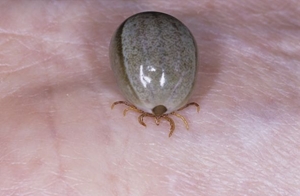
We had a bit of drama with the white newborn calf. She suddenly became quite sick and I found quite a number of paralysis ticks on her. She displayed the same symptoms as dogs and cats when they succumb to this parasite ie. back leg paralysis. The vet said she had had a few calves and alpacas go down this year from ticks and it has been a very bad year for them. The only thing they could do would be to give the calf some tick anti venom at $500 a dose and even then they could not guarantee survival. So Doctor Bob and I began hand feeding her 4 times a day with her mother’s milk to prevent dehydration but she got weaker and weaker and eventually died. Sad for us and sad for the cow which has been mooing plaintively for the last two days. But as Farmer/Doctor/Trainer Bob said “that’s life on the land.” The other four calves are doing very well.
The Suspected Culprit


We are gearing up for the tourist season. It was reported today in our local paper the population of the Shoalhaven Council area is expected to increase from 97,000 to about 320,000 from Boxing Day and will probably be at that level for the following 4 weeks.
I am not going to have my annual whinge about the ‘touros’ but as usual we will be glad when we get our beaches, town and roads back in February.

Sunday, November 18, 2012

More Books

It's not often I abandon a book half way through but Steve Job's biography is one.
It is an interesting enough history of Apple but the repetitive description of Job's manic and self obsessed behavior wears a little thin after a few hundred pages.


                         "Flight 32" is the absorbing story of a QANTAS Airbus A380 flight from Singapore to Sydney that suffered an almost catastrophic engine explosion a few minutes after departure.
Written by the flight's captain, it is a detailed story of how the crew kept the plane in the air and eventually landed safely without injury to anyone on board. Some people on the ground in Indonesia were hurt by falling debris.
It will either put you off flying for life or give you additional confidence in the air crews who pilot us around the world, usually without incident, on a daily basis.
It has a six degrees of separation element for us. Stirl's nephew was cabin crew on that flight. A little known fact is that after a few days rest and recovery in Singapore, the crew was put on another flight which also had to return to Singapore with mechanical problems.
The nephew is still flying.


George Smith is one of Australia's all time great Rugby players.
He played 110 times for his country as well as numerous Super Rugby games for the Canberra Brumbies.
Raised in a large Tongan family on the northern beaches of Sydney, he had a checked youth, falling in with the wrong crowd and getting expelled from school.
But Rugby saved him from an uncertain future.
An interesting biography from a social and sporting point of view but really one for the Rugby tragic only, one of whom resides in this house.


"Revolutionaries" is a detailed account of both the American Revolution and the Revolutionary War concentrating on those who went into battle, those who kept the country running during the conflict and drew up the states' and national constitutions (and subsequent amendments), the diplomats seeking foreign support abroad, the treaty makers and those who took up the challenges, political, social and economic, of making a success out of a newly formed nation.
A lot of well known names and some not so well known. For a change this book delves into their personalities, motivations and private lives, not just their actions.
Hard going in a lot of places, especially when it comes to constitutional matters, but rewarding in the end.
Definitely one for American history buffs only.


My daughter bought me a Kindle for my birthday.
Takes a bit of getting used to but I am warming to it.
Lots of free books available as well as latest releases.
We buy most of our books from Amazon USA and even with freight added they are about 50% of the prices in Australian book stores.


So with a book being downloaded within a few seconds, we will now be saving the freight costs.
The upshot of all this is my 'reviews' may now be minus a cover shot although I have a lot of real books stacked up to read. Hopefully I can work my way through them all during summer.

Tuesday, November 06, 2012

Calves! And More Calves

Obviously the bull we sold back in June had had one last fling with his girls.
The first calf appeared a few weeks ago.
And then another a little later.
And one last week.
Last night we had two.
One of those had to be helped a little. It was the mother's first and she was struggling a bit.
Neighbour Bob (a cow man from way back) thought it was good idea to do 'a pull'.
So we did.


A bit of a struggle at first but finally with our help she pushed out a very healthy looking bull calf.
Mother was exhausted and it took some expert wrangling to get her to her feet. Bob could also be a rodeo star!
Another one born a week or so ago wasn't looking that good so we have kept her and her mother up around the house paddock to could keep an eye on her. The two have bonded well and now the calf seems to be out of the woods.


Neighbour Bob has been promoted to Doctor Bob......for a little while anyway.
We wish him well with his horse which is racing today up at Nowra as part of the Australia wide racing carnival based around the Melbourne Cup, a famous race run on the first Tuesday of November at the Flemington racecourse. Today is the 152nd time the race has been run.
And seeing we have just touched on gambling, the Oz Lotto draw tonight is worth $100 million.
You have to be in it to win it!
7th November Update: Bob's horse ran 6th. So it's back to Seldom Winning Trainer Bob. The Melbourne Cup was won by 19-1 outsider Green Moon.
And the $100 million OzLotto was shared between four. Sadly, we weren't one of those.

Thursday, November 01, 2012

Sculpture by the Sea

There is a wonderful walk along the coast line of Sydney's eastern suburbs from southern Bondi Beach to Coogee and on to Maroubra
The first part covers about 6 km and winds its way around rugged headlands, down to some of the city surf  beaches and past some of the most expensive real estate in the world.
You can stop for a coffee or a meal at the many beach side restaurants, cool off with a swim in the surf or an ocean pool or just sit and people watch.


Every year on the Bondi to Tamarama section they hold a 'Sculpture by the Sea' exhibition.
It is very popular and gets really crowded especially at weekends.
We had to go to Sydney for an overnighter and decided to see if the parking fairy would be with us in the area.
We were in luck! We managed a spot just a short walk away.
Bondi Beach from Marks Park


It was a perfect day with the crowd at a minimum, the sea blue as blue and the sun shining in a cloudless sky.
Really the star of the show is the walk itself but some of the work on display was interesting.
Our favourite was a collection of 222 bamboo poles with wind driven fans on top. These were attached to a clapper which hit the poles, each of which had been cut to a certain length, to produce a different tone.
It is a memorial to the 222 victims of the two Bali bombings nearly a decade ago.
The stiff northerly breeze produced waves of Indonesian sound and it was a weird sensation to walk through.


A close second for me was a man made completely out of staples.
We spend a couple of hours there enjoying the view and starting our summer tan.


Wednesday, October 24, 2012

Refrigeration in the Wine Industry

No, not getting the bottle of white wine cold before drinking but keeping the juice (must) and wine cool during the production process ie. grape delivery, crushing, fermentation, pressing, transfer, storage.
Modern wineries use refrigeration units to keep their white fermenting musts cool.
This encourages desirable aroma and flavour compounds. The target is usually between 10°C and 16°C.
The temperature of grapes coming in from the vineyard during harvest in summer can be a lot higher than this, so cooling is almost always necessary.
But what about the more primitive 'Vin de Garage' operations like mine?
How do I keep the ferment cool without going to a huge (and unwarranted) equipment expenditure?
Adding dry ice has been suggested. This would have the additional advantage of adding carbon dioxide as an oxidizing protectant but it always involve the danger of taste taint and it is not the safest thing to handle (burns and asphyxiation).
Putting a small tank inside a larger one and filling the void with an ice or ice/salt mix has been suggested together with insulating the outside tank with a flexible foam sleeve. Logistically all possible but no real temperature control.
Adding ice in containers to the actual must is another suggestion. This could be viable as long as the containers were sanitized and secure so any melt water did not get into the wine.
Searching on the net I found plenty of information on the affects of ice addition to water and the resultant cooling affect.
One formula was able to calculate final temperature based on original weight and temperature of water and weight of ice added.


I decided to test this out. So I added a specific amount of ice (1000g) contained in a sealed mineral water bottle to a specified amount of water (6000g) and noted the temperature drop. It fell 6°C in one hour and remained there for about 3 hours before starting to rise.
The result was considerably higher than the formula predicted . I guess ambient conditions were to blame.
However this method is indeed worth pursuing and I will try a full scale experiment with water in a wine tank soon.
Temperature could be adjusted by the addition and removal of bottles. Maintenance of the required temperature would depend on the number of bottles required. That is the great unknown at this stage.